The Stock Exchange of Thailand (SET) Index closed at 1,497.88 on Friday, down 15.63 points or 1.03 per cent. Total transactions amounted to Bt96.69 billion with an index high of 1,518.05 and a low of 1,494.45.
In the morning session, an analyst at Krungsri Securities expected the index to fall to between 1,500 and 1,505 points despite the Bangkok Metropolitan Administration’s move to allow 13 types of business to reopen in Bangkok.
“The index will be under pressure due to a decline in foreign fund inflows and mass sell-offs of bank shares [KTB, SCB and BBL] after their fourth-quarter performance was worse than expected,” he said.
The 10 stocks with the highest trade value today were KBANK, BBL, PTT, STGT, SCB, KTC, CPN, TISCO, GPSC and SCC.
As of 4.30pm, the price of oil dropped by US$0.88 or 1.66 per cent to $52.25 per barrel, while gold dropped by $4.10 or 0.22 per cent to $1,861.80 per ounce.
Other Asian indices were mixed:
Japan’s Nikkei Index closed at 28,631.45, down 125.41 points or 0.44 per cent.
China’s Shang Hai SE Composite Index closed at 3,606.75, down 14.51 points or 0.40 per cent, while Shenzhen SE Component Index closed at 15,628.73, up 108.13 points or 0.70 per cent.
Hong Kong’s Hang Seng Index closed at 29,447.85, down 479.91 points or 1.60 per cent.
South Korea’s KOSPI Index closed at 3,140.63, down 20.21 points or 0.64 per cent.
Taiwan’s TAIEX Index closed at 16,019.03, down 134.74 points or 0.83 per cent.
Prime Minister Prayut Chan-o-cha held a meeting with the government’s economic team on Friday to discuss plans to ease tax burdens on different groups of Thais.
The agenda included discussions on land and construction tax as well as the possible extension of the deadline for filing personal income tax.
Prayut said he will table the plan at the next Cabinet meeting on Tuesday.
He also insisted that the government is not ignoring people’s problems, but is looking for ways to boost their income and ease their burden.
The economic team comprises Deputy PM, Supattanapong Punmeechaow, Finance Minister Arkhom Termpittayapaisith, National Economic and Social Development Council’s secretary-general Danucha Pichayanan and Finance Ministry’s permanent secretary Krisda Chinavicharana.
Thai export contracted 6.01 per cent to US$231.468 billion last year, better than the previously forecast decline of 7 per cent, the Commerce Ministry said on Friday.
Imports last year dropped 12.39 per cent to $206.991 billion.
Exports in December alone last year surged 4.71 per cent to $20.082 billion, the first rise in eight months and the highest growth in 22 months, due to recovery in demand for industrial products.
Imports in December expanded 3.62 per cent to $19.119 billion.
Despite fresh waves of Covid-19 in many Thai export markets, goods transport had not been badly disrupted since countries had imposed zoned restrictions rather than national lockdowns, said Pimchanok Vonkorpon, director-general of the ministry’s Trade Policy and Strategy Office.
The ministry forecasts exports will grow 4 per cent this year to $240.727 billion, with a chance of 5-per-cent expansion to US$243.042 billion, thanks to the global economic recovery.
Positive factors include limited lockdown restrictions and the availability of Covid-19 vaccines.
Among negative factors for Thai exports is the strengthening baht and shortage of goods containers.
The Stock Exchange of Thailand (SET) Index dropped by 1.16 points, or 0.08 per cent, to 1,512.35 in the morning session on Friday.
An analyst at Krungsri Securities expected the index to fall to between 1,500 and 1,505 points despite the Bangkok Metropolitan Administration’s move to allow 13 types of business to reopen in Bangkok.
“The index will be under pressure due to a decline in foreign fund inflow and mass sell-offs of bank shares [KTB, SCB and BBL] after their fourth-quarter performance was worse than expected,” he said.
He recommended investors to buy:
• PTTGC, TOP, IVL, EPG, VNT, SCGP, CBG, ROJNA, TVO, STGT, CPF, RCL, PSL, SYNEX, COM7, XO, WICE, JMT, MTC, SAWAD and KCE, as their fourth-quarter turnover is expected to improve.
• ADVANC, INTUCH, AP, SIRI and WHAUP, as they pay high dividends.
The SET Index closed at 1,513.98 on Thursday, down 1.74 points or 0.11 per cent. Total transactions amounted to Bt91.98 billion with an index high of 1,529.27 and a low of 1,510.80 due to mass sell-offs of low free-float stocks (DELTA and KTC) and uncertainty over the decline in fund inflow.
CPF raises Bt30 billion as investors lap up debentures
Jan 22. 2021
By The Nation
Charoen Pokphand Foods Pcl (CPF) successfully offered five series of debentures with a tenor of two years to 12 years and coupon rates from 1.75 per cent to 3.80 per cent to retail investors and institutional and/or high net worth investors during the period from January 18-21.
The joint lead arrangers revealed that investors were still looking for debentures with attractive returns, especially those issued and offered by stable and sustainable companies, and CPF debentures tick all the right boxes.
Paisan Chirakitcharern, chief financial officer, said that CPF would like to thank all investors, both retail and institutional and/or high net worth investors, for trusting and showing interest in the debenture issue.
Seeing the response, CPF decided to exercise the greenshoe option — selling more debentures than initially planned — and raised a total of Bt30 billion.
Krungsri posts 2020 net profit of Bt23.04bn, building strong provision buffer
CorporateJan 22. 2021Krungsri president and CEO Seiichiro Akita
By The Nation
Krungsri (Bank of Ayudhya and its business units) has announced net profits of Bt23.04 billion for 2020, representing a 14.5 per cent drop from its net profit in 2019. The bank attributed the sharp drop to provisioning for future uncertainties given the Covid-19 outbreak in mid-December and the fragile outlook for economic recovery.
Krungsi said its asset quality remains strong with a non-performing loan (NPL) ratio of 2 per cent and the coverage ratio at a record high of 175.12 per cent.
The bank cited achievements including the status conversion of its Cambodia subsidiary, Hattha Kaksekar Ltd, from a microfinance firm to a commercial bank named Hattha Bank; its Asean expansion by acquiring a 50 per cent stake in SB Finance Company, a subsidiary of Security Bank Corp (SBC) in the Philippines; investment in and strategic alliance with Grab; and the successful launch of Kept – an online savings management platform it said has been well-received by target groups.
Key highlights of Krungsri’s consolidated 2020 results:
· Net profit: Recorded at Bt23.04 billion, down 14.5 per cent from normalised net profit in 2019.
· Loan growth: Up 0.8 per cent or Bt15.058 billion from December 2019, driven by retail and SME loans which grew by 2.2 and 2 per cent, respectively. Corporate loans contracted by 1.5 per cent, mainly due to loan repayments made by Thai corporates.
· Deposit growth: Totalled Bt1.834,505 trillion, an increase of 17.1 per cent, or Bt267.62 billion, from December 2019, attributed to an increase in savings deposits.
· Net interest margin (NIM): Recorded a 3.47 per cent, from 3.60 per cent in 2019, driven by interest rate reductions following assistance measures for customers impacted by the pandemic.
· Non-interest income: Dropped Bt3.877 billion or 10.6 per cent from normalised non-interest income in 2019, resulting from lower fee and service income following the economic slowdown.
· Cost to income ratio: Improved to 42.52 per cent from 45.1 per cent in 2019.
· Non-performing loans (NPL) ratio: Recorded at 2 per cent, compared to 1.98 per cent in December 2019.
· Coverage ratio: New high of 175.12 per cent, from 163.82 per cent in December 2019.
· Capital adequacy ratio: At 17.92 per cent, compared to 16.56 per cent in December 2019.
Krungsri president and CEO Seiichiro Akita said the Thai economy would take at least two years before returning to its pre-pandemic level. Krungsri Research forecasts the Thai economy will grow by 2.5 per cent in 2021, from its low base of 6.4 per cent contraction in 2020 – barring heightened risk from the domestic outbreak.
As of December 31, 2020, Krungsri, Thailand’s fifth largest bank in terms of assets, loans and deposits, reported Bt1.83 trillion in loans, 1.83 trillion in deposits, and Bt2.61 trillion in total assets. The bank’s said its capital was strong at Bt276.26 billion, equivalent to 17.92 per cent of risk-weighted assets, with 12.85 per cent in common equity tier 1 capital.
Kasikornbank and its subsidiaries reported a net operating profit of Bt29.48 billion for 2020, with fourth-quarter net profit being Bt13.25 billion, the bank said in a press release.
KBank Chief Executive Officer Kattiya Indaravijaya said the overall economy contracted in 2020 amid the domestic and global impact by Covid-19. The crisis negatively impacted domestic spending, exports and tourism.
“The economy faces additional downside risks in 2021, particularly with the new wave of Covid-19. Therefore, economic recovery remains highly uncertain, while government expenditure and investment will remain key supportive factors,” she said.
“Since January 1, 2020, the bank and its subsidiaries have adopted TFRS related to financial instruments. Some items are not comparable with the financial statements and key financial ratios of previous years,” the press release said.
It added that KBank and its subsidiaries reported a 2020 net profit of Bt29.48 billion, a decrease of Bt9.24 billion, or 23.86 per cent compared to the previous year, mainly due to the fact that the bank and its subsidiaries complied with the prudent approach of setting aside a higher-than-expected credit loss from the preceding year of Bt9.53 billion, or 28.04 per cent, with reserves of Bt32.06 billion since the first half of 2020 due to high uncertainty from the Covid-19 pandemic.
With relief measures gradually ending in the second half of 2020, customers were still able to repay debts better than expected, and with the new wave of Covid-19 in late fourth quarter, the bank had revisited and assessed the adequacy of its reserves and found they were sufficient.
The bank expected a credit loss amounting to Bt43.54 billion for 2020 – a level that could cover potential damages occurring in line with the situation, the statement said, adding that net interest income increased by Bt6.33 billion, or 6.17 per cent, mainly due to a decrease in interest expenses as a result of a drop in the average interest rate and a decrease in contributions to the Financial Institutions Development Fund, resulting in NIM that stood at 3.27 per cent.
Meanwhile, non-interest income was down by Bt11.93 billion, or 20.65 per cent, mainly due to a decrease in revenue from securities sales and fees income related to loans, which changed to reflect interest income, it said.
In addition, other operating expenses dropped by Bt2.73 billion, or 3.76 per cent, mainly due to a decrease in estimated employee and marketing expenses, while those for debt management increased.
“In the quarter, other operating expenses increased by Bt3.82 billion, or 23.26 per cent, due mainly to the increase in IT-related expenses in order to support customers’ needs, marketing expenses due to seasonality and activities with business partners, resulting in a cost-to-income ratio that stood at 45.19 per cent,” the release said.
“As of December 31, 2020, the total assets of KBank and its subsidiaries were Bt3,658,798 million, an increase of Bt364,909 million, or 11.08 per cent, compared to the end of 2019. The majority came from loans, while NPL gross-to-total loans stood at 3.93 per cent,” it said. “The bank has provided support and assured customers impacted by Covid-19 of credit quality, while at the end of 2019 this stood at 3.65 per cent.”
The coverage ratio as of December 31 stood at 149.19 per cent, while at the end of 2019 this stood at 148.60 per cent, the statement said.
In addition, as of December 31, Kasikornbank Financial Conglomorate’s capital adequacy ratio, according to the Basel III Accord, was 18.80 per cent, with a Tier-1 Capital ratio of 16.13 per cent, the bank added.
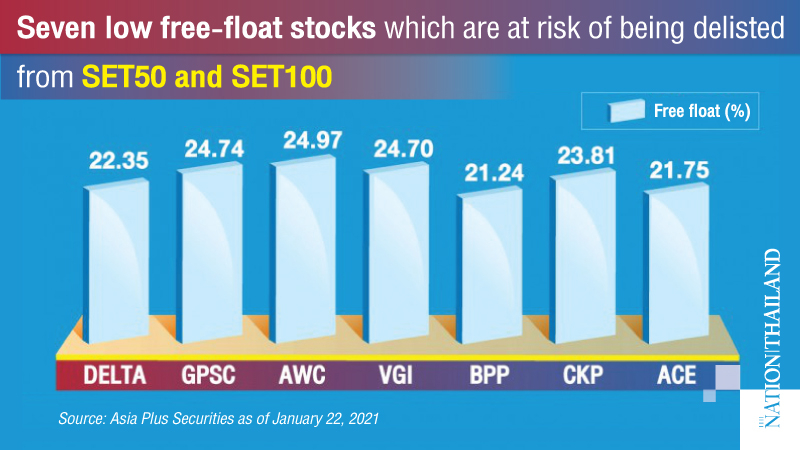
Seven low free-float stocks are at risk of being delisted from the SET50 and SET100 indices after the Stock Exchange of Thailand (SET) implemented free float adjusted market capitalisation regulations.
An analyst at Asia Plus Securities said DELTA, GPSC, AWC, VGI, BPP, CKP and ACE would be delisted from SET50 and SET100 indices due to SET’s new regulations.
He added that passive funds would reduce investment in MAKRO by 84 per cent, DELTA by 49 per cent, SCC by 31 per cent, GULF by 39 per cent, BAY by 47 per cent and GPSC and AWC by 43 per cent.
Somchai Amornthum, executive vice president at Krung Thai Asset Management, said SET’s free float adjusted market capitalisation regulations would help investors to manage investments in line with real market conditions.
“However, we advise investors to monitor how many low free float stocks will have reduced investment and be delisted from SET50 and SET100 indices before adjusting investment portfolio because domestic funds would not have many low free-float shares,” he said.
Thidasiri Srisamith, executive vice president at Kasikorn Asset Management, said apart from passive funds’ move to reduce investment in low free-float stocks, investors should monitor other factors, such as listed companies’ liquidity and growth potential, stocks’ fair price and funds’ overview.
The price of gold dropped by Bt50 per baht weight in morning trade on Friday, the Gold Traders Association reported.
As of 9.24am, the buying price of a gold bar was Bt26,350 per baht weight and selling price Bt26,450, while gold ornaments were priced at Bt25,878.12 and Bt26,950, respectively.
At close on Thursday, the buying price of a gold bar was Bt26,400 per baht weight and selling price Bt26,500, while gold ornaments were Bt25,923.60 and Bt27,000, respectively.
Spot gold price moved to US$1,864 (Bt55,835) per ounce in the morning, while Comex (Commodity Exchange) gold to be delivered in February dropped by 60 cents to $1,865.9 per ounce on Thursday due to mass sell-offs of the precious metal after its price had hit the highest level in two weeks.
Hong Kong gold price dropped by HK$30 to $17,260 (Bt66,694) per tael, the Chinese Gold and Silver Exchange Society reported.
By Syndication Washington Post, Bloomberg · Elizabeth Low, Alex Longley
Oil dipped below $53 a barrel in New York as the demand outlook in some of the world’s largest economies remained fragile.
Futures slipped 0.6% after JPMorgan Chase & Co. cut demand estimates for China as lockdowns spread ahead of the Lunar New Year travel rush. Meanwhile the U.K. suffered its worst day of the pandemic on Wednesday, with more than 1,800 deaths recorded in 24 hours.
On the supply side, the American Petroleum Institute said U.S. crude inventories swelled by 2.56 million barrels last week and gasoline and distillates stockpiles also increased, according to people familiar with the data.
Despite a more uncertain short-term consumption outlook, crude is still trading near the highest level in almost a year. There’s been a boost to energy use from cold weather, while Saudi Arabia’s unilateral output cuts and a weak dollar have also buoyed the market. There are hopes that the new Biden presidency will add fresh stimulus measures to boost demand.
“The recent price support is based on economic support packages,” said Hans Van Cleef, senior energy economist at ABN Amro Bank. Nonetheless, “the British variant of the virus spreading fast is keeping a lid on the upside potential.”
Though the API data largely pointed to stockpile increases, there was a big draw at the storage hub of Cushing, Oklahoma, which is the main pricing point for U.S. crude futures.
Declines there have helped to boost WTI’s nearest timespread to its strongest level since May — an indication of market tightness. The move was also aided by the expiry of the February contract this week, which had been in a bearish contango structure.

 Prime Minister Prayut Chan-o-cha

 Krungsri president and CEO Seiichiro Akita
 KBank Chief Executive Officer Kattiya Indaravijaya