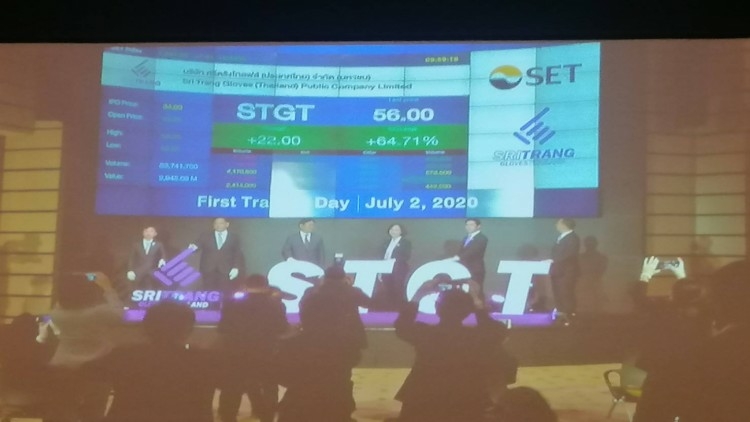
Shares in Sri Trang Gloves (Thailand) (STGT) soared to 75 per cent of their initial public offering (IPO) price on their opening day of trading today, in the Stock Exchange of Thailand’s first IPO since the Covid-19 outbreak.
The company’s shares hit a high of Bt60.25, from their IP0 price of Bt34, before falling back to Bt57.5 by the end of the morning session – up 69.12 per cent from the IPO price.
Sri Trang is the world’s third largest producer and distributor of rubber gloves for medical and industrial use, churning out more than 32.5 billion gloves per year.
A subsidiary of Sri Trang Agro Industry (STA), Sri Trang Gloves was created from the merger of rubber glove manufacturing and distribution companies to support business expansion.
STA plans to use the estimated Bt15 billion raised from the listing to expand its production of rubber gloves worth about Bt11 billion. STA will hold 50.7 per cent of STGT shares after the IPO.
By The Washington Post · Ian Duncan, Michael laris, Lori Aratani · NATIONAL, BUSINESS, CONGRESS, TRANSPORTATION WASHINGTON – Boeing repeatedly downplayed to federal regulators the importance of a flight control system that would later be implicated in the fatal crashes of two 737 Max jets, according to an inspector general’s report released Wednesday.
The watchdog’s review concluded that Boeing decided as early as 2013 to portray the new automated feature as simply a modification of the plane’s existing controls – a decision in keeping with the company’s goal of minimizing the new training pilots would need on the aircraft, saving its customers money.
But the feature, known as the Maneuvering Characteristics Augmentation System (MCAS), continued to evolve during the plane’s development, becoming more powerful, and staff members with the Federal Aviation Administration told auditors that they made key decisions about the feature without knowing that it had been altered. What’s more, the final flight tests of the Max’s control systems in late 2016, just a few months before the FAA granted the plane its final blessing, included some tests using the old, less powerful, version of the feature because Boeing was continuing to update it.
The result of those and other decisions meant FAA officials signed off on a system without a clear sense of how it worked and instead chose to focus on other areas regulators deemed high risk during the certification process, including the aircraft’s larger engines and changes to its landing gear, the inspector general wrote.
The core of the inspector general’s interim report was a detailed timeline that reads like a compendium of missed opportunities that resulted in tragedy.
In response, the FAA pointed to a letter from the Department of Transportation outlining several improvements that are being made in the agency’s policies and procedures.
Boeing, in a statement, said: “We appreciate the Inspector General’s efforts in reviewing the 737 MAX design and certification process, with which we have cooperated fully and extensively.”
“Since the accidents, multiple committees and governmental authorities have examined issues related to the MAX, and in response to their findings and our own internal reviews, we have made substantial changes within our company to further enhance our commitment to safety. We are committed to transparency with the FAA during all aspects of the airplane certification process, and have made significant changes to improve our support to that regulatory process,” the company said.
The release of the report comes the same week that FAA pilots and staff from Boeing completed a series of test flights on the Max, which has been grounded worldwide since March 2019 following the two crashes. The flights are seen as a key step for Boeing to win certification of the aircraft, but a number of other requirements must be met, including the evaluation of data gathered from the three days of testing.
The inspector general offered no recommendations, saying those may be included in future reviews of pilot training requirements, the FAA’s oversight of the certification process and other related matters.
The inspector general reviews also chronicled the FAA’s oversight of Boeing under a system known as Organization Designation Authorization, which gives manufacturers such as Boeing broad powers to perform much of the certification work for their own aircraft. The inspector general had, before the two Max crashes, identified deficiencies in the FAA’s oversight of its delegation system, and the details outlined in its latest report point to additional shortcomings. For example, the report notes that the FAA’s Boeing Aviation Safety Oversight Office has just 42 employees to oversee Boeing’s 1,500 representatives.
The two fatal 737 Max crashes happened less than five months apart – the first on Oct. 29, 2018, off the coast of Indonesia, and the second March 10, 2019, in Ethiopia – killing a total of 346 passengers and crew members. Crash investigators say a faulty reading from one of the planes’ sensors caused the MCAS to repeatedly activate, pushing the planes’ noses down and making it virtually impossible for the pilots in both incidents to regain control.
The tragedies damaged the reputation of one of the United States’ leading manufacturers and led to the ouster of its chief executive, Dennis Muilenburg, in December, as well as several other key company officials. It also led to scrutiny of the relationship between the FAA and the companies it is supposed to regulate.
Company emails uncovered as part of a separate congressional investigation showed several instances in which employees bragged about “Jedi mind tricking” regulators and showed contempt for their own internal process. In one 2017 exchange, a Boeing employee wrote, “this airplane is designed by clowns who are in turn supervised by monkeys.”
Boeing’s new leader, Dave Calhoun, has pledged to rebuild trust in the company, which has lost billions in revenue because of the Max crisis.
Some of the concerns raised by the nonpartisan inspector general have been raised in other reports, but this latest examination offers the clearest summary of the actions taken by Boeing and the FAA throughout the certification process and in the aftermath of the two crashes.
“I commend the DOT Office of the Inspector General for agreeing to take on this critically important examination of the FAA’s certification of the Boeing 737 MAX,” said Rep. Peter DeFazio, D-Ore., chairman of the House Transportation and Infrastructure Committee, which has conducted five hearings on the Max. “This IG report reinforces some of the findings of our Committee’s ongoing investigation, which has revealed a number of disturbing patterns, including Boeing’s efforts to conceal critical information from regulators in its rush to get the MAX to market.”
DeFazio said his committee will release additional findings from its investigation.
In a joint statement, Reps. Sam Graves, R-Mo., and Garret Graves, R- La., minority leaders on the committee, said it is critical that lawmakers use the inspector general’s work and findings from other groups as Congress moves forward on possible changes.
“This is just the first step in the OIG’s process, but this report shows the FAA’s certification process at the time was followed and decisions made were based upon certain assumptions that we now know must be reevaluated by the FAA and Boeing,” the lawmakers said. “In particular, we are very interested in the OIG’s continuing review of FAA’s processes for determining the certification basis, assessing pilot training needs, and conducting risk analyses.”
The inspector general’s report showed that the FAA did not sufficiently require complete, timely and trustworthy information from Boeing.
Boeing did not communicate its own formal risk assessment to the FAA regarding the automated feature until a few months before the FAA certified the Max, the report found.
“According to FAA management, it is not unusual for manufacturers to complete and submit the safety assessments toward the end of the certification process,” according to the report.
And even then, the FAA relied on flawed Boeing findings. The company did not anticipate “catastrophic” results from a failure of the automated feature, the report said. As a consequence, neither Boeing nor the FAA called for installing key safety redundancies, which experts say could have saved the planes.
An FAA spokesman declined to respond directly, referring instead to a response from a deputy to Transportation Secretary Elaine Chao.
The report points to “some strengths in FAA’s aircraft certification process, as well as areas for improvement,” General Counsel Steven Bradbury told the inspector general in a letter last month.
Bradbury said the “FAA anticipates strengthening coordination” among agency officials responsible for certification, “as well as enhancing its human factors, flight controls, and system safety expertise to address weaknesses that led to an incomplete understanding of MCAS prior to certification.”
Sen. Roger Wicker, R-Miss., chairman of the Senate Commerce Committee, which oversees aviation, and ranking Democrat Sen. Maria Cantwell of Washington state, have jointly introduced legislation that would strengthen the FAA’s oversight of Boeing employees who conduct safety work on behalf of the agency and ensure that government and company employees are free to communicate with one another. The bill would also require the FAA to rethink its approach to evaluating the risks posed when automated flight systems and human pilots have to work together.
Previous reviews of the Max crashes have concluded that the agency and Boeing did not anticipate the difficulty some pilots would have overriding the MCAS if it failed.
House Democrats also are expected to introduce legislation following an extensive investigation into Boeing and the FAA. An interim report they released branded the agency as “grossly insufficient” in its initial review of the Max and blamed Boeing for having a “culture of concealment.”
Meanwhile, the FAA continues to move forward with test flights in the Seattle area. The flights are an important step toward approving the Max to resume flying. The planes are being put through a set of maneuvers and emergency procedures to test whether changes Boeing made after the crashes meet the FAA’s standards.
FAA Administrator Steve Dickson has said that the coronavirus pandemic has not slowed the agency’s work in reviewing the Max. But he told members of Congress recently that convening a panel involving pilots from around the world, another important step in the process, could be challenging. Dickson has said he will personally fly a Max before signing off on ungrounding it.
“The report reinforces concerns that have been raised by the Commerce Committee, including Boeing’s lack of candor during the certification process, FAA’s questionable oversight of critical safety systems, and the FAA’s response after the Lion Air crash,” Wicker said. “Although the IG report does not include recommendations, it does provide a factual basis for further consideration of bipartisan aviation safety legislation that Senator Cantwell and I have introduced.”
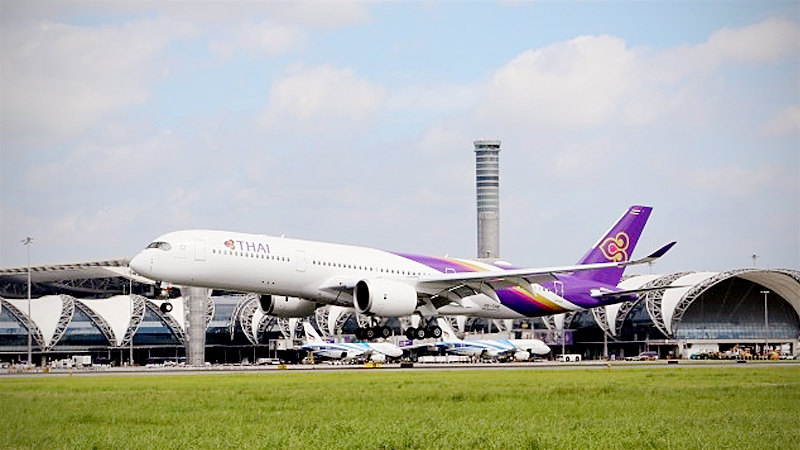
The panel in charge of rehabilitating debt-ridden Thai Airways International Plc (THAI) on Tuesday (June 30) confirmed that the carrier will only shed 5 per cent of the 20,000 employees as part of the airline’s reorganisation effort.
Nares Peungyam, former president of THAI’s labour union, said he, representatives of the airline staff as well as representatives of the labour union met the rehab panel to discuss some issues on Tuesday.
He said that at the meeting, panel member Pirapan Salirathavibhaga said now the panel is aiming to cut only 5 per cent of the airline’s workforce, down from the initial target of 30 per cent.
According to Pirapan, some redundant staff members will be shifted to departments that need more workers, Nares said.
Meanwhile, THAI’s board held an extraordinary meeting on Wednesday (July 1) to appoint board member Chansin Treenuchagorn as acting president as of July 2. The airline’s board also accepted the resignation of Chakkrit Parapuntakul from his post as acting president. Chakkrit will continue holding the position of THAI’s second vice chairman.
The carrier filed for rehabilitation with the Central Bankruptcy Court on May 26 and the court accepted the petition on May 27. The court will hear the case on August 17.
Italthai is preparing to open 12 new hotels across Asia as the hospitality industry emerges from a lockdown that caused domestic and international revenues to drop 60-70 per cent.
The construction and hospitality giant is the parent company of ONYX Hospitality Group, whose brands include Amari hotels.
Yuthachai Charanachitta, Italthai’s chief executive, acknowledged the company had been affected by the crisis but said it was able to move forward despite severe damage to the tourism sector.
The company experienced a slowing but not a halt in its construction business during lockdown, since the market for power plants, petrochemical and industrial factories escaped heavy impacts.
Meanwhile, the tourism business is in its worst state for 50 years after lockdown restrictions cut revenue by 60-70 per cent. However, Italthais’ 4-5 star hotels and services were able to generate revenue from long-term clients during the pandemic.
Italthai also used the lockdown period as an opportunity to renovate several hotels in Bangkok and train staff to operate an online platform, said Yuthachai.
Promotions to stimulate business and raise confidence among returning guests have been launched, including hygiene measures under the ONYX Clean campaign.
“ONYX Hospitality Group will continue with plans to open 12 new hotels within 12 months and expand its network in Asia Pacific, including China,” Yuthachai said.
Another Italthai business that suffered impacts from Covid-19 was heavy machinery distribution. The company is seeking to change its strategy by adding heavy machines for asphalt and concrete road works, and electrical trucks and drilling platforms for mining.
Krungsri (Bank of Ayudhya) has rolled out a digital tool designed to make saving easier for customers in the “new normal” era.
The Kept financial management platform features an easy-to-use digital wallet and savings jars that lure users with higher interest rates.
High household debt coupled with the impacts of Covid-19 have highlighted the low personal savings rate in Thailand, said Krungsri’s head of Retail Banking and Distribution Phonganant Thanattrai.
“Therefore Krungsri developed Kept [as] an assistant to make savings possible and financial goals achievable, just by adjusting savings behaviour.”
The platform has three accounts – Kept, Grow and Fun – under “the one wallet, two savings jars” system, he added.
Customers can transfer money to the Kept Wallet, and set a certain amount of money for spending in advance. The remaining amount will be automatically transferred to the Grow account at the end of every day. If there’s not enough money in the Kept wallet, the system has a feature for automatically transferring money back from the Grow account. Customers can transfer money in and out of Kept as often as needed without paying any fee.
The Grow account works as a long-term savings jar, receiving automatic transfers of surplus money (minimum of Bt5,000) for high interest (currently 1.6 per cent) in the first year and 1.8 per cent in the second.
The Fun account works like a short-term savings jar, enabling customers to set up and regulate daily transfers into and out of the account.
The Kept application is available for download on iOS and Android.
Fuel sales at PTT filling stations in June were almost back to the same level as this time last year, after further easing of the country’s Covid-19 lockdown.
Sales from July onward were expected to grow further, following the launch of numerous government measures to stimulate the economy and boost domestic tourism, said Jiraphon Kawswat, president and chief executive officer of PTT Oil and Retail Business Plc.
She added that it was too soon to tell how much overall sales would decline this year, as the company was waiting to see what direction the economy takes.
However, the company forecasts that sales for 2020 will come close to matching 2019’s monthly average of 460,000 litres if there is no second wave of Covid-19 infections, she said.
Jul 01. 2020Sara Lamsam, president and chief executive officer at Thai Life Assurance Plc
By The Nation
The Covid-19 impact has triggered a significant change in the life-assurance industry, which is expected to contract by 3 to 5 per cent this year, said Sara Lamsam, president and chief executive officer at Thai Life Assurance Plc.
Total premium receipts for life insurance in April plunged 20 per cent and is expected to drop further during the rest of the year, he said.
Due to the Covid-19 outbreak, consumers are more interested in health insurance, while their interest in savings policies is dropping due to the low-interest environment.
As for his company’s performance, Sara said total premiums fell sharply by 19 per cent in the first four months of the year to Bt22.4 billion, as new policies fell 19 per cent to Bt5.9 billion and renewed policies dropped 20 per cent to Bt16.5 billion.
Hence, he said, in line with consumers’ health awareness, his company will start focusing on health insurance products at a premium that is much cheaper than saving products. For instance, a Bt1 million insurance will be sold at a yearly premium of Bt17,000 for men aged 35 and up and Bt18,000 for women in the same age range.
Also, in line with the digital lifestyle, the company has developed an app called MTL Click, which will make it easier for consumers to access services. He projected that his company’s health insurance business will jump 99 per cent this year after growing between 30 and 35 per cent in the first four months.
Jun 30. 2020Abel Deng, CEO, Huawei Technologies (Thailand) Co., Ltd
By THE NATION
Thailand is a 5G leader in the Asean region and is building an ultra-fast 5G ecosystem will help create new business opportunities in almost every sector, says tech giant Huawei.
Applications and new services that come with the 5G network will also help revive a Thai tourism and hospitality sector hit hard by the Covid-19 pandemic, said the company.
“Thailand has a lot of potential to implement 5G technology,” said Abel Deng, CEO of Huawei Technologies (Thailand), at a seminar titled “5G Ecosystem and the Future of Thailand”.
5G technology will be the key driving force for the Thai economy’s recovery, and drive new economic and societal growth for the country in every aspect, Deng added.
“The 5G ecosystem will not just serve the individual but the whole digital society, playing an important role to increase productivity, reduce expenditure, and improve the quality of products and services.”
Huawei Thailand’s mission was to grow with the country, backing Thailand in its utilisation of the 5G network to support businesses, said Deng. He added that the country was already advanced in implementation of the technology after being an early adopter of 5G in the Asean region.
The 5G ecosystem will consist of the four key factors, said Woragarn Likhitdechasakdi, deputy chief technology officer of carrier network, Huawei Technologies (Thailand).
These are:
• Business Mode Innovation: 5G adoption will not be limited to smartphones, as the 5G ecosystem can generate new kinds of services with more diversity. Apart from the business-to-consumer service, 5G will be also adopted in the business-to-business field.
• Local Ecosystem Integration: To build the most effective network that suits every industry, the ecosystem will need partners from all areas of various industries – including network operators, large and small entrepreneurs in vertical intra-industry, hardware and software vendors like Huawei, and local solution providers and integrators.
• Real Use Cases: This year, 5G will become more concrete and affordable, moving beyond proof-of-concept testing or successful case presentation, with networks and solutions available for real usage and adoption across various fields.
• Global Best Practices: Huawei is using its considerable experience and achievements in other markets globally to adapt solutions for the Thai market.
Deng added that the combination of 5G connectivity with Artificial Intelligence (AI) will create infinite possibilities.
“In the future, every industry will integrate Cloud, AI and Big Data with 5G technology, and ‘smart’ tech will be integrated into every aspect of business procedures, creating Smart Manufacturing, Smart Healthcare, and even Smart Cities. These will improve business capabilities, help generate more profits, and pioneer new business opportunities.”
Woragarn said that new user-based experiences that come with 5G may include Virtual Reality (VR), Augmented Reality (AR), Cloud Gaming through the full-scale internet network, through live-streaming with 4K resolution, or through VR/AR, etc.
For the business sector, 5G technology can provide better solutions for various industries including agriculture, covering three areas:
1. Increase productivity.
2. Reduce defection rate.
3. Reduce manufacturing and operation costs.
In addition, 5G would also help improve “digital society” in Thailand, creating a new standard for the healthcare industry, supporting online education, and reducing digital inequality to help facilitate nationwide access to digital resources.
These enablers will improve Thailand’s basic infrastructure and elevate the country’s digital-economy potential in the agricultural, industrial, e-commerce, and tourism sectors, which are key drivers for Thailand’s economic recovery from Covid-19 challenges. Many nations are also currently undergoing digital technology integration to drive their economies.
“The tourism and hospitality industry, as one of the most essential sectors in Thailand, can be amplified through the utilisation of 5G, especially during this challenging period. The two main ways of using 5G in the industry are for tourism promotion and building trust,” Woragarn added.
Using 5G to promote tourism
5G can be used to create environmentally-friendly tours to experience smart agriculture. This will bring three benefits to farmers: better quality of agricultural products, more visitors to their smart farms, and more income from sale of agricultural products.
5G technology can also boost domestic tourism through the development of new multimedia that provides more immersive experiences. This can be created by partnering with famous YouTubers, content creators, and related agencies to create VR/AR content in order to promote tourist destinations, hotels and restaurants. This will help promote “Unseen Thailand” and distinctive travelling experiences for tourists, reinforcing the “new normal” lifestyle and boosting domestic tourism.
Using 5G to build trust
Thailand has implemented 5G technology to cope with Covid-19 over recent months, helping to regain confidence in the tourism industry.
The technology includes remote medical services through Telemedicine, with AI speeding up diagnosis. The advanced analysis solutions are adding to the efficiency of medical personnel in the region and enhancing the healthcare industry in Thailand. This is also helping to reinforce the reliability of the country’s medical tourism.
“The 5G innovations will enable the creation of “smart airports” that will boost tourist trust and help Thailand to rapidly restore its status as a regional and global destination,” Woragarn concluded.
Huawei said it is working closely with telecoms operators in Thailand to deliver a quality 5G network with strong coverage, with the aim of driving ICT investment and development in Thailand.
Jun 30. 2020A gas flare is seen in a field at dusk near Mentone, Texas, on Aug. 31, 2019. MUST CREDIT: Bloomberg photo by Bronte Wittpenn
By Syndication Washington Post, Bloomberg · David Wethe · BUSINESS
The shale bust has reached a grim milestone by claiming the pioneer of America’s drilling renaissance. But Chesapeake Energy Corp., which filed for bankruptcy protection on Sunday, is just the latest in a long list of casualties.
More than 200 North American oil and gas producers, owing over $130 billion in debt, have filed for bankruptcy since the beginning of 2015, according to a May report from law firm Haynes & Boone. This month alone, seven oil and gas companies have gone under, tying December 2015 for the busiest on record after crude prices plunged amid the Covid-19 pandemic, according to data compiled by Bloomberg.
The shale boom spearheaded by the likes of Chesapeake a decade ago was fueled by debt. Profitability and shareholder returns have been consistently disappointing, and investors had already grown wary of throwing more money into shale before this year’s oil crash. The rate of default on high-yield energy debt stood at 11%, Fitch Ratings said in a June 11 report, the highest level since April 2017.
Here are a handful other notable shale bankruptcies so far this year:
Whiting Petroleum
An oil explorer focused on the Bakken Shale in North Dakota, Whiting Petroleum Corp. was already facing head winds before 2020. Last year, the Denver-based company announced it would fire a third of its workforce and scale back production targets after posting a surprise quarterly loss.
Crude prices had their worst quarter ever in the first three months of 2020, with oil heavyweights Saudi Arabia and Russia failing to agree on supply cuts just as worldwide lockdowns wiped out demand for fuel. That was enough to push Whiting, saddled with $3.6 billion in debt, into bankruptcy on April 1.
But not before the board approved $14.6 million in cash bonuses for top executives to “ensure the stability and continuity of the company’s workforce and eliminate any potential misalignment of interests that would likely arise if existing performance metrics were retained,” the company said in a filing the same day it filed for Chapter 11 protection.
Extraction Oil & Gas
Another Colorado driller, Extraction Oil & Gas Inc. focused exclusively on the Denver-Julesburg Basin in the Rockies. It filed for Chapter 11 on June 15, offering to ease its debt burden of roughly $1.5 billion by giving noteholders 97% of new common stock to be issued.
Extraction had withdrawn its 2020 guidance in May and warned it may have to file for bankruptcy. Then, in early June, the company announced plans to pay 16 executives and senior managers a total of $6.7 million in return for staying with Extraction ahead of a possible default on its bond payments.
Ultra Petroleum
Once wasn’t enough.
Ultra Petroleum Corp. filed for its second bankruptcy in May, four years after its first. Listing $2.56 billion in debt and $1.45 billion in assets in its Chapter 11 filing, the Englewood, Colorado, driller reached a deal with most of its senior creditors that would slash $2 billion in debt, while looking to restructure within three months.
In its struggles to stay afloat, Ultra went so far as to suspend its drilling program in January to bolster free cash flow and focus on paying down debt. The explorer first filed for bankruptcy in 2016 and emerged the following year, just as the shale patch was beginning to crawl out of what had been the worst oil industry crash in a generation — until this year.
Sable Permian Resources
Soon after his ouster from Chesapeake in 2013, co-founder Aubrey McClendon went to work building a new empire, American Energy Partners. But after McClendon died in a car crash three years later, the company shut down.
Part of that business, American Energy – Permian Basin, merged with Sable Permian Resources LLC last year. That particular business was widely seen as having among the best assets of a half dozen oil-and-gas acquisition vehicles that McClendon set up during his brief tenure at American Energy Partners.
Sable filed for bankruptcy last week in Houston alongside affiliates, listing at least $1 billion of assets and liabilities each.
Lilis Energy
The Permian explorer Lilis Energy Inc. followed right on the heels of Chesapeake, filing for bankruptcy protection on Monday.
The company said it was a victim of the coronavirus-induced downturn. Lilis was struggling even before the pandemic, warning in January that it might default after lenders slashed its credit line.
“Like many companies in the oil and gas industry, we have been impacted by the severe downturn in commodity prices throughout the Covid-19 pandemic,” Joseph C. Daches, Lilis’s chief executive officer, said in a statement announcing the filing.
BTS Group Holdings (BTS) has written to the Mass Rapid Transit Authority (MRTA) to state that the BSR Joint Venture is ready to invest in the construction of the 2.6-kilometre Ratchada-Lat Phrao extension to the elevated Yellow Line.
Surapong Laoha-Unya, executive director of BTS Group Holdings, said BSR will also spend approximately Bt3 billion to link the Yellow and Green MRTA lines.
“BSR is ready to invest in this project because the study results were approved by the committee for land-traffic system management and already added in the rail-transport system development master plan,” he said.
“BSR still maintains the offer to share revenue with MRTA if the number of commuters using the Yellow Line rises.”
Surapong said the Bangkok Expressway and Metro (BEM) has complained that the MRTA Yellow Line extension will take commuters away from the MRT.
“However, we cannot compensate BEM if the MRT loses commuters. Hence, we have decided to invest in this project on our own and are ready to share revenue with the MRTA. So, it depends on MRTA if it wants to accept this offer,” he said.
He added that the plan to extend the MRTA Yellow Line should be studied before the service opens in 2021. “If the construction is not completed in time, we may have to cancel the offer,” he said.
Meanwhile, Pakapong Sirikantaramas, MRTA governor, said the agency was still waiting for BSR and BEM to decide on whether the Yellow Line extension will go ahead.
“According to our study, the number of commuters using the MRT Blue Line will drop by approximately 6,000 people per day once the MRTA Yellow Line starts running,” he said.





 Sara Lamsam, president and chief executive officer at Thai Life Assurance Plc
 Abel Deng, CEO, Huawei Technologies (Thailand) Co., Ltd
 A gas flare is seen in a field at dusk near Mentone, Texas, on Aug. 31, 2019. MUST CREDIT: Bloomberg photo by Bronte Wittpenn