AIS posts 8% rise in revenue last year #ศาสตร์เกษตรดินปุ๋ย

#ศาสตร์เกษตรดินปุ๋ย : ขอบคุณแหล่งข้อมูล : หนังสือพิมพ์ The Nation

https://www.nationthailand.com/business/30381711?utm_source=category&utm_medium=internal_referral

AIS posts 8% rise in revenue last year

Feb 06. 2020
By THE NATION

Advanced Info Service (AIS) announced on Thursday (February 6) a total revenue of Bt183.432 billion last year, up 8-per cent year on year, and a net profit of Bt31.051 billion, a 4.6 per cent increase from 2018.

AIS has around 42 million subscribers.

Somchai Lertsutiwong, the company’s CEO, said: “Last year marked our  30th year in the business. Despite numerous changes, AIS remained steadfast in building capabilities in digital infrastructure and technology as well as keeping pace with innovations”.

AIS has been expanding its 4G network. It currently has more than 158,000 base stations across the country.

JAL expands role in local activities for rise in Thai passengers #ศาสตร์เกษตรดินปุ๋ย

#ศาสตร์เกษตรดินปุ๋ย : ขอบคุณแหล่งข้อมูล : หนังสือพิมพ์ The Nation

https://www.nationthailand.com/business/30381709?utm_source=category&utm_medium=internal_referral

JAL expands role in local activities for rise in Thai passengers

Feb 06. 2020
By Sirivish Toomgum
THE NATION

Japan Airlines Co Ltd (JAL) has deepened its involvement in local activities in Thailand as a means to reach out to potential Thai customers, said Sze Hunn Yap, JAL’s regional marketing manager, Asia Pacific.

Its participation in local events such as the Japan National Tourism Organisation’s travel fairs in Thailand, have served to familiarise Thais with the carrier.

She hopes Thais would feel comfortable flying with JAL and the great value it has to offer, citing the carrier’s high standards of products, service and hospitality.

“Regionally, we are running a brand campaign titled ‘Fly Once Fly Always’ to encourage people who have never flown JAL to fly with us once to experience first-hand the high level of service and quality. We believe travellers will remember the JAL brand through the experience,” she added.

With this campaign, JAL aimed to highlight its strength including a base of over 500 Thai cabin crew, of which several will be placed on duty for every flight in and out of Bangkok.

JAL is also one of the most awarded airlines for punctuality by Flighstats.

“We want to instill peace mind in our Thai customers with Thai-speaking staff on board, who offer authentic Japanese hospitality”.

Sze Hunn Yap

Sze Hunn Yap

JAL also boasts an exquisite selection of in-flight cuisine, with some of its meals crafted by award-winning as well as Michelin-starred chefs.

“This year is going to be an exciting one for Japan as a country. It will host the Olympics and we hope to take the opportunity to highlight the many beautiful destinations in the country, not just the big cities of Tokyo and Osaka”.

“JAL flies to more domestic airports in Japan than other carriers and offers great-value fares. We strive to meet the needs of Thais planning to go to Japan with our quality products and services, as well as the number of flights daily between the two countries,” she added.

She added that JAL has always valued Thai customers and has been improving relevant services and communications.

“The Thai travel market is growing, and we have seen a rise in the number of repeat Thai visitors to Japan In 2018 alone, more than 1.132 million Thais visited Japan and there is a lot of potential in both first-timers and repeat flyers to Japan”.

Currently JAL operates five daily flights between Thailand and Japan, of which three to Tokyo (2 to Haneda airport, 1 to Narita airport), one to Osaka, and one to Nagoya.

JAL participated in Japan National Tourism Organization's travel fair in Thailand last year.

JAL participated in Japan National Tourism Organization’s travel fair in Thailand last year.

When asked about the intensifying competition, she said that Japan Airlines is a full-service carrier and also a Skytrax 5-Star Airline that was awarded for the quality of products such as the World’s Best Economy Class Seat.

“We also fly to the highest number of airports in Japan, catering to the growing numbers of Thais visiting various prefectures in Japan, and to some destinations that no other airline fly to, such as Yakushima, an island south of Japan where the ancient rainforest has been designated a natural World Heritage Site. These are our competitive advantages over others in the market”.

JAL was founded in 1951 and became the first international airline in Japan. The airline now flies to 349 airports in 52 countries and regions, together with its codeshare partners with a modern fleet of more than 230 aircraft.

Open an SCB account at any 7-Eleven via facial recognition #ศาสตร์เกษตรดินปุ๋ย

#ศาสตร์เกษตรดินปุ๋ย : ขอบคุณแหล่งข้อมูล : หนังสือพิมพ์ The Nation

https://www.nationthailand.com/business/30381704?utm_source=category&utm_medium=internal_referral

Open an SCB account at any 7-Eleven via facial recognition

Feb 06. 2020
By THE NATION

Siam Commercial Bank (SCB) and Counter Service Co Ltd are letting non-SCB customers open an online non-passbook savings account at 7-Eleven’s Counter Service using facial recognition technology to verify their identities.

The “This is Me at 7-Eleven” campaign lets people open an account using only an ID card without ever having to visit a bank branch.

The service, available starting on Thursday (February 6), is expected to add more than a million customers this year alone and pave the way for other financial services in the future.

SCB president Apiphan Charoenanusorn said the partnership with Counter Service extends the success of their Banking Agent service partnership launched last year.

That collaboration generated Bt31.9 billion worth of transactions, consisting of Bt31.8 billion in deposits and Bt99.5 million in withdrawals, for an average of Bt185.3 million per day.

“SCB and Counter Service joined to facilitate cash deposits and withdrawals using SCB account numbers and the SCB Easy mobile application at all 7-Eleven branches,” said Counter Service senior vice president Weeradej Ackapolpanich.

“The service has been welcomed by a large number of customers. This new collaboration will make Counter Service a leading banking agent in Thailand.”

To open an account, you insert your ID card in the Electronic Data Capture (EDC) device at the 7-Eleven, have a photo taken for facial recognition, enter your telephone number and a PIN at EDC, agree to the conditions presented and confirm.

Then you download the SCB Easy application and fill in the required information to open a non-passbook savings account.

Casper’s shrunken IPO will test markets’ appetite for unprofitable startups #ศาสตร์เกษตรดินปุ๋ย

#ศาสตร์เกษตรดินปุ๋ย : ขอบคุณแหล่งข้อมูล : หนังสือพิมพ์ The Nation

https://www.nationthailand.com/business/30381673?utm_source=category&utm_medium=internal_referral

Casper’s shrunken IPO will test markets’ appetite for unprofitable startups

Feb 06. 2020
A Wall Street street sign hangs in front of the New York Stock Exchange on April 18, 2016. MUST CREDIT: Bloomberg photo by Michael Nagle.

A Wall Street street sign hangs in front of the New York Stock Exchange on April 18, 2016. MUST CREDIT: Bloomberg photo by Michael Nagle.
By Syndication Washington Post, Bloomberg · Elizabeth Fournier, Crystal Tse · OPINION

The year’s first fallen unicorn is about to test public markets’ appetite for unprofitable startups, and so far it’s not looking like a positive bellwether for the class of 2020.

Mattress retailer Casper Sleep Inc. cut the price range Wednesday for its initial public offering, shrinking its potential market value to well below the $1.1 billion valuation it hit in a private funding round less than a year ago. It’s now aiming to sell shares for $12 to $13 each, down from the original range of $17 to $19.

Questions about how private valuations for buzzy startups translate into public trading dogged 2019’s marquee listings, with the two most prominent debuts — Uber Technologies Inc. and Lyft Inc. — still trading well below their initial public offering prices. Meanwhile, the spectacular collapse of WeWork reads like a cautionary tale for money-losing unicorns headed for public markets.

Speaking before Bloomberg reported that Casper was planning to slash its price range, the co-chair of law firm Cooley LLP’s global capital markets practice group said he was expecting a more subdued pipeline of wannabe public companies in 2020, and a less tumultuous ride for investors.

“Last year, we saw some of the most interesting tech deals but not a great deal of stability in the post-market trading for other companies to want to emulate,” said David Peinsipp. “This year, I expect to see more consistency and stability, which I think will be a good sign for the market.”

Casper, which counts Target and the chief executive officer of Canada Goose Holdings among its backers, echoed IPO pitches of the past by focusing prospective investors’ attention away from losses and onto its rapid revenue growth — and the potential for more as it taps into the $432 billion “global sleep economy.” That may have been enough to spook those who’ve been burned by similar promises.

“Investors continue to be very focused on companies with leadership position in big markets,” said Greg Chamberlain, head of U.S. technology, media and telecommunications equity capital markets at JPMorgan Chase. “There’s an increased focus on detailing the path of profitability.”

Five weeks into the year, markets have so far been kind to debutantes, with all but one of the six U.S. listings that raised more than $100 million trading above their IPO price, despite anxiety about the spreading coronavirus roiling equities in recent days. Of course, not all of the candidates fit the mold of the loss-making unicorn pumped up by private money.

Reynolds Consumer Products Inc., the profitable maker of Reynolds Wrap aluminum foil and Hefty trash bags, last week raised $1.2 billion in the biggest U.S. IPO this year. Its shares closed Tuesday up almost 16% from their debut. That offering will likely be surpassed by PPD Inc., a biotechnology and pharmaceutical research services company — also profitable — that’s seeking to raise $1.62 billion in its IPO set for Wednesday.

While Casper is taking the traditional route to tap public market investors, one trend market watchers are expecting is a flurry of companies considering direct listings instead of an IPO. The alternative route lets existing investors sell shares without being diluted, and without a lock-up period during which they can’t cash out. Even companies that aren’t likely to go public that way are asking about the process.

“We’re certainly seeing the IPO process evolve,” JPMorgan’s Chamberlain said. “We’ll likely see increased transparency in the process, including the manner of communicating with public market investors and method of price discovery.”

Companies could also rush to market in the first half of the year to avoid coinciding with the U.S. presidential election in November. Listings often tend to trail off around the Thanksgiving holiday, but the effect could be particularly stark this year.

“Subject to the market’s view on the impact of the 2020 election, IPOs are likely to be front loaded with the majority pricing before July or August,” said Colin Stewart, global head of technology capital markets at Morgan Stanley.

Over 180 companies went public on U.S. exchanges last year, raising more than $51 billion combined, according to data compiled by Bloomberg. Here are some of the ones we’re watching in 2020.

– Airbnb: While Airbnb Inc. isn’t expected to pursue a traditional IPO, the 12-year-old home-rental company is still likely to be the most high-profile listing this year.The profitable company, last valued at $31 billion in a 2017 private funding round, is planning a direct listing where it won’t raise new capital, people familiar with the matter have said. Airbnb Inc. previously said it plans to be publicly traded during 2020.

– Other direct listings: Investors expect one to four direct listings this year, compared to just one — Slack Technologies Inc. — last year, according to a survey conducted by Deutsche Bank. Work management platform Asana Inc. filed on Monday for a direct listing. Food-delivery service Doordash Inc. and software development and information-technology operations GitLab Inc. are also among firms considering the alternative method.”Almost every company is asking about direct listing today,” said Jackie Kelley, Americas IPO Leader at Ernst & Young.

Venture capital firms as well as Goldman Sachs and Morgan Stanley each held events last year to promote the listing option. The New York Stock Exchange and Nasdaq have submitted bids to the Securities and Exchange Commission to let companies raise primary capital during a direct listing.

– Food: If 2019 was the year of the ride-hailing IPO, 2020 could be the year that the food-delivery industry gets shaken up. The only U.S. listed player, Grubhub Inc., has denied reports that it is for sale while Postmates Inc. has been sitting on its confidential IPO filing since last February. Alongside Uber Eats and Doordash, betting on the winner is no easy task.

Olo, which powers the back-end software for some of these delivery services, reached out to potential advisers late last year for an IPO that could value it at about $1 billion, Bloomberg reported. The company, whose name is derived from “online ordering,” counts Shake Shack Inc. founder Danny Meyer and Tiger Global Management among its investors.JAB Holding Co., meanwhile, is working with banks on the planned IPO of its coffee empire, which includes brands such as Caribou Coffee and Peet’s, people with knowledge of the matter have said.

– Sports and fitness: Dallas, Texas-based Topgolf International Inc., an operator of golf-themed driving ranges, tapped Morgan Stanley, JPMorgan and Bank of America Corp. for an IPO that could raise about $1 billion, people familiar with the matter have said. The company, backed by Providence Equity Partners and Callaway Golf Co., is seeking a valuation of $4 billion. Group workout company F45 Training — backed by actor Mark Wahlberg, and boutique fitness franchise owner Xponential Fitness LLC are both planning listings.

– Fashion: Debt-laden retailer J. Crew Group Inc.’s plan to spin off its denim unit Chinos Holdings Inc., branded as Madewell, could happen later this year. The deal would help the parent raise capital amid a heavy debt load, which stands at almost $2.5 billion.Premium shoe brand Cole Haan Inc., acquired in 2013 by private equity firm Apax Partners from Nike Inc., filed for an IPO confidentially in October.

– Cybersecurity: Santa Clara, California-based cybersecurity firm McAfee Inc. has hired Morgan Stanley and Bank of America Corp. as well as a full banking syndicate for an IPO, people familiar with the matter said last year. The listing would be return to public markets for McAfee, which was taken private by Intel Corp. in 2010 in a $7.7 billion buyout. Private equity firms TPG and Thoma Bravo later took stakes.

– Enterprise software: Software companies, including Zoom Video Communication Inc. and Datadog Inc., posted a post-IPO gain of 41% on a year-to-date weighted average basis, compared to an average of 20.8% across industries, according to data compiled by Bloomberg. The enthusiasm has encouraged a roster of similar companies to follow suit.

Procore Technologies Inc. is working with Goldman Sachs on a listing that could value the construction-management software maker at more than $4 billion, while JFrog Inc. has tapped Morgan Stanley and JPMorgan for an IPO. Jamf Software, which makes tools for enterprises to manage Apple Inc. devices, has filed confidentially and could be valued at about $3 billion in a listing.

“Some of the software companies that went public five years ago have matured, and investors are looking for the next wave of enterprise software companies and rewarding them with higher multiples,” said Justin Smolkin, Deutsche Bank’s head of technology, media and telecommunications equity capital markets.


UOB (Thai) activates Asia’s first solar industry ecosystem in Thailand #ศาสตร์เกษตรดินปุ๋ย

#ศาสตร์เกษตรดินปุ๋ย : ขอบคุณแหล่งข้อมูล : หนังสือพิมพ์ The Nation

https://www.nationthailand.com/business/30381663?utm_source=category&utm_medium=internal_referral

UOB (Thai) activates Asia’s first solar industry ecosystem in Thailand

Feb 06. 2020
By The Nation

U-Solar, Asia’s first solar industry ecosystem, has been launched by United Overseas Bank (Thai) in Thailand to power the development and adoption of renewable energy across the country.

Through the U-Solar programme, activated on Wednesday (February 5), the bank connects businesses and consumers across the entire solar power value chain and helps each in their transition to a low-carbon economy. The programme is also available in Indonesia, Malaysia and Singapore.

In supporting the growth of the solar power industry, UOB provides solar project developers with solutions in green financing, project loans and portfolio financing, as well as cash management services.

For Engineering, Procurement Construction (EPC) contractors, UOB offers end-to-end contract-based financing solutions, from bid bonds and letters of credit issuance to performance guarantees and working capital facilities.

To promote the adoption of solar power by the end-users which include companies and consumers seeking solar power solutions for their factories, offices or homes, U-Solar offers a one-stop shop for them to plug easily into the services provided by UOB’s partners across the region.

They can also tap UOB’s financing solutions for the installation, operation and maintenance of solar power systems based on their business or personal needs in making the switch to solar power.

The launch in Thailand was officiated by Sontirat Sontijirawong, Minister of Energy and Anupap Kuvinichkul, Senior Director of Banking Supervision Department, Bank of Thailand.

The government has been continuously promoting renewable energy in Thailand. It aims to increase the share of the country’s total renewable energy power generation from 10 per cent in 2019 to 37 per cent or 20,755 megawatt (MW) in 2037. The Ministry of Energy has previously implemented several schemes, such as the feed-in premium and feed-in tariff scheme, to stimulate investments in the renewable energy sector.

Sontirat said: “The Ministry of Energy recently launched the 700MW community-based Power Plant programme to promote power generation from renewable energy resources, including biomass, biogas, as well as hybrid systems comprising bio-based, wind and solar energy. This programme is aligned with the Ministry of Energy’s Energy for All policy that aims to enable the local community, especially low-income residents to participate in the production of renewable power sources for additional income. Through the programme, we not only accelerate the development and deployment of renewable energy but also help to boost the livelihood of local residents”.

Tan Choon Hin, Chief Executive Officer and President (UOB Thai), said: “With the Thai government driving the growth of the renewable energy sector, we believe the U-Solar programme can help contribute to the progress of the solar power industry in Thailand. By encouraging the development and the adoption of solar power among local corporates and consumers, we can play a part in building a greener future for the country”.

UOB (Thai) has partnered with leading integrated energy solutions company in Asia-Pacific such as Banpu Public Company Limited, and EPC contractors including Bangkok Solar Power and KG Solar, to offer businesses and home owners installation, commissioning, operations and after-sales service packages for solar power systems.

To help with the costs of installing and maintaining the system, UOB (Thai) will provide businesses solar equipment financing up to Bt45 million and home owners zero per cent interest installment plan for up to 24 months.

Macy’s is closing 125 stores and laying off 2,000 employees #ศาสตร์เกษตรดินปุ๋ย

#ศาสตร์เกษตรดินปุ๋ย : ขอบคุณแหล่งข้อมูล : หนังสือพิมพ์ The Nation

https://www.nationthailand.com/business/30381604?utm_source=category&utm_medium=internal_referral

Macy’s is closing 125 stores and laying off 2,000 employees

Feb 05. 2020
By The Washington Post · Abha Bhattarai · BUSINESS, RETAIL

Retailer Macy’s is closing 125 stores – about a fifth of its total – and laying off about 2,000 workers as it struggles to shore up sales after a disappointing holiday season.

The department store chain is also shutting down its second headquarters in Cincinnati and will move operations to New York, the company announced in a statement Tuesday. The company also plans to close offices in San Francisco and Lorain, Ohio, as well as a customer service center in Tempe, Arizona, resulting in a 10% reduction of corporate and support staffs.

“The changes we are making are deep and impact every area of the business, but they are necessary,” Jeff Gennette, chief executive of Macy’s, said in a statement. “We are taking the organization through significant structural change to lower costs, bring teams closer together and reduce duplicative work.”

Macy’s, which had $25 billion in sales in 2018, is one of the country’s largest and most prominent retailers, with anchor stores at hundreds of U.S. shopping malls. But changing consumer habits and mounting competition from Walmart, Amazon and Target have been reversing its fortunes. The retail giant has closed dozens of underperforming stores, many of them in shopping malls, over the past four years as it invests in its most lucrative properties. Even so, Macy’s has struggled to win over customers who are increasingly buying online.

The company’s woes come amid continued turmoil in the retail industry. U.S. companies announced a record 9,300 store closures last year, according to Coresight Research, and analysts said they expect that trend to continue into the new year. Dozens of major companies – many of them mall staples such as Gymboree, the Limited and Sears – have filed for bankruptcy in recent years.

Macy’s has experimented with smaller store formats and Backstage outlets. It recently partnered with online reseller ThredUp to sell used clothing at a few dozen of its stores. On Tuesday, the retailer announced yet another new idea: Market by Macy’s, a small-format store that will sell local goods, as well as food and drinks, at “lifestyle” shopping centers around the country. The first Market store is schedule to open in Dallas this week.

In addition to about 600 Macy’s and Bloomingdale’s stores, the company operates 171 Bluemercury beauty shops and has been building its Macy’s Backstage outlets. The company’s “Story” concept stores, meanwhile, offer a range of experiences, including yoga classes and cooking workshops aimed at attracting younger shoppers who do most of their buying online.

Shares of Macy’s stock fell slightly, about 0.12%, after the news.

CAT partners with, Alt Telecom edotco to prepare 5G infrastructure #ศาสตร์เกษตรดินปุ๋ย

#ศาสตร์เกษตรดินปุ๋ย : ขอบคุณแหล่งข้อมูล : หนังสือพิมพ์ The Nation

https://www.nationthailand.com/business/30381598?utm_source=category&utm_medium=internal_referral

CAT partners with, Alt Telecom edotco to prepare 5G infrastructure

Feb 05. 2020
CAT Telecom president Colonel Sanpachai Huvanandana

CAT Telecom president Colonel Sanpachai Huvanandana
By The Nation

State agency CAT Telecom has entered into a tripartite memorandum of understanding with network infrastructure provider Alt Telecom and Malaysia-based infrastructure giant edotco Group to collaborate in the development of sharing infrastructure services across Thailand, the firms said in a press statement on Tuesday (February 4).

The partnership consolidates the expertise of the parties towards optimising current and future telecommunications infrastructure sharing, where edotco will be focused on the development and enhancement of passive infrastructure in helping the country gear up  for a successful 5G roll-out.

“Building the right infrastructure is an essential part of laying a strong framework for the deployment of next generation mobile networks,” CAT Telecom president Colonel Sanpachai Huvanandana said. “This consideration has guided our decision to partner with Alt Telecom and edotco Group – top players in this segment that bring strong local and regional expertise. Together, we will be better positioned to benefit Thailand’s 5G network cost effectiveness and facilitate innovative services for the country.”

CAT Telecom is one of the four operators participating in the upcoming 5G spectrum auctions conducted by the National Broadcasting and Telecommunications Commission (NBTC) on February 16. The telecom regulator expects the auctions to make the country’s telecom infrastructure ready for a technology change required to support the “Thailand 4.0” Initiative.

“We are encouraged by NBTC’s move to auction 5G spectrum licences,” Alt Telecom president and executive director Preeyaporn Tangpaosak said. “The dawn of 5G is upon us and we look forward to the prospect of its vast potential in the coming years. Enabling this is infrastructure-sharing as it has been proven to help mobile network operators focus on their core business and service offerings by alleviating the cost pressures of building and maintaining the sites,” Preeyaporn added.

“As a regional infrastructure player, edotco is committed to partnering with nations, continuously supporting them on their path to realising their digital ambitions,” edotco CEO Suresh Sidhu said. “We have partnered with governments, regulators and operators in countries across the region and have accumulated a wealth of best practices that we hope to implement here. Thailand is well-poised to roll out next-generation networks and we are confident in this partnership’s ability to propel Thailand’s telecommunications industry.”

Five submit bid documents for spectrum licences #ศาสตร์เกษตรดินปุ๋ย

#ศาสตร์เกษตรดินปุ๋ย : ขอบคุณแหล่งข้อมูล : หนังสือพิมพ์ The Nation

https://www.nationthailand.com/business/30381574?utm_source=category&utm_medium=internal_referral

Five submit bid documents for spectrum licences

Feb 04. 2020
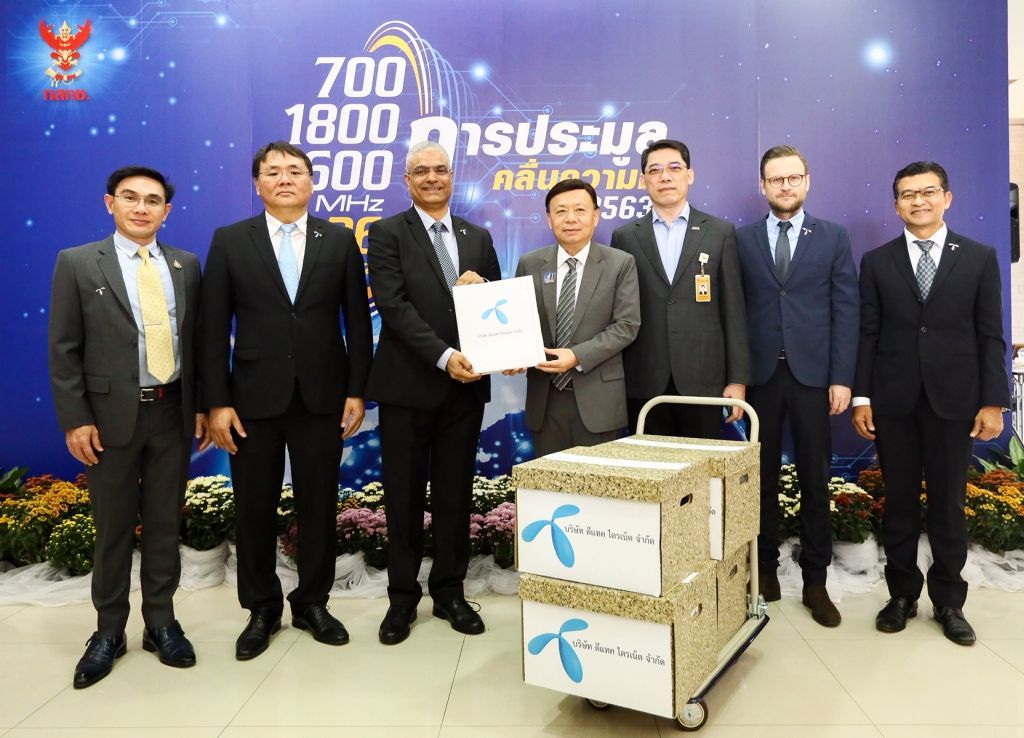
Dtac CEO Sharad Mehrotra, third left, accompanied by his management team, submits the bid documents for the upcoming multiband spectrum auction to NBTC's secretary-general Takorn Tanthasit.

Dtac CEO Sharad Mehrotra, third left, accompanied by his management team, submits the bid documents for the upcoming multiband spectrum auction to NBTC’s secretary-general Takorn Tanthasit.
By THE NATION

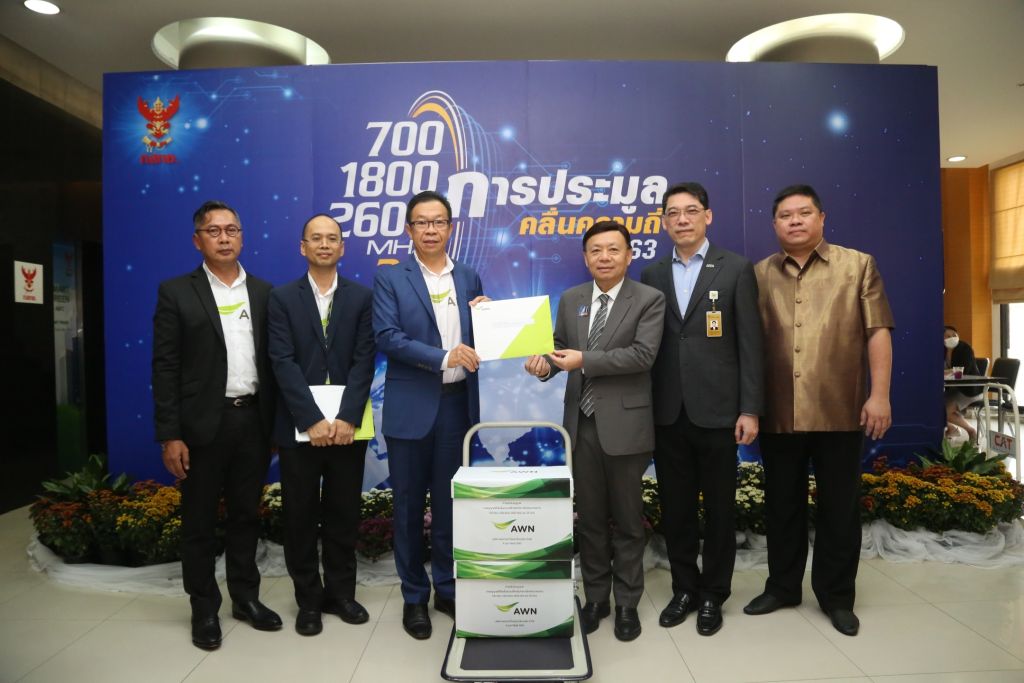
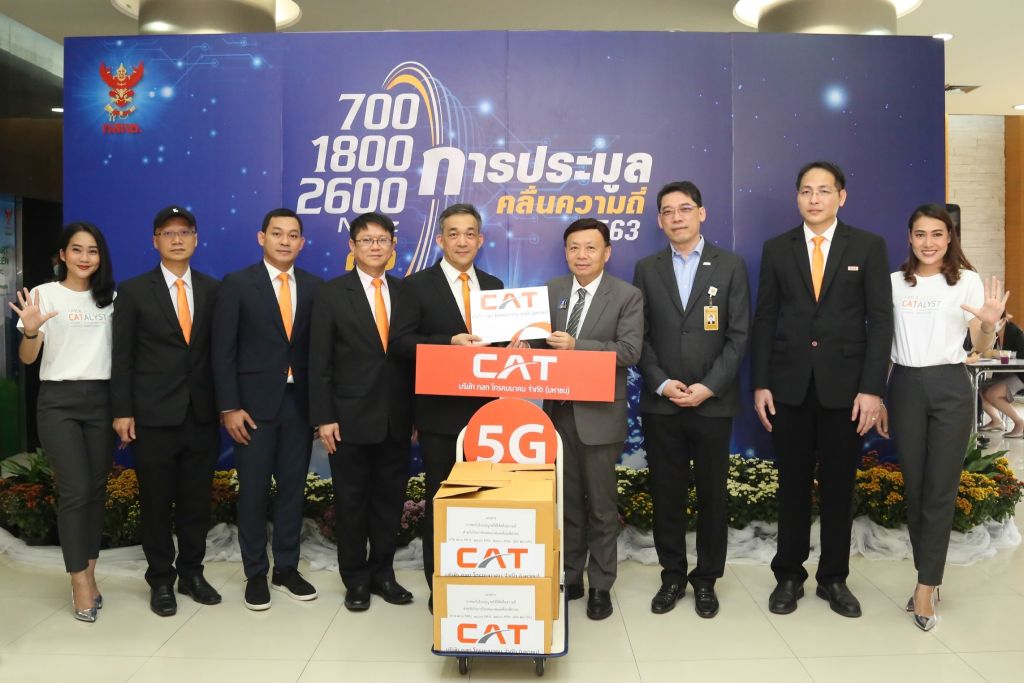
Five private and state telecom operators on Tuesday (January 4) submitted bid documents for the National Broadcasting and Telecommunications Commission (NBTC)’s spectrum licence auction on February 16.

They are True Move H Universal Communication Company Limited (TUC) of True Corp, dtac TriNet of Total Access Communication, Advanced Wireless Network (AWN) of Advanced Info Service (AIS), TOT and CAT Telecom.

NBTC secretary-general Takorn Tantasith said that NBTC is expected to gain Bt70 billion from the auction, which will be handed over to the state.

He estimated that the winning bidders would invest a total of Bt130 billion in 5G network rollout this year, followed by Bt200 billion next year.

The NBTC will auction three licences of the 700MHz, seven licences of 1800MHz, 19 licences of the 2,600MHz, and 27 licences of the 26GHz.

According to a dtac statement on Tuesday, the board of directors had mandated its subsidiary, dtac TriNet, to participate in the upcoming spectrum auction for relevant licences.

The upcoming multiband auction is an opportunity for dtac to further strengthen its spectrum portfolio towards its goal of “never stop improving its network experience”, the statement said.

The dtac team was led by chief executive officer Sharad Mehrotra.

Due to NBTC’s stipulated “silent period”, dtac will refrain from making any further comments regarding the auction.

Sarit Jinnasith, co-Group President of True Corp said: “The Board of Directors of True Move H Universal Communication Company Limited (TUC) has passed the resolution to approve TUC’s participation in the auction”.

To take part in the auction, the company had conducted a thorough valuation analysis as well as hired a third party consultant to conduct a feasibility study on each available frequency.

The company’s consideration was based on consumers’ demand, return on investment as well as values for all stakeholders. Conditions of the upcoming multiband spectrum auction are favourable. It provides a variety of spectrums and sufficient bandwidths for operators to select, more than what were offerred in previous auctions.

Having more bandwidths will further strengthen TrueMove H’s network superiority and secure its market leadership to serve the increasing amount of customers as well as the customers’ fast-growing data usage.

The board of TOT approved the state agency to enter the bid, in line with the policy of the Ministry of Digital Economy and Society that TOT upgrade the country’s telecom infrastructure to boost its competitiveness.

January 4 was only day set for the submission of bid documents.

Share prices of telecom companies ended higher on Tuesday with True gaining 2.69 per cent to close at Bt3.82, AIS increasing 1.46 per cent to Bt208 and dtac climbing 1.70 per cent to Bt44.75.

Tags:

Bernard Ebbers, WorldCom CEO convicted in historic fraud scandal, dies at 78 #ศาสตร์เกษตรดินปุ๋ย

#ศาสตร์เกษตรดินปุ๋ย : ขอบคุณแหล่งข้อมูล : หนังสือพิมพ์ The Nation

https://www.nationthailand.com/business/30381578?utm_source=category&utm_medium=internal_referral

Bernard Ebbers, WorldCom CEO convicted in historic fraud scandal, dies at 78

Feb 04. 2020
By The Washington Post · Harrison Smith 

Bernard J. Ebbers, a telecom executive who grew a small Mississippi firm into the Wall Street juggernaut WorldCom, only for its gains to be unmasked in an $11 billion corporate accounting scandal that landed him in prison and sent shock waves through the U.S. economy, died Feb. 2 at his home in Brookhaven, Mississippi. He was 78.

Ebbers, who was convicted in 2005, had been released early from federal prison in December after serving more than 13 years of his 25-year sentence. In court filings, his lawyers and family said he suffered health problems that included macular degeneration, a heart condition and dementia. His family announced his death in a statement.

At 6-foot-4 and 220 pounds, Ebbers – also known as Bernie – was a swaggering figure in his industry, a former collegiate basketball player who became known as “the telecom cowboy” for wearing jeans, boots and a 10-gallon hat while working out of his corporate headquarters in Clinton, Mississippi. Using stock to fuel relentless acquisitions, he grew WorldCom into the country’s second-largest long-distance provider by the time it peaked in 1999, with a market capitalization of about $185 billion.

It turned out that fortune was largely the result of outright fraud, which wiped out the portfolios of many employees and shareholders and drained billions of dollars from retirement accounts. The country’s largest public pension fund, the California Public Employees’ Retirement System, lost $565 million on WorldCom bonds and stock, according to a 2002 report in The New York Times.

The WorldCom collapse was the largest in a string of early 2000s corporate accounting and corruption scandals – including at Adelphia, Global Crossing, Enron and Tyco – and came to symbolize the excesses of the telecom and dot-com bubble at the close of the millennium. Ebbers, who denied playing any role in the accounting fraud, was among the most prominent executives convicted during that period and received the most severe sentence. (Former Enron chief executive Jeffrey Skilling was sentenced to 24 years, later reduced to 14, and released from federal custody last year.)

Constance Bagley, a legal scholar and senior research fellow at the Yale University’s school of management, said Ebbers’s prison sentence “obliterated” what is now known as the “aw shucks” defense, in which executives beg ignorance of accounting tricks or technological machinations used to justify bogus profits.

“Before him,” Bagley added, “CEOs often were able to get off the hook,” notably by using a line of argument Ebbers deployed throughout his career. “The thing that has helped me personally is that I don’t understand a lot of what goes on in this industry,” he once told Time magazine. “To this day,” he testified in court, “I don’t know technology, and I don’t know finance and accounting.”

As chief executive, Ebbers purchased more than 70 telecom companies, a practice that led him to name his yacht the Aquasition. Originally known as Long Distance Discount Service (LDDS), his business took off after the Telecommunications Act largely deregulated the industry in 1996; the next year, it acquired MCI Communications for $37 billion, in what was reportedly the largest merger in U.S. history.

In 1999, WorldCom moved to scoop up Sprint as well. Competitors slashed prices and cut costs, laying off thousands of workers while struggling to keep pace with Ebbers’s buying binge. But the Sprint merger was ultimately called off amid opposition from antitrust regulators and, in April 2002, Ebbers resigned while facing a Securities and Exchange Commission probe into WorldCom’s support of more than $400 million in personal loans.

The company’s stock price had cratered, falling more than 90% even before June 2002, when WorldCom announced it had improperly accounted for $3.8 billion in expenses, a figure that nearly tripled as investigators continued to pore over financial statements. (Its statements were approved by outside auditor Arthur Andersen, whose reputation had already been tarnished by the Enron accounting scandal.)

WorldCom filed for what was then the largest bankruptcy in U.S. history, since surpassed by Washington Mutual and Lehman Brothers during the 2008 financial crisis. The fraud revelations were widely credited with helping to spur the 2002 passage of the Sarbanes-Oxley Act, which instituted new corporate governance requirements and increased penalties for business fraud.

Ebbers was indicted two years later, after several of his subordinates pleaded guilty to fraud. At age 63, he was convicted of securities fraud, conspiracy and filing false reports with regulators, after his former chief financial officer testified that Ebbers directed him to cook the books.

Defense attorneys argued for leniency in sentencing, saying Ebbers was unfairly “transformed into a symbol of corporate corruption.” But a New York federal judge seemed to side with former WorldCom employees such as Henry Bruen, who was invited to speak before Ebbers’s 25-year sentence was imposed.

“He can never repay me or the tens of thousands like me whose lives disintegrated in the blink of an eye,” said Bruen. “Where do I get my life savings back from? Where is the attempt to make victims like me whole, not just class-action litigants?”

Bernard John Ebbers was born in Edmonton, Alberta, on Aug. 27, 1941. His father was a traveling salesmen and auto mechanic who moved the family to California and later New Mexico, where Ebbers attended school on a Navajo reservation.

He returned to Edmonton for high school and worked as a milkman and a bar bouncer before earning a basketball scholarship to Mississippi College, a private Baptist school in Clinton, where he received a bachelor’s degree in physical education in 1967.

Ebbers worked as a schoolteacher, managed a garment warehouse and began acquiring local motels, one of which included a long-distance telephone service as a sideline, according to a 2002 report in The Washington Post. It became LDDS, with Ebbers installed as chief executive in 1985. The company changed its name to WorldCom a decade later.

As he rose to international prominence, Ebbers maintained a low-key persona around Clinton, mowing his lawn, teaching Sunday school, frequenting the local diner and helping his brother on a cattle ranch. More quietly, he also acquired assets including a yacht-building business in Georgia, a ranch in British Columbia and a soybean farm in Louisiana, according to The Wall Street Journal.

Ebbers’s marriages to Linda Pigott and Kristie Webb ended in divorce. Survivors include four daughters from his first marriage; a stepdaughter from his second; three brothers; a sister; 12 grandchildren; and a great-grandson.

In recent months, his family successfully petitioned for compassionate release, citing Ebbers’s deteriorating health. In a statement circulated by his daughter Joy Ebbers Bourne, the family said they intended to advocate for other incarcerated people “deserving of compassionate release to their families.”

“Many stockholders and employees lost their investments in the fall of WorldCom. Many of our friends – and many in our family – did too,” the statement said. “Thankfully, Judge [Valerie E.] Caproni agreed with us – keeping Dad in prison, especially in his unexplained and undiagnosed deteriorated condition, would not bring back anyone’s investments. My family and I continue to pray for everyone affected by the fall of WorldCom.”

Signa, Central Group acquire Swiss department store chain Globus #ศาสตร์เกษตรดินปุ๋ย

#ศาสตร์เกษตรดินปุ๋ย : ขอบคุณแหล่งข้อมูล : หนังสือพิมพ์ The Nation

https://www.nationthailand.com/business/30381577?utm_source=category&utm_medium=internal_referral

Signa, Central Group acquire Swiss department store chain Globus

Feb 04. 2020
By THE NATION

Signa and Central Group have jointly acquired Swiss luxury department store chain Globus along with eight associated real estate properties from Migros-Genossenschafts-Bund (MGB) under 50:50 joint investment.

The two firms jointly own Germany’s KaDeWe Group, with upcoming projects in Düsseldorf and Vienna, Austria, while Central Group owns nine of Italy’s La Rinascente and Denmark’s Illum stores.

With Globus, the combined presence of Signa and Central will span five countries on the continent – Germany, Austria, Italy, Denmark, and Switzerland – making both one of the leading operators and owners of luxury department stores in Europe.

“For the acquisition of Globus Switzerland, the deal is a joint venture between Central Group and SIGNA, our incumbent partner in the KaDeWe Group and a new project in Vienna. The transaction includes the purchase of prime Swiss properties and a hotel, worth over ₣1 billion altogether”, said Central Group CEO and executive chairman Tos Chirathivat.

“Since entering Europe in 2011 by acquiring Rinascente, our business in Europe has grown from €200 million [Bt6.87 billion] to a projected €2 billion this year. Today, we operate in 19 cities in five European countries, plus two under development in Düsseldorf and Vienna, eight of which will be flagship stores. We are now one of the largest luxury retailers in Europe,” he added.

“Globus is a wonderful brand very close to our hearts,” said Vittorio Radice, CEO of Central Group Europe, representing the joint venture. “As a historic Swiss brand, Globus is a perfect fit for our European alliance with strong local presence and great international recognition. By working together, we will guarantee Globus and the rest of our brands a solid, sustainable and successful future,” he added.

The new owners aim to develop Globus into the leading luxury department store group in Switzerland, with a strong national identity by means of rapid integration and sustainable repositioning.

Said Radice: “Working with the KaDeWe Group, Rinascente and Illum, Globus will benefit from the know-how and experience necessary to develop and drive the department store of today. Together we will implement our successful business model at Globus. Our shareholders will invest substantially in Globus stores in order to guarantee its future sustainability for the long term.”

Radice will assume strategic leadership of the joint venture. According to the statement, he will be supported by an experienced team from the group of shareholders and affiliated companies. Globus CEO Thomas Herbert will become a member of the Board of Directors. Deputy CEO Franco Savastano will assume operative management as CEO.

The final acquisition is subject to approval by European competition authorities and should be completed by mid-2020.