Sony raises profit forecast ahead of Big PlayStation 5 debut
CorporateOct 29. 2020A Sony Alpha 9 mirrorless digital camera at the Sony Corp. headquarters in Tokyo on Feb. 4, 2020. MUST CREDIT: Bloomberg photo by Kiyoshi Ota.
By Syndication Washington Post, Bloomberg · Takashi Mochizuki · BUSINESS, WORLD, TECHNOLOGY, US-GLOBAL-MARKETS, ASIA-PACIFIC Sony Corp. raised its fiscal-year operating profit outlook by 13% to 700 billion yen ($6.7 billion) as its video game unit rode a surge in demand for entertainment from home-bound consumers.
The forecast, up from a previous 620 billion yen, surpassed the average analyst expectation of 658.9 billion yen and precedes the PlayStation 5’s highly anticipated November debut. Sony aims to sell more than 7.6 million PS5 units by the end of March, more than the PS4 managed in its first fiscal year, Chief Financial Officer Hiroki Totoki said.
Sony’s outlook hike underscores how the entertainment giant is benefiting from a global Covid-era consumer shift. While sales of its smartphone image sensors have been hit by U.S.-China trade tensions, the Japanese company is drawing gamers to its online services. Sony is betting that the PS5 will help it outdo Nintendo Co. during the all-important holidays and drive growth.
Sony’s American Depositary Receipts climbed about 3.3% in pre-market trade.
Hardware sales of the new console are likely to contribute “a small minus” to Sony’s bottom line over its first few months, the CFO added, confirming expectations that it will be a loss leader to begin with.
“Sony will spend a lot of money to deliver many units of the PlayStation 5 to the U.S., probably by air,” said Ace Research Institute analyst Hideki Yasuda. “The hardware would be sold at a slight loss as well.”
Operating profit for the three-month period ended Sept. 30 rose 14% to 318 billion yen, outstripping expectations. Game software sales in the quarter were 331 billion yen, down from the 432.5 billion of the prior three months. Sony now has 45.9 million members signed up for its PlayStation Plus subscription, up from 45 million in the prior quarter.
Key takeaways:
– Sony sees improved profits in all segments except for imaging and sensing.
– Raising fiscal-year operating profit forecast for gaming division to 300 billion yen from 240 billion yen.
– Company cites software, mainly add-ons, for improved gaming outlook.
– Monthly active PlayStation users declined to 10.7 million from 11.4 million quarter-on-quarter.
Sony Interactive Entertainment Chief Executive Officer Jim Ryan told Reuters the company pre-sold as many PS5 units in the device’s first 12 hours of availability as it did in the PS4’s first 12 weeks.
The novel coronavirus continued to weigh on Sony’s motion picture business, as many theaters around the world remained far shy of capacity, though the company’s movie prospects may be headed for a bump in the next quarter, according to Bloomberg Intelligence analyst Masahiro Wakasugi. This is largely thanks to the runaway success of a Demon Slayer movie released to theaters on Oct. 16, recording the fastest box office debut in Japan with 10.8 billion yen earned in its first 10 days. The movie’s revenue is part of the group’s music segment.
SCG Packaging (SCGP) forecasts its revenue next year will rise by over Bt100 billion thanks to its second polymer factory in Vietnam and acquisition of three paper and polymer packaging businesses.
SCGP chief executive officer Wichan Jitpukdee said the Vietnam plant should be completed by the end of this year and would help boost production.
He also expects to see revenue realised by the end of 2020 from the acquisition of Bien Hoa Packaging Joint Stock Company (SOVI).
“With demand for paper and polymer packaging expected to increase despite the Covid-19 outbreak, we have a plan to expand the business, especially in Asean countries,” he said, adding that the acquisition of three paper and polymer packaging businesses is currently being negotiated, with one of the deals set to be finalised by year-end.
He said paper-packaging factories in Vietnam, Indonesia and the Philippines worth Bt7.7 billion are under construction and on schedule for completion in 2021.
“These factories will help boost production by 620,000 tonnes per year and generate revenue of Bt9 billion per year, so the company’s revenue from overseas will increase sharply,” he said. Currently, the company’s overseas business accounts for 52 per cent of total revenue, he added.
This was an opportunity for investors to buy SCGP shares at a price lower than the initial public offering (IPO) price, he said.
“We expect our shares to be attractive to foreign investors after the company is listed on the MSCI on November 10,” he said, adding that SCGP is already listed on the SET50 Index.
By Syndication Washington Post, Bloomberg · Patrick Clark · BUSINESS Hotel companies are going to new lengths to get guests through the doors in a bid to salvage a historically bad year for the industry.
More than 2,000 hotels in the Marriott International Inc. system will begin allowing guests to check in at 6 a.m. and stay as late as 6 p.m. the next day, a promotion aimed at remote workers looking for a change of scenery from their homes.
Other Marriott hotels are trying out similar initiatives, including one that offers discounted rates to guests who want a room for the day but not the night. Another program pitches resorts as places where parents can work while hotel staff supervise activities for their kids.
“People are tired of being at home,” said Peggy Fang Roe, global officer for customer experience at Marriott, the world’s largest hotel company. “They want the ability to be in different space, and they also want to stay safe. Working out of a guest room is the best of both worlds.”
At the tail end of the most dismal year in the history of the modern hotel industry, there’s little downside to trying. Across the country, revenue per available room, a measure of occupancy and pricing, was down 47% in September from the year before, according to lodging-data provider STR. Results were even worse in the largest U.S. markets, giving owners and operators reason to get creative.
Hilton Worldwide Holdings Inc. and Hyatt Hotels Corp. also have tried marketing rooms as makeshift offices. As far back as March, when the covid-19 pandemic ground U.S. travel to a halt, hotels have looked for new sources of business, offering cheap lodgings to medical personnel and first responders, or turning rooms into temporary college dorms.
Marriott says surveys have shown that office workers see hotel rooms as a way to ease the stresses and distractions of working from home, and that some of its corporate clients are studying the possibility of offering rooms to employees.
Quantifying demand for these kinds of efforts is difficult, but lodging industry consultant Bjorn Hanson said his research shows that hotels in big markets are finding some takers, at least for day rates. Beyond room rentals themselves, the initiatives may help hotel companies deepen customer relationships with corporate accounts, he said.
“It lets them say, ‘Look how good we’ve been as a partner during a difficult time,’ ” Hanson said.
Ant IPO by the numbers: It’s bigger than Finland’s GDP
CorporateOct 28. 2020Jack Ma. MUST CREDIT: Bloomberg photo by Kiyoshi Ota Photo by: Kiyoshi Ota — Bloomberg Location: Tokyo Japan
By Syndication Washington Post, Bloomberg · David Scanlan · BUSINESS
There’s no shortage of superlatives for Ant Group Co.’s initial public offering. Here’s a look at some of the key metrics, and why billionaire Jack Ma seems to be such a fan of the number eight.
IPO: $34.5 Billion
Ant’s $34.5 billion IPO blows past the previous record, set last year by Saudi Aramco at $29 billion. Ant’s money raise will likely jump another $5.2 billion once bankers sell additional shares to meet demand in what’s known as the greenshoe option. This chart of the 10 biggest IPOs also reflects the growing economic clout of Asia. The top five are all from Asia or the Middle East, and eight of the 10 are from the region, including Ma’s online giant Alibaba Group Holding Ltd. and Japan’s SoftBank Group Corp.
Valuation: $315 Billion
Ant’s IPO puts the company’s valuation at dizzying heights. At about $315 billion, Ant is worth more than the gross domestic products of Egypt, Chile or Finland. For corporate comparisons, it’s bigger than JPMorgan Chase & Co., the biggest U.S. bank. Ant is larger than payment rival PayPal Holdings Inc., media giant Walt Disney Co. and dwarfs Bank of America Corp. It’s three times bigger than tech giant IBM Corp. and four times larger than Goldman Sachs Group Inc.
Wealthy Eight
Ma appears to be a big fan of the number eight, which is often associated with wealth in China. Eight is pronounced “ba” and rhymes with the word for “prosperity” or “getting rich” in Mandarin. As a result, couples often try to get married in August, the 8th month, while eight is a popular number for street addresses and apartment floors. The 2008 Beijing Summer Olympics opening ceremonies began at 8 p.m. on Aug. 8.
Ant is knee-deep in eight. The stock ticker in Shanghai will be 688688; in Hong Kong it’s 6688. Six is also considered a lucky number in China. The shares were priced in Shanghai at 68.8 yuan and at HK$80 in Hong Kong. Ma’s Alibaba Group, which owns about a third of Ant, trades under the ticker 9988 in Hong Kong.
The eight focus seems to be working for Ma. Alibaba has soared since its Hong Kong listing last year, up 69%, trouncing the Hang Seng Index, which is down 8% over that period.
76 Billion Shares
Ant’s IPO was expected to attract investors from all over the world and that’s borne out in the demand for shares. Institutional investors put in orders for 76 billion shares, more than 284 times the initial offering, according to the Shanghai filing. Brokers were willing to lend individual investors credit worth 20 times their investment so they could load up on the shares. Ant is planning to stop taking investor orders for the Hong Kong leg a day earlier than scheduled as the share sale has already been heavily subscribed, according to people familiar with the matter.
$71.6 Billion Fortune
Ma, the former English teacher who co-founded Alibaba with $60,000, is poised to become the world’s 11th-richest person after the Ant IPO.
Ma’s 8.8% stake is worth $27.4 billion based on the stock pricing in Hong Kong and Shanghai. That will lift the 56-year-old’s fortune to $71.6 billion on the Bloomberg Billionaires Index, exceeding that of Oracle Corp.’s Larry Ellison, L’Oreal SA heiress Francoise Bettencourt Meyers and individual members of the Waltons, whose family own Walmart Inc.
$396 Million Fees
The banks working on the IPO are looking at a nice windfall.
Ant is set to raise as much as $19.8 billion in Hong Kong if it fully exercises an overallotment option. The fintech giant disclosed in a filing that it will pay an underwriting commission of as much as 1% of the total deal size, or $198 million. That’s below the average 1.45% paid by companies raising over $1 billion in the city, according to data compiled by Bloomberg. Add in the 1% fee paid by investors via brokers, and the amount jumps to about $396 million.
By Syndication Washington Post, Bloomberg · David McLaughlin · BUSINESS Visa Inc.’s $5.3 billion acquisition of Plaid Inc. has raised competition concerns at the U.S. Justice Department, which is nearing a decision about whether to sue to block the deal, according to two people familiar with the matter.
Lawyers at the Justice Department’s antitrust division who are investigating the takeover are worried the deal could allow Visa to acquire a potential competitor, said the people. The division’s leadership hasn’t made a final decision about whether to sue.
The Justice Department, Visa and Plaid declined to comment.
Visa operates a network that facilitates payments between consumers and merchants around the world. Plaid connects a bevy of financial technology apps with the data sitting inside consumers’ bank accounts.
Visa said in January it was seeking to purchase Plaid in a deal that was valued at $5.3 billion and the two companies hoped to close the transaction within three to six months. By July, the company acknowledged it needed more time to satisfy regulators’ concerns.
“We certainly are expecting to close by the end of the calendar year and are doing everything we can to comply with any request from the regulators that are looking at it,” Chief Executive Officer Al Kelly told analysts on a conference call in July.
The Wall Street Journal reported earlier on the Justice Department’s concerns.
Toyobo and Indorama Polyster to build new plant for automobile airbag yarns
CorporateOct 26. 2020From left: Ashok Arora, chief executive officer of Toyobo-Indorama Advanced Fibers Co Ltd, and Seiji Narahara, president of Toyobo Co Ltd.
By The Nation
Toyobo Co Ltd has joined hands with Indorama Polyester Industries Pcl (IPI) to set up a joint venture firm for the manufacture of yarns for automobile airbags.
IPI is a part of Indorama Ventures Pcl, the world’s largest polyethylene terephthalate producer.
The joint venture company plans to build a new plant on the IPI factory site in Rayong province, and start operations in the first quarter of 2022.
The airbag market is expected to continue growing at three-four per cent annually, thanks to an increase in the number of airbags installed per vehicle and growth in the proportion of vehicles equipped with airbags in emerging economies.
In 2014, Toyobo and IVL jointly acquired PHP Fibers GmbH, a German airbag yarn-maker that held the second-largest share in the world at that time. Since then the relationship has grown stronger with many joint activities carried out between Toyobo and PHP, the companies said.
The joint venture will produce PA66 airbag yarns and ramp up efforts to expand their airbag business. The JV will be an integral part of the Indorama Mobility Group.
IVL, with its presence in Thailand, is undertaking the manufacturing for the proposed JV, with 100 per cent offtake by Toyobo for its weaving plant. Production capacity is expected to be a maximum of 11,000 tonnes per annum.
Toyobo said it aims to meet global clients’ needs as the sole manufacturer capable of producing and supplying airbag materials ranging from yarn to fabrics at its five operations hubs in Japan, Thailand, China, the United States and Europe.
The price of SCG Packaging (SCGP) closed at Bt35 per share on the first day of trading on Wednesday, on par with its initial public offering (IPO) price.
Shares worth Bt11 billion were traded.
The company’s share price had risen to Bt37 per share in the morning session, up Bt2 or 5.17 per cent, before facing volatility. The share price hit the highest at Bt37.25 per share.
Pichet Sithi-Amnuai, the president of Bualuang Securities who are underwriters to the issue, said he was satisfied with the first day of trading even though the share price did not rise to the expected level.
He said some investors sold SCGP shares to hold cash, but he expected institutional investors to buy more shares, as it was considered a large-cap share with growth potential in line with the growing Asean packaging market.
“SCGP shares are large-cap shares focusing on sustainable growth, so we would like investors to be confident and keep an eye on its growth in the long term,” he said.
Veena Lertnimitr, executive vice president at Siam Commercial Bank, who are also the underwiters, said the company would be listed on the SET50 Index in line with the Stock Exchange of Thailand (SET)’s fast track regulations.
She added that SCGP had a high chance to be listed on the MSCI Index on November 10 this year from its market capitalisation and stock liquidity.
SCGP chief financial officer Kulachet Dharachandra said that of the approximately Bt45 billion raised from this issue, Bt10 billion would be used for repaying debt to financial institutions, which would help reduce the company’s interest-bearing debt ratio to 0.5 times from the current 0.9 times, while another Bt27 billion would be used for business expansion in the Asean region.
“The company is currently studying acquisition of a corrugated packaging company in Vietnam, which is expected to close the deal by the end of this year,” he said.
“Meanwhile, the company is studying investment opportunities in glass bottle, film and polyethylene terephthalate packaging businesses.”
He added that cash flow from the fundraising was sufficient for investment in the next 2-3 years.
SCGP chief executive officer Wichan Jitpukdee expected the company’s sales this year to be higher than the past of 6-7 per cent yearly, as the company has adjusted its business model to be strong.
“This is an important step for SCGP to become a public company, which will help boost the company’s potential and financial status,” he said.
He added that in 2020-21, the company intends to invest Bt8.2 billion to increase flexible packaging production capacity in Vietnam and Thailand, as well as paper packaging production capacity in Indonesia and Philippines.
Delta Electronics expects its net profit this year to hit a new high from the increase in purchase orders.
Director Anusorn Muttaraid said the company’s performance in the second half of this year would be better than the first half of Bt27.63 billion in revenue and Bt2.87 billion in net profit, thanks to the increase in orders, relief from the Covid-19 crisis and realised gains from the acquisition of Eltek Australia at the end of July.
He added that Eltek Australia can generate revenue from US$50 million (Bt1.56 billion) to $60 million per year.
“Therefore, we expect the company’s net profit this year to hit a new high from Bt2.95 billion in 2019 as the number of purchasing orders is increasing gradually, especially from data centre infrastructure solutions and businesses related to electric vehicles,” he said.
“Also, the company gained positive sentiment from a change in technologies to support the 5G network, and the weakening baht.”
Anusorn said Delta does not have any plans to acquire more businesses as it has to focus on management to cope with the Covid-19 situation first.
“We believe Delta’s financial status is still strong as the company’s cash flow was around Bt9 billion, so we have confidence it can support more investment in the future,” he added.
By The Washington Post · Steven Zeitchik · NATIONAL, BUSINESS, ENTERTAINMENT For months it’s been clear that Disney, the country’s most prominent entertainment company, was facing a financial disaster unlike any in its history.
On Tuesday, it became evident just how deep the carnage has gone.
The company revealed that as a result of the coronavirus pandemic it took in just $11.8 billion in revenue and $1 billion in operating income in the three-month period that ended in June, the height of lockdowns in the country. The numbers are a significant drop from the same period a year ago, when it generated $20.25 billion in revenue and $4 billion in operating income, among the worst slides of the modern era.
The earnings report for the fiscal third-quarter gave numeric form to what had been the sense of many in the entertainment and financial communities: Disney, once the high-flying giant of Hollywood, has been brought low by the virus, its creations often unable to be produced or consumed.
To try to get some of that revenue back, the company said it would finally release “Mulan,” the action-adventure reboot that has been delayed several times since its March opening.
But the company said it would employ a patchwork approach to do so. The live-action film will be made available on Disney Plus in the United States beginning Sept. 4 – at a cost of $29.99. The same pattern will follow in Canada, Australia and some of Western Europe. Customers will be given indefinite access to the film in exchange for the fee, but only as long as they subscribe to Disney Plus.
In countries where Disney Plus is not offered or theaters are widely open, meanwhile, the movie will go to theaters. This will almost certainly include China, where the film is expected to generate a large percentage of its box office.
In moving the film to a digital platform in the United States, Disney is acknowledging that covid-19 surges make unlikely the quick resumption of normal business – a belief embraced by other studios, which have either substantially postponed their movies to 2021 or pursued a more circumscribed American release plan.
The “Mulan” announcement also finally resolves what had been one of the great ambiguities of corona-era Hollywood.
Where many movies – including those from Disney – had either been postponed to the end of 2020 or moved quickly to digital, “Mulan” had remained in a kind of purgatory, postponed several times as the studio sought to bring it to theaters around the world. With the move, Disney has decided on a solution, if a hybrid one. It will bring out the film in theaters in some countries but not others, and it is taking it to a subscription streaming platform but still charging a supersized theater price.
Disney’s $11.78 billion in revenue in the quarter was lower than the $12.37 billion many analysts expected, though earnings-per-share of 8 cents was above the 64-cent loss many forecast.
The company saw major revenue drops in several business units compared to 2019.
Theme parks saw a plummet from $6.58 billion to $983 million, a plunge of 85%. No American or European park was open in the quarter, while parks in Shanghai and Hong Kong reopened only midway during the period.
Equally concerning for Disney have been the few rays of theme-park light since the quarter ended. The company reopened Disney World in Florida last month to begin rebuilding its revenue pipeline. But chief financial officer Christine McCarthy acknowledged the move has not panned out as hoped.
“The upside we’re seeing is less than we originally expected given the surge of covid-19 in Florida,” she told analysts.
Disney chief executive Bob Chapek said that the park has experienced a “higher-than-expected level of cancellations” as people decide not to travel to Orlando, Fla., because of the virus.
The company’s studio unit, which did not release any major new movies to theaters, saw revenue drop from $3.8 billion during the quarter last year to $1.74 billion this year, a slide of 55% .
Its TV unit, however, was able to hold the line, as revenue stayed mostly flat at $6.6 billion compared to $6.7 billion last year, with many advertisers already paid up through the quarter. Harsher effects could be felt in the months ahead with the lack of new shows and a slowdown in the ad-sales market.
One of the rare bright spots in the quarter was Disney Plus, the streaming service the company launched in November. Disney executives said on a conference call it now has 60.5 million subscribers worldwide after moving a number of previously theatrical movies to the service, most notably “Hamilton” on July 4 weekend. The service is growing faster than many analysts expected, reaching 54.5 million in May and adding six million subscribers since.
The direct-to-consumer division, of which Plus is a part, saw revenue tick up slightly, by 2 percent, from $3.88 billion in the same quarter in 2019 to $3.97 billion in 2020.
Still, with investment costs high, the company does not expect profitability from Disney Plus for several more years, and the direct-to-consumer division saw a loss of $706 million in the quarter, 26% more than last year.
“Mulan” is one way that challenge might be remedied: a product financed by another division that could bring revenue to the startup service.
Disney executives acknowledged how uncommon the tack was but called it a necessary exception at this moment.
The pandemic has “forced us to consider different approaches and look for new opportunities,” Chapek said in an analyst call.
The move, though, is unusual even in the streaming world, which has typically offered an all-you-can-eat plan to subscribers in which all new content is available under the monthly fee. According to the “Mulan” plan, however, a customer must subscribe to the service just for the right to pay for the movie.
By placing the movie exclusively on the service instead of making it available through cable or satellite providers, the company is gambling that the benefit of the new Disney Plus subscribers it attracts will outweigh the lost revenue from people who are not subscribers.
It also is making a financial calculation: by putting the movie exclusively on its own platform, Disney is avoiding handing over as much as 20% of sales revenue to cable operators, as studios typically do with distributors.
Later in the call, Chapek seemed poised to rule out the possibility this could be a trial balloon but then stopped short of that position.
“We’re looking at Mulan as a one-off as opposed to trying to say there’s some new business-windowing model,” he said. But then he added, “That said, we find it very interesting to take a new offering to consumers at a $29.99 price point and learn from it.”
The company’s stock price has not dropped during the pandemic, as bargain-hunters and long-term investors have sent the price up more than 20% since lockdowns began in mid-March. On Tuesday, investors, apparently reacting to the digital “Mulan” announcement, sent the share price up 4% in after-hours trading.
Both Chapek and executive chairman Bob Iger face significant headwinds in the months ahead. Any hope of a Disney comeback in the last six months of 2020 will turn on several factors related to the pandemic: Whether sports, particularly the NBA and Major League Baseball, can continue uninterrupted and bring much-needed revenue to ESPN; whether prime-time shows can begin shooting to ensure a reasonable start to the broadcast-network fall season; and whether enough theaters can reopen in the United States and around the world to begin collecting box office revenue.
While Mulan will not be in U.S. theaters, Disney has high hopes for November, when it has Pixar’s “Soul” and Marvel’s “Black Widow” scheduled to open.
Disneyland will also need to reopen if the company wishes to restore its theme parks to its past glory; the park remains closed under California orders. The parks are key to Disney’s financial fortunes: with $6.76 billion in operating income last fiscal year, the division was the most profitable of any unit besides television.
Energy firm Scan Inter (SCN) should complete development of its 220-megawatt solar energy plant in Minbu, Myanmar ahead of the original deadline of late next year, said chief executive officer Littee Kitpipit.
Green Earth Power (Thailand) or GEP, in which SCN holds a 40 per cent stake, has revised the plan by developing phases 2, 3 and 4 at the same time.
Under phase 2, generation capacity will be 50 megawatts, increasing by 50MW and 70MW in phases 3 and 4.
GEP completed phase 1 development with 50MW capacity in September last year. The company estimates the plant will generate revenue of Bt2 billion per year once the full 220MW capacity is reached.
GEP (Thailand) owns 100 per cent of GEP (Myanmar), which has been granted a build-operate-transfer concession for the plant by Myanmar.

 A Sony Alpha 9 mirrorless digital camera at the Sony Corp. headquarters in Tokyo on Feb. 4, 2020. MUST CREDIT: Bloomberg photo by Kiyoshi Ota.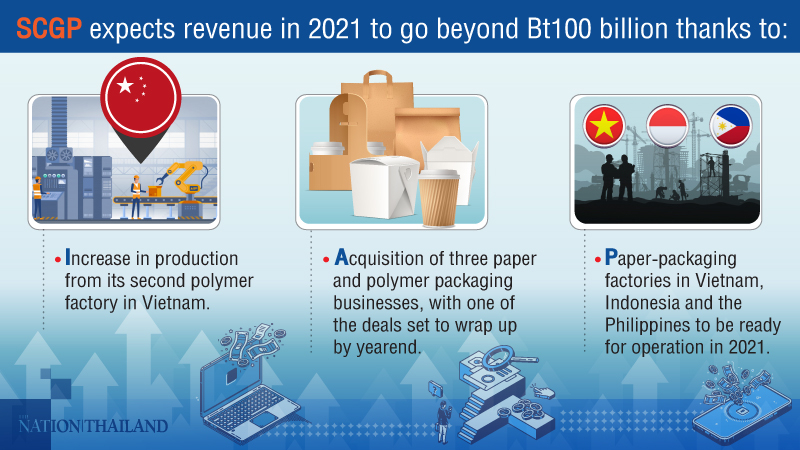

 Jack Ma. MUST CREDIT: Bloomberg photo by Kiyoshi Ota Photo by: Kiyoshi Ota — Bloomberg Location: Tokyo Japan
 From left: Ashok Arora, chief executive officer of Toyobo-Indorama Advanced Fibers Co Ltd, and Seiji Narahara, president of Toyobo Co Ltd.

 Littee Kitpipit.
