Auspicious Chinese New Year menus greet the Year of the Rabbit at The Silk Road The Athenee Hotel, a Luxury Collection Hotel, Bangkok
WEDNESDAY, JANUARY 18, 2023
The Silk Road Chinese restaurant at The Athenee Hotel, a Luxury Collection Hotel, Bangkok, will be celebrating the arrival of the Year of the Rabbit in authentic style from Saturday January 21 to Sunday January 29 with menus offering auspicious dishes including Yu Sheng and Poon Choi.
Chef Kam and his team are creating a series of Chinese New Year menus for lunch and dinner, with an à la carte, a dim sum à la carte, a six-course Blessing Menu at THB 2,888++ per person, and an eight-course Longevity Menu at THB 24,888++ for 10 persons. Prices for the à la carte items begin at THB 420 per dish, and for the dim sum à la carte from THB 160 per dish.
Yu Sheng, also known as Lo Hei, or Prosperity Toss, is a Cantonese-style raw fish salad, mixed with shredded vegetables and condiments, which is placed in the centre of the table and the ingredients heartily tossed by the group, using chopsticks and declaring “lo hei, lo hei!” or “scoop it up!”
Chefs at The Silk Road are preparing two versions for the à la carte. Salmon Yu Sheng is available in a standard portion for two to four persons at THB 1,888++, and in a large portion for five to eight persons at THB 2,688++. Abalone Yu Sheng includes strips of fresh salmon and is served in a standard portion at THB 2,388++, and a large portion at THB 3,388++. Salmon Yu Sheng is also included in the Lucky Rabbit Set Menu.
Yu Sheng is also available as a takeaway at THB 1,888+ for the salmon version small size and THB 2,688+ large size, and THB 2,388+ and THB 3,388+ for the abalone version.
Chinese New Year Poon Choi, a traditional Cantonese meal cooked in a clay pot and with layered ingredients including braised mixed meats, dried scallops, fish maw, abalone, sea cucumber and black mushrooms, is on the a la carte at THB 2,200++ for eight to 10 persons. Nian Gao, the traditional Chinese New Year cake, is available at THB 888+
20% discount for The Athenee Club Members and 10% Marriott Club Members.
Reservations are recommended. Please call 02 650 8800 or e-mail: fb.theathenee@luxurycollection.com or visit website: www.theatheneehotel.com
MHI Signs MoU to Collaborate in Studies on Ammonia Co-Firing for Power Generation
WEDNESDAY, JANUARY 18, 2023
Studies Aim to Achieve 20% Co-Firing at a Coal-Fired Thermal Power Plant; Includes Procurement and Utilization of the Fuel
In Singapore, on January 16, Mitsubishi Heavy Industries signed a Memorandum of Understanding to collaborate in a feasibility study for the introduction of ammonia co-firing at a coal-fired thermal power plant operated by BLCP Power Limited, which is an independent power producer in Thailand and a joint venture (50:50) between Banpu Power Public Company Limited and Electricity Generating Public Company Limited.
The project aims to decarbonize the existing power plant, supporting Thailand in achieving its climate ambitions and becoming a low-carbon society.
The MoU was signed during the Japan-Thailand Energy Policy Dialogue held in Thailand’s capital Bangkok on January 12. Several Thai and Japanese organizations in addition to MHI and BLCP are also involved in the project, exemplifying the importance of international cooperation in reducing global emissions. These include BPP and EGCO Group from Thailand, as well as JERA Co., Inc. and Mitsubishi Corporation from Japan.
Under the feasibility study plan, MHI, with support from its power solutions brand Mitsubishi Power, will determine and conduct a study on the supply of ammonia burners, boiler facilities and equipment necessary for ammonia co-firing. JERA will examine the procurement and transportation of ammonia fuel, whereas JERA and Mitsubishi Corporation will investigate the port facilities, along with ammonia receiving and storage facilities.
This will go toward establishing an integrated fuel value chain from procurement to utilization. BLCP, MHI, Mitsubishi Corporation and JERA will also jointly conduct studies and develop plans to achieve up to 20% ammonia co-firing, supporting reductions in CO2 emissions and decarbonization.
Located in Rayong province in southeastern Thailand, the BLCP Power Station comprises two subcritical coal-fired boilers with a total output of 1,434 megawatts that began operations in 2006 and 2007. MHI supplied the boilers, steam turbines, and other main facilities of the power station.
Thailand has announced its commitment to reach carbon neutrality by 2050, and net zero greenhouse gas emissions by 2065. The country plans to strengthen cooperation with Japan regarding decarbonization technologies for fuels such as ammonia and hydrogen.
MHI and Mitsubishi Power have supplied more than 25 gigawatts of power generation equipment to Thailand, including facilities currently under construction, accounting for well more than half of the country’s generating capacity. Through its industry-leading power generation equipment and services, Mitsubishi Power has played a vital role in Thailand’s transition from coal to natural gas fuel, supporting the gradual shift toward reducing CO2 emissions.
Continuing the momentum of this MoU, MHI and Mitsubishi Power offer decarbonization solutions to customers and the power generation industry around the world, to ensure a stable supply of energy and deliver a sustainable future for the region.
Thailand investment privileges jump 39% driven by FDI in EV, data centres
WEDNESDAY, JANUARY 18, 2023
The Thailand Board of Investment (BOI) provided investment privileges for 2,119 projects worth 664.63 billion baht last year, said government spokesman Anucha Burapachaisri on Wednesday.
The number of projects rose 41% from the previous year while the worth of privileges rose 39%.
The BOI attributed the jump in investment privilege applications to the improving Covid-19 situation that had restored economic activities and investments to almost pre-pandemic level.
The government also rolled out measures to promote key industries, including electric vehicle (EV) manufacturing, power generation, and data centre businesses, said Anucha.
The BOI said foreign companies accounted for 65% of investment privileges, worth a total 433.97 billion baht – a 36% rise from the previous year.
China was Thailand’s biggest foreign investor with 158 projects worth over 77.38 billion baht, or 15% of total foreign investment. Japan was second with 293 projects worth 50.76 billion baht, while the US was third with 33 projects worth 50.29 billion baht.
Industries attracting most foreign investment last year were electrical appliances, electronics, petrochemicals, chemicals, and automotive components.
“Prime Minister Prayut Chan-o-cha is confident that Thailand’s economy will continue to grow this year based on increasing confidence among Thai and foreign investors,” said Anucha. “The government is committed to upgrading the country’s industrial infrastructure and improving regulations to facilitate investment across various industries in a bid to recover our economy, promote employment and enhance the quality of life of all citizens.”
Thailand reveals tourism strategy to beat Covid at World Economic Forum
WEDNESDAY, JANUARY 18, 2023
Finance Minister Arkhom Termpittayapaisith revealed Thailand’s successful formula for reopening the country to tourists while preventing the spread of Covid-19, at the World Economic Forum on Tuesday.
Arkhom was speaking at the “Travelling Again, Differently” seminar hosted by CNN’s Richard Quest during the annual four-day forum in Davos, Switzerland.
Arkhom told Quest that Thailand had launched the Phuket Sandbox as early as July 2021, to pilot the reopening of borders to international visitors in a controlled area.
The tight restrictions were gradually lifted as the pandemic receded, allowing larger numbers of foreign tourists to enter the country.
Meanwhile, the government supported the tourism sector with subsidies to boost domestic travel, and promoted tourism in secondary provinces to distribute income to small businesses and local communities.
Arkhom also highlighted Thailand’s “5F strategy” of Food, Fashion, Festival, Fighting, and Film. The strategy is designed to lure tourists to other provinces and reduce crowding in major cities. Tourism infrastructure has been prepared in these areas, especially facilities targeted at retiree travellers who have high spending power, he said.
Arkhom mentioned that Thailand is also considering measures to promote the use of sustainable aviation fuel to fulfil the country’s environmental goals.
Also joining the session were Clare Akamanzi, CEO of the Rwanda Development Board; John Holland-Kaye, CEO of Heathrow Airport Holdings Limited; and Jeffrey Katz, CEO of Journera, a travel technology platform.
JobsDB: ‘Keep your guard up’ and how to spot job scams
TUESDAY, JANUARY 17, 2023
Given the rising number of job scams in recent months, JobsDB Thailand is advising jobseekers to ‘keep their guard up’ and to try spot differences between a job scam and a legitimate job ad.
“Online fraud is a real threat, and, unfortunately, quite a few Thais have fallen victim to these scams,” said Duangporn Promon, Managing Director of Jobs DB Recruitment (Thailand) Limited
“Given the rising costs of living, it’s understandable that more people are looking for opportunities to supplement their income. One of the consequences of the demand for jobs is that there have also been increased opportunities for fraud. “As job recruitment scams grow prevalent on the internet, being able to tell the difference between a genuine position opening, and a scam can mean the difference between losing money and earning money.”
Some tell-tale signs of job scams are as follows:
1. If it is too good to be true, then chances are, it is
High-paying jobs are usually given to people with more experience or higher levels of expertise. If you want to get hired for a high-paying job, there are many legitimate ways to do so. You can gain more experience or even upskill to qualify for jobs outside your level of expertise. Jobseekers should always keep in mind that ‘Nothing in life comes easy’. Your career should not be an exception, as it should be earned and developed naturally through hard work and a willingness to grow.
When it comes to advertisements for overseas positions, candidates should also be cautious and consider.
2. The hirer communicates exclusively through social media
If a supposed hirer reaches out to you through social media, then you should already be sceptical. Most hirers from legitimate companies communicate primarily through email, phone, or messaging apps where their actual identities are shown. Some may message candidates through social media but will eventually move to more formal means of communication as talks advance.
If an alleged headhunter only messages through social media and has no other contact information, then maybe it is time to ignore those message alerts. When in doubt, always search for information about the company online. All companies that operate legally will always have an online presence.
If a hirer is claiming to be affiliated with a certain company, you can check the company’s website or social media and email the company or message one of their representatives to confirm whether the job offer is genuine or not.
3. The company sends you suspicious emails Communicating via email does not automatically make a hirer legitimate. In fact, you can spot a job recruitment scam based on the contents of the email.
Is the message coming from an official company email address? If it is coming from a personal email address or one that is unrelated to the company it claims to represent, then the job ad could be a scam.
You can also tell from how the email is written. If it is not written professionally and filled with grammatical errors, the offer may likely be fake. Always check from whom the email is. If it is from a proper hirer, you must be able to search the person through social media or within the company’s official website.
4. The hirer asks you for your personal details Real job hirers are only interested in the things in your resume: your work and educational background, expertise, and basic personal information. Beyond that, no company will have an actual use for any additional information, such as your bank details or social security number. You should only give this private information once the company employs you.
People asking for more information from you than job hirers typically need might be after something else. Beware of job ads or job offers that require personal details that you are not comfortable sharing.
5. You get instant job offers—with no application needed If someone reaches out to you online with an outright job offer, that is a serious red flag. A typical job offer comes after a thorough job application, which involves submitting a resume and cover letter, a proper screening of candidates by the hirer, and a formal job interview. It is not handed out freely and randomly to anyone with an email address or a social media account.
Some job hiring scammers will claim to have seen your credentials online and have deemed you qualified for the job. Even if this were true, the fact that they did not screen you further suggests that they are not taking their talent search seriously. Hiring an employee is a process that usually takes weeks. In contrast, job scams are usually urgent in nature and require quick action.
6. They ask you for money Job scammers were able to take millions of baht from jobseekers last year. They convinced their victims to shell out money as part of their job, with the promise of getting an even larger amount down the line.
Employers asking for your money are among the biggest red flags when looking at job ads or job offers. If you have to pay to apply for a job, it is likely not real. When you encounter such fraudulent individuals, report them to the proper authorities so they stop victimising more people.
Do not give your credit card information to fake job sites either. However, as a general rule, applying for jobs online should not cost anyone.
Kalapapruek House, the Best Living Upon the Fullest Lifestyle Nearby Bangkok CBD
MONDAY, JANUARY 16, 2023
Choosing where to purchase your dream home is one of the toughest and most grueling decisions you will make in life. And as housing developments and high-rise condominiums are becoming more prevalent in Bangkok, land in the capital is becoming more scarce.
You might feel pressured to choose a house slightly outside of Bangkok as a result, such as housing locations in the surrounding metropolitan areas.
But take a short drive through Kalapapruek road—a hidden gem within the capital’s Thonburi side—and you might just reconsider your options.
Kalapapruek is home to one of the fastest-growing lifestyle developments, with restaurants, malls, hospitals, and schools all located within a few kilometers away. The road is directly connected to Bangkok’s central business district (CBD), and has long been secretly known as one of the prime real estate destinations in Thailand.
So in the pursuit of the best location for your dream house, let’s explore where Kalapapruek actually is, what it’s known for, and where the best housing developments in the area actually are.
Where exactly is Kalapapruek in Bangkok?
Kalapapruek road (officially spelled Thanon Kanlapaphruek), is a six-lane paved road connecting Ratchapruek road and Kanchanaphisek road, stretching around 7.7 kilometers from end to end.
First opened to the public in 2002, the road has rapidly grown to become one of the hottest real estate locations in Bangkok. This is mainly because Kalapapruek also connects three of Bangkok’s districts: Bang Khae, Chom Thong, and Phasi Charoen.
Many Bangkokians have abandoned the dream of getting a brand-new house nearby any BTS or MRT station. Kalapapruek, however, is less than 5 kilometers away from the nearest MRT station, depending on the house’s location.
Kalapapruek was first opened to the public in 2002, and it is now clear to see why it has grown to become one of the hottest real estate areas in the capital.
Buying a House in Kalapapruek: A Complete Lifestyle Hub Near Bangkok’s CBD
Here are some noteworthy nearby destinations & lifestyles that are reachable while living within Kalapapruek road:
Malls & lifestyle:
• The Mall Bang Khae – A popular shopping mall on Phetkasem road, reachable by MRT • The Mall Tha Phra – Also reachable by MRT • Seacon Bang Khae – Also reachable by MRT • Homepro Kanlapaphruek – A home decor and equipment department store • Makro Kanlapaphruek – A wholesale department store for buying in bulk • Lotus Bang Khae – A highly-frequented hypermarket
Schools & higher education:
• Assumption College Thonburi • Assumption College Bang Rak • Bangkok Christian College • Saint Joseph Convent School • Shrewsbury International School • Siam University
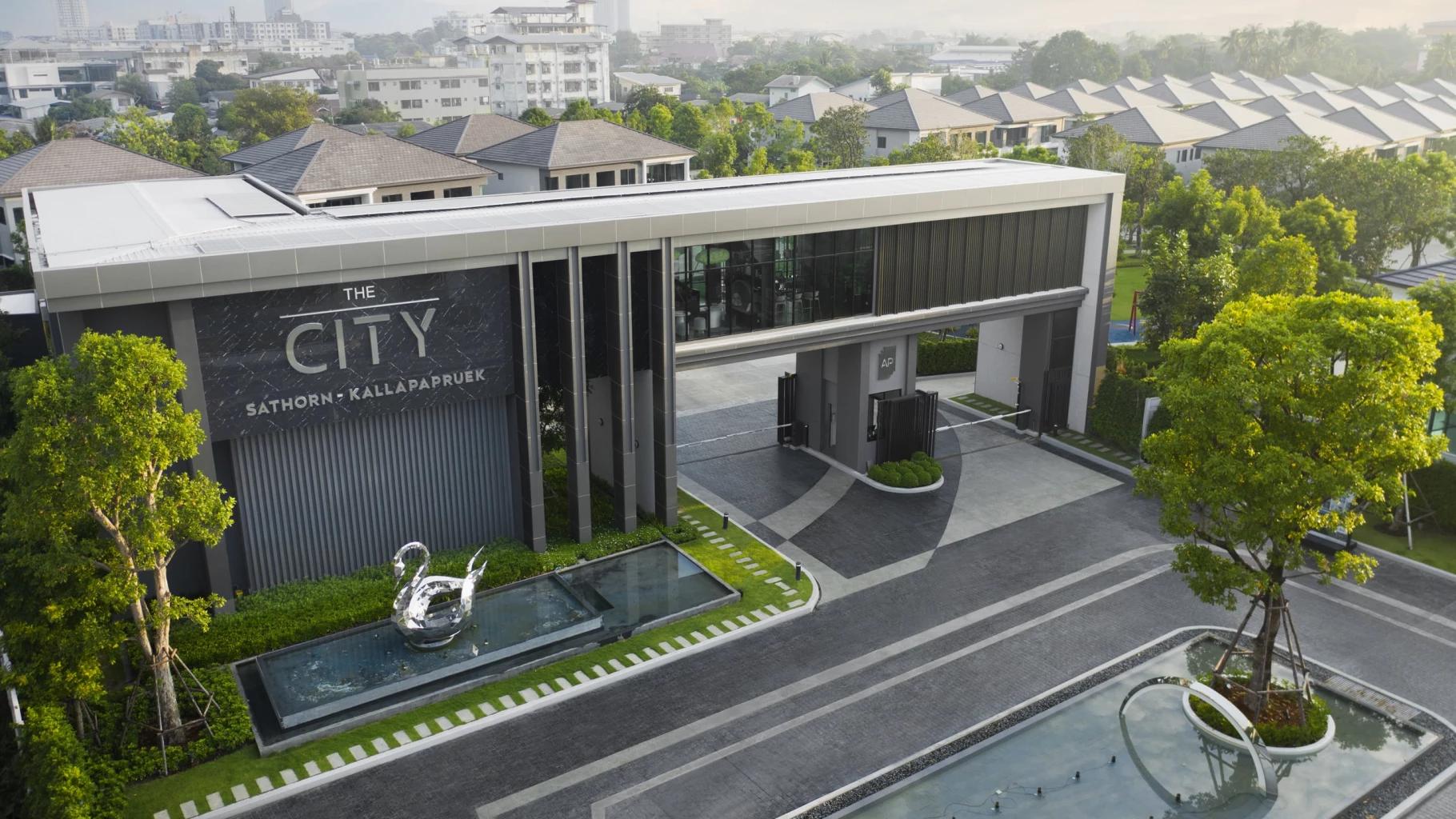
Considered one of AP Thai’s most exclusive neighborhoods, THE CITY is just a 10-minute drive away from the Sathorn area, known as Bangkok’s most bustling CBD.
House owners can enjoy spacious views from an all-two-floor housing setup across the entire neighborhood, such that one would no longer expect to find from an area so close to the city.
THE CITY Sathorn-Kallapapruek features four different house types, ranging from 233 to 330 square meters in size, with parking for two to three cars available, depending on the type.
And with only 121 units available throughout the whole neighborhood, along with its close proximity to the locations above, THE CITY is surely not to be overlooked.
Although this neighborhood is generally an option for slightly smaller families, CENTRO is no less convenient by any means. Also featuring four house types, CENTRO’s houses range from 175 to 225 square meters in size.
And with two parking spaces per house, this location is perfect for new or soon-to-be families, or existing families who need a location slightly closer to the city.
With only 173 units available, it has now become one of the most high-in-demand neighborhoods in the entire Kalapapruek area.
Buying a house in Kalapapruek will offer a surreal experience of being nearby Bangkok’s most frequented destinations, while still being surrounded by your own personal space. So when looking to buy a house in or around Bangkok, be sure to include Kalapapruek house in your potential list.
Thailand’s Horizon Plus in talks to make EVs for Chinese, European brands
TUESDAY, JANUARY 17, 2023
Horizon Plus, a joint venture between PTT subsidiary Arun Plus and Taiwan-based Hon Hai (Foxconn), has announced plans to manufacture electric vehicles (EVs) in Thailand for Chinese and European brands.
Horizon Plus’s Chonburi plant aims to open in 2024 with production capacity of 50,000 EVs per year to drive Thailand’s ambition to become an Asian hub of EV manufacturing. Capacity will rise to 150,000 EVs by 2030 to meet growing demand from Asean consumers, the company says.
On Monday, Arun Plus managing director Ekachai Yimsakul revealed Horizon Plus is currently negotiating to produce EVs for several partner brands from Europe and China.
“Deals with two partners are expected to be completed by the first quarter of this year,” he said.
China’s Hozon Auto, which makes the Neta V model, is reportedly among the EV brands planning to produce cars at the Horizon Plus plant in Rojana Nong Yai Industrial Estate, Chonburi.
Meanwhile, Horizon Plus has invested US$1 billion (36.1 billion baht) to build a full EV manufacturing cycle in Thailand, promote domestically manufactured EVs, and recruit more than 2,000 skilled workers, Ekachai said.
Developing an EV ecosystem is part of PTT’s mission to create energy sustainability in Thailand, he explained.
PTT president and CEO Auttapol Rerkpiboon said the joint venture with Foxconn will push Thailand towards becoming a low-carbon society.
“This move is also seen as an important strategy to help PTT achieve its goal of net-zero greenhouse gas emissions by 2050,” he added.
Nearly three-quarters (73%) of CEOs believe global economic growth will decline over the next 12 months, according to PwC’s 26th Annual Global CEO Survey, which polled 4,410 CEOs in 105 countries and territories in October and November 2022.
The bleak CEO outlook is the most pessimistic CEOs have been regarding global economic growth since we began asking this question 12 years ago and is a significant departure from the optimistic outlooks of 2021 and 2022, when more than three-quarters (76% and 77%, respectively) thought economic growth would improve.
Nearly 40% of CEOs think their organisations will not be economically viable in a decade
In addition to a challenging environment, nearly 40% of CEOs think their organisations will not be economically viable in a decade if they continue on their current path. The pattern is consistent across a range of sectors, including telecommunications (46%), manufacturing (43%), healthcare (42%) and technology (41%). CEO confidence in their own company’s growth prospects also declined dramatically since last year (-26%), the biggest drop since the 2008-2009 financial crisis when a 58% decline was recorded.
Globally, business confidence around economic growth varies starkly, with G7 economies, including France (70% v 63%), Germany (94% v 82%) and the United Kingdom (84% v 71%) – all weighed down by an ongoing energy crisis – more pessimistic about their domestic growth prospects than they are about global growth.
CEOs are also seeing multiple direct challenges to profitability within their own industries over the next 10 years. More than half (56%) believe changing customer demand/preferences will impact profitability, followed by changes in regulation (53%), labour/skills shortages (52%), and technology disruptions (49%).
Inflation, macroeconomic volatility and geopolitical conflict are top CEOs’ concerns
While cyber and health risks were the top concerns a year ago, the impact of the economic downturn is top-of-mind for CEOs this year, with inflation (40%) and macroeconomic volatility (31%) leading the risks weighing on CEOs in the short-term – the next 12 months – and over the next five years. Close behind, 25% of CEOs also feel financially exposed to geopolitical conflict risks, whereas cyber risks (20%) and climate change (14%) have fallen in relative terms.
The war in Ukraine and growing concern about geopolitical flashpoints in other parts of the world have caused CEOs to rethink aspects of their business models, with almost half of the respondents that are exposed to geopolitical conflict integrating a wider range of disruptions into scenario planning and corporate operating models either by increasing investments in cybersecurity or data privacy (48%), adjusting supply chains (46%), re-evaluating market presence or expanding into new markets (46%), or diversifying their product/service offering (41%).
CEOs are cutting costs but not headcount or compensation
In response to the current economic climate, CEOs are looking to cut costs and spur revenue growth. 52% of CEOs report reducing operating costs, while 51% report raising prices and 48% diversify product and service offerings. However, more than half – 60% – say they do not plan to reduce the size of their workforce in the next 12 months. A vast majority – 80% – indicate they do not plan to reduce staff remuneration in order to retain talent and mitigate workforce attrition rates.
Bob Moritz, Global Chairman, PwC, said: “A volatile economy, decades-high inflation, and geopolitical conflict have contributed to a level of CEO pessimism not seen in over a decade. CEOs globally are consequently re-evaluating their operating models and cutting costs, yet despite these pressures, they are continuing to put their people front and centre as they look to retain talent in the wake of the ‘Great Resignation.’ The world continues to change at a relentless pace, and the risks facing organisations, people – and the planet – will only continue to rise. If organisations are not only to thrive – but survive the next few years – they must carefully balance the dual imperative of mitigating short-term risks and operational demands with long-term outcomes – as businesses that don’t transform, won’t be viable.”
Managing climate risk is a growing priority for businesses
While climate risk did not feature as prominently as a short-term risk over the next 12 months relative to other global risks, CEOs still see climate risk impacting their cost profiles (50%), supply chains (42%) and physical assets (24%) from a moderate to a very large extent. CEOs in China feel particularly exposed, with 65% seeing the potential for impacting their cost profiles, 71% to supply chains, and 56% to physical assets. Recognising the impact climate change will have on business and society over the long-term, a majority of CEOs have already implemented – or are in the process of implementing – initiatives to reduce their companies’ emissions (65%), in addition to innovating new, climate-friendly products and processes (61%), or developing a data-driven, enterprise-level strategy for reducing emissions and mitigating climate risks (58%).
Despite an increasing number of countries now having some form of carbon pricing, a majority of respondents (54%) still do not plan to apply an internal price on carbon in decision-making, and over a third (36%) don’t plan to implement initiatives to protect their company’s physical assets and/or workforce from the impact of climate risk.
The continued importance of trust and transformation in generating long-term value
CEOs noted the need to collaborate with a wide range of stakeholders to build trust and deliver sustained outcomes if they are to generate long-term societal value. The survey found that when organisations partner with non-business entities, it is to address sustainable development (54%), diversity, equity, and inclusion (49%), and education (49%).
If organisations are to remain viable in the near and long-term, they must also invest in their people and technological transformation agendas to empower their workforces. Technologically, nearly three-quarters (76%) of organisations say they are investing in automating processes and systems, implementing systems to upskill workforces in priority areas (72%), and deploying technology such as the cloud, AI and other advanced technology (69%).
However, many CEOs question whether critical preconditions for organisational empowerment and entrepreneurship – such as alignment to company values and leaders’ encouragement of dissent and debate – are present in their companies to tackle the increasingly complex risks organisations face. For example, only 23% of CEOs say leaders in their company often/usually make strategic decisions for their function without consulting the CEO. Further, only 46% of CEOs say leaders in their company tolerate small-scale failures often/usually. However, more optimistically, nearly 9 in 10 (85%) respondents say the behaviours of employees are often or usually aligned with their companies’ values and direction.
Torn between the demands of short-termism and long-term transformation, CEOs say they are primarily consumed with driving current operating performance (53%), rather than evolving the business and its strategy to meet future demands (47%). If they could redesign their schedules, CEOs say they would spend more time on the latter (57%).
Bob Moritz, Global Chairman, PwC, concludes: “The risks facing organisations and society today cannot be addressed alone and in isolation. CEOs must therefore continue to collaborate with a wide range of public and private sector stakeholders to effectively mitigate those risks, build trust and generate long-term value – for their businesses, society and the planet.”
About the data: PwC surveyed 4,410 CEOs in October and November of 2022. The global and regional figures in the report are weighted proportionally to the country or regional nominal GDP to ensure that CEOs’ views are representative across all major regions. The industry and country-level figures are based on unweighted data from the full sample of 4,410 CEOs. Interviews were conducted with CEOs from three global regions (North America, Western Europe and Asia-Pacific).
Future shines bright for Thai jewellery sector through new MoU with Shenzhen
MONDAY, JANUARY 16, 2023
Chanapat Komlongharn
After a long hiatus due to the pandemic, Thailand’s jewellery makers can now return to China and make the most of the opportunities offered by a new memorandum of understanding (MoU).
The Asean Gems and Jewellery Association (AGJA) signed an MoU with the Jewellery Museum of Shenzhen on Thursday at the “China-Thailand Modern Fashion (Gold and Jewellery Cooperation” meeting in Bangkok.
Present at the event were top executives from leading organisations of both countries, including Yang Qing, first secretary at the Chinese embassy; Zuo Jinping, executive deputy head of Shenzhen’s Luohu district; Sitthichai Parinyanusorn, deputy director of the Gem and Jewellery Institute of Thailand (GIT); and Boonlert Siripatvanich, advisory chairman of the Thai Goldsmith Association.
The pact aims to drive the gems and jewellery industries in both countries, as well as foster cooperation, tighten ties and boost trade, a Facebook post from AGJA said.
Suttipong Damrongsakul, president of the Thai Gem and Jewellery Traders Association, said he strongly believes all sides will benefit from this collaboration as most economies are in recovery mode.
Meanwhile, Zuo Jinping said Thailand has been trading with Luohu – a major diamond producer – for a while now, and with this link, both countries can work more effectively together.
“The era of rejuvenation has arrived and the door for Thais to invest in China has opened,” he added.
Suttipong Damrongsakul (Left) and Wang Zhen (The Curator of Jewellery Museum of Shenzhen) (Right)were signing MoU.
According to Luohu’s Bureau of Industry and Information Technology, Shenzhen has developed 10 projects to stimulate growth in the sector.
The projects are:
• Industrial chain replenishment and extension
• Gold finance innovation
• Design creativity promotion
• Intelligent manufacturing
• Brand promotion
• Consumption expansion
• Talent cultivation
• Intellectual property rights protection and standardisation
• Internationalisation
• Environmental enhancement
Liw Chen, an official from Luohu’s Bureau of Industry and Information Technology, also believes the collaboration will be successful.
“We are working together to help Thailand break into the Chinese gems market,” he added.
Meanwhile, Sitthichai said Thailand’s gems and jewellery industry earns more than US$3 billion per year from export and local consumption.
This accounts for about 2% of the country’s gross domestic product (GDP). He pointed out that the industry has also created more than 750,000 jobs in Thailand.
Meanwhile, Shenzhen’s Luohu district is considered China’s jewellery hub, packed with local and international brands, many of whom plan to expand their investment this year.
1,500 jobs up for grabs for Thais on three US cruise ships
TUESDAY, JANUARY 17, 2023
Labour Minister Suchart Chomklin on Tuesday urged Thais who can communicate in English to apply for 1,500 jobs available on three US cruise ships, which could pay up to around 87,000 baht a month.
Suchart said CTI Group Worldwide Services Inc has 1,500 job vacancies in 37 positions for Thais who are at least 21 years old.
The vacant posts include chefs, waiters and waitresses, beverage staff, electricians, maids and garbage collectors.
Suchart said successful applicants would work on one of three cruise ships for six to nine consecutive months and would be paid between 19,618 to 87,176 baht per month, plus tips. They also will get free accommodation and food.
Applications can be submitted from January 18 to February 16, the minister added.
“Thai workers are naturally pleasant-mannered and polite and have a smiling face at all times, so they are in high demand by foreign employers,” Suchart said.
“Working abroad will widen your vision and provide you working experience while helping earn foreign currency for the country,” he said.
Pairoj Chotikasathien, director-general of the Employment Department, said the CTI Seafarer Recruitment (Thailand) Co Ltd has submitted an agreement for recruiting services and a letter from CTI Group to the department, stating the need for 1,500 staff.
Pairoj said applicants must have at least six months of experience in the positions they apply for and must have good command over English.





 Suttipong Damrongsakul (Left) and Wang Zhen (The Curator of Jewellery Museum of Shenzhen) (Right)were signing MoU.
 Sitthichai Parinyanusorn

 SootinClaimon.Com