MEA posts advice on what to do if powerline falls on your car
Sep 17. 2020
By THE NATION
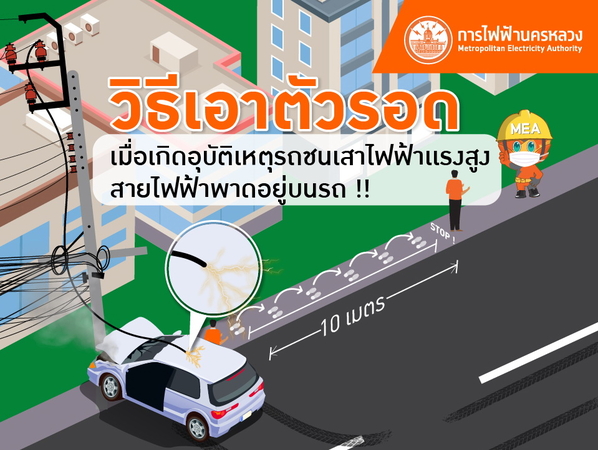
The Metropolitan Electricity Authority (MEA) posted on Facebook a series of steps motorists should take in case a powerline snaps and falls on their car.
“You need to remain calm and not immediately get out of the car. First check the surrounding area and see if the powerline is touching the car or the ground and see if the ground is wet or dry,” it said.
MEA advises the following steps if the car can move:
• Do not leave the car until you are sure the powerline is not touching the vehicle and the ground is not wet;
• Notify passersby and tell them not to approach the car;
• If possible, move the car at least 10 metres from the powerline before getting out of the vehicle. Take care not to drive over the powerline as it can entangle with the car’s lower body or suspension.
If the car cannot move or has caught fire, the motorist is advised to:
• Avoid stepping out of the car and instead jump out with both feet and ensure no part of your body is touching the car;
• When you have made your way out, hop away as far as possible with both feet. Avoid walking or running as you may step on live wire;
• Do not return to the car for valuables or try to put out the fire until the authorities cut off the power in that area.
Call MEA hotline 1130 for accidents in Bangkok, Nonthaburi or Samut Prakan, and the Provincial Electricity Authority hotline 1129 for other provinces.
Six centres of excellence will be launched in the Eastern Economic Corridor (EEC) to equip students with knowledge of advanced technologies for the 10 industries targeted by the corridor, said EEC Office secretary-general Kanit Sangsubhan.
Each will focus on teaching one technology specialism, with a centre of automation and robotics, of logistics, of next generation automotives, of track systems, of aviation, and of tourism.
Recently the EEC authority joined with Mitsubishi Electric Factory Automation (Thailand) to set up an automation and robotics excellence centre, called the EEC Automation Park, at Burapha University in Chonburi.
“The EEC expects to see demand for more than 37,000 workers with automation and robotics skills in the next five years,” Khanit said.
The company’s managing director, Wichiene Ngamsukkarsemsri, said that students of Burapha University and 20 other educational institutes can use the facilities at the centre. This would create a vast network of personnel with automation and robotics skills, he added
Construction of the centre is 30 per cent complete and should be finished by the middle of next year.
The EEC stretches across the eastern seaboard provinces of Rayong, Chonburi and Chachoengsao.
Experts are advising investors to monitor the political rally on Saturday (September 19), because the direction Thailand’s stock index takes will depend very much on the severity of the situation.
Apichat Poobunjirdkul, Tisco Securities senior director for strategic analysis, said the domestic political situation has always had an effect on the Thai stock market.
He said that though government will not initially harm protesters, the result will depend on how far the protesters go.
“We don’t expect the index to fall below 1,250, and it even has the chance to rise beyond 1,300 if the protest wraps up quickly. However, there is a chance that the index will drop to 1,200 if the situation escalates or is prolonged,” he said.
“The student-led protest on Saturday and the House meeting on September 23-24 will have an impact on the direction the Thai stock market takes, while the US presidential election, US-China tensions and Brexit negotiations will cause market volatility over the next two months.”
He said he expects the index to move between 1,250 and 1,280, and is advising investors to buy stocks for investment as the current price-to-earnings ratio has risen to 16-17 times from 15-16 times at the end of last year. Hence, he believes the index will move between 1,281 and 1,297 in the fourth quarter of this year, and rise beyond 1,300 in the first quarter of 2021.
He also added that the Thai stock market is likely to face a Fibonacci retracement technical correction at 1,269.
“We recommend buying stocks that pay dividends of more than 4 per cent per year and whose profits will rise later in the year,” he added.
Therdsak Thaveeteeratham, executive vice president for research at Asia Plus Securities, said investors are closely monitoring the political situation and the index will probably fall below 1,270 if things escalate. However, he said, the index will move between 1,270 and 1,300 if the situation is not severe.
“Currently, there were two factors pressuring the index – local political unrest and the Covid-19 outbreak,” he said.
Meanwhile, Nuttachart Mekmasin, assistant managing director for Trinity Securities, said he does not think the Saturday rally will get out of hand, though protesters will continue pressuring the government.
“The Thai stock index will fluctuate in a narrow range if protesters continue pressuring the government peacefully, but it will fall sharply if the situation gets out of hand. Hence, this is the time to buy shares because listed companies’ performance is expected to improve next year,” he said.
He sees the index resistance level at 1,310 and the support line between 1,270 and 1,250, adding that the index movements will depend very much on whether or not the situation escalates.
He advised investors concerned about the political situation to purchase stocks that will escape the political impact and are not involved in country’s supply chain, such as food, electronics and rubber products produced for export.
The Stock Exchange of Thailand (SET) Index closed at 1,288.39 on Friday, up 3.99 points or 0.31 per cent. Total transactions amounted to Bt49.97 billion with an index high of 1,293.29 and a low of 1,280.43.
In the morning session, an analyst at Krungsri Securities expected the day’s index to fluctuate between 1,275 and 1,295 despite the oil price rising above US$40 per barrel.
“Student protesters’ rally tomorrow [Saturday] and the FTSE’s index rebalancing, which will be effective on Friday evening, will cause volatility in the SET,” he said.
The 10 stocks with the highest trade value today were BBL, CRC, PTT, TASCO, AOT, KBANK, BDMS, SCB, ADVANC and SCC.
As of 4.30pm, the price of oil rose by US$0.06 or 0.15 per cent to $41.03 per barrel, while gold rose by $13.50 or 0.69 per cent, to $1,963.40 per ounce.
Other Asian indices were on the rise:
Japan’s Nikkei Index closed at 23,360.30, up 40.93 points or 0.18 per cent.
China’s Shang Hai SE Composite Index closed at 3,338.09, up 67.65 points or 2.07 per cent, while Shenzhen SE Component Index closed at 13,245.09, up 229.90 points or 1.77 per cent.
Hong Kong’s Hang Seng Index closed at 24,455.41, up 114.56 points or 0.47 per cent.
South Korea’s KOSPI Index closed at 2,412.40, up 6.23 points or 0.26 per cent.
Taiwan’s TAIEX Index closed at 12,875.62, up 2.88 points or 0.022 per cent.


 EEC Office secretary-general Kanit Sangsubhan