Covid-19 death rates are lower worldwide, but no one is sure whether that’s a blip or a trend #SootinClaimon.Com

#SootinClaimon.Com : ขอบคุณแหล่งข้อมูล : หนังสือพิมพ์ The Nation.

Covid-19 death rates are lower worldwide, but no one is sure whether that’s a blip or a trend

Health & BeautyOct 09. 2020Physician Peter Chang tracks coronavirus indicators, including hot spots in Tampa, where he works at Tampa General Hospital. MUST CREDIT: Washington Post photo by Michael S. Williamson.Physician Peter Chang tracks coronavirus indicators, including hot spots in Tampa, where he works at Tampa General Hospital. MUST CREDIT: Washington Post photo by Michael S. Williamson. 

By The Washington Post · Ariana Eunjung Cha, Loveday Morris, Michael Birnbaum · WORLD, HEALTH, HEALTH-NEWS 
After working for three months straight at Detroit Medical Center, Said El Zein noticed that the coronavirus patients who began arriving in May appeared less sick than those who came before.

More than 4,000 miles away in northern Italy, researcher Chiara Piubelli was struck by the same thing.

Rafael Cantón, an infectious-disease specialist in Madrid, also marveled at the change. “It’s totally different,” he said last month of the falling admissions at his medical center, noting that only 130 of 1,000 beds were full despite surging infections – a huge change from early spring when every bed was occupied.
Mortality decline Photo by: The Washington Post — The Washington Post

Mortality decline Photo by: The Washington Post — The Washington Post

Death rates from the novel coronavirus are lower in hot spots around the world, even as new infections accelerate in what may be the pandemic’s next wave. Scientists are confident the change is real, but the reasons for it – and whether it will last – are a matter of intense debate.

“Is this a trend or a blip?” asked Joshua Barocas, an infectious-disease specialist at the Boston University School of Medicine. “Nobody really knows.”

The mortality rate of the coronavirus has been a moving target since the outbreak began.

Early reports out of China put it as high as 7%. But that was based mostly on hospitalized patients, and by the time the wave hit the United States, epidemiologists believed it was closer to 2 to 3%. Now, factoring in asymptomatic infections, as well as mild cases that might not be part of official tallies, the Centers for Disease Control and Prevention puts the mortality rate at 0.65%.
Rate Photo by: The Washington Post — The Washington Post

Rate Photo by: The Washington Post — The Washington Post

Barocas emphasized that even the lowest estimates represent the potential for millions more deaths. The United States already has the highest number of cases in the world and the most recorded deaths of any country. Though its 330 million people represent roughly 4.25% of the world’s population, the country has recorded just over 20% of deaths from covid-19, the disease caused by the coronavirus.

As we enter a new phase of the pandemic, Barocas said, with much of the country experiencing colder weather amid a reopening of more workplaces and schools, it’s too soon to be confident that mortality rates won’t tick up alongside case counts, as young people spread the disease to their elders.

He called this time “a cliffhanger moment.”

Public health officials cite multiple reasons for the lower death rates: They note a shift in the demographics of who is being stricken with the virus, with younger people making up the bulk of new infections. More widespread testing is capturing a more diverse range of people and illness, and improved treatment strategies that include antivirals and steroids are saving more lives.

But some researchers speculate there may be more to the story.

One prominent but still unproven theory suggested by early research is that we miscalculated humanity’s susceptibility to the coronavirus, and that a slice of the population may be partially immune, perhaps due to previous exposure to the common cold coronavirus, childhood vaccinations or something else.

The other possibility is that something important has changed in our environment – the weather, behaviors or the virus itself.

Most viruses lose their killing edge eventually, due to a lack of hosts, mutations that make them less deadly, or new treatments or vaccines. The novel coronavirus will, too, experts say, but it’s a matter of when and how many lives are lost until then. But most scientists doubt that’s what we are seeing now, based on genetic sequencing research.

One idea that has generated a lot of discussion recently, bolstered by two back-to-back studies – El Zein’s and another from Italy, presented in late September to the European Society of Clinical Microbiology and Infectious Diseases – is that social distancing and masks are reducing the dose of virus people are receiving, resulting in less-severe illness.

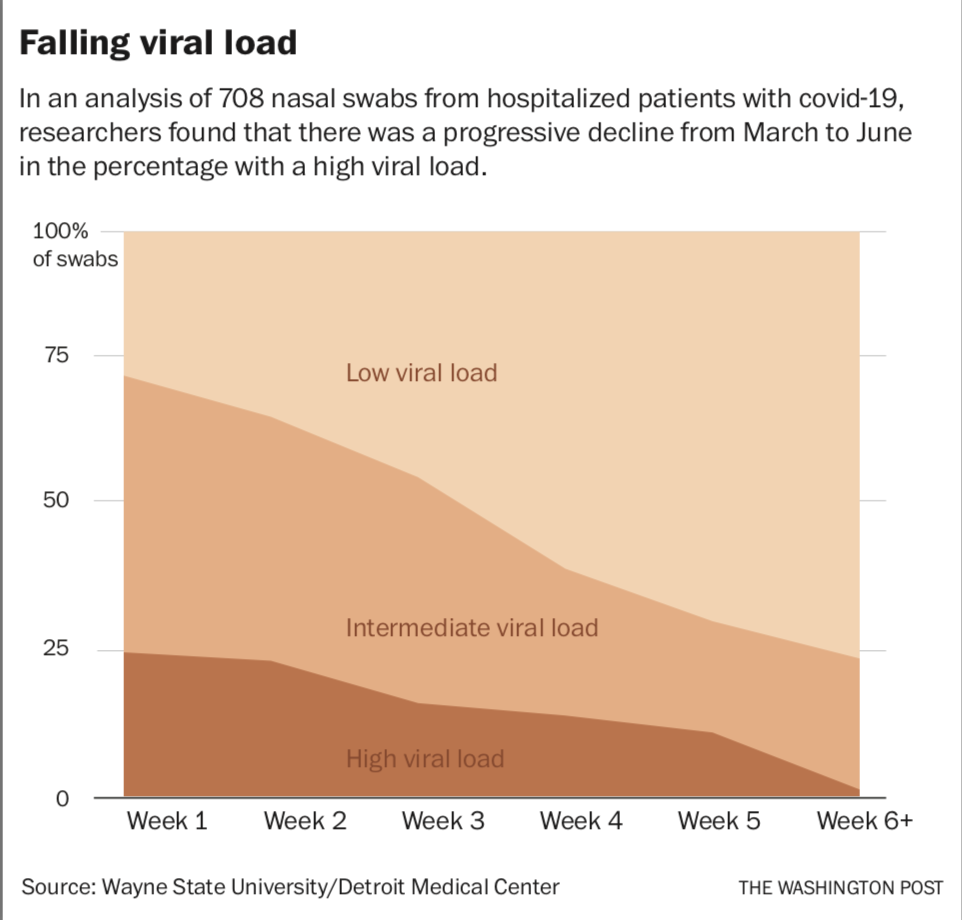
As El Zein and other doctors in Detroit probed why their patients appeared to be less ill, they were startled to find that one indicator in particular changed dramatically over time: viral load.

Among 708 patients treated by early summer, the average viral load – a measure of the particles of virus in the body as measured by nasal swabs – fell almost on a weekly basis. In most infectious diseases, including Ebola, HIV/AIDS and hepatitis, the higher the load, the worse the outcome.

El Zein saw glimmers of hope in the findings: Could it be that the steps being taken to mitigate the coronavirus’s effects were showing success?

Monica Gandhi, an infectious-diseases researcher at the University of California at San Francisco, shares that view. If the initial viral dose – known as the “inoculum” – is lower, she theorized, people’s bodies are able to fight back more effectively.

This “likely indicates an ability to control the viral infection better, and, therefore, have less severe disease,” Gandhi said.

– – – 

Of the many mysteries of the coronavirus, perhaps the most important to the average person is his or her risk of death. For smallpox, it’s about 10%, thanks to treatments. For Ebola, it’s about 50%. For rabies, it’s almost 100%, making it the most lethal infectious disease on the planet.

President Donald Trump has repeatedly talked about coronavirus mortality rates, even claiming on Fox News in July that the United States had the “number-one low-mortality rate.” Those claims are incorrect, according to the White House’s own data (fact-checkers pointed out that the chart he was looking at that day was upside down). But the confusion underscores how complex the subject is and how such rates can vary dramatically over time, country, region, age and other factors.

“What you are seeing is a misapplication of data and statistics that ends up being overtly false and sometimes very, very misleading,” explained Amesh Adalja, a senior scholar at the Johns Hopkins Center for Health Security.

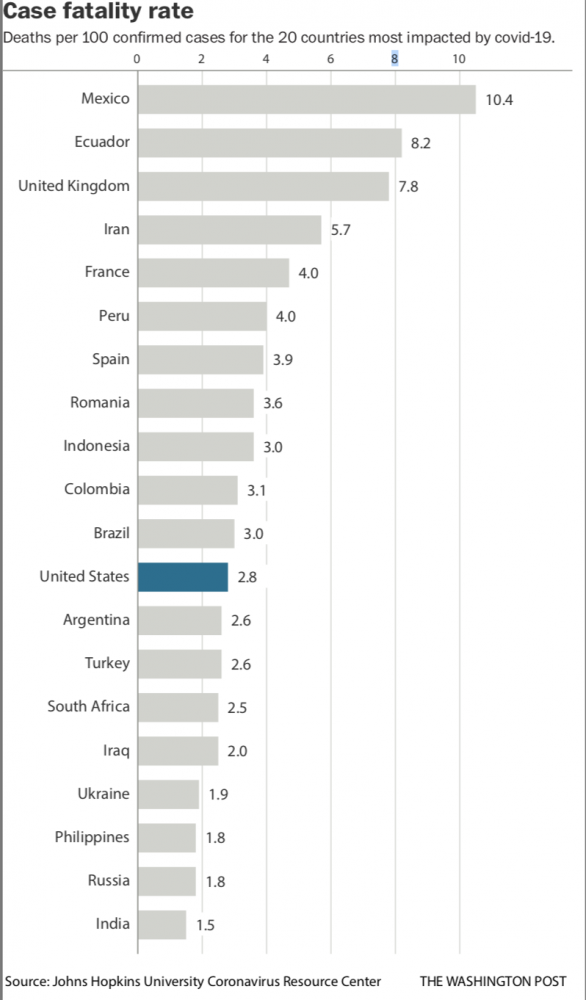
There are many different ways to measure deaths. The most-cited numbers – the ones often released by hospitals – are case fatality rates, or the percentage of deaths among confirmed cases. In contrast, the infection fatality rate is typically an estimate of deaths as a proportion of all those believed to be infected, including people who are asymptomatic or who have mild cases and may not have bothered to get tested, so they would not be counted as part of official tallies. So the former number often looks scarier than the latter.

According to a Johns Hopkins University analysis, which is updated daily, the case fatality rate in the United States was 2.8% as of Thursday. That compares with the CDC’s 0.65% estimated infection fatality rate – which includes confirmed cases plus an estimate of those who may not even know they have been exposed. The case fatality rate in the United States is much higher than in South Korea, Taiwan and Iceland, where it has been below 2%, but lower than in some other hard-hit countries, such as Iran and Brazil.

Some public health officials suggest part of the change in mortality rates is partly a mathematical trick: The more people we test, the larger the denominator of positive cases and the lower the mortality rate.

At the peak of Spain’s epidemic earlier this year, for example, Cantón said, he was doing 500 PCR tests a day, but now it’s more than five times that.

“It looks like we have more positive patients now,” said Cantón. “But this is because we are doing more diagnosis.”

Rinesh Parmar, an intensive care doctor who heads the United Kingdom’s Doctors’ Association, agreed: “The amount in the community was grossly underestimated. We were undertesting.”

Epidemiologists also look closely at deaths per 100,000 people in the population. Because that rate is less dependent on the wild variations in testing capacity, it can be a useful number to compare regions or nations.

To put these numbers into context, the infection fatality rate for the flu, Adalja said, is about 0.1%, making the coronavirus about six times more deadly.

“I think people don’t realize a small percentage of a big number is still a very big number,” he said. Sixty-five hundredths of the U.S. population of roughly 330 million, he pointed out, is 2.145 million – or 2.145 million potential deaths.

– – – 

The earliest reports of a less-deadly coronavirus came on May 31 and drew widespread skepticism. Alberto Zangrillo, head of the San Raffaele Hospital in Milan in the northern region of Lombardy, which had been the epicenter of Italy’s outbreak, and Matteo Bassetti, from a hospital in Genoa, conjectured that the virus was weakening.

Zangrillo provided the first evidence that viral loads might be linked, stating that in the previous 10 days, nasal swabs taken at his hospital in Milan detected “absolutely infinitesimal” amounts of the virus as compared with the previous two months.

The claims were quickly denounced by public health officials who said there was no evidence of any change in the virus’s lethality. But over time, to some scientists’ surprise, the data has borne out the falling mortality rates and decreased viral load.

An Aug. 13 letter published in JAMA by doctors at Houston Methodist, which operates eight hospitals, reported huge differences between what they called surge 1 and surge 2 patients. In surge 2, which took place from May 16 to July 7, a smaller proportion of patients required intensive care (20%), as compared with those seen earlier, from March 13 to May 15, during surge 1 (38%). They spent less time in the hospital (4.8 days versus 7.1 days).

Most importantly, the later patients were much less likely to die – 5.1% versus 12.1%.

A broad analysis of 53 countries and regions with the highest coronavirus death rates identified similar trends. Published in September in Transboundary and Emerging Diseases by a group of American and Chinese researchers, the report found that 80% of countries and regions estimated lower case fatality rates in the disease’s second wave. The paper cited numerous possibilities for what might be driving the shift, including that the most vulnerable had already been infected and died in the first wave. Other theories involved better preparedness, the younger ages of those infected and more favorable environmental conditions, including warmer weather.

“Current evidence remains limited to suggest which of the above hypotheses is more plausible,” the authors wrote. However, they said the classical epidemiological triangle model, which states that “the interactions of the host, pathogen and environment determine the characteristics of outbreaks, rather than one or two factors alone,” likely holds true for the coronavirus.

Viral loads have been one of the most mystifying aspects of the virus.

The now widely available nasal swabs, or PCR tests, give a simple binary yes or no answer about the presence of the virus. But scientists have recently made new discoveries about the importance of the quantity of virus people carry.

When it comes to infectivity, scientists generally believe a negative PCR test, which indicates what is basically a viral load of zero, means you can’t transmit it. This is why the CDC originally recommended two negative tests 72 hours apart before people came out of self-isolation. A high viral load, on the other hand, is believed to mean higher infectivity.

There’s less certainty about how viral load relates to the patient’s own clinical course. Previous studies on influenza tell us that higher viral loads in hospitalized patients are generally not associated with worse outcomes. In contrast, for patients with MERS or SARS – the other severe coronaviruses – higher viral load was an independent risk factor for mortality.

The new Italian viral load study seems to support that link for the novel coronavirus, too. It found that in 373 patients seen in the emergency room in the city of Negrar in northern Italy, viral load declined from March through May, corresponding with a sharp drop in intensive care admissions over those months, down to zero in May.

In a presentation to other scientists in Europe last month, Piubelli, a researcher at Sacro Cuore-Don Calabria Hospital, surmised that “lockdown measures had an impact not only in the absolute number of infected people but also on the severity of clinical manifestations.”

El Zein’s study found more direct evidence that high viral load appears correlated with increased mortality. But the findings are considered preliminary because the team is still analyzing possible confounding factors, such as differing treatments, to see if the relationship holds. In the first week of the study, about 25% of the viral loads were high, half were intermediate and 25% were low. By the fifth week, about 12% had high viral loads, and in the sixth week, no patients had high viral loads.

The death rate of patients in the high viral load group was 45%, compared with 32% of those in the intermediate group and 14% in the low group.

El Zein said the relationship was so striking that he went back to the lab to check, double-check and then triple-check equipment, and to try to figure out whether anything had changed with the procedures for collecting samples, but found no differences.

“It definitely wasn’t by chance or by mistake those numbers are going down,” he said.

One puzzling thing, he noted, is that some studies have shown that children with high viral loads appear to be completely asymptomatic, although those levels correlate with those of adults in intensive care. Separately, the new coronavirus mutation becoming dominant in the world has been associated with higher viral loads in at least one study. El Zein has been stumped about how to reconcile that with his analysis and others of lower viral loads among recent patients.

As cases, hospitalizations and deaths in the United States and Europe have ticked upward in recent weeks – albeit with a lower proportion of deaths than in the past – some health officials have expressed concern that they will be overwhelmed by a slower but more sustained second wave. If the virus spreads back to older people, as many fear is inevitable, death rates may rocket back upward.

Even in Germany, considered a model for coronavirus control and which stood out this spring as an anomaly with a low case fatality rate of less than 0.5%, Health Minister Jens Spahn warned the rate would likely rise. Already, there are 470 patients in intensive care, double the number of a month ago, he said.

“People think that the virus isn’t as serious because we got through the summer well,” he said. “But that’s a false conclusion. It was because we took preventive measures that we did well.”

Spahn blamed the increase on a lax attitude among the younger population that “want to party, to travel, and think of themselves as invulnerable.”

Across the rest of the world, alarmed governments are scrambling to bring back restrictions that haven’t been in place since spring: Paris has closed its bars, Madrid has ordered residents not to leave the city, and Moscow has told companies to make sure at least 30% of their employees are working remotely starting next week.

In New York on Tuesday, about 100 public schools were ordered closed in neighborhoods that have seen a resurgence of the virus.

“It’s a matter of time before we see a rise,” said Steven Van Gucht, the head of viral diseases at Sciensano, Belgium’s national public health institute. “The characteristics of the virus have not changed.”

Contacts of Trump event guests may never be traced #SootinClaimon.Com

#SootinClaimon.Com : ขอบคุณแหล่งข้อมูล : หนังสือพิมพ์ The Nation.

Contacts of Trump event guests may never be traced

Health & BeautyOct 09. 2020People listen as President Trump announces Judge Amy Coney Barrett as his nominee to the Supreme Court in the Rose Garden on Sept. 26. MUST CREDIT: Washington Post photo by Jabin BotsfordPeople listen as President Trump announces Judge Amy Coney Barrett as his nominee to the Supreme Court in the Rose Garden on Sept. 26. MUST CREDIT: Washington Post photo by Jabin Botsford 

By The Washington Post · Isaac Stanley-Becker, Rosalind S. Helderman, Josh Dawsey, Amy Gardner · NATIONAL, HEALTH, POLITICS, SCIENCE-ENVIRONMENT 
WASHINGTON – An evangelical pastor preached in Georgia. An attorney exercised at a gym in California. A political strategist went out on the stump in North Carolina. And a Cabinet secretary embarked on a three-state tour of manufacturing facilities.

Each had been in Washington days before, visiting the White House for a Sept. 26 ceremony introducing President Donald Trump’s Supreme Court nominee. The elegant affair, involving much of the country’s conservative elite, is now believed to have possibly contributed to a coronavirus outbreak sickening Trump and at least nine other members of his administration, in addition to top Republican officials and members of Congress and the military.

With no systematic effort to trace or advise the hundreds of guests at the Rose Garden ceremony and other events in the surrounding days, many made their way home and resumed their busy schedules, according to interviews with more than 40 people who attended events with the president between Sept. 25 and Oct. 1, when Trump announced he had tested positive.

Experts said the fallout, driven largely by individuals forced to make their own choices without clear instructions from a central authority, is emblematic of the nation’s response to the pandemic and helps explain why the virus remains uncontained nearly 10 months after it first arrived in the United States. The infection of Trump and those around him was, even more starkly, a window into an attitude of invulnerability and indifference that surrounds the president.

One of the people ensnared in the outbreak was Ronna McDaniel, the chairwoman of the Republican National Committee, who mingled with donors at a Sept. 25 event headlined by Trump at his hotel in Washington. She tested positive for the virus five days later but only made her diagnosis public on Oct. 2 after informing the president that morning. A person close to her said she attempted to reach the president sooner but was unable to talk to him.

For 36 hours after her diagnosis, the RNC made no attempt to inform donors who had attended the extended, indoor fundraiser with McDaniel. Only on Oct. 2, after the president had also tested positive, were attendees told they might have been exposed.

Guests of the president and his campaign returned to at least 20 states, often by plane. They visited college campuses and sat across the dinner table from elderly parents. They attended church and addressed crowds at indoor conventions, including on the topic of election security. 

Upon learning they may have been exposed, some chose to quarantine or get tested. Others were waiting instead to see if they developed symptoms – despite months of warnings from scientists that it is possible to be contagious without feeling ill. 

And in many cases, the attendees said they were not worried, expressing faith in the health precautions taken by their hosts despite the outbreak.

“Feeling tiptop,” said Frank Cannon, a conservative strategist, upon returning from a campaign swing through North Carolina in support of Republican Sen. Thom Tillis, who attended the celebration for Judge Amy Coney Barrett and later tested positive. Cannon also attended the Sept. 26 event but said he used a rapid test and received a negative result.

“I would go to such an event again,” said Yechezkel Moskowitz, 33, a venture capitalist from Long Island who attended a Sept. 30 fundraiser at Trump’s Bedminster, N.J., club. “I felt safe.” 

Trump attended the Bedminster fundraiser even though a close aide, Hope Hicks, had tested positive for the coronavirus earlier in the day. A timeline compiled by the RNC indicates the president was inside with donors for about 65 minutes, hours before he announced his positive test. He did not wear a mask. A list provided to state authorities showed he was around more than 200 people

The reaction to the outbreak was notably different in the communities where the events occurred, and in some of the places to which guests returned, where businesses temporarily shuttered or quarantined staff after contact with associates of the president. People have gone into quarantine from Minnesota to Massachusetts Avenue, bracing for possible secondary infections.

Holy Angels, a nonprofit run by the Sisters of Mercy in Belmont, N.C., which provides jobs and other opportunities for people with disabilities, closed three of its businesses on Oct. 2 for a day of deep cleaning following a surprise visit from Ivanka Trump, the president’s daughter and adviser, who reported a negative test that day. 

Sister Nancy Nance, vice president of community relations for Holy Angels, said the group took precautions not knowing immediately the status of Trump’s daughter or of others in her entourage. She said the businesses had just reopened after about six months in which they were closed to protect the medically fragile population served by Holy Angels. 

“I don’t think the White House as a whole has handled the covid-19 pandemic appropriately,” Nance said. “They’ve downplayed it, and now it’s pushing people like me into a political arena that I don’t want to be in.”

Some guests said they regretted participating in the events, despite extensive security procedures that made them feel safe at the time. Guests in the Rose Garden described multiple checkpoints where attendees were required to wear masks, though many later took them off once seated. 

“There was a false sense of security, being in the presence of people around the president who had been tested,” said one person who was pictured in the Rose Garden hugging Sen. Mike Lee, R-Utah, and shaking hands with Chris Christie, the former governor of New Jersey. Both have since tested positive. “I’ve thought about it, and talked to my wife, and that’s a good lesson learned,” said the attendee, who had received one negative test and was considering whether to take another, and who spoke on the condition of anonymity to discuss private health matters. 

None of those interviewed by The Washington Post said they had been contacted by the federal government with questions about possible symptoms of covid-19 and contacts over the past 12 days. None had been advised by federal authorities about protocol to keep others safe during a period in which an infection could still develop, previous negative tests notwithstanding.

Rebekah Holler Ashworth, whose brother, Lance Cpl. Luke Holler, was killed in 2006 by a roadside bomb in Iraq, said she and her relatives – a group of seven – traveled from Texas for a Sept. 27 White House event for Gold Star families. She said that she had not been contacted by the White House but that no one in her family had become ill.

“No one has gotten sick,” Ashworth said. “I felt like everything was handled so well, and we were very comfortable. It was a phenomenal event.”

The White House says it is tracing contacts only for the 48-hour period preceding the president’s positive test, in line with the Centers for Disease Control and Prevention’s definition of a “close contact.” If someone falls into that time frame, said White House spokesman Judd Deere, the “Medical Unit makes appropriate notifications and recommendations.

“Any positive case is taken very seriously, which is why the White House Medical Unit leads a robust contact-tracing program with CDC personnel and guidance to stop ongoing transmission,” he said.

That approach means administration officials may never learn how the coronavirus was introduced into the president’s bubble, disease investigators said. Nor will the federal government be able to identify and help contain the possible secondary infections spawned from a series of bustling events, both indoor and outdoor, attended by people now reporting infections – from the glitzy event for donors at the Trump International Hotel on Sept. 25 to the fundraiser at Trump’s golf course in Bedminster on Oct. 1.

“If there are indications that events look like seats of activity and spread, even if they occurred more than 48 hours before the onset of symptoms or a positive test, then it certainly pays to interview those people,” said Jeffrey Koplan, a former director of the Centers for Disease Control and Prevention. “But the process may reveal information that this White House doesn’t want, magnifying the incredible crisis induced by this organism.”

For the Rose Garden event – as for the Trump hotel fundraiser and the event in the East Room for families of deceased U.S. troops – anyone expected to come into contact with the president submitted to a rapid test, which can provide results in 15 minutes but is less reliable than the more common tests that take three to five days. For the Rose Garden event, that included pastors who prayed with Trump and those who joined him afterward for an indoor reception. Several who remained outside recalled submitting to no more than a temperature check.

Beyond these precautions, designed to protect Trump from the public but hardly guaranteeing the safety of those around him, social distancing was not uniformly observed, according to public photos and interviews with attendees. Few guests consistently wore masks. 

The high-ranking government officials, prominent media personalities, wealthy donors and well-connected lobbyists who attended the events preceding the president’s diagnosis have access to the best scientific information in the world, said Ross Goldberg, president of the Arizona Medical Association. They still flouted widely known best practices like mask-wearing and social distancing.

At least two of the people infected – Christie and Kellyanne Conway – attended debate prep, the Rose Garden ceremony and a VIP party inside the Diplomatic Reception Room. White House officials have not yet determined where they contracted the virus. Several aides who had been in close contact with Hicks said they only learned many hours later, and often through secondhand channels. 

Rich Roberts, a physician and retired pharmaceutical executive who attended the Bedminster fundraiser, said in an interview that he had assumed that the rapid coronavirus test administered by the Secret Service would have been highly accurate and used cutting-edge technology. Roberts said he was not worried about catching the virus from other attendees, believing that even if they had contracted the virus, their negative test result would likely mean that they were not contagious. 

If he knew what test the Secret Service administered, and that it had a significant false-negative rate, he would not have attended the event, Roberts said in an interview. He also said that calls to contract-trace the White House outbreak don’t make much sense to him, because of what he views as the near-impossibility of tracking the movements of so many people who entered the president’s orbit and then returned to their own lives.

“This is not like a linear handoff of a baton,” Roberts said, likening the quest to contain the White House cluster to a relay race. “This is lots of batons flying in many directions for everyone.”

Goldberg, the Arizona doctor, said the batons have been dropped.

“You couldn’t design a better example of how this thing spreads when people let their guard down, or deny the reality of the virus,” he said.

Because there was no immediate effort to interview guests at White House and campaign events about possible symptoms or to trace their contacts, responsibility fell to local health departments, which took different approaches. Otherwise, most attendees assessed their risk on their own.

One Washington lobbyist who attended the Rose Garden event said he sought out a rapid test last week because “I came back from that event and my wife was like, ‘I saw the photos, and there was not a lot of social distancing.’ “

Health officials in Mecklenburg County, N.C., said they were conducting a case investigation and contact tracing related to Tillis, “as we do with all positive results on county residents.” In Pennsylvania, health authorities encouraged attendees of the president’s Sept. 26 rally at the Harrisburg International Airport to download the state’s covid-19 app.

But a local case investigation was yet to begin for Greg Laurie, the pastor at a megachurch in Riverside, Calif., who tested positive after returning from the Rose Garden event and a prayer march the same day on the National Mall, said a spokesman for the county health department. 

“At this point that church has not communicated with us,” said the spokesman, Jose Arballo.

A spokesman for Laurie said he “thought the labs/testing centers are the ones who report the cases.” In a video posted on Facebook, the pastor said, “I just wish that at a time like this, we could not politicize something like this and show compassion to people that are struggling with this.”

Jentezen Franklin, senior pastor of Free Chapel in Gainesville, Ga., posted a video on social media a week after he had attended the Rose Garden ceremony expressing excitement for church. “Get your family there,” he said. “We’re going to social distance. We’re going to wear masks.”

Beyond the individual decision to get tested, there was no central mechanism for tracking and preventing possible spread from the events in Washington.

At the fundraiser at Trump’s hotel, donors paid up to $100,000 a head to participate in a roundtable event, including taking a photo with the president. McDaniel, the RNC chairwoman, attended the roundtable and a dinner with donors after. 

Guests were instructed to wear masks while awaiting the results of rapid tests, several who attended said. Each was then given a piece of paper reporting their results.

That sheet specifically alerted attendees that the tests are not fail-safe and sometimes produce false negatives, one donor said. Nevertheless, after testing negative, attendees were permitted to remove their masks. Neither McDaniel nor the president wore a mask, attendees said.

Attendees said efforts were taken to keep them more than six feet away from the president. Guests were photographed standing a distance from the president and were told that the images would be altered to make it appear as though the president was standing next to each donor. Updated CDC guidance suggests the virus can spread beyond six feet indoors.

No such precautions were taken for McDaniel, who mingled freely with others. Among those in attendance was Labor Secretary Eugene Scalia.

The next day, Scalia and the president attended the Rose Garden ceremony, while McDaniel returned to her home in Michigan, said a person close to McDaniel, who spoke on the condition of anonymity to share private information.

By Monday, McDaniel had begun experiencing a sore throat and fatigue, the person said. The person said McDaniel believed she may have contracted the virus upon her return home from a family member who had tested positive earlier in the week but whom she had not seen for 17 days before her return. During her absence she had also been traveling extensively and meeting with donors and supporters, at times without a mask.

The person said McDaniel called the White House on Sept. 28 to inform the president that she was not feeling well and had decided to skip his debate the following day. It was not clear whether the White House took any steps in response to the news that the party chairwoman was experiencing symptoms.

That same day, McDaniel sought a test for the coronavirus, the person said. The results did not come back until Sept. 30 – after the president had spent significant time interacting with aides and family and attending the debate in Cleveland. The test was positive.

At that point, McDaniel attempted to reach the president to inform him of her results but was unable to get through. Again on Thursday, she tried and failed to inform the president. She eventually reached Sean Conley, the White House doctor. Other White House aides have said they were not aware of her diagnosis.

Mike Reed, an RNC spokesman, said McDaniel tested negative the day of the fundraiser, as well as the day before.

“She went home early the next morning and began to feel symptoms the following week after being exposed to a member of her immediate family who tested covid-19 positive,” Reed said. “This was the chair’s first contact with this family member since the individual tested positive, so there was no reason to believe she had the virus the week prior.”

He said more than 40 staff members who interacted with McDaniel before she returned to Michigan are all feeling well and have tested negative for that coronavirus and that RNC officials have been in contact with donors who attended the fundraiser and that none have reported symptoms or positive tests.

Following the weekend events, Scalia resumed his busy schedule as a Cabinet secretary. That Monday, he began a tour of manufacturing facilities, wending his way through Ohio, Pennsylvania and New York for roundtable events with workers. That Wednesday, he joined Karen Pence, the wife of Vice President Mike Pence, at a naval air station in Jacksonville, Fla., to announce a new program to assist military spouses. Photographs of the events posted on Twitter show Scalia and others wearing masks.

A spokesman for the Labor Department said Scalia is “frequently tested,” adding that all of his tests have come back negative. He did not provide a date of Scalia’s most recent test. One of his brothers, the Rev. Paul Scalia of the St. James Catholic Church in suburban Virginia, apologized to his parish for attending the ceremony without a mask.

Health officials in Minnesota, where the president attended a fundraiser Tuesday, the day before his diagnosis, said they had not been in contact with the White House, the president’s campaign or the RNC and did not have a list of those who had attended events in the state.

Meanwhile, 13 staffers at Murray’s, a historic downtown Minneapolis steakhouse, had been quarantined after catering a $7 million fundraiser that Trump attended in Shorewood, Minn., on the evening of Sept. 30. In a statement, Chuck Sanger, a restaurant spokesman, said the staff did not come into contact with Trump. But upon learning of the president’s diagnosis, the restaurant had immediately enacted a 14-day quarantine and asked the staffers to get tested.

Covid vaccine by year-end is ‘unlikely,’ EU agency’s chief says #SootinClaimon.Com

#SootinClaimon.Com : ขอบคุณแหล่งข้อมูล : หนังสือพิมพ์ The Nation.

Covid vaccine by year-end is ‘unlikely,’ EU agency’s chief says

Health & BeautyOct 08. 2020

By Syndication Washington Post, Bloomberg · Suzi Ring · WORLD, HEALTH, EUROPE, HEALTH-NEWS 
A covid-19 vaccine is looking “unlikely” by year-end, according to the head of the European medicines regulator, even as the agency conducts accelerated reviews of two front-runners for a successful shot.

“Technically, of course it’s possible. Practically it’s very difficult — it’s very unlikely,” said Guido Rasi, executive director of the European Medicines Agency, in an interview Thursday. Even if drugmakers “submit the data in a few weeks, we are already approaching middle of October, so if we wait a few weeks and we take a minimum time of evaluation, more or less we are at the end of the year.”

Pressure is mounting globally for a vaccine as infection rates soar and countries revisit lockdown measures. In recent weeks, the EMA started two so-called rolling reviews — real-time evaluations of data to speed up potential approvals — of jabs from AstraZeneca and the University of Oxford, and from Pfizer and BioNTech. In the U.S., getting a shot through by the November election, President Donald Trump’s desired deadline, also looks increasingly unlikely.

The first vaccines will probably be given conditional marketing authorizations, according to Rasi. These are temporary, one-year approvals granted when the benefit of having a product immediately available outweighs the risk of less substantial data. Regulators would need to know the duration of immunization for a vaccine before granting a full marketing clearance, he said.

It’s still possible that countries in the European Union could use national emergency powers to distribute a vaccine before the EMA approves one. The U.K. set out plans in August to amend legislation and clarify its powers so that an unlicensed covid-19 shot could be temporarily authorized in Britain. But this could create confusion around safety, and countries would do better focusing on their vaccine distribution plans than trying to have a shot “a few days before,” according to Rasi.

“I really discourage” the thought of EU countries going it alone, he said. If a country tries to go ahead of the EMA, it might be “perceived as though this rush is not giving us all the reassurance about the safety and efficacy, so might just fuel vaccine hesitancy.”

Asked about the U.S. regulator’s decision to continue to pause Astra’s final-stage trial in America, Rasi said he thought the Food and Drug Administration was very close to releasing its opinion and didn’t see the situation as a major issue. Astra told analysts this week that it expects an update in the next one to two weeks on the trial, which was halted after a U.K. participant fell seriously ill. Tests have already resumed in the U.K., Brazil and South Africa.

Rasi will step down as head of the EMA on Nov. 15, with Emer Cooke, a former colleague at the agency, set to replace him. She has been working as head of medicines regulation at the World Health Organization.

Europe battles to contain virus as cases spike across the region #SootinClaimon.Com

#SootinClaimon.Com : ขอบคุณแหล่งข้อมูล : หนังสือพิมพ์ The Nation.

Europe battles to contain virus as cases spike across the region

Health & BeautyOct 08. 2020Pedestrians walk past a closed restaurant at night in Madrid, Spain, on Oct. 7, 2020. MUST CREDIT: Bloomberg photo by Paul Hanna.Pedestrians walk past a closed restaurant at night in Madrid, Spain, on Oct. 7, 2020. MUST CREDIT: Bloomberg photo by Paul Hanna. 

By Syndication Washington Post, Bloomberg · Rudy Ruitenberg, Geraldine Amiel, Lenka Ponikelska, Naomi Kresge · BUSINESS, WORLD, US-GLOBAL-MARKETS, EUROPE

European countries stretching from Spain to Ukraine posted record increases in coronavirus cases, underscoring growing alarm in the region as it struggles to control the pandemic.

Local authorities are being pushed to take the lead in limiting late-night activity in cities and towns, as national politicians fear that more wide-ranging measures could result in another collapse in economic activity. Several cities, including Paris and Berlin, have imposed more severe restrictions to try to rein in the social activity blamed for helping spread the disease.

In France, President Emmanuel Macron’s government ordered bars in Paris to close for a two-week period and said more curbs will be announced later on Thursday. The Czech Republic is also considering additional steps.

“There must be more restrictions such as the ones put in place” in the region of Marseille, where bars and restaurants were shut, Macron said in a TF1 interview.

Daily infections in France increased by 18,746, health authorities said on Wednesday, bringing the seven-day rolling average to the highest level yet. Spain reported a record 5,075 new cases, while infections in Germany in the past 24 hours exceeded 4,000 for the first time since early April.

France’s health minister will announce measures on Thursday that will focus on places where the virus is circulating faster among elderly people and where hospitals are the fullest, Macron said. The number of covid-19 patients in intensive care in Paris hospitals has tripled since the start of September, similar to the situation in the Marseille region.

Like Paris, Berlin is fighting against a surge in infections and will close bars at 11 p.m., starting on Saturday.

The German capital has the worst outbreak among the country’s 16 states, with 40.5 cases per 100,000 people over the last seven days, according to the public health authority. The city’s residents would be restricted from domestic travel if the figure rises above 50. Some districts already exceed the threshold and one local newspaper, citing its own calculations, reported Thursday that the city as a whole had edged above it.

Coronavirus infections across the whole of Germany climbed by 4,010 in the 24 hours through Thursday morning, the highest since April 10, according to data from Johns Hopkins University. That brought the total to 311,137.

The numbers are “very worrying,” Health Minister Jens Spahn said at a briefing. While ruling out the idea of a second national lockdown, Spahn called for targeted local restrictions and appealed to individuals to avoid situations where the virus is likely to spread, such as indoor gatherings and poorly ventilated areas.

The pandemic is “a character test for us as a society,” Spahn said. “I want us to pass this test, and we can do it, but we can only do it together.”

Across the border from Europe’s largest economy, the Czech Republic on Thursday posted a record 5,335 new cases for the previous day. The country’s 14-day cumulative number of cases per capita is now the highest in the EU, surpassing Spain.

The government will announce “more significant” measures to stem the outbreak at the end of the week, Health Minister Roman Prymula said Wednesday, reaffirming a pledge not to impose another full-scale nationwide lockdown.

Austria also recorded a record number of daily infections on Thursday, with Vienna accounting for more than half of the 1,209 new cases. Ukraine recorded an additional 5,397 infections, which is also the highest one-day total.

In Poland, covid-related deaths jumped by a record 76 to 2,867 in the past 24 hours. The government is expected to announce measures to stem infections in Warsaw at a press conference later on Thursday.

The virus’s resurgence in Italy — where numbers have been more contained than in some neighboring countries — twice prevented parliamentary votes earlier this week on new measures to combat the pandemic, as a number of lawmakers were in quarantine.

A cabinet meeting chaired by Prime Minister Giuseppe Conte extended emergency powers to counter the pandemic to Jan. 31. The government again made wearing face masks outdoors compulsory nationwide.

Senior Marine tests positive for coronavirus, second high-ranking uniformed official this week #SootinClaimon.Com

#SootinClaimon.Com : ขอบคุณแหล่งข้อมูล : หนังสือพิมพ์ The Nation.

Senior Marine tests positive for coronavirus, second high-ranking uniformed official this week

Health & BeautyOct 08. 2020

Gen. Gary Thomas, the assistant commandant of the Marine Corps

Gen. Gary Thomas, the assistant commandant of the Marine Corps

By The Washington Post · Missy Ryan · NATIONAL, HEALTH, NATIONAL-SECURITY, HEALTH-NEWS 
WASHINGTON – A senior military official who was quarantining after interaction with another uniformed leader who contracted covid-19 has tested positive for the coronavirus, the Marine Corps said on Wednesday. Gen. Gary Thomas, the assistant commandant of the Marine Corps, received the positive test a day after he began quarantining, the service said in a statement.

“In accordance with established Marine Corps COVID policies, General Thomas will continue to quarantine at home. He is experiencing mild symptoms, but otherwise is feeling well,” the statement said. 

Covid-19 is the illness caused by the novel coronavirus.

Thomas is the second senior uniformed official whose diagnosis was announced this week, following news that Adm. Charles Ray, the vice commandant of the Coast Guard, tested positive on Monday. Ray and Thomas were among the senior officials who attended a meeting at the Pentagon on Friday. Another was Gen. Mark Milley, chairman of the Joint Chiefs of Staff.

Defense Secretary Mark Esper was traveling last week and did not attend the meeting.

Now, those that attended are isolating at home where, officials say, they remain able to work. Officials on Wednesday said the group, which included the top officials from the Army, Air Force and Navy, took a second coronavirus test Wednesday. If they receive three negative results, they are expected to return to their offices as early as next week. 

Jonathan Hoffman, a spokesman for Esper, said in a statement that the Defense Department would follow guidelines established by the Centers for Disease Control and Prevention for isolation and contact tracing.

“At this time we have no additional senior leader positive test results to report,” he said.

It’s not clear whether the outbreak among senior uniformed officials is related to an event the White House held on Sept. 27 for the families of fallen servicemembers, which was attended by President Donald Trump, Milley, Ray and other senior uniformed officials.

White House clears Food and Drug Administration coronavirus vaccine standards it tried to derail #ศาสตร์เกษตรดินปุ๋ย

#SootinClaimon.Com : ขอบคุณแหล่งข้อมูล : หนังสือพิมพ์แนวหน้า

White House clears Food and Drug Administratration coronavirus vaccine standards it tried to derail

Health & BeautyOct 07. 2020

By The Washington Post · Laurie McGinley, Yasmeen Abutaleb, Carolyn Y. Johnson · NATIONAL, HEALTH, POLITICS, SCIENCE-ENVIRONMENT, HEALTH-NEWS 
WASHINGTON – The White House on Tuesday, after weeks of delay, approved tough new standards for coronavirus vaccines – but only after the Food and Drug Administration unilaterally published the guidelines on its website as part of briefing materials for outside vaccine advisers.

The standards, which would be applied to an emergency use authorization for a vaccine, are the same as ones the agency proposed weeks ago. In many ways, they are similar to the standards for a traditional approval. But the White House, worried that the criteria would delay authorization of a vaccine, presumably beyond the Nov. 3 election, decided to sit on the guidance.

One of the pharmaceutical companies at the forefront of efforts to develop a vaccine, Pfizer, on Tuesday declared its support for the agency in its struggle with the White House. Albert Bourla, the company’s chief executive, said on Twitter, “Pfizer has never discussed [FDA’s] vaccine guidelines with the White House and will never do so as it could undermine the agency’s independence.” He said the agency’s independence “is today more important than ever as public trust in [covid-19] vaccine development has been eroded by the politicization of the process.”

The delayed clearance by the White House occurred days after President Donald Trump accused the FDA of being “political” in fashioning the guidance and after The Washington Post reported that White House Chief of Staff Mark Meadows was demanding detailed justification from the agency about the criteria. Meadows’s action raised fears the White House would thwart or block standards designed to boost public trust in a vaccine, according to individuals familiar with the situation who spoke on the condition of anonymity to discuss internal deliberations.

The FDA, as requested, provided the White House with additional data, but nothing happened, according to a senior administration official who spoke on the condition of anonymity because they did not have permission to talk publicly about the issue. On Tuesday, tired of the delay, the FDA circumvented the White House by publishing the criteria online as part of a briefing package for a meeting with its vaccine advisory committee that is scheduled for Oct. 22.

Shortly after the standards were published, the White House approved the vaccine guidance, according to the official.

The guidance is far more rigorous than what was used for emergency clearance of hydroxychloroquine, an anti-malaria drug used in the early days of the coronavirus pandemic, or convalescent plasma, which is taken from people who have recovered from covid-19 and whose antibodies might offer a measure of protection to other patients. It is an effort to shore up confidence in the vaccine development process and the FDA, which has made missteps during the pandemic.

The guidelines recommend that participants in late-stage vaccine clinical trials be followed for a median of at least two months, starting after they receive a second vaccine shot – which experts said could make it difficult, though not impossible, for a vaccine to be authorized before the election.

On Tuesday night, Trump issued a tweet proclaiming, “New FDA Rules make it more difficult for them to speed up vaccines for approval before Election Day. Just another political hit job!” The president tagged FDA Commissioner Stephen Hahn at the end of the tweet.

The Post reported Sept. 22 that the FDA was poised to issue a tough new standard for an emergency authorization of a coronavirus vaccine. As a sign the vaccine works, the agency said it would want to see at least five severe cases of covid-19, the disease caused by the novel coronavirus, in the placebo group for each trial, and some cases of the disease in older people. Assuming there weren’t cases – or not as many – in the group receiving the vaccine, that would be a signal that a shot is working.

At a news conference Sept. 23, President Trump said the FDA plan sounded like “a political move” and warned the White House might reject it.

Even as the White House rattled sabers, the head of the FDA section that oversees vaccines repeatedly said in public he would stick to the criteria and that he had told vaccine companies weeks ago what he was looking for to grant an emergency-use authorization.

“The companies know what we’re expecting,” Peter Marks, director of the FDA’s Center for Biologics Evaluation and Research, said last week at an event sponsored by the advocacy group Friends of Cancer Research. He said the publication of the guidance was in large part designed to reassure the public that the FDA would use stringent standards in authorizing a vaccine.

Scott Gottlieb, a former FDA commissioner, said at a symposium on scientific integrity and vaccines Tuesday, “There are few moments I can think of where so much political dust was created by political officials for so little actual practical effect – and perhaps negative effect.”

He added, “The bottom line is FDA is going to stick to the objective criteria that they outlined in the guidance, the [advisory committee] is going to support those principles and the sponsors are going to adhere to them.”

Marks said at the conference that the criteria spelled out in the guidance is an attempt to build trust and confidence in vaccines that receive regulatory approval.

“We’ll continue to be as transparent as we can about what we do, because ultimately we do need to make sure that regardless of where someone comes on the spectrum of their beliefs that they can at least trust in this and feel confident that what comes through our process is something, because we at FDA are comfortable giving that to our families, they will feel comfortable giving it to their families,” Marks said.

He added that the two-month time frame was chosen because data shows that the majority of side effects occur within two to three months of vaccination. For example, he said that side effects such as Guillain-Barre, when the immune system attacks the nerves, could occur about six weeks after vaccination, but an inflammation of the spinal cord would typically happen within three months.

White House signals stronger coronavirus precautions, but Trump continues to resist #ศาสตร์เกษตรดินปุ๋ย

#SootinClaimon.Com : ขอบคุณแหล่งข้อมูล : หนังสือพิมพ์ The Nation.

White House signals stronger coronavirus precautions, but Trump continues to resist

Health & BeautyOct 07. 2020A member of the White House cleaning staff sanitizes in the press area on Monday. MUST CREDIT: Washington Post photo by Jabin BotsfordA member of the White House cleaning staff sanitizes in the press area on Monday. MUST CREDIT: Washington Post photo by Jabin Botsford 

By The Washington Post · Ashley Parker, Josh Dawsey · NATIONAL, HEALTH, POLITICS, HEALTH-NEWS 
WASHINGTON – The White House offered an informal nod to coronavirus best practices Tuesday, with mask-wearing prevalent after months of flouting public health recommendations and new internal guidelines for interacting with President Donald Trump, who tested positive for the virus late last week. 

But the biggest source of resistance appeared to be Trump himself, who, despite having just come home from a three-night hospitalization, was defiant – lobbying to return immediately to work in the Oval Office, discussing an address to the nation as early as Tuesday evening and clamoring to get back on the campaign trail in the coming days. 

At least nine White House employees have now tested positive for the virus, including senior adviser Stephen Miller, who got his positive result late Tuesday, a senior administration official said. Trump’s aides, allies and advisers find themselves grappling with how to implement more safety measures and precautions without displeasing their boss, who continues to say – as he did in a tweet Monday – “Don’t be afraid of Covid. Don’t let it dominate your life.” 

In a video he recorded maskless from the White House south balcony Monday night, the president also falsely claimed that perhaps he was “immune” to the virus, said he felt “better than 20 years ago” and urged the public to “get out there.” 

The result is a bifurcated culture in Trump’s White House and broader orbit, with informal and halting steps toward more rigorous health measures often undermined or upended by the president. 

His team, for instance, tried to puzzle out if there was a way for him to safely return to the Oval Office on Tuesday but ultimately nixed the request, said two people familiar with the discussions, who like others spoke on the condition of anonymity to reveal internal deliberations.

“The White House really isn’t doing anything you’re supposed to be doing in these situations,” said Angela Rasmussen, a virologist on the faculty of Columbia’s Mailman School of Public Health. 

Rasmussen added that while she agreed with Trump’s call not succumb to fear, “we also shouldn’t not take the virus seriously just because President Trump says he feels better and is flying around on Marine One and standing on the balcony like Evita.”

On Monday, the White House Management Office sent out an email to senior staff who routinely interact with Trump, aimed at protecting both the president and his advisers. The memo, obtained by The Washington Post, urges staffers to “limit all foot traffic on the first floor of the West Wing as well as in the Residence” and says that “staff should only go to the Oval Office or the second floor Residence when they are requested and expected.”

For staffers who do visit the Oval Office or the second floor of the residence, where Trump lives and holds meetings, and who expect to be within six feet of the president, the memo also requires that they wash their hands or use hand sanitizer before entering; remove any outer garments; and don personal protective equipment provided in an “Isolation Cart” – including a yellow gown, surgical mask, protective eyewear and gloves. 

The White House has not changed its mask guidance and is still following Centers for Disease Control and Prevention guidelines that recommend, but do not require, wearing a mask. Several administration officials said that nearly everyone in the White House has been wearing a mask in recent days, including Trump’s son-in-law and senior adviser Jared Kushner, who usually does not sport one. 

Rapid coronavirus testing is still required for anyone in proximity to Trump, and the White House is also offering testing to members of the White House press corps who worry that they may have been exposed to the virus in the past week, an administration official said. 

There has been minimal staffing in the White House since Trump’s positive diagnosis, officials said.

“We feel comfortable working here, those of us who are still here,” Alyssa Farah, the White House communications director, said in an interview with Fox News on Tuesday.

Privately, however, career administration officials and mid-level and junior staffers say they are scared – nervous about coming into work and wary of being the next to test positive. 

Trump, meanwhile, has been pushing to give a national address of some sort, said two people familiar with his discussions. There were active negotiations Tuesday about the president speaking to the nation that night, although no plan ultimately emerged, one of those people added. 

The White House Operations team, the White House Medical Unit and the chief of staff’s office have sought to present Trump with a menu of things he can safely do until he’s declared coronavirus-free, a senior administration official said.

Trump will probably continue to push out videos on social media and, at his request, increase his public visibility by a bit more each day – including offering updates on non-coronavirus topics as early as the end of this week, the official added. 

Tuesday night, Trump was expected to hold a call with campaign volunteers in Georgia to urge them to continue working on his behalf, said someone familiar with his schedule. 

The president wrote in a tweet Tuesday morning that he was looking forward to attending the second presidential debate – in Miami on Oct. 15 – and he has expressed eagerness to return to the campaign trail, according to several people familiar with his thinking.

Advisers are already planning campaign events with large crowds, including bus tours, airport hangar rallies, speeches at local centers and more, campaign officials said. The president’s message in the final stretch, one Republican official involved in the campaign added, is likely to be: “You can beat this. It shouldn’t stop your life.”

Asked specifically what precautions Trump plans to take before appearing again on a debate stage with Democratic nominee Joe Biden – including whether he will do so only after testing negative – Trump campaign spokesman Tim Murtaugh responded in an email, “The president intends to debate in person.”

And asked about Trump’s campaign plans, including if heading back out in public will be contingent on a negative test, Murtaugh referred to the president’s own words, writing, “The president is eager to get back to the campaign trail.”

In private moments, Trump sometimes seems aware of the political problems posed by his handling of the coronavirus – both the pandemic roiling the nation and his personal cases. He recently told an adviser not to reveal their coronavirus diagnosis, as the Wall Street Journal first reported, but the adviser disclosed it anyway. 

The president has also pressed his political advisers on how his hospitalization is playing politically. “How’s it working out?” he asked, according to one person familiar with his calls.

Public polling in recent days has painted a long uphill climb for reelection, including a CNN/SSRS poll released Tuesday showing Trump falling to 16 points behind Biden, who leads 57 to 41%. 

A GOP group working to elect Senate Republicans conducted polling over the weekend in four states – Colorado, Georgia, Montana and North Carolina – as Trump was hospitalized. The president’s numbers dropped “significantly” in every state, falling by about five points in all four. 

“The president is in real trouble,” said one of the group’s operatives, who is also close to the White House. 

Many of Trump’s allies and advisers see his response to his own illness as a missed opportunity. Some had hoped that he would emerge from his hospital stay slightly humbled, with a newfound display of seriousness and empathy, and would receive a boost of public sympathy. 

But so far, that has not happened. Internal Republican polling has consistently shown that the coronavirus – and not taking it seriously enough – remains the president’s electoral albatross. They believe it has caused the president to lose support among senior citizens and suburban women, both key voting blocs. 

Several former administration officials said they were appalled at the president’s conduct over the past few days, as well as the behavior of the people around him. One such official described Trump’s decision to leave the hospital Sunday for a ride in his presidential limo, which required two Secret Service agents to be in the car with him, as “so monstrously wrong.”

“In my lifetime, it was the most appalling thing I’ve seen a president do for a political stunt,” the former official said, speaking on the condition of anonymity to share a candid opinion. “It’s genuinely unhinged.” 

The approach in Trump’s orbit stands in marked contrast to that in other parts of the White House. Vice President Mike Pence’s chief of staff, Marc Short, has told his team to stay home until “further notice.” And the East Wing, where Melania Trump works, has long taken more stringent precautions than White House officials have required.

Early in the pandemic, the first lady’s staff all began working from home whenever possible, coming into the office only for events and travel – and even then with just a skeletal team, an administration official said. Everyone in the East Wing wore masks, and sometimes when doing events with her husband, Melania requested that no one personally staff her, to limit the number of aides at any given event, this official added.

After last week’s outbreak, in which the first lady also tested positive, her chief of staff, Stephanie Grisham, again instructed all East Wing staffers to stay at home.

Some entire corridors of the West Wing were empty Tuesday. A number of advisers who said they’d worked in the White House in recent days did not return with Trump back in the building. 

White House spokesman Judd Deere, in an emailed statement, said Trump will continue to receive “around-the-clock medical care,” provided by the White House Medical Unit, which functions “out of a state-of-the-art clinic.”

“The American people can rest assured with the president’s return that the White House is taking every precaution necessary to protect not only him and the first family, but every staff member working on the complex to support the federal government’s operations consistent with CDC guidelines and best practices,” Deere said. “Physical access to the president will be significantly limited and appropriate PPE will be worn when near him.” 

But some have their doubts about whether the president and his team are really taking adequate precautions – and modeling good behavior for the nation. Referring to Trump’s maskless appearance on the White House balcony Monday, Rasmussen said the president may not have conveyed the vigor and stamina he intended. 

“I supposed the message he was trying to send was that he’s super strong and defeated covid, but it was obvious even to me that he was gasping for breath, and that doesn’t suggest he has, in fact, defeated covid,” Rasmussen said. “It’s really premature to be declaring victory, and it’s also a really bad message to send.” 

President’s talk of attending debate alarms health experts, who see danger #ศาสตร์เกษตรดินปุ๋ย

#SootinClaimon.Com : ขอบคุณแหล่งข้อมูล : หนังสือพิมพ์ The Nation.

President’s talk of attending debate alarms health experts, who see danger

Health & BeautyOct 07. 2020

 President Donald Trump

President Donald Trump

By The Washington Post · Amy Goldstein, Frances Stead Sellers · NATIONAL, HEALTH, POLITICS, SCIENCE-ENVIRONMENT, HEALTH-NEWS 
WASHINGTON – President Donald Trump’s tweet Tuesday that he looks forward to next week’s presidential debate alarmed some medical and public health experts, who warned that his coronavirus infection might still be contagious then and could endanger others.

A day after the president was discharged from a three-night hospital stay, during which he was put on an aggressive mix of treatments usually reserved for the most severe cases of covid-19, the disease caused by the novel coronavirus, he continued to project an image of being fully in charge and able to conduct all his regular activities.

Some outside health experts, however, said Trump’s determination to attend the Oct. 15 debate is part of a pattern of recklessness that has defined his response to the pandemic, with the president and his aides not wearing masks or observing social distancing. At least 19 people on his staff or his campaign, or who attended recent White House events, have tested positive for the virus in the past week.

On Tuesday, White House physician Sean Conley continued to give upbeat reports on Trump’s recovery, issuing a three-sentence memo saying the president “reports no symptoms” and has stable vital signs. “Overall, he continues to do extremely well,” the memo said.

Neither Conley nor other White House officials have said how they will determine when it might be safe for Trump to go out in public – for his own health, or for others near him. 

Several outside medical experts suggested that the president’s actions indicate he is unchastened by his own experience contracting a virus that has killed more than 210,000 Americans – or by the spreading infections among his own staff and supporters.

Trump’s removal of his mask moments after returning to the White House on Monday evening, and his subsequent assertion that he would appear at the debate “is irresponsible and reckless, and frankly that borders on malicious,” said Michael Mina, a physician and assistant professor of epidemiology at Harvard’s T.H. Chan School of Public Health.

“We should be throwing the kitchen sink at him, not just for treatment, but for ensuring that he is safe to be out in society and he is not imposing a risk to citizens of this country,” Mina said. 

Mina noted that the president’s medical team has many ways to determine the status of his infection. Beyond administering the “PCR” test, considered the most definitive way of assessing whether someone has the virus, he said doctors could ask him to cough onto a petri dish to see whether the virus grows, swab his nose to culture the specimen, or administer antigen tests to see whether he has the virus’s protein in his nose.

“The average American doesn’t have tools to go through this,” Mina said, “but the president is a very special person. We have tools to do this.”

Guidelines from the federal Centers for Disease Control and Prevention recommend that covid-19 patients self-isolate for 10 days after their symptoms begin. The CDC also said they should not go out unless they have been fever-free for at least 24 hours, and their other symptoms should be improving. 

Covid-19 patients who were seriously ill may need to stay isolated for as long as 20 days after their first symptoms, the guidelines say.

The CDC does not define a serious case, and Trump’s doctors have withheld certain information that would provide a clearer picture of his medical condition – for instance how low his blood-oxygen levels dropped on two occasions or whether CT scans showed signs of pneumonia or lung damage. 

If Trump developed symptoms late last week, the 10-day window would end before the debate.

Outside doctors debated whether the 10-day period for mild and moderate cases should apply to the president and whether it would be premature for him to go out in public next week.

Thomas File Jr., an Akron, Ohio, infectious-disease specialist and president of the Infectious Diseases Society of America, said that Summa Health, the company for which he works, generally follows the CDC guidelines. In all but the most serious cases, he said, “we would allow someone to go into the general public within 10 days of their symptoms appearing.”

Georges Benjamin, executive director of the American Public Health Association, said most patients are no longer infectious after 10 to 14 days. But given the known timing of when Trump began feeling ill, “he’ll be really close. All you have to do is be wrong within a day or two, and he could easily still be infected . . . it’s going to be tight.”

Rajesh Gandhi, an infectious-diseases physician at Massachusetts General Hospital and Harvard Medical School, said the CDC guidelines make sense but emphasized that covid-19 cases vary widely. About 80 percent of people have no symptoms or are mildly to moderately ill. Another 15% are hospitalized with serious cases like the president’s, while the remaining 5% become critically ill, Gandhi said.

“I would reiterate on average that we are most cautious around the week or so after the onset of symptoms,” Gandhi said. 

Mina said the CDC guidelines are an average for a whole population, balancing risk of transmitting the virus with the desire for people to return to jobs and other aspects of their normal interactions. 

“The president is in a position he should be serving as the absolute gold standard,” he said, adding that Trump should get every possible method of testing, “given that he is the president, given that he goes to things that have so many people and have so many opportunities for transmission to occur.”

Despite some apparently labored breathing by the president, experts saw little to be concerned about in Trump’s brief appearance at the White House.

“What I saw was that he took a couple of deep breaths standing up there. He had just climbed up two flights with a mask on his face,” said David Hager a specialist in pulmonary and critical-care medicine at Johns Hopkins. “I think he looks well.”

Other doctors thought it might be premature for Trump to be making plans for his own health, simply because of the unpredictable course of the disease. John Zerlo, chief of the infectious-diseases division of Philadelphia-based Jefferson Health, said that any plans the president makes could change, depending on the progression of a disease that sometimes fools physicians and patients alike.

People who look and feel well can suddenly crash and need to be put on ventilators, Zerlo said. “If [the president’s doctors] are not waiting at the ready to do that, they would be foolish. This infection is pretty capricious.” 

Kevin Sheth, a critical-care neurologist at Yale Medicine, said that the president should be monitored and tested for cognitive issues. “You want to survive the respiratory piece,” he said, “but we know there are neurological complications.” Those can include problems such as stroke and inflammation and longer-term cognitive changes. 

“For somebody in a leadership position, that’s what I’d be concerned about,” Sheth said. “Clearly the virus in some patients is having effects on the brain.”

Many public health officials and some physicians said they were angered by the symbolism of the president’s tweets and actions since his diagnosis – and the damage they think he has inflicted on the safety messages they have been trying to convey to curb the nation’s worst public health crisis in more than a century.

Hours before his discharge Monday, Trump tweeted: “Don’t be afraid of Covid. Don’t let it dominate your life.”

His tweet also said, “I feel better than I did 20 years ago!” Outside physicians noted that the treatment Trump has been receiving includes dexamethasone, a steroid used to treat inflammation that has been shown to increase the survival rate among the sickest covid-19 patients. The drug’s side effects can include insomnia, irritability or a feeling of euphoria.

“He really probably does feel a lot better,” said Keith Hamilton, an infectious-disease specialist and associate professor of Clinical Medicine at the Perelman School of Medicine at the University of Pennsylvania. “Steroids make everyone feel better.”

Several physicians said they had seen patients on the steroid become angry, confused or manic, but that such instances were rare and typically occurred when people received high doses.

Al Sommer, former dean of the Johns Hopkins Bloomberg School of Public Health, who has used the public health tools to wage global battles against diseases such as smallpox, said, the president is thinking short term, about his own recovery and reelection.”But the pandemic has far from run its course.” 

Trump displays “an outrageous, irresponsible disregard of the advice of our best, most informed medical knowledge and public health practice,” Sommer contended.

Peter Beilenson, director of Sacramento County’s Department of Health Services, where coronavirus cases have seesawed, called the president’s actions “totally irresponsible” as he described his own efforts to counter people’s desire to do away with public health measures as the dangers seem to wane.

“This is a guy who got taxpayer-funded world’s best treatment, acting as if it were no big deal and we should deal with it,” Beilenson said. Beyond the 210,000 deaths, he noted, are countless patients known as long haulers – “people who have extensive problems, respiratory, cardiac, neurological, for months, maybe permanently. We don’t know.”

Josh Sharfstein, vice dean for public health practice and community engagement at the Johns Hopkins Bloomberg School of Public Health, said that even if the president wins his own battle against the virus, he is damaging Americans’ well-being. The confusion he causes is to the benefit of the virus,” Sharfstein said.

Doctors withhold some details of Trump’s recovery, say they remain ‘on guard’ #ศาสตร์เกษตรดินปุ๋ย

#ศาสตร์เกษตรดินปุ๋ย : ขอบคุณแหล่งข้อมูล : หนังสือพิมพ์ The Nation.

Doctors withhold some details of Trump’s recovery, say they remain ‘on guard’

Health & BeautyOct 06. 2020President Donald Trump returns to the White House on Marine One after being treated for covid-19 at Walter Reed National Military Medical Center on Monday, Oct. 5, 2020. MUST CREDIT: Washington Post photo by Matt McClain
President Donald Trump returns to the White House on Marine One after being treated for covid-19 at Walter Reed National Military Medical Center on Monday, Oct. 5, 2020. MUST CREDIT: Washington Post photo by Matt McClain 

By The Washington Post · Frances Stead Sellers, Laurie McGinley, Ariana Eunjung Cha, Amy Goldstein · NATIONAL, HEALTH, HEALTH-NEWS
WASHINGTON – President Donald Trump left an elite medical center Monday evening as his doctors acknowledged that they were entering “uncharted territory” and – citing privacy laws – continued to withhold information that could illuminate the president’s prognosis for recovering from covid-19.

Trump’s determination to appear in control in the waning weeks of the presidential race left unclear whether he or his doctors were calling the shots, especially because members of his medical team at Walter Reed National Military Medical Center continued to cherry-pick what they shared with the public. They said that his oxygen levels were normal and that he had no fever, but they refused to answer questions about results from lung scans, his last negative test for the coronavirus or why he is receiving the steroid dexamethasone, typically reserved for patients with severe illness.

The president returns to the White House at a fraught moment in his recovery – before he has seemingly escaped a period when some patients are known to crash.

“The problem with covid-19 is that people’s condition can deteriorate rapidly, even after days of stability,” said Harlan Krumholz, a cardiologist and health-care researcher at Yale University and Yale New Haven Hospital. “And so we are more accustomed to be cautious with people with high risk.”

The president has received care accessible to few other Americans. He was given a brew of laboratory-made antibodies that fewer than 10 other patients have received outside of clinical trials. And for him, returning home means arriving at a place that can be adapted to cater to his needs, Krumholz and others said.

Jonathan Reiner, a George Washington University Hospital cardiologist, said that in an emergency, the White House medical unit “can do what an emergency room can do in the first 15 minutes” – someone could be resuscitated and stabilized during a heart attack, for example, and then transferred to a hospital. For ongoing treatment, he said, it would be wise for Trump to remain hospitalized.

“It makes zero sense to move him from Walter Reed,” Reiner said.

At a Monday news conference, White House physician Sean Conley said doctors were “cautiously optimistic and on guard” about Trump’s discharge. But he said the benefits of returning to the White House outweighed the risks.

“Every day a patient stays in the hospital unnecessarily is a risk to themselves,” Conley said. “And right now there’s nothing that’s being done upstairs here that we can’t safely conduct down home.”

But Conley acknowledged that the medical team is in “uncharted territory” with the mix of medications the president has been given and that the dangerous period for the infection is not over. He’s “looking to this weekend” for assurance that Trump has cleared rough waters.

“If we can get through to Monday” of next week, he said, doctors will “take that final deep sigh of relief.”

Conley declined for the third briefing in a row to answer additional questions about X-rays and other images taken of Trump’s lungs, and about other key data, such as when he last received a negative coronavirus test before falling ill. Instead, Conley emphasized symptoms the president was not experiencing: A “slight cough” was gone. There were never complaints of muscle aches. And fever-reducing drugs had not been deployed for at least 72 hours.

“He’s up and back to his old self, predominantly,” Conley said.

In the White House, Trump’s doctors will be vigilant for sudden changes, specialists predicted.

“You would want to be prepared to take care of any sudden unanticipated or very concerning event,” said Jeanne Marrazzo, an infectious-diseases expert at the University of Alabama at Birmingham. The biggest risk, she said, would be the sudden onset of acute respiratory distress syndrome, which sometimes occurs with covid-19, the illness caused by the novel coronavirus. Patients’ lungs fill with fluid, and they cannot breathe on their own.

While Trump could get supplemental oxygen at the White House, “if I were that sick, I would want to be at Walter Reed,” she said.

Marrazzo said she would also be on the lookout for cardiac abnormalities, especially given Trump’s age and lack of exercise. She said covid-19 causes heart problems including myocarditis, heart failure and clotting. While Trump could be whisked back to Walter Reed in the Maryland suburbs if problems developed, she said, “lots of things can happen in 20 minutes, lots of things can happen in five minutes.”

Daniel Kaul, an infectious-diseases expert at the University of Michigan, said people of Trump’s age and with similar severity of illness – to the extent that is known – “usually have a pretty slow recovery, with weeks and sometimes months of cognitive difficulties, shortness of breath, severe fatigue.”

Like other experts, Kaul said it is highly probable that Trump had pneumonia.

At the briefing, Conley selectively invoked health privacy laws known as HIPAA – the Health Insurance Portability and Accountability Act – when questions arose about the president’s respiratory-system scans or whether he remained infectious.

Asked when Trump last tested negative for the coronavirus, Conley replied, “HIPAA precludes me from going into too much depth.”

When asked about imaging tests of the president’s lungs, Conley responded, “So there are HIPAA rules and regulations that restrict me in sharing certain things for his safety and his own health.”

The president’s doctors showed no such hesitancy in disclosing details about his temperature, blood pressure, heart rate and blood oxygen level – all of which they said were normal.

Trump minimized in a tweet Monday the dangers presented by the virus that has felled at least 209,000 people in the United States.

“Don’t be afraid of Covid. Don’t let it dominate your life,” he tweeted. “We have developed, under the Trump Administration, some really great drugs & knowledge. I feel better than I did 20 years ago!” 

Trump returns to a White House complex with two medical clinics, according to people familiar with the facilities: a small one on the ground floor available to the first family and others working in the building, and a larger one in the Executive Office Building. The latter unit is equipped to stabilize patients needing urgent care after incidents ranging from an accident to a heart attack or stroke. The goal is to stabilize patients before transferring them to a hospital.

For a scheduled procedure, presidents typically go to Walter Reed; for trauma, they go to George Washington University Hospital, where Ronald Reagan was treated after being shot almost four decades ago.

Health officials from current and past administrations agreed that the White House medical unit can bulk up on staffing and equipment to ensure that it can care for and at least stabilize a patient who takes a turn for the worse. 

“But it’s really inefficient and risky compared to being on site in a hospital” with Walter Reed’s capability, said a health official from a previous administration who spoke on the condition of anonymity to freely discuss the topic.

Greg Martin, a pulmonary critical-care specialist at Emory University, said Trump’s blood oxygen levels could be tracked constantly through a finger monitor available at drugstores. The president would be watched for changes in mental status as a side effect of medications, especially the steroid dexamethasone, which might include difficulty with attention, depression or mania.

His blood would probably be tested several times a day for changes in coagulation or inflammation – those might indicate a higher risk of clotting or that his body may be heading into a dangerous “cytokine storm,” which would require more serious interventions. Doctors may run an echocardiogram on his heart once a day to look for signs of a hardening of the walls, which is a known and relatively common issue with covid-19.

But Martin cautioned that there are complications of covid-19 for which there is often no warning or advance notice: strokes or heart failure due to microclots, or a pulmonary embolism from a clot in the legs or other part of the body suddenly moving to the lungs.

“These are things you wouldn’t know are going to happen until they do,” Martin said. 

The White House did not respond to questions Monday afternoon about whether new equipment or personnel had been brought in to treat Trump.

The degree of monitoring available from a staff of physicians, nurses and physician assistants could be important for a patient such as Trump, whose risk factors include his age and weight, and who may be contagious for days to come.

“I think he has to be assumed to be infectious,” said William Schaffner, a professor of infectious diseases at Vanderbilt University’s medical school.

“We need to know some details – how closely is he going to be monitored?” Schaffner said. “That’s very important. The concern is, though he’s feeling rather chipper, he could still crash.”

In particular, he said, the president faces a potential hazard of developing cardiac problems that could disrupt his heart rhythm or breathing difficulty that could damage his lungs.

Schaffner said one of the metrics of improving health highlighted by the president’s physician Monday – Trump’s lack of a fever for more than 72 hours – could be a byproduct of the fever-suppressing qualities of dexamethasone.

One significant question Trump’s doctors have not addressed is how long they plan to continue giving him the steroid and a combination of disease-fighting antibodies, said John Mellors, chief of the division of infectious diseases at the University of Pittsburgh school of medicine.

Mellors said some patients with symptoms similar to those described by the president’s doctors achieve a full recovery. Others feel unwell for weeks or months, with symptoms that can include fatigue, body aches, shortness of breath, low-grade fever and mental fogginess. 

In other cases, the virus can be suppressed temporarily but come back to cause major damage in the lungs or the heart, or by developing blood clots. Which trajectory any given patient takes “is all emerging” in terms of medical research findings.

The president probably is still contagious, experts said. Conley said doctors were using “advanced diagnostics” to determine “when it’s safe to get around and be around people.”

The real question, Marrazzo said, is why Trump returned.

“Is it a continued theatrical effort to assure us he is well enough to be discharged, or is it that they think he truly improved that quickly and can recover in the comfort of his own home?”

Russia ramps up rhetoric to defend vaccine efforts #ศาสตร์เกษตรดินปุ๋ย

#ศาสตร์เกษตรดินปุ๋ย : ขอบคุณแหล่งข้อมูล : หนังสือพิมพ์ The Nation.

Russia ramps up rhetoric to defend vaccine efforts

Health & BeautyOct 05. 2020The Washington Post · Isabelle Khurshudyan · WORLD, HEALTH, EUROPE, HEALTH-NEWS · Oct 04, 2020 - 8:34 PM
The Washington Post · Isabelle Khurshudyan · WORLD, HEALTH, EUROPE, HEALTH-NEWS · Oct 04, 2020 – 8:34 PM 

By The Washington Post · Isabelle Khurshudyan · WORLD, HEALTH, EUROPE, HEALTH-NEWS

MOSCOW – Included in Russian President Vladimir Putin’s speech at the United Nations last month was an offer: All U.N. staff could receive Russia’s Sputnik V coronavirus vaccine, free of charge.

The Washington Post · Isabelle Khurshudyan · WORLD, HEALTH, EUROPE, HEALTH-NEWS · Oct 04, 2020 - 8:34 PM

https://www.washingtonpost.com/video/c/embed/b2a8c7a9-e514-42f8-b5a9-085a72349a7a?ptvads=block&playthrough=false

Russia’s race to be first with a credible vaccine is also an exercise in the science of state-run spin.

Nationalism has inevitably crept into the breakneck vaccine stakes. President Donald Trump used Tuesday’s debate to tout U.S. pharmaceutical companies in the vaccine hunt and British Prime Minister Boris Johnson donned a white lab coat during a mid-September tour of an Oxford lab seeking a vaccine.

Russia, too, had turned up the patriotic volume along with the vaccine push. In a promotional video that was part of the rollout for Sputnik V – whose name itself taps into the pride of the Soviet Union being first out of the blocks in the Cold War’s space race with a satellite in 1957 – the vaccine is portrayed circling a coronavirus-infected earth, wiping out the disease as it goes.

Now that the global competition is heating up – 10 possible vaccines are undergoing Phase 3 testing, according to the World Health Organization – Russia has further amped up its rhetoric around Sputnik V. 

Russia is now going on the offensive. 

The Kremlin-directed campaign to promote Sputnik V has largely dismissed any criticism – especially claims that Russia is cutting corners on safety – as anti-Russian smears. Meanwhile, Russian officials are attempting to cast doubt on rival vaccine hunters with unsupported assertions, such as making claims that Western approaches to find a vaccine are less effective and riskier.

In August, Putin announced that Russia registered the world’s first coronavirus vaccine, even before the start of Phase 3 large-scale clinical trials. That day, he said one of his two daughters received the prospective vaccine and experienced only mild symptoms – a startling disclosure since he rarely mentions his children in public. 

On Wednesday, Kremlin spokesman Dmitry Peskov said Putin “is thinking” about getting vaccinated himself. 

“This is not a gentlemanly stroll in the park by a bunch of people who all agree that there’s some common public good we all need to strive for,” said J. Stephen Morrison, director of the Center on Global Health Policy at the Center for Strategic and International Studies in Washington. “This has become a geopolitical race, and it’s one that’s seen as tied to domestic stability and support amid lots of adversity.”

The Russian Direct Investment Fund, which bankrolled the country’s vaccination effort, has frequently hailed Sputnik V’s delivery system: two doses to carry different, harmless cold viruses, or human adenoviruses. They have been engineered in hopes of carrying cells of the gene for the coronavirus. 

The investment fund’s head, Kirill Dmitriev, has taken aim at other labs seeking a vaccine using adenoviruses from monkeys or messenger RNA. 

After Oxford University and pharmaceutical company AstraZeneca resumed their coronavirus vaccine trial following a week-long pause because of an unexplained illness in a trial participant, Dmitriev issued a comment that he was “delighted” trials resumed. Unlike Sputnik V, their vaccine uses a cold virus from a monkey rather than a human. 

“At the same time, the suspension of trials clearly showed the fallacy of the approach, when entire countries exclusively rely on novel and untested platforms when choosing a vaccine for widespread use,” Dmitriev’s statement continued.

Morrison said Dmitriev’s comments “sound like propaganda.”

“Trying to bad-mouth other competitors’ vaccines seems like a little bit of rowdy behavior,” Morrison said.

Sputnik V is undergoing Phase 3 testing with 40,000 volunteers, but the production rights for millions of doses have already been sold to several countries, including India, Brazil and Mexico. 

In another move to show confidence in the potential vaccine, Russia will shoulder some of the legal risks should anything go awry, Dmitriev said, rather than seeking full indemnity as many other vaccine-makers have sought. 

That could be an international selling point for Russia compared to vaccine candidates that use a similar technology, such as ones from pharmaceutical giant Johnson & Johnson and the Chinese company CanSino Biologics.

“Countries have a choice to make, and we think they’ll focus on a portfolio of different vaccines,” Dmitriev said. “But we’re absolutely sure that a human adenovirus vaccine will be in the portfolio of most countries.”

But for all of Russia’s efforts to convince its international skeptics, Sputnik V doesn’t have strong domestic support yet. 

An August poll found that 54 percent of the more than 1,600 respondents said they were not ready to volunteer for vaccination, according to the independent Levada Center. 

Russian Health Minister Mikhail Murashko told the state-run Tass news agency in September that Sputnik V will be more widely available to the general population in late November or December. 

Alexey Kuznetsov, an aide to Murashko, said in a statement that “voluntary vaccination of citizens at risk has begun: first of all, medical workers and teachers.” But the Health Ministry has declined to say how many teachers and front-line health-care workers have so far volunteered to receive Sputnik V. 

Leonid Perlov, a 66-year-old who teaches geography in Moscow, said he was offered the potential vaccine but declined because it “has not passed all of the necessary stages of testing.”

“This is all premature,” he added.

But not for everyone. He noticed a divide among his colleagues – perhaps influenced by the Kremlin’s heavy emphasis on the possible vaccine as a symbol of national pride. 

“The biology teachers are not in a hurry to get vaccinated,” Perlov noted. “They’re more cautious. But the history teachers are the ones who are ready to volunteer.”

After Russia’s daily ticker of confirmed new coronavirus cases showed steady decline over the summer, infections have started rising again to more than 8,000 per day, sparking local fear that another nationwide lockdown could soon follow. 

The economy suffered from the closures in April and May, and Putin’s approval ratings consequently slumped. Russia may point to its vaccine as justification for avoiding a second round of strict restrictions. 

Olga Demicheva, an endocrinologist in Moscow, said she volunteered to be a Phase 3 clinical trial participant for Sputnik V, but doesn’t believe that the possible vaccine should be available even for high-risk groups before that large-scale testing is completed.

Semyon Galperin, head of the Doctors’ Defense League rights group, opted for a similar compromise.

“My volunteering is to hopefully prevent a situation where there is some pressure on our (medical) colleagues to get vaccinated,” Galperin said. “Before the clinical trials are complete, we shouldn’t tell anyone to get vaccinated or not.”