Rift between GOP, corporate America creates opening for Bidens tax plan #SootinClaimon.Com

#SootinClaimon.Com : ขอบคุณแหล่งข้อมูล : หนังสือพิมพ์ The Nation.

https://www.nationthailand.com/international/40000002

Rift between GOP, corporate America creates opening for Bidens tax plan


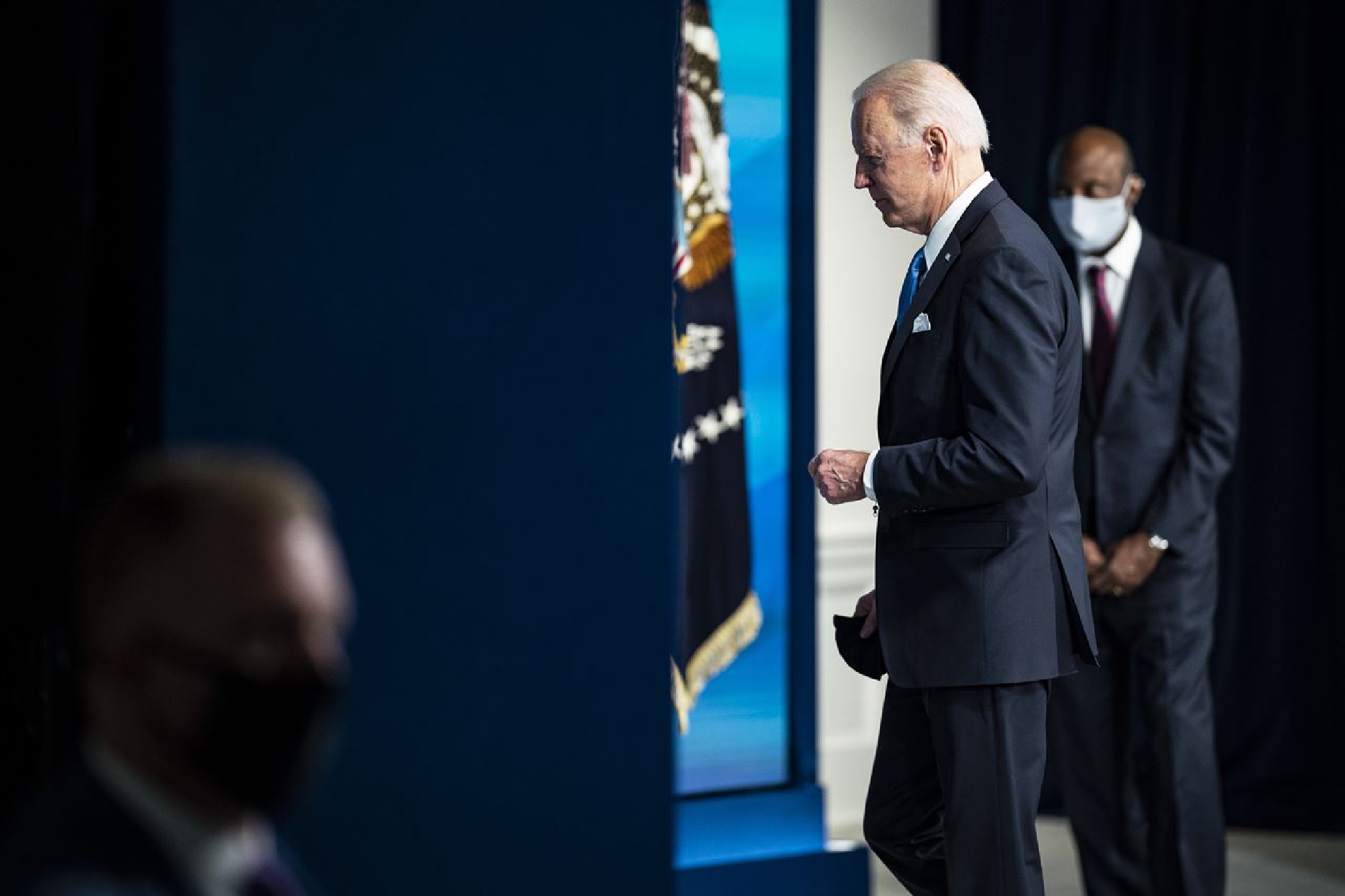
WASHINGTON – The morning that President Joe Biden introduced his jobs and infrastructure plan, senior White House officials briefed Goldman Sachs CEO David Solomon, Bank of America CEO Brian Moynihan, and four other chief executives of the countrys biggest banks about the measure.
Rift between GOP, corporate America creates opening for Bidens tax plan

WASHINGTON – The morning that President Joe Biden introduced his jobs and infrastructure plan, senior White House officials briefed Goldman Sachs CEO David Solomon, Bank of America CEO Brian Moynihan, and four other chief executives of the country’s biggest banks about the measure.

White House officials in a 24-hour period also briefed powerful business groups such as the National Association of Manufacturers, the Chamber of Commerce, and Business Roundtable about the proposal, while also planning outreach to thousands of small businesses. White House senior adviser Cedric Richmond and White House National Economic Council Director Brian Deese were among the administration’s emissaries for the legislation.

The meetings were in part the result of an effort from the Biden administration to take advantage of the growing rift between corporate America and the Republican Party as they seek to sell the nation on more than $2 trillion in tax hikes.

“We have prioritized business outreach; we think they have an important role to play and that their voice is important,” said Zach Butterworth, the White House’s director of private sector engagement. “They know we’re operating in good faith and that we’re proposing policies that are good for workers and good for business.”

The strategy is aimed at blunting the ferocity of business opposition to the tax hikes, likely the most controversial part of Biden’s jobs and infrastructure package. White House officials have argued to corporate executives that the tax hikes are necessary to fund large investments in public infrastructure that the business sector has long sought. But Democratic officials also recognize that their efforts risk bringing about a quick reconciliation between the GOP and business community, driving them together in opposition against a common foe.

Commerce Secretary Gina Raimondo has spoken to more than 50 leading executives in recent days about the plan, according to her spokeswoman.

“Some [executives] have said they’re fine with the tax increases as proposed; others have said they’re expecting a corporate tax increase” and were relieved Biden is not pushing for it to be increased to 35 percent, Raimondo said in an interview. The corporate tax rate was at 35 percent before Trump’s 2017 tax law. “Others have said maybe there’s some room for compromise on the rate or that the base doesn’t have to be broadened as much. To which I say: ‘The president has been very clear; there is room for compromise.”

Corporate America’s relatively muted reaction thus far to significant tax hikes was until recently unthinkable and reflects major changes in U.S. politics – the most important of which may be the recent falling out between the GOP and business elites.

When congressional Republicans worked to approve a $2 trillion tax cut in 2017, the GOP and corporate America worked together seamlessly to build support for the measure and push it into law.

Now, that relationship is under unprecedented strain. Congressional Republicans are incensed by corporate criticisms over GOP-backed voting restrictions and stances on culture war issues. Business groups, meanwhile, have increasingly eyed the GOP as a dangerous partner, toxic to their brand and harmful to their ability to recruit young worker talent.

“Capitol Hill Republicans and big business groups like the Chamber [of Commerce] are not as close as they once were. And that weakens their ability to affect the tax bill; it just does,” said Matt Mackowiak, who runs Potomac Strategy Group, a Republican political and corporate consulting firm.

The rift began under former President Donald Trump but was dramatically accelerated after the Jan. 6 Capitol riot and disagreements over a new Georgia voting rights law. Those disputes come on top of months of fights over other issues, such as climate change and transgender rights, in which parts of corporate America has tried to find separation from the conservative base. GOP lawmakers such as Sen. Ted Cruz, R-Texas, have pushed for revoking antitrust immunity for Major League Baseball – which moved the All-Star Game out of Georgia due to the voting law – and said “cancel culture” has infected elite business circles.

“It’s a thankless job defending corporate America, and it’s even more thankless when corporate America is simultaneously poking you in the eye,” said Brian Riedl, a former aide to Sen. Rob Portman, R-Ohio, now at the Manhattan Institute think tank. “When I talk to Republicans, they are really, really frustrated about this. They are exhausted from defending the 2017 tax cuts from attacks that it was too tilted to the rich and don’t see political upside in defending low taxes for corporations.”

An increasing number of Republicans are taking a more aggressive stance against big businesses. Andrew Surabian, a Republican strategist, said: “If these corporations want to act like mini-governments and they’re going to throw in with the other side nonstop, we should stop pretending they’re our allies. If they’re not our allies, why would we ever waste any political capital on them for some of the very unpopular things they want to get done in government?”

To be sure, both business groups and Republican lawmakers have criticized the Biden tax plan as likely to hurt American workers and U.S. competitiveness internationally.

Senate Majority Leader Mitch McConnell, R-Ky., has joined other GOP leaders in repeatedly slamming the “massive tax increases on all the productive parts of our economy.” Republicans have ruled out supporting an infrastructure package that includes corporate tax hikes, pushing instead for the funding to be raised from user fees.

A senior Senate Republican aide, who spoke on the condition of anonymity to describe internal thinking, said: “Regardless of what the business community does, Republicans will never not be energized to run against Democrats who raise your taxes.”

And many people in both the GOP and business community believe the rift will mend as the corporate tax hikes become closer to a reality. Congressional Republicans stewed last fall when the Chamber of Commerce, a traditionally safely GOP ally, endorsed an unprecedented 23 House Democratic lawmakers in the 2020 elections. But last week, the Chamber came out with a blistering attack on Democrats’ voting rights bill, in a potential sign of reconciliation. The National Association of Manufacturers has warned Biden’s tax hikes would “cost a million jobs,” while the influential Business Roundtable has launched an advertising campaign opposing the measure.

Still, the White House’s tax plans have divided the business world in ways few predicted. Many small businesses, for instance, are largely spared from Biden’s proposed tax hikes and their advocates have been relatively quiet in opposing the measure. Other business groups stand to benefit substantially from other parts of the bill, such as its research and development funding and infrastructure investments.

Amazon, for instance, baffled some GOP lawmakers by saying it supported an increase in the corporate tax rate and cited the need to improve U.S. infrastructure. (Amazon chief executive Jeff Bezos owns The Washington Post.) Executives at Intel, Lyft, Ford, Toyota, and other leading firms have expressed positive sentiments about Biden’s push. Hospital and other health industry groups have backed the plan’s $400 billion investment in home care.

And further diminishing the extent of business opposition is that Biden’s tax hikes could be substantially weakened before final legislation is passed into law. Sen. Joe Manchin (D-W.Va.), whose vote Democrats need to pass the measure without Republican support, has been adamant that the corporate tax rate only be raised from 21 percent to 25 percent, rather than the 28 percent proposed by the White House. Corporate America would oppose such a measure but likely “could live with it,” as one lobbyist put it.

“A raise from 21 to 25 — which is where Manchin has put the marker at — is not going to create mass hysteria, particularly when many corporations had an economic boom during the pandemic,” said Jefrey Pollock, founding partner and president of Global Strategy Group, a public relations and polling firm.

Republicans are hopeful the tax hikes will remind business groups that Republicans are their natural allies. Lisa Spies, a GOP fundraiser, said that she is advising companies to not make knee-jerk decisions because they might come to regret it. Spies said they needed to remember that Republicans would likely support more of the policies that help their bottom line — and they would need them to defend their favored business stances.

“After the riots on January 6, I told people, why don’t you wait and see what the new president’s policies are and that should direct your giving?,” she said. “You should just focus on the policies.”

For now, though, business groups are keeping their distance from Republicans even as leading politicians like Florida Gov. Ron DeSantis hammer their priorities. Former Rep. Barney Frank, D-Mass., who faced intense industry opposition for banking reform proposals he advanced under President Barack Obama, said corporate America increasingly fears the impact of a populist right more than they do of the center-left Democratic establishment.

“The business community, responsible elements of the business community, have figured out it’s in their interest to help defuse angry populism,” Frank said. “They’re not afraid of Joe Biden. Biden does not say they’re bad people, and that’s a large part of it. But they’re also not as afraid as what Democrats will do. They’re much more afraid of the Republicans.”

Published : April 20, 2021

By : The Washington Post · Jeff Stein, Josh Dawsey

NASA flies helicopter on Mars, the first time aircraft has flown on another planet #SootinClaimon.Com

#SootinClaimon.Com : ขอบคุณแหล่งข้อมูล : หนังสือพิมพ์ The Nation.

https://www.nationthailand.com/international/40000001

NASA flies helicopter on Mars, the first time aircraft has flown on another planet


NASA successfully flew its four-pound helicopter from the surface of Mars early Monday in the first powered flight of an aircraft on another planet, a feat that NASA officials compared to the Wright brothers first flight in 1903.

NASA flies helicopter on Mars, the first time aircraft has flown on another planet

At about 3:30 a.m. Eastern time, the twin, carbon-fiber rotor blades began spinning furiously, and the chopper, called Ingenuity, lifted off the surface of the Red Planet. It reached an altitude of about 10 feet, where it hovered, buffeted ever so slightly by the wind, turned 96 degrees and then came softly back to the Martian surface in an autonomous flight that lasted just about 30 seconds, the space agency said.

Inside the flight operations center at NASA’s Jet Propulsion Laboratory in California, engineers broke into applause when confirmation of the flight arrived, more than three hours after the flight, in a data burst that traveled 178 million miles to Earth through a complex communications network – from the helicopter, to the rover, to a spacecraft in orbit around Mars, to NASA’s massive international Deep Space Network of antennae and, finally, to JPL.

The atmosphere in the room turned almost giddy when a still photo shot from the helicopter captured its shadow on the ground, followed by video of the aircraft’s flight, taken from the nearby Mars rover Perseverance.

“We can now say we’ve flown a rotorcraft on another planet,” MiMi Aung, NASA’s Ingenuity program manager, told the occupants of the flight control room, all masked to protect against the coronavirus. “We together flew on Mars. We together have our Wright brothers moment.”

She added: “We don’t know from history what Orville and Wilbur [Wright] did after their first successful flight. But I imagine the two brothers hugged each other. Well, you know, I’m hugging you virtually.”

Scientists say the successful test, which they called “a flawless flight,”could eventually help the space agency more quickly roam across Mars as it looks for signs of ancient life. Engineers are already thinking about future aircraft, as heavy as 50 pounds or more, that could carry science experiments years in the future, NASA officials said.

“It opens up new doors,” said Thomas Zurbuchen, NASA’s associate administrator for the science mission directorate. A helicopter can fly over craters and other areas not accessible by rovers, he said. And being able to “scout ahead is just absolutely critical.”

Michael Watkins, the director of NASA’s JPL, said that having eyes in the sky gives “us the third dimension. It freed us from the surface now forever in planetary exploration.”

NASA flies helicopter on Mars, the first time aircraft has flown on another planet

https://www.washingtonpost.com/video/c/embed/db76bbc5-f4f8-45a5-8a41-2d1ba82d7e44?ptvads=block&playthrough=false

To make the brief flight, Ingenuity’s technology had to overcome Mars’s super-thin atmosphere – just 1 percent the density of Earth’s – which makes it more difficult for the helicopters’ blades, spinning at about 2,500 revolutions per minute, to generate lift.

It was a triumphant add-on to the main part of NASA’s latest Mars mission – the Perseverance rover, a car-sized vehicle that is set to explore a crater that once held water and could yield clues to the history of the planet and whether life ever existed there. Deciding to build a helicopter that could fly on Mars was a project years in the making and one that was the result of “finding that right line between crazy and innovative,” Zurbuchen said.

Ingenuity, with four spindly legs and a solar panel and costing about $80 million, made the long journey to Mars tucked in the rover’s undercarriage.

As a tribute to the Wright brothers, Ingenuity has a postage-sized bit of fabric from the brothers’ aircraft, known as the Flyer, attached to a cable under the solar panel.

If all goes according to plan, the helicopter could make as many as four more flights in coming weeks, each one more ambitious than the last. The second, for example, would fly slightly higher, to 16 feet, and then horizontally for a little bit before coming back to the landing site. “We want to push it to the limit,” Aung said.

Aung told her team to celebrate, to enjoy the moment, but added: “This is just a first flight. Let’s get back to work and have more flights.” The next flight, she said later, would come “in the next few days.”

The flight was originally scheduled to occur last week. But a problem halted a test of the helicopter’s rotors, and the flight was delayed as engineers diagnosed and then fixed the issue. While expressing confidence, engineers acknowledged before the flight that anything so difficult and audacious could easily run into problems.

“We’re doing everything we can to make it a success, but we also know that we may have to scrub and try again,” Aung wrote in a blog on NASA’s website before the flight. “In engineering, there is always uncertainty, but this is what makes working on advanced technology so exciting and rewarding.”

Published : April 20, 2021

By : The Washington Post · Christian Davenport

‘Godzilla vs. Kong’ extends Warner Bros. reign at box office #SootinClaimon.Com

#SootinClaimon.Com : ขอบคุณแหล่งข้อมูล : หนังสือพิมพ์ The Nation.

https://www.nationthailand.com/news/30405035

‘Godzilla vs. Kong’ extends Warner Bros. reign at box office

InternationalApr 19. 2021

By Syndication Washington Post, Bloomberg · Kelly Gilblom

“Godzilla vs. Kong,” the monster epic from Warner Bros. and Legendary, dominated the box office for a third straight week, showing that a new movie available for streaming at home can also draw fans to theaters.

The film took in $7.7 million in weekend sales in North American theaters, according to researcher Comscore Inc., further cementing its spot as the biggest movie release of the pandemic with cumulative sales now of $80.5 million. So far, “Godzilla vs. Kong” has exceeded analysts’ expectations, suggesting people are becoming comfortable with attending theaters more than a year into a global pandemic.

The performance is a major win for AT&T Inc.’s WarnerMedia division, which opted to release all of its 2021 movies on both HBO Max and in theaters. When the studio announced the move last year, filmmakers warned it would hurt cinema owners that were already struggling to survive the covid-19 virus and competition from streaming services.

“Warner has played an integral role in the early transition phase as we now cautiously approach the next stages of global box office recovery,” said Shawn Robbins, chief analyst for Boxoffice Pro. “The key now is to look forward.”

Most other studios have been wary about putting out big releases during the pandemic. The next big-budget movie due out will be another Warner Bros. feature, “Mortal Kombat,” on April 23. After that, audiences will have to wait until May 28 to see “A Quiet Place Part II” from Paramount Pictures and until summer for other highly anticipated films like Universal Pictures’ “F9,” part of the “Fast and Furious” series, and Walt Disney Co.’s “Black Widow.”

The decision to stream new movies the same day they come out on the big screen has posed some challenges for theaters. It’s not clear how many people are opting to watch movies at home instead of venturing out. Additionally, studio and theater executives have acknowledged that consumers no longer want to wait up to 90 days for movies to leave multiplexes and be available for home viewing.

But the combination of closings and the lack of new movies to show has worn down some of the theater owners who have resisted change. AMC Entertainment Holdings Inc. Chief Executive Officer Adam Aron said in an interview this week that attendance “quintupled” with the March 31 release of “Godzilla vs. Kong.” New films are a key part of recovery for cinemas, some of which have gone out of business because of the virus.

Other, returning pictures rounded out the other top spots at the box office this weekend. Universal’s “Nobody,” a thriller starring Bob Odenkirk that came out March, took in $2.5 million in sales. “The Unholy” made about $2.1 million and Disney’s “Raya and the Last Dragon,” an animated film about a warrior girl, made $1.9 million.

Egypt passenger train crash kills at least 11 people, injures scores #SootinClaimon.Com

#SootinClaimon.Com : ขอบคุณแหล่งข้อมูล : หนังสือพิมพ์ The Nation.

https://www.nationthailand.com/news/30405034

Egypt passenger train crash kills at least 11 people, injures scores

InternationalApr 19. 2021

By Syndication Washington Post, Bloomberg · Ahmed Khalil El-Sayed

A passenger train derailed Sunday north of Cairo, leaving at least 11 people dead and about 1oo others injured, a Health Ministry official said, the latest in a string of rail accidents.

The derailment occurred when at least four of the train’s carriages went off the tracks shortly after its departure from a station in Qalyubia governorate en route to Mansoura, state media reported. Almost 60 ambulances rushed to the scene to transport the injured to local hospitals.

The crash was the third railway incident in Egypt in a month. In March, a crash in southern Egypt left 19 dead and sparked fresh calls for revamping the country’s aging railway infrastructure and a revision of safety protocols.

Tesla with ‘no one’ driving crashes in Texas, killing two people #SootinClaimon.Com

#SootinClaimon.Com : ขอบคุณแหล่งข้อมูล : หนังสือพิมพ์ The Nation.

https://www.nationthailand.com/news/30405033

Tesla with ‘no one’ driving crashes in Texas, killing two people

InternationalApr 19. 2021

A logo is displayed on a Tesla electric vehicle in 2020. MUST CREDIT: Bloomberg photo by Nina Riggio

By Syndication Washington Post, Bloomberg · Noah Buhayar

A Tesla electric car that “no one” appeared to be driving crashed late Saturday in Texas, erupting into flames and killing the two passengers, according to local authorities.

One victim was found in the front passenger seat of a 2019 Model S, and the other was in the rear, Harris County Precinct 4 Constable Mark Herman said in a telephone interview. The car ran into a tree in the Carlton Woods subdivision near The Woodlands after traveling fast and failing to navigate a turn.

The position of the victims, statements and other physical evidence suggest that “no one was driving the vehicle at the time of impact,” Herman said. “It’s still under investigation.”

Herman said his office is coordinating with federal authorities, without specifying which ones, and did not know whether the Autopilot feature was engaged. It took more than 30,000 gallons of water to extinguish the fire, which burned for four hours, he added.

Tesla did not immediately respond to a request for comment Sunday.

Federal officials have criticized Tesla for fire risks related to the battery packs in its cars and for what they call insufficient effort to keep drivers from using the driver-assist function inappropriately. In a hearing last year, the National Transportation Safety Board’s chairman said “it’s time to stop enabling drivers in any partially automated vehicle to pretend that they have driverless cars.”

Tesla CEO Elon Musk has defended the safety record of his company’s vehicles. Last week, he shared a report on Twitter, saying that a Tesla with Autopilot engaged is now approaching a “10 times lower” chance of a crash than an average vehicle.

‘Ripe for fraud’: Coronavirus vaccination cards support burgeoning scams #SootinClaimon.Com

#SootinClaimon.Com : ขอบคุณแหล่งข้อมูล : หนังสือพิมพ์ The Nation.

https://www.nationthailand.com/news/30405032

‘Ripe for fraud’: Coronavirus vaccination cards support burgeoning scams

InternationalApr 19. 2021

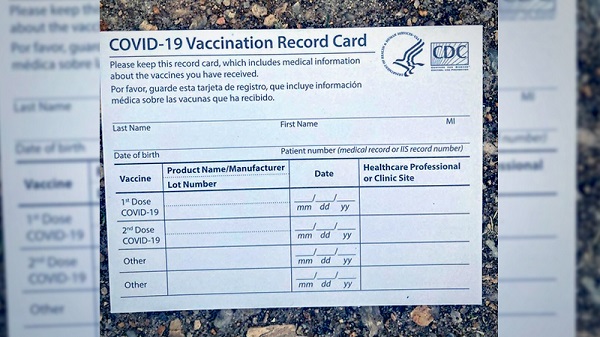
An “Authentic CDC Vaccination Record Card” was sold by eBay user “asianjackson” and sent to a customer. MUST CREDIT: Obtained by The Washington Post

By The Washington Post · Dan Diamond

One listing offered eBay customers an “Authentic CDC Vaccination Record Card” for $10.99. Another promised the same but for $9.49. A third was more oblique, offering a “Clear Pouch For CDC Vaccination Record Card” for $8.99, but customers instead received a blank vaccination card (and no pouch).

All three listings were posted by the same eBay user, who goes by “asianjackson” – using an account registered to a man who works as a pharmacist in the Chicago area – and all were illegal, federal regulators say. The account sold more than 100 blank vaccination cards in the past two weeks, according to The Washington Post’s review of purchases linked to it.

The listings are a “perfect example” of burgeoning scams involving coronavirus vaccination cards that could undermine people’s safety, as well as the success of the nation’s largest mass vaccination effort, said North Carolina Attorney General Josh Stein. Individuals might use them to misrepresent their vaccination status at school, work or in various living and travel situations, potentially exposing others to risk.

Stein, who led a recent effort with 47 colleagues demanding that eBay and other e-commerce platforms crack down on the scams,pointed to the FBI’s warning that anyone who makes or buys a fake vaccine card is breaking the law, and said he would consider prosecution, too.

“This is a concern that is national and bipartisan,” Stein added, saying the spread of fake vaccination cards “will extend the pandemic, resulting in more people sick and more people dead.”

At least 129.5 million Americans have gotten at least one or both doses of a coronavirus vaccine and have received a free proof-of-vaccination card with the logo of the Centers for Disease Control and Prevention, as officials push to inoculate the nation. But that vaccination drive has pitted people like asianjackson, selling blank or fake credentials, against law enforcement officials rushing to stop them – and warning that the full scope of the problem is impossible to grasp.

The clash has escalated as businesses and universities say they’ll require proof of vaccination before allowing Americans to board cruises, enter some stores and even return to college classes, prompting some vaccine-hesitant people to search for false IDs or make their own. And the showdown is unfolding amid a bitter national debate about whether Americans should have digital “vaccine passports” instead of paper cards, and whether the government should be involved in credentialing such efforts.

For months, officials have been a step behind the scammers, who have openly discussed strategies to fake the cards on social media, sold them on sites such as eBay and pulled blank photos off state websites. Federal officials’ decision to use paper cards that can be easily photocopied or even printed off a template, rather than a digital tracking system, worsened those risks.

“This is exactly the scenario that you want to guard against. It undermines the entire effort by having falsified cards out there,” said Jennifer Kates, who oversees global health policy for the Kaiser Family Foundation and reviewed asianjackson’s eBay listings. “It certainly bolsters the argument for a digitized mechanism – which isn’t a tamper-proof system, but certainly a more secure one.”

“Paper anything is ripe for fraud,” saidNenette Day, an assistant special agent in charge at the Department of Health and Human Services’ inspector general’s office who oversees whistleblower tips. Day said she has reviewed dozens of reported vaccination-card scams that range from Americans stealing blank cards to sharing tips on how to fake a card on social media. She described the trend as among the most frustrating chapters in a 20-year career that included responding to the 9/11 terrorist attacks as an FBI agent.

“I feel like nobody has taken this to its natural conclusion,” Day said, hypothesizing about a scenario where an unvaccinated person could illegally create a vaccination card and pretend to be immunized, using that to enter a high-risk environment such as a nursing home, then unknowingly spread the virus, potentially resulting in someone’s death. “It disturbs me, having been in law enforcement this long, this flippant attitude that people have.”

While e-commerce platforms cracked down on listings after recent news reports, there are already signs that the supply of the cards is bouncing back, said Saoud Khalifah, chief executive of Fakespot, a company that specializes in rooting out online fraud and that began tracking fake vaccine cards in February.

“We’ve seen ads on Facebook and TikTok and other social platforms being used to target these anti-vaxxers,” Khalifah said. “There’s demand from people who don’t want to get vaccinated, but also people who think they can use the cards to skip the line (and) say, ‘Hey, I got dose one, can I get dose two?’ “

Some federal officials involved in the vaccine drive said that last summer, they had initially discussed using digital systems to track the vaccine push and to help Americans manage getting shots. CDC officials believed they could harness the nation’s dozens of immunization information systems, which track shots administered by providers within a specific geographic area.

“IT/data infrastructure supports entire distribution, ordering, tracking process from end-to-end,” according to a July slide deck about the CDC’s planned vaccine rollout that was obtained by The Washington Post. The slide deck made no mention of using paper cards.

A CDC letter sent the following week, also obtained by The Post, similarly touted using IT systems to manage the vaccine rollout, including “record-keeping for the vaccine recipient,” with no mention of paper cards.

Pamela Schweitzer, a retired assistant surgeon general who helped with the coronavirus response last year, said that she and her colleagues were aware in June that the CDC was focusing on a “comprehensive IT infrastructure” to help Americans track their vaccinations before opting for paper cards as a fallback later in the year.

A former administration official closely involved in the vaccine effort who spoke on the condition of anonymity to discuss private conversations confirmed initial plans for “a digital system with digital reminders about when to get your shot, like, ‘Your library book is due in five days.’ ” But technical setbacks and time pressure forced the administration to rely instead on paper cards, which the CDC had positioned as a “fail-safe,” the official said.

“If there had been a vaccine during the 1918 flu pandemic, you could probably have used the same exact card – just with different logos at the top,” the official said, adding that the paper cards, which are passed around in health settings and potentially handled by sick patients, were not ideal for curbing safety risks. “It’s a hard, tactile object in the middle of the pandemic. It’s a pretty gross thing to have.”

Paul Mango, a former Trump administration official who helped oversee Operation Warp Speed, the administration’s vaccine accelerator, acknowledged that “there were many complexities, technical and otherwise, associated with digital vaccination tracking, so for exigency purposes, we fell back on vaccination cards.”

While state and local immunization registries do store individual coronavirus vaccination data, officials said there’s no current system that would allow businesses, schools and other organizations to easily check the databases to see if a visitor was presenting a falsified paper card.

HHS did not respond to questions about health officials’ decision to opt for paper cards and whether that increased the risk of scams. An HHS spokesperson pointed to an October playbook that instructed accredited vaccinators to provide “a completed COVID-19 vaccination record card to every vaccine recipient/parent/legal representative.”

Private-sector organizations, including pharmacies such as Walmart and Walgreens, have recently mounted a push for using digital “vaccine passports” for Americans to prove they’ve gotten shots, arguing such systems would better track vaccinations and protect against fraud. But federal officials have struggled to corral the initiatives and adopt a standardized approach, particularly as the issue has become politicized in recent weeks.

Even as public health officials warn about the risk of fraud, some states have inadvertently boosted it. The Post identified several states, including Tennessee and Texas, that posted blank card templates to their health department websites among their coronavirus-related resources. Some social media users have boasted that they had printed the documents to produce their own fake cards.

Day, the official at the HHS’s inspector general’s office, recounted an explosion of whistleblower tips related to vaccination card scams in the past month. “On any given day, it’s 40 to 50 percent of our covid-related complaints,” she said.

One report was about a woman who worked in a vaccination clinic and gave a blank card to her boyfriend. The boyfriend then detailed on social media how he had filled in the card himself and bragged about the accomplishment, Day said.

Schweitzer, who has volunteered at multiple vaccination clinics across Arizona, compared the abundance of blank vaccination cards at those sites to doctors not protecting their prescription pads.

“There’s limited control over these cards,” she said. “They’re all over the place. It’s pretty easy to get a stack.”

Asianjackson – the eBay account maintained by a man who works at a Chicago-area location of a national pharmacy chain – sold at least 110 blank vaccination cards through eBay, including 50 cards alone on April 11, according to a Post review. The Post obtained one of those cards, which was identical to the CDC vaccination cards dispensed by pharmacies, and sent from a Zip code in the greater Chicago area.

Law enforcement officials said they are alarmed by the possibility that eBay users such as asianjackson are taking blank cards from pharmacies or other health-care facilities where they work.

“That’s very troubling,” said Stein, the North Carolina attorney general. “That’s an instance where it’s an actually authentic card but illegally acquired and sold.”

When contacted by The Post through the full name offered on the eBaysales receipt, the man who uses the “asianjackson” account confirmed he lives in the Chicago area and works in a pharmacy, and listed other items sold through the account, such as empty boxes from luxury-goods retailers like Hermès and Chanel. But he claimed he had not used eBay this month and had no knowledge of any vaccination card sales.

“I need to get that straightened out with eBay,” the man said, claiming he had stopped using the service after his password was unexpectedly changed about two weeks ago. The Post is not identifying him because he disputes he sold the cards.

After The Post brought the listings to eBay’s attention on Thursday, the company removed them. “Our team has reviewed and taken appropriate action,” said eBay spokesperson Parmita Choudhury, who declined to disclose additional details about the account.

Pharmacies insist they have protections in place to track the blank cards they receive and would know if any cards were wrongly removed.

“Our pharmacies receive a limited number of CDC dose cards as part of the CDC immunization supply kits shipped to the stores that are receiving and administering coronavirus vaccines,” Walgreens spokesperson Erin Loverher said in a statement.

“We store and monitor the vaccination cards in our pharmacies and each vaccine card is a 1:1 match for the vaccine doses in a pharmacy’s inventory, so we would know if any are missing,” said Mike DeAngelis, a CVS spokesperson.

Still, scammers have had a field day, getting plenty of help from the public, not just in making fake cards but also in committing identity theft: Many Americans put pictures of their vaccination cards online, sharing information such as the day of their shot, their birthdays and other identifying details. The trend, intended to boost vaccine acceptance, has alarmed regulators. “While the #COVID19 vaccine helps protect against the virus, posting your vaccine card online opens you up to another type of plague – scammers who would use the document to steal your identity,” Ashley Moody, Florida’s attorney general, wrote on Twitter in February.

Day agreed that those pictures have helped scammers get the details right, including vaccine manufacturer and lot information. “They can fill out their cards, which would have at least some level of legitimacy, because they had the right numbers and letters for the lot numbers,” she said.

Khalifah, the Fakespot CEO, said regulators face persistent challenges because of how easy the cards are to exploit.

“Let’s speak bluntly about this. We’re talking about paper and stamps – technology that’s been around for a while,” Khalifah said, adding that some people selling cards online are involved in other long-running scams. “There’s overlap with these stores and others selling fake Gucci bags. They’ll leverage fake reviews, fake upvotes. There’s a lot of fraud.”

Officials said it’s impossible to get a true picture on the number of Americans who have faked vaccine cards themselves or have bought them online. “It’s not the kind of thing that the person buying is going to report. In some ways, they’re complicit,” Stein said.

“Anything that’s going to delay the end of this pandemic is incredibly unfortunate and counterproductive,” he added. “These vaccine cards will do just that.”

Biden restores foreign policymaking process with Afghanistan decision #SootinClaimon.Com

#SootinClaimon.Com : ขอบคุณแหล่งข้อมูล : หนังสือพิมพ์ The Nation.

https://www.nationthailand.com/news/30405031

Biden restores foreign policymaking process with Afghanistan decision

InternationalApr 19. 2021

By The Washington Post · Karen DeYoung, Missy Ryan

WASHINGTON – Three months after taking office, President Joe Biden has reestablished the formal decision process, which his direct predecessor seemed determined to destroy, that has guided U.S. administrations through foreign policymaking since the Second World War.

Afghanistan was among the first major issues on which the process, organized and directed by the National Security Council, became fully operational. Dozens of high-level meetings were held, including four sessions with the president in the Situation Room. Military, intelligence and diplomatic assessments were compiled, and consultations were held with allies and lawmakers.

Yet at the end of the day, Biden did not budge from where he began nearly 13 years ago, when a visit to Afghanistan as vice president-elect persuaded him, he said last week, that “more and endless American military force could not create or sustain a durable Afghan government.”

His decision to withdraw all of the few thousand American troops remaining in Afghanistan by Sept. 11 – the 20th anniversary of the 2001 al-Qaida terrorist attacks that began the war there – defied the advice of senior military leaders and raised significant national security questions.

U.S. officials said Gen. Mark Milley, chairman of the Joint Chiefs of Staff; Gen. Frank McKenzie, head of U.S. Central Command; and Gen. Scottie Miller, commander of U.S. and NATO troops, advocated a conditions-based approach, additional time for negotiation, or, at a minimum, keeping some sort of residual counterterrorism force on the ground in Afghanistan. The generals said the fall of Kabul to the Taliban, waves of Afghan refugees rushing to neighboring countries and Europe, and the reemergence of al-Qaida as a potent terrorist threat were possibilities.

Defense Secretary Lloyd Austin, asked by reporters last week in Brussels whether the top brass had agreed with the “down to zero” decision, rebuffed the question, saying “their voices were heard, and their concerns taken into consideration.”

Officials said Austin, like his counterparts in uniform, supported a continued military presence, though he shared his personal views with a small group of people. A Defense Department official said Austin’s approach was informed by his own experiences in uniform, including in Iraq, where he oversaw the Obama administration’s rapid withdrawal of forces in 2011. Less than three years later, the Islamic State took over a third of the country.

CIA Director William Burns, in testimony the day before Biden’s Wednesday announcement, told Congress that “when the time comes for the U.S. military to withdraw, the U.S. government’s ability to collect and act on threats will diminish,” he said of possible resurgence by al-Qaida and other terrorist groups with global ambitions. “That is simply a fact.”

At NATO, where Secretary of State Antony Blinken and Austin officially informed the alliance of the decision last week, Secretary General Jens Stoltenberg indicated that NATO members with troops in Afghanistan had little choice but to follow suit. “In light of the U.S. decision,” he said, “all Allies agreed to the statement” of joint withdrawal.

To many in the White House, widely reported accounts of the disagreements miss the point, especially in light of President Donald Trump’s habit of not even consulting the military before tweeting abrupt diktats on troop withdrawals.

Even Trump, however, often succumbed to after-the-fact military pressure to reverse his decisions.

A senior administration official acknowledged that “there were people among [Biden’s] senior team on both sides of this question. It’s certainly not that everybody was in favor of one option or the other.”

But the decision process worked “exactly how the system was designed to work,” the official said, speaking on the condition of anonymity under White House ground rules. “These decisions do not rest in our democracy with the Pentagon. They rest with the president.” The military’s views “are extremely consequential, given its role in the policy that is made. But the policy decisions rest with the president.”

Although Biden supported the initial deployment of U.S. troops to Afghanistan two decades ago, his views had changed sharply by 2009, when he argued against the force surge the military advocated and President Barack Obama ultimately approved.

In 2011, he was an outlier in publicly saying that the Taliban “per se is not our enemy” and had never expressed a desire to attack the U.S. homeland. During his presidential campaign last year, he vowed to end America’s “forever wars.”

Administration officials have cited Trump’s 2020 agreement with the Taliban to withdraw by May 1 this year as limiting Biden’s options. “We started from the perspective of having inherited a policy that candidly was not in a very good place,” the senior official said. “We had the lowest troop numbers since the early years of the war. We had the Taliban feeling ascendant on the battleground and kind of fighting the Afghan government to virtually a stalemate.”

“And we had this May 1 deadline,” he said, after which the Taliban had threatened to resume attacking any remaining U.S. and other allied forces on grounds that the Trump agreement had been broken.

Neither the United States nor the Taliban have complied with other elements of the agreement, including full prisoner releases, the lifting of sanctions against the militants and a reduction in overall violence. The militants have not severed their ties with al-Qaida, according to the Pentagon and the United Nations. Inter-Afghan talks began last fall but have gotten nowhere.

But the deadline gave Biden a template for the withdrawal. “It is perhaps not what I would have negotiated myself, but it was an agreement made by the United States government, and that means something,” he said in his Wednesday announcement. “So, in keeping with that agreement and with our national interest, the United States will begin our final withdrawal . . . on May 1 of this year.”

Administration officials disputed any suggestion that the three-month National Security Council review was a mere formality. “We ran a real process,” the senior official said. In addition to the Situation Room meetings Biden led, “the principals” – the top national security officials – met without the president three times in sessions chaired by national security adviser Jake Sullivan. Their deputies met at least 10 times, the official said, as risks and options were honed for delivery to increasingly higher levels. Afghanistan was a frequent topic of discussion during the president’s daily intelligence briefing, often attended by Austin and Milley, officials said.

“It’s noteworthy that, unlike previous policy reviews, particularly on this subject . . . there was remarkably little backstabbing and leaking in the press, people saying they weren’t being heard, the process was being circumvented, or the president had already made up his mind when he went into this,” the official said.

During the course of those meetings, if not before, the president came to several key conclusions. He rejected the notion that U.S. troops could or should be used as leverage to stem inter-Afghan violence or promote negotiations.

He believed that anything other than a fixed departure timeline meant going back to war with the Taliban. And he concluded that there was no viable middle option between setting a date certain for complete withdrawal or staying indefinitely.

By the time of NATO’s winter meeting of defense ministers on Feb. 17, though the decision process was incomplete, Austin began informing allies of the direction it was heading. In March, alarmed by news reports suggesting that the lack of a decision meant an indefinite stay was becoming more probable, Blinken told NATO foreign ministers that getting out was a very real possibility.

In a news conference at the end of March, Biden gave the clearest public indication of his thinking, saying that full withdrawal was “unlikely” by May 1, but that “I can’t picture” U.S. forces still being in Afghanistan when 2022 begins.

Some experts have questioned whether a refusal to leave meant return to war with the Taliban was inevitable. Others have noted that the United States has often used its military forces as leverage in other countries such as South Korea and Japan, where tens of thousands of troops are deployed to dissuade North Korea from attacking and to fight back if it does.

The militants have insisted that the May 1 deadline is real, no matter what timetable Biden has set for departure, and any foreign troops remaining after that will be subject to attack. The United States and NATO have promised aggressive retaliation if they are attacked while heading for the exit.

But the bottom line, according to several senior administration officials, is that Afghanistan is no longer a high U.S. priority, as it was in 2001, compared with the threats of 2021, including Chinese and Russian aggression, terrorist surges elsewhere in the world, climate change, global health and nonproliferation. Public opinion has strongly supported withdrawal.

The administration has pledged that it will continue paying for Afghanistan’s own security forces, pressing for inter-Afghan negotiations, providing humanitarian assistance, and using diplomatic and economic tools to keep the Taliban from returning to the draconian policies and repression of women and minorities that characterized the last time it controlled Afghanistan from the mid-1990s until the 2001 U.S. incursion in pursuit of Osama bin Laden that quickly became war with the Taliban.

In an interview on Sunday with ABC’s “This Week,” Blinken seemed to accept an inevitable militant takeover. If the Taliban has “any expectation of getting any international acceptance, of not being treated as a pariah,” he said, “it’s going to have to respect the rights of women and girls” or risk the withdrawal of “international recognition” and “international status.”

Many veterans don’t trust coronavirus vaccines. For a VA crew in the rural West, that means changing minds, one by one. #SootinClaimon.Com

#SootinClaimon.Com : ขอบคุณแหล่งข้อมูล : หนังสือพิมพ์ The Nation.

https://www.nationthailand.com/news/30405018

Many veterans don’t trust coronavirus vaccines. For a VA crew in the rural West, that means changing minds, one by one.

InternationalApr 18. 2021

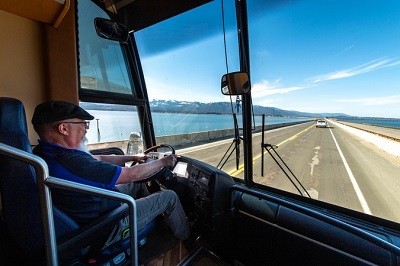
Bob Sonderman drives a Veterans Affairs mobile medical unit from Libby, Mont., to Sandpoint, Idaho, as part of a campaign to get rural veterans vaccinated against the coronavirus. Photo by Tony Bynum for The Washington Post

By Lisa Rein
The Washington Post

LIBBY, Mont. – On the morning he was scheduled to get his first shot of coronavirus vaccine, Mike Jellesed woke in a fury and wheeled his pickup out of his trailer park, headed for the Veterans of Foreign Wars post in town.

A giant star-spangled bus that had crossed 160 miles of the Rocky Mountains from Spokane, Wash., was waiting for him in the parking lot. Inside were three Department of Veterans Affairs workers and 26 Moderna syringes ready to go. Jellesed, a 61-year-old Air Force veteran with scarred lungs that left him vulnerable to covid-19, had driven there with his 11-year-old son to tell the VA crew all the reasons – despite his scheduled appointment – he didn’t believe in the vaccine.

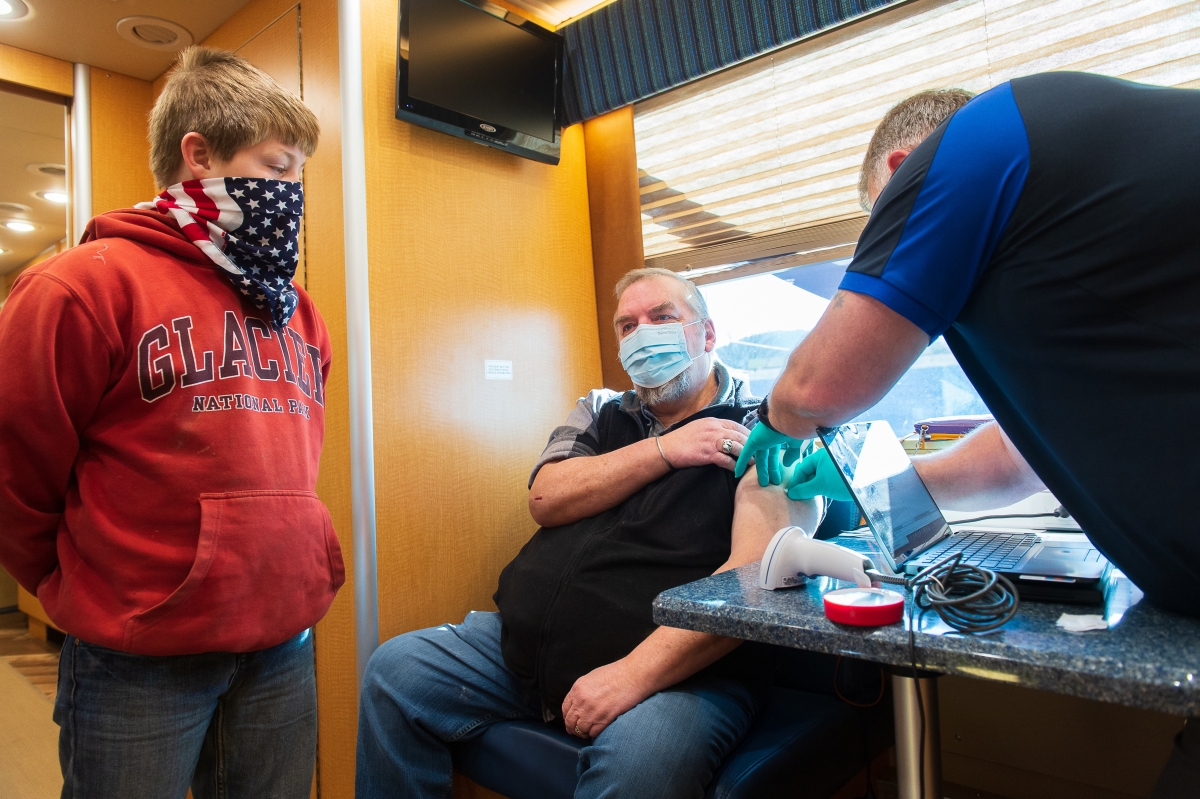
Logan, 11, and his father, U.S. Air Force veteran Mike Jellesed, 61 of Libby, Mont., after a long discussion, receives the Moderna Vaccine from RN Mark Sheldon on March 30, 2021. Photo by Tony Bynum for The Washington Post

Logan, 11, and his father, U.S. Air Force veteran Mike Jellesed, 61 of Libby, Mont., after a long discussion, receives the Moderna Vaccine from RN Mark Sheldon on March 30, 2021. Photo by Tony Bynum for The Washington Post

He felt like a lab rat: “That’s what I am,” he said. “I don’t like being told what to do.”

The VA mobile medical unit’s third visit since January to Libby, an old mining and lumber town 70 miles from the Canadian border in a deep-red band of America, had been unexpectedly rough.

Even as the Biden administration’s campaign to inoculate the country accelerates each day, the agency has struggled to persuade a vulnerable population to protect itself and help the country get to herd immunity. The rugged communities that stretch from eastern Washington through the Idaho Panhandle into northwestern Montana include some of the country’s highest concentrations of former service members. Mostly conservative and White, they are also highly suspicious of coronavirus vaccines.

In many cities and suburbs, millions are lining up for shots they have waited more than a year to get. Here, the political and cultural currents are pulling in the other direction, against the federal government, public health experts and a new president many of these veterans distrust. VA’s halting and labor-intensive effort may be a warning for the country as vaccine advocates seek to persuade unwilling Americans to sign up.

To counter the wariness, the agency’s Spokane hospital embarked in January on a mission to convince the roughly 46,000 veterans under its care that whatever was holding them back was the real danger. The 45-foot bus previously used as a primary-care clinic – 10 feet longer than a Greyhound and the height of a tractor-trailer, with two exam rooms, a triage room with a hospital bed, and a centrifuge to spin blood – has since logged 2,500 miles in a carefully waged campaign against skepticism.

Nationally, about 3 in 4 Americans have indicated a willingness to accept a vaccine. Yet just 1 in 4 veterans contacted by the Spokane VA for an appointment on the bus have said yes. And on a trip early this month, roughly 1 in 6 with appointments canceled or didn’t show.

When Jellesed arrived, he complained that the scheduler had unfairly pressured him by warning that his VA benefits, now the only source of income for his family of six, would be cut off if he turned down the shot.

He feared the vaccine was meant to harm people, to eventually cause cancer in those who got it.

“My wife’s totally against it,” he said. He explained that his reluctance came from “all the things I’ve read on Facebook.”

Yet he also knew people who had died in the pandemic and how lonely those deaths could be. A close childhood friend had flown in from California to see his mother when she was hospitalized with covid last year, but the hospital in Libby wouldn’t even let him inside before she died.

Jellesed’s elderly mother was home recovering from a stroke. If something else happened to her, he wanted to make sure the hospital would let him in to see her.

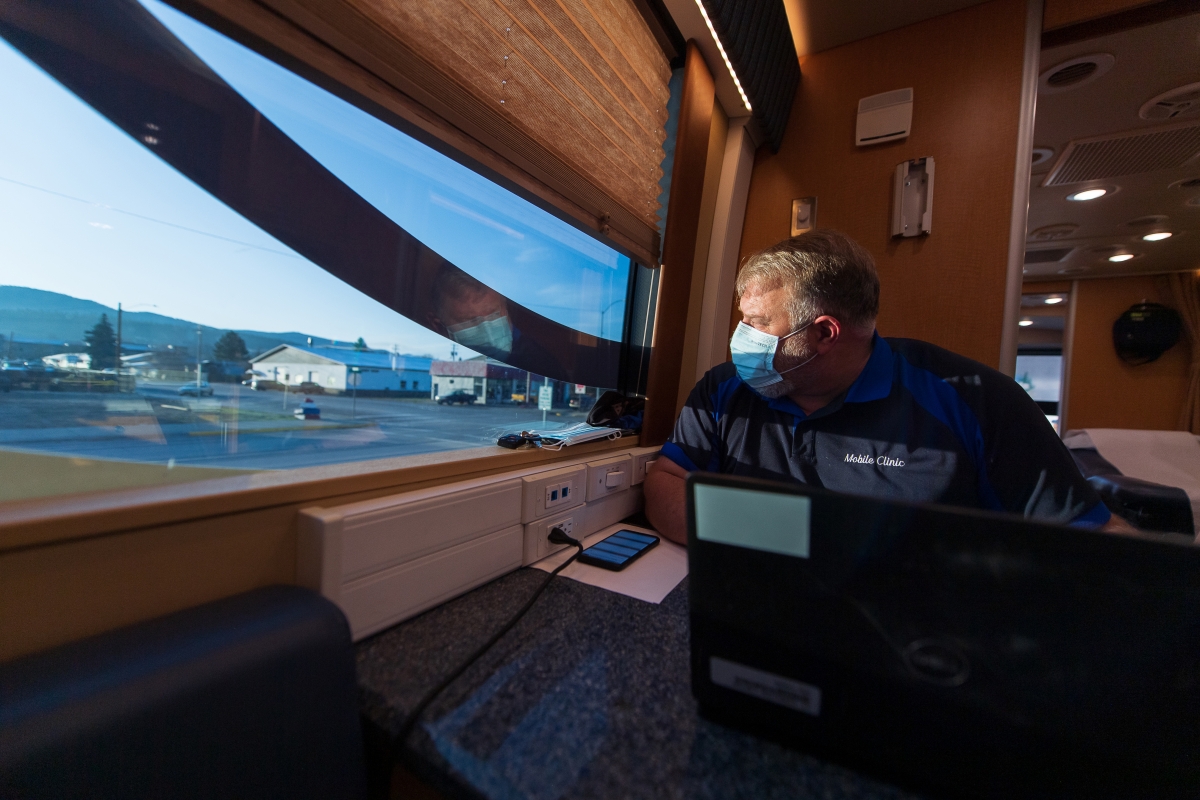
VA emergency room nurse Mark Sheldon, a Gulf War combat Marine, looks out the window of the mobile clinic in Libby, Mont., on March 30, 2021. Photo by Tony Bynum for The Washington Post

VA emergency room nurse Mark Sheldon, a Gulf War combat Marine, looks out the window of the mobile clinic in Libby, Mont., on March 30, 2021. Photo by Tony Bynum for The Washington Post

A little after 10 a.m., Mark Sheldon came to hear him out. The Gulf War combat Marine, now an emergency room nurse, is the Spokane hospital’s chief weapon on the ground. In almost three months on the road running the mobile clinic, along with a nurse practitioner and a driver, he had learned that pressure tactics do not work on cynical veterans.

He gently made the pitch for the vaccine, sharing that he also had wavered, after taking experimental drugs to protect against nerve agents during the war. He sensed that, for all Jellesed’s fury, the veteran could be swayed.

“I don’t want you to get this shot if it’s not what you want,” Sheldon told him. He promised Jellesed wouldn’t lose his benefits, regardless.

The outreach to veterans in the 64,000 square miles served by the Spokane VA begins with a phone call from a 20-year-old medical support assistant working in a cubicle at the hospital. She is paid $25,000 a year.

Kylee Flower, known by the staff for her oatmeal cookies and grace under pressure, is the agency’s first point of contact with hesitant veterans, a role requiring deft navigation around the minefields of politics, culture and misinformation.

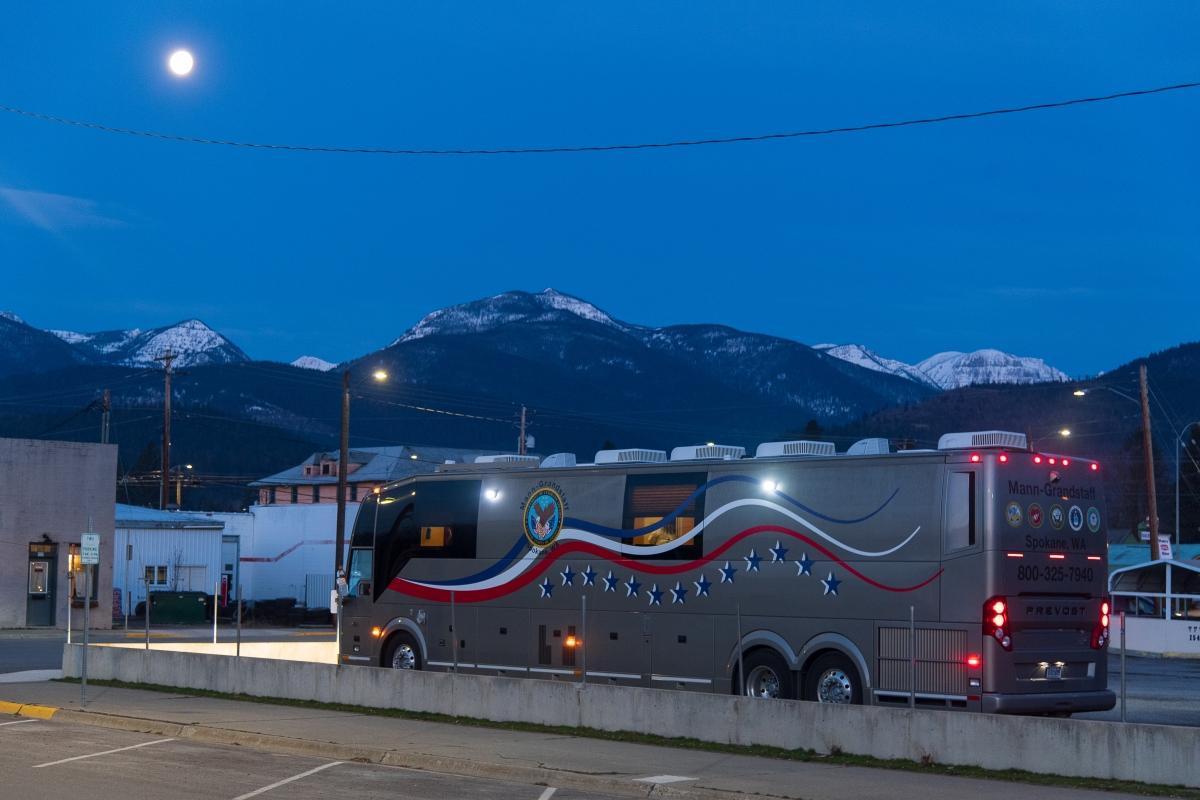
The VA mobile medical unit has made three trips to Libby, Mont., since January. Photo by Tony Bynum for The Washington Post

The VA mobile medical unit has made three trips to Libby, Mont., since January. Photo by Tony Bynum for The Washington Post

As the bus rolled toward Libby, Flower was working ahead, trying to set up appointments for its next trip. She scrolled down an Excel file on her computer that listed veterans by age and illness, put on her headphones and wrapped her white Vans sneakers around the base of her chair.

“Hello, this is Kylee calling from the Spokane VA,” she began. “I’m calling for John. Hi, John! How are you? I was just calling to see if you wanted to get the coronavirus vaccine in Colville.”

John had signed up to get his shot at the local fire station. The next veteran, Donald, had already gotten vaccinated. The next call went to voice mail and Flower wrote herself a note to try again – twice. Then Ronald picked up.

“Hi, Ronald. How are you?” Flower asked. Did he want the vaccine? “No? OK. Sounds good. Thank you for letting me know.”

The “no” answers tend to be nonnegotiable.

“That’s the hard part,” Flower said after hanging up. “What I’ve been told is if they say no, no is OK. I don’t want to argue with them.” She said she would never threaten to pull benefits.

The veterans’ “no” reactions rest on several theories, she explained. The vaccine injects a microchip that will let the government track their movements. It can’t be safe, because it was developed too fast. They’ve quarantined for this long, so they don’t need it. Former president Donald Trump says they don’t need to get it, so they’re not getting it. None of these claims are true, but that doesn’t matter.

To settle on the right messaging, a hospital administrator wrote the objections on Post-it Notes and stuck them on the wall at a staff meeting. Everyone concluded that the workers should stay away from the word “government” in their conversations with the veterans.

That was only one issue to untangle in months of planning and improvisation at the 70-bed facility, which, as a test-pilot site, is still troubleshooting a rocky rollout of VA’s new electronic health-records system. For the vaccine push, fifteen schedulers were pulled from other duties to call veterans in five-year age increments, starting with a 102-year-old World War II veteran, who said yes.

Since late January, the schedulers had been making 580 calls a day, but the effort needed to get more shots in arms. The staff tried to speed up the system with a mass vaccination site at the city’s armory (but vaccine supplies were too unreliable) and email blasts (low response). After giving shots in the hospital’s dental clinic, the staff also took over the offices for treating substance abuse as they searched for more space last month.

For those beyond driving distance from the city, however, the one constant is the bus.

The crew had been 10 weeks on the road in cold and snow, 620 shots in with six weeks to go, and now, finally, the sun was shining on the VFW parking lot in Libby. Because of the town’s painful history – residents were exposed to toxic dust as mining company W.R. Grace dug millions of tons of asbestos-laced vermiculite from a nearby mountain – Libby was a priority. But this visit was quickly becoming muddled.

Even before Jellesed showed up, an Air Force veteran named Connie Giles arrived, angry that the new computer system was spitting out old prescriptions and medical records.

Bob Sonderman, the mobile clinic’s bus driver, who served in the Marines after the Vietnam War, was scrambling on the phone with colleagues in Spokane to find replacements for the no-shows. Those who actually canceled told him they had decided not to get the shot.

“I tell them, ‘That’s your choice, but you realize we’re gonna have to throw a covid shot away?’ ” he said in frustration. The crew hadn’t had to waste a syringe yet, but now the possibility was there. (The agency has not been allowed to give the vaccine to nonveterans, although a recently approved law expands eligibility.)

William Bishop, a 57-year-old Army veteran sitting nearby for 15 minutes of observation after his shot, said he had lost his father to covid last year. “It’s a duty to myself and a duty to my community,” he said, explaining why he was getting vaccinated. “I’m a veteran. Duty is what it’s about.”

His was not the prevailing view. For most veterans, the pressure not to get the shot was enormous.

Libby is an old mining and lumber town in northwest Montana. Almost 12% of its population of 2,700 is veterans. Photo by Tony Bynum for The Washington Post

Libby is an old mining and lumber town in northwest Montana. Almost 12% of its population of 2,700 is veterans. Photo by Tony Bynum for The Washington Post

“We have a lot of anti-vaxxers here,” said Dorian Bolling, a 39-year-old disabled Army veteran. “It’s growing. I mean, I’m hearing about microchips. VA here doesn’t have the best image with the vets.” But a bout with pneumonia a few years back had convinced her that she never wanted to feel that awful again.

“A lot of people think this is just the flu,” said Valerie Downing, next up for the shot with her husband, Clifford, whom she met in the Navy. Valerie got the coronavirus last year from the couple’s 6-month-old granddaughter, and four other members of the family got sick, too.

“A lot of people think they haven’t gotten sick yet, so why do I need a shot?” Clifford said. “Well, we know that life matters to God,” his wife said.

Mark Sheldon had managed to coax Jellesed and his son onto the bus. The nurse, now 50, with piercing blue eyes and a linebacker’s build, had returned from shooting shoulder-launched rockets in the Persian Gulf with herniations in his back, still-unexplained rashes and mental health issues, he said – along with a facility for de-escalating tense situations.

The two men sat around a small counter, and Jellesed rolled up his flannel sleeve. The nurse explained that the vaccine had definitely not been rushed into being. “They didn’t cut any corners. It’s a quality product,” Sheldon said.

“I’m not liking it, but I’m doing it because I have family I need to see,” Jellesed responded.

“We all have our whys,” Sheldon said. “My grandson is my why.”

The shot went in, and they shook hands. Sheldon told Jellesed that if he had truly felt he would lose VA care if he didn’t get the shot, “I need to fix that, because we’re better than that.”

On the dirt parking lot that afternoon, a veteran wheeled a battered bike toward the bus to get a closer view. He was homeless, 61 and at risk for the virus. He didn’t see the point of the vaccine, he said, mostly because “they could track you by this injection.”

An Air Force veteran in a camouflage jacket named Mike Aja walked up with his 4-year-old son, Shane. He was a “no,” too. He said he had heard that the average death rate had dropped last year, proof that the government was making too big a deal out of the virus. (Deaths actually are up markedly.) He said there was no way President Joe Biden was serious about the pandemic because he was letting thousands of undocumented immigrants flow across the border.

“You’re convincing us not to trust you,” Aja said, directing his skepticism at the president.

A small crowd had gathered at the VFW post, where the slot machines were in full use. The charismatic manager, Julie Mason, is a self-described conspiracy theorist with a QAnon sticker on her car’s rear windshield.

The post no longer carries broadcasts of NFL or Major League Baseball games “due to the disrespect shown towards our American Flag and the men and women that have sacrificed so much to defend it,” a sign on the back wall says.

Kenny Rayome Jr., an operator at the local water plant, and his wife, Megan, a lawyer in town, were relaxing over beers at the bar. They got mild cases of covid-19 last year, and Kenny’s uncle died of it. Megan suffers from lupus, an autoimmune illness. Still, they have no plans to get vaccinated.

“I’m just not afraid of it, I guess,” said Kenny, 40, whose family goes back six generations in Libby. During six years as a Navy submariner, he explained, “they told me what to do. Don’t tell me what to do now.”

It was the same sentiment around the bar. “I got plenty of little bugs overseas,” said Rob Hughes, 51, a retired Marine who owns a gun shop in town. “I’ve been shot at for a living. It’s not gonna hurt my feelings if a bug kills me.”

On the bus, the VA crew had found veterans for the unclaimed shots. But four had already canceled in Sandpoint, Idaho, their next stop, where a planned two-day visit had been condensed into one because not enough people were signing up.

Before sunrise, the bus rolled out of the Venture Inn and onto two-lane roads flanked by firs, bull pines and tamarack trees, with snow-covered mountains in the distance. It drove west past long-shuttered silver mines and sawmills, bald eagles, elk and deer, and small white markers where car crashes had taken lives on the winding roads.

Just across the Idaho border loomed a giant billboard that read: “Welcome to Trump Country.” Sandpoint’s spectacular lakefront setting is attracting wealthy outsiders; the picturesque ski town, population 8,400, now boasts art boutiques and a Sotheby’s storefront, while the long dirt roads around Lake Pend Oreille wind through the mountains to cabins where veterans and retired law enforcement officers settled years ago.

As the bus stopped on a side street near a clinic serving low-income residents, Jayne Shoda, the mobile clinic’s nurse practitioner, began pulling boxes of gloves, alcohol swabs and hand sanitizer from the cabinets. Sonderman fired up Paul McCartney’s “Wings” on the bus speakers, printed out Moderna information sheets and started calling to confirm appointments.

“Bob’s got the last flip phone in the VA!” Sheldon ribbed his colleague, as he pulled vaccine vials from the medical-grade refrigerator and loaded syringes.

After weeks on the road, they were a tight crew, despite political differences they had learned to live with. They all worried what the day would bring. “These are the first shots where we’re having such attrition,” Shoda said.

A young Marine veteran who had served in Iraq, with brown hair down to his shoulders, showed up without an appointment and explained that his doctor at the private clinic next door had just told him the vaccine was safe. It was hard to know whom to listen to, he said. “I’ve got anti-vaxxers in my life, and they’re full of fear and skepticism.” The veteran, who got the shot, spoke on the condition of anonymity, saying he was fearful of the pressure not to be vaccinated.

A Vietnam veteran named Knut Lyssand, 69, arrived in cowboy boots and a T-shirt that read: “The answer is beer.” He had been ready to cancel after talking to fellow veterans, but when he couldn’t sleep at 4 a.m., he turned on the television to Newsmax and heard a doctor say it was OK to get vaccinated.

By noon, there were still three no-shows. Sonderman reached one by phone who claimed he had never agreed to be vaccinated, “and I will never take a covid shot.” The crew had to throw out its first syringe in 10 weeks.

On the way back to Spokane the next morning, Sheldon concluded they needed to regroup. They were running out of willing veterans, and after second doses in Libby and Sandpoint, the bus would return to primary- care work. The hospital had canceled the upcoming clinic in Colville, Wash., after Flower, the medical support assistant, had trouble filling appointments.

“I feel by now if you wanted this shot, you’d be hustling to get it done,” Sheldon said.

The bus will head back to Libby for second doses April 27. Jellesed’s already on the list. After his first dose, he told family and friends the shot didn’t hurt – and had no side effects. But he is adamant that even after the second one, his vaccination will be just .01 percent more protection against the virus than if he hadn’t gotten it. “I’m just not seeing any benefit,” he said, explaining that he had read the statistic somewhere.

His wife and kids won’t get inoculated. But Jellesed is comforted in knowing that if his mother ends up in the hospital, he will be able to see her.

“These are the things you do for family,” he told his children. “It’s not for me. It’s for her.”

The mystery behind a child’s grave in D.C. #SootinClaimon.Com

#SootinClaimon.Com : ขอบคุณแหล่งข้อมูล : หนังสือพิมพ์ The Nation.

https://www.nationthailand.com/news/30405019

The mystery behind a child’s grave in D.C.

InternationalApr 18. 2021

Karon Flage has visited Nannie’s headstone over the years and has taken photos of the toys left for her. Photo by Karon Flage.

By Theresa Vargas
The Washington Post

WASHINGTON – Lindsey Brittain Collins discovered Nannie in the same way most people do: unintentionally.

Collins knew nothing of the girl on the day she decided to visit two adjoining historic Black cemeteries in Georgetown in 2016. She had been drawn to the tucked-away graveyards after learning that a small brick structure on the grounds may have served as a stop on the Underground Railroad.

The day she walked through the area, she passed overgrown weeds, broken grave markers and people using the space as a dog run.

Then, she noticed the dolls.

She saw several antique figures and other toys sitting in front of a headstone that offered just enough information to show that those gifts were for a girl who lived long ago and not long enough. The marker read “Nannie,” and it held two dates that indicated she died at the age of 7, just days before her birthday.

Born May 26, 1848

Died May 18, 1856

Collins also noticed something else on the ground: a laminated birthday card addressed to Nannie.

“I thought it was beautiful,” she says. She recalls thinking: “Who is it that has this connection to this young girl who died so long ago?”

An energy that Collins felt standing in that spot and the questions that remained with her after she walked away compelled her to return months later. She arrived not long after Nannie’s birthday and found a new doll and card. She knew then, she says, that the person who had left those earlier items was still around, thinking of Nannie.

“I continued to go back and visit over the years,” Collins says. She recalls seeing toys grow weathered. A doll that wore a tan dress one year lay in threads another year. But one thing remained consistent, she says. “Every year, after her birthday, without fail, there was a new doll and laminated birthday card.”

The grave marker of Edgar Allan Poe was known to draw a mysterious visitor each year on the writer’s birthday. In the darkness of night, a masked person would leave a bottle of cognac and three red roses.

A similar mystery has intrigued those who know about Nannie’s headstone.

Who leaves those cards and toys? they have wondered. Is it one person, or is it many? Is it a descendant, or is it a stranger? Will that person show up next month, on May 26, to mark another birthday?

Not even the people who are overseeing the preservation of those cemeteries have those answers. No one, it seems, has many answers when it comes to Nannie. The difference between Poe and Nannie: He was well-known. She is unknown. The identity of her birthday visitor isn’t the only mystery connected to her headstone. So, too, is her identity.

“There are mostly question marks,” says Patrick Tisdale when I ask him about Nannie on a recent evening. He volunteers with the foundation Mount Zion-Female Union Band Society Historic Memorial Park, which manages the restoration and preservation of the cemeteries by those names. “We don’t know anything about her beyond what is on her headstone.”

That headstone, though, offers some clues about the life she might have known.

It reveals that she was alive during a time when many Black people remained enslaved across the country. Her death came six years before President Abraham Lincoln issued the Emancipation Proclamation.

It also shows that she was connected to someone who had a comfortable level of wealth, Tisdale says. Many grave markers during that time were made of inexpensive wood, concrete or soft sandstone, he says. Nannie’s headstone was made from Virginia bluestone. Tisdale describes some of the other people in the cemeteries with bluestone grave markers as ship builders, businessmen and clergy.

Without a last name listed on her headstone, there is no way to know for sure who Nannie’s parents were or whether she was free or enslaved at the time of her death. But all the dolls that have been left for her are Black, and the placement of her headstone makes it probable that she was, too, Tisdale says. It sits on a side of the property that a group of free Black women obtained before Nannie’s death.

“Black women weren’t allowed to buy property at that time, but as Black women do, they found a way,” says Lisa Fager, executive director of the Mount Zion-Female Union Band Society Historic Memorial Park. “Nannie, as a young Black girl, was part of that. She was shown what free Black women could do. If I look at it like that, I think she was loved. “

Fager has found photos showing that some of the toys that now sit in front of Nannie’s headstone were placed there more than 11 years ago. She finds it amazing that no person or animal has disturbed or taken them.

“Who is she?” Fager says. “I want to know. It’s important to know our history.”

Since discovering Nannie’s headstone during a walk, Karon Flage has visited it every year or two. Each time she goes, she takes photos of the toys. She has also let her thoughts wander to the person who brings them.

“Is it an older woman and she’s leaving the toys her grandchildren have outgrown?” Flage asks. “Is it someone who lost a child and doesn’t have a grave to visit for some reason, so she visits this grave instead?”

Is it someone who wants to remain anonymous? If that’s the case, Flage says, she is fine not knowing any answers.

“Some mysteries you want to know the endings,” she says. “I don’t need to know the ending for this.”

There is a power to Nannie’s story, even with the unknowns, or maybe even more so because of them. She is drawing people to a historic Black cemetery and making them consider what life in Georgetown might have looked life for a Black girl in the 1850s. She is making strangers think about human connection – then and now.

During her visits, Collins has seen the cemetery change from a once-neglected space to a place that volunteers are actively working to restore.

She also developed an unexpected connection to Nannie’s mystery visitor. An artist who grew up in the Washington D.C. region, she was inspired by the dolls left at the site. She started working on a painting shortly after that 2016 visit. That eventually grew into pieces that she completed over the years and recently showed as part of an exhibit in New York.

The series features painted images of the dolls surrounded by concrete. Over time, as the concrete crumbles, the painting beneath it becomes more visible. It becomes unearthed.

Collins believes that one person has been bringing the cards for Nannie each year based on the similarities between them. She also suspects that person is elderly. But she stops herself from imagining much more. She doesn’t want to guess wrong – about Nannie or her mystery visitor.

Last year, Collins worried that the pandemic might keep the visitor from coming. She went to the cemetery shortly after Nannie’s birthday and found nothing new. She then went again in July, and learned that the coronavirus had delayed the birthday offering, not stopped it.

A tiny ballerina dangled in front of the headstone. Nearby, she found the laminated card.

“Happy Birthday, Nannie!” it read, before listing the age she would be now: “172.”

Gunman in Indianapolis FedEx shooting used two legally purchased assault rifles, police say #SootinClaimon.Com

#SootinClaimon.Com : ขอบคุณแหล่งข้อมูล : หนังสือพิมพ์ The Nation.

https://www.nationthailand.com/news/30405015

Gunman in Indianapolis FedEx shooting used two legally purchased assault rifles, police say

InternationalApr 18. 2021

By Breanna Cooper, Lateshia Beachum, Joel Achenbach
The Washington Post

INDIANAPOLIS – Residents held vigils here Saturday in memory of eight people gunned down late Thursday at a FedEx plant, as authorities said the 19-year-old gunman used two assault rifles to target his former workplace.

Police said the shooter, Brandon Hole, purchased the rifles legally last July and September, raising further questions as many call for tighter restrictions on powerful firearms and more safeguards on who can own them. Earlier last year, officials say, Hole’s mother had reported her fears that her son would attempt “suicide by cop,” leading authorities to question Hole and temporarily detain him for mental health reasons.

This latest mass shooting – the sixth in the United States in the past five weeks – left local leaders once again calling for action to stop these violent outbursts that have targeted offices, stores, places of worship, movie theaters, nightclubs, colleges and grade schools.

“We have to act against gun violence,” said Rupal Thanawala, president of the Asian American Alliance in Indianapolis. “I cannot say why this happened, but these people will not come back. Everyone should have the right to feel safe at work, at school, at houses of worship. But, people don’t have that anymore.”

The victims of Thursday’s shooting ranged in age from 19 to 74 years old, including a recent high school graduate with basketball talent and a 68-year-old Indian immigrant who loved long walks around his neighborhood. Four members of the Sikh community were killed. The massacre also hospitalized at least five people with one in critical condition, according to the Indianapolis Metropolitan Police Department.

On Saturday, officials released no new details about Hole’s motive. The gunman, who last worked at the FedEx plant in 2020, was found dead at the crime scene by police Thursday with what appeared to be a self-inflicted gunshot wound.

A person who knew Hole said he had suffered from mental illness, and said he did not get the treatment he needed.

“I feel really bad for the eight families that lost loved ones,” said a man who identified himself as a family friend who spoke in an interview with The Washington Post on the condition of anonymity because he does not want to be the family’s spokesperson. “Should have never happened at all. I do know that they did try to get him help, and they couldn’t.”

In a statement released Saturday, Hole’s family said, “we are devastated at the loss of life caused as a result of Brandon’s actions; through the love of his family, we tried to get him the help he needed.”

“Our sincerest and most heartfelt apologies go out to the victims of this senseless tragedy. We are so sorry for the pain and hurt being felt by their families and the entire Indianapolis community,” the statement reads.

No one answered the door at Hole’s home on Saturday. A “no trespassing” sign was on the front door.

Hole was known to law enforcement: Last spring, according to a brief statement released Friday by the FBI, his mother called police to say he might try to commit “suicide by cop.” The FBI said Hole was interviewed after items of an undisclosed nature were found in his bedroom. A shotgun was confiscated. Authorities have released no further details about that investigation.

Authorities may need time to piece together a “psychological autopsy” of the gunman, said Christopher Ferguson, a Stetson University professor of psychology who is an expert on mass shootings.

He said a common feature in many mass shootings is that the perpetrator has an untreated or undiagnosed mental illness and is an “injustice collector” who blames some group, or society generally, for all that has gone wrong in the person’s life.

“Other people are screwing them over. Society is evil. Society is hurtful. They are emotionally crushed by their relationship with society, and they’re very angry about it. So they want to die, but they want to bring other people with them,” Ferguson said.

The massacre has recharged the political debate about gun laws, with President Biden calling for a ban on military-style semiautomatic rifles and limits on ammunition cartridges. Some local leaders demanded new laws to keep weapons out of the hands of people known to pose a public threat.

Indianapolis City-County Council member Ali Brown, a Democrat, renewed a call Saturday for lawmakers to ban military-style assault weapons.

“We’re all shook to our core and we all feel the need to have something change,” she told a local TV station, WISH. “This country has a problem, and it was exhibited here in Indianapolis on Thursday night and pretty much every other day in Indianapolis.”

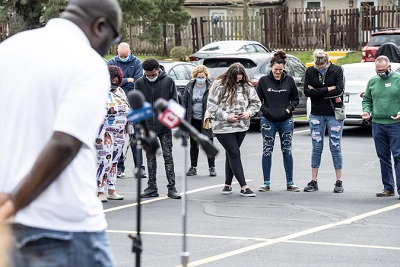
Early Saturday afternoon, DeAndra Yates, 38, who founded an anti-violence group in 2015 after her 13-year-old son Deandre was shot and injured, organized a prayer vigil in a church parking lot. “I know prayer vigils seem cliche now, but as a believer, I think prayer is our greatest weapon,” she said.

Another event organizer, Cathy Weinmann of the group Moms Demand Action, said she plans to send a letter to the governor demanding action: “‘Thoughts and prayers’ aren’t working,” she said.

An evening vigil brought even more calls for reform – and weariness.

“I have to be honest, I’ve been asking myself the same question since Thursday,” Indianapolis Mayor Joe Hogsett, a Democrat, told a crowd of roughly 200 people. “Oh, loving God, what more can we take?”

Eight candles were lit, the first one by Ryenne Beaty, a 19-year-old friend of victim Samaria Blackwell, also 19. After the shooting, she said, she waited 16 hours hoping her best friend of a decade would turn up safe.

Blackwell was “selfless, she said.

Michelle Parksey, 37, and Savana Delao, 20, were both supposed to be at work at the FedEx when the shooting occurred.

“I was on my way to work when I saw 20 cops fly be me, and for some reason I just knew they were going to FedEx,” Parksey said. “I was late, because I spent 40 minutes in the drive-through at Fazoli’s, which I was mad about, but they ended up saving my life. I would have been in the parking lot when he was shooting at cars.”

The single mom of three teenage sons said she’s thankful for every moment that she now has with her sons.

“If I would have gone to work that night, I wouldn’t have come home to my babies,” she said. “I’m all they have.”

They don’t know when employees will be able to return to work. Delao said she’s not sure she’ll be emotionally ready when the time comes. “I can just imagine in my head walking in there, and knowing bodies were laying there on the ground,” Delao said.

Delao knew Blackwell from work and said her smile and energy could light up a room.

“For someone that young to die, it’s just not fair,” Delao said. “I can’t understand it.”

Just days before the shooting, Parksey trained another victim, Karli Smith, 19, who was about to receive her first paycheck.

“She was awesome, it’s just heartbreaking,” Parksey said.

– – –

Beachum and Achenbach reported from Washington. The Washington Post’s Meryl Kornfield in Indianapolis and Alice Crites, Julie Tate, Fenit Nirappil, Hannah Knowles and Timothy Bella in Washington contributed to this report.