Climate change may be costing Russia billions every year #SootinClaimon.Com

#SootinClaimon.Com : ขอบคุณแหล่งข้อมูล : หนังสือพิมพ์ The Nation.

https://www.nationthailand.com/news/30405004

Climate change may be costing Russia billions every year

InternationalApr 18. 2021

Fog shrouds Yakutsk, which has a reputation as the world’s coldest city, on Feb. 16, 2016. The eastern Siberian city is in Sakha Republic, Russia. MUST CREDIT: Bloomberg photo by Andrey Rudakov

By Syndication Washington Post, Bloomberg · Olga Tanas, Dina Khrennikova

The residents of Irkutsk, one of Russia’s coldest regions, are used to harsh winters. But when the temperature dropped to negative -76 Fahrenheit (60 degrees Celsius) last January, even they had to submit to the elements. “Please stay at home unless absolutely necessary,” Governor Igor Kobzev pleaded on Instagram.

With the cold came the heaviest snowfall in 25 years. It blanketed Siberia, the Far East and central Russia. When temperatures starting rising at the end of March, the Ministry of Emergency Situations warned that the melting snow may cause dangerous floods.

“The unstable climate system is leading to increasing extremes, to a growing number of weather anomalies, including dangerous events,” said Anna Romanovskaya, director of the Moscow-based Yu. A. Izrael Institute of Global Climate and Ecology. “The direction of the trend is undeniable.”

Russia is one of the countries most vulnerable to climate change. A significant part of its territory is in the Arctic, which is warming more than twice as fast as the rest of the world. That’s manifested in Siberia’s unusually high 2020 temperatures, two consecutive years of record wildfires and thawing permafrost-the frozen ground that covers vast swaths of the country.

The disasters have caused expensive damage. Reinsurance broker Aon Benfield estimated that June floods near Russia’s border with China in 2019 cost the nation more than $460 million. In total, major catastrophes may have led to just under $1 billion of losses in Russia that year, it said.

“The heat wave in Siberia in 2020 and the corresponding widespread fires are renewed evidence of climate change,” said Ernst Rauch, chief climate and geo scientist at global reinsurance provider Munich Re. “We view with concern the thawing permafrost soils, which amplify global warming by releasing methane.”

Russia hasn’t developed a comprehensive system for assessing weather-related losses. Leading databases only record events with registered damage, some of the nation’s top climate scientists at its Federal Service for Hydrometeorology and Environmental Monitoring, or Rosgidromet, wrote in a 2019 paper. “Data on the losses are, for the most part, only descriptive, while monetary assessments are rare.”

The paper also cites confidentiality requirements and the lack of a developed insurance system as key hurdles to assessing the nation’s economic damage from natural catastrophes. The lack of data means current estimates for Russia’s annual weather-related economic damage by insurers, researchers and governmental bodies vary greatly.

Munich Re, which been gathering estimates of losses caused by natural disasters across the world for nearly 50 years, has only limited information on Russia’s recent annual weather-related damage. “The data quality for Russia is not sufficient,” a spokesman said.

A resident passes frozen trees, with a Russian orthodox church in the background, in Yakutsk, Sakha Republic, Russia, on Feb. 14, 2016. MUST CREDIT: Bloomberg photo by Andrey Rudakov

A resident passes frozen trees, with a Russian orthodox church in the background, in Yakutsk, Sakha Republic, Russia, on Feb. 14, 2016. MUST CREDIT: Bloomberg photo by Andrey Rudakov

The Russian climate scientists in their 2019 paper presented a mathematical model for assessing losses from only four high-impact weather events: strong wind, summer rain, winter snow and rain, and frost. According to the model, the events resulted in monetary losses of as much as $4 billion (234 billion rubles) in 2017.

Romanovskaya from the Yu. A. Izrael Institute says that calculations should go further, including not only direct but also collateral economic losses, such as damage to residents’ health and the environment. She estimates Russia’s total weather-related losses for 2019 were around 850 billion rubles, meaning working citizens paid almost 10,000 rubles each. It’s “kind of a climate tax,” she said.

The Russian government remains sanguine about the impacts of climate change. It’s the world’s biggest energy exporter and fourth-largest emitter of planet-warming greenhouse gases, yet lags other nations in taking steps to reduce its pollution.

The nation pledged to reduce greenhouse gas emissions by as much as 70% from 1990 levels by 2030, assuming that its vast forests absorb the maximum amount of carbon dioxide possible. The target is so low that Russia met it years ago and has so far expressed no desire to set a more ambitious goal. Carbon Action Tracker, a U.K.-based nonprofit, rates its policies as “critically insufficient.”

Russia is working on a national climate strategy set to be adopted this year, with recent comments from officials indicating the country aims to develop a low-carbon economy in the next decades rather than reach full carbon neutrality.

Meanwhile the warming Arctic will keep causing greater weather imbalances in the northern hemisphere, according to Yury Varakin, head of the Rosgidromet’s situation center. In recent weeks, scientists have linked higher temperatures in the Arctic to the cold spell that moved as far south as Texas, shutting down power plants and leaving residents without electricity.

Air masses “are moving more frequently from north to south or south to north” rather than in the west-east circulation that dominated during the 20th century, Varakin said. That means an Arctic blast can reach southern regions relatively quickly and Mediterranean heat can move rapidly into northern areas. “This trend will only increase irreversibly in the next 10 to 15 years,” leading to wilder swings in the weather, he said.

Asia’s richest man rebuilds a 261-year-old British icon #SootinClaimon.Com

#SootinClaimon.Com : ขอบคุณแหล่งข้อมูล : หนังสือพิมพ์ The Nation.

https://www.nationthailand.com/news/30405003

Asia’s richest man rebuilds a 261-year-old British icon

InternationalApr 18. 2021

The Hamleys toy store at the DLF Saket Avenue mall in New Delhi, on April 10., 202l. MUST CREDIT: Bloomberg photo by Prashanth Vishwanathan.

By Syndication Washington Post, Bloomberg · P R Sanjai, Chris Kay

A struggling 261-year-old U.K. toy-store chain is seeking a new lease of life in the hands of billionaire Mukesh Ambani, who’s looking to India where about a fifth of the world’s babies are born to fuel its revival.

Hamleys, a British retail icon that hasn’t made a profit for a number of years, plans to quadruple its outlets in the former British colony to more than 500 in three years despite the pandemic, according to Darshan Mehta, chief executive officer of Ambani’s Reliance Brands. Besides the main growth market, the company is also adding stores from Europe to South Africa and China, he said in an interview.

Ambani, 63, bought Hamleys in 2019 to strengthen his retail footprint as part of the ongoing transformation of his oil-and-chemicals conglomerate Reliance Industries Ltd. into a consumer and technology behemoth. The deep pockets of Asia’s richest man and India’s demographics could help breathe new life into Hamleys, whose share of global toy sales was estimated at 0.6% last year by Euromonitor International, and see it avert the pitfalls faced by rivals such as Toys “R” Us Inc.

With a backer whose net worth is $72 billion, Hamleys is seeking to tap into what it sees as an inadequately serviced section of India’s almost 1.4 billion people, of which about 27% are children under 14. The country accounts for just 1% of the $90 billion global toy industry, meaning the potential for growth is high, Mehta said.

“There is a lot of headroom and India is no way near saturation,” Mehta said. “We are now mulling how we can roll out stores in newer geographies and new formats.”

Hamleys stores are famed for the carnival-like experience, allowing children to race toy cars, enjoy model train sets and play various games. In a country like India, with its densely packed cities and limited entertainment options, such an environment could be a hook to get customers to visit again. Product prices appealing to buyers of modest means as well as the super-rich make Hamleys an “elastic brand,” said Mehta.

A street cleaning buggy moves along the pavement outside The Hamleys Group flagship store on Regent Street in London on June 11, 2020. MUST CREDIT: Bloomberg photo by Chris J. Ratcliffe.

A street cleaning buggy moves along the pavement outside The Hamleys Group flagship store on Regent Street in London on June 11, 2020. MUST CREDIT: Bloomberg photo by Chris J. Ratcliffe.

In Asia, Hamleys is seen as “high class and it’s on par with Harrods in some ways,” said Marc Alonso, a London-based senior research analyst at Euromonitor. “So it’s attracting that customer base, which is why in some places like India and China, it has been seeing some good sales growth in the past few years.”

While the pandemic has been hitting parts of India’s economy, Mehta sees the toy industry as “recession proof” because many families choose the happiness of kids over anything else.

But other chains have struggled before the virus. Toys “R” Us was the biggest victim of the U.S. retail apocalypse when it filed for bankruptcy in 2017, crushed by debt and felled by competition from online sellers such as Amazon.com. Though the American chain is on a recovery path now under a new owner, a protracted pandemic points to an uncertain future for retailers.

Nailing online sales is key to avoiding the fate of other high-end toy chains, according to Reliance. As part of Ambani’s e-commerce and technology pivot, his group is building Jiomart, a shopping portal, to take on giants such as Amazon.com and Walmart’s Flipkart in the local market. Reliance Industries has roped in Facebook Inc. and Google as investors to fuel those ambitions.

With covid-19 accelerating the group’s digital strategy, Mehta expects 30% of Hamleys’ sales coming from orders online in five years, versus 20% now. Direct selling over the phone or via WhatsApp would account for 20% in the same period, he said.

Euromonitor’s Alonso said that target may be too ambitious because some customers could go to another portal that offers cheaper prices. “You can get the same product much cheaper by going straight to Lego, for example, on their e-commerce site,” said Alonso.

A child looks at a display in a Hamleys toy store at the DLF Saket Avenue mall in New Delhi, India on April 10, 2021. MUST CREDIT: Bloomberg photo by Prashanth Vishwanathan.

A child looks at a display in a Hamleys toy store at the DLF Saket Avenue mall in New Delhi, India on April 10, 2021. MUST CREDIT: Bloomberg photo by Prashanth Vishwanathan.

Founded by William Hamley in 1760, Hamleys has seen its share of troubles. Ownership of the London-based chain has changed at least three times in the past decade alone — from an Icelandic bank to a French group and then to a Chinese fashion retailer. Two years ago, Ambani snapped it up for about $89 million in cash. Hamleys’ most recent books for 2019 show a loss of almost 9 million pounds ($12.4 million) on revenue of about 48 million pounds.

The onset of the pandemic just months after Reliance took control compounded Hamleys’ financial distress in the U.K., where it runs 21 outlets. Like most shops in the deserted streets of London, its grand seven-story Regent Street flagship store that opened in 1881 remained closed for much of the past year until recently, while it cut a quarter of its staff to weather the crisis.

Mehta believes the U.K. operations will “come out very strongly” with non-essential stores reopening this week following the easing of curbs. After 100 days of lockdown, consumers flocked to shopping streets across England on Monday. Retailers like Hamleys are hoping the pent-up demand will translate into bumper sales. Mehta said another coronavirus wave could cause temporary disruption — like delayed plans for the U.S., a market Hamleys wants to crack.

Prior to the acquisition of the chain, Reliance had the master franchise for Hamleys in India. The retail unit of Reliance is also the local partner for over 45 international brands including Burberry, Hugo Boss, Jimmy Choo and Tiffany & Co., according to the company’s website.

The pandemic has limited Hamleys’ India target to just about 50 new stores this year before the roll out picks up pace. The toy retailer is looking at outlets in the U.S. this year or next, depending on travel restrictions, as well as in tourist hot spots in European countries, including France and Italy, the Reliance executive said.

Still, India is likely to be a key market, said Arvind Singhal, chairman of Indian retail consultancy Technopak Advisors. With about 26 million children born in the country each year, Hamleys is unlikely to be short of customers there even if only the top 5% of the population can afford to shop at its store, he said.

“Toys is one category where emotions sometimes overtake your financial abilities,” said Singhal. “Hamleys is probably one of the best investments from Mr. Ambani’s point of view in retail — the visibility the Hamleys brand has in India is unparalleled.”

Afghanistan plans raise U.S. security concerns #SootinClaimon.Com

#SootinClaimon.Com : ขอบคุณแหล่งข้อมูล : หนังสือพิมพ์ The Nation.

https://www.nationthailand.com/news/30405001

Afghanistan plans raise U.S. security concerns

InternationalApr 18. 2021

By The Washington Post · Missy Ryan, Shane Harris, Paul Sonne

WASHINGTON – The military and intelligence agencies are racing to refine plans for countering extremist groups in Afghanistan following President Joe Biden’s planned troop withdrawal, but current and former officials warn it will be far more difficult to head off threats to U.S. security from afar.

Biden said the United States would reposition personnel and equipment once the Pentagon pulls its forces out of Afghanistan ahead of the 20th anniversary of the Sept. 11, 2001, attacks.

“We’ll not take our eye off the terrorist threat,” Biden said as he announced his decision, to end a war that is now America’s longest, a goal that has eluded earlier presidents.

Top Biden aides said the move, which came despite warnings from military and intelligence leaders that withdrawal could permit a diminished al-Qaida to regroup, was necessary to comply with a 2020 withdrawal agreement President Donald Trump negotiated with the Taliban, and to allow the United States to focus on more pressing challenges, like China’s military rise.

But some officials cautioned that the trade-offs for American security, especially given the anemic state of peace talks between the Taliban and Afghan government, could be steep without the constellation of military bases, arsenal of weaponry and aircraft, and network of human sources the two-decade American effort in Afghanistan has accrued.

“The reason why al-Qaida is pretty weak right now is that we’ve been putting pressure on them,” making it hard for them to attempt to regroup, said Lisa Curtis, who served as the top White House official for Afghanistan and Pakistan during the Trump administration. Without an American presence, she said, “they’re going to have the freedom to do just that.”

Curtis’ warning echoed statements from CIA Director William Burns, who told lawmakers this week that the military departure would diminish the U.S. government’s ability to detect and respond to upticks in extremist threats, also including the Islamic State. “To be honest, there is a significant risk once the U.S. military and the coalition militaries withdraw,” he said.

Pentagon officials say that preliminary repositioning plans, drawn up during a policy review Biden kicked off after taking office and during earlier debates about U.S. options in Afghanistan, will be reworked and submitted to Defense Secretary Lloyd Austin for approval.

“We’re still working out what the future bilateral relationship is going to be with Afghanistan,” Pentagon spokesman John Kirby said on Friday. “It will not include a U.S. military footprint,” he said, with the exception of a Marine force assigned to protect the U.S. embassy.

Among the biggest challenges once troops are gone will be how to effectively surveil – and potentially strike – extremist groups in Afghanistan, which is landlocked and far from any major American base. U.S. aircraft could launch flights from al-Udeid, the sprawling air base outside the Qatari capital that is the main U.S. air hub in the Middle East. But the Gulf nation’s distance from Afghanistan, compounded by the need to fly around neighboring Iran, makes it an expensive option.

Fighter jets flying from Qatar to Afghanistan require substantial aerial refueling, which if scaled up could further strain the military’s stock of aging tanker planes. More significantly, those staffed flights would occur without the on-the-ground search-and-rescue backup they now have.

Flying unstaffed aircraft like the MQ-9 Reaper from Qatar entails a six- to eight-hour round trip, reducing the time the drones can spend over Afghanistan. That means the military would need a high number of drones to attain 24-hour coverage over multiple areas of Afghanistan at a time when the Pentagon is seeking to shift surveillance resources to East Asia.

Current and former officials said the administration will likely consider closer options for drone operations, including Uzbekistan, whose Karshi-Khanabad base was a logistics hub for Afghanistan until Uzbek officials ousted the United States in 2005. While Uzbekistan is less under the sway of U.S. rival Russia than neighbors like Tajikistan, where U.S. officials say Moscow has positioned weaponry near the Afghan border, its dismal human rights record could make renewed cooperation unpalatable.

Also nearby is Pakistan, where the CIA once flew drone missions out of Baluchistan province’s Shamsi airfield until Islamabad closed it to American use during a 2011 dispute. While Pakistan has sought to show its support for Afghan peace talks, Prime Minister Imran Khan, who once led sit-ins against U.S. drone strikes, appears unlikely to approve such a move.

Pakistani leaders “want to be friends, but I don’t think there’s an eagerness to go back to old patterns,” said Husain Haqqani, who served as Pakistani ambassador in Washington and is now a Hudson Institute fellow.

Current and former officials said that major advances in surveillance technology nevertheless means U.S. visibility would be far better in Afghanistan than it was before 9/11.

“But strike options will become more limited because we won’t have a team of JSOC who can go out and do a raid,” a former defense official said, referring to elite Joint Special Operations Command operatives who have carried out missions against militant leaders.

It’s not yet clear whether the Biden administration will, as other administrations have done in the past, seek to assign a small number of troops under embassy or intelligence authority in a way that could be seen as complying with the letter, if not the spirit, of the U.S.-Taliban deal.

Some former officials pointed to the U.S. experience in Iraq following the Obama administration’s hurried 2011 withdrawal as a potential model. There, a contingent of roughly two dozen Special Operations forces stayed behind, placed under embassy control so they could continue to advise Iraq’s elite Counterterrorism Service, which U.S. troops had established after the 2003 invasion.

“That proved to be pretty decisive” when the Islamic State overran much of Iraq less than three years later, said retired Gen. Joseph Votel, who served as head of U.S. Special Operations Command and Central Command before retiring in 2019.

Votel said Biden faced “a really hard decision” in Afghanistan. “But I am concerned it may be one we come to regret,” he said.

The Biden administration has declined to publicly address how the withdrawal will impact intelligence agencies in Afghanistan, where they have played a shadowy but substantial role since 2001.

Burns and other top officials have pointed to the Taliban’s responsibility, under the terms of the 2020 U.S.-Taliban deal, for ensuring Afghanistan does not again become a launchpad for terrorist plots.

“Our expectation is they’re going to live up to their obligation and continue to ensure that al-Qaida can’t again use Afghanistan as a platform to stage external attacks,” Burns told Congress.

But it remained unclear in the days following Biden’s announcement whether that intelligence presence, which in addition to traditional spycraft includes a paramilitary operation staffed in part by military personnel who partner with Afghan counterterrorism teams, can continue their work.

Simone Ledeen, who served as a Pentagon official for Special Operations during the Trump administration, said other U.S. agencies operating in Afghanistan “are doing so off the DOD logistics backbone.”

“They’re going to be really challenged if they’re left behind, despite the fact they still have a fundamental mission to keep the homeland safe,” she said.

Mick Mulroy, a former CIA paramilitary officer who also served as a top Pentagon official for the Middle East during the Trump administration, said he understood the desire to leave.

“We’ve reduced our exposure and we’ve significantly reduced our casualties,” he said. “I just don’t think the investment of 3,000 troops is too much to keep what we’ve gained in 20 years.”

A former intelligence official said while it may be possible for the CIA, which has its own aircraft, to press on, officials might also decide it is too risky without the medical support and far greater firepower the military can provide. “I have a feeling the new director is going to say ‘Heck no. We can defend ourselves, but it’s going to be an Alamo situation,’ ” the former official said, who spoke on the condition of anonymity to discuss a sensitive matter.

The troop pullout is likely to make the job of recruiting intelligence agents more difficult, and some experts worry that Afghans who have spied for the Americans will become Taliban targets.

Marc Polymeropoulos, a retired CIA officer, recalled being in Kandahar in early 2002 some time after scores of Afghans had been hanged by the Taliban in a soccer stadium. Among them was an Afghan CIA agent, he said.

“I very quietly slipped into the agent’s family compound, and through a curtain, as I was not permitted to make eye contact with the female family members, I passed them money that the U.S. government owed our former agent,” Polymeropoulos recalled.

“I fear such scenes – bodies hung in soccer stadiums – will repeat themselves with a precipitous full U.S. withdrawal, as the Taliban takes revenge on any and all Afghans who helped the U.S. government over the last two decades,” he said.

WHO looks to facilitate Covid-19 vaccine manufacturing in low-income countries #SootinClaimon.Com

#SootinClaimon.Com : ขอบคุณแหล่งข้อมูล : หนังสือพิมพ์ The Nation.

https://www.nationthailand.com/news/30404987

WHO looks to facilitate Covid-19 vaccine manufacturing in low-income countries

InternationalApr 17. 2021

By THE NATION

The World Health Organization (WHO) and its partners are seeking to expand the capacity of low- and middle-income countries (LMICs) to produce Covid-19 vaccines and scale up manufacturing to increase global access to these critical tools to bring the pandemic under control.

The WHO will facilitate the establishment of one (or more, as appropriate) technology transfer hub(s) that will use a hub and spoke model (REF) to transfer a comprehensive technology package and provide appropriate training to interested manufacturers in LMICs. This initiative will initially prioritise the mRNA-vaccine technology but could expand to other technologies in the future, the WHO said.

The intention is for these hubs to enable the establishment of production process at an industrial or semi-industrial level, permitting training and provision of all necessary standard operating procedures for production and quality control. It is essential that the technology used is either free of intellectual property constraints in LMICs, or that such rights are made available to the technology hub and the future recipients of the technology through non-exclusive licences to produce, export and distribute the Covid-19 vaccine in LMICs, including through the Covax facility, WHO said.

Preference will be given to applicants who have already generated clinical data in humans, as such clinical data will contribute to accelerated approval of the vaccines in LMICs, the WHO said.

It is anticipated that WHO will work with funders and donors to mobilise financial support to establish the hubs and, as they are being established, to support the transfer of technology to selected manufacturers in LMICs, taking into consideration the need to establish permanent vaccine production capacity in regions where this is currently mostly absent, the WHO said. This broader objective will ensure that all WHO regions will be able to produce vaccines as essential preparedness measures against future infectious threats, it added.

To support this activity, WHO is seeking expressions of interest from:

1. Small/middle-sized (public or private) manufacturers of medical products (drugs, vaccines or drug substances) preferably, but not exclusively, in LMICs, which could host a Covid-19 mRNA hub.

2. Owners (public or private) of technology and/or intellectual property rights. These may be academic institutions, pharmaceutical companies, non-governmental organisations or any other entity willing to contribute these to a technology transfer hub, under the auspices of WHO, to enable production of mRNA-based Covid-19 vaccines in LMICs.

Entities willing to be considered as a technology transfer hub, or able to provide the necessary know-how, process training, and intellectual property rights, are invited to provide a brief summary of their capacity, and their interest in participating in the establishment of a Covid-19 vaccine technology transfer hub to: Martin Friede (friedem@who.int) and Raj Long (rlong@who.int)

White House announces it’s keeping Trump-era refugee caps, then backtracks amid furor #SootinClaimon.Com

#SootinClaimon.Com : ขอบคุณแหล่งข้อมูล : หนังสือพิมพ์ The Nation.

https://www.nationthailand.com/news/30404981

White House announces it’s keeping Trump-era refugee caps, then backtracks amid furor

InternationalApr 17. 2021

By The Washington Post · Sean Sullivan, Seung Min Kim, Tyler Pager

WASHINGTON – President Joe Biden on Friday all but abandoned a pledge to enable tens of thousands of refugees fleeing danger abroad to come to the United States this year, then abruptly backtracked after drawing a furious response from human rights advocates and fellow Democrats.

In a directive issued early Friday, the administration announced it would leave the cap on refugees at 15,000, the record-low ceiling set by President Donald Trump. But after hours of blistering criticism from allies, White House press secretary Jen Psaki reversed the announcement, issuing an unusual statement saying the order had been “the subject of some confusion.”

Psaki said that Biden would actually set the final cap – which sets the refugee allotment through the end of September – by May 15, and that while the White House expects it will be higher than Trump’s ceiling, it was “unlikely” to rise to the 62,500 that Biden had put forward with some fanfare in February.

Psaki said Biden could not keep that promise because the Trump administration had “decimated” the refugee program. But advocates dismissed that explanation as unpersuasive, saying the Biden team was more likely seeking to abandon the pledge amid concerns about the political criticism surrounding the current surge of migrants to the southern border.

“It’s deeply disappointing that the administration elected to leave in the place the shameful record low of its predecessor,” said Krish O’Mara Vignarajah, president and chief executive of Lutheran Immigration and Refugee Service, a resettlement agency working with the government.

Biden’s new decree – known formally as an emergency presidential determination – did move away from Trump-era policies by changing the regional allocation of refugees. Under Trump’s directive, strict restrictions were placed on accepting refugees from certain African and majority-Muslim countries.

The tortuous maneuvering reflected growing concern about immigration inside the White House, according to people with knowledge of the decision-making process, who cited worries about expanding the refugee program at a moment when critics are pummeling Biden with claims that he is too soft in his policies and rhetoric. The president is struggling to contain the soaring number of migrants arriving at the southern border, which has caused significant anxiety inside the West Wing, according to people with knowledge of the situation.

Some of those people pointed to Ron Klain, Biden’s chief of staff, as a driving force behind the president’s announcement that he would keep the Trump-era caps. A senior administration official denied that Klain engineered the initial decision and said instead that the chief of staff was a driving force behind Psaki’s clarification. All of these officials spoke on the condition of anonymity to discuss private deliberations.

Biden’s long-delayed decision-making has resulted in hundreds of canceled flights for refugees, including a pregnant mother who missed the window to travel, and it has cast many people into limbo who had organized their lives around coming to the United States after Biden signaled a new direction, according to advocates and Democratic lawmakers.

Biden’s directive Friday was greeted with anger from Democrats and leaders of the resettlement agencies that work with the government, some of whom equated his approach to Trump’s. The decision prompted the most forceful denunciations from his own party that Biden has experienced as president.

“This Biden Administration refugee admissions target is unacceptable. These refugees can wait years for their chance and go through extensive vetting. Thirty-five thousand are ready. Facing the greatest refugee crisis in our time there is no reason to limit the number to 15,000,” Sen. Richard Durbin of Illinois, the second-ranking Senate Democrat and a close Biden ally, said in a statement. “Say it ain’t so, President Joe.”

For all the furor, the political effect of Biden’s move was unclear. While he met a torrent of outrage from Democrats, some conservatives suggested that the impulse to hold off on a dramatic increase in refugees showed sensitivity to the politics of immigration.

“This reflects Team Biden’s awareness that the border flood will cause record midterm losses *if* GOP keeps issue front & center,” tweeted Stephen Miller, a chief architect of Trump’s hard-line immigration platform.

Republicans who have struggled to dent Biden’s popularity when it comes to his handling of the coronavirus pandemic and the economy have increasingly focused on immigration, suggesting that the president has botched the situation on the border and is responsible for an influx of migrants that is hard to control.

Biden did make some changes to Trump’s order. His revised regional allocations include 7,000 spots for refugees from Africa and 3,000 from Latin America. While those moves garnered some praise, they were drowned out by the chorus of Democrats from across the political spectrum who lambasted the president’s decision and raised concerns about whether Biden would fulfill his prior commitment to lift the cap on refugees to 125,000 beginning in October.

Underlying the stormy reaction was the feeling among Democrats that harshness toward migrants and refugees was central to what they disliked about Trump. Biden was expected to usher in a return to a more welcoming United States, one that provided a haven for suffering and persecuted people from around the world.

Biden’s initial decision Friday, to some Democrats, seemed to contradict that promise as well as the president’s rhetoric promising a more tolerant country.

Before Friday’s announcement, Senate Foreign Relations Committee Chairman Robert Menendez, D-N.J., prepared a letter to Biden, urging him to lift Trump’s refugee cap expeditiously and warning that the delay had already had “serious repercussions.” Menendez called the 15,000 limit that Biden has retained for now “appallingly low.”

Menendez was joined by prominent liberal lawmakers. “There are simply no excuses for today’s disgraceful decision,” tweeted Rep. Ilhan Omar, D-Minn., who lived in a refugee camp in Kenya as a child after her family fled civil war in Somalia.

“Completely and utterly unacceptable,” added Rep. Alexandria Ocasio-Cortez, D-N.Y.

Rep. Pramila Jayapal, D-Wash., a naturalized U.S. citizen who was born in India, issued a blistering statement calling Biden’s move “unconscionable.”

The White House acknowledged that the turbulent situation on the border played a role its decision-making process, citing the demands it has placed on the Office of Refugee Resettlement.

“We have to ensure that there is capacity and ability to manage both,” said Psaki under questioning during a briefing, referring to the border surge and the refugee pressures. White House officials said the pandemic and the challenge of rebuilding a system the previous administration shredded were also factors.

But representatives of resettlement agencies working with the government were not convinced by these explanations, pointing out that the refugee system is entirely distinct from the arrangement used to process would-be migrants at the border. Jenny Yang, vice president for advocacy and policy at World Relief, said the White House’s reasons amounted to a “completely faulty excuse.”

The U.S. refugee program is aimed at people displaced from their countries because of severe conditions such as genocide, civil war, and other political, religious or racial persecution. Admission is a multistep process that begins outside the United States. That is in contrast to the asylum program, which allows migrants to apply upon arriving at the border.

Refugees go through a vetting process that can take years. Once approved, they are often paired with organizations that work to arrange transport and resettlement in the United States. Until the Trump era, the United States regularly resettled tens of thousands of refugees annually and led the world in accepting refugees.

Presidents have broad leeway in administering the program. While they must notify congressional leaders of their plans, they do not need their approval to set annual caps on how many refugees can come. Biden delivered a speech at the State Department on Feb. 4 in which he announced his intention to move sharply away from Trump’s strict policies.

“It’s going to take time to rebuild what has been so badly damaged,” he said in the address. He announced that he would raise the annual cap on refugee admissions to 125,000 for the next fiscal year and move swiftly toward a “down payment” soon.

On Feb. 12, the State Department submitted a report to Congress on the president’s proposal for the rest of the fiscal year, which would override Trump’s directive. The report, the culmination of an interagency process including the State Department, the Department of Homeland Security and the Department of Health and Human Services, outlined how the Biden administration wanted to raise the refugee cap to 62,500 people.

In the past, signing the emergency declaration has been viewed as a formality, as the report reflects the consensus of the three agencies responsible for refugees. But Biden never signed the declaration, and people familiar with the process said they could not recall a time when a president enacted a presidential determination that was different than the report to Congress.

In early March, the State Department had to cancel flights it had booked to bring approved refugees to the country because Biden had not yet signed the presidential determination. The flights, people with knowledge of the situation said, reflected the department’s expectation that Biden would quickly sign the order to lift the cap.

The United States has accepted more than 3 million refugees since 1980, according to the State Department. That system has a history that defies political labels. Many resettlement agencies are religiously based, including some sponsored by evangelical Christians and mainstream denominations, alongside nonpartisan charitable groups.

Refugee resettlement has been a bipartisan priority for decades and at times has included strong ideological overtones, such as a Republican-backed program to resettle large numbers of Soviet Jews during the Cold War.

According to a report released recently by the International Rescue Committee, the Biden administration has admitted only 2,050 refugees at the halfway point of this fiscal year and is on pace to accept the lowest annual number of refugees of any modern president.

Biden’s backtrack is in contrast to many other areas of foreign policy and national security where the new president has pointedly reversed Trump, arguing that the United States should be a moral and humanitarian leader for the world.

“This is incredibly disappointing. The U.S. is the most powerful nation in the world and we can’t do better?” said Ali Noorani, executive director of the National Immigration Forum.

Police shooting of 13-year-old in Chicago leads to calls in the city for radical police reform #SootinClaimon.Com

#SootinClaimon.Com : ขอบคุณแหล่งข้อมูล : หนังสือพิมพ์ The Nation.

https://www.nationthailand.com/news/30404979

Police shooting of 13-year-old in Chicago leads to calls in the city for radical police reform

InternationalApr 17. 2021

By The Washington Post · Kim Bellware, Mark Guarino, Robert Klemko

CHICAGO – The fatal police shooting of a 13-year-old Adam Toledo has the city bracing for protests as a mayor who campaigned on police accountability searches for answers and progressives renew their call for “radical” police reforms.

A protest began Friday evening in Little Village, a predominantly Mexican American community on the West Side of the city where Toledo grew up, posing an earlier-than-expected challenge for a police department and a city gearing up for a potential violent reaction to the conclusion of the Minneapolis trial of Derek Chauvin, whose killing of George Floyd last year ignited nationwide protests.

On Thursday, Chicago authorities released police body camera and surveillance footage of Officer Eric Stillman chasing Toledo on March 29 then firing a bullet into his chest. Toledo died at the scene despite the efforts of Stillman and other responding officers to revive him.

The video shows Toledo, who is Latino, carrying an object police say was a firearm during the chase, but tossing it behind a fence and raising his hands in the split-second before he is fatally wounded. Police spokesman Tom Ahern described the shooting as an “armed confrontation” in a tweet on the day of the killing.

“At the time Adam was shot, he did not have a gun. OK?” said Toledo’s family’s attorney, Adeena Weiss-Ortiz, at a news conference Thursday. “If he had a gun, he tossed it.”

In early April, in the wake of Toledo’s killing but before release of the videos, Chicago Mayor Lori Lightfoot, a Democrat, had called for reform of the department’s foot chase policy.

Lightfoot said she found the video incredibly difficult to watch. “I say that not only as a mother of a 13-year-old myself but as a mother who is deeply passionate about protecting our young people,” she said Thursday. “We all must proceed with deep empathy and calm and importantly, peace.

“This is an important moment for us to take stock, to listen, and then to reinvest in strategic ways that will really improve the quality of young people’s lives,” she said.

Illinois state Rep. La Shawn Ford, a Democrat whose district includes the far West Side of Chicago, said Lightfoot must embrace radical police reform now.

“This was bound to happen,” said Ford, “because we have not been strong enough in fighting for and implementing reforms in the city of Chicago. And it will happen again.

“We’re going to need a mayor to understand that we need radical changes in . . . policing in Chicago. She has to make sure she puts policies in place that control behaviors . . . or people will lose their children. This is like a war on the family and the community.”

Ford has been calling for critical race theory education for law enforcement officers, many of whom have “never ever lived around Black people or Brown people, yet they spend most of their day overseeing them in their eyes.” Critical race theory, in part, says that institutions such police departments are inherently racist.

Ford along with Illinois’ House Black Caucus of 30 legislators have pushed for an end to qualified immunity for police with a bill that opens up individual officers to civil litigation if they violate individual rights. The measure also would require local municipalities to disclose information about settlements resulting from law enforcement violations. The bill passed the House Restorative Justice Committee in late March.

Others are skeptical of what they see as incremental efforts to change the police.

“We are in a position where we’re trying to move the discussion toward real systemic change, not more reform,” said Chicago activist Ja’Mal Green, who participated in a protest outside the Chicago police headquarters on the South Side on Friday. “Policing in America doesn’t work. The system of policing must be taken down and we must start over.”

The Invisible Institute, a journalism nonprofit which tracks officer complaints and other police data in Chicago, said Stillman, who is White, has had three complaints filed against him since 2017 and four use-of-force reports in that span.

Stillman, who joined the department in 2015, is assigned to the 10th district on the city’s predominantly Black and Latino West Side. The complaints against him were for search-related conduct, according to the records. One complaint was determined “unfounded,” one was closed with no finding and a third is pending investigation. In the use-of-force reports, all four subjects were Black men in their late 20s or older.

Several hundred protesters who rallied in Little Village Friday evening carried signs and banners calling for ‘Justice for Adam,’ Lightfoot’s resignation and the abolition of the police department. Families of people who were killed by the department shared their stories and rallied support for continued pressure on police and city officials.

Sandra Nevarez, whose son of Marc Nevarez was fatally shot by police in October, pleaded for officials to let young people suspected of wrongdoing have their day in court. “Illinois doesn’t have the death penalty. Is [the Chicago Police Department] now the death penalty?” Nevarez asked the crowd. “Let these kids go to court. Let them defend themselves. Let them bury their parents, not the parents bury their kids.”

According to a public opinion survey by the Chicago Index taken in March before Toledo’s shooting, 73% of respondents indicated they thought the city is on the “wrong track” while just 16% of respondents rated Lightfoot’s performance as “excellent or good.”

The Chicago Police Department fared slightly better in the survey, with 37% of respondents saying they were “satisfied or very satisfied” with the police force.

India Jackson, 20, said people in the Chicago’s youth activist community are struggling ahead of Friday night’s protests.

“Everyone is drained that this keeps happening,” said Jackson, who leads communications for GoodKids MadCity, a youth-organized group on the city’s South and West Sides that is among the organizers of Friday evening’s protest. “But this is a different type of heartbreak because Adam Toledo was a child.”

Groups like GoodKids MadCity are pushing for the defunding and eventual disbandment of the Chicago Police Department.

Jackson said she was “floored” when news emerged in February that Lightfoot had spent $281.5 million in federal covid-19 relief money on personnel costs for CPD, a move that angered not only activists but progressive members of the Chicago City Council. The city’s budget department said money went to officers who staffed airport coronavirus screenings, a virus field hospital at McCormick Place, virus testing sites across the city and resident wellness checks.

“Criticism comes with the job of mayor but this one’s just dumb,” Lightfoot told reporters at the time.

Jackson said, “We want [city leaders] to invest those funds into our community: schools, housing, food banks, medical centers. People are suffering from poverty and the CPD is sitting on a billion dollars.”

There has not been a critical mass of calls for Lightfoot to resign in the same way former mayor Rahm Emanuel faced widespread condemnation over his handling of the video release in the 2014 police shooting of Laquan McDonald, a landmark shooting in the rise of the Black Lives Matter movement.

American, Georgetown universities join growing list of campuses to require coronavirus vaccines #SootinClaimon.Com

#SootinClaimon.Com : ขอบคุณแหล่งข้อมูล : หนังสือพิมพ์ The Nation.

https://www.nationthailand.com/news/30404978

American, Georgetown universities join growing list of campuses to require coronavirus vaccines

InternationalApr 17. 2021

By The Washington Post · Lauren Lumpkin

WASHINGTON – American and Georgetown universities joined a growing list of universities this week in requiring students who return in the fall to get a coronavirus vaccine.

As vaccine eligibility expands and schools come closer to reopening for the fall, at least a dozen campuses have shared plans to mandate vaccines. Some, including Georgetown and AU, are also considering requirements for faculty and staff.

But the announcements have raised questions over the validity of such requirements, as well as access. International students, particularly in countries where coronavirus vaccines are not widely available, could run into challenges securing inoculations, college leaders acknowledge.

Despite the potential obstacles, the announcement at American was met with excitement, said Eric Brock, a junior and student body president. He said students have encouraged the university to enact a mandate.

“Personally, I feel safe coming back to campus knowing that those vaccines are going to be required,” said Brock, who has been taking classes remotely from his home in Phoenix. “I couldn’t be happier.”

AU president Sylvia Burwell, who served as health and human services secretary under President Barack Obama, said Wednesday that vaccines will be an important piece of the school’s plan to reopen campus in the fall.

“While public health measures like face coverings and physical distancing will likely be part of our fall operations, robust vaccination in our community will enable us to expand activities and interactions that enrich the educational, research, and social experiences that are fundamental to AU,” Matthews wrote in a statement.

Like other schools that have unveiled vaccine requirements, AU will make exceptions for students with medical or religious reasons, Burwell said.

While schools are expecting students to be inoculated for the fall, many students in other countries do not have access to vaccines that have been authorized in the U.S., Burwell said. Officials are determining how to handle those cases, she said.

International students who have not yet received vaccines will be directed toward clinics in the U.S. when they arrive in the fall, according to Burwell.

Georgetown shared similar guidance with international students, according to a message sent to the community this week.

Vaccine requirements have gained popularity in recent weeks as access in the United States has widened. Every adult is expected to be eligible for a shot by Monday.

Universities are hopeful that students will secure their doses by the time school starts in late summer.

Eric Feldman, a law professor at the University of Pennsylvania’s Carey Law School, said he believes schools have legal standing should their mandates be challenged.

“It may not be unambiguous in the legal text that universities can require the vaccination of students, but I think we have many, many years of precedent,” Feldman said.

A student sued the University of California in 1925, claiming he met all the school’s attendance requirements, except for the smallpox vaccination mandate. A judge sided with the university. A 2015 California law that required vaccines for schoolchildren withstood legal challenges as well.

Feldman called the pushback about the coronavirus vaccines’ emergency authorization “overblown.”

“The FDA didn’t provide emergency-use authorization at the last minute without having a very robust set of data that demonstrates the safety and efficacy of the vaccine,” Feldman said. “In terms of emergency-use authorization, the universities are on pretty safe ground.”

More schools are expected to join AU and Georgetown. Maryland’s attorney general recently advised that the state’s university system can legally mandate vaccinations, according to a letter sent to state Sen. James Rosapepe, D-Prince George’s, whose district includes the University of Maryland at College Park.

A decision has yet to be announced but Jay Perman, the system’s chancellor, told the Board of Regentson Fridaythat he supports the notion of requiring returning students to have vaccines.

He cited difficulties enforcing social distancing in residence halls, and said students risk spreading the virus through their interactions in classes, during extracurricular activities and at gatherings.

“I’ve already said that widespread vaccination is the way to resume some semblance of normal operations this fall,” Perman said.

NIH cuts fetal tissue research restrictions #SootinClaimon.Com

#SootinClaimon.Com : ขอบคุณแหล่งข้อมูล : หนังสือพิมพ์ The Nation.

https://www.nationthailand.com/news/30404977

NIH cuts fetal tissue research restrictions

InternationalApr 17. 2021

By The Washington Post · Amy Goldstein

WASHINGTON – The National Institutes of Health on Friday removed restrictions that the Trump administration imposed on research using fetal tissue, allowing university researchers and government scientists freer rein to use material from elective abortions when studying diseases and possible treatments.

A brief update for outside scientists from the NIH director’s office said the Department of Health and Human Services was reversing a 2019 decision that had required applicants for federal grants and contracts involving fetal tissue to undergo an extra layer of review by an ethics advisory board.

In a separate notice emailed Friday, NIH told its internal scientific and clinical directors that it was lifting a Trump-era ban on using federal money to buy human fetal tissue for biomedical studies by government employees.

The announcement, foreshadowed the day before by HHS Secretary Xavier Becerra, marks a profound shift in science policy and social values from former president Donald Trump to the three-month-old Biden administration.

The White House remained silent Friday about NIH’s move. Yet rescinding the restrictions on federal support for fetal tissue research conforms to the oft-stated pledge by President Joe Biden and his top health advisers – largely in the context of trying to defeat the coronavirus pandemic – that they will place primacy on science.

Two years ago, the question of whether government money should continue to be invested in studies relying on cells from aborted fetuses became a major collision point between social conservatives and the nation’s scientific community.

In 2019, Trump overrode the advice of his HHS secretary, Alex Azar, by blocking the use of NIH funds to purchase fetal tissue for use in government research labs. For outside researchers, the ban was less explicit, saying any application for a NIH grant or contract involving fetal tissue would need to be screened by a new ethics advisory board, if the application was deemed worthy on its scientific merits.

The Trump administration did not form the panel for about a year. When it did, most of its members strongly identified with opposition to abortion. The board convened once last summer before disbanding. It reviewed 14 proposals and recommended rejecting all but one.

Behind the scenes, senior figures at NIH were known to disagree with the two-part restrictions, though they did not speak against them publicly.

NIH’s actions Friday rescind the central parts of the Trump-era policy but do not entirely restore rules to the way they had been. The 2019 rules compelled academic and other outside scientists applying for grants or contracts to start including extensive justification of why human fetal tissue was needed for the work and why other research methods were inadequate. Scientists complained the justification took up too much space in grant proposals and contract applications with a length limit.

Friday’s changes leave in place the requirement for that extensive justification, according to proponents and opponents of the rewritten rules.

The policy change immediately flipped the politics surrounding federal fetal tissue policy. Scientists and their representatives who decried the Trump administration rules are celebrating their demise. Meanwhile, abortion opponents who advocated the last administration’s policy Friday are bemoaning that it is now abandoned.

“The scientific community appreciates that the Biden administration is lifting the arbitrary restrictions on promising biomedical research using human fetal tissue,” Christine Mummery, president of the International Society for Stem Cell Research, said in a statement. Saying that NIH should be “insulated from political interference,” Mummery said Friday’s actions were a “return to evidence-based policymaking.”

Lawrence S.B. Goldstein, a senior researcher at the University of California at San Diego and the only member of the Trump administration’s ethics advisory board who has used fetal tissue in his work, said, “It’s an unqualified win. . . . Hopefully, all those great research projects will come back that were killed by the ethics advisory board.”

Goldstein said, “I hope we are not going to enter an era of policy yo-yo as we change administrations,” but he added, “For the moment, I am happy.”

On the other hand, Tom McClusky, president of March for Life Action, an antiabortion advocacy group, said the research that the new rules will help permit “is a gross violation of human dignity. . . . The government has no business creating a marketplace for aborted baby body parts.”

Tony Perkins, president of the like-mindedFamily Research Council, condemned Becerra as “a fanatical advocate for abortion.”

David Prentice, another member of the ethics advisory board and research director of the antiabortion Charlotte Lozier Institute, said, “It’s a sad turn of events. . . . Now, taxpayer funds will be used for research that is poor ethics and poor science. We’ve just backed away from any sort of ethical consideration around this issue.”

Prentice said that under Friday’s turnabout, “We’re trafficking in aborted fetal tissue for antiquated experiments.” He contended that fetal tissue is less effective in research than adult stem cells, artificially grown groups of cells known as organoids and other material not derived from aborted fetuses.

Asked whether Lozier or other organizations opposed to fetal tissue research might legally challenge the Biden rules, Prentice said, “At this point, we are reviewing all possible avenues.”

The role of fetal tissue in biomedical research extends to the 1950s, when Swedish researchers developed a polio vaccine by using fetal cells. In the late 1980s, scientists developed the technique of breeding mice with deficient immune systems and transplanting into them small amounts of immune system tissue from aborted fetuses.

These “humanized” mice grow the equivalent of a human immune system. They have become crucial lab animals in studying several major diseases, including therapies for HIV, cancers, neurological problems, sickle cell disease and eye disorders. NIH, by far the largest funding source for biomedical research in the United States, has paid for most of this work. Last year, a federal researcher was blocked from using fetal tissue to try to develop treatment for covid-19, the disease caused by the coronavirus.

Friday’s updated NIH guidance for outside researchers said HHS and NIH “will not convene another NIH Human Fetal Tissue Research Ethics Advisory Board.” It said researchers applying for federal grants or contracts involving work with fetal tissue still must obtain consent from the tissue’s donor, may not pay for such tissue and must follow all other federal, state or university requirements.

For scientific studies undertaken by government employees, a one-paragraph email from Michael M. Gottesman, NIH’s deputy director for “intramural” – or internal – research said guidelines “will return to their previous state.” Human fetal tissue, the email said, “may again be used” in NIH’s laboratories.

Work that requires new purchase of fetal tissue “from all previously-approved sources may be conducted,” the notice said. Projects approved for use of fetal tissue before June 2019, when Trump changed the rules “will be reinstated without further review.”

The Biden administration has been making piecemeal changes to conservative health-related policies of its predecessors.

In February, federal health officials rescinded a Trump administration policy allowing states to ask for permission to require some low-income residents to work or prepare for jobs to qualify for Medicaid. Instead of cutting back on efforts to urge Americans to enroll in Affordable Care Act health plans, the current administration created an unprecedented extended sign-up period, then lengthened it from three months to six months.

Biden officials had not publicly discussed a pending change in the rules for fetal tissue research until Thursday. Testifying at a budget hearing on Capitol Hill, Becerra said an announcement from NIH was imminent, and he made clear the direction it would take, thought not the details.

“We believe that we have to do the research it takes to make sure that we are incorporating innovation and getting all of those types of treatments and therapies out there to the American people,” Becerra said.

Hong Kong schools devote a day to China’s national security #SootinClaimon.Com

#SootinClaimon.Com : ขอบคุณแหล่งข้อมูล : หนังสือพิมพ์ The Nation.

https://www.nationthailand.com/news/30404940

Hong Kong schools devote a day to China’s national security

InternationalApr 16. 2021Students raise the Chinese national flag during a ceremony marking the National Security Education Day at a school in Hong Kong on April 15. MUST CREDIT: Bloomberg photo by Chan Long Hei.Students raise the Chinese national flag during a ceremony marking the National Security Education Day at a school in Hong Kong on April 15. MUST CREDIT: Bloomberg photo by Chan Long Hei.
By Syndication Washington Post, Bloomberg · Kari Lindberg, Iain Marlow, Chloe Lo

Hong Kong marked its first National Security Education Day since last year’s imposition of sweeping national security legislation by Beijing, as the government ramps up efforts to overhaul the school system and instill patriotism in the city’s populace following the protests of 2019.

Schools across the city were mandated to hold events including singing the Chinese national anthem and raising flags. In addition, giant billboards promoting the event have been plastered across the city, while the police held an open day where they displayed professional drills, anti-terrorism exercises and displayed armored vehicles.

While mainland China has celebrated such a day since 2016, this is the first time the semi-autonomous financial hub is marking the occasion. The city’s government is required, under the national security law that was drafted in Beijing and forced on the city with no meaningful local debate, to “promote national security education in schools and universities.”

The shift to a forceful inculcation of national security issues, even among young children, comes as Beijing increases its control over almost all sectors and institutions in Hong Kong. In its most recent move to stifle political dissent, China’s top legislative body approved an overhaul of the city’s already limited elections to give authorities an effective veto over any potential opposition candidate.

Carol Chan, an events manager who has children aged three and five, said of the new curriculum, “Would you teach a kindergarten kid how much money to put into the bank? They are only counting coins. It’s insane.”

Beijing believes that Hong Kong’s insufficiently patriotic youth were responsible for the sometimes violent protests throughout 2019 and the national security education day is one way of trying to shape nationalistic students, said Ivan Choy, a senior lecturer at the Chinese University of Hong Kong.

“They think that one of the major sources of instability is from the students, the young people, so they will put more efforts on this aspect,” said Choy, who studies Hong Kong politics. “They have put more patriotic education in, and they have tried to punish or discipline teachers in secondary schools.”

As the city prepared to mark the occasion, China’s state media also published several articles about citizens who had allegedly compromised national security. These include a Shanghai real estate tycoon who allegedly financed “anti-China” activists in Hong Kong, a mainland student who became supportive of the city’s protests and a migrant worker who allegedly photographed a military port in the southern city of Shantou for foreign spies.

The day began with a formal ceremony featuring top officials of the Hong Kong government. Also in attendance were Zheng Yanxiong, head of the secretive agency China created to implement the controversial security law that was condemned by major Western governments, and Major General Chen Daoxiang, head of the People’s Liberation Army garrison in the city.

In a speech, Luo Huining, Beijing’s top official in Hong Kong, said, “Any attempt by foreign countries and external forces to flagrantly interfere in the affairs of Hong Kong, and to exploit Hong Kong as a pawn will be met with impactful countermeasures.”

Schools held a number of events, including what the government called a national security themed bulletin board design competition at a primary school.

“To support the theme and objectives of the National Security Education Day, the school has arranged flags to be raised,” one local secondary school said in an email to parents that was seen by Bloomberg. “In addition, there is a set of displays near the school office with details on National Security and some Q&A posted for information.”

Hong Kong students also took part in what a government press release called “Together We Safeguard Our Nation and Homeland – Community Mosaic Wall,” where students put stickers with “smiling faces” onto a display board — reminiscent of the Lennon Walls which protesters built around the city during the 2019 protests exhibiting protest slogans and artwork.

Bookmarks distributed to students days before the event list a host of topics linked to national security, including “polar security,” “deep sea security” and “ecological security.”

There were limited public displays of opposition in a city where social-distancing restrictions and the national security law have made once raucous protests almost disappear entirely. Four activists led a small protest in the city’s Wan Chai neighborhood, according to local broadcaster RTHK.

The city has identified education, along with media and the judiciary, as key sectors that need to be brought to heel, after students played a key role in the city’s protest movement. Beijing has urged Hong Kong to eliminate the alleged “black hands” influencing its schools, intimating that foreign forces have helped foment societal unrest.

International schools seem to be exempt from participating in National Security Education Day. According to the South China Morning Post, the English Schools Foundation, which operates a group of international schools in Hong Kong, told parents in February that it would still have autonomy over its curriculum.

However, the city’s Education Bureau stressed that international schools still need to prevent “teaching or other school activities” that breach the security law, as well as ensure students “acquire a correct and objective understanding and apprehension of the concept of national security and the National Security Law.”

The government’s website promoting national security day has only been made available in Chinese.

Representatives of multiple of the city’s international schools didn’t immediately respond to requests for comment about how they would handle the day’s events. A spokeswoman for the ESF declined to comment.

Hong Kong told schools in February to start using a more patriotic curriculum and advised teachers to report breaches of the national security law. Children starting from around kindergarten age will be taught to memorize offenses under the law, including subversion, secession, terrorism and collusion with foreign powers.

Loha Tse, who works as a hotel manager and is parent to a four-and-a-half year old, said her child received a sticker last week promoting the event.

“It makes no sense to force these things on to kids so young,” said Tse.

German institutes cut 2021 GDP forecast on longer lockdowns #SootinClaimon.Com

#SootinClaimon.Com : ขอบคุณแหล่งข้อมูล : หนังสือพิมพ์ The Nation.

https://www.nationthailand.com/news/30404939

German institutes cut 2021 GDP forecast on longer lockdowns

InternationalApr 16. 2021

By Syndication Washington Post, Bloomberg · Birgit Jennen, Carolynn Look

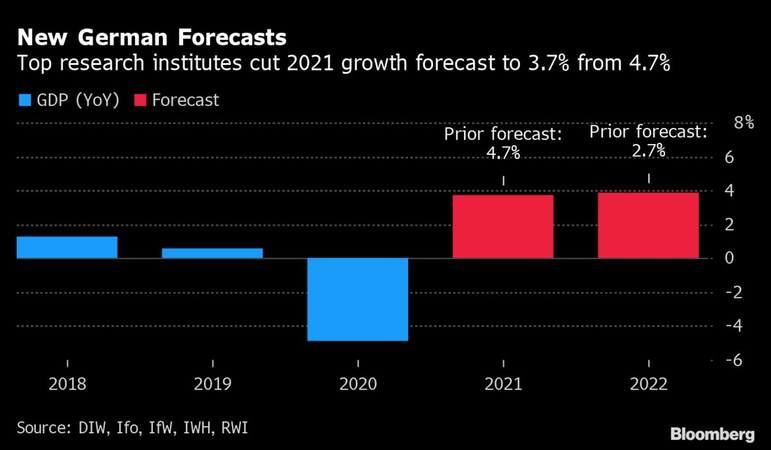
Germany’s leading research institutes cut their joint 2021 growth forecast for Europe’s biggest economy as prolonged lockdowns hold back the nation’s recovery.

The downgrade to a 3.7% expansion in gross domestic product, from 4.7% previously, reflects a sluggish vaccination campaign which has forced the government to extend virus restrictions. The outlook for 2022 was upgraded to 3.9% from 2.7%.

The economy likely shrank by 1.8% in the first quarter of this year, Torsten Schmidt, Economic Director of RWI Leibniz Institute for Economic Research, said in the report.

Germany has struggled to control a third wave of infections, and Chancellor Angela Merkel is seeking to impose even harsher curbs in virus hot spots. The institutes said they don’t expect rules to be loosened again until the middle of the second quarter, and that restrictions will likely remain in place until the end of the third quarter.

The twice-yearly outlook is prepared for the economy ministry by the DIW, Ifo, IfW, IWH and RWI institutes, and helps guide the government’s own forecasts and budget planning.

The government’s forecast is for growth of 3% this year, after a contraction of around 5% in 2020, and it expects a return to pre-pandemic levels of output in mid-2022. The economy ministry has said the signs point to a recovery over the rest of this year, and that a pickup in the pace of inoculations is fostering confidence.

Economy Minister Peter Altmaier said Thursday that he’ll publish an update to the government’s forecasts on April 27, and the prediction for this year would likely be “well above the previous forecast.”

“In particular, manufacturing is currently robust,” he said in an emailed statement. “However, we still have major problems in the area of retail and services,” he said.

Merkel’s ruling coalition has made tens of billions of euros available to offset the economic impact of the pandemic, and Finance Minister Olaf Scholz said Thursday it’ll continue to help businesses and households for as long as necessary.

“We must ensure that we can support companies and jobs with financial aid until the end of the crisis,” Scholz said during a lower house of parliament debate on the his supplementary budget for this year.

“We can afford to finance everything that is needed,” he said, adding that Germany’s budget will be in better shape than other countries after the crisis thanks to sensible policies in the past that laid a solid foundation.