U.S. could have 300 million extra vaccine doses by end of July, raising concerns over hoarding #SootinClaimon.Com

#SootinClaimon.Com : ขอบคุณแหล่งข้อมูล : หนังสือพิมพ์ The Nation.

https://www.nationthailand.com/news/30404938

U.S. could have 300 million extra vaccine doses by end of July, raising concerns over hoarding

InternationalApr 16. 2021

By The Washington Post · Adam Taylor, Emily Rauhala

The United States is on track to have gathered an oversupply of hundreds of millions of coronavirus vaccine doses as soon as July, even while many countries in the developing world will have to wait years to vaccinate a majority of their populations, according to a report by the Duke Global Health Innovation Center.

https://www.washingtonpost.com/video/c/embed/3cadc601-82a1-44fc-b2e7-c164d2799130?ptvads=block&playthrough=false

The new estimates, included in the paper alongside recommendations, come as the Biden administration faces mounting pressure to facilitate equitable vaccine distribution around the world. The United States has pledged money to the global immunization effort, but has resisted calls to share vaccine technology or donate surplus doses.

On Thursday, Secretary of State Antony Blinken held a fundraising event for Covax, a World Health Organization-backed push to distribute coronavirus vaccines, particularly to low- and middle-income countries, and called on other nations to do more.

Covax aims to secure and distribute enough vaccine to reach up to 20% of the population in 92 participating target countries by the end of 2021. In February, the Biden White House pledged up to $4 billion in support, reversing a Trump administration decision to opt out.

At a virtual event on Thursday, Blinken urged countries to give more, saying an additional $2 billion could help Covax reach 30%, rather than 20%, of target populations this year. “Just think for a moment of all the people whose lives would be impacted by hitting that higher target.” he said.

The secretary of state said countries must support vaccine manufacturing, but stopped short of announcing any specific policies or plans. He did not address the issue of surplus U.S. doses.

On Wednesday, Oxfam released a letter signed by more than 100 former heads of state and Nobel laureates calling on President Joe Biden to waive intellectual property rules for coronavirus vaccines and “put the collective right to safety for all ahead of the commercial monopolies of the few.”

“Leadership from the US on safe, effective, and equitable global access to Covid-19 vaccines is imperative,” the Duke paper argues, pushing for Washington to increase funding for vaccine-sharing programs, and to donate excess doses and use its clout to open up vaccine manufacturing.

Another proposal, put forward in a letter backed by the Center for Strategic and International Studies (CSIS), calls for the United States to donate 10% of its excess doses over the summer, moving to 50% by the end of the year, and argues that Biden should deliver a speech this spring to make the case to the American people.

Under the leadership of Gayle Smith, Blinken’s new coordinator for global coronavirus response and health security, the ONE Campaign, a nonprofit organization, called on wealthy countries to donate 5% of their surplus doses once they’ve vaccinated 20% of their populations.

The proposals come just after the United States surpassed that 20% target -and as the virus spreads uncontrolled in much of the world and more-virulent variants continue to take hold.

The United States will probably have “at least 300 million excess doses or more” by the end of July, the Duke paper’s authors estimate, even as vaccination programs are extended to the vast majority of U.S. children.

The estimate is based on the assumption that the vaccine developed by AstraZeneca receives emergency-use authorization and the Johnson & Johnson vaccine is used widely, despite rare side effects.

The oversupply in the United States forms a stark contrast with the situation in many poorer parts of the world, where vaccination programs have been slow to begin amid problems with supply and distribution, and could ultimately prolong the pandemic and hamper a U.S. recovery.

The Biden administration has pledged to donate doses. “If we have a surplus, we’re going to share it with the rest of the world,” Biden said last month, when pressed on the issue. “We’re going to start off making sure Americans are taken care of first, but we’re then going to try to help the rest of the world.” And Blinken has made the case that protecting Americans requires international action. “This pandemic won’t end at home until it ends worldwide,” he said at a news conference on April 5. But no global plan to donate doses has been specified.

The world’s poorest 92 countries will not be able to reach a vaccination rate of 60% of their populations until 2023 “or beyond” if current distribution trends continue, the Duke paper estimates.

The authors include former U.S. officials such as Mark McClellan, who served as commissioner of the Food and Drug Administration under President George W. Bush, as well as Krishna Udayakumar, founding director of the Duke Global Health Innovation Center.

Their recommendations echo the concerns from other public health experts worldwide, including World Health Organization Director General Tedros Adhanom Ghebreyesus, who called vaccine-distribution plans that focus only on domestic issues a “self-defeating strategy [that] will cost lives and livelihoods.”

French President Emmanuel Macron in February pushed for the United States and Europe to donate up to 5% of secured vaccine doses, although the idea has not gained significant momentum.

Covax is just one part of the broader Access to COVID-19 Tools (ACT) Accelerator, a broader plan that has a funding gap of more than $22 billion.

Even if Covax were fully funded this year, it would be able to vaccinate only a quarter of the populations in the world’s 92 poorest nations, according to the Duke paper.

Although many experts think the United States needs to do more to ensure that the developing world can vaccine faster, they differ on approach.

While the letter spearheaded by Oxfam called on the United States to back a temporary waiver of World Trade Organization intellectual property rules, breaking vaccine monopolies, the Duke experts argued that such a measure is unnecessary and could prove chaotic.

Instead, they propose that the United States should back the use of cooperative licensing arrangements to increase manufacturing capacity, so that production can be scaled up quickly but safely.

The Duke authors also state that although U.S. contracts with drug manufacturers may restrict donations of excess doses, the Biden administration could modify its contracts and could provide “loans” of currently available vaccine doses (as it has done with Mexico and Canada). It also could shift the timing of vaccine deliveries so more-needy countries receive their doses first.

Both the Duke and CSIS proposals noted that although the AstraZeneca vaccine does not have emergency-use approval in the United States, it could be used in other countries. The United States has purchased 300 million doses of the AstraZeneca vaccine alone.

Spring wave of coronavirus crashes across 38 states as hospitalizations increase #SootinClaimon.Com

#SootinClaimon.Com : ขอบคุณแหล่งข้อมูล : หนังสือพิมพ์ The Nation.

https://www.nationthailand.com/news/30404937

Spring wave of coronavirus crashes across 38 states as hospitalizations increase

InternationalApr 16. 2021A heart emblazoned with a hopeful message appears at American Coney Island in Detroit. The popular tourist site is closed during Michigan's stay-at-home order during a coronavirus surge. MUST CREDIT: Photo by Nick Hagen for The Washington Post.A heart emblazoned with a hopeful message appears at American Coney Island in Detroit. The popular tourist site is closed during Michigan’s stay-at-home order during a coronavirus surge. MUST CREDIT: Photo by Nick Hagen for The Washington Post.
By The Washington Post · Joel Achenbach, Jacqueline Dupree

The coronavirus pandemic in America has turned into a patchwork of regional hotspots, with some states hammered by a surge of infections and hospitalizations even as others have seen the crisis begin to ease. The spring wave of the pandemic has driven hospitalizations above 47,000, the highest since March 4.

Thirty-eight states have reported an increase during the past week in the number of people hospitalized with covid-19, the illness caused by the virus, according to a Washington Post analysis of data provided by the Department of Health and Human Services.

But the national statistics fail to capture the intensity of the coronavirus emergency in the hotspots. Michigan reported more than 10,000 new infections on Tuesday alone. The state on Wednesday reported an average of 46 deaths a day, up from 16 a month earlier.

“We’re still climbing, unfortunately,” said Nicholas Gilpin, system medical director for infection prevention at Beaumont Health, which runs eight hospitals in the Detroit area and has more than 800 patients hospitalized.

Michigan officials have pleaded with the White House for more vaccine doses, but the Biden administration has said it will stick to allocations based on state populations. Administration officials stressed that vaccines aren’t rapid-response tools for outbreaks.

“What we need to do in those situations is shut things down,” Rochelle Walensky, director of the Centers for Disease Control and Prevention, said Monday. “We need that vaccine in other places. If we vaccinate today, we will have, you know, impact in six weeks, and we don’t know where the next place is going to be that is going to surge.”

Along with Michigan, 32 other states have also registered increases in infections in the past two weeks, including all the states along the Great Lakes from Wisconsin to Pennsylvania. Minnesota and South Dakota are also up, making the Upper Midwest the major regional center of the spring wave. If there’s a single broad trend, it’s that the northern tier of the country is generally faring worse than the southern – for the moment.

Other regional hotspots include Maine and New Hampshire in northern New England; Delaware and Maryland in the mid-Atlantic; Colorado, Arizona and Nevada in the Mountain West; and Oregon and Washington in the Pacific Northwest.

By contrast, much of the Deep South, with the exception of Florida and Georgia in recent days, has reported sharp decreases. Since the winter wave ended, West Texas and the Great Plains have seen improving numbers.

“The spring wave has not had a huge amplitude nationally, but has been very regional,” said David Rubin, director of PolicyLab at Children’s Hospital of Philadelphia.

He and his colleagues have pointed to weather and seasonality as a factor in infection rates, with warmer and lengthening days supporting less virus transmission.

“There’s a clear latitude effect. If you go up into Canada, they’ve been having a really hard time,” he said.

The vaccination campaign appears to have altered the demographics of hospitalizations: With a large majority of elderly people now inoculated, the average age of patients has dropped. Gilpin, of Beaumont Health, said patients are generally less ill than in previous phases of the pandemic.

As of Thursday, more than 76 million people in the United States had been fully vaccinated. The vaccines are not foolproof, however – something known since the first results emerged from clinical trials. The CDC said Thursday that 5,800 cases of post-vaccination “breakthrough infections” have been reported nationwide. That’s fewer than 1 in every 13,000 vaccinations.

Of those breakthrough cases, 29% were asymptomatic and 7% required hospitalizations. CDC spokeswoman Kristen Nordlund said 74 of those vaccine recipients who had breakthrough infections died.

Separately, officials in the state of Washington reported Wednesday that 217 people among the 1.7 million fully vaccinated there had suffered breakthrough infections. Five deaths among patients ranging in age from 67 to 94, all with multiple underlying conditions, are under investigation, the state department of health said.

Anthony Fauci, President Joe Biden’s chief medical adviser on the pandemic, said during Monday’s White House task force news conference that there are two distinct types of vaccine failure.

“Primary vaccine failure” is when the body doesn’t mount a robust immune response. That could be caused by poor health, age, medication or something wrong with the vaccine. “Secondary vaccine failure” is when immunity fades over time, or if the person is exposed to a different virus strain.

“However, even if a vaccine fails to protect against infection, it often protects against serious disease,” Fauci said.

The CDC said these breakthrough infections were seen in all age groups. Women accounted for 65% of reported breakthrough cases. The CDC did not break down the cases by vaccine type.

“To date, no unexpected patterns have been identified in case demographics or vaccine characteristics,” Nordlund said. She added that the CDC continues to advise vaccinated people to take precautions in public places, such as wearing masks, maintaining social distancing, and avoiding crowds and poorly ventilated places.

The nation appears to be moving forward, if not always smoothly, toward its goal of crushing the pandemic. By the end of the week, the United States is poised to reach the milestone of 200 million vaccine shots into arms, and the now-rapid pace of inoculations among the most vulnerable populations is driving down mortality rates from covid-19.

But vaccine hesitancy is much on the mind of public health officials. In coming weeks, the supply of doses may outstrip demand. Biden administration officials said Wednesday the country is averaging 3.3 million vaccine doses a day. On Wednesday, the government reported only 2.5 million vaccine doses administered – even though that included pre-pause Johnson & Johnson vaccinations.

That pause is because of a rare blood-clotting condition seen in six women, one of whom died. That number is small compared with the 7.5 million doses delivered, but the similarity of the cases to blood clotting seen in Europe in the rollout of the AstraZeneca vaccine – which uses a similar vector for introducing the vaccine into the body – has grabbed the attention of the scientific community.

This country’s vaccination efforts have relied far more heavily on the Pfizer-BioNTech and Moderna vaccines. But Johnson & Johnson has been ramping up in recent weeks, with 344,000 vaccinations reported Monday before the pause.

Any attempt to forecast the future of the pandemic has been hampered by unknowns about the virus and the human immune response to it, the unpredictability of human behavior, the successes or failures in persuading people to get vaccinated, and many other crosscurrents that can push infection and hospitalization numbers in opposite directions. Changing metaphors: There are many dials controlling this situation, manipulated simultaneously, clockwise and counterclockwise.

One dial involves the speed of vaccination. That took a setback this week. Inoculations with the Johnson & Johnson vaccine were paused nationwide amid reports of six women between the ages of 18 and 48 who suffered a rare blood clotting disorder.

That is not a showstopper given that Johnson & Johnson so far has represented only about 5% of vaccinations. But the news was unwelcome in Michigan. The worries about this one vaccine could erode confidence in the broader vaccination campaign and the assurances of public health experts, at a moment when vaccines are the most powerful tool for ending the pandemic, Gilpin said.

“You’ve already got a pretty concerned chunk of the population that are already skeptical of the vaccine. This is not going to help,” Gilpin said. “This has become a race, a race to get the vaccine into people as quickly as possible before the virus can continue to spread, or continue to mutate. And so this will slow us down.”

Rubin, of Children’s Hospital, said human behavior is the biggest cause of recent infection upticks. Fatigued by the pandemic, people are lowering their guard, traveling more readily, socializing indoors with unvaccinated people. Governors and mayors are easing restrictions on gatherings.

“The biggest driving force of the spring resurgence has been how quickly the American people have abandoned social distancing,” Rubin said.

One of the big unknowns is the number of people who have already been infected with the virus and may have at least partial immunity. The official count is 31 million, but some experts believe the true number is many times that. Some states hammered by high numbers of infections earlier in the pandemic, such as Iowa, have recorded more modest spring numbers, while states such as Maine and New Hampshire, largely spared until now, are seeing sharp spikes in cases.

On Tuesday, the country’s seven-day daily average for new infections topped 71,000 for the first time since Feb. 18.

Federal coronavirus data released Wednesday showed 1,414 counties color-coded as red, with “high transmission” rates, a rise from 1,317 on March 14. There was a mirror image to that increase: The number of counties color-coded blue, “low transmission,” also rose in the same time period, from 186 to 249.

Within states, the trends are not uniform. In Georgia, which has seen its average of new cases increase more than 17% in the past week, 38 of its counties – many in the north and west of the state – have registered case average increases, while 52 have experienced decreases and the other 67 counties reported no change.

The northern states such as Michigan and Minnesota may have reached a peak in cases, as the upward trend of new infections has flattened in recent days. Rubin said modeling by Children’s Hospital of Philadelphia suggests those states, as well as the New York City area, could soon experience declining infections. The forecasts are based in part on widespread drops in test positivity percentages that have consistently foreshadowed declines in caseloads and hospitalizations, Rubin said.

Highly contagious, mutation-laden variants of the virus are circulating. A variant first seen in the United Kingdom, known as B.1.1.7, and believed to be at least 50% more transmissible, is now the dominant strain in the United States, according to the CDC. Several other less-common variants are in the mix. The vaccines work against the variants for now, but evolution of the virus could necessitate changes in the vaccines similar to the reformulation of seasonal flu shots.

“There are these variants that are wild cards. But one thing we know for sure is if a virus can’t circulate, if it can’t replicate, it can’t create new variants,” said Ellen Foxman, an immunologist at Yale School of Medicine.

That points to the need for mass vaccination, she said, and the Johnson & Johnson vaccine pause shouldn’t derail the campaign.

“You want normal life? That’s your ticket, is mass vaccination. We don’t want to let this one little bump of this very rare complication of this one vaccine to interrupt the progress that we’ve been making,” she said.

U.S. imposes economic sanctions on Russia over cyberspying, efforts to influence presidential election #SootinClaimon.Com

#SootinClaimon.Com : ขอบคุณแหล่งข้อมูล : หนังสือพิมพ์ The Nation.

https://www.nationthailand.com/news/30404936

U.S. imposes economic sanctions on Russia over cyberspying, efforts to influence presidential election

InternationalApr 16. 2021

By The Washington Post · Ellen Nakashima

WASHINGTON – The Biden administration on Thursday imposed sanctions targeting the Russian economy to punish the Kremlin for a cyberespionage campaign against the United States and to influence the presidential election, according to senior U.S. officials.

The administration also sanctioned six Russian companies that support Russian spy services’ cyberhacking operations and will expel 10 intelligence officers working under diplomatic cover in the United States. It formally named the Russian intelligence service SVR as responsible for the hacking operation commonly known as SolarWinds.

The measures were taken under a new executive order and are an effort to make good on President Joe Biden’s vow to hold Moscow accountable for a series of operations, including election influence and the cyberhacks that compromised nine federal agencies and about 100 private firms.

“Our view is that no single action that we will take or could take . . . could directly alter Russia’s malign behavior,” said Jonathan Finer, principal deputy national security adviser. “But this is going to be a process that is going to take place over time, and it will involve a mix of significant pressure and finding ways to work together.”

The announcement of a U.S. response had been repeatedly pushed back, in part because Biden has wanted his team to develop more effective measures, said senior administration officials who spoke on the condition of anonymity to discuss a sensitive matter.

Biden told Russian President Vladimir Putin in a call on Tuesday that Washington would be taking actions “in the coming days” to defend U.S. national interests, without specifying the exact timing or measures, a senior administration official said. Biden also raised the possibility of a summit in a third country with Putin in the coming months.

As president-elect, Biden had told Putin in January that his administration would be “compelled to respond” to these activities, the official said. “So it should not come as a surprise to the government of Russia that we’re taking these actions.”

The package includes sanctions on all debt Russia issues after June 14, barring U.S. financial institutions from buying government bonds directly from the Russian Central Bank, the Russian National Wealth Fund and the Ministry of Finance. The action, experts said, will complicate Moscow’s ability to raise money in the international capital markets.

Some Russian officials discounted the move, saying it is easy for investors to work around the restriction by investing in bonds on the secondary market through an intermediary.

But under the new order signed by Biden, the United States is reserving the right to broaden the scope of the sovereign debt sanctions to include secondary markets if Moscow’s malign activities persist, officials said.

“This action signals that the Biden administration is not going to hold back,” said Edward Fishman, a nonresident senior fellow at the Atlantic Council. “They’re taking significant actions against the Russian economy and putting global markets on notice that Russian sanctions will increase if Russia’s aggressive behavior continues.”

At the same time, said a second senior administration official, “we’re not looking for escalation. We’re providing a proportionate and tailored response.”

Kremlin spokesman Dmitry Peskov said Thursday that Russia viewed any U.S. sanctions as illegal and would retaliate in kind. Moscow summoned U.S. Ambassador to Russia John Sullivan for what a Foreign Ministry spokeswoman said would be “a difficult talk.”

Peskov said sanctions would not be helpful in the lead-up to the proposed summit.

“We condemn any sanction aspirations,” Peskov said. “We believe they are illegal. In any case, the principle of reciprocity applies in this case. Reciprocity will meet our interests in the best possible way.”

The SVR, Russia’s foreign intelligence agency, dismissed the accusations that it was involved in cyberattacks as “nonsense.”

The European Union, Australia and Canada issued statements of support after the White House’s actions on SolarWinds, noting that European countries were also affected but they did not join in sanctions targeting Russia’s sovereign debt.

The measures will be accompanied by what the White House hopes will be a strong message to Moscow to convey U.S. displeasure, but without cutting off diplomacy, said a second official. The message, the official said, is: “We are willing to talk about certain things, but we can’t have a strong relationship while you continue to take these malign steps.”

One action that will not be tied to the sanctions is Russia’s reported effort to put bounties on the heads of U.S. troops in Afghanistan in 2019, officials said. U.S. intelligence agencies had low to moderate confidence that officers with the Russian military spy agency, the GRU, sought to encourage Taliban attacks against U.S. and coalition personnel – not strong enough to justify the imposition of sanctions, officials said.

“But we do believe that this information puts the burden on the Russian government to explain its action and takes steps to address this disturbing pattern of behavior,” the senior administration official said. “We expressed those concerns directly to the government of Russia.”

The new executive order focuses on Russian activities outside its borders and “is intended to signal to the Russian government that its destabilizing behavior is unacceptable and that the United States will impose economically impactful costs if it continues or escalates,” the senior official said.

The executive order covers a range of actions that can be sanctioned, from cyberattacks to election interference to transnational corruption. Creating such an umbrella order streamlines the messaging, allowing the administration to sanction one nation – Russia – for a diverse set of activities under one authority, experts said.

“It’s good to clearly message our priorities to Russia,” said Andrea Kendall-Taylor, a senior fellow at the Center for a New American Security. “By packaging a response to several things at once, the administration can get off the back foot and move on its agenda. What we don’t want is to always be in response mode to Russia.”

The sanctions and expulsions come four months after revelations that Russian cyberspies had compromised major federal agencies, including the Treasury and State departments and a number of private-sector companies. The hacks were enabled by corrupted software updates from the Texas-based company SolarWinds. The Washington Post first reported that the SVR was believed to be behind the intrusions. The SolarWinds link was first disclosed by a private cyber firm, FireEye.

Biden’s repeated vows to punish the party responsible raised expectations the administration would take action – despite the fact that the intrusions apparently fell into the category of political espionage. All developed countries engage in such espionage.

But senior administration officials have said that Russia’s presence in federal networks could give it a toehold to undertake more disruptive actions. And some policy experts have said that should be grounds for punishment. Others disagreed, saying the operation did not reach disruptive levels.

The six cyber firms to be sanctioned have facilitated Russian government hacking in some way, from providing expertise to developing tools that allow the spy agencies to gain access to targeted networks, the officials said. Some, but not all, are linked to the SolarWinds campaign, they said.

The U.S. intelligence community last month issued a report concluding that Putin sought to sway the 2020 election in President Donald Trump’s favor by spreading misleading information about Biden.

In response, the Treasury Department is sanctioning 32 entities and individuals involved in the influence campaign and other acts of disinformation. They include Konstantin Kilimnik, a Ukrainian-Russian who worked in Ukraine with Trump’s 2016 presidential campaign chairman Paul Manafort. A Senate panel last year concluded that Kilimnik was a Russian intelligence officer, and the Treasury on Thursday offered new details, saying that during the 2016 campaign, Kilimnik “provided Russian intelligence services” with sensitive information on polling and campaign strategy.

The Treasury also sanctioned Russian disinformation sites including InfoRos, which calls itself a news agency but is primarily run by the GRU; and the Strategic Culture Foundation, an online journal controlled by the SVR that the Treasury said promoted false narratives in the 2020 election and tried to obscure its Russian origins.

The United States is expelling the 10 operatives from Russia’s embassy in Washington. Russian spies have been sent home before. The Obama administration expelled 35 intelligence operatives in December 2016 in retaliation for Kremlin interference in that year’s presidential election. The Trump administration in 2018 ordered out 60 Russian officers, including a dozen identified as spies, in response to the poisoning of former Russian spy Sergei Skripal in Britain. That action was taken in coordination with European allies.

Officials in Moscow expressed anger that the Biden administration expelled diplomats and slapped on new sanctions two days after Putin’s call with Biden. “Such aggressive behavior will doubtless be decisively rebuffed,” said Russian Foreign Ministry spokeswoman Maria Zakharova, saying Russia would inevitably respond. “Washington must realize that the degradation of bilateral relations will come at a cost. Responsibility for what is happening lies entirely with the U.S.,” she said.

The new sovereign debt sanctions, affecting ruble and nonruble bonds, are noteworthy, officials said. Before this action, U.S. sanctions barred Americans from buying only nonruble denominated debt – about 20% of Russia’s sovereign debt. Now, said the second senior administration official, the other 80%, or the full amount, will be covered.

Police order to hold back riot-control weapons compromised Capitol, inspector general tells House panel #SootinClaimon.Com

#SootinClaimon.Com : ขอบคุณแหล่งข้อมูล : หนังสือพิมพ์ The Nation.

https://www.nationthailand.com/news/30404935

Police order to hold back riot-control weapons compromised Capitol, inspector general tells House panel

InternationalApr 16. 2021

By The Washington Post · Karoun Demirjian

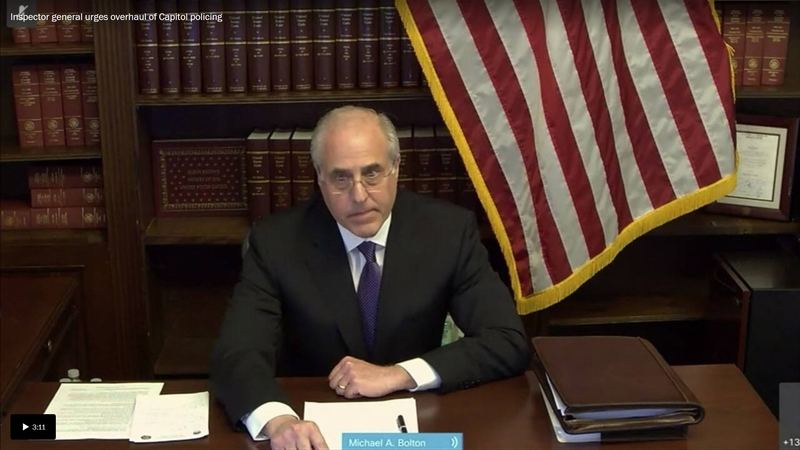
WASHINGTON – An order to hold back heavy riot-control weapons left Capitol Police at a grave disadvantage as front-line officers, vastly outnumbered, fought to protect Congress from a violent mob Jan. 6, the force’s inspector general told lawmakers Thursday, as he urged an overhaul of campus security.

Inspector General Michael Bolton told the House Administration Committee that a deputy assistant chief of police instructed officers not to use the weapons – including stingballs and 40mm launchers – out of concern that “they could potentially cause life-altering injury and/or death, if they were misused in any way.” Bolton did not identify the chief, but he said that had officers employed such measures, “it certainly would have helped us that day to enhance our ability to protect the Capitol.”

“The takeaway from that is, let’s provide the training to our officers so they are used appropriately,” Bolton said, later adding: “Training deficiencies put officers. . . in a position not to succeed.”

More than a half-dozen congressional committees and one task force appointed by House Speaker Nancy Pelosi, D-Calif., have opened inquiries into how law enforcement missed warning signals and failed to hold back the insurrection, during which thousands of President Donald Trump’s supporters invaded the Capitol campus in a deadly but failed bid to prevent Congress from certifying President Biden’s election win. But Bolton’s investigation, projected to continue for several more months, is expected to produce the most comprehensive analysis of how inadequate training and intelligence-gathering and operational “deficiencies” allowed the Capitol’s first line of defense to be overrun.

To date, the inspector general has produced two interim reports for Congress detailing investigators’ preliminary findings, including that the force lacked the security clearances needed to properly assess warnings that the Capitol might come under attack. He also determined that the Capitol Police had incomplete records of the personnel and equipment on hand to respond to civil disturbances – and that many of the officers did not know how to use the crowd-control weapons at their disposal.

During Thursday’s hearing, Bolton was emphatic that the Capitol Police would have to undertake sweeping procedural changes in order to be prepared for future threats to the Capitol and Congress. He also called for a “cultural change,” arguing that the force must move away from the “traditional posture of a police department,” and start acting instead like “a protection agency” focused not on responding to disturbances, but on preventing events like the Jan. 6 riot.

The hearing came as lawmakers are readying a supplemental spending package to pay for reforms and enhancements to campus security. Many are based on recommendations from former Army Lt. Gen. Russel Honore, whom Pelosi tasked earlier this year to conduct an evaluation. His team’s draft report, released last month, recommended an expansion of the campus police force, and construction of mobile and retractable fencing around the Capitol to be deployed in emergencies.

Pelosi told reporters during a Thursday news conference that she had received a draft of the House Appropriations Committee’s proposal to apportion funds for stepped-up security measures, including plans “to harden the windows, the doors and the rest.”

But when the inspector general was asked Thursday where Congress should be spending its money, Bolton focused on a different answer: training.

“If you want to invest dollars, that’s the place to invest it: training,” he said, lamenting that for too long, police training had been treated as an afterthought to other measures.

Bolton specifically raised lapses in the department’s Civil Disturbance Unit, or CDU, to highlight how a lack of training directly affected the Jan. 6 response. The Capitol Police CDUfunctions as “an ad hoc unit,” he said, instead of a permanent force with specialized skills.

He called for Congress to adopt incentives to attract officers to the high-risk job, and to build a force that is prepared to respond to potentially riotous crowds and threats to the Capitol.

“To be truly effective, you have to have that continuous training,” he testified. “They need to have a stand-alone unit, whatever size the department deems appropriate, and that’s their full-time job.”

Bolton also emphasized that improving the Capitol Police’s capacity to gather, analyze and assess intelligence is vital for responding to future threats.

“We need an intelligence bureau, . . . a full-service, comprehensive bureau,” he said. Bolton has also called for ensuring that civilians and officers tasked to intelligence-gathering operations obtain top-secret clearances, which not all employees currently have.

Bolton is not the first official to call for an overhaul of training, staffing, communications and intelligence operations. In recent weeks, Congress has heard about law enforcement failures and errors from the Capitol Police’s former chief, Steven A. Sund, the current acting chief, Yogananda D. Pittman, and the former Senate and House sergeants at arms who resigned after the riot, Michael Stenger and Paul Irving, respectively.

None of those officials has yet spoken with the House Administration Committee – a fact Republicans criticized in their remarks Thursday.

“This is the first hearing that the chair has called on January 6, more than three months after the attack,” said Rep. Rodney Davis, R-Ill., the panel’s ranking member, complaining that they had “skipped a step” by not having first called in officials who made the decisions leading up to Jan. 6.

Sund, the former police chief, has accused the two sergeants at arms of refusing his requests to call in the National Guard as a backup force before the riot. Under current rules, the police chief must seek permission from the Capitol Police Board, composed of the sergeants at arms and the Architect of the Capitol, before deploying additional resources in response to emergencies.

Davis insisted that any review of the Capitol Police that sidestepped scrutiny of the Board would be incomplete. Bolton answers to the Capitol Police board and does not have jurisdiction over them.

“I’ve said for a long time that an overhaul of the Board is needed,” Davis said, complaining that the committee’s probe was not satisfactorily bipartisan. He promised to release “a series of short reports” of his own.

The Administration Committee, made up of six Democrats and three Republicans, is one of at least five House panels that have launched probes into aspects of the Capitol riot, with still others examining questions surrounding forms of domestic extremism that were highlighted by the attack. But most of those inquiries have been slow to get underway.

Many lawmakers expected that such committee-level inquiries would quickly be overshadowed by an independent, 9/11-style commission, a concept that had seemed to have strong bipartisan support in the attack’s immediate aftermath but now has stalled in the face of political disputes over the scope of its authority.

In the Senate, a joint investigation between the committees on Rules and Homeland Security and Governmental Affairs has made more headway, with a report documenting the failures that led to the mayhem on Jan. 6 expected to be completed next month, according to various aides familiar with its progress.

Texas blackout scare renews call to rein in unruly power market #SootinClaimon.Com

#SootinClaimon.Com : ขอบคุณแหล่งข้อมูล : หนังสือพิมพ์ The Nation.

https://www.nationthailand.com/news/30404934

Texas blackout scare renews call to rein in unruly power market

InternationalApr 16. 2021A worker repairs a power line in Austin, Texas, on Feb. 18, 2021. MUST CREDIT: Bloomberg photo by Thomas Ryan Allison.A worker repairs a power line in Austin, Texas, on Feb. 18, 2021. MUST CREDIT: Bloomberg photo by Thomas Ryan Allison.

By Syndication Washington Post, Bloomberg · Josh Saul, Mark Chediak

It didn’t take a heat wave or freak winter storm this time to raise the specter of rolling blackouts in Texas. All it took was a mild spring day.

The fact that the state’s power system, serving nearly 30 million people, made an urgent plea for conservation with temperatures in the 80s Fahrenheit is prompting fresh questions about the need for reform less than two months after February’s deadly blackouts.

“It’s a disgrace for a power grid in modern times to struggle to keep the lights on during a mild day,” said Daniel Cohan, an associate professor of environmental engineering at Rice University. “We’ll be in trouble when a summer heat wave comes in and demand is one-and-a-half times as much as it was yesterday.”

Texas has long taken a laissez-faire approach to its power grid, allowing market forces — rather than regulations — ensure there’s enough power on hand to satisfy demand. State lawmakers have been reluctant to buck that philosophy as they consider legislation to address the problems that led to February’s crisis. Yet without changes, unpredictable weather will continue to beget chaos, experts warn.

“The reality is the market is designed to operate with very thin reserve margins,” said Katie Bays, an analyst at FiscalNote Markets. “And weather unpredictability combined with a white-knuckle approach is going to produce volatility.”

This week’s brush with outages stemmed largely from human error: grid operators misjudged the weather.

The Electric Reliability Council of Texas, which manages most of the state’s grid, had counted on a mild cold front sweeping the state to lower demand for power. It didn’t happen. As a result, demand on the grid was about 3,000 megawatts higher than anticipated — or the equivalent of 600,000 homes.

Normally, additional power plants would kick in to make up the shortfall. But about 25% were off line for repairs to gear up for summer, when plant owners make the bulk of their money selling electricity to satisfy Texas’s insatiable demand for air conditioning.

Unlike other U.S. grid operators, Texas doesn’t have a capacity market that pays generators to be available in order to meet expected demand. Instead, the Texas market is designed for wholesale prices to spike when supplies get tight in order to encourage power producers to come online. That approach allowed prices to surge to $9,000 a megawatt-hour during the last crisis, which pushed many companies into default and has left the power market in ongoing financial distress.

“It further highlights the need for Ercot reform and it’ll put a fire under legislators’ butts,” said Josh Price, an analyst for Height Capital Markets.

Lawmakers are considering a series of measures in response to February’s blackouts. One bill would require power plants to prepare better for cold weather. Another would ban retail electricity providers from exposing customers to the volatility of wholesale power prices. And other measures would require renewable generators to buy reliability services, increasing their financial burden. But a bill that would create a capacity market hasn’t budged.

“The legislature has been trying to take a hands-off approach to Ercot and assume that the fundamentals of the market will solve the underlying issue,” Bays said.

Texas lawmakers advanced several power bills on Wednesday. The Senate passed a measure that would force renewable generators to shore up their ability to deliver supplies, while a House committee approved a proposal that would permit co-operatives, municipal utilities and power companies to sell debt to cover huge obligations racked up during the crisis, according to a note sent out by Price. Any bills would have to be passed by both chambers to become law.

Texas ranks last among U.S. regional power networks when it comes to reserve capacity, according to the North American Reliability Corporation, which oversees grids in the U.S., Canada and parts of northern Mexico. Ercot has failed to meet its own target reserve of 13.75% for the past three years, according to the agency.

An Ercot spokeswoman said it was speculative to say whether or not a higher reserve margin would have resulted in different outcomes from the winter storm.

Weather doesn’t usually have a big impact on electricity demand in spring and fall. Those are the so-called shoulder seasons when customers are neither cranking their heaters nor blasting their air conditioners.

On Tuesday, temperatures in Dallas, Brownsville and Houston were moderately higher than normal, reaching or exceeding 80 degrees Fahrenheit (27 Celsius). That, combined with a dearth of generation, prompted Ercot to ask for conservation for almost four hours.

The real test could come this summer. While Ercot said last month it expects to have adequate supplies for the season despite anticipated record peak demand, almost 75% of Texas is gripped by drought, and more than 91% is abnormally dry. Drought makes heat worse because the sun’s energy goes into warming the air rather than evaporating ground moisture.

“This doesn’t bode well for summer when they are already issuing these kind of alerts,” said Jim Rouiller, lead meteorologist at the Energy Weather Group. “The cold killed people. The heat will kill a lot more people.”

Recovery quickens as U.S. retail sales soar, jobless claims ease #SootinClaimon.Com

#SootinClaimon.Com : ขอบคุณแหล่งข้อมูล : หนังสือพิมพ์ The Nation.

https://www.nationthailand.com/news/30404932

Recovery quickens as U.S. retail sales soar, jobless claims ease

InternationalApr 16. 2021Shoppers wearing protective masks carry bags across Post Street in San Francisco on April 14, 2021. MUST CREDIT: Bloomberg photo by David Paul Morris.Shoppers wearing protective masks carry bags across Post Street in San Francisco on April 14, 2021. MUST CREDIT: Bloomberg photo by David Paul Morris.

By Syndication Washington Post, Bloomberg · Olivia Rockeman

The U.S. economy’s comeback is firing on all cylinders with employment, retail spending and manufacturing exhibiting strong gains.

Thursday’s barrage of economic data showed that some parts of the economy, like retail sales, have returned to or exceeded pre-pandemic levels. Applications for unemployment benefits, while still elevated, hit the lowest in 13 months.

The rebound reflected a wave of business reopenings last month, increased vaccination rates and a fresh round of stimulus checks to households. In addition, the bounce back follows a harsh winter and surge in Covid-19 cases in many parts of the U.S. that curbed activity.

U.S. retail sales accelerated in March by the most in 10 months, increasing 9.8% after declining in February. A separate report showed initial state jobless claims fell by almost 200,000 last week, partly reflecting a significant drop in California.

Other reports Thursday showed strength in manufacturing too. A Federal Reserve Bank of New York index of factory activity in the state jumped to the highest level since 2017. A Philadelphia Fed manufacturing gauge improved to the strongest reading since 1973.

Additionally, production at U.S. factories increased in March by the most in eight months following the weather-related setback in February.

U.S. stocks rose to record highs and Treasury yields fell as investors cheered the data and earnings reports.

While the economy has shown signs of roaring back, Fed officials have cautioned in recent days that the U.S. has a long road to recovery — with many Americans still out of work and the virus still percolating.

Initial jobless claims are more than double pre-pandemic levels and there are an estimated 8 million fewer jobs than in February 2020. The recovery has also been uneven, with the service industry hit the hardest, leaving many lower-income and minority Americans out of work.

The government’s retail sales report — which was better than expected — showed all 13 categories posting gains in March. The total value of sales in each category, with the exception of restaurants, are above where they were in February of last year.

Receipts at restaurants rose 13.4% in March, while sales at apparel retailers jumped 18.3% — both the strongest advances since June of last year.

“With consumers still sitting on a pile of accumulated savings combined with the expected reopening of the service economy this summer, our forecast looks for a consumer spending boom this year that will rival any in living memory for most Americans,” Tim Quinlan and Shannon Seery, economists at Wells Fargo Securities, said in a note.

Businesses that have been strong throughout the pandemic, including furniture outlets and building material merchants, experienced solid March sales. E-commerce sales also rebounded.

Ray Blanchette, chief executive officer of restaurant chain TGI Friday’s, said comparable sales, a key indicator in the restaurant industry, turned positive in March and April over 2019 figures.”Stimulus checks helped,” Blanchette said. “There’s a lot of pent-up demand. And when folks get out they want to enjoy themselves. In many cases, it’s the first time they’ve done it in some time.”

While federal stimulus payments provided a temporary spending boost in the month, their impact in the longer term remains to be seen. Reports in the coming months will show whether job growth and overall consumer confidence will be enough to allow for such huge monthly sales gains.

Further, as the economy continues to reopen, consumers may steer their spending away from merchandise and more toward travel and other services, which could lead to more moderate retail sales.

Gas station receipts rose 10.9%, at least in part reflecting higher fuel prices, which averaged $2.88 per gallon at the end of March, compared with $2.72 at the end of February. The retail figures aren’t adjusted for price changes.

Sales at car and motor vehicle parts dealers advanced 15.1% in March, even as automakers faced production constraints due to the global semiconductor shortage.

Baghdad’s streets and squares are largely abandoned a year after youth revolution #SootinClaimon.Com

#SootinClaimon.Com : ขอบคุณแหล่งข้อมูล : หนังสือพิมพ์ The Nation.

https://www.nationthailand.com/news/30404918

Baghdad’s streets and squares are largely abandoned a year after youth revolution

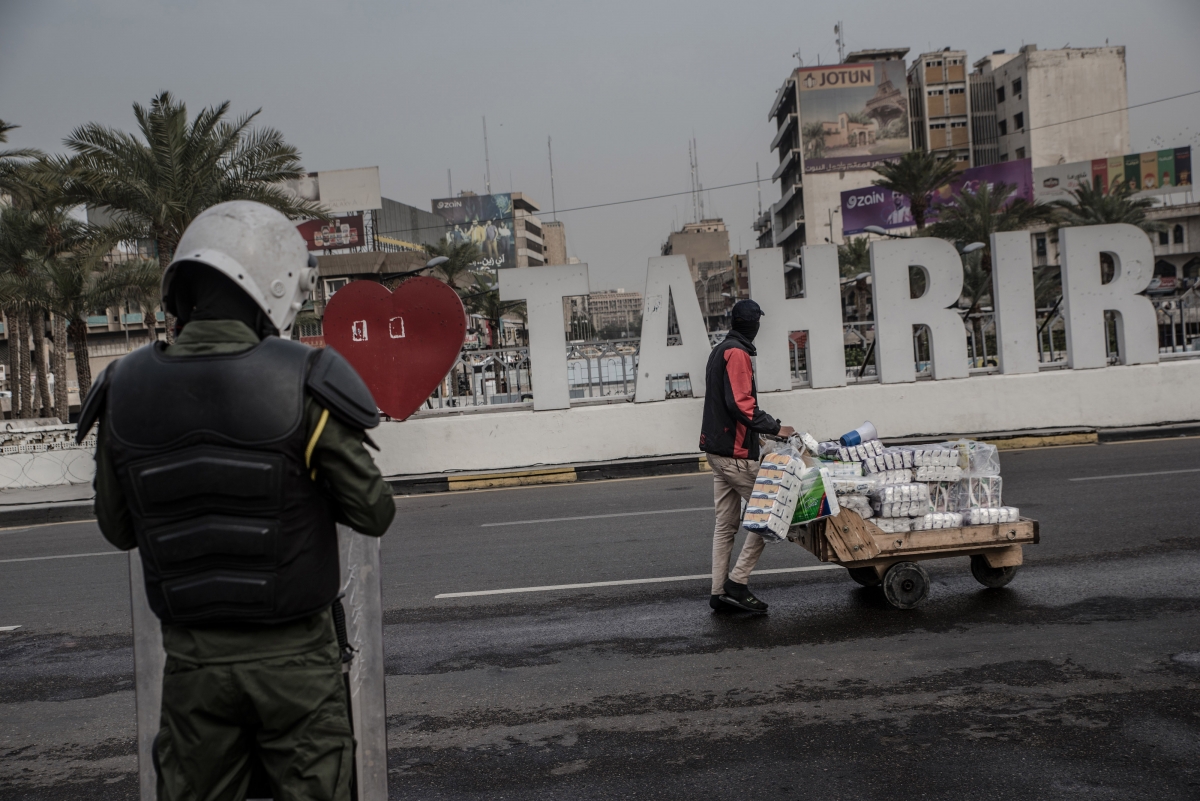
InternationalApr 15. 2021The The “I Love Tahrir” sign in Baghdad’s Tahrir square in January 2020. Photo for The Washington Post by Emilienne Malfatto

By Louisa Loveluck, Emilienne Malfatto
The Washington Post

BAGHDAD – It’s been more than a year since Iraqi protesters brought down their prime minister as part of the largest uprising in generations. Born in the shadow of the 2003 U.S.-led invasion, the young demonstrators who protested from Baghdad to Iraq’s southern cities had called for an end to the political system that the U.S. occupation installed. They wanted an end to corruption and sectarian politics that have left them with little hope of a future in their own country, they said. Their sloga

That dream was quashed with deadly force. More than 600 protesters were killed by Iraq’s security forces and militia groups. Thousands more were injured and still live with the scars. In May 2020, a new prime minister, Mustafa al-Kadhimi, came to power vowing justice for the dead. But not a single member of Iraq’s security forces has been prosecuted, and most of the hardships that inspired Iraq’s protest movement have been worsened by an economic crisis that accompanied the country’s coronavirus epidemic.

Squares rarely fill with protesters these days, but public discontent rumbles on. Scattered demonstrations occur weekly outside government buildings, with people demanding jobs and services that a cash-strapped and inefficient Iraqi state cannot provide.

The "I Love Tahrir" sign in Baghdad's Tahrir square in January 2020. Photo for The Washington Post by Emilienne Malfatto

The “I Love Tahrir” sign in Baghdad’s Tahrir square in January 2020. Photo for The Washington Post by Emilienne Malfatto

Dozens of protesters have been shot dead by security forces over the past year. Activists have been disappeared by Iran-backed militia groups they dare to challenge, according to human rights monitors. Fearing for their lives, other young demonstrators have fled to Iraq’s semiautonomous Kurdish region, or abroad and to exile.

As spring temperatures start to climb, Iraqi officials worry in private that the country’s power grid will be unable to meet public demands during the sweltering summer months, bringing more protesters out to the streets. That could set the stage for another deadly confrontation.

Freelance photographer Emilienne Malfatto visited Baghdad’s protest sites in 2020, the height of the movement, and a year later. Here is her recounting.

– – –

The "I Love Tahrir" sign in Baghdad's Tahrir square in January 2020. Photo for The Washington Post by Emilienne Malfatto

The “I Love Tahrir” sign in Baghdad’s Tahrir square in January 2020. Photo for The Washington Post by Emilienne Malfatto

I glanced through the window as we drove by Tahrir Square. It felt terribly empty. The tents were gone. The tables with sweets, fruits and tea, also gone. And, above all, the joyful, naive effervescence – this belief that a “revolution” was happening for a “better Iraq” – that’s gone, too.

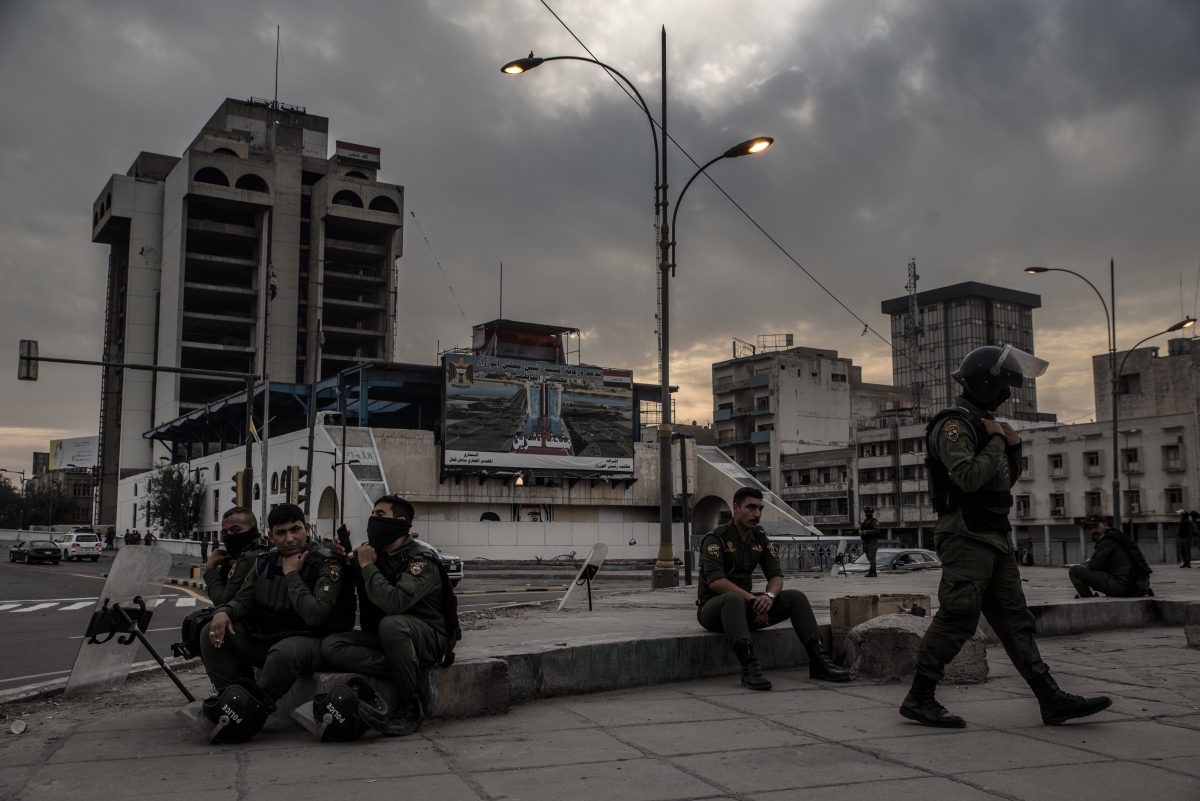
Replacing all of that was a sea of uniforms, olive green and dark blue, sometimes black. Young men standing on guard in what felt like a show of force. The message was clear: We’re here, we’re holding the place, and protesters are not coming back.

It was just a little over a year ago when I had last visited Tahrir Square. At that time, protests against the government and clashes with the police were a daily occurrence, with the square occupied by demonstrators calling for a change in governing policies. In another part of the city, at a pedestrian bridge near Muhammad Qassem highway, I had photographed a procession for a fallen protester as well as an intense confrontation between youths and police, the sky dark with the smoke of burning barricades.

The "I Love Tahrir" sign in Baghdad's Tahrir square in January 2020. Photo for The Washington Post by Emilienne Malfatto

The “I Love Tahrir” sign in Baghdad’s Tahrir square in January 2020. Photo for The Washington Post by Emilienne Malfatto

A year later, all I had seen has disappeared. It’s as if nothing ever happened there. The sky was gray, but from a sandstorm. The barricades and tents were replaced with plastic chairs on which soldiers rested their weapons. The place felt sad, like a missed opportunity, like the dream was over.

I could also see this transformation in the faces of the soldiers and policemen guarding these forgotten places of protest. A year ago, I had photographed the exhausted men and boys who led that revolution, their eyes reddened by tear gas, black stains covering their hands and faces as heavy smoke rose from burning tires. All of them said they had a reason to fight, a cause they believed in. A year later, the faces on Tahrir Square looked different. They were still young, but, with their uniforms and their shields, they represented the end of a movement, of hope.

Public health experts increase vaccine education during Johnson & Johnson pause #SootinClaimon.Com

#SootinClaimon.Com : ขอบคุณแหล่งข้อมูล : หนังสือพิมพ์ The Nation.

https://www.nationthailand.com/news/30404916

Public health experts increase vaccine education during Johnson & Johnson pause

InternationalApr 15. 2021

By Jenna Portnoy
The Washington Post

A day after federal agencies recommended a pause in administration of the Johnson & Johnson coronavirus vaccine while they investigate potential rare side effects, public health experts and providers in the Washington region on Wednesday said they are increasing education and transparency to allay potential worries among people about coronavirus vaccines.

Community leaders and those in charge of vaccinating vulnerable populations said that the pause does not appear to have immediately deterred people who want to be vaccinated or have upcoming vaccine appointments.

“My concern is the people who were already not planning to get the vaccine will latch on to this as further justification just for why they shouldn’t get it,” said Leana Wen, a former Baltimore health commissioner, emergency physician and Washington Post contributing columnists.

Federal officials recommended the nationwide pause in administering the Johnson & Johnson vaccine while they review a rare type of blood clot known as cerebral venous sinus thrombosis in conjunction with thrombocytopenia, or low blood platelets, developed in six women who had received that vaccine. One such woman from Virginia died.

Public health officials say the pause is proof that the adverse effect reporting system is working properly and that the Centers for Disease Control and Prevention and Food and Drug Administration are taking even extremely rare side effects seriously.

The District of Columbia, Maryland and Virginia stopped administering the Johnson & Johnson vaccine within hours of the federal recommendation, as clinics that were prepared to give that vaccine quickly switched to the two-dose Pfizer-BioNTech or Moderna versions. The one-dose Johnson & Johnson vaccine was particularly useful for people experiencing homelessness and for transient populations who may have trouble returning for a second dose.

Mark Whitlock, senior pastor at Reid Temple AME, which partnered with Luminis Health Doctors Community Medical Center to host vaccine clinics for Prince George’s County, Md., residents, said one congregant contacted him Tuesday with concerns about the Johnson & Johnson pause.

“She and I had prayed, and I assured her that we had Pfizer and Moderna,” he said. “I am very concerned about the safety of the membership of Reid Temple. I am celebrating the fact that they did take it off the market.”

Vaccine supply and access – not hesitancy – remains his biggest concern in Prince George’s, one of the region’s communities hit hardest by the coronavirus, which can cause the illness covid-19.

The long-term impact of the pause will depend on what investigators discover and how they communicate findings to the public, experts said.

“If we can’t confidently have the American public believe and trust in the safety and efficacy of vaccines, that could undermine the entire effort,” Danny Avula, Virginia’s vaccine coordinator, told reporters Tuesday.

But he said the incidence of six cases among the millions of doses administrated is “exceedingly rare for a serious side effect.”

About 31 million people, or 10% of the American, population has contracted the novel coronavirus; of that number, one out of 585 people died of the disease, he said.

“In relative terms, these are really low rates of incidence,” he said of the six cases. “All of this is like a big risk-benefit calculation,” he said.

– – –

The Washington Post’s Erin Cox contributed to this report.

Target, Netflix, Bank of America join companies, executives in opposing limits to voting rights #SootinClaimon.Com

#SootinClaimon.Com : ขอบคุณแหล่งข้อมูล : หนังสือพิมพ์ The Nation.

https://www.nationthailand.com/news/30404915

Target, Netflix, Bank of America join companies, executives in opposing limits to voting rights

InternationalApr 15. 2021Florida Gov. Ron DeSantisFlorida Gov. Ron DeSantis

By Todd C. Frankel, Josh Dawsey, Jena McGregor
The Washington Post

WASHINGTON – Top Republican officials continue to push back against a surge of major companies and corporate leaders who oppose new voting laws being pursued by Republicans in dozens of states, with fresh signs that some in the GOP are waiting to see how far companies are willing to go on this issue.

Even as executives representing a wide swath of Corporate America discussed via Zoom last weekend potentially withholding political donations and business investments over the issue, speakers at the Republican National Committee retreat in Palm Beach were pledging to continue the fight. Florida Gov. Ron DeSantis was applauded at the RNC meeting for attacking Major League Baseball, among others, according to a recording obtained by The Washington Post.

“Major businesses who are getting in bed with the left, the corporate media and big tech … these corporate executives have no backbone, they don’t want to be criticized by the corporate partisan media – they cave, they virtue signal in one direction,” DeSantis said.

“You have these woke corporations who are colluding with all those folks,” he continued. “We have to stand up for ourselves, we’ve got to fight back.”

On Wednesday, hundreds of major companies and corporate leaders released a joint statement that said voting is “the lifeblood of our democracy” and “we must ensure the right to vote for all of us” – a seeming rebuke of the hostile tone coming from Republicans who insist the laws are needed for election security and companies should stay out of politics.

The developments could possibly reshape political giving and potentially fracture a long-held alliance between the GOP and corporate business giants, who are increasingly under pressure to take political stands – and can feel the backlash for doing it. “I think what is happening is new,” said Steven Law, who runs the Senate Leadership PAC, the major fundraising arm for Senate Minority Leader Mitch McConnell, R-Ky. Political groups say corporate PAC giving is down this year across the board.

Still, it remains to be seen whether the mounting rhetorical attacks will lead to an actual rupture between corporations and the GOP.

Wednesday’s statement by corporate leaders – which cast the issue as nonpartisan – included support from recognizable corporate names such as Target, Netflix, Bank of America, Facebook, Cisco, Twitter, Microsoft, Starbucks, Amazon, Mastercard, American Airlines, United Airlines and Vanguard, as well as prominent people such as investor Warren Buffett, law firms and nonprofit organizations.

The statement was also notable for the names that were missing, including Delta Air Lines and Coca-Cola – two companies that earlier this month were among the first to oppose new voting rules in their home state of Georgia.

The statement was discussed during the Zoom meeting of corporate leaders last weekend and published Wednesday as an ad in The Washington Post, the New York Times and other major newspapers.

The current crop of voting measures being debated in statehouses nationwide is fueled by lingering animosity over the last presidential election, when baseless accusations of voter fraud resulted in Republican officials pushing for restrictive new laws.

“The legislation is so egregious and so targeted as to keep certain types of people from voting – I think it’s wonderful that Corporate America is taking a stand,” said one of the signers, Debra Lee, the former chief executive of Black Entertainment Television, who sits on four corporate boards.

But it remains unclear how far companies are willing to go to address concerns about voting rights.

Some GOP operatives believe the tensions will die down once the business community realizes it needs the GOP as it faces a Democratic White House proposing major new spending and potentially higher corporate tax rates.

“I am curious to see how corporations are going to feel once they start feeling the wrath of this administration, which is going to raise their taxes,” said Lisa Spies, a prominent GOP fundraiser.

Spies said she suspected much of the controversy churned was for “public display” and “a lot of these people are still donating and very active.”

Law said he didn’t think Major League Baseball thought through its decision this month to move the All-Star Game from Georgia to Colorado over a voting rights bill.

“There can be an astonishing cost as to what they might always think is virtue signaling,” Law said.

“This is happening at the same time the new Biden administration is planning very aggressive moves that will be largely hostile to the business interests of these companies,” Law said.

He also pointed out the absence of Coca-Cola and Delta from Wednesday’s statement. “That could suggest that these companies learned the hard way, that when you go out relying on fake talking points supplied by (leading Georgia Democrats) Stacey Abrams and Raphael Warnoc​k, you do so at your own risk,” Law said.

A Delta Air Lines spokeswoman declined to comment further about why it did not sign Wednesday’s statement, pointing to a statement made by the carrier’s CEO March 31. Coca-Cola said it did not receive the statement or a request to sign it and that its “focus has been on meeting and collaborating with local groups, and we have spoken up in support of the foundational right to vote.”

Several company officials said their decision to sign Wednesday’s statement was not a partisan one.

“We believe that is a false talking point that is being mounted by the individuals who are trying to restrict voting access to large segments of Americans,” said Neil Blumenthal, co-CEO of Warby Parker.

The statement came after Kenneth Chenault, the former chief executive of American Express, and Kenneth Frazier, the chief executive of Merck, pushed companies to take a stand on what they viewed as discriminatory laws on voting.

Chenault and Frazier coordinated a letter signed last month by 72 Black business executives that made a similar point – a letter that first drew attention to the voting bills in executive suites across the country.

Dozens of law firms also signed the statement, representing a growing effort to fight restrictive voting laws in court. Among the firms listed were Squire, Patton, Boggs; Cravath, Swaine and Moore; Akin Gump Strauss Hauer and Feld; and Paul, Weiss, Rifkind, Wharton and Garrison.

There was also a smattering of celebrities – some with their own companies – included on the statement, such as Naomi Campbell, Tracee Ellis Ross, Katy Perry and Gwyneth Paltrow.

The fight has left some business leaders torn.

Kathryn Wylde, who leads the Partnership for New York City, which calls much of the elite business community its members, said Republicans tend to see the voting rights issue as a partisan effort to shore up the chances of a continued Democratic majority.

“The Black executives don’t see it as a partisan issue. They see it as a civil rights issue,” Wylde said. “But a lot of the businesses can’t afford to alienate the Republicans who have defined this as a partisan issue. The reason people didn’t sign is that.”

But it is not a fight either side seemed ready to back away from.

Reid Hoffman, the co-founder and former chairman of Linkedin, said he expects the business community to keep fighting.

“My hope would be a willingness to go all the way on this issue,” he said.

NATO unanimously backs U.S. exit from Afghanistan #SootinClaimon.Com

#SootinClaimon.Com : ขอบคุณแหล่งข้อมูล : หนังสือพิมพ์ The Nation.

https://www.nationthailand.com/news/30404914

NATO unanimously backs U.S. exit from Afghanistan

InternationalApr 15. 2021

By John Hudson
The Washington Post

BRUSSELS – The 30-member NATO alliance on Wednesday unanimously backed the United States’ decision to withdraw all forces from Afghanistan by Sept. 11 after President Joe Biden’s top diplomat and defense official made the cause for the move in a joint visit to Brussels.

In a closed-door meeting of alliance foreign ministers, followed by a news conference with NATO Secretary General Jens Stoltenberg, Secretary of State Antony Blinken sought to put a positive spin on the conclusion of the long-grinding conflict, which has lost the confidence of the general public in much of Western Europe and North America. He said the alliance had ensured that Afghanistan would never again become a platform or haven for global terrorists.

“The threat from al-Qaida in Afghanistan is significantly degraded; Osama bin Laden has been brought to justice,” Blinken said. “We have achieved our objective.” Remaining in Afghanistan, he said, is not “in our interest. Not for the United States, not for NATO and our allies.”

The military alliance went into Afghanistan after invoking its collective defense clause, Article 5, for the first time in its history following the 9/11 attacks. About 7,000 non-U.S. foreign troops remain in Afghanistan, mostly from NATO countries such as Germany, Italy and Britain, but also non-NATO countries including Georgia and New Zealand.

Those troops outnumber the 2,500 troops the United States maintains in Afghanistan, but they rely heavily on U.S. air and logistical support. That reliance caused many NATO allies to express concern in recent years when President Donald Trump would tweet sporadically about a full U.S. withdrawal from Afghanistan without coordinating with allies.

Blinken on Wednesday assured foreign partners that there would be no such surprises in the Biden era.

“I am here to work closely with our allies, with the [NATO] secretary general, on the principle that we have established from the start: ‘In together, adapt together and out together,’ ” Blinken said before an earlier meeting with Stoltenberg.

Blinken was joined in Brussels by Defense Secretary Lloyd Austin, who is also meeting with NATO counterparts on the plan to begin a U.S. troop withdrawal and complete it by Sept. 11.

In a closed-door meeting among all 30 NATO members, Austin set the tone for the discussion with a strong endorsement of the withdrawal, said a European official familiar with the matter who spoke on the condition of anonymity to discuss alliance deliberations. Austin referenced his military service and intimate knowledge of the sacrifices made in the conflict, but underscored that the time to leave the country was upon us, the official said.

Following Austin’s remarks, the official said, those in the room who spoke for their countries broadly supported the withdrawal plan, with the exception of some grumbling from the representatives of the Czech Republic and Belgium, who spoke about the speed of Biden’s decision and the investments European countries had made in the conflict.

British and German officials have indicated that they will accompany the United States with their own departure from Afghanistan. For some countries, however, the exit is more difficult to swallow.

“We have had dozens of soldiers die there,” said one Western European official who spoke on the condition of anonymity to discuss his reaction to the U.S. plan. The diplomat noted, however, that the terrorism threat from Afghanistan has been significantly reduced, which was always the main objective.

“Our first and foremost goal is just not to have in Afghanistan a future place for international terrorism,” the diplomat said.

At the news conference, Stoltenberg said the alliance decision was “unanimous,” adding that “this is not an easy decision and it entails risks. . . . We’ve said for many months we face a dilemma, because the alternative to leaving in an orderly fashion is to be prepared for a long-term, open-ended military commitment with potentially more NATO troops.”

Like Blinken, he said that the alliance and other partners would continue to support Afghanistan. “This is not the end of our relationship with Afghanistan, but rather the start of a new chapter,” Stoltenberg said.

But in making that pledge, he also referred to the problems Afghanistan will face, and the belief of many officials and experts that the Taliban is likely to increase its campaign to take over the country.

“It is now for the Afghan people to build a sustainable peace” that “puts an end to violence, safeguards the rights of all Afghans – particularly women and children – and assures that Afghanistan never again serves as a safe haven for terrorists,” Stoltenberg said.

He made clear that the U.S. withdrawal was a primary factor in the NATO decision. “In light of the U.S. decision to withdraw, we discussed the way forward today,” he said, adding that any Taliban attack on departing troops “will be met with a forceful response.”

For years, many NATO members, especially Germany, indicated that any withdrawal must be based on the conditions on the ground in Afghanistan. But the Biden administration made clear on Tuesday that this would not be the standard.

Austin did not respond to a question at the news conference about his own recent statements that withdrawal would be “conditions-based.”

“I fully support his decision,” Austin said of Biden. “Our troops have accomplished the mission they were sent to achieve.” Asked if U.S. military leaders agreed on the departure, Austin said he would not speak for them. “What I can tell you is this was an inclusive process,” he said of internal administration decision-making, “and their voices were heard, their concerns taken into consideration as the president made his decision.”

Strong reservations about the fate of Afghanistan remain, but European diplomats acknowledged that staying in the country indefinitely was unsustainable, logistically and politically.

“As long as the U.S. consults, gives at least a veneer of co-decision, and withdraws responsibly enough that it doesn’t leave the Europeans high and dry, then the Europeans won’t be hard to deal with on this issue,” said Jeremy Shapiro, research director at the European Council on Foreign Relations. “In the end, the Europeans went into Afghanistan for America and NATO; they’ll accept to leave for the same reasons.”