TOKYO – The Seoul government said it had found its first case of covid-19 in a cat on Monday, shortly after offering free tests to pets in the South Korean capital.
Experts say there is no evidence cats or dogs can pass the novel coronavirus to humans, but they have nevertheless placed the cat in a 14-day quarantine. It was tested after having symptoms of vomiting and decreased activity, and after the family it lives with were all found to have contracted covid-19, officials said.
The Seoul Metropolitan Government announced last week it would offer free coronavirus tests to symptomatic dogs and cats, shortly after a kitten at a religious facility in the southeast of the country was found to have contracted the virus.
In the United States, the Centers for Disease Control and Prevention says a few pets have been infected with the virus that causes covid-19, mostly after the animals were in close contact with infected humans, although globally such cases have been rare.
Since the beginning of the outbreak, scattered reports of animals contracting the disease have raised fears that pets or farmed animals such as mink could become a reservoir for the disease, prompting widespread culling in infected mink farms.
The CDC, however, says that “based on the limited available information, the risk of animals spreading the COVID-19 virus to people is considered low,” while most animals who had contracted the virus had experienced mild illness and fully recovered.
“There is no evidence that viruses can spread to people or other animals from a pet’s skin, fur or hair,” it says.
Seoul’s city government said it would provide tests only to animals that showed symptoms such as fever or breathing difficulties after coming into contact with infected humans.
The kitten found positive last month was placed into quarantine at a nearby animal shelter but did not show any symptoms, and so after 14 days was released, local health authorities said.
In an online briefing last week, disease control official Park Yoo-mi reminded people to keep their pets “at least two meters away from people and other animals when walking them.”
Research has shown that cats can spread the disease to other cats, at least in a laboratory setting.
Over the weekend, the San Diego Zoo Safari Park said a troop of western lowland gorillas had made a full recovery after several had contracted the coronavirus, but in Pakistan officials said two 11-week-old white tiger cubs appear to have died of covid-19 last month.
By The Washington Post · Juliet Eilperin, Desmond Butler
WASHINGTON – Some of the climate impacts of a grocery store trip are obvious, like the fuel it takes to get there and the electricity that keeps its lights glowing, conveyor belts moving and scanners beeping. But then there are the invisible gases seeping out into the atmosphere when you reach for your ice cream of choice.
In nearly every supermarket in America, a network of pipes transports compressed refrigerants that keep perishable goods cold. Most of these chemicals are hydrofluorocarbons (HFCs) – greenhouse gases thousands of times more powerful than carbon dioxide – which often escape through cracks or systems that were not properly installed. Once they leak, they are destined to pollute the atmosphere.
The Biden administration now sees eliminating these chemicals from the nation’s refrigerators as low-hanging fruit in its broader effort to rein in climate pollutants. The Environmental Protection Agency issued a public call last week for companies to report production and import data on HFCs.
Under the American Innovation and Manufacturing Act, which passed in December, the EPA must phase down the production and import of these potent greenhouse gases 85% over the next 15 years.
“The environmental benefits here are very large, they’re very important,” said Cindy Newberg, who directs the stratospheric protection division in the EPA’s Office of Air and Radiation. The new law, she added, “provides explicit authority for us to do this work, and that’s incredibly important to the agency, and for all of us.”
A new undercover investigation by an advocacy group suggests that some supermarkets are leaking climate-damaging refrigerants at a higher rate than regulators have assumed. The industry estimates that every year supermarkets lose an average of 25% of their refrigerant charge – chemicals introduced in the 1990s to replace ones depleting Earth’s ozone layer.
Armed with high-tech sensors, undercover investigators for the Environmental Investigation Agency (EIA) have documented widespread leakage of HFCs at grocery stores in the District of Columbia, Maryland and Virginia. While Walmart and other supermarket companies have pledged to curb their use of these chemicals, more than half the stores the EIA surveyed were emitting these climate-warming refrigerants.
Out of 45 supermarkets surveyed – including 20 Walmarts as well as stores operated by ALDI, Costco, Giant, Harris Teeter, Safeway, ShopRite, PriceRite, Trader Joe’s and Whole Foods – investigators found leaks in 55% of them. (Whole Foods is owned by Amazon, whose founder and CEO, Jeff Bezos, owns The Washington Post.) The investigation did not determine the exact amount of HFCs released.
“This is a systemwide, industry-wide problem,” said Avipsa Mahapatra, climate lead for the EIA advocacy group. “In reality, they could easily check for this.”
None of the companies contacted for this story provided a comment on the survey itself, but a few noted their commitment to curbing these pollutants.
Whole Foods said it is “proud to be a leader among U.S. supermarkets in our efforts to reduce emissions of hydrofluorocarbons.” A little more than 30 of its stores have switched to carbon-dioxide refrigerants, and it touts one market in Brooklyn that has become 100% HFC-free.
Walmart noted that it has pledged to reach zero emissions across its operations within two decades, a goal that includes “transitioning to low-impact refrigerants for cooling and electrified equipment for heating in our stores, clubs and data and distribution centers by 2040.”
Commercial refrigeration, which includes grocery stores, restaurants and food processing, accounts for about 28% of U.S. emissions of HFCs. Air conditioning for commercial buildings and homes represents between 40% and 60% of emissions, according to federal data.
The EIA survey was based on a limited sample in one region of the United States. The investigators were also not able to measure the overall quantity and rate of leakage. But it suggests that large supermarket chains may be unaware of the extent of the problem, and do not have regular monitoring in place. In some cases, the leaks persisted months after they were detected.
The investigators, who began their survey in 2019, used leak detectors that they could insert in refrigerators and freezers as well as an infrared camera that could film fugitive greenhouse gases.
The food retail sector represents one part of the puzzle of how to drastically cut back on emissions in the coming years. HFCs trap thousands of times more heat than carbon dioxide, and with increasing sales they are projected to represent nearly a fifth of climate-warming emissions by mid-century. It’s a growing problem: The hotter Earth gets, the more people need cooling infrastructure.
According to new data released Friday, HFC emissions in the United States rose by 4 million metric tons between 2018 and 2019. The 38,000 supermarkets in the United States use thousands of pounds of HFCs each year, according to the EPA, with each store having the equivalent climate impact of 300 cars on the road. Taken together, it is equal to 49 billion pounds of coal being burned each year.
While monitoring for leaks and upgrading refrigeration systems translate into long-term savings by reducing energy use, stores operating on tight margins cannot always afford it.
Ratio Institute co-founder Jonathan Tan, whose organization works with the food retail industry, policymakers and conservationists on the issue, estimated that while it can cost a store between $50,000 to $100,000 to make repairs to a system, transitioning from current refrigerant to a less-potent greenhouse gas such as carbon dioxide can cost between $1 million and $2.5 million.
Walmart said private companies would need government help in making the transition. “We also believe that private and public sector action is needed to foster innovation and enable an economically viable phasedown of HFCs globally,” it said in a statement.
Europe is making a swifter transition than the United States. More than 26,000 supermarkets in European countries are using lower-impact refrigerants, compared with 600 stores in the United States.
The EPA has regulated earlier generations of refrigerants for decades under the 1987 Montreal Protocol, the landmark global treaty aimed at repairing the ozone layer. Those compounds – chlorofluorocarbons and hydrochlorofluorocarbons – damaged the ozone layer that shields Earth from damaging ultraviolet rays from the sun. HFCs made an appealing substitute because they did not deplete ozone, but they warmed the planet instead.
In 2016, the Obama administration helped broker the Kigali Amendment, through which countries pledged to phase down HFCs. But the agency’s effort to regulate the refrigerants ran aground during the Trump administration.
One rule identifying “unacceptable” uses of HFCs was partly overturned by the U.S. Court of Appeals for the D.C. Circuit in 2017. The administration rewrote the rule, but the same court said it did not follow proper procedures and did not need to abolish the Obama-era requirements altogether. Last year, Trump officials withdrew another Obama-era rule, which required companies to detect and repair leaks from any appliance or piece of equipment using more than 50 pounds of HFCs.
President Donald Trump declined to submit the Kigali Amendment to the Senate for ratification: President Joe Biden signed an executive order last month instructing his secretary of state to take that step.
The federal government has pursued cases against grocery chains, and won, when it comes to leaks of older refrigerants that damage the ozone layer. In 2019, for example, Southeastern Grocers agreed to spend $4.2 million to reduce coolant leaks and pay a $300,000 civil penalty. But HFCs are in a different category.
“EPA’s recognized that it is a significant contributor to climate change and has tried to take action,” said Tom Land, a longtime agency staffer who retired in 2019 after working on international climate negotiations and the agency’s voluntary refrigerants program, GreenChill. “It basically had to stop; it didn’t have authority.”
Food retailers that participate in the GreenChill program have a leak rate of 14.3%, nearly half the industry average. Kristen Taddonio, senior climate and energy adviser at the Institute for Governance & Sustainable Development, said in an interview that reinstating regulations mandating leak detection could help grocers make greater reductions.
“It’s like that old adage, you can’t manage what you can’t measure,” said Taddonio, who worked on energy efficiency at the EPA and the Energy Department between 2004 and 2015.
By The Washington Post · Matthew Cappucci, Andrew Freedman
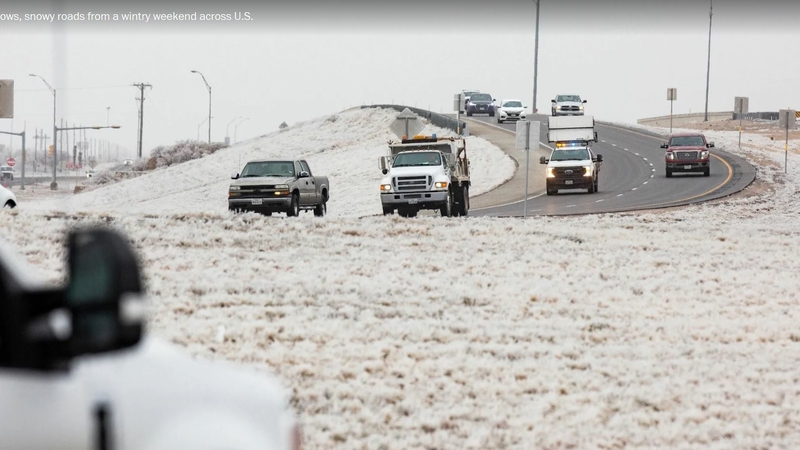
A historic Arctic outbreak continues to bring a bone-chilling deep freeze to the central United States, as the coldest air in generations plunges south and is accompanied by snow and ice all the way to the Gulf of Mexico. Some cities will see their lowest temperatures in more than a century as high-impact winter storms roll across the country.
Temperatures about 50 degrees below average occupy an enormous swath of the central United States, stretching from the Rockies to the Mississippi Valley and the Midwest. At least 15 states could see temperatures of minus-10 or colder, while lows near the U.S.-Canada border flirt with minus-40.
More than 50 million people could see temperatures dip below zero during the next several days as the record-setting deep freeze envelops the country.
Meanwhile, Gov. Greg Abbott issued a state disaster declaration for Texas, where every one of the state’s 254 counties was under a winter storm watch, warning or advisory leading up to the approaching storms.
“Extreme impacts” were likely, according to the National Weather Service. Oklahoma Gov. Kevin Stitt declared a weather disaster emergency for his state, as well, with every county under a winter storm warning. The cold is expected to be damaging in these areas, with pipe bursts in homes adding to ice-induced power outages.
The core of the cold was found bleeding south over the Plains on Sunday morning. This air originated in Siberia and crossed the Pole before moving south into North America.
Numerous daily temperature records are falling during this cold snap, and even some all-time records. For example, the temperature in Bottineau, N.D., fell to minus-51 degrees Saturday morning, an all-time record. Bismarck reported a low of minus-28 early Saturday and was sitting at minus-25 to start Sunday morning.
Grand Forks, N.D., hadn’t reported a temperature above zero since Feb. 6 and probably won’t until at least Monday afternoon. Saturday’s high temperature was minus-12, up from a morning low of minus-27.
Minneapolis had dropped below minus-10 degrees seven of the past nine nights, with Sunday’s low falling to minus-17. Subzero readings had also been observed in Omaha, Des Moines and Chicago, while International Falls, Minn., set a daily record early Saturday at minus-42 degrees.
Wind chill warnings and advisories are in effect from Nebraska to Illinois and northwest to Montana and the Dakotas, indicating the risk of frostbite from the combination of cold air and winds.
The climax of the cold air outbreak is expected Monday night, when temperatures between minus-10 and minus-15 could pour as far south as the Texas Panhandle, with single digits and teens making it to the Gulf of Mexico. Houston could start early Tuesday at 10 degrees, which would be its coldest reading since 1989.
Oklahoma City may hit minus-11 on Tuesday morning, a temperature not observed there in 116 years. In Texas, the electrical grid was under strain because of heavy demand from the impending cold.
The cold air’s push south is associated with a deep dip in the jet stream, a narrow river of strong upper-level winds slicing across the country. A steep temperature contrast between the frigid air and relatively mild air to the south and east will spark winter storms that are poised to bring a rare dose of prolonged winter weather to tens of millions.
Depending on its effect on agriculture and the broader economy, this cold snap could end up on the list of 2021′s billion-dollar weather events because of its wide scope, duration and severity.
Snow had already broken out in the Texas Panhandle and much of Oklahoma early Sunday, with moderate snow reported in Amarillo, Texas, and Tulsa. In Albuquerque, a severe thunderstorm warning was issued for a lightning-producing snow squall as the developing system got underway Saturday night.
The dangers of the winter weather was highlighted on Thursday in Fort Worth, when at least six people were killed during the morning in a 133-car pileup on icy roads slickened by freezing drizzle. Now, the Metroplex is bracing for a plowable snowfall of 3 to 4 inches, which will again lead to hazardous driving conditions.
Snow will increase in coverage and intensity across the Lone Star State and Oklahoma throughout the day on Sunday, with heavy snow possible at times with an isolated rumble of thunder. Five to 10 inches of snow was expected in Oklahoma City, where single-digit temperatures dropping below zero Sunday night were expected to lead to a fluffy powder and winds were forecast to lead to blizzard conditions at times.
There was a chance that Austin could see more snow from the system than the 4.5 inches Washington, D.C., has measured this winter.
In Texas, freezing rain and sleet could make it to such places as Brownsville and Corpus Christi, even dipping into Tamaulipas, Mexico. Winter storm warnings were up for every county in Texas. Houston was expecting 1 to 2 inches of snow, along with a 10th to a quarter of an inch of ice.
For the first time, the National Weather Service issued a wind chill warning that covers Houston. The warning, in effect from Sunday night through noon local time on Tuesday, calls for wind chills to potentially drop below zero.
More snow is forecast to pile up north of the city, where up to 6 inches could fall in College Station, followed by a steep drop in temperatures with wind chills heading below zero.
“Prepare for power outages and have nonperishable food and water on hand,” wrote the National Weather Service in Houston. “Do not travel unless it is an emergency.”
Sleet and freezing rain were likely across most of Louisiana except for the Florida Parishes and greater New Orleans, with a dangerous glaze of 0.1 to 0.3 inches of ice likely in Lake Charles, a region ravaged by back-to-back hurricanes during August and October 2020.
The storm will pull northeast on Monday, affecting such places as Memphis, Louisville and Cincinnati with snow and Jackson, Miss., Nashville and Lexington, Ky., with freezing rain and ice.
Ice storm warnings are also up in Charleston, W.Va., where up to a quarter-inch of ice is expected. This could cause outages as trees take out power lines.
Thereafter, significant snow accumulations are expected in the Northeast and interior New England, with a messy mix for some and rain near the coast. On the warm side of the storm, flooding and severe weather could occur Monday and Tuesday in parts of the southeastern United States and Florida.
There is a growing chance that yet another winter storm laden with snow and ice could spin up from the Southern Plains through the Mississippi and Tennessee valleys on Wednesday and Thursday, again pulling into the Northeast.
The barrage of storminess and extreme cold can be traced back to an early January disruption of the polar vortex, which allowed lobes of extreme cold to ebb south over North America, Europe and Asia. A weaker polar vortex has a tougher time bottling up Arctic air at high latitudes, allowing for cold air outbreaks in areas where we reside.
The cold pattern looks to ease late in the week, along with a moderation in temperatures and, perhaps, a slight quieting of the weather pattern currently affecting the country.
French carmaker rivalry defies Macron’s EV battery vision
InternationalFeb 15. 2021Emmanuel Macron, France’s president, at a European Union (EU) leaders summit in Brussels on Dec. 11, 2020. MUST CREDIT: Bloomberg photo by Geert Vanden Wijngaert.
By Syndication Washington Post, Bloomberg · Tara Patel
President Emmanuel Macron’s vision for France Inc. to join forces in building batteries for cars of the future isn’t going exactly as planned.
The more than 120-year rivalry between Peugeot and Renault has proved too fierce to overcome, even for a 5 billion-euro ($6 billion) project backed by their powerful shareholder, the French government. Instead, PSA Group, now part of Stellantis, and oil giant Total are pushing ahead without Renault, which may pursue its own plans with South Korea’s LG Chem.
Macron sought to form a united front because batteries will be one of the most powerful forces to reshape Europe’s auto industry in decades. Getting significant regional production up and running to counter Asian dominance and meet the needs of a booming electric-car market will take years, and it’s been made more difficult by the pain inflicted by the pandemic.
“Every carmaker with plans to make and sell electric vehicles in Europe will need to eventually source batteries in the EU,” said Jean-Louis Sempe, a Paris-based analyst at Invest Securities. “To be competitive, they will have to internalize this as much as possible and it will cost a lot of money.”
France and Germany, where the electric revolution is making obsolete thousands of jobs in areas like engine and transmission-making, have led the political push over the past few years for developing a local battery cell industry in a bid to take back control of a car part that can make up 40% of an EV’s value. Yet other carmakers are further along in sorting out battery-supply strategies than the French.
Volkswagen and BMW have teamed up with startup Northvolt AB, which has plans for factories in Sweden and Germany, while Tesla Chief Executive Officer Elon Musk has said he’ll produce cells at the company’s auto plant that’s under construction outside Berlin. BMW will also source batteries from China’s Contemporary Amperex Technology Co. Limited that is building a site in Erfurt, Germany.
In France, the inability of Renault and Stellantis to work together on what is effectively the country’s only viable project to date has become increasingly clear. The companies have long battled to woo customers of affordable cars and even Macron’s strong-arming them to work together in what was dubbed the ‘Airbus of Batteries’ has failed so far.
“Renault doesn’t want to be in a supply agreement with PSA due to their historic rivalry,” Sempe said. Their talks “may have ended in a clash, but for diplomatic reasons no one is saying so.”
Carlos Tavares, the CEO of Stellantis, has left the door open for his competitor, stating “Renault is very welcome.”
“Renault could bring us something from a technological point of view,” said Yann Vincent, who heads the joint venture with Stellantis and Total called Automotive Cells Company. “But the business plan was built without them so we can move ahead without them.”
At Renault, executives seeking to turn the loss-making automaker around have sent ambiguous signals. Chairman Jean-Dominique Senard has said the carmaker wants battery production close to its factories in northern France and could join ACC if it’s “treated at parity.”
CEO Luca de Meo has said only that the company is in talks with many companies about future supplies. Other parties include LG Chem, which provides batteries for Renault’s best-selling Zoe model from its plant in Poland, and tiny French startup Verkor.
A little more than a year after Macron journeyed to a small town in southwestern France to promote ACC, an official in his office said discussions are ongoing about participation in the project including with Renault. Macron has looked to back innovation in industries like battery cells, automation and aeronautics as a way to safeguard jobs in France and keep factories going in regions outside the capital which have suffered from decline in the past decades.
Batteries can make up roughly 40% of the value of an EV depending on the model. They weigh hundreds of kilograms, making long-distance supply chains unworkable both environmentally and as vehicle output grows.
Governments are putting an eye-watering amount of subsidies into battery projects, as part of an effort to make Europe more self-sufficient. Electrified cars will account for 35% of sales by 2030, in a market that typically exceeds deliveries of 15 million vehicles annually, according to BloombergNEF.
The European Commission last month unveiled a second package in as many years bringing the total sum of support to 6.1 billion euros. Automakers BMW, Stellantis’s Fiat Chrysler Automobiles and Tesla were listed as direct recipients along with companies ranging from chemical makers to power producers. The bloc expects the funds to generate another 14 billion euros in private investment.
Europe will need at least eight to 10 battery factories to support a market making 15 million battery-electric and plug-in hybrid vehicles annually, according to Jean-Luc Brossard, who oversees R&D at France’s auto lobby La Plateforme Automobile. This would include a couple in southern Europe to supply car factories in Italy, Spain and Portugal, he said.
Stellantis’s ACC will get 1.3 billion euros from France and Germany and has pledged to open plants in both countries. The project will have an initial production capacity of 8 gigawatt-hours and aims for 48 gigawatt-hours by 2030, enough to supply 1 million electric vehicles annually. By then, the European market will be about 400 gigawatt-hours, according to a company forecast.
ACC is far behind Northvolt, which was founded in 2016 by former Tesla executives and expects to start churning out cells later this year at a factory in Skelleftea, Sweden. It aims to grab a quarter of the European battery market, establishing 150 gigawatt-hours of manufacturing capacity in Europe by 2030. Aside from the BMW-backed plant of China’s CATL, LG Chem already has a plant in Poland.
As EV sales grow, the potential for battery-supply bottlenecks is increasing. Tesla’s Musk this month said cell production was “the primary limiting factor” on raising vehicle output. He has urged global suppliers to boost capacity, saying Tesla will “buy as much as they can send to us.”
Competition in a tight market is adding tension for suppliers and carmakers alike. This week, SK Innovation Co. was banned from importing South Korea-made-batteries into the U.S. for 10 years, after rival LG Chem accused it of stealing battery-making secrets. The decision spells potential trouble for Ford and VW’s EV plans, with Ford calling for the companies to work out a settlement.
If Renault opts to develop its own battery production at a French factory, the country could end up with two plants instead of one. ACC is still refining the type of battery technology it plans to adopt and has started discussions with a range of carmakers on selling future output from its plants, according to Vincent.
“There is more than enough room for all the battery projects out there now,” he said.
2021 looks like a black hole for battered European tourism
InternationalFeb 15. 2021People socialize at Camoes Square ahead of the afternoon curfew in Lisbon, Portugal, on Nov. 22, 2020. MUST CREDIT: Bloomberg photo by Jose Sarmento Matos.
By Syndication Washington Post, Bloomberg · Paul Tugwell, Flavia Rotondi, Alberto Brambilla
Across Southern Europe’s tourist hotspots, all they can do is get ready and hope.
Vaccinations for the coronavirus are being rolled out, but it’s going to be months before enough shots are delivered that people can start crowding onto planes, taking cruises, or hanging out in packed bars along the beach. That means businesses are largely in the dark about this year’s summer season.
The expectation is that it will be better than 2020, but that’s a low bar to hit. On the Greek island of Santorini, just three cruise ships arrived last year, compared with close to 600 in 2019. European Commission figures released on Thursday showed non-resident holiday nights in Italy, Spain and Greece fell at least 70%, and it warned the industry to brace for another quiet year.
“Tourism flows on the whole are not expected to fully recover to their pre-crisis levels in 2021,” the commission said. In Italy, tourism will lag behind the broader economic recovery as visitors “only gradually return as uncertainty diminishes.”
For those in the industry, that’s already apparent less than two months into the year. Paolo Manca, who runs the Felix Hotels chain in Sardinia, says he would normally see summer reservations at 30% by now as people grow weary of long winter nights. Instead, he’s looking at near empty books.
It’s a difficult situation for owners, who still have maintenance and hiring costs with no guarantee of income.
“We need to be ready without knowing if we can open,” said Manolis Karamolegos, who owns Meltemi Hotels and Resorts in Santorini and is president of the local hoteliers ‘association. “We can’t leave preparations to the last minute.”
The temple of the Parthenon in Athens, Greece, Oct. 4, 2020. MUST CREDIT: Bloomberg photo by Yorgos Karahalis.
Tourism is crucial for many places along Southern Europe. It accounts for 21% of the economy in Greece, and 17% in Portugal. It’s often the main employer in regions where other industries are absent, providing crucial income for families and support for local economies.
The outlook will improve as vaccinations continue, with pent-up demand leading to more spontaneous holiday bookings. But the emergence of vaccine-resistant strains across the continent could scupper that.
Even if there’s a surge in last-minute bookings, the benefits won’t be felt evenly. The European Commission says they will favor destinations at home or within driving distance over places like Greece and Portugal.
Meanwhile, as the European Union’s inoculation campaign progresses slowly — and controversially — governments are looking at any opportunity to help tourism.
Greece wants the European Union to create a certificate so those who are inoculated can travel freely. It’s already made an agreement with Israel, which is the world leader in vaccinations, according to the Bloomberg Vaccine Tracker.
TUI, the world’s biggest tour operator, said this week it’s sticking with plans to offer four-fifths of its usual holiday program this summer. It’s betting that the rapid pace of the U.K. vaccine rollout will boost demand from British sunseekers.
But its enthusiasm isn’t shared by the U.K. government. Transport Secretary Grant Shapps advised Britons this week against booking holidays yet given the uncertainty.
“I simply don’t know the answer to the question of where we’ll be up to this summer,” he said. “The best advice is do nothing at this stage.”
Some hotels in Southern Europe are seeing stronger domestic demand, which will offset some, but not all, of the hit to revenue. In Portugal, Pestana Hotel Group Chief Executive Officer Jose Theotonio said rooms in his January sales were snapped up by locals, as ongoing fear of travel bans and quarantines deterred foreign visitors.
While vaccines should bring to an end such harsh measures, it’s still very unclear when. And governments have often been haphazardly introducing restrictions, keeping businesses, and their potential customers, on edge.
“We need precise indications from the government, in terms of safety guidelines, protocols, in order to plan ahead,” said hotelier Manca, who is also head of hoteliers’ association Federalberghi Sardegna. “For tourism, lack of clarity is as damaging as covid itself.”
By The Washington Post · Tory Newmyer, Matt Zapotosky
The Biden administration is sending a clear signal to Wall Street that the industry’s Washington cops are back on the beat. Regulators and federal prosecutors are probing potential misconduct in the GameStop trading frenzy, as the Securities and Exchange Commission moves to restore harsher penalties on wrongdoers.
Attorneys in the Justice Department’s criminal division are conducting a wide-ranging investigation into possible market manipulation from the trading surrounding GameStop, and recently issued a subpoena to Robinhood as part of that, a person familiar with the matter said. The probe, though, appears to be in its early stages.
SEC acting chair Allison Herren Lee in a radio interview earlier this month said the agency already is investigating the matter “from a number of different angles, and they’re very significant.”
Specifically, she indicated the agency is looking into whether brokers such as Robinhood complied with regulations when they limited trading in certain so-called “meme stocks.” And she said the agency is looking for signs of market manipulation amid the trading mania. A Robinhood spokesman declined to comment.
Beyond the GameStop probe, Lee said Thursday that the agency is reversing a policy that shielded financial firms settling charges from further punishment. Under the Trump-era approach, the SEC bundled settlement agreements with waivers that allowed the targeted companies to continue raising money in public markets.
Lee in a statement said the new policy marks a “return to the division’s long-standing practice” and ensures “that the consideration of waivers is forward looking and focused on protecting investors, the market, and market participants from those who fail to comply with the law.”
The same day, the SEC announced it suspended trading in SpectraScience, a defunct company that had seen its stock zoom amid social media chatter. The agency said in a statement that “certain social media accounts may be engaged in a coordinated attempt” to boost the share price of the company, a Minnesota-based business that had not filed any reports since 2017.
The suspension itself was unremarkable. The SEC acted similarly more than 100 times last year. But the agency used the move as an opportunity to remind investors they should “exercise tremendous caution when investing based on social media or a sudden surge of enthusiasm for a particular security, especially where that interest does not appear tied to any news about the company or industry,” Melissa Hodgman, the acting head of the agency’s enforcement division, said in a statement.
Taken together, the SEC’s moves “certainly signal a changing of the guard,” said Philip Moustakis, a former senior counsel in the SEC’s enforcement division now with Seward & Kissel.
But Moustakis also noted that despite invoking the GameStop frenzy in its announcement of its latest trading suspension, the SEC did not halt trading in GameStop itself. He said that signals the agency “made an initial determination that the facts and circumstances here don’t give rise to sufficient concerns about manipulation to warrant a suspension” of that stock or others that saw dramatic run-ups thanks to attention they attracted from amateur investors.
The matter is poised to get further scrutiny in the coming week, when the House Financial Services Committee convenes a Thursday hearing on it. The panel’s witness list so far includes Robinhood CEO Vlad Tenev, Citadel CEO Ken Griffin, Melvin Capital CEO Gabriel Plotkin, Reddit co-founder Steve Huffman, and Keith Gill, the trader with a huge online following who helped set off the GameStop surge.
DAKAR, Senegal – Public health officials in Guinea declared a new epidemic of Ebola on Sunday after recording seven cases and three deaths – the first resurgence since the hemorrhagic fever devastated the West African nation and two neighbors from 2014 to 2016.
More than 11,300 people died in the last outbreak, the deadliest on record, which started in a rural Guinea village before tearing through Liberia and Sierra Leone.
Health investigators are rushing to trace and isolate suspected contacts, said Sakoba Keita, head of the National Health Security Agency. The country is building a new Ebola treatment center.
But resources are thin in Guinea, one of the world’s poorest countries, which was already battling the coronavirus pandemic on top of outbreaks of yellow fever and measles.
“We are facing four epidemics at the same time,” Keita said.
The nation of 13 million has recorded 14,895 coronavirus infections and 84 deaths.
An Ebola vaccine rollout is expected to begin as early as this week in the southeast region of Nzerekore, Keita said, where the latest outbreak was detected.
Authorities blamed the spread on the Feb. 1 funeral of a nurse.
It’s unclear if Ebola caused her death, Keita said, but seven people who attended the burial later showed the telltale symptoms: diarrhea, vomiting and bleeding.
Three died: One man and two women.
“Faced with this situation and in accordance with international health regulations, the Guinean government declares an Ebola epidemic,” Guinea’s health ministry said in a statement Sunday.
The government urged anyone with symptoms to contact a doctor. Officials set a goal: Containment in six weeks. “Together, we will win!” Remy Lamah, the health minister, said in a statement.
Ebola is spread through contact with bodily fluids. Corpses of those who died from the illness are also infectious.
The World Health Organization called for a swift response to the threat in Guinea.
“It’s a huge concern to see the resurgence of Ebola in Guinea, a country which has already suffered so much from the disease,” said Matshidiso Moeti, the WHO’s regional director for Africa. “However, banking on the expertise and experience built during the previous outbreak, health teams in Guinea are on the move to quickly trace the path of the virus and curb further infections.”
The last outbreak began in the same region. The first case, reported in December 2013, was an 18-month-old boy in a rural village. Doctors believe he was infected by a bat.
The contagion blazed through Conakry, the capital, and into neighboring countries. Officials recorded 28,616 cases in Guinea, Liberia and Sierra Leone before the outbreak was contained.
Also Sunday, the Democratic Republic of Congo confirmed a fourth new case of Ebola in North Kivu, where a flare-up of the virus was reported on Feb. 7. (The outbreaks are not thought to be linked.)
Authorities declared the end of Congo’s nearly two-year outbreak in June after more than 2,200 deaths.
Mexico hopes to work with Cuba on covid vaccine Phase 3 trial
InternationalFeb 15. 2021A healthcare worker administers a dose of the Pfizer BioNtech covid-19 vaccine at the Centenario Hospital Miguel Hidalgo in Aguascalientes, Mexico, on Jan. 14. MUST CREDIT: Bloomberg photo by Mauricio Palos
By Syndication Washington Post, Bloomberg · Fabiola Zerpa
Mexico is in talks with Cuba to host part of a trial on a covid-19 vaccine in an effort to draw more supplies from international laboratories as doses run short in the country and the death tally grows.
So far, just 0.5% of Mexico’s population has received at least one vaccine against the coronavirus, compared with 11.5% in the U.S., according to the Bloomberg vaccine tracker.
The country received 870,000 AstraZeneca vaccines from India on Sunday and is preparing to start inoculations of its elderly, officials said during a press briefing headed by President Andres Manuel Lopez Obrador. Of the total, 10% will be channeled to Mexico City.
AMLO, as the president is known, pledged during the briefing from Oaxaca state to vaccinate more than 15 million people above 60 years of age by mid-April with at least a first dose.
Mexico is negotiating with Cuba to host part of a Phase 3 vaccine trial and will announce it once health regulator Cofepris approves it, Foreign Minister Marcelo Ebrard said. Cuba has four vaccine candidates in trials, the Wall Street Journal reported in January.
Mexico is racing to reach vaccine deals with several companies and nations, among them China, Russia and now Cuba, as inoculations remain slow. AMLO said Mexico is looking at developing its own vaccines.
So far, Mexico has inked deals with the United Nations’s vaccine system COVAX, Pfizer/BioNTech and China’s CanSino Biologics. The country was first in the region to start a vaccination plan in late December, but the pace has lagged.
Mexico reported 173,771 deaths from the virus as of Saturday night, the third most in the world. Total cases are approaching 2 million.
Other details from Sunday’s press conference:
– The first batch of AstraZeneca vaccines are being sent to seven states by land and to the rest of Mexico’s states by air so that all states receive some shots. Mexico City is getting 87,000 of the initial doses. AstraZeneca vaccines that arrived Sunday are ready to administer and another 1.2 million such doses from India are due to arrive in March. The Indian shipment was going to be reduced to 500,000 doses, but Mexico pressed India to deliver the full amount, AMLO said.
– Pfizer will deliver 490,000 vaccines on Tuesday and a second batch the following week, Ebrard said. The Pfizer batch will go toward second doses for health care workers.
– Vaccination of elderly will go ahead in all states, starting with 330 small towns, so that the least fortunate are also being vaccinated, AMLO said.
– Russia’s Sputnik V vaccines are supposed to arrive next weekend.
– China’s Sinovac is set to send Mexico 1 million doses in the coming days, Ebrard said.
Biden aide feels heat from all sides on White House equality vow
InternationalFeb 15. 2021Rep. Cedric Richmond, D-La., speaks during a news conference on Capitol Hill on July 1, 2020. MUST CREDIT: Bloomberg photo by Erin Scott
By Syndication Washington Post, Bloomberg · Mario Parker
As President Joe Biden seeks to address racial inequities across the U.S., he’s turned to former congressman Cedric Richmond to help keep a promise to end discriminatory practices ranging from housing to voting rights – a task complicated by the risk of alienating Republicans whose support is needed on key legislative priorities.
Richmond, a Louisiana lawmaker who led the Congressional Black Caucus during the Trump administration, heads Biden’s Office of Public Engagement. There, he’s the counterpart for outside groups and activists ready to hold the president accountable for his pledge to address the nation’s deep-seated racial divisions.
Together with his promise to fight inequality across all policies, Biden campaigned on healing the nation’s political rifts and working across the aisle to restore civility in Washington. But many Republicans have rejected the president’s call to address racial disparities – and even the notion that institutionalized racism exists – setting up a potentially persistent conflict for Richmond to negotiate.
“We’re listening to everybody and we’re going to take input, but that doesn’t mean that we’re going to compromise our values,” Richmond said in an interview. “I’ll just give you one old African proverb as a way to think about it: When two elephants fight only the grass suffers. And so we want to make sure that the people are not the grass – that you have endless fighting and they never get help.”
Biden has staked his presidency on bringing the coronavirus pandemic to heel and reinvigorating the U.S. economy after the crisis dealt a disproportionate blow to minorities.
But aside from immediate relief, civil rights groups demand structural changes that would help address racial economic disparities and rights going forward. That includes passing a new voting rights law to expand ballot access, even as Republican legislatures attempt to enact measures that would tighten rules on voting – moves that would disproportionately affect minority groups, their advocates say.
“It’s important that President Biden has named racism as one of the crises that he must attack, along with covid, along with the climate crisis and the economy,” said Judith Browne Dianis, executive director of the Advancement Project National Office, a civil rights group. “And so our task, as the outside groups, is to make sure that they are being real on their commitment.”
As the main conduit between Biden and outside liberal groups pushing to undo former President Donald Trump’s policies and advance a progressive agenda, Richmond will deal with issues ranging from unequal health care to police brutality. Other important administration figures on those issues, Dianis said, include Catherine Lhamon, who’s in charge of racial justice and equity on the Domestic Policy Council; Kristen Clarke, Biden’s nominee for assistant attorney general for the Civil Rights Division; and Vanita Gupta, his nominee as associate attorney general.
“I might be what my dad used to call a jack of all trades, a master of none. In baseball terminology, more of a utility player,” said Richmond, a former college ballplayer who helped Democrats dominate Republicans in their annual charity game.
Biden, Richmond recounted, “said over and over on the campaign trail that he wants to be a very transformational president, that he wants to empower groups that generally were not empowered. And he wants his legacy to be that of the most empowering president to ever govern.”
Biden made significant moves in his first weeks in office, issuing directives to rescind Trump’s ban on diversity training for federal workers, prevent discrimination in housing and end the use of private prisons. The president has infused his pandemic response with measures to address the virus’s out-sized toll on Black and Brown Americans, and has outlined plans to invest $150 billion in minority-owned small businesses and increase spending for Historically Black Colleges and Universities.
Richmond said these early steps are a key signal to the public that Biden’s pledge to work toward equity was serious.
“That is a big deal. That means we are looking for and watching and being intentional about equity throughout government. So that means advertising, procurement, that means education,” Richmond said in an interview. “But even within our Covid package and Covid response, so far we’ve done it through a lens of racial equity, too.”
Richmond, 47, graduated from Morehouse College, a Historically Black College and University in Atlanta, before earning his law degree from Tulane University in New Orleans.
He was first elected to Louisiana’s House of Representatives when he was 26 years old, and served for 11 years before being elected to the U.S. House in 2010. He chaired the Congressional Black Caucus from 2017 to 2019 – a period characterized by deep racial strife as Trump’s divisive rhetoric helped fuel a resurgence of white supremacism.
Under Richmond’s leadership, the caucus delivered a 125-page report to Trump rebutting his “what have you got to lose?” pitch to Black voters during his 2016 campaign. The report was titled: “We Have a Lot to Lose: Solutions to Advance Black Families in the 21st Century.”
The group champions many of the issues on Biden’s agenda, such as criminal justice reform, eliminating health disparities and addressing the wealth gap. But Richmond can also help Biden reach across the aisle; as a lawmaker, he cultivated relationships with key Republicans including Steve Scalise of Louisiana, the second-ranking GOP member in the House, who calls Richmond a “close friend.”
Republicans have already signaled that an uphill battle awaits Biden’s initiatives on race.
Senate Minority Leader Mitch McConnell refused to allow a floor vote on the voting rights bill when his party controlled the chamber under Trump. Sen. Tom Cotton of Arkansas has taken issue with Biden’s plan to end systemic housing discrimination and boost home ownership in communities of color.
“Is it ever appropriate for the government to treat people differently based on their race?” Cotton asked during a confirmation hearing for Marcia Fudge, Biden’s nominee for secretary for Housing and Urban Development.
And Sen. Rand Paul, R-Ky., said that Biden’s inaugural address, which focused heavily on inequality, amounted to an allegation that Republicans were racist.
But Joe Trippi, a Democratic strategist, said Biden and Richmond may be able to win “surprise” Republican votes on some equity measures. For example, he said former Sen. Doug Jones, D-Ala., whom he previously worked for, cosponsored legislation with Sen. Ted Cruz, a Texas Republican, on reviving cold cases from the Civil Rights era.
In Richmond, Biden has “an astute politician” who can manage the challenge, said James Clyburn, the third-ranking Democrat in the House.
Clyburn – who is largely credited with saving Biden’s faltering campaign when he endorsed him ahead of South Carolina’s Democratic primary – was instrumental in introducing Biden to Richmond, leading to the prominent White House role. Clyburn is a powerful political figure among Black Americans and civil rights groups and said he expects Richmond to be involved in all major policy discussions at the White House.
“He will make a very effective adviser to the president,” Clyburn said, cautioning Biden to heed Richmond’s counsel. “If he doesn’t, he’ll hear from me.”
Biden has signaled he has no intention of defining Richmond’s role narrowly or limiting him to inequality issues. On Feb. 5, for example, Richmond was part of an Oval Office meeting to discuss the pandemic relief package with House Democrats.
Richmond is “a young man but a seasoned politician,” said Marc Morial, president of the National Urban League and former mayor of New Orleans, who has known Biden’s aide since his political career began two decades ago.
“The president needs him around the table on every big decision.”
‘Dearest Sweetheart’: The passion and poignancy of wartime love letters
InternationalFeb 15. 2021Celia Straus shows her collection of letters and photos from her parents, Raymond and Patricia Brim, to historian Andrew Carroll of the Center for American War Letters. MUST CREDIT: Photo for The Washington Post by Robb Hill
By The Washington Post · Gillian Brockell
“Darling, I hope you like this rather weird pose. This was the surprise I had for you and I do hope you like it. I love to keep you well supplied with pictures, so you won’t ever have a chance to forget me … so this photo is from me … Lots of love and millions of kisses, Pat.”
Those are the words Patricia Brim, 20, wrote to her husband, Raymond, on Valentine’s Day 1944, with a photo of her “rather weird pose” attached. Raymond was in the Army Air Corps, fighting the Nazis in Europe on dangerous bombing runs. A little more than a year earlier, he had gone AWOL from his air base in Wyoming for 48 hours so he could quickly marry Patricia in Utah before being sent overseas.
“My dad said a hundred times, a thousand times: ‘I swore to myself I would come home to Pat,'” said their daughter Celia Straus on Saturday.
He did. Now, 77 years later, Straus, who lives in Washington, D.C., is handing her mother’s love letters over to a longtime acquaintance, historian Andrew Carroll.
“These are really rare,” Carroll told The Washington Post. “Back then it was mostly men writing home to their wives, so they (the wives) could keep the letters. But if the wives wrote the husbands, they (the husbands) couldn’t in many cases hold onto them.”
A photo of Patricia Brim, which she had taken on Valentine’s Day 1944, to give to her husband, Raymond, who was serving in World War II. Two love letters she wrote to him are with the photo. MUST CREDIT: Photo for The Washington Post by Robb Hill
Carroll knows this better than anyone; he has been collecting war letters since his sophomore year of college in 1989. His family home in D.C.’s Georgetown neighborhood burned down that year. He was upset over the loss of family memorabilia, so, perhaps to console him, an older cousin showed him a letter the cousin had sent his wife during World War II.
When Carroll tried to return the letter, the cousin told him, “Keep it. I probably would have thrown it away anyway.”
“And that was the spark,” Carroll said.
Since then, Carroll has collected more than 100,000 war letters. He has letters from American conflicts from the Revolutionary War through the wars in Iraq and Afghanistan (which now come in email form). He has often picked up old letters in person, earning him the nickname “the historian who makes house calls.”
There was a book compilation of the letters, a PBS documentary, and a play that made it to the Kennedy Center. The latest iteration is a podcast, called “Behind the Lines,” with journalist Barbara Harrison.
Other than descriptions of combat, the most common subject of the letters is love.
“Everything becomes more vivid in the prism of warfare,” Carroll said, “The letters of faith are a little more philosophical; the letters of love are a little more impassioned, because a lot of them realize this might be the last letter their spouse receives.”
There are tragic ones. During World War II, a woman named Gene Sobolewski, who was in the Women’s Army Auxiliary Corps, sent a letter to her fiance on the front lines:
“Dearest Sweetheart,
I didn’t write to you last night, Honey, but I guess you won’t miss one letter. You get my mail in bunches anyhow. Besides, I always write about the same subject, hundreds and thousands of books were written about it also. I’m talking about ‘love.'”
Months later, the letter was returned to her unopened with red letters on the envelope: “Deceased.”
“It’s heartbreaking,” Carroll said. “Because they weren’t married, she was not officially notified. His parents got the official notification, so this was how she found out the love of her life was gone forever.”
Sobolewski eventually married another service member and had children, but she kept the unanswered letter her entire life. Her daughter donated it to Carroll.
There are happy stories, too. Nathan Hoffman had gone on only five dates with Evelyn Giniger in New York City before he was shipped overseas during World War II. They wrote each other every day, and because of Hoffman’s assignment as an Army clerk, he was able to keep her letters. When he returned to his hometown of Waco, Texas, 16 months later, she was there waiting for him. They married soon afterward.
They were still happily married in 1999 when they donated their complete collection – more than 2,000 letters, Carroll said. Months later, director Steven Spielberg contacted Carroll. Spielberg said was directing a special millennium celebration show for CBS and hoped to have an elderly couple read their World War II letters onstage; might Carroll know anyone who fit the bill?
That was how the Hoffmans found themselves on the steps of the Lincoln Memorial on New Year’s Eve, surrounded by celebrities and in front of President Bill Clinton, reading their sweet nothings aloud.
“My dearest Evelyn, in leaving I have only one regret – that I was unable to see you just one last time. There was so much that we didn’t get around to talking about, a great deal that I’m sure each of us would have said that now will have to wait . . .”
“My dear, every day I miss you a little bit more. And today, I miss you like tomorrow. The knowledge that you’re getting closer to the front makes me tremble every time I think of it. I wonder how you must feel. All I can do is pray and keep a hopeful heart …”
Nathan Hoffman died in 2005, Evelyn Hoffman in 2011. They were married for 59 years.
Raymond and Patricia Brim married on Dec. 7, 1942, at St. Mark’s Cathedral in Salt Lake City. To do so, he went AWOL from his base in Cheyenne, Wyo., for 48 hours. His crew covered for him. MUST CREDIT: Photo for The Washington Post by Robb Hill
Carroll has acquired letters from gay and lesbian service members, but none of them are love letters – an empty space he very much hopes to fill. He is still haunted by a radio interview he did 15 years ago, when a man called in and said he and his boyfriend used to send each other love letters in code during the Vietnam War. Carroll told the man he would be honored to have the letters; the man said he would consider it, but Carroll never heard from him again.
He has tried, without success so far, to contact Secretary of Transportation Pete Buttigieg, about a letter he spoke of on the campaign trail. Buttigieg described writing a “just in case” letter to his parents in 2014 before leaving for Afghanistan. He vowed to come out of the closet if he returned home safely.
“It’s funny to think that I wrote that trying to project a sense that I didn’t have any resentment over missing out on things, when what I was missing out on then was now the most important thing in my life,” Buttigieg told USA Today in 2019. He met his husband, Chasten, after returning from Afghanistan in 2015.
For a time, Carroll rented the apartment next door to his own just to store the letters. In 2013, he donated the collection to Chapman University in California, and it became the Center for American War Letters, where they will be preserved and digitized.
He was still making house calls on the center’s behalf when the pandemic hit. Though the work has been put on hold for nearly a year, the center is still accepting submissions. “We’ve actually seen a huge uptick in donations throughout the pandemic, and it’s because people are trapped in their homes,” Carroll said.
Straus, who works with veterans experiencing PTSD and traumatic brain injury, has known about Carroll and his letter-collecting mission for years; they have worked together on veteran support projects. Her parents were happily married for 65 years until her mother’s death in 2007. Her father died in 2019, and she inherited the old manila folder stuffed full of letters. Reading them is inspiring, she said, because the immediacy “makes me grasp the bravery of these kids.”
Straus has received the coronavirus vaccine, and Carroll followed strict guidelines so he could safely meet with her Saturday and accept the letters.
“I hope their story inspires others to save their letters from relatives who served, because they are so important to our country,” she said. “Particularly right now.”
So, in honor of Valentine’s Day, here is a transcript of one her mother’s letters, written for a different holiday, Christmas 1943:
– – –
My darling,
This is just to try and half express what I feel – because it’s Christmas and because you’re over there and I’m here so far away from you. Of course, I’m writing it way ahead of time but the feeling is the same and always will be, dearest, for that matter.
To say that I am thinking of you, dear, is not to touch it. Christmas Eve is when it will be the worst, because all I’ll see is us last year – having our little supper and our tree – and church in the snow and all that. We were afraid we’d be homesick and darling, I can truly say I’ve never in my life been less homesick or more happy. It was all heaven, every moment with you – loving you as I do, and knowing that I have a husband who is so wonderful and sweet and tender and loves me so terribly.
Darling, I’ve missed you terribly since you went away, but it’s nothing to how I’ll feel when you read this. I’ve tried to send a few things to help make it a better Christmas but perhaps I can promise that next year, when we’re together, we’ll have our love and happiness and the most perfect Christmas in the world. Ray, my dearest darling, I love you. I love you with all my heart and body and soul. Nothing can ever change it. And so, darling, a Merry Christmas and God keep you always,




 Emmanuel Macron, France’s president, at a European Union (EU) leaders summit in Brussels on Dec. 11, 2020. MUST CREDIT: Bloomberg photo by Geert Vanden Wijngaert.
 People socialize at Camoes Square ahead of the afternoon curfew in Lisbon, Portugal, on Nov. 22, 2020. MUST CREDIT: Bloomberg photo by Jose Sarmento Matos.


 A healthcare worker administers a dose of the Pfizer BioNtech covid-19 vaccine at the Centenario Hospital Miguel Hidalgo in Aguascalientes, Mexico, on Jan. 14. MUST CREDIT: Bloomberg photo by Mauricio Palos
 Rep. Cedric Richmond, D-La., speaks during a news conference on Capitol Hill on July 1, 2020. MUST CREDIT: Bloomberg photo by Erin Scott
 Celia Straus shows her collection of letters and photos from her parents, Raymond and Patricia Brim, to historian Andrew Carroll of the Center for American War Letters. MUST CREDIT: Photo for The Washington Post by Robb Hill