By Syndication Washington Post, Bloomberg · Felix Njini, Mike Cohen
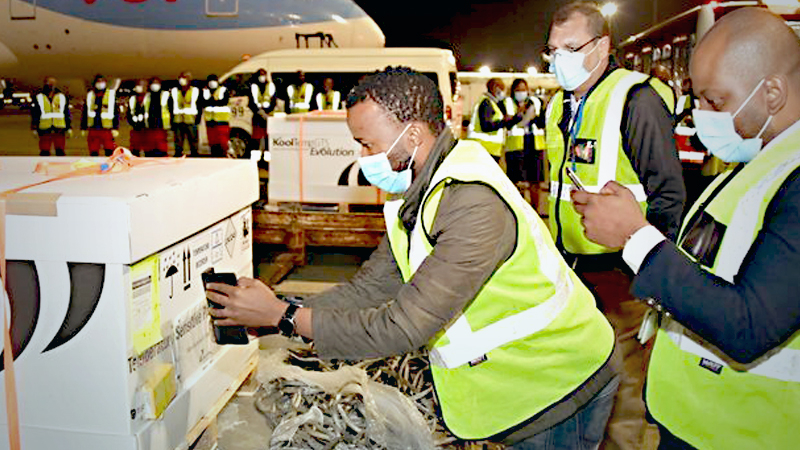
South Africa began administering its first coronavirus vaccines on Wednesday, dispensing Johnson & Johnson shots to health workers and top politicians just hours after they arrived in country from Belgium.
President Cyril Ramaphosa and Health Minister Zweli Mkhize were among those to be inoculated at a hospital in the Cape Town suburb of Khayelitsha. Their inclusion among the first group of people to be vaccinated was aimed at reassuring the public that they are safe, after surveys showed widespread hesitancy about receiving them.
“This is really a milestone for our country,” Ramaphosa said after receiving his shot. “We are going to be rolling out this vaccine throughout our country. I think it is going to be flawless.”
The government had previously faced criticism from scientists and labor unions for being slow off the mark to procure vaccines, after it lagged 79 countries in beginning their rollout. The country has secured enough doses for all those that need them, according to Mkhize.
The process of vaccinating two-thirds of the population of 60 million in order to achieve herd immunity is expected to take 12 to 18 months, said Stavros Nicolaou, head of the health-work unit at lobbying group Business for South Africa.
“Phase one is critically important,” Nicolaou, who also heads strategic trade at Aspen Pharmacare Holdings Ltd., said in an interview with radio 702 on Wednesday. “We need to vaccinate 1.3 million health workers before we get to the third wave.”
South Africa has recorded more than 1.49 million coronavirus cases since March last year, the most on the continent. A total of 48,313 people who were diagnosed with the disease have died, according to the Health Ministry.
South Africa switched to using J&J shots for its initial inoculations, after a small study showed shots developed by AstraZeneca Plc and the University of Oxford had little impact on mild infections caused by a variant of the virus first identified in the country last year. The J&J vaccines are being issued as part of a study, allowing normal regulatory approvals to be bypassed.
A sprawling stimulus package may be the next shot in the arm for the economy, but the Federal Reserve is making it clear the recovery also hinges on literal shots in Americans’ arms.
Central bankers tend to talk about interest rates and asset purchases when it comes to policy. But in a downturn as unusual as the covid-19 pandemic, the Fed is increasingly leaning on a new vocabulary set – one that may seem drawn from a medical textbook instead of an economics one.
Whether talking about mask-wearing or social distancing, the Fed’s message increasingly is that healing the economy will require ending the public health crisis. And at their January policy meeting, Fed leaders discussed speedy vaccine delivery as a must-do to carry the economy through to the other side, according to meeting notes released Wednesday.
Policymakers pointed to risks tied to new covid-19 strains, possible public resistance to vaccines and issues with production and distribution of the shots. On the flip side, an effective vaccine program, mixed with aid from Congress, could improve the outlook ahead, the notes said.
“There’s nothing more important to the economy right now than people getting vaccinated,” Federal Reserve Chair Jerome Powell said at a news conference following last month’s meeting.
Powell and his colleagues are quick to leave medical advice to the experts. But their overarching point is that the economy and public health are intertwined like never before.
“Using traditional metrics to gauge or understand the path of the economy has not proven very effective,” said Tim Duy, an economist at SGH Macro Advisors and the University of Oregon. “It’s a very large change in how the Fed views its role in supporting the economy in a much more diverse and inclusive fashion.”
Powell and other Fed leaders have long argued that basic health protocols go hand-and-hand with monetary policy or more aid from Congress. But the vaccine push has been viewed by some economists as an endorsement of the stimulus package currently working its way through Congress. President Joe Biden’s $1.9 trillion stimulus proposal includes hundreds of billions of dollars toward the pandemic response, including a national vaccine program, expanded testing and funding to help schools safely reopen. The White House said last week that it will have enough vaccines for 300 million people by end of July.
“The virus is the bottleneck in the economy,” said David Beckworth, a monetary policy expert at the Mercatus Center, a libertarian think tank at George Mason University. The Fed’s focus on vaccines and other health tools is “a consistent but more focused message that ‘we’ve got to get the virus taken care of,'” Beckworth said.
At the Fed, that message mission is core to restoring the 10 million jobs still missing from the labor force and pumping momentum into a recovery that shows signs of leveling off. And Powell and others have signaled that their job doesn’t stop when the workforce is back to its pre-pandemic strength.
In a speech last week, Powell said that steady employment “improves mental health” and “increases life spans” – goals that stretch far beyond the Fed’s more traditional role.
“Our job is not to replace Dr. (Anthony) Fauci,” Powell said last week. “It really is to understand the implications for the economy, and in this particular case, the risks seem to be to the downside, from a slower rollout of the vaccination, or less successful rollout or the new strains. So we monitor all of that.”
InternationalFeb 18. 2021A utilities truck drives down the street during a power outage on Feb. 16, 2021, in McKinney, Texas, about 30 miles north of Dallas. MUST CREDIT: Bloomberg photo by Cooper Neill
By Syndication Washington Post, Bloomberg · Rachel Adams-Heard, Naureen S. Malik, Brian Eckhouse
The finger-pointing began immediately: It was the freezing of the wind turbines that foolishly replaced traditional sources. No, fossil fuels were at fault. No, Texas’s deregulated power market, unique in the country, had allowed companies to skimp on maintenance and upgrades.
As the hours ticked by and millions more were plunged into frozen darkness, a more sober reality emerged. The greatest forced blackout in U.S. history, as this event has almost certainly become, was the result of a systemic and multifaceted failure. There are no promises of when power will be restored and little likelihood that the episode won’t be repeated in a corner of the country hard hit by climate change.
“This feels like a technical design failure,” said Michael Webber, who founded the Webber Energy Group at the University of Texas at Austin and serves as chief science and technology officer at French utility Engie.
Power plants weren’t fully weatherized, wiping out generation capacity. The ones that were still standing struggled to get enough fuel, with shale wells experiencing so-called freeze-offs. Many wind turbines stopped spinning. Texas, with a grid notoriously isolated from the rest of the U.S., was unable to call on neighboring states for help.
Still, as the pressure dropped last week and frigid air descended from the north, some saw what was coming and felt as if they were witnessing a train crash. They lay part of the blame on ERCOT, the Electric Reliability Council of Texas, which manages the flow of power to consumers and says the extreme nature of the weather made it hard to be ready.
“We were woefully unprepared for this kind of cold,” said Texas state Rep. Ron Reynolds, D, whose own house is without power. “They got caught with their pants down and now millions of Texans have no power. This is a matter of life and death.”
ERCOT officials couldn’t say when power would be restored. “I know it’s frustrating we can’t offer a time certain, but it’s a process we’re engaged in to get the grid back in balance,” ERCOT CEO Bill Magness said during a news conference Tuesday.
Adam Sinn, owner of Aspire Commodities LLC, a power and gas trader, was one of those wondering why so little was being done. He said that a week ago, when the seven-day outlook hit, ERCOT’s own projections showed too little supply to meet soaring demand.
“We were looking at this week thinking, they are going to have to cut 10,000 megawatts of consumers,” he said. “I really think ERCOT is to blame on this one.” He said there were spare megawatts that weren’t brought online. For example, Vistra Corp., a large generator, had 4,000 megawatts offline for maintenance in four plants that could have been turned on quickly, he said, citing data from Genscape Inc.
Sinn said ERCOT either failed to order the megawatts back on or was told not to, which should have generated publicity so residents could prepare.
ERCOT and Genscape didn’t respond to requests for comment. Vistra declined to comment.
If ERCOT knew what was in store, it wasn’t apparent in its messaging to Texans. Over the weekend, recommendations from its official Twitter account included closing the blinds and unplugging unused kitchen gadgets. “Laundry on Valentine’s Day?” it said in another post. “No.”
Idle oil drilling rigs in the snow at a lot near Midland, Texas,on Feb. 13, 2021. MUST CREDIT: Bloomberg photo by Matthew Busch
On Tuesday, Dan Woodfin, a senior director for ERCOT, attributed the main factors to frozen instruments at natural gas, coal and nuclear plants. He and other ERCOT officials said they believed generators had prepared better for such cold.
ERCOT’s authority is somewhat limited. In 2011, the last time freezing weather caused rolling outages, it released recommendations for power generators but could not require they be followed, said Adrian Shelley, Texas office director of Public Citizen, an advocacy group.
Federal energy regulators also issued a 357-page report that recommended generators winterize their equipment, including insulating pipes.
“The financial incentive isn’t there to harden that infrastructure,” he added. “From a generator perspective, the only incentive is to bring energy to market as cheaply as possible.”
Power prices spiked on several days to the price cap in Texas — a staggering $9,000 per megawatt-hour.
A 100-megawatt wind farm in the state that might have normally made almost $40,000 over a two-day period in February could reap more than $9.5 million on Monday and Tuesday alone, Nicholas Steckler, a power-markets analyst at BloombergNEF, said. On Monday, electricity sales likely totaled $10 billion, according to Wood Mackenzie.
While some pointed to wind power as a culprit, as of early Tuesday wind shutdowns accounted for 3.6 to 4.5 gigawatts — or less than 13% — of the 30 to 35 gigawatts of total outages, ERCOT’s Woodfin said. Gas produced 35% of the power in January.
Others said Texas’s problems were wide-ranging.
“Everyone wants to blame someone, so they blame ERCOT,” Webber said. “But if the gas can’t come out of the ground, is that ERCOT’s fault? If we have sloppy building codes that don’t properly insulate homes, is that ERCOT’s fault?”
He suggests a combination of upgrades and expansions nationally at a cost of trillions of dollars over decades. Roughly 10% of that will need to take place in Texas. That’s a lot of money, which is why little was done the last time Texas saw a major test of its grid in the cold a decade ago.
A Dallas Morning News newspaper half-covered in snow on Feb. 16, 2021, in McKinney, Texas, about 30 miles north of Dallas. MUST CREDIT: Bloomberg photo by Cooper Neill
Texas lacks the long-term planning processes that other parts of the country employ. In the east, grid operators run capacity markets that act like insurance policies. Generators are paid to guarantee that their supplies will be available on the most extreme hot and cold days. If they don’t show up, they face stiff penalties. Texas has instead left it up to prevailing prices and industry.
That deregulated and competitive nature of the markets stands to exacerbate massive price run-ups. More than 100 electric suppliers compete for customers who churn power companies like credit cards. They take big risks to attract new customers, offering incredibly low rates and allowing unlimited power use on weekends. But when the wholesale markets backfire, they bail on them.
The state also refuses to connect its grid with neighbors in part out of fear that the system will fall under federal oversight and regulation. But its politicians are coming to realize that independence has a down side.
Natural gas played an outsize role in the disaster. As early as last Thursday, Energy Transfer LP sent a warning to customers on its Transwestern natural gas pipeline: It was going to be cold, and if producers’ shipments were to deviate from their normally scheduled flows, they needed to let the operator know.
Maybe the North Dakota oil field could withstand frigid temperatures, but the infrastructure that connects the Permian Basin in West Texas and southeastern New Mexico is exposed to the elements. Drilling liquids freeze inside pipes, forcing wells and gas processing plants shut.
By Friday, temperatures had dropped to 24 degrees in Dallas. Texans were told to start conserving energy. Physical gas prices soared to more than $500 in Oklahoma from less than $4 at the start of the week. As of Tuesday, they had doubled to roughly $1,000 per million British thermal units. Texas Gov. Greg Abbott, R, asked a major gas exporter to limit their intake.
All of this is to speak nothing of the human toll.
“It’s mentally draining, the constant thought of wondering, ‘When will the power come back on, how can I get us out of this situation?'” said Alton McCarver, 30, an IT worker who led his family into his Dodge Charger for hours at a time to blast the heater and charge phones. “It’s been an uphill battle to stay warm.”
Trump casino implodes, literally, in Atlantic City
InternationalFeb 18. 2021A composite image of the Trump Plaza Hotel & Casino being imploded in Atlantic City, N.J., on Feb. 17, 2021. The demolition of the one-time jewel of former President Donald Trump’s casino empire clears the way for a prime development opportunity on the middle of the boardwalk. MUST CREDIT: Bloomberg photo by Angus Mordant
By Syndication Washington Post, Bloomberg · Tina Davis, Sophie Alexander, Christopher Palmeri
Trump Plaza, the first casino Donald Trump ever built and a faded vestige of Atlantic City’s glamorous past, came crashing to earth Wednesday morning in a cloud of dirt, dust and noise.
Carefully placed explosives imploded the 39-story white tower on the Atlantic Ocean, which stood empty for years. City officials were keen to destroy it amid complaints that chunks of concrete were falling off the building. A few hundred people in cars paid $10 to park at a former airfield less than 2 miles (3.2 kilometers) away on a freezing, winter morning to watch the Plaza’s final destruction.
While Trump’s faded name could still be seen in the outlines of giant letters that once branded the building, he hasn’t owned it in years. Carl Icahn acquired it when he bought Trump Entertainment Resorts out of bankruptcy in 2016. Icahn hasn’t disclosed plans for the property. The mayor of Atlantic City, who fought to tear down the Plaza, said he wants it replaced with a mixed-use development, perhaps something centered on family entertainment. “The last thing we need right now is another casino,” Mayor Marty Small, D, said in an interview.
Taking down the building represents “turning the page, the dawn of a new era,” Small said. “The Trump era in Atlantic City will be officially over.”
The Plaza opened in 1984, the first of three casinos Trump would eventually own in Atlantic City. All of them would end up in bankruptcy.
“I like the casino business,” Trump wrote in his 1987 book, “The Art of the Deal.” “I like the scale, which is huge, I like the glamour, and most of all, I like the cash flow.”
The Trump Plaza casino looms above the colorful facade of the Bally’s Casino in Atlantic City, N.J., on Feb. 28, 2004. MUST CREDIT: Bloomberg photo by Emile Wamsteker
Trump became interested in casinos early in his career. The idea of getting into the business first came to him in late 1975, when he heard a radio report about how a strike by hotel workers in Las Vegas had sent Hilton’s stock price sinking — even though the two casino hotels were a small portion of the company’s portfolio.
“It occurred to me that even if I finally got the hotel built and it became a major success in the greatest city in the world, it still wouldn’t be nearly as profitable as a moderately successful casino hotel in a small desert town in the Southwest,” Trump wrote in the book. “What I did shortly after I heard that radio report, was take a trip down to Atlantic City.”
He admits in the book to some bluffing to secure his future partner in Trump Plaza. Early on in the project, he invited executives from Holiday Inn to come see how much work had been done on the site. In fact, the building had barely been started, but Trump gathered “every bulldozer and dump truck” his construction manager could find to make it look like they were busy at work when the Holiday Inn reps came to visit.
“If they got some actual work accomplished, all the better, but if necessary, he should have the bulldozers dig up dirt from one side of the site and dump it on the other,” he said. Holiday Inn decided to team up with Trump on the project. The partnership didn’t last long — in 1986, Trump bought out Holiday Inn’s stake.
The initial success of Trump Plaza would spur more spending. Trump took on more debt, buying and finishing the Taj Mahal in Atlantic City after famously getting in a bidding war over the parent company, Resorts International, with Merv Griffin. At its peak, Trump’s portfolio consisted of four casinos, three in Atlantic City and one in Indiana. The expansion was costly, however, and his company’s high debt load make it difficult to compete with rivals. At one point, Trump’s New Jersey casinos lacked money to put stools in front of slot machines.
Atlantic City was the sole place to gamble legally in the eastern U.S., and it was for a time the largest gaming market after Las Vegas. Atlantic City’s casino revenue peaked at $5.2 billion in 2006. The expansion of legalized betting in neighboring states led to a collapse of traffic to the remote New Jersey beach resort, with more than half of the properties changing hands or shutting down. The city’s nine casinos generated $1.5 billion in sales last year, although online casino games and sports betting delivered another $1.4 billion in revenue statewide.
Tilman Fertitta bought the Trump Marina in Atlantic City for $38 million in 2011, rebranding it as the Golden Nugget. In a recent presentation, Fertitta said he has increased sales by 36% since acquiring the casino and generated a 15% return on investment on the once-money losing operation. Fertitta also used it to build an online betting business with a current market value of more than $800 million.
Hard Rock International bought the Trump Taj Mahal, remodeled and rebranded it. It’s now the second-highest grossing casino in the city after MGM Resorts International’s Borgata. Joe Lupo, President of Hard Rock Hotel & Casino Atlantic City, said at a news conference Feb. 2 that the company was so pleased with the financial performance they’d seen in an otherwise difficult 2020 they were paying out $1 million in employee bonuses.
In 2014 Trump sued to have his name taken off the two remaining New Jersey resorts, saying they had fallen into disrepair. The Indiana riverboat casino was also sold. Now, the Trump empire includes no casinos — not even at Trump International Hotel Las Vegas, which advertises itself as “a sophisticated, non-smoking and non-gaming” luxury hotel.
When Icahn acquired Trump Plaza, it had already been shut for two years. The building had been deemed an “imminent safety hazard,” according to the mayor. “You had chunks of concrete falling from the top floor.”
Small said that in his first state of the city address last year, “the thing that got the biggest applause when we put the slide up was a bulldozer going through Trump Plaza.” He initially proposed a charity auction, where the winner would get the chance to hit the button that would bring the building down. That was scrapped last month due to safety concerns, but Small said Icahn matched the highest bid and donated $175,000 to the Boys & Girls Club of Atlantic City.
It seems fitting the casino’s last act would be to help a city where Small said Trump had a history of “stiffing so many small businesses, mom-and-pop shops.”
In July 2016, Hillary Clinton used the hotel as a backdrop during her failed presidential campaign to give a speech highlighting Trump’s multiple bankruptcy filings.
That prompted a swift Trump response via Twitter: “I made a lot of money in Atlantic City and left 7 years ago, great timing (as all know).”
Democrats pivot back to Biden’s stimulus with Trump’s trial done
InternationalFeb 17. 2021The Capitol building at dawn in Washington, D.C., on Tuesday, Feb. 9, 2021. MUST CREDIT: Bloomberg photo by Stefani Reynolds.
By Syndication Washington Post, Bloomberg · Laura Davison
With Donald Trump’s impeachment trial behind them, Democrats are quickly pivoting back to President Joe Biden’s priorities, particularly his $1.9 trillion stimulus plan and confirming the rest of his cabinet.
Lawmakers face a short turnaround to approve another round of stimulus payments, jobless compensation and funding for schools and vaccines before key benefits from the last round of pandemic aid expire on March 14. In less than four weeks, Democrats must pass a bill out of the House and get all 50 Senate Democrats to back the legislation.
That will likely require amending some provisions, such as the $15 federal minimum wage requirement, that at least two Democratic Senators — Kyrsten Sinema of Arizona and Joe Manchin of West Virginia — say they won’t support. Any changes made in the Senate would mean that the bill would have to go back to the House for another vote.
The eagerness of congressional Democrats to move past Trump was evident from start to end of the shortest Senate impeachment trial in history. The agreement on the trial format between Senate Majority Leader Chuck Schumer and GOP leader Mitch McConnell kept the proceedings compressed, and the four days of arguments ended ahead of schedule.
After Senators voted on Saturday to allow witnesses to testify — a surprise result that risked delaying the trial’s conclusion by several weeks — House impeachment managers and the former president’s defense team agreed to enter a public statement into the record. That let the chamber move on to a verdict that day, acquitting Trump.
Although Democrats expressed disappointment in the outcome, they said they are ready to put the former president behind them and focus on Biden’s priorities.
“We in Congress need to move forward with delivering the expanded unemployment checks, the stimulus checks, the reinvestment in our economy that the American people so desperately need and deserve,” Senator Chris Coons, a Delaware Democrat who is close to Biden, said Sunday on ABC’s “This Week” program.
Biden continued pushing ahead as the trial was going on, meeting with a group of governors and mayors as well as leading chief executives including JPMorgan Chase’s Jamie Dimon and Walmart’s Doug McMillon to rally support for his stimulus plan. With Trump’s impeachment no longer consuming national attention, Biden plans public events this week to refocus the country on fighting the pandemic and bolstering the economy, including a town hall event Tuesday in Milwaukee.
Although seven Republicans joined with Democrats in voting to find Trump guilty — falling short of the 67 votes required for a conviction — it’s unlikely that bipartisan showing will repeat itself on the economic relief legislation.
Ten Republican lawmakers — including Senators Susan Collins of Maine, Mitt Romney of Utah and Lisa Murkowski of Alaska, who all voted to convict Trump — have floated a $618 billion stimulus proposal that keeps Biden’s plans for school and vaccine funding, but pares back unemployment benefits and stimulus checks, and completely eliminates key Democratic priorities, including $350 billion in state and local aid and family tax credits.
These Republicans had a series of meetings with Biden and White House staff on the potential for a bipartisan stimulus approach, but despite both sides calling the meetings productive, there has been little movement to bridge the gap between Biden’s $1.9 trillion proposal and the GOP plan, which is approximately one-third of that.
House committees approved the legislation last week under a fast-track budget reconciliation framework, that will allow them to move the bill with simple majorities in both chambers, thanks to a tie-breaking vote from Vice President Kamala Harris in the Senate. Neither chamber is scheduled to be in Washington this week, but the House Budget Committee is planning to assemble the bills approved in committee to prepare the stimulus package for a vote on the House floor the week of Feb. 22.
House Speaker Nancy Pelosi has said that she will send the bill to the Senate as soon as it passes the House. Schumer is looking for ways to speed up the process once the bill reaches him, which include bypassing Senate Finance Committee approval for parts of the bill in order to get the legislation to Biden before federal unemployment benefits expire on March 14. Republicans have criticized that approach, saying Democrats should follow the regular legislative process.
Despite several hurdles to clear an economic relief bill in the coming weeks, Democrats have already set their sights on their next move: an infrastructure and jobs bill. Biden has already begun meeting with senators of both parties to discuss potential proposals on physical infrastructure upgrades, rural broadband internet and renewable energy investment.
In a move that could ease negotiations on an infrastructure bill, House Appropriations Chair Rosa DeLauro and Senate Appropriations Chair Patrick Leahy’s plan to restore lawmaker-directed spending, known as earmarks, which Congress banned a decade ago. The practice allows lawmakers to insert funding for pet projects into legislation and is seen as a useful tactic to get members to back large ambitious bills, but it has been the source of scandal and abuse by some lawmakers.
DeLauro plans to release details about reinstating earmarks in the coming weeks, House Appropriations spokesman Evan Hollander said. It will include more transparency and limits on the total dollar amounts and recipients.
PARIS – Concern about the spread of coronavirus variants in eastern France has prompted an acceleration of vaccination in that region, as well as calls to suspend the rollout of the Oxford-AstraZeneca vaccine to the health care workers there who had been first in line to get it.
AstraZeneca vaccinations in France only began Feb. 6. But the French government’s top vaccine adviser, Alain Fischer, suggested in a weekend interview with the Journal du Dimanche newspaper that health workers in Moselle – where variants first detected in South Africa and in Brazil are suspected to be particularly widespread – should not receive that particular vaccine, one of three authorized in the European Union.
Instead, Fischer recommended administering either of the two authorized mRNA vaccines, developed by Pfizer-BioNTech and by Moderna, as a “precautionary measure” because they allow individuals to obtain protection more quickly.
According to the paper, Fischer also cited the preliminary South African research finding that the AstraZeneca vaccine provided “minimal protection” against mild to moderate coronavirus cases caused by the variant known as B.1.351. The South African researchers left open the possibility that the vaccine may still prevent severe cases of the disease caused by the variant, but the South African government paused its rollout of the vaccine last week.
Both Pfizer-BioNTech and Moderna have claimed their vaccines are effective against more contagious variants of the virus.
The eastern region of France announced Monday that it would receive 30,000 additional vaccine doses from the government – all of them from Pfizer-BioNTech, according to France’s public broadcaster. It was not clear whether the choice was a deliberate response to the recommendation by the government’s top adviser. The French health ministry confirmed that it was sending additional doses to the region but did not immediately respond to a request for further details.
French health minister Olivier Véran said last week that he continued to support the AstraZeneca vaccine, saying it provided sufficient protection against “nearly all the variants.”
The AstraZeneca vaccine – which is not yet authorized in the United States – remains a key component of Europe’s immunization strategy, and Fischer defended its use elsewhere in France, saying Monday that he did not want to imply that “it’s not good.”
But whereas the European drug regulator authorized it for all adults last month, French authorities had recommended it only for people under 65, citing a lack of sufficient data for its efficacy among older people.
And now, the suggestion that its use should be further limited has prompted additional questions in a country that already had one of the highest rates of vaccine skepticism in the world.
“It seems unwise to immunize caregivers” with the Oxford-AstraZeneca vaccine, Jérôme Marty, president of the UFML health care workers union, said Tuesday. He cited doubts over its efficacy against the variant first found in South Africa but also more general objections.
Health care workers tend to be exposed to particularly high viral loads, Marty said, and are disproportionately likely to transmit the virus to vulnerable people. His union has demanded that health care workers across France receive preferred access to the Pfizer-BioNTech or Moderna vaccines, which have a higher efficacy.
In the eastern French region that has seen a surge in suspected variant cases, union representative Monique François said Monday that only a few health workers appeared to have signed up to receive the AstraZeneca vaccine.
“It proves that some have questions,” François told BFM TV, calling for additional BioNTech-Pfizer shots.
Between 4 and 5% of new coronavirus cases across France are estimated to be caused by the variants first detected in South Africa and in Brazil, according to the French health ministry, and both strains are believed to be highly transmissible.
Officials have expressed growing concern over the spread in the east, along the German border. Officials said they had detected 300 suspected new cases of the South African and Brazilian variants within four days last week, though that figure had not yet been confirmed through detailed sequencing.
France has opted to speed up vaccinations in the region – a deviation from the approach pursued in some other countries, where harder-hit areas have not received more vaccines per capita than other places.
The strategy shift was welcomed by doctors unions this week. “We need to act quickly in the areas that are most affected by variants,” Marty said.
French doctors are also concerned that the South African variant could more easily reinfect people who already had covid-19. In what appears to be one of the first such cases, a 58-year old man is in a critical condition in a French hospital after being reinfected with the South African variant, according to a study published last week.
The government in France hopes that accelerated vaccinations and a nationwide 6 p.m. curfew will keep the variants in check. But the country has been among the slowest and most cautious in Europe to roll out its vaccination programs. And like the rest of Europe, it now faces a shortage of doses.
The French government has resisted calls for a local lockdown, even as politicians in neighboring Germany pondered possible border closures.
World fashion capitals look at possible $600 million shortfall, thanks to covid
InternationalFeb 17. 2021In 2011, Roberto Cavalli’s Fashion Week party was held at the Battersea Power Station in London. This year, the virus has forced cancellation of fashion shows for a second season in the fashion capitals of New York, London, Paris and Milan. The power station is shown on March 28, 2010. MUST CREDIT: Bloomberg photo by Simon Dawson
By Syndication Washington Post, Bloomberg · Kim Bhasin, Angelina Rascouet, Flavia Rotondi
Each year over four weeks in February and March, thousands of fashion executives, celebrities, influencers and models hopscotch between the world’s style capitals to attend runway shows. Attached to them is a multimillion-dollar economy that pumps both investment and tourist spending into New York, London, Paris and Milan.
For the second season in a row, all of that has been erased by the pandemic. Almost all shows will be virtual, as they were last September. The luxury hotels normally packed with fashion’s finest will be near empty, local clubs and venues won’t be welcoming many for nightly parties, museum and art exhibitions will be ghost towns, and high-end boutiques will miss out on the cash that flows from a flood of shoppers willing to shell out thousands for a dress or handbag.
All told, the four cities could miss out on more than $600 million in economic activity this season, according to data compiled by Bloomberg.
Here’s a look at what it’s like on the ground in the world’s four prime fashion hubs as the industry braces for a second lost season:
New York
Not long after last February’s shows ended, New York City became the epicenter of the global coronavirus pandemic, leaving tens of thousands dead. A late-year resurgence in the Northeastern U.S. led to renewed restrictions on business in Gotham, though infection rates have recently started to decline again. Nevertheless, New York’s Fashion Week, which began this past weekend, is being held virtually.
More than 100 events are on the calendar, from panels to presentations on live streams and a few runway shows that actually include physical elements. Mainstays like Rebecca Minkoff and Jason Wu will take part as usual, and more than a dozen young designers will be spotlighted by the Black In Fashion Council.
The Council of Fashion Designers of America said it expects business this spring to be tougher than last fall. “This season, even more than last, will be a great challenge for all of us as the world grapples with an increasingly devastating pandemic and economic downturn,” Tom Ford, chairman of the CFDA, wrote in a letter to the industry.
New York’s Fashion Week usually generates hundreds of millions of dollars in annual revenue, surpassing that of the U.S. Open tennis tournament the city also hosts each year, according to the state legislature’s Joint Economic Committee. During normal times, they attract 150,000 attendees who fill Manhattan’s hotels, light up the night life and spend lots of money.
London
It’s been a mixed start of the year for London, with a more easily transmitted virus variant forcing a third lockdown while the vaccine rollout raises hopes that another catastrophic surge can be avoided. The British Fashion Council is holding a digital-only event starting Feb. 19 that will showcase both women and menswear by 95 designers-with names including Victoria Beckham.
London’s Fashion Week usually brings in more than $374 million (£269 million), according to FashionUnited’s Business Intelligence. Oxford Economics estimates 240,000 direct jobs representing more than one-quarter of the U.K. fashion industry’s workforce have been lost because of the pandemic. Including indirect jobs, the toll spikes to 350,000.
Back in 2011, nightclub owner Carlo Carello organized Roberto Cavalli’s Fashion Week party at the Battersea Power Station. He’s had to fire 80% of the staff at the Raffles club, an iconic venue in the posh Chelsea neighborhood. “We’d be heaving every night of the week, we’d normally have two or three Fashion Week parties on,” Carello said of pre-pandemic times. “A business like ours is being decimated.”
Making things worse is another malaise looming over the U.K. fashion industry: Brexit. Walpole, the organization representing luxury brands such as Burberry, said smaller fashion brands have stopped doing business with the European Union for the time being because “there’s an imperfect understanding” from country to country of duties that need to be charged, now that the U.K. is on its own.
A worker prepares to close a restaurant before curfew in Duomo Square in Milan on Oct. 26, 2020. Each of the four Milanese fashion weeks has brought in about 30 million euros in tourism spending, a number that this year will be reduced about 80%, says the head of the Italian Fashion Chamber. MUST CREDIT: Bloomberg photo by Francesca Volpi
Milan
When this year’s fashion shows begin in Milan on Feb. 23, they will be fully digital, apart from a few presentations where a limited number of buyers and media have been invited to watch, socially distanced. Opening night will be an Instagram live party with a DJ set instead of an in-person blowout in a city that suffered some of the pandemic’s worst loss of life last spring.
To keep the city involved-and to allow passersby to watch live shows by icons such as Armani, Prada, Fendi and Dolce & Gabbana-the Italian Fashion Chamber will put up big screens in strategic locations across central Milan.
“It will be a symbolic gesture,” said Carlo Capasa, the chamber’s chairman and chief executive officer. “A reminder for the people of Milan that fashion is still part of everybody’s life, resilient despite the covid crisis, still able to incarnate the city’s values: creativity and efficiency.”
In past years, each of the four Milanese fashion weeks would bring in about 30 million euros in spending at places like hotels and restaurants. Capasa expects that income to be cut by at least 80%.
Barriers block access to the Louvre museum during coronavirus lockdown measures in Paris on April 14, 2020. A year ago, Louis Vuitton’s Nicolas Ghesquiere set up his catwalk inside the Louvre, a monumental show that fashion filmmaker Loic Prigent described as “a swan song to covid-free times.” MUST CREDIT: Bloomberg photo by Cyril Marcilhacy
Paris
A year ago, Louis Vuitton’s Nicolas Ghesquiere set up his catwalk inside the Louvre, a monumental show that long-standing fashion filmmaker Loic Prigent described as “a swan song to Covid-free times.” Gone are the days when A-list celebrities would huddle in the front rows at the world’s the most visited museum. This time, the womenswear Paris Fashion Week will be an online affair. It kicks off on March 1.
The Institut Francais de La Mode estimates that Paris Fashion Weeks generated 450 million euros annually before the pandemic. While new estimates since the virus struck haven’t come out yet, the amount has predictably dropped, according to Pascal Morand, chairman of the Federation de La Haute Couture et de La Mode, which organizes the event.
Five of Paris’s 12 premier hotels, dubbed Palaces, are currently open, though with occupancy rates hovering between 5% and 15%, Christophe Laure, chairman of the UMIH Prestige hotel industry group said. During a normal pre-covid Fashion Week, all Palaces would be open with 80% to 100% of their rooms booked. The situation “is pretty worrying,” Laure said.
Morand said covid-19 has at least democratized access to the shows, thanks to their digital format-and the numbers show it. The Louis Vuitton’s fall menswear show by Virgil Abloh in January 2020 has been viewed just under 500,000 times on the brand’s YouTube page, whereas the 2021 show has already amassed more than double that amount.
Nevertheless, Morand looks forward to the day when traditional fashion shows return, since the digital experience “will never fully replace” the feeling of being there.
Myanmar generals defend coup, dismiss impact of U.S. sanctions
InternationalFeb 17. 2021Brigadier-General Zaw Min Tun, the lead spokesman for the State Administration Council
By Syndication Washington Post, Bloomberg
Myanmar’s junta again defended its move to oust the civilian government in the face of nationwide protests, dismissing the impact of U.S. sanctions while showing no signs of a compromise with demonstrators.
Brigadier-General Zaw Min Tun, the lead spokesman for the State Administration Council, said Tuesday the military’s actions were in line with the 2008 constitution and “not a coup.” He added that the regime was taking steps to fight Covid-19 and wanted to attract foreign investment, while seeking to discredit protesters by showing videos of violence against authorities.
“To ensure democracy and prosperity, people should cooperate with us without being emotional,” Zaw Min Tun said in the military’s first official press briefing since the Feb. 1 coup. He said the junta would proceed with an election according to its timeline while “trying not to be violent as much as possible.”
The remarks signal Myanmar’s army is looking to improve its image after tens of thousands of people have hit the streets in defiance for more than a week, including on Tuesday, drawing support from democracy activists in Asia and Western governments. U.S. President Joe Biden sanctioned coup leader Min Aung Hlaing and other top generals while foreign investors have reassessed plans to put money in the country.
Zaw Min Tun said the generals expected sanctions and dismissed their impact, saying it had experience of such things when Myanmar faced international isolation prior to its shift toward democracy a decade ago.
“We will make sure to keep good terms with the UN and all the countries,” he said. “Our council is trying to strengthen ties with all countries.”
The regime shut down the internet for a second straight night, part of efforts to disrupt telephone and internet access to prevent demonstrators from organizing. They have also made changes to the telecommunications law to impose harsher prison sentences for illegal online activity, while also granting themselves new powers to intercept communications and detain dissidents.
Myanmar’s military leaders have struggled to gain control of the streets since ousting the government led by Aung San Suu Kyi, whose party won a landslide victory in November elections. She has urged the country’s 55 million people to oppose the army’s move, calling it “an attempt to bring the nation back under the military dictatorship.”
Suu Kyi and other political leaders are among more than 400 people detained since the coup, a number that keeps rising by the day. Police filed an additional charge against her, Reuters reported on Tuesday, citing her lawyer. Zaw Min Tun said Suu Kyi was in “good health,” while adding that authorities were investigating money laundering at a foundation she runs.
While police and soldiers have largely avoided confronting protesters in major cities like Yangon who have ignored a ban on public gatherings, several demonstrators have been injured in crackdowns — including a woman shot in the head who is now on life support in Naypyidaw, the capital.
Zaw Min Tun declined to say whether the woman was hit with a rubber bullet or live bullet, as protesters have alleged. “We will give you all the information about what the girl did to the police,” he told reporters.
He also urged civil servants to return to work, saying “we will unavoidably take actions against these civil servants after a certain period.” He added that the government was “operating as normal” despite the protests.
According to a copy of the amended telecommunications law seen by Bloomberg News, anyone found guilty of perpetuating a cyberattack to threaten national sovereignty or unity may now face up to five years in prison and fines of as much 30 million kyat (about $22,570). Those who commit such attacks to hurt Myanmar’s relationship with other countries face even stiffer penalties, up to seven years in prison and a 50 million kyat fine.
Those found guilty of spreading fake news or hoaxes online to cause public panic, or publishing private information of another individual without their permission, meanwhile face up to three years in prison and fines of as much as 5 million kyat.
Telenor Group, which owns one of two wholly foreign owned telecommunications providers in Myanmar, on Monday joined mounting opposition to the junta’s proposed cybersecurity bill, saying it gives the regime broad powers including the ability to order lawful interception. The Asia Internet Coalition, whose members include Facebook Inc., Apple Inc. and Google, stated on Feb. 11 that the bill allows for unprecedented censorship, violates privacy and would “significantly undermine freedom of expression.”
“The current very short and limited consultation has not allowed for the required dialog on the proposed Cyber Security Bill,” Telenor said in a statement. “We are concerned that the proposed bill does not progress relevant regulatory frameworks and law for a digital future, nor promotes and safeguards digital safety and rights.”
Power outages plague Texas, other states amid deadly cold, snow
InternationalFeb 17. 2021Snow and ice blanket downtown Cleveland, Miss., on Tuesday, Feb. 16, 2021. MUST CREDIT: Photo for The Washington Post by Rory Doyle
By The Washington Post · Andrew Freedman, Paulina Firozi, Jason Samenow, Matthew Cappucci
At least 14 people are dead in four states from the effects of a record-shattering cold snap and winter storms since Sunday. In Texas, as the electricity grid struggled to keep pace with record demand, people were turning to unsafe means to heat their homes. A woman and a girl died of carbon monoxide poisoning in Houston after a car was left running in a garage to keep them warm, according to police.
The Arctic air has also claimed the life of at least one homeless person in Houston, and a 10-year-old boy died after he fell through ice near Millington, Tenn. A tornado associated with the storm system that helped draw Arctic air to the south struck in North Carolina overnight, killing at least three and injuring 10.
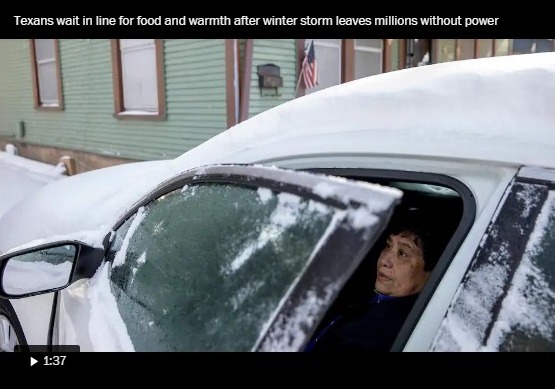
A third of electric customers in Texas were without power Tuesday morning according to PowerOutage.us, because of snow and ice, an overloaded power grid and emergency measures to reduce the electricity demand affecting a number of cities as well as rural areas. About 4.3 million customers were affected.
Texas is unusual in that its electric grid is nearly entirely independent from the rest of the country. When demand exceeds supply, the state is largely unable to import electricity from neighboring states, as is a customary practice almost everywhere else in the country.
The demand, largely driven by the need to heat homes in brutal Arctic temperatures, ran the risk of overwhelming the power grid and triggering uncontrolled outages. The Electric Reliability Council of Texas announced Monday that it was instituting rotating power blackouts.
The blackouts have been anything but rolling; many people have had outages lasting at least 24 hours. The electricity taken off the grid was enough to power 2 million homes.
The U.S. Department of Energy temporarily lifted pollution restrictions to allow power plants to operate and produce at full capacity.
Social media was ablaze with widespread reports that downtown areas, such as in Austin, were lit up “like a shiny island in a sea of black” while neighboring suburbs remained dark in the frigid cold.
Texas Gov. Greg Abbott, a Republican, criticized private power companies.
In a call to the local ABC13 station late Monday, Abbott said outages were in part a result of private power generation companies having “fallen short.”
“There’s a separate part of the system that is not working right now, and those are the private companies that generate the power that goes into ERCOT. And it’s those private companies that generate power that are not working,” Abbott told ABC13. “They were working up until about midnight last night, but after midnight, some of them literally froze up, and were incapable of providing power, and some are still incapable of providing power.”
ERCOT is the Electric Reliability Council of Texas. It handles about 90% of the state’s electricity load.
Abbott was asked about preparations made to prevent such outages after a cold wave that hit Texas in 2011. He said not enough was done to “gauge for this type of event, because the last time we had this type of weather was more than 100 years ago.”
The Federal Energy Regulatory Commission announced that it would open a joint inquiry alongside the North American Electric Reliability Corp. into power systems.
The regulatory agencies said the inquiry would include work with other federal, state and regional agencies and utilities to help identify problems with system performance, and to help assess what can be done to address those problems, according to a release from the agency.
“For now, the emphasis must remain on restoring power to customers and securing the reliability of the bulk-power system,” FERC Chairman Rich Glick said in a tweet.
The agency said the inquiry would formally begin in the “days ahead.”
A decade ago, the two agencies also conducted an inquiry and produced a report on the severe cold-weather event the Southwest experienced in 2011.
Corpus Christi issued a boil order after a “major water main break” led to low water pressure or no water for some customers. The city has issued an order to boil water before drinking it, cooking with it, or making ice, or instead to purchase bottled water.
In North Carolina a tornado tore through the southern part of the state late Monday, the Brunswick County sheriff said in a morning news conference.
Sheriff John Ingram said early Tuesday that at least three people were killed and 10 were injured in a storm that caused “a lot of destruction” along Highway 17 between the North Carolina coastal communities of Sunset Beach and Ocean Isle Beach, near the border with South Carolina and about 40 miles southwest of Wilmington, N.C. The devastation has left many buildings destroyed and residents trapped in their homes, authorities said, though the full severity of the damage remains unclear. Trees and power lines were also reported down throughout the area.
At midnight, a tornado was spotted in Honey Island, N.C., according to WWAY, about 45 miles west of Wilmington. Shortly thereafter, the National Weather Service reported power lines down along Highway 17 in Brunswick County.
A second winter storm is heading to the same region. Winter storm warnings were issued in parts of Texas, Oklahoma, Louisiana and Arkansas as more dangerous winter weather approached.
By Syndication Washington Post, Bloomberg · Brian K. Sullivan, Naureen S. Malik, Javier Blas
Millions of households in Texas are suffering rolling blackouts for the first time in a decade as an unprecedented Arctic freeze sends temperatures plummeting across much of the U.S., roiling energy markets.
Large swaths of Dallas, Houston and other cities are being plunged into darkness for an hour at a time — and in some cases longer — as surging demand for heat pushes the power grid to the brink. The situation is poised to become more dire as temperatures are forecast to fall to as low as 3 Fahrenheit (minus 16 Celsius) in parts of the state.
“Every grid operator and every electric company is fighting to restore power right now,” said Bill Magness, head of the Electric Reliability Council of Texas, which runs the state’s grid.
The extreme cold that’s crippling Texas’s power market is part of a larger weather pattern gripping much of the U.S. Winter storm warnings, advisories and watches stretch from New Mexico to Maine. In the past week, about 800 daily records for cold temperatures have been set in the U.S. as arctic air pushes all the way to the Gulf of Mexico. Accuweather called it one of the busiest winter-weather patterns in decades.
Texas is the home of the U.S. energy industry, and the impact of blackouts hitting its major cities; oil and gas production falling because of the cold weather, and power prices soaring to eye-watering levels is highly symbolic of a world that’s trying to get its grip on a battle against climate change, moving away from hydrocarbons.
The extreme cold appears to have caught Texas’s highly decentralized electricity market by surprise. When they warned of possible blackouts Sunday, grid operators said they’d likely last for 15 to 30 minutes at a time. On Monday morning, officials said they were lasting considerable longer.
“These are not rolling blackouts. We are dealing with system-wide power outages across the state,” Houston Mayor Sylvester Turner said on Twitter.
These are the first rolling blackouts caused by cold weather since 2011. Spikes in electricity demand usually happen in summer in Texas when air conditioning use rises. A loss of frequency on the grid has caused 30 gigawatts of generation to halt. Many stations will have been undergoing scheduled maintenance, leaving the grid more exposed during unusually large spikes in demand.
Rotating outages will likely last throughout Monday morning and are a possibility until the weather conditions ease, Ercot said in a statement.
Parts of Texas were colder than Alaska, according to the National Weather Service. The temperature at 5 a.m. in Houston was 18 degrees Fahrenheit, matching the reading in Anchorage. In the Dallas-Fort Worth area it was 5 degrees Fahrenheit.
Frigid temperatures and a parade of storms in the U.S. follow other instances of extreme winter weather this year that have snarled ports and upended energy markets in Asia and Europe. Texas, which isn’t accustomed to winter’s full fury, is getting a big taste. President Joe Biden declared a state of emergency, mobilizing federal assistance to aid local response efforts.
“We would expect to be in emergency operations tomorrow through at least Tuesday morning,” said Dan Woodfin, a senior director at Ercot.
The power crunch is being compounded by a lack of wind generation with output more than halving to 4.2 gigawatts. Wind turbines may freeze in bitterly cold weather, reducing efficiency, and the blades can ultimately stopping spinning.
Earlier, spot electricity prices in Texas’ West hub surpassed the grid’s cap of $9,000 per megawatt hour, a 3,466% increase from Friday, according to data compiled by Bloomberg. LNG exports from the U.S. also plummeted after the freeze shut ports and wells, and oil production also took a hit, with Permian oil production plunging by as much as one million barrels a day. West Texas Intermediate futures rose by as much as 2.5%, above $60 a barrel for the first time in more than a year.
The cut to crude supplies is threatening to unleash a rush for everything from propane to heating oil, fuels that are used in mobile heating devices.
Odessa, one of the largest oil producing areas in the Permian Basin, still has power. While San Antonio has lost power with rolling blackouts lasting 10-15 minutes, according to sources on the ground.
In Houston, there are long lines to refill household propane canisters and firewood is selling out. The city may pick up as much as 2 inches (5 centimeters) of snow overnight, along with ice and sleet, the National Weather Service said. It will get hit by another storm bringing ice and freezing rain Wednesday.
“It is going to be a cold week,” said David Roth, a senior branch forecaster at the U.S. Weather Prediction Center. “The southern plains are in a cold pattern and it is going to take a while for them to break out of it.”
A mix of freezing temperatures and precipitation is paralyzing wind farms in Texas. That would be devastating for power plants with contracts to provide a certain amount of electricity at specific times if they need to instead buy it on the spot market to meet their obligations. At the moment, that power is exceedingly expensive.
“When wind-turbine blades get covered with ice, they need to be shut down,” said Joshua Rhodes, a research associate who focuses on energy at The University of Texas at Austin.
The grid is Texas has relatively little connection with the rest of the country, making it an island when it comes to supplies.
The storms will largely miss major cities along the East Coast, Bob Oravec, senior branch forecaster with the U.S. Weather Prediction Center said. While there could be some snow showers and ice in New York and Boston, the bulk of the accumulation will be in upstate New York and interior New England Monday to Tuesday.

 Federal Reserve Chair Jerome Powell
 A utilities truck drives down the street during a power outage on Feb. 16, 2021, in McKinney, Texas, about 30 miles north of Dallas. MUST CREDIT: Bloomberg photo by Cooper Neill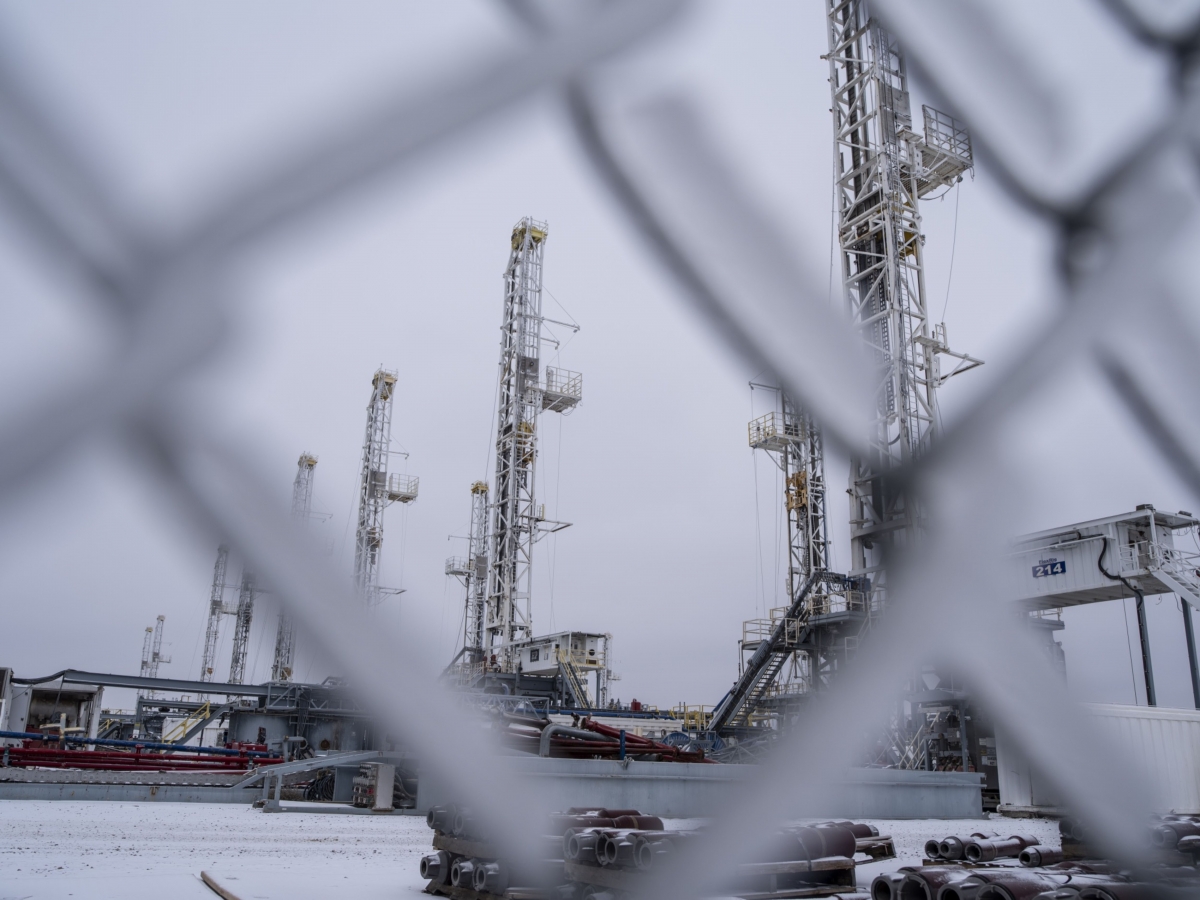

 A composite image of the Trump Plaza Hotel & Casino being imploded in Atlantic City, N.J., on Feb. 17, 2021. The demolition of the one-time jewel of former President Donald Trump’s casino empire clears the way for a prime development opportunity on the middle of the boardwalk. MUST CREDIT: Bloomberg photo by Angus Mordant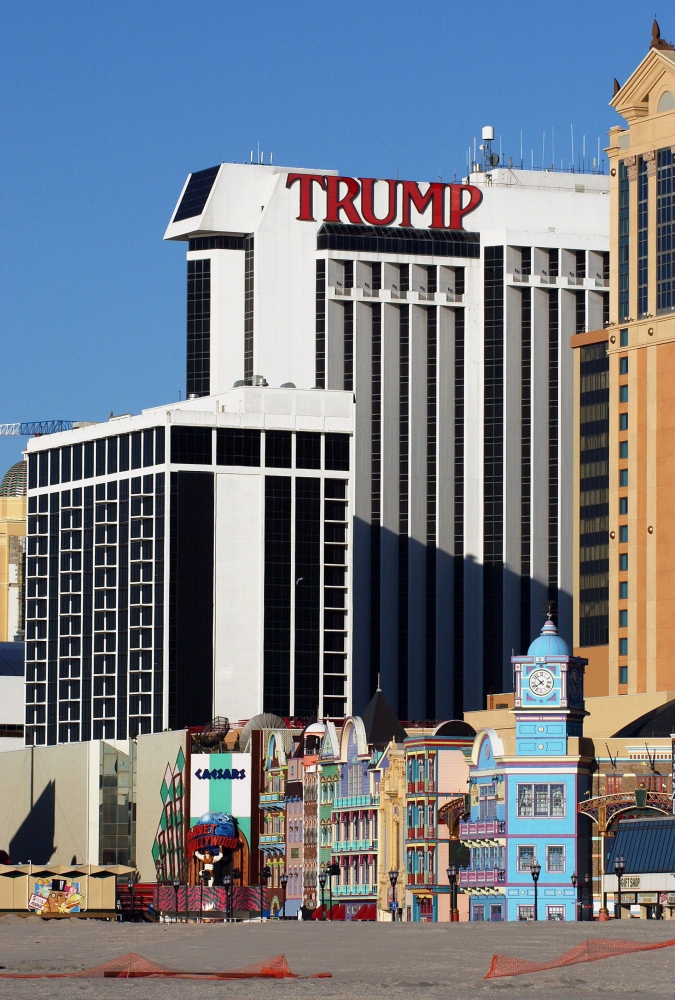
 The Capitol building at dawn in Washington, D.C., on Tuesday, Feb. 9, 2021. MUST CREDIT: Bloomberg photo by Stefani Reynolds.
 In 2011, Roberto Cavalli’s Fashion Week party was held at the Battersea Power Station in London. This year, the virus has forced cancellation of fashion shows for a second season in the fashion capitals of New York, London, Paris and Milan. The power station is shown on March 28, 2010. MUST CREDIT: Bloomberg photo by Simon Dawson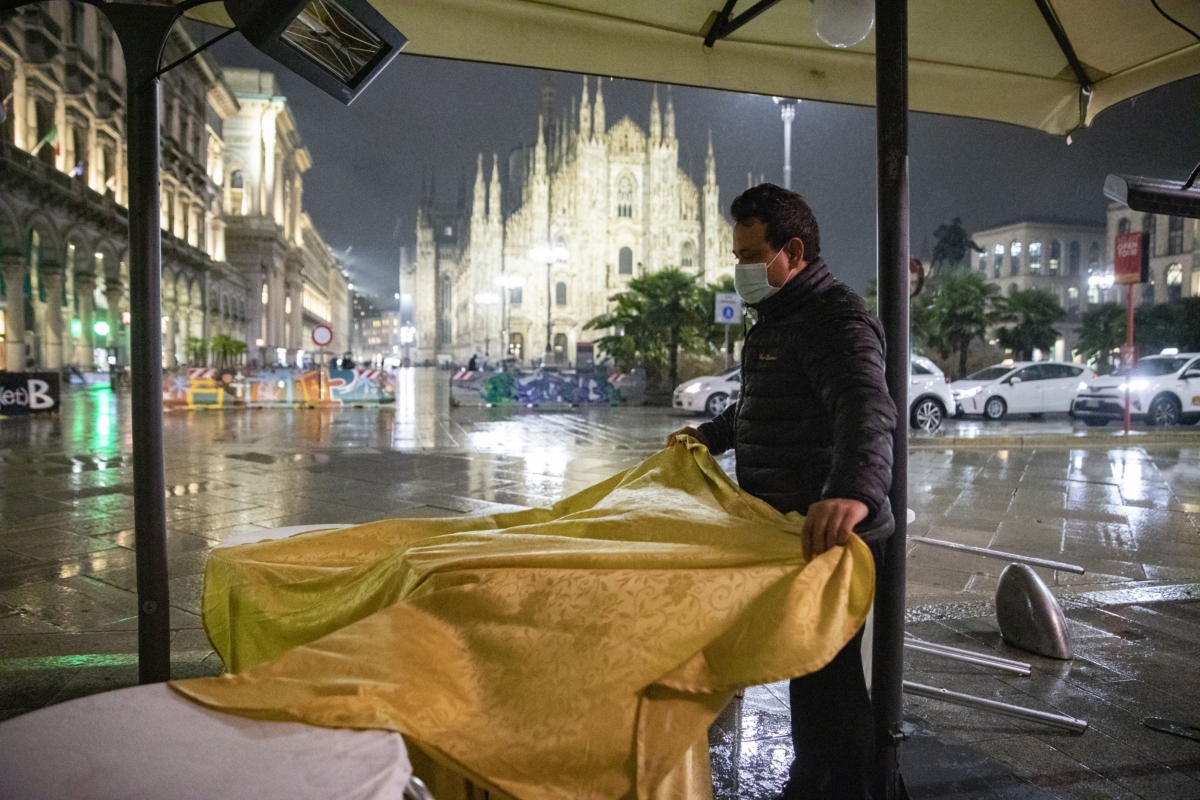

 Brigadier-General Zaw Min Tun, the lead spokesman for the State Administration Council
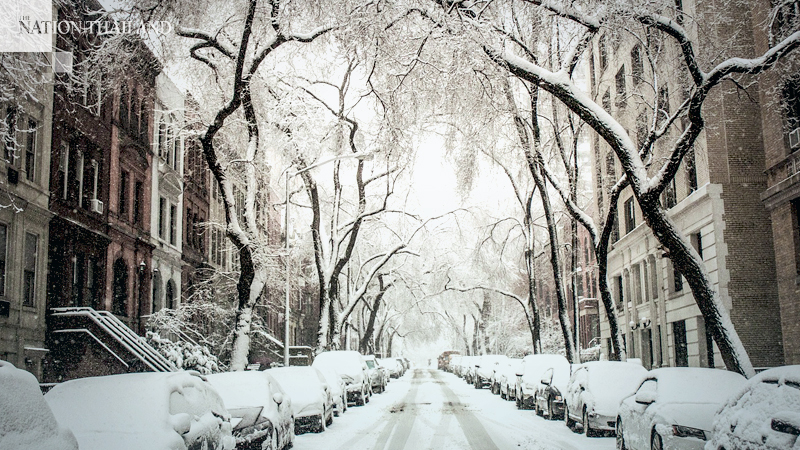
 Snow and ice blanket downtown Cleveland, Miss., on Tuesday, Feb. 16, 2021. MUST CREDIT: Photo for The Washington Post by Rory Doyle