
Democrats wrestle with length of Trump trial #SootinClaimon.Com

#SootinClaimon.Com : ขอบคุณแหล่งข้อมูล : หนังสือพิมพ์ The Nation.

Democrats wrestle with length of Trump trial

InternationalJan 16. 2021 The House votes to impeach President Trump earlier this week, paving the way for a Senate trial, whose shape is not yet clear.  
Washington Post photo by Melina Mara. The House votes to impeach President Trump earlier this week, paving the way for a Senate trial, whose shape is not yet clear. Washington Post photo by Melina Mara.

By The Washington Post, Seung Min Kim

WASHINGTON – Democratic lawmakers eager to punish President Donald Trump for his role in fomenting last week’s deadly attack on the Capitol are grappling with how elaborate and lengthy a Senate trial should be, as President-elect Joe Biden ramps up pressure on Congress to swiftly implement his ambitious agenda.

Few if any Senate Democrats want a lengthy impeachment proceeding, senators and aides said Friday – particularly as Biden faces a raft of crises with potentially no Cabinet secretary in place on the first day of his presidency, a break from past practice. Some have suggested the trial be put on pause to first tackle confirmations and pandemic relief.

But Senate leaders have not yet found a way to move ahead simultaneously on the impeachment trial and the chamber’s normal activities, such as confirming nominees, despite Biden urging them to do so.

Once an impeachment trial of a president begins in the Senate, it traditionally supersedes all other business. To do otherwise would almost certainly require consent from all 100 senators, many of whom might not share the political incentive to help move along Biden’s priorities expeditiously.

Democrats are increasingly talking up the possibility of a quick trial, arguing that there is only a single, relatively straightforward charge – that Trump incited insurrection by egging on the crowd before it assaulted the Capitol.

“It’s a simple allegation, and the facts are mostly not in dispute,” Sen. Brian Schatz, D-Hawaii, said Friday. “We can do this responsibly without allowing it to take too long.”

Barring a major reversal from Senate Majority Leader Mitch McConnell, R-Ky., who would have to agree to reconvene the Senate earlier than planned, Trump’s second impeachment trial is set to begin at 1 p.m. on Wednesday – one hour after Biden becomes president.

House Speaker Nancy Pelosi, D-Calif., could delay the starting date by withholding the article of impeachment until a later time. At a news conference Friday, Pelosi declined to specify when she will send the article to the Senate.

“On January 6th, there was an act of insurrection perpetrated on the Capitol of the United States, incentivized by the president of the United States,” Pelosi said, adding, “So urgent was the matter, they’re now working on taking this to trial. . . . You’ll be the first to know when we announce that we’re going over there.”

Biden has not said publicly how he believes the impeachment trial should proceed, other than to suggest that the Senate tackle other agenda items simultaneously. In private, he has deferred to Democratic leaders such as Pelosi on strategy.

But in a sign of how sweeping his agenda is likely to be, Biden on Friday unveiled a $1.9 trillion relief package that he said was urgently needed to fight the pandemic. Ronald A. Klain, Biden’s incoming White House chief of staff, said there are ways for the Senate to tackle both the relief package and the impeachment trial.

“Obviously, there will have to be committee work on this proposal that the president-elect put forward, that can obviously go on while impeachment trial is going on,” Klain said in a Washington Post Live interview. “There will be floor time outside of the impeachment trial, and hopefully the trial will not be a lengthy trial.”

Jen Psaki, the incoming White House press secretary, said there is precedent for the Senate juggling multiple priorities during impeachment proceedings, noting that Senate committees held hearings as Trump’s first trial unfolded last year. However, the Senate did not take any floor votes for the duration of that trial, which lasted three weeks.

Privately among Senate Democrats, a sense is growing that the “sooner we can get this over with, the better,” said one aide familiar with the dynamics, who spoke on the condition of anonymity to discuss internal matters. Some Democrats said they hoped their Republican colleagues, exhausted by the outgoing president’s antics, would agree to help the Senate move on.

But some GOP senators may prefer to slow down the trial in hopes of bogging down Biden’s initiatives, include the pandemic relief package, which several Republicans have already said they oppose.

McConnell noted this week that the three previous presidential impeachment trials conducted by the Senate lasted for several weeks – 83, 37 and 21 days, respectively. He suggested there was little reason to believe this one would be any different.

Some Democrats have suggested either indefinitely withholding the article from the Senate or devising other procedural delays so that senators can first handle Biden’s nominations and the coronavirus aid package.

“If there is a mechanism by which to either delay the trial or to be able to do it in parts, I would certainly support that,” Sen. Chris Murphy, D-Conn., said in an appearance with the Atlantic Council on Friday. “I think that confirmation and covid relief legislation is more important right now than expediting the trial of a president who has already left office.”

Bifurcating the Senate calendar – by, for example, conducting regular business in the morning and the trial in the afternoon – could also have the unintended effect of prolonging a trial, which few Democrats want.

The nine House impeachment managers tapped by Pelosi earlier this week, who will act as prosecutors during the trial, have declined to discuss details of their strategy such as whether they plan to call witnesses. Doing so could allow powerful testimony on the riot and Trump’s role in it, but could also prolong the proceedings.

House Democrats announced Friday that they have tapped two outside lawyers – Barry Berke and Joshua Matz – to serve as impeachment counsels as they prepare for the trial.

As for the defendant, it remained unclear Friday whom Trump would pick to lead his defense. White House counsel Pat Cipollone and deputy counsel Pat Philbin, who steered his legal strategy last year, have privately indicated they don’t want to do so again, and would be under no imperative to defend Trump when he officially becomes a private citizen.

One option discussed last year – to choose key Trump allies among House Republicans to defend Trump – is also unlikely, because congressional ethics rules bar members of Congress from serving as a “fiduciary” to an outside interest, according to a GOP official familiar with the procedure who spoke on the condition of anonymity to discuss strategy.

Senate Minority Leader Chuck Schumer, D-N.Y., who is set to become majority leader next week, said Friday that the trial and the Senate’s other work are both priorities.

“Donald Trump remains a threat to our democracy and will be held accountable for what he’s done, whether or not he’s president during trial,” Schumer said in his weekly address aired Friday. “At the same time, the Senate’s work on behalf of the American people will not be deterred.”

Because the trial will be held after Trump leaves office, congressional leaders do not believe Chief Justice John Roberts Jr. will be summoned to preside over the Senate proceedings, according to a Democratic official familiar with the matter, who spoke on the condition of anonymity to disclose internal conversations.

The Supreme Court has declined to comment on whether Roberts would be involved.

India is launching one of the world’s largest vaccination campaigns. But it’s unclear if one of the vaccines works. #SootinClaimon.Com

#SootinClaimon.Com : ขอบคุณแหล่งข้อมูล : หนังสือพิมพ์ The Nation.

India is launching one of the world’s largest vaccination campaigns. But it’s unclear if one of the vaccines works.

InternationalJan 16. 2021

By The Washington Post, Joanna Slater and Niha Masih

NEW DELHI – The boxes began arriving at airports across this vast nation earlier this week, escorted by police and stamped with a message of hope: “May all be free from disease.”

India is set to launch on Saturday one of the world’s largest vaccination campaigns with the aim of immunizing 300 million people by this summer.

The mammoth undertaking is a leap forward in the fight against the coronavirus in India, second only to the United States in its total number of cases.

The effort is being buoyed by two locally-made vaccines and India’s prior experience with large-scale immunization campaigns. But what might have been a triumph for the country’s vaccine industry has been dogged by controversy.

The Indian government granted emergency approval to two vaccines – a locally manufactured version of the Oxford-AstraZeneca vaccine and a vaccine called Covaxin developed by Bharat Biotech, an Indian pharmaceutical company.

Only the Oxford-AstraZeneca vaccine has completed a Phase 3 clinical trial for safety and efficacy. Bharat Biotech has finished earlier-stage trials on its vaccine but has so far provided no data on whether it works. Yet both vaccines will be administered starting Saturday, and people being immunized will not be able to choose which they receive.

Complicating matters further, Indian regulators have said that the Bharat Biotech vaccine will be used in “clinical trial mode,” a phrase that left experts baffled. One of India’s foremost vaccine experts, Gagandeep Kang, told an interviewer that she had “no clue” what it meant.

Unlike the United States and the United Kingdom, India is starting its vaccination campaign at a moment when the virus is in retreat. New cases have dropped drastically since peaking in September: India is recording about 14,000 cases a day and fewer than 200 deaths.

The massive vaccine push is expected to kick off at 3,000 sites across the country on Saturday, a number that authorities say will grow in the coming weeks.

To start, the Indian government has purchased 11 million doses of the AstraZeneca vaccine, manufactured by Serum Institute of India, and 5.5 million doses of the Bharat Biotech vaccine. Both vaccines were sold at $2.75 a dose (the Pfizer vaccine, by comparison, costs $19.50). If targets are met, 300,000 people could receive doses on Saturday.

The first to receive vaccines will be approximately 30 million health-care workers, soldiers, paramilitary personnel and municipal employees dealing with sanitation. They’ll receive it free of cost. Then the immunization drive will target 270 million people over the age of 50 as well as those below 50 who have co-morbidities.

The rollout of the vaccine program matters not just for India, but for the entire developing world. India is a vaccine powerhouse with a proven track record of low-cost manufacturing. Serum Institute of India is the world’s largest vaccine maker by volume.

Serum Institute will be a major supplier to COVAX, a global initiative backed by the World Health Organization to distribute vaccines equitably to poorer countries. Several countries – including Brazil, Bangladesh and Nepal – are looking to purchase vaccines directly from Indian companies.

Adar Poonawalla, the chief executive officer of Serum Institute, said that the company would start delivering doses to COVAX by the end of this month. The company has also forged deals to supply the AstraZeneca vaccine to Saudi Arabia, Bangladesh, Myanmar and Morocco, he said.

In India, health officials have been preparing for weeks – registering recipients, training vaccinators and conducting dry runs. Neither the AstraZeneca vaccine nor the Bharat Biotech vaccine requires ultracold storage, a crucial plus in a country such as India.

Rajesh Bhaskar, the official in charge of covid-19 management in the state of Punjab, said he expected to be able to vaccinate 30,000 people on Saturday and to complete the immunization of the state’s health-care workers within 10 days.

“There is a sense of relief, big relief,” he said. “We hope this will suppress the pandemic and eventually we will get rid of it.”

The distribution effort has already spread across the country. In Chandrapur, a predominantly rural district in central India, an initial shipment of 20,000 doses of the AstraZeneca vaccine arrived by road in a government van earlier this week.

They were stored in an ice-lined refrigerator guarded by a private security firm specially hired for the occasion, said Rajukumar Gahlot, the district’s health officer. Nearly 100 health-care personnel in the district have contracted covid-19, he said. Six of them died.

The AstraZeneca vaccine will represent the large majority of vaccines administered on Saturday, but Covaxin is also a key part of the launch, particularly in cities. There remains “a lot of conjecture” around how regulators reached the decision to grant emergency approval to the Bharat Biotech vaccine in the absence of efficacy data, said Anant Bhan, a public health and bioethics expert.

Bhan said that by granting approval to Bharat Biotech’s vaccine in “clinical trial mode,” regulators raised many unanswered questions. Critics of the government went further. “Indians are not guinea pigs,” Manish Tewari, a spokesman for the opposition party, told Asian News International.

Bharat Biotech declined to respond to questions about concerns over the efficacy of its vaccine, but it has pointed to the results of early-stage studies showing an immune response as an indicator of future results.

Bharat Biotech’s vaccine is “incredibly safe but I don’t know if the d— thing works,” said one expert on India’s vaccine industry who spoke on the condition of anonymity to comment frankly. Both vaccines are “less than ideal,” the expert added, noting that the data on the efficacy of the AstraZeneca vaccine showed huge variations, partly as the result of a dosing mistake.

Some experts worry that the lack of transparency in the process of approving vaccines for emergency use could undermine confidence in them more broadly. That would represent a break from the past in India, a place where vaccine skepticism is low and immunization is seen as an essential tool in reducing mortality.

Margo St. James, saucy advocate for sex workers, dies at 83 #SootinClaimon.Com

#SootinClaimon.Com : ขอบคุณแหล่งข้อมูล : หนังสือพิมพ์ The Nation.

Margo St. James, saucy advocate for sex workers, dies at 83

InternationalJan 16. 2021

Margo St. James

Margo St. James

By The Washington Post, Emily Langer

The organization Margo St. James founded in 1973 was called COYOTE – short for Call Off Your Old Tired Ethics – but she and her associates also referred to themselves as a “loose union of women” or, winkingly, a “union of loose women.”

St. James, a self-described erstwhile prostitute, emerged from the countercultural ferment of San Francisco in the early 1970s as an outspoken advocate for sex workers, their rights and the decriminalization of their profession.

Peppering her impassioned arguments with saucy humor, she fashioned herself a grande dame of what is often dubbed the world’s oldest profession and became an irresistible subject for the local, national and international media in her heyday.

“It’s a service which is demanded by society,” she told Canada’s Globe and Mail in 1980, referring to prostitution. “We have to accept the viability of sexual service as a means of work – it’s just like someone doing your nails, doing your hair, or giving you an enema in the hospital.”

St. James, who once ran for the San Francisco Board of Supervisors on the slogan “The Lady Is a . . . Champ,” died Jan. 11 at a nursing home in Bellingham, Wash. She was 83 and had complications from dementia, said her sister, Claudette Sterk.

St. James was known in San Francisco as the convener of the Hookers’ Ball, a COYOTE fundraiser that for years was one of the city’s most colorful political events. At its height, in 1978, it attracted 20,000 guests, including a sizable contingent of politicians.

“In any other city in America, the photo opportunities alone would ruin a political career,” a Washington Post reporter wrote in 1996, describing that year’s attendees as clad in attire “largely constructed of leather thongs and neoprene, with lots of cutouts.”

“But not in San Francisco,” the dispatch continued, “a city that revels in its tolerance of lifestyles and activities that would be scandalous elsewhere.”

St. James had moved to the city in the late 1950s from Washington state, where she was born Margaret Jean St. James in Bellingham on Sept. 12, 1937. She grew up on her father’s dairy farm and was married around the time of her high school graduation to an older classmate, Don Sobjack. Shortly thereafter, their son, Don Sobjack Jr., was born.

“I knew that was a mistake,” St. James told the Guardian in 1986, reflecting on her sudden entry into parenthood. “I knew I would be a bad mother.”

Nurturing ambitions to become an artist, she settled in San Francisco, leaving her husband and son behind. She said she did not engage in prostitution until after she was arrested on false accusations of having done so.

Police had become suspicious of the volume of people going to and from her home, and she conceded to the Windy City Times of Chicago in 2011 that “a lot of friends came over to my house after work, and there was a lot of pot-smoking and sex.”

But “your Honor,” she recalled telling the judge in her case, “I’ve never turned a trick in my life.” His reply, she said, was that “anyone who knows the language is obviously a professional.”

St. James said she enrolled in law school in part to appeal her conviction, which was ultimately overturned. By her account, she began taking money for sex to pay her tuition. She did not complete law school and said that at various points she earned income by working as a process server, private detective, car parker, restaurant hostess and deckhand on a dinner cruise boat.

Although her tactics at times seemed high on entertainment value – she once made her entrance at the Hookers’ Ball astride an elephant – her mission was deeply serious, part of a broader movement to gain greater health services, legal rights and financial security for sex workers.

“We are trying to funnel sex workers into the mainstream,” she told the Globe and Mail. “We’ve got to demystify it. We’ve got to accept them as human beings.”

In addition to founding COYOTE, St. James established the St. James Infirmary, a clinic that serves sex workers in San Francisco. In the 1980s, she moved to Europe with Gail Pheterson, a fellow activist and author of the volume “A Vindication of the Rights of Whores.” There St. James helped organize international conferences of sex workers in Amsterdam in 1985 and in Brussels the following year, hammering out a World Charter for Prostitutes’ Rights.

St. James later returned to the United States, making her bid for elective office in San Francisco in 1996. (She was said to have sought the Republican nomination for president in 1980, but the extent of her efforts were unclear.)

Claiming to have “the support of the bohemians, the old hippies, the gays,” as well as “the veterans and the longshoremen and the politicians,” she promised to install a red light outside her office, to be turned on when she was present in City Hall.

Her experience in politics, she argued, was greater than many voters realized.

“I’m perceived as an outsider, but I’ve really been on the inside all these years – sitting on their laps in the smoke-filled rooms,” she said on CBS at the time. “So now I want to come in the front door and I want a place at the table.”

St. James won endorsements from Mayor Willie Brown and poet Lawrence Ferlinghetti, among others, but in a race for one of six seats, she came in seventh place.

In the later years of her life, she returned to Washington state, where she lived with her second husband, Paul Avery, a California crime reporter who had covered cases including the serial murders of the Zodiac Killer and the kidnapping of heiress Patty Hearst by the Symbionese Liberation Army in 1974. He died in 2000 after seven years of marriage.

Besides her sister, St. James’s survivors include her son, Don Sobjack of Custer, Wash.; a brother; a half brother; three grandchildren; and nine great-grandchildren.

St. James was a unionist to the core. Once, a newspaper reported that she had been a madam, and she agitated for a retraction, according to The Washington Post.

“I was never management,” she declared.

2020 rivals hottest year on record, pushing Earth closer to a critical climate threshold #SootinClaimon.Com

#SootinClaimon.Com : ขอบคุณแหล่งข้อมูล : หนังสือพิมพ์ The Nation.

2020 rivals hottest year on record, pushing Earth closer to a critical climate threshold

InternationalJan 15. 2021Inmate firefighters watch as the El Dorado Fire burns a hillside near homes in Mountain Home Village, Calif., inside the San Bernardino National Forest on Sept. 9. MUST CREDIT: Photo by Kyle Grillot for The Washington Post.Inmate firefighters watch as the El Dorado Fire burns a hillside near homes in Mountain Home Village, Calif., inside the San Bernardino National Forest on Sept. 9. MUST CREDIT: Photo by Kyle Grillot for The Washington Post.
By The Washington Post · Chris Mooney, Andrew Freedman, John Muyskens

The year 2020, which witnessed terrifying blazes from California to Siberia and a record number of tropical cyclones in the Atlantic, rivaled and possibly even equaled the hottest year on record, according to multiple scientific announcements Thursday.

Only the “super” El Niño year of 2016 appears to have been slightly hotter in the era of reliable measurements dating to the late 1800s, according to the results from NASA, the National Oceanic and Atmospheric Administration, the United Kingdom’s Met Office and Berkeley Earth. NASA finds that 2020 edged out 2016 by less than a hundredth of a degree Celsius, while the other three groups say it fell shy by a mere .01 to .02 degrees Celsius (.02 to .04 degrees Fahrenheit).

“The last seven years have been the seven warmest on record,” said Ahira Sánchez-Lugo, a climate expert with NOAA’s National Centers for Environmental Information. “And the 10 warmest years have now occurred since 2005.”

Experts said that another year as hot as 2016 coming so soon suggests a swift step up the climate escalator. And it implies that a momentous new temperature record – breaching the critical 1.5 degrees Celsius (2.7 degrees Fahrenheit) warming threshold for the first time – could occur as soon as later this decade.

Particularly striking is the unassuming way that 2020 joined the ranks of the very hottest years. Unlike 2016, it did so without any substantial boost from an El Niño. The El Niño phenomenon, part of a natural climate cycle with global consequences, spreads unusually warm waters across the tropical Pacific Ocean and generally unleashes hotter temperatures as a result.

But 2020 was the opposite: A La Niña developed later in the year. La Niña years tend to be relatively cool in comparison with El Niño years. Except, perhaps, when the planet is changing so quickly.

“It is somewhat shocking to me how fast the warming seems to be proceeding,” said Andrew Dessler, a climate scientist at Texas A&M University, in an email.

And those very high temperatures had sweeping consequences across the globe.

– – –

2020 was characterized by some of the biggest wildfires on record in Siberia, Australia, the Western United States and the Pantanal, a vast, carbon-rich wetlands ecosystem in South America. In most of these cases, climate change played a key role, according to scientific studies.

“It truly was the year of global fire. From the devastating fires in Australia . . . to the fires in the largest wetlands in South America to the coastline of California, the fires that occurred in 2020 responded to very dry conditions and warm temperatures on several continents,” said Merritt Turetsky, a climate scientist at the University of Colorado Boulder.

The year began with severe fires in eastern Australia that devastated some of the nation’s most biologically productive landscapes. As many as 3 billion animals, including species such as the koala and kangaroo, perished. The fires were so intense they lofted smoke high into the stratosphere, and the smoke is still swirling aloft a year later.

In the western United States, the 2020 wildfire season was devastating and deadly, with a total of about $16 billion in losses, and Colorado and California saw their largest blazes in state history. Five of the six largest wildfires in California history occurred in 2020, including the biggest blaze, known as the August Complex. That fire alone burned more than 1 million acres, becoming the state’s first “gigafire.” The region was smothered in noxious smoke for months, a severe assault on people’s lungs even as they hunkered down because of the coronavirus pandemic.

In California as well as Australia, climate change has meant hotter, drier weather, with faster-spreading blazes and fires that burn more intensely. California had its hottest fall on record, following an unusually hot and dry summer, which primed the region for firestorms. Los Angeles hit an record high of 121 degrees Fahrenheit (49.4 degrees Celsius) on Sept. 6, which came during one of a series of scorching heat waves that ratcheted up the fire threat.

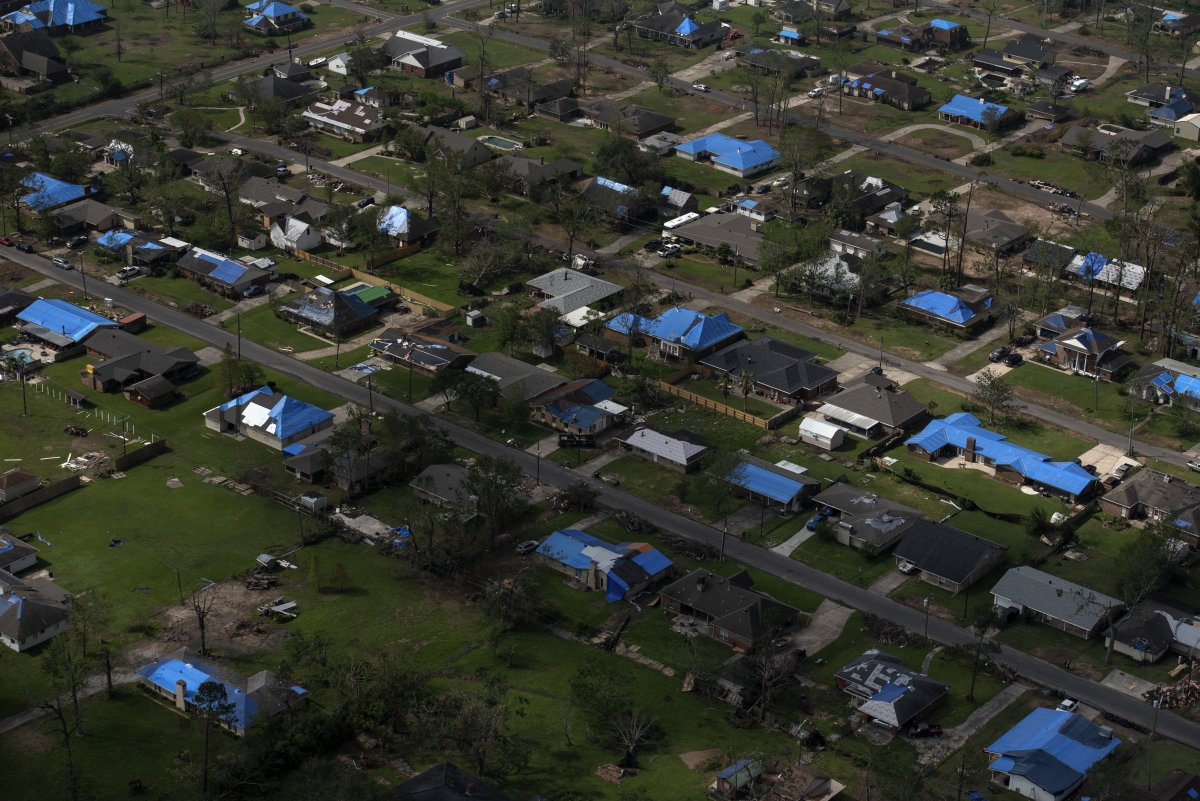
Tarps cover homes after Hurricane Laura and Hurricane Delta landed in southwest Louisiana on Oct. 11. MUST CREDIT: Photo by Callaghan O'Hare for The Washington Post.

Tarps cover homes after Hurricane Laura and Hurricane Delta landed in southwest Louisiana on Oct. 11. MUST CREDIT: Photo by Callaghan O’Hare for The Washington Post.

Some of 2020’s most extreme climate conditions were focused in northern Siberia and parts of the Arctic, with annual average temperatures between 3 and 6 degrees Celsius (5.4 to 10.8 degrees Fahrenheit) above normal. In certain months, these anomalies topped 8 degrees Celsius (14.4 degrees Fahrenheit). Even after a somewhat cooler December compared with previous months, Siberia stands out on 2020 temperature maps as a large red splotch of unusually hot conditions. The Arctic as a whole is warming at about three times the rate of the rest of the globe.

In the remote Siberian town of Verkhoyansk, about 3,000 miles east of Moscow, the mercury climbed to 100.4 degrees Fahrenheit (38 degrees Celsius) on June 20, the highest temperature recorded north of the Arctic Circle since record-keeping began in 1885.

The warmer-than-usual conditions had cascading consequences. Wildfires in the Siberian Arctic began early, in May, and continued later than average, through October. These blazes set a record for the amount of carbon dioxide released north of the Arctic Circle.

“These extreme events are happening in the context of continuing impacts on Arctic communities who are dealing with the hazards of ground collapse from permafrost thaw, loss of land and sea ice, and, overall, an increasingly unfrozen Arctic,” said Sue Natali, Arctic program director at the Woodwell Climate Research Center. “And this is what we’re seeing at [an approximately] 1 C global temperature increase, so 1.5 C or more is very much a concern.”

Data from NASA shows that since 1970, the Arctic has warmed by an average of 2.94 degrees Celsius, or 5.29 degrees Fahrenheit, compared with the global average of 0.95 Celsius, or 1.71 degrees Fahrenheit, during the same period. Scientists call the phenomenon “Arctic amplification.”

Researchers studying global warming’s role in extreme events found that the Siberian heat wave, including the 100-degree temperature and January-to-June average temperatures, would not have occurred without human-caused global warming.

– – –

Last week, the Copernicus Climate Change Service in Europe also pronounced that 2020 tied with 2016 for the title of warmest year. The group’s data showed the gap between the two at just under .01 degrees Celsius (.02 degrees Fahrenheit).

Overall, the final 2020 result represents a “photo finish,” said Zeke Hausfather, a climate expert at the Breakthrough Institute who works on the Berkeley Earth temperature database. “For most of the records, 2020 will be effectively tied with 2016, within the uncertainty of our estimates.”

2020’s extreme heat means that the planet last year (and in 2016) was roughly 1.2 degrees Celsius, or 2.16 degrees Fahrenheit, warmer than it was in the late 1800s, which climate researchers dub the preindustrial period. The United Kingdom’s Met Office puts that figure even higher, at just shy of 1.3 degrees Celsius (2.34 degrees Fahrenheit) of warming, when compared with the preindustrial period from 1850 to 1900.

It all has scientists concerned that a very momentous climate record could be coming quite soon: We could see a year that breaches, for the first time, the 1.5 degrees Celsius (2.7 degrees Fahrenheit) temperature threshold.

The logic is simple: Lately the Earth has been warming at slightly over 0.2 degrees Celsius (0.36 degrees Fahrenheit) per decade, explained NASA’s Gavin Schmidt, who directs the Goddard Institute for Space Studies, which maintains one of the major temperature data sets.

Meanwhile, individual years can vary in temperature by more than 0.1 degrees Celsius (0.18 degrees Fahrenheit) because of natural factors that shape the climate, such as the El Niño and La Niña cycle in the Pacific.

What this effectively means is that, while every year won’t be warmer than the last, records will occur at regular intervals. And although no one can say precisely when it will occur, a first leap over 1.5 degrees Celsius could soon be among them.

“I think it will happen by 2030 perhaps,” Schmidt said. “But then, being permanently over that won’t happen for another decade.”

Scientists have become increasingly concerned that if the planet holds a temperature at or above 1.5 degrees Celsius of warming for long, there could be severe impacts, such as the loss of most of the globe’s coral reefs, increasing risks of a nearly ice-free Arctic Ocean in the summer and further destabilization of the polar ice sheets, locking in large-scale sea-level rise.

The 2015 Paris climate agreement set an aspirational global warming limit of 1.5 degrees Celsius. That agreement, which the incoming Biden administration intends to rejoin after the Trump administration walked away from it, set a more firm limit of “well below” 2 degrees Celsius, or 3.6 Fahrenheit, of warming.

– – –

It wasn’t just wildfires: 2020 featured the busiest Atlantic hurricane season on record, with the most named storms to make landfall in a single season in U.S. history. Two hurricanes struck within 14 miles of each other along the western Louisiana coast, devastating the city of Lake Charles. With warmer-than-average water temperatures throughout the Atlantic basin, many storms rapidly intensified, a trend tied to climate change.

In all, 30 named storms with top winds of at least 39 mph developed in the Atlantic basin, of which 13 became hurricanes (top winds of 74 mph or greater). Six of those storms became major hurricanes of Category 3 intensity or greater. This eclipsed the record season of 2005, when 28 named storms formed, and was only the second year forecasters were forced to dip into the Greek alphabet for names.

Globally, 2020 tied 2018’s record for the most named tropical cyclones observed: 103 of them, according to the NOAA’s Sanchez-Lugo. That’s far above the average of around 80.

Overall, climate scientists say the disasters of 2020 are but a preview of what’s to come if greenhouse gas emissions are not quickly curtailed.

“What keeps us climate scientists up in the dead of night is wondering what we don’t know about the self-reinforcing or vicious cycles in the Earth’s climate system,” said Katharine Hayhoe, a professor at Texas Tech University, in an email. “The further and faster we push it beyond anything experienced in the history of human civilization on this planet, the greater the risk of serious and even dangerous consequences. And this year, we’ve seen that in spades.

“It’s no longer a question of when the impacts of climate change will manifest themselves: They are already here and now. The only question remaining is how much worse it will get. And the answer to that question is up to us.”

Dozens of people on FBI terrorist watch list came to D.C. the day of Capitol riot #SootinClaimon.Com

#SootinClaimon.Com : ขอบคุณแหล่งข้อมูล : หนังสือพิมพ์ The Nation.

Dozens of people on FBI terrorist watch list came to D.C. the day of Capitol riot

InternationalJan 15. 2021Supporters of President Donald Trump mob the U.S. Capitol on Jan. 6, 2021. MUST CREDIT: Photo for The Washington Post by Evelyn HocksteinSupporters of President Donald Trump mob the U.S. Capitol on Jan. 6, 2021. MUST CREDIT: Photo for The Washington Post by Evelyn Hockstein
By The Washington Post · Devlin Barrett, Spencer S. Hsu, Marissa J. Lang

WASHINGTON – Dozens of people on a terrorist watch list were in Washington for pro-Trump events Jan. 6, a day that ended in a chaotic crime rampage when a violent mob stormed the U.S. Capitol, according to people familiar with evidence gathered in the FBI’s investigation.

The majority of the watchlisted individuals in Washington that day are suspected white supremacists whose past conduct so alarmed investigators that their names had been previously entered into the national Terrorist Screening Database, or TSDB, a massive set of names flagged as potential security risks, these people said. The watch list is larger and separate from the “no-fly” list the government maintains to prevent terrorism suspects from boarding airplanes, and those listed are not automatically barred from any public or commercial spaces, current and former officials said.

The presence of so many watch-listed individuals in one place – without more robust security measures to protect the public – is another example of the intelligence failures preceding last week’s assault that sent lawmakers running for their lives and left five others dead, some current and former law enforcement officials argued. The revelation follows a Washington Post report earlier this week detailing the FBI’s failure to act aggressively on an internal intelligence report of internet discussions about plans to attack Congress, smash windows, break down doors and “get violent . . . go there ready for war.”

Other current and former officials said the presence of those individuals is an unsurprising consequence of having thousands of fervent Trump supporters gathered for what was billed as a final chance to voice opposition to Joe Biden’s certification as the next president. Still, the revelation underscores the limitations of such watch lists. Although they are meant to improve information gathering and sharing among investigative agencies, they are far from a foolproof means of detecting threats ahead of time.

Since its creation, the terrorist watch list, which is maintained by the FBI, has grown to include hundreds of thousands of names. Placing someone’s name on the watch list does not mean they will be watched all of the time, or even much of the time, for reasons of both practicality and fairness. But it can alert different parts of the government, like border agents or state police, to look more closely at certain people they encounter.

It’s unclear whether any of the dozens of people already arrested for alleged crimes at the Capitol are on the terrorist watch list.

“The U.S. Government is committed to protecting the United States from terrorist threats and attacks and seeks to do this in a manner that protects the freedoms, privacy and civil rights and liberties of U.S. persons and other individuals with rights under U.S. law,” a U.S. official said, adding that because of security concerns, the government has a policy of neither confirming nor denying a person’s watch list status.

The FBI declined to comment.

The riot’s political aftershocks led the House of Representatives on Wednesday to impeach President Donald Trump for allegedly inciting the violence – his second impeachment in a single four-year term – and may have significant consequences within law enforcement and national security agencies.

Inside the FBI and the Department of Homeland Security, officials are grappling with thorny questions about race, terrorism and free-speech rights as some investigators question whether more could have been done to prevent last week’s violence.

While some federal officials think the government should more aggressively investigate domestic terrorism and extremists, others are concerned the FBI, DHS and other agencies may overreact to the recent violence by going too far in surveilling First Amendment activity like online discussions.

Several law enforcement officials said they are shocked by the backgrounds of some individuals under investigation in connection with the Capitol riot, a pool of suspects that includes current and former law enforcement and military personnel, senior business executives and middle-aged business owners.

“I can’t believe some of the people I’m seeing,” one official said.

The TSDB, often referred to within government as simply “the watch list,” is overseen by the FBI’s Terrorist Screening Center, which was created in the wake of the 9/11 attacks carried out by al-Qaida. The watch list can be used as both an investigative and early warning tool, but its primary purpose is to help various government agencies keep abreast of what individuals seen as potential risks are doing and where they travel, according to people familiar with the work who, like others, spoke on the condition of anonymity because the work is sensitive.

Often that can be done as a “silent hit,” meaning if someone on the watch list is stopped for speeding, that information is typically entered into the database without the individual or even the officer who wrote the ticket ever knowing, one person said.

After the 2013 Boston Marathon bombing, for instance, the FBI quickly searched a similar database to see which people on it had recently traveled to that city or raised other suspicions about possible involvement.

Before the Jan. 6 gathering of pro-Trump protesters, FBI agents visited a number of suspected extremists and advised them against traveling to the nation’s capital. Many complied, but according to people familiar with the sprawling investigation, dozens of others whose names appear in the terrorist watch list apparently attended, based on information reviewed by the FBI.

Separately, while the FBI is hunting hundreds of rioting suspects who have dispersed back to their hometowns, federal agents are increasingly focused on alleged leaders, members, and supporters of the Proud Boys, a male-chauvinist group with ties to white nationalism, these people said.

The Proud Boys participated in last week’s protests, and FBI agents are taking a close look at what roles, if any, their adherents may have had in organizing, directing or carrying out violence, according to people familiar with the matter.

The group’s chairman, Enrique Tarrio, had planned to attend Trump’s Jan. 6 rally but was arrested when he arrived in D.C. and charged with misdemeanor destruction of property in connection with the burning of a Black Lives Matter banner taken from a Black church during an earlier protest in Washington. He is also accused of felony possession of two extended gun magazines.

Tarrio told The Post on Wednesday that his group did not organize the Capitol siege.

“If they think we were organizing going into the Capitol, they’re going to be sadly mistaken,” he said. “Our plan was to stay together as a group and just enjoy the day. We weren’t going to do a night march, anything like that. That’s it as far as our day.”

Tarrio said he’s actively discouraging members from attending planned armed marches scheduled Sunday, and the Million Militia March next week when Biden is inaugurated. Proud Boys, he said, are on a “rally freeze and will not be organizing any events for the next month or so.”

It is unclear how many Proud Boys devotees will abide by the freeze, or if such a shutdown might lessen the FBI’s interest in the group. Even before the Jan. 6 riot, federal and local investigators were working to understand the group’s plans, goals and activities. Privately, some federal law enforcement officials have described the group as roughly equivalent to a nascent street gang that has garnered an unusual degree of national attention, in part because Trump mentioned them specifically during one his televised debates with Biden during the campaign. Other officials have expressed concern that the group may be growing rapidly into something more dangerous and directed.

The FBI already has arrested dozens of accused rioters, and officials have pledged that in cases of the most egregious conduct, they will seek to file tough, rarely used charges like seditious conspiracy, which carries a potential 20-year prison sentence.

The bureau continues to face criticism over its handling of a Jan. 5 internal report warning of discussions of violence at Congress the next day. Steven D’Antuono, the head of the FBI’s Washington Field Office, claimed in the days after the riot that the bureau did not have intelligence ahead of time indicating the rally would be anything other than a peaceful demonstration.

The Jan. 5 FBI report, written by the bureau’s office in Norfolk, Va., and reviewed by The Post, shows that was not the case, and the Justice Department took other steps indicating officials were at least somewhat concerned about possible violence the next day. The Bureau of Prisons sent 100 officers to D.C. to supplement security at the Justice Department building, an unusual move similar to what the department did in June to respond to civil unrest stemming from racial justice protests.

Mindful of the criticism that law enforcement took a heavy-handed, all-hands-on-deck approach to Black Lives Matters protests in D.C. in the spring and summer, Justice Department officials deferred to the Capitol Police to defend their building and lawmakers there. Some former officials have questioned whether the FBI and Justice Department should have done more.

“It would not have been enough for the bureau simply to share information, if it did so, with state and local law enforcement or federal partner agencies,” said David Laufman, a former Justice Department national security official. “It was the bureau’s responsibility to quarterback a coordinated federal response as the crisis was unfolding and in the days thereafter. And it’s presently not clear to what extent the FBI asserted itself in that fashion during the exigencies of January 6 and in the immediate aftermath.”

Experts warn of vaccine stumbles ‘out of the gate’ because of Trump officials’ refusal to consult with Biden’s team #SootinClaimon.Com

#SootinClaimon.Com : ขอบคุณแหล่งข้อมูล : หนังสือพิมพ์ The Nation.

Experts warn of vaccine stumbles ‘out of the gate’ because of Trump officials’ refusal to consult with Biden’s team

InternationalJan 15. 2021

By The Washington Post · Laurie McGinley, Amy Goldstein, Lena H. Sun, Isaac Stanley-Becker

WASHINGTON – The last time a presidential transition began during a national emergency – in 2008, amid the Great Recession – the outgoing Bush administration set aside partisanship to work closely with incoming Obama officials about how to deal with the economic collapse.

“Everyone was completely responsive to any question,” said Lawrence Summers, director of the National Economic Council under President Barack Obama. “They talked to us about major decisions.”

That smooth handoff is in stark contrast to what is happening now as President-elect Joe Biden prepares to assume power during a double-barreled crisis involving a lethal virus and its economic fallout that experts say demands close cooperation. Instead, as the coronavirus overwhelms U.S. hospitals and kills more than 3,300 people a day on average, the Trump administration has balked at providing access to information and failed to consult with its successors, including about distributing the vaccines that offer the greatest hope of emerging from the pandemic.

For more than a month, the Biden team pressed to attend meetings that offered “real-time information on production and distribution of vaccine” – important details for the president-elect’s advisers debating ways to bring the pandemic under control, said a transition official, speaking on the condition of anonymity to discuss private interactions.

While health agencies’ career staff have been helpful, it was not until this week that Biden officials were allowed to attend meetings of Operation Warp Speed, the administration’s initiative to accelerate vaccine development and distribution. They were also not invited to the two Warp Speed sessions this weekend when Trump officials decided on sweeping changes to try to speed up the sluggish vaccine rollout. Nor were they briefed on those changes in advance.

While some of those policies mirrored Biden plans, others raised red flags among the president-elect’s advisers. One is a recommendation to offer vaccines immediately to tens ofmillions under 65 who have high-risk medical conditions – a change the Biden team fears could overwhelm state supply and already stressed sign-up systems, while creating unrealistic expectations for those eager to get inoculated.

Another new policy, involving the controversial question of whether to penalize slower-moving states, was to take effect the week after Biden becomes president. State officials say they are uncertain about whether to take the new policy seriously or to brush it off because it seems to lack support from the incoming administration.

But on Thursday, Conn. Gov. Ned Lamont, a Democrat, tweeted that federal officials had notified the state that it would receive an additional 50,000 doses next week “as a reward for being among the fastest states” to get shots into arms. West Virginia, which is moving at the fastest clip based on Centers for Disease Control and Prevention data, did not get any additional doses, said Holli Nelson, a spokeswoman for the state’s National Guard. An HHS spokesperson did not immediately respond to a request for comment.

The Biden transition official also said it took the transition team several weeks to get access to Tiberius, a data system that would have helped officials understand earlier “where vaccine is going, which states are ordering, when it is moving.”

“Look, we are still prepared to meet our goal of 100 million shots in 100 days,” the official said, referring to a commitment Biden made in early December. “But it would have been a lot more helpful if we’d had access to real-time information.”

On Thursday afternoon, another senior Biden official described “uneven cooperation” from the Trump administration. He spoke on the condition of anonymity before Biden’s speech Thursday night calling on Congress for an additional $400 billion to fight the pandemic, including $20 billion for a national vaccination program.

The lack of coordination has alarmed public health officials and experts on presidential transitions, especially as a more contagious virus variant first identified in Britain spreads across the United States and the Centers for Disease Control and Prevention projects as many as 477,000 covid-19 deaths by Feb. 6.

The dearth of coordination “means we are stumbling out of the gate with the vaccine,” said Douglas Brinkley, a presidential historian at Rice University. “We are failing at a government level on distribution because there is no game plan. There is a chaotic Trump one and a learning-curve Biden one.”

The decision to urge states to immediately vaccinate a much larger pool of people – about 81 million between the ages of 16 and 64 with high-risk medical conditions- was “absolutely inappropriate,” said Michael Osterholm, a member of Biden’s covid-19 advisory board and director of the Center for Infectious Disease Research and Policy at the University of Minnesota.

“When you make a recommendation that . . . far exceeds the number of doses that are available for the foreseeable future, that’s not helpful,” Osterholm said. “It only creates confusion, frustration and, frankly, a lack of trust in the system.”

At least 11.1 million people have received one dose of the vaccine in the U.S.

Health and Human Services Secretary Alex Azar and other Warp Speed officials said they made the decision to dramatically increase eligibility because too many doses are sitting in freezers and they have greater confidence in a reliable supply of vaccines.

A senior Trump official denied there was any effort to keep Biden in the dark about Warp Speed activities. The official, who spoke on the condition of anonymity to discuss internal deliberations, said that while Biden officials only recently have been invited to Warp Speed meetings, they have been regularly briefed on what has been discussed.

The official said it was not appropriate for the Biden team to take part in making decisions because the United States has “one government at a time.” He added that when Biden becomes president, “they can change everything if they want.”

Tensions between incoming and outgoing administrations aren’t unusual – for example, the post-election period between Democrat Harry S. Truman and Republican Dwight D. Eisenhower in the early 1950s was especially acrimonious. But it’s hard to imagine a transition more fraught than this one, with a president raging against the election results as a deadly pandemic rages out of control.

“It’s a very bad TV show that I would stop watching because it is so unbelievable,” said Howard Markel, a medical historian at the University of Michigan.

The transition initially was stalled when the General Services Administration, headed by a Trump appointee, refused to recognize Biden’s victory and provide funding to his transition team. The GSA administrator reversed course on Nov. 23.

But even when Trump career officials were told they could talk to the Biden team, they were permitted to share only publicly available information, said an administration health official who spoke on the condition of anonymity to discuss internal matters. “After that, we could share nonpublic information, but it had to be cleared first.”

Even if the Trump forces did not want to cooperate with Biden in some areas, there should have been a free flow of information on vaccine issues, said the Trump health official, who compares the current crisis to a war. “The pandemic should have been a DPZ – depoliticized zone,” he added.

Brinkley shared that view. “Operation Warp Speed should be deeply bipartisan” with a constant exchange of information, he said. “The fact that has not been happening with Trump is because he’s called it a fraudulent election. Why would I give data to somebody who is a fake president-elect?”

Max Stier, president and CEO of the Partnership for Public Service and an expert on presidential transitions, described handoffs of power as a relay race in which runners have to pass the baton. “You run side by side as fast as possible so you can win,” he said. “You don’t want it to be a start-and-stop strategy, you want it to be a smooth handoff.

“Because your decisions might only last for another week, there should be an alignment” with the incoming administration, he added.

Despite the challenges, Biden and his team have scooped up extensive information about coronavirus vaccine production and distribution from long-standing contacts in pharmaceutical companies and federal agencies. And they have gotten information through back channels from career staff working “off the clock” and using personal email accounts.

Jeffrey Koplan, a former director of the CDC, said it was “shocking” that members of the outgoing administration hadn’t involved Biden’s team in their decision-making.

“It’s not rocket science – it’s been done before,” said Koplan, who was head of the CDC under both Bill Clinton and George W. Bush.

There also was much more discussion and cooperation in prior transitions on a range of health issues, said Nicole Lurie, who is advising the Biden team, participated in the Obama transition and later served as Obama’s assistant secretary for preparedness and response at HHS.

“I knew the person who had been in the role before me, we had a period of overlap, and there was just a lot of information-sharing,” Lurie said. “It’s nowhere near as complicated as it is now.”

While the Bush-Obama handoff is often cited as a model, a well-functioning transition has been regarded by leaders of both parties as an important goal until very recently, according to former administration officials and historians.

Through most of the 20th century, outgoing and incoming presidents were occasionally antagonistic, such as in the transition between Herbert Hoover and Franklin D. Roosevelt in the early 1930s, Brinkley said. Yet even in those times, it was thought that “the crown jewel of American democracy is the smooth transition. You go out for political combat for two years” until the election, followed by a seamless transition, he said.

Partisanship intensified in the 1990s, he said. But even after the 2000 election, which was contested for more than a month before being decided by the Supreme Court, Bill Clinton’s staff provided the George W. Bush team with intelligence data on al-Qaida and other terrorist groups. That occurred before it was clear that Bush – not Clinton’s vice president, Al Gore – would be the next president, Brinkley noted.

Recalling the drawn-out election battle, Summers, who in 2000 was Clinton’s outgoing treasury secretary, said: “We didn’t think what happened was fair or legitimate. But it didn’t occur to anyone to not concede, or to not work with the transition once the Supreme Court ruled.”

Said Brinkley, “It used to be seen as anti-American not to have a smooth transition.”

Biden to ask for $400 billion to bolster fight against covid-19 #SootinClaimon.Com

#SootinClaimon.Com : ขอบคุณแหล่งข้อมูล : หนังสือพิมพ์ The Nation.

Biden to ask for $400 billion to bolster fight against covid-19

InternationalJan 15. 2021Workers hang banners Thursday for President-Elect Biden ahead of next week's inauguration. MUST CREDIT: Washington Post photo by Jabin BotsfordWorkers hang banners Thursday for President-Elect Biden ahead of next week’s inauguration. MUST CREDIT: Washington Post photo by Jabin Botsford

By The Washington Post · Amy Goldstein

President-elect Joe Biden is calling on Congress to pour another roughly $400 billion into fighting the coronavirus pandemic to create a national vaccination program, expand testing, and hire 100,000 more community health workers.

Part of a broad relief package to lift up the nation’s economy and ease the devastation caused by the pandemic at its worst moment so far, Biden’s request spells out his oft-stated determination for the federal government to assume a far more muscular role in responding to the public health crisis.

The scale of what the president-elect envisions far outstrips the funding Congress devoted to fighting the pandemic in a stimulus package it adopted late last year, as well as the sums that House Democrats had unsuccessfully sought.

In particular, senior members of the incoming administration said before Biden’s Thursday night speech that he wants to invest an additional $20 billion to build a federal infrastructure for administering vaccines to protect Americans against covid-19, the illness caused by the virus. It would include adding an unspecified number of locations in communities across the country where people could get shots, as well as mobile sites to go into rural communities and other places where retail pharmacies and health-care facilities are scarce.

“This is a national emergency, and we need to treat it like one,” said one Biden official, speaking on the condition of anonymity before the president-elect’s remarks. “We are woefully behind on where we need to be . . . Delay means more illness and more deaths.”

Biden’s push a half-dozen days before he takes office comes as criticism has mounted of the sluggish pace of immunizing Americans, since two vaccines won federal authorization for emergency use last month. The mass vaccination campaign is considered urgent to protect people from the virus, which is overwhelming many hospitals and killing thousands of people every day.

As of Thursday, at least 11.1 million people have received a first dose of one of the vaccines, each of which requires a two-dose regimen. That is slightly more than a third of the 30.6 million doses that have been distributed to states, cities and U.S. territories, according to the Centers for Disease Control and Prevention.

Biden said more than a month ago that he wants 100 million shots to be given within the first 100 days of his presidency, a period that goes through late April.

He is scheduled to release a detailed vaccine plan Friday, but the financial underpinnings laid out Thursday reflect the fundamental difference between the incoming administraton’s approach and that of President Donald Trump. In the fall, the Trump administration directed each state to write and submit its own vaccination plan. Biden’s team maintains that such an unprecedented vaccination campaign requires strong federal coordination, greater funding and some aspects to be run by the federal government itself.

“We are in a race against time,” the Biden official said. “We need these resources to vaccinate Americans and put covid behind us.”

The $20 billion Biden requested in additional money for vaccines compares with nearly $29 billion included in Congress’s December stimulus package – about $9 billion of the latter for vaccine distribution.

Overall, the approximately $415 billion for pandemic-fighting in Biden’s relief request compares to roughly $50 billion approved by Congress last month for that purpose, according to Marc Goldwein, senior vice president for the Committee for a Responsive Federal Budget. Goldwein said House Democrats had wanted earlier last year to spend approximately $100 billion for that purpose.

The president-elect also wants to invest $50 billion in a large-scale expansion of coronavirus testing, including the purchase of tests that provide rapid results and to expand laboratory capacity. Such expansion, his team contends, would allow schools to test students and staff more frequently, making it safe for schools to reopen – another goal he set last month for his first 100 days in office.

Biden is seeking money to hire 100,000 public health workers to encourage people to get vaccinated, as well as to do contact tracing to figure out who has been exposed by people who test positive. Over the longer term, he envisions these workers helping to build up the nation’s depleted public health departments. His advisers did not spell out how much money would be needed for this purpose.

A portion of the funds would be used to expand genomic sequencing to detect new strains of covid-19, including more-rapidly spreading variants that were first detected in Britain and South Africa.

Other aspects of his request are intended to provide help to people living in poor communities or those belonging to racial and ethnic minorities who have been especially hard hit by the pandemic. His proposal would expand funding for community health centers and for health services for Native Americans on tribal lands.

The proposal would, in addition, help states deploy “strike teams” to nursing homes and other long-term care facilities with outbreaks of covid-19, as well as to help slow the virus spread in prisons and detention centers.

Biden unveiling $1.9 trillion economic and health care relief package #SootinClaimon.Com

#SootinClaimon.Com : ขอบคุณแหล่งข้อมูล : หนังสือพิมพ์ The Nation.

Biden unveiling $1.9 trillion economic and health care relief package

InternationalJan 15. 2021Joe Biden Joe Biden

By The Washington Post · Erica Werner, Jeff Stein

WASHINGTON – Poised to inherit a health-care disaster and a deteriorating economy, President-elect Joe Biden is laying out a $1.9 trillion emergency relief plan Thursday night that will serve as an early test of his ability to steer the nation out of the pandemic disasters and make good on his promises to unite a divided Congress.

The wide-ranging package is designed to take aim at the twin crises Biden will confront upon taking office Jan. 20, with a series of provisions delivering direct aid to American families, businesses, and communities, and a major focus on coronavirus testing and vaccine production and delivery as the pandemic surge continues.

Biden is aiming to get GOP support for the measure, senior transition officials said, although at nearly $2 trillion the price tag is likely to be too high for many Republicans to swallow. But after campaigning as a bipartisan deal-maker, Biden wants to at least give Republicans the opportunity to get behind his first legislative effort as president.

“We think there is a broad understanding of the urgency of the moment, of the immediacy of the crisis and the need to act,” a senior Biden administration official told reporters ahead of the speech. “And so we’re hopeful that the ideas that are laid out here and the action that is reflected here is something that there’s a lot of support for, and you’re going to see the president-elect tonight call for the kind of move toward pragmatism and unity to try to get something done.”

The package is titled the “American Rescue Plan.” Biden officials described it as a package of emergency measures to meet the nation’s immediate economic and health care needs, to be followed in February by a broader relief plan.

The proposal, which Biden will lay out in a speech at 7:15 p.m. Eastern time Thursday night, comes at a critical time for the nation. More than 4,200 people in the United States died of the coronavirus on Tuesday, a new daily-record high. Also, the economic recovery appears to be backsliding, with jobless claims spiking to a new high since August, as nearly a million people filed for unemployment last week.

It also comes six days before Biden’s inauguration, and a day after the House of Representatives impeached President Donald Trump, highlighting the president-elect’s challenge of trying to get his top agenda item passed even as the Senate is likely to be enmeshed in an impeachment trial. Biden has expressed the hope that the Senate can simultaneously move forward on his agenda while also conducting an impeachment trial, although it’s unclear how well that might work in practice.

The plan contains a raft of provisions that build on the approximately $4 trillion Congress has already devoted to addressing the pandemic, which included a $900 billion measure Trump signed in December which Biden has repeatedly described as unfinished business.

It is divided into three major areas: $400 billion for provisions to fight the coronavirus with more vaccines and testing, while reopening schools; more than $1 trillion in direct relief to families, including through stimulus payments and increased unemployment insurance benefits; and $440 billion for aid to communities and businesses, including $350 billion in emergency funding to state, local and tribal governments.

The plan will aim to make good on Biden’s plan for a universal vaccination program, devoting $20 billion to that goal, as well as $50 billion for a “massive expansion” of testing and $130 billion to help schools reopen safely. Among the many goals laid out in the proposal, Biden hopes to deliver 100 million vaccine shots in 100 days, and re-open a majority of K-12 public schools in that same time frame.

Incoming Senate Majority Leader Chuck Schumer, D-N.Y., had urged Biden to consider a higher price tag than what he was initially eyeing for the proposal, according to a person familiar with the conversation who spoke on condition of anonymity to recount the conversation. The size and scope of the package exceeded the expectations of a number of outside advocates, while answering demands from economists for a major new investment to get the economy on a sounder footing.

“We do need more stimulus. In the United States, fortunately, there is fiscal space to do so,” International Monetary Fund Managing Director Kristalina Georgieva said in an interview with The Washington Post, adding that she favored “sizable support.”

The legislation includes a number of priorities sought by top congressional Democrats, including some of the more liberal members, from increasing the federal minimum wage to $15 an hour to adding billions in funding for childcare.

Biden calls for increasing federal unemployment benefits from $300 per week to $400 per week for millions of jobless Americans. The benefits would be extended through September, preventing millions of people from losing their jobless aid in March, as would occur under current law. Biden’s plan states that he will also “work with Congress” to link the level of unemployment benefits to general economic factors, aiming to implement “automatic stabilizers” long sought by Democratic policy experts. These measures would require the federal government to automatically increase benefits when the unemployment rate spikes, meaning federal support could not be contingent on Washington gridlock.

As expected, Biden’s proposal would also increase to $2,000 per person the stimulus payments approved by Congress in December, which had been $600 per person. Trump enthusiastically endorsed the $2,000 stimulus payments, as did congressional Democratic leaders, but many Republicans oppose the idea. Biden’s plan would also expand eligibility for the stimulus payments to families where one parent is an immigrant, as well as to adult children claimed as dependents on their parents’ tax returns. Both categories were excluded in the last relief packages due to GOP opposition. About 13.5 million adult dependents were excluded from the checks as a result, including millions of disabled people.

A major expansion of tax credits is also included in Biden’s proposal, both for children and lower-income workers. Biden’s plan would expand a tax credit for children to $3,600 a year per child under six years of age, as well as $3,000 a year for children under 17. It would also extend eligibility for the credit to millions of very poor families who currently cannot access it. It would also dramatically boost the Earned Income Tax Credit, a tax benefit to workers, from $530 to $1,500, while also expanding eligibility for that program.

The size of the package and its embrace of multiple liberal priorities that are anathema to Republicans — including a large sum for state and local governments, which has proven a sticking point for the GOP for months — raises questions about how much bipartisan support Biden will be able to get for the proposal. Biden is already facing pressure from liberals on Capitol Hill who want to use their newfound control of Congress to push through aggressive and costly legislation.

Sen. Bernie Sanders, I-Vt., who will chair the Budget Committee, has said he is working to put together a massive stimulus bill that could pass under special budget rules with a simple majority vote in the Senate, instead of the 60-vote margin normally required.

Biden, however, wants to try for a bipartisan majority on his first bill. Democratic aides say that if Republicans do not appear willing to cooperate, they can shift gears quickly and move to “budget reconciliation,” the procedure that would allow them to pass legislation without GOP votes. That was the process Republicans used to pass their big tax cut bill after Trump took office and that President Barack Obama used for the Affordable Care Act.

The Senate will be divided 50-50 between Republicans and Democrats in the new Congress, giving Democrats control of the chamber because Vice President-elect Kamala Harris will have the tie-breaking vote. Democrats’ 222-211 majority in the House is the narrowest for either party in years.

Biden aims for new course on trade, breaking with Trump and Democratic predecessors #SootinClaimon.Com

#SootinClaimon.Com : ขอบคุณแหล่งข้อมูล : หนังสือพิมพ์ The Nation.

Biden aims for new course on trade, breaking with Trump and Democratic predecessors

InternationalJan 15. 2021Katherine Tai speaks after being formally nominated by President- elect Joe Biden to be U.S. Trade representative on Dec. 11, 2020, at the Queen Theater in Wilmington, Del. MUST CREDIT: Washington Post photo by Joshua LottKatherine Tai speaks after being formally nominated by President- elect Joe Biden to be U.S. Trade representative on Dec. 11, 2020, at the Queen Theater in Wilmington, Del. MUST CREDIT: Washington Post photo by Joshua Lott

By The Washington Post · David J. Lynch

It may not take long for President-elect Joe Biden to distinguish his trade policy from his predecessor’s “America First” approach.

When members of the World Trade Organization meet in Geneva to agree on a new chief, probably within a few weeks of Inauguration Day, Biden could drop the Trump administration’s veto of the consensus candidate, former Nigerian Finance Minister Ngozi Okonjo-Iweala, and allow her to become the first woman to head the global trade body.

Accepting the well-respected official favored by almost all other U.S. trading partners would mark a sharp break from President Donald Trump’s go-it-alone stance and begin reshaping international economic policy after years of tariff threats and trade wars.

Biden hasn’t said publicly whether he will endorse Okonjo-Iweala, a naturalized U.S. citizen. And a spokesman for his transition team did not respond to a request for comment.

But whatever he decides about the WTO leadership, Biden’s handling of trade policy is expected to represent a departure from that of Trump and past Democratic presidents alike.

The Wall Street-friendly push for trade liberalization that held sway for a quarter century after the Cold War has been rendered obsolete by domestic political developments, supply-chain security concerns triggered by the coronavirus pandemic, and growing alarm about China’s rise.

“We need to do things differently,” said Cathy Feingold, director of the AFL-CIO’s international department. “You can’t go back.”

Biden and his advisers have sketched a trade policy that echoes Trump’s focus on manufacturing jobs and seeks to use foreign economic engagement to promote the U.S. middle class.

But unlike Trump, Biden describes most foreign nations as potential partners, not adversaries bent on unfairly competing for commercial spoils. The Democrat is likely to substitute industrial policy for tariffs, seeking to revive domestic factories with a $400 billion “Buy America” initiative and $300 billion in clean energy research.

Katherine Tai, the top trade lawyer for the House Ways and Means Committee and Biden’s choice as chief U.S. trade negotiator, called last summer for bolstering U.S. competitiveness and workers’ skills rather than concentrating on tariffs and enforcement efforts.

“Policy has been disproportionately shaped by what’s good for corporations. Now, the focus will be: What’s it mean for workers?” said one Democratic congressional aide, who spoke on the condition of anonymity for lack of authorization to speak publicly.

Still, Biden will confront the same question that has bedeviled U.S. policymakers for three decades: How can the United States shape for maximum benefit its overseas commercial engagements?

In the 1990s, as the Soviet bloc crumbled and China opened its market, U.S. presidents sought greater economic efficiency through liberalized trade and promised to compensate American workers who suffered as a result.

That financial support and retraining help, however, was inadequate, leaving millions of factory workers at the mercy of low-wage foreigners. The resulting blue-collar resentments helped elevate Trump, who vowed to shield American jobs behind a tariff wall.

The populist Republican, however, proved more adept at identifying problems than solving them. The U.S. trade deficit, which he assailed as a drain on national wealth and vowed to close, stands at a 14-year high. And after growing by 4 percent during his first three years in office, manufacturing employment is now lower than when he took office.

On the campaign trail, Biden promised a “pro-American worker tax and trade strategy.”

In practice, that means labor and environmental concerns will now get top billing at the negotiating table, potentially overshadowing corporate America’s investment-oriented agenda. New agreements might borrow provisions from Trump’s North American trade deal requiring a certain percentage of work to be conducted in high-wage countries such as the United States. With China, U.S. diplomats may spend more time on Beijing’s use of forced labor in Xinjiang province, supplanting Trump’s focus on forced technology transfer.

“I’m somewhat more optimistic than I expected to be,” said Public Citizen’s Lori Wallach, a longtime critic of trade liberalization.

Biden will face a long to-do list, including decisions about how to handle Trump’s tariffs on most Chinese goods as well as on imported steel and aluminum. The Democrat will inherit unfinished negotiations with the United Kingdom and Kenya. And he must balance calls to rejoin a Pacific trade deal that Trump quit with union worries about potential job losses.

The shift may be most evident in relations with Europe, which Trump has castigated and threatened with auto tariffs. Biden’s hopes of reestablishing robust trans-Atlantic ties depend upon resolving a thorny dispute about European efforts to tax U.S. digital economy giants.

Still, no major policy moves are expected before the completion of a 100-day supply-chain review intended to avoid a repeat of the medical product shortages that the United States experienced early in the pandemic.

“I would expect trade to be on a slower track,” said Michael Wessel, a longtime trade consultant. “It’s climate change and infrastructure that are the priorities.”

But with Australia, China, Japan and the European Union having reached new trade deals, the incoming president won’t be able to afford an indefinite hiatus.

“Our allies in Europe and Asia have cut deals with the Chinese, so the incoming administration shouldn’t take too long to lay out our trade agenda,” said Myron Brilliant, executive vice president of the U.S. Chamber of Commerce.

‘Sizable’ stimulus needed from the U.S., IMF managing director urges #SootinClaimon.Com

#SootinClaimon.Com : ขอบคุณแหล่งข้อมูล : หนังสือพิมพ์ The Nation.

‘Sizable’ stimulus needed from the U.S., IMF managing director urges

InternationalJan 15. 2021International Monetary Fund Managing Director Kristalina GeorgievaInternational Monetary Fund Managing Director Kristalina Georgieva

By The Washington Post · Heather Long

International Monetary Fund Managing Director Kristalina Georgieva is urging the United States to go big on additional stimulus to aid the economy as the pandemic rages and to ensure low-income workers are not left behind.

“We do need more stimulus. In the United States, fortunately, there is fiscal space to do so,” Georgieva told The Washington Post, adding that she favored “sizable support.”

President-elect Joe Biden is set to give a major speech Thursday evening proposing another stimulus package of at least $1 trillion. This would be on top of the $3.5 trillion the nation has spent so far in an effort to address the worst economic crisis since the Great Depression and the most deadly pandemic in a century.

Georgieva said the pandemic is “moving from bad to worse” and that additional help for the economy is needed to get people through the next few months until vaccines are more widely available. She characterized this period as an “unprecedented race” between the virus and the vaccines.

“We are still faced with tremendous uncertainties about the exit from the health crisis and we do have a difficult period ahead. There is scarring from [it] we are yet to address,” Georgieva said.

In a sign of renewed pain for the economy, the U.S. Labor Department reported Thursday that new applications for unemployment aid spiked to nearly 1 million last week – the highest since August. Overall, more than 18 million Americans are receiving unemployment aid and the nation is grappling with even deeper job losses that during the Great Recession.

Some Republicans have expressed concern that the United States cannot afford to spend so much money to address the crisis, but Georgieva said now is not the time to focus on the debt. She noted that it is incredibly cheap for the United States to borrow money and the nation has ample capacity to borrow more. Federal Reserve Chair Jerome Powell has made the same argument to Congress in recent months.

“In our view, the time to take action on debt and deficit is when we have a durable exit from the health crisis. In other words, we see it in the rearview mirror,” Georgieva said.

While the top priority of the incoming Biden administration should be getting the virus under control, Georgieva also urged Biden’s team to use this moment to enact policies to lessen inequality and put the economy on a more sustainable course by tackling climate change.

“I am convinced that as crisis … is opportunity. This is our best shot to change course for the better. We must take it on,” she said

Biden has said he wants big investments to upgrade U.S. infrastructure and address climate change, initiatives that he hopes will boost growth and jobs.

Georgieva said climate action is a “win, win, win” that can help the planet, boost growth and create a large number of jobs, especially for people who are getting left behind by the digital economy.

Nearly 10 million people who lost their jobs between March and April of last year still have not been able to gain employment again. Biden is under pressure to create conditions that get as many of these people back to work as quickly as possible. It’s a tall order. Among recent presidents, only Ronald Reagan in his second term and Bill Clinton in each of his terms managed to oversee that scale of job creation.

Georgieva also called on China, India, and other nations to enact more stimulus, and she warned that the pandemic has further exacerbated inequalities between the rich and poor in many countries as well as between rich nations and poor nations.

She cautioned that there could be more protests and riots if countries don’t focus on fighting poverty, creating job opportunities and ensuring all people receive vaccines as quickly as possible.

“Without coordinated international support we will see that divergence becoming a problem for the countries themselves but also for security and stability of the world in the future,” she said.