MSI launches its new laptop line-up in virtual event
Sep 10. 2020
By The Nation
MSI, a leading producer of high-performance laptops, launched its new line-up virtually at the “Determined to Succeed” summit on Thursday.
The virtual event unveiled three new series under MSI’s “Business and Productivity” line-up, called “Summit”, “Prestige” and “Modern” all of whom sport a new logo and are powered by 11th Gen Intel processors.
Henri Chen, chief design officer at the MSI notebook division, said the new logo was designed following the principles of the “Fibonacci number” and the “golden ratio”.
The event also examined the changing needs and demands of the growing remote work force. Executives from major companies shared thoughts on how vital an excellent laptop is for working from home.
“It’s important to have enterprise-grade security. Protecting our IP is a huge priority,” said Oi-Masahiro, general manager of Canon’s IT products sales division.
Anita Feng, account manager at Microsoft Taiwan, said what she needs from a laptop is “long battery life that supports long working hours, touch panel for better user experience and a great camera for conferences”.
The Summit series housed in a slim aluminium chassis comes in two models – Summit B which provides over 10 hours of battery life, and Summit E which includes an infrared camera that supports Windows’ Hello facial recognition feature. The series also features touchscreen and an “AI noise cancellation” function that can eliminate background noise while video conferencing.
Also unveiled were the updated Prestige and Modern series, which now sport a new logo and come in chic colours. The hosts presented Prestige 14 Evo, the first laptop to be certified on the Intel Evo platform, and also provided a glimpse of the upcoming MSI Summit E13 Flip, which combines the utility of a laptop and convenience of a tablet.
The “business and productivity” laptops are expected to go on sale from next month.
Motorola’s 5G foldable Razr adds better cameras and processor, costs less
Sep 10. 2020Motorola’s second-generation foldable Razr 2 with the main screen closed. MUST CREDIT: Bloomberg photo by Mark Gurman
By Syndication Washington Post, Bloomberg · Mark Gurman · BUSINESS, TECHNOLOGY Seven months after launching its first modern reboot of the early-2000s classic, Motorola on Wednesday announced its second-generation foldable Razr and said the first had greater impact on improving its brand rather than sales.
The new Android smartphone continues to give China’s Lenovo Group Ltd. a unique selling point versus the likes of Apple Inc.: a screen that folds in half like a flip phone. Still measuring 6.2 inches, the main display functions like that of any other modern device, but it turns into a compact square when closed, and Motorola has focused on improving the things a user can do with the exterior screen in this new iteration. It also adds 5G wireless capabilities, a faster processor and much-improved cameras.
Motorola’s Razr foldable smartphone. MUST CREDIT: Bloomberg photo by Mark Gurman
The Razr brought in more people switching from competing Android brands this year than any other Motorola device, according to the company. 20% of Razr buyers were iPhone or iPad owners, the company added, indicating that the pricey Razr was crossing partisan tech divides and appealing to those loyal to the Apple brand.Priced at $1,399, the 5G Razr is $100 cheaper than its predecessor and also more affordable than the $1,449 Samsung Galaxy Z Flip 5G, its only competition in this nascent class and pocketable size. In an interview, Motorola executives said the first Razr owns 50% of the foldable phone market in North America. Motorola is launching the 5G edition in several new countries, including China. In the U.S., the new Razr will go on sale later this year, adding T-Mobile and AT&T to Verizon Wireless as carrier options.
Sergio Buniac, Motorola’s president, told Bloomberg News that sales numbers for the original model were in line with internal projections, though he wouldn’t divulge specifics. He said that the device wasn’t a major portion of the company’s overall sales in 2020, but that the impact was larger than the numbers as it drove new awareness of Motorola as a brand.
The first foldable Razr’s launch just weeks before the coronavirus outbreak in the U.S. hurt the debut, but the company was profitable across all geographies during the quarter from April to June and grew 35% from the previous quarter, Buniac said.
The tweaked Razr 5G design has a more polished back, updated colors and a fingerprint scanner that has been moved from the front chin to the back. Depending on a person’s hand size, that is either an improvement or a downgrade. The camera specifications are updated considerably, going from a 5-megapixel selfie camera to 20 megapixels and upgrading to a more sophisticated 12-megapixel main shooter on the rear with larger individual pixels and optical image stabilization. This is one of the few flagship-tier Android devices on the market without a multicamera system, one of the compromises enforced by the foldable form factor.
Stepping up to Qualcomm’s Snapdragon 765G processor is a move in the right direction, though a tier below Samsung’s Z Flip 5G. The new Razr’s battery has also been upgraded to 2,800mAh, but it too is behind most of the Android competition.
The new Razr feels decidedly less flimsy in the hand than the original foldable, but the screen still emits a slight creak when it opens and closes. It is also a fingerprint magnet and uses a plastic cover unlike its Samsung rival with ultrathin glass.
The price, $1,399, is a high one to pay for a phone without an overwhelming use case advantage, especially at a time when every Android manufacturer is putting out devices, including Motorola’s own Edge+, that cost hundreds of dollars less and offer far better specifications, displays and battery life.
JPMorgan, Morgan Stanley join call for U.S. carbon pricing
Sep 10. 2020Water vapor rises from a fossil plant. MUST CREDIT: Bloomberg photo by Luke Sharrett
By Syndication Washington Post, Bloomberg · Eric Roston, Ben Bain · NATIONAL, BUSINESS, SCIENCE-ENVIRONMENT The U.S. government should start making businesses pay for their greenhouse gas emissions to help combat global warming, according to a powerful group of finance and energy titans including Morgan Stanley, JPMorgan Chase & Co. and BP Plc.
Climate change poses a significant risk to the financial system and regulators must “move urgently and decisively,” the group said in a report that was signed by executives from the three firms and more than two dozen other global businesses, investors and nonprofit organizations.
The document released Wednesday was produced by a committee that advises the U.S. Commodity Futures Trading Commission on climate-related market risks. The panel is sponsored by Rostin Behnam, a Democratic commissioner at the CFTC.
Extreme weather events, previewed by those the U.S. has seen all summer, “pose significant challenges to our financial system and our ability to sustain long-term economic growth,” Behnam said in a statement.
The report wasn’t voted on by commissioners at the Republican-led agency. CFTC Chairman Heath Tarbert said in a statement that he appreciated Behnam’s “leadership on convening various private sector perspectives,” but cautioned against moving too quickly.
The “report acknowledges that ‘transition risks’ of a green economy could be just as disruptive to our financial system as the possible physical manifestations of climate change, and that moving too fast too soon could be just as disorderly as doing too little too late,” he said.
Calls by corporate executives for a tougher government stance have had little success during President Donald Trump’s administration as officials have reversed policies implemented to cut emissions and the U.S. is withdrawing from the 2015 Paris agreement on climate change. Wednesday’s report includes a series of nonbinding recommendations, but it could serve as a blueprint if Democratic candidate Joe Biden wins the White House in November.
The U.S. should price greenhouse gas pollution to ensure that financial markets reduce risks “consistent with the Paris agreement,” the report said. Its authors stressed how unprepared financial markets are to deal with climate change, warning that without a carbon price “capital will continue to flow in the wrong direction, rather than toward accelerating the transition to a net-zero emissions economy.”
Using carbon pricing to lower emissions has seen some success in Europe, where the rising cost of allowances and cheaper natural gas have helped reduce the role of coal in the power sector, leading to an 8.3% drop in emissions last year. The U.S. has some regional carbon markets, led by California’s, but nothing close to Europe’s scale.
Bob Litterman, a former Goldman Sachs Group Inc. executive and founding partner of Kepos Capital who chairs the CFTC advisory committee, led the call for U.S. carbon pricing in the group’s report. Litterman has spent much of the last decade writing and speaking about how a basic economic principle — that people respond to price incentives — applies to climate change. Carbon dioxide emissions inflict a cost on society that is not reflected in market energy prices, he has argued, and a carbon price is the most efficient way to fix it.
Nathaniel Bullard, chief content officer of BloombergNEF, is a member of the CFTC climate-risk subcommittee, which also included representatives from Marsh & McLennan Cos., Citigroup Inc., Cargill Inc. and ConocoPhillips.
A unanimous report from such a diverse collection of authors could also be a political signal to the ultimate authority in carbon policy: the U.S. Congress. There are existing laws that enable regulators to help markets deal with climate risk, including mandating material disclosures to protect investors and ensuring institutions have the ability to absorb climate-related losses.
Still, the threat goes beyond the finance industry, according to Jesse Keenan, a Tulane University professor who was an editor of the report. “This isn’t just about Wall Street,” he said. “This is about the entirety of the U.S. financial system, and that includes our housing and labor markets as well.”
Much of the American West is on fire, displaying the dangers of a climate of extremes
Sep 09. 2020Photo by: The Washington Post — The Washington Post
By The Washington Post · Scott Wilson · NATIONAL, SCIENCE-ENVIRONMENT SANTA BARBARA, Calif. – Much of the American West is burning.
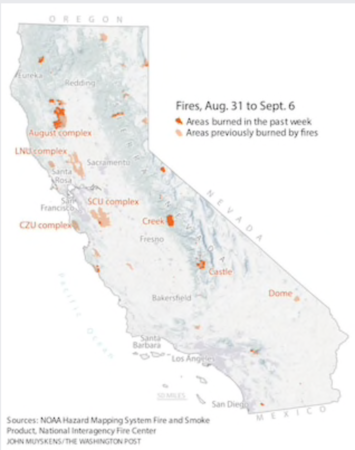
Though the start of traditional fire season has yet to begin, more than 70 wildfires are charring parts of a half-dozen states from coastal California to the Rocky Mountains, fed by tinder-dry vegetation, record heat and blustery winds that kicked up Tuesday across the region. Smoke has cast a worrisome pall over massive amounts of terrain, turning the sky an ominous red and threatening people who have allergies or asthma.
While not as deadly or damaging to property as those that have burned here in recent years, the fires have set in motion a seasonal displacement of weary Westerners, many of whom are now accustomed to packing “go bags” each late-summer season when forced evacuations have become commonplace.
In California, where two dozen major wildfires are burning, a new round of fast-moving blazes sparked up over the weekend just as thousands of people began returning to homes evacuated just last month due to threat from a different set of fires. More than 2.3 million acres have burned in the state this year, a modern record with the traditional peak fire season still weeks away.
It is a measure of how quickly the West’s climate is turning to one of extremes – periods of soaking rains followed suddenly by high temperatures – that the old record was set just two years ago. More than 3,300 buildings – homes, farmhouses, wineries – have been reduced to ash this year.
“It’s become a yearly thing that we dread, and this year it has come early,” said Jeff Okrepkie, whose house in Santa Rosa’s Coffey Park burned down in the Tubbs Fire in October 2017.
Okrepkie, who works for an insurance agency, and his family moved into their rebuilt home in February. The Tubbs Fire wiped out their neighborhood and, last year, the Kincade Fire forced the evacuation of more than 100,000 people in his county. For weeks, he and members of the Coffey Park Facebook group have been watching smoke from the Walberg Fire, just north of Santa Rosa, that flared up again overnight on Monday.
“There is anxiety, stress and fear,” Okrepkie said. “And people here are trying to manage this in the best way they can. It is a very strange head space to be in right now.”
As fire season increasingly has become a year-round event in the West, each blaze has taken on a character of its own.
Three years ago, wine country and this county burned, the first in a series of mega-fire years. Two years ago was California’s deadliest wildfire season, when the Camp Fire destroyed the foothill town of Paradise, killing 85 people and burning more than 17,000 homes and other buildings.
Last year, more than 200,000 people fled their homes under forced evacuation or warnings; this year more of the state has burned than ever before with the season of dangerous winds – known across the state as Diablos, Sundowners and Santa Anas – still ahead.
Many of the fires burning now are far from major cities, and as of Tuesday, more than 42,000 people remained under mandatory evacuation orders. Weather forecasts suggest that flames heading east in recent days and away from city centers could be turned around by an expected wind shift.
On Tuesday, red-flag warnings signaling a high fire threat stretched along the entire West Coast from the U.S. border with Mexico to Canada, including much of California and Nevada, western Oregon and Washington, along with western Arizona and southern Utah.
Strong winds swept areas in and around Seattle and Portland, Ore., with wildfire concerns in both areas. In some places, winds have been strong enough to knock out power, leaving tens of thousands without electricity amid the heat.
Here in California, with the early arrival of offshore winds, red-flag warnings have been issued for much of Northern and Southern California, as well as the Sierra Nevada mountains and foothills, as fire weather migrates from north to south.
California’s Creek Fire, which is burning fast through expansive dry stands of trees on the western slopes of the Sierra Nevada, destroyed half the homes in the tiny town of Big Creek over the weekend and stranded dozens of holiday campers along the shores of a reservoir.
At the same time, a wildfire in Washington state wiped out much of Malden, a town of 200 people south of Spokane in the state’s far east. The National Weather Service on Tuesday placed northwestern and southwest Oregon under an extreme fire danger warning, marking the first time southern Oregon has ever been issued such a warning, according to the Oregon Climate Office.
The Portland area was covered in a smoky haze Monday afternoon and overnight as strong winds knocked over trees and led to widespread power outages. The smoke from the nearby wildfires prompted an air quality advisory, warning that the smoke could be dangerous for the young and the elderly, as well as those already most at risk for the novel coronavirus.
The stiffening winds in California threatened to push existing fires into more-populous communities, particularly those in the Bay Area and in Los Angeles, San Bernardino and San Diego counties.
“It’s hard to come up with a scenario that is higher risk,” said Noah Diffenbaugh, a professor and climate scientist at Stanford University. “We haven’t gone into a wind event in California with this many large fires burning. Just from that perspective, we are in uncharted territory.”
The fires are taxing the West’s ability to fight them and, here in California, testing an electrical grid stressed by record heat and the stay-home ethos demanded by the coronavirus pandemic.
More than 14,000 firefighters are battling to contain flames from San Diego County in the far south, where the Valley Fire has blown up to nearly 20,000 acres, to the Creek Fire in the state’s parched center.
Smoke has hampered some air operations, and the California National Guard was called in Friday evening to carry out the evacuation of 214 stranded campers and 11 pets from the shores of Mammoth Pool Reservoir. National Guard officers said it was the largest operation of its kind in recent memory, and state officials said another 164 people were being evacuated by air on Monday.
State and local officials have urged residents over the long weekend to conserve energy in any way possible. Rolling blackouts did not occur, thanks in part to millions of utility customers shutting off big appliances and other electricity drains during peak hours. State residents still used 25% more energy this weekend than the average summer day peak.
The conservation request has been met with some ridicule here given the squeeze residents have been experiencing due to other government instructions. State officials had already told residents to stay home over the holiday weekend to avoid coronavirus infection, which has led to a far higher rate of power consumption than usual. Some counties closed beaches during the historic heat wave.
Woodland Hills, a city in northern Los Angeles County, reached 121 degrees over the weekend. That is the highest temperature recorded in the county or in any of the three directly north of it. Those are among a sweep of counties stretching from Point Conception to the Mexican border that are among the fastest-warming in the Lower 48 states during the past century and a half.
Two fires are spreading east of Los Angeles amid the heat, one allegedly started by fireworks set off at a gender-reveal party, a cause now under investigation. Winds also fanned the Walberg Fire in wine country, north of San Francisco, that began three weeks ago amid thousands of lightning strikes.
Anticipating dangerous offshore winds, Pacific Gas and Electric (PG&E) shut off power to 172,000 in several wine country counties early Tuesday morning, an inconvenient preventive measure the company has employed in the past two years. The utility, which has a long history of safety lapses, is liable for fires started by its power lines and other equipment.
“We are altogether engaged, not only in this moment but in the medium and long-term solutions to these extreme events that have almost been normalized here,” California Gov. Gavin Newsom, a Democrat, said during a midday briefing.
“I have no patience for climate-change deniers,” he added. “You may not believe it intellectually, but you can believe what is in front of your own eyes.”
While the Southern California fires are burning closer to larger towns and cities, the Creek Fire in the western Sierra has proven to be the most frightening and dramatic, burning so hot and fast that it sent plumes of smoke 50,000 feet into the air.
The fire, fueled by dense patches of overgrown pines and trunks killed by bark beetles and drought, doubled in size within the Sierra National Forest to about 135,000 acres overnight. It has scarred more than 143,000 acres in four days.
The speed overwhelmed groups of campers, who had been warned to prepare to jump into the reservoir if the flames reached them. They did not have to, the flames held off by the treeless buffer around the reservoir. After evacuation by air, some were hospitalized with injuries ranging from smoke inhalation to broken bones.
In many ways, the Creek Fire is a sign of the times and of things to come.
Temperatures in the area remain unseasonably high, and the region has not seen significant rain since early spring. Historically, fires would burn through the Sierra every 50 to 150 years, naturally clearing the dead wood that serves as fuel.
Those fires have been corralled in recent decades, and the forests have thickened to dangerous levels despite controlled burns and other efforts to manage and clear brush.
“Now these forests are dense enough that when you have these dry fuels and a little fire, it’s a combination that creates the conditions for these catastrophic fires,” said Eric Vane, a U.S. Forest Service official at the Tahoe National Forest, which like others in the region has closed to overnight campers because of fire danger.
“We’re not catching up to where we need to be in terms of creating these more fire-adapted ecosystems,” Vane said. “This leads to a whole host of issues, including the ability of a forest to regenerate itself when there isn’t a living tree within a mile.”
Robot cleaners are coming, this time to wipe up your coronavirus germs
Sep 08. 2020
By The Washington Post · Rachel Lerman · NATIONAL, TECHNOLOGY, HEALTH, HEALTH-FEATURES SAN FRANCISCO – Every day at Sharp Grossmont Hospital, custodial teams wheel two boxy robots down the halls from one patient room to the next, using ultraviolet light to disinfect them from the coronavirus and bacteria.
All covid-19 patient rooms and a few break rooms – about 30 spaces in total – of the San Diego County-based hospital get disinfected each day by the robots, a marvel to Neil Mandalia, the environmental services director. He asked administrators in the early days of the pandemic if he could spend $250,000 on two robots that are capable of disinfecting an operating room in 12 minutes, something that takes a worker 90 minutes. In patient rooms, the mobile lights disinfect more thoroughly than most humans.
“On our discharge, we would need to clean the walls, the ceilings, every inch of the baseboard, everywhere a pathogen could live. That’s not necessarily being done in every room every time,” he said. “But a robot does do that.”
The hospital’s purchase of the UV robots underscores how the coronavirus pandemic is accelerating the drive toward automation across the U.S. economy – this time, not just with the goal of having machines more efficiently do the work of humans but also eradicating germs and limiting human contact due to the public health threat.
The trend is being most strongly felt in airports, stadiums and public transportation, where authorities are snapping up new technologies aimed at automating cleaning, from floor scrubbers to disinfecting drones. That poses long-term risks to the low-wage workers who usually do janitorial work.
Already, working-class people face heightened risks of losing their jobs to automation throughout the economy during deep recessions as companies seek ways to save on costs.
“Labor market research especially has been showing over the last three recessions that automation constantly happens, but it’s cyclical,” said Mark Muro, a senior fellow at the Brookings Institution. “It doesn’t occur only at a steady gradual pace. It deploys in bursts.”
In a Brookings Economics Study report, researchers found 88 percent of job loss in routine occupations, such as some clerical or manufacturing work, occurs within 12 months of a recession – and much of that results from an increase in automation. Meanwhile, seven months after the coronavirus began spreading in the United States, 29 million people are receiving unemployment.
The technology deployed can range from more basic automation, like self-checkout stands at a store, to more complicated robots or drones. And while robotics hasn’t progressed as quickly as developers or sci-fi novels would have us believe, robots have taken on food delivery, warehouse work and other jobs typically performed by humans.
Retail stores and warehouses have been early adopters in the crisis. Warehouse robots have become more important as facilities across the country try to function in a socially distanced environment, which means workers take more time to complete tasks.
American Eagle Outfitters last month bought 26 warehouse robots to help the apparel store sort through mounds of clothes people ordered online, robot-maker Kindred said in a news release. The robots help maintain social distancing standards, Kindred wrote, and maintain a “safe working environment.”
Earlier this year, Amazon said it would start licensing its cashierless shopping software to other stores as retailers seek to limit face-to-face contact and cut wait times in line. The “Just Walk Out” system uses computer vision to track customers throughout stores. When they’re done shopping, customers walk out of the store without ever scanning and paying for items. That technology has sparked more interest from retailers as grocery and other store workers face danger and exhaustion during the pandemic.
(Amazon CEO Jeff Bezos owns The Washington Post.)
At least two companies are adapting drones to fly inside sports stadiums and spray disinfectant solution onto the thousands of seats in the hopes of making the areas safe for crowds again. One company, EagleHawk, said it spent months researching a way to spray huge arenas in a way that can both disinfect from the virus and be done in a quick way. Otherwise, it might be too costly and time consuming to fully disinfect such huge spaces.
“Along with a public health crisis and epidemic of illness, the virus may well prompt a new spike of automation and lasting changes to an already rapidly evolving job market,” Muro and Brookings researchers Robert Maxim and Jacob Whiton wrote in a report about the initial effects of the virus on automation.
– – –
An early example – driven by necessity as companies work to keep facilities and public spaces clean and safe – is the huge spike in demand for cleaning and disinfecting robots from hospitals, nursing homes, airports and hotels.
The LightStrike robot in use at the San Diego hospital is a box on wheels with a mushroom-shaped light sticking out of it. It’s so powerful, the company says, it can disinfect a space of 99.99 percent of the virus that causes covid-19 in less than five minutes. That’s something humans can’t achieve as quickly, although humans are still needed for general cleaning and sanitizing, as well as operating the robot. For now, the robots are increasing staffing levels, if anything, given the demands for sanitation amid the pandemic, Mandalia said.
People can’t be in the room while the machine disinfects, so workers instead set up the LightStrike, leave the room, and then come back after the first cycle to reposition chairs, flip over mattresses and turn the call button around to get ready for the second cycle. They run it about three times.
Its maker, Xenex, said sales have shot up 600 percent this year alone as hospitals, airports and hotels scramble to disinfect rooms of coronavirus-carrying cells.
The Metropolitan Transportation Authority (MTA), which runs mass transit in New York City, is also testing out ultraviolet light as a way to kill coronavirus cells on trains and buses, hoping to make them safer to ride as the pandemic continues.
The MTA started using 150 lights from Puro Lighting, a company that says its sales are already up 700 percent from all of last year because of the pandemic. Puro is working on a fully robotic disinfecting light that will map and navigate a room entirely on its own without needing an operator. Right now it sells lights that are stationary or are mounted on rolling bases that can be pushed.
“The nice thing with a robot is no one has to press a button,” said CEO Brian Stern. “You don’t have to pay for another employee.”
Using UV lights to disinfect bacteria has been around for decades, the Food and Drug Administration points out. Mounting them to mobile and autonomous robots is an invention that has mostly developed over the last decade and is facing a jump in innovation as a result of the pandemic.
The Massachusetts Institute of Technology has already created software for a UV disinfecting robot that moves by itself, though it still needs some human help. Robotic researchers at the school deployed the robot with Ava Robotics in June at the Greater Boston Food Bank as more and more people sought help as unemployment numbers skyrocketed. The robot learned the outline of the food bank’s main room and moves around at night, showering it with disinfecting light.
“By knowing the geometry of the space – usually represented as a map – the robot can compute a patrolling trajectory and speed to expose all surfaces to the dosage that neutralizes the pathogens,” said Daniela Rus, director of MIT’s computer science and artificial intelligence laboratory.
The robot came together in about a month, Rus said, though it was based on more than a decade of research into mobile robotics. Now her department is fielding several calls each week from others interested in trying it out, and she expects the product will expand.
Other cleaning robots are used in tandem with workers, ideally to speed up cleaning. Big, automated floor scrubbers – which drive themselves and look like small Zambonis off the ice – are being used more often this year than in the past, said Eugene Izhikevich, CEO and co-founder of software company Brain Corp.
The San Diego company makes the software, or the “brain,” that goes into many of the machines, something that allows them to map a room and learn the route within a day. The robots are being used about 24 percent more this year than last year, Izhikevich says.
That’s largely to keep facilities as clean as possible during the pandemic. It’s also to keep employees away from each other.
Before covid, employees of Flagship Facility Services, a contractor cleaning airports around the country, would use the hour while the floor scrubber worked to detail clean corners and edges. Now, they each work in a separate area, usually away from each other, said Gustavo Solis, director of operations at Flagship, and disinfect “touch points” such as electrical outlets and door handles that are heavily used.
“During covid, we shifted that labor to be cost-competitive with clients,” Solis said.
– – –
But not everyone sees automation as worth the money.
Juan Padilla, owner of Spotless Cleaning Chicago, said the scrubbers would have to save him three hours of human labor every day to make it worth the price tags of between $30,000 and $50,000.
“Companies that are selling this equipment are making it seem like, ‘Hey, this is the best thing ever,’ but I’m not seeing much implementation of it to be honest,” said Padilla, whose company works mostly with office buildings.
Rainbow Property Maintenance, also in Chicago, signed up to be part of the pilot for the Whiz robotic industrial vacuum cleaner, which learns a space and cleans the carpet autonomously, from SoftBank.
“We tried it, and man, we really wanted to fit the square peg into the round hole,” said Rainbow consulting technology manager John Duda. “We really wanted to make it work.”
But if it didn’t have big swaths of carpet to clean, it got stuck in corners, Duda said. And employees, perhaps worried about being replaced, picked up their productivity and could finish the same job faster, he said.
SoftBank spokesperson Kass Dawson said customers are confident in Whiz and “see its efficiency every day.”
Companies are probably right to be a little cautious, said Françoise Carré, a research director at the University of Massachusetts at Boston who has been working with UCLA researcher and professor Chris Tilly on a wide-ranging study for more than two years looking at technology across retail.
“One thing we do know is that it takes a fair amount of time to train these robots,” Tilly said. In some cases, the researchers heard of robots still struggling to learn shelf inventory after being in stores for nearly a year.
Big tech adoptions could certainly risk job losses for retail and custodial workers, which would disproportionately affect women and people of color, who hold the jobs in greater numbers, said Tilly.
But exactly how that will play out is unclear. Even though the pandemic has caused demand for cleaning robots to surge, there are also a lot of employees out of work that might be willing to do the jobs at low wages.
But the cleaning robots are also doing some psychological work – convincing customers, travelers and patients that spaces are clean and orderly during the pandemic.
Brain Corp.’s Izhikevich said two-thirds of the increase of usage he’s seeing in the automated floor scrubbers is due to robots operating during daytime hours, a fairly uncommon time for the big machines to run. Daytime usage hours have more than doubled since last year, he said. They are usually turned on at night when buildings are mostly empty.
A lot of customers asked for increased day work during the early months of the pandemic said Padilla from Spotless Cleaners. They wanted touch points such as doorknobs cleaned nearly constantly, he said.
“I think the first maybe two months people were really afraid,” he said, noting customers have since backed off daytime cleaning a bit.
The pandemic won’t last forever, but Rus says the robots, especially the disinfection robots, will persist and expand into more hotels, hospitals and warehouses.
“Wouldn’t you feel safer being in a space that has not only been dusted and swept, but is also certified to be virus-free?” she asked.
WeChat and TikTok are taking Chinese censorship global, study says
Sep 08. 2020
By Syndication Washington Post, Bloomberg · Jamie Tarabay · BUSINESS, WORLD, ASIA-PACIFIC The most popular Chinese-owned social media from WeChat to TikTok are increasingly censoring content in the U.S. and elsewhere, taking practices honed for years behind the Great Firewall to an international audience.
ByteDance Ltd.’s TikTok often buries or hides words that reflect political movements, gender and sexual orientation or religion in most countries where it operates, the Australian Strategic Policy Institute said in a report released Tuesday. Most of the content censored on WeChat supported pro-democracy activists in Hong Kong, as well as messages from the U.S. and U.K. embassies regarding a new national security law enacted by Beijing at the end of June that has provoked protests across the city.
TikTok, which began as a place where teens lip-sync to music, has become a forum for political protest including the Black Lives Matter movement, said Fergus Ryan, one of the authors. Hashtags related to LGBTQ+ issues were also suppressed in several languages, according to the report. Other topics censored in the past included criticism of Russian President Vladimir Putin.
The findings may lend ammunition to the Trump administration, which banned TikTok and Tencent Holdings Ltd.’s WeChat after accusing the apps of bending to Beijing’s will in censoring content, potentially influencing the November elections. While social media services like Facebook scrub content such as hate speech, Washington accuses services like TikTok of blocking content considered sensitive to the Communist Party. WeChat has long complied with controls back home, while TikTok — which operates only outside China — has pushed back against claims it’s influenced by that country’s government.
“TikTok is a more curated experience where the platform has a huge amount of power to decide what content to serve up to users,” said Ryan. “Most of these hashtags are categorized in TikTok’s code in the same way that terrorist groups, illicit substances and swear words are treated on the platform.”
A Tencent representative declined to comment, while a ByteDance spokesperson had no immediate comment when contacted. The Australian institute cited TikTok as saying some terms “were partially restricted due to relevant local laws.” It was also cited as saying it “strongly supports our LGBTQ creators around the world, and is proud that LGBTQ content is among the most popular category on the platform with billions of views.”
Washington’s moves against TikTok and WeChat underscore how the concept of an internet decoupling is becoming reality. The Trump administration’s ban on TikTok and WeChat takes effect in mid-September, when both apps are likely to get taken off app stores but may continue to be accessible to many American users. WeChat can be a powerful vector in countries like the U.S. where the Chinese diaspora is substantial, because it is often a major source of information for that population.
But principles like free speech do not form part of those apps’ core values, rather they’re more likely to over-censor to align with local government wishes, according to the report.
ByteDance is now embroiled in sensitive discussions about a TikTok takeover in the U.S. with suitors including Microsoft Corp. and Oracle Corp., a deal estimated to fetch upward of $20 billion. But uncertainty around the deal escalated sharply last week after China asserted its right to approve or block the sale of technology abroad, complicating an already complex process under scrutiny from the White House. The law underscored how Beijing wants to retain some control over content moderation and that it considers ByteDance’s algorithms to be a matter of state security, Ryan said.
“The rubber really hits the road with the algorithm,” he said. “TikTok’s algorithms are extremely sophisticated and powerful.”
Facebook plans to label posts ‘more aggressively,’ VP says
Sep 07. 2020Nick Clegg, Facebook’s vice president of global affairs and communications, speaks to journalists in May 2019. CREDIT: Bloomberg photo by Marlene Awaad
By Syndication Washington Post, Bloomberg · Jordan Yadoo · NATIONAL, POLITICS Facebook will “much more aggressively” label posts meant to manipulate or mislead U.S. voters in the lead-up to November’s presidential election, said Nick Clegg, a top company official.
“We’re now going to do this much more forcefully between now and November the third,” Clegg, Facebook’s vice president for global affairs and communications, said Sunday on CNN’s “Reliable Sources.”
Facebook’s stepped-up efforts at content-flagging are being done in conjunction with the Washington-based Bipartisan Policy Center.
The social network last week announced new policies to combat misinformation and voter suppression, including a ban on new political ads on its platform in the week before Election Day, and removal of posts that claim people will contract the novel coronavirus if they take part in voting.
In a year when increased mail voting could delay the results of some contests, the company also said it will add labels to posts from politicians who try to claim victory before official outcomes are known.
Facebook CEO Mark Zuckerberg has warned of potential “civil unrest and violence” while election results hang in the balance.
Hours after unveiling the changes last week, Facebook flagged a post from President Donald Trump suggesting that people vote in person as well as by mail, which is illegal, adding a label that directed users to its voting information center.
“Voting by mail has a long history of trustworthiness in the U.S. and the same is predicted this year,” Facebook wrote on the label appended to the president’s post.
Facebook has been criticized about misinformation that flowed freely on the social-media platform during the 2016 election, and also for not moving quickly enough in the current voting cycle.
“We’re moving with the pace of the election campaign,” Clegg said. “This is not the first time we’ve announced policies on election campaigns and how they play out on our platform. We’re constantly iterating.”
How college students can make the most of remote learning
Sep 07. 2020
By The Washington Post · Teddy Amenabar · TECHNOLOGY, FEATURES, EDUCATION
The zoomers are settling in for another semester of Zoom University.
Most U.S. colleges and universities are offering some form of online instruction this fall semester. In many ways, this is more of the same. In the spring, the forced pivot to remote instruction was a trial by fire for schools. Now, university officials say they’re better prepared to translate coursework online.
“The remote learning that we did in the spring, as an emergency, probably won’t look the same as the remote teaching that we’re doing now,” said Thomas J. Tobin, the director of the Learning Design, Development and Innovation team at University of Wisconsin at Madison.
The Washington Post spoke with six university instructors who have spent the summer helping faculty rearrange classes for the start of the year. Many of them said students should expect more opportunities for “asynchronous learning,” which means students will complete portions of a course on their own time – not during a set Zoom call with the entire class.
“What we do hasn’t actually changed all that much. How we do it has changed and shifted radically,” Tobin said.
As Tobin explains it, asynchronous instruction flips the standard lecture on its head. Jenae Cohn, an academic technology specialist at Stanford University, said students will have a bit more flexibility and agency to decide how they spend their time completing coursework.
“They don’t have to be thinking of classes as the time that their butt is in the chair in the lecture hall,” Cohn said.
– Find a daily schedule and a place that works best for you
Cohn said students should build a daily schedule around accomplishing tasks – not just when their next Zoom lecture is happening. Take some time to reflect on “your ideal universe” for finishing assignments, Cohn said. Try to reflect on how you learn.
“When is your favorite time to listen to a lecture?” Cohn asked. “When are you most focused and most engaged?”
Once you create a weekly schedule, stick with it, because Zoom University can otherwise feel all-encompassing. A structured day will help you feel “more in control” over your coursework, Cohn said.
After you’ve settled “when” you work, move on to “where” you work. Find a room, a corner of a room, a desk or another dedicated area where you only study. It helps to have an area separate from other slightly less productive moments on the internet.
If at all possible, take your classes in a space where someone else is already studying – such as a roommate. It doesn’t matter if that person is taking a different course; you’re both working. The social pressure can keep you on “the task at hand,” said Art Markman, a psychology and marketing professor at the University of Texas at Austin and the head of the school’s academic working group for reopening this semester.
It’s the same feeling you get when you’re studying at the library with a studious friend, Markman added.
Of course, an in-person study group might not be possible because of social distancing measures. One workaround could be calling a classmate on FaceTime while in a live lecture on Zoom, Markman said. That way, there’s some added accountability between the two of you to pay attention to the instructor.
Markman added that a lot of these solutions are attempts to manufacture social interactions that would have happened naturally in an ordinary semester.
Above all else, spend the time to create a “distraction-free” workspace. Hide your phone. Download tools on your browser to block social networks or other distracting websites.
“Make it difficult to do anything other than what you’re there for,” Markman said.
– Zooming can get exhausting. Limit your screen time when possible.
Zoom fatigue is real. Hours spent on videoconferences can feel draining, and remote learning often requires a steady slog of lectures, study sessions and working groups via webcam.
“If we have our camera on for hours and hours in a day, we feel – psychologically – that other people are looking at us,” Tobin said. “That feeling of being ‘onstage’ is really draining.”
It’s hard to watch anyone “drone on” for a two-hour Zoom lecture, even if the instructor is brilliant, Markman said. Professors know this, and students should prepare for classes to be more interactive – with breakout rooms and voting.
“For the students: Show up and take advantage of those opportunities to actually engage in those discussions,” Markman said. “These classes that are designed to be online have a lot more engagement, even when they’re larger classes, and so it really is well worth being there.”
Some professors may give you the option to turn off your camera during a lecture on Zoom, Cohn said. That way, you can listen and take notes without constantly being under a microscope. Do what works best for you to manage screen fatigue, Cohn said.
“Everyone has to kind of look out for their own well-being right now,” Cohn said. “Take breaks; get away from the screen a little bit.”
Outside of class, readings and research often add hours of screen time to the day. It’s true that there are differences between reading on screen and on paper, said Cohn, who has a forthcoming book on strategies for digital reading in college.
Instead of endlessly scrolling through a PDF, Cohn recommends students download tools, such Hypothesis, PowerNotes or Scrible, to help them annotate and manipulate text on screen. Think of reading on a screen as “a conversation” between you and the text, Cohn said, adding that you have to be mindful of why you’re reading and what you’re trying to get from a text.
“If you’re working in different material spaces, you have to adopt different strategies to remembering and keeping track of information,” Cohn said.
– Socializing in and out of class needs to become a lot more intentional
Zoom doesn’t allow for the same happenstance conversations while walking around campus. You’re not going to run into a professor in the hallway or see your teaching assistant at the library. Students and faculty have to create those opportunities for casual social interactions this semester, Markman said.
When the University of Texas at Austin surveyed students about remote learning at the end of last semester, Markman told The Post that many students reported that they felt disconnected from the campus community.
Markman has one suggestion: Think of the friends of friends you would say hi to while walking to your next class. Write their names down and send a text – or even call – to keep in touch, Markman said.
While in lectures on Zoom, Markman recommends students find the backchannels other classmates are using to talk about a course away from the watchful eye of the instructor.
“That’s where all the action is,” Markman said. Even if it’s a grab bag of “snark and value.”
Backchanneling is actually proven to help students process material in the middle of class, Cohn said.
“If you’re having a productive conversation with someone about the class on GroupMe or WhatsApp, or wherever you’re going, I think that should be encouraged,” Cohn said. “Those are things you always probably did in class in some way.”
In the spring, students and professors could lean on existing relationships they formed before the pandemic to get through the end of the year. Now, most students and professors are starting with a blank slate. Markman said he’s planning an “offbeat campus tour” one evening to intentionally create out-of-class opportunities for students to meet and talk.
All the instructors The Post spoke with encouraged students to speak up and contact their professor if they have questions about a particular concept or problem in class. Professors are going to try to be a lot more available to talk this semester, Markman said. And it helps if students make an effort to be a “known quantity” in the classroom.
“I think a lot of people are just reluctant to talk to a professor, believing they’re completely out of reach,” Markman said. “The fact is, most professors are just goofy people.”
California faces record-setting heat as fires rage across state
Sep 07. 2020
Photo by: The Washington Post — The Washington Post
By The Washington Post · Andrew Freedman · NATIONAL, SCIENCE-ENVIRONMENT Much of California endured one of its hottest days in memory Sunday, the day after scorching temperatures set scores of records and intensified destructive wildfires erupting in the state.
Red-flag warnings for high fire danger covered the state while the heat fueled fires already burning as well as new blazes.
Numerous locations in California experienced their hottest September day on record Sunday. A few spots saw their highest temperatures observed in any month.
Woodland Hills, 20 miles from downtown Los Angeles, soared to 121 degrees, the highest temperature ever observed in Los Angeles County. Chino, 32 miles east of Los Angeles, also hit 121 degrees. The Chino and Woodland Hills temperatures were the highest recorded west of the mountains in Southern California.
Farther north, the readings in San Luis Obispo, 10 miles from the Pacific Ocean, reached 120 degrees. This may be the highest temperature ever measured so close to the ocean in the Americas. Downtown San Francisco reached 100 degrees, a record for the date.
The heat helped fuel a wildfire that developed Saturday when the Creek Fire in the Sierra National Forest erupted, about 290 miles north of Los Angeles. The blaze was detected Friday night and rapidly grew to at least 45,500 acres by Sunday afternoon.
That fire trapped about 1,000 people near Mammoth Pool reservoir as flames crossed the San Joaquin River, including about 150 people who became stranded at a boat launch, The Associated Press reported.
According to the AP, 200 people were rescued from the Mammoth Pool Campground by military helicopters. Two people were severely injured, 10 had “moderate injuries,” and others had minor or no injuries. According to the California Air National Guard, this was the largest wildfire-related air evacuation in recent memory.
The Fresno Bee reported that at one point, people trapped by the flames were told to jump into the water as a last resort if the fire got too close. However, Sierra National Forest officials said that the fire burned around the reservoir and that the air evacuations took place because the blaze blocked evacuation routes.
The Fresno sheriff ordered new evacuations Sunday morning as the fire grew.
The Creek Fire sent smoke, embers and fine particles at least 45,000 feet in the air Saturday and Sunday, forming a pyrocumulonimbus cloud. Such clouds, which look like explosions from a distance, are fire-driven weather systems. The one seen Saturday was causing lightning to strike areas downwind along with erratic and gusty surface winds. Ash fell more than 10 miles from the fire.
Fires this weekend are what are known as plume-dominated blazes, which occur when the environment is favorable for the upward billowing of smoke and vertical transfer of heat.
Plume-dominated fires can become firestorms, taking on the structure of a thunderstorm because of their vertical release of heat. Extreme fire behavior, as has been seen with the Creek Fire, is often a characteristic of plume-dominated fires.
The Creek Fire appeared to produce fire tornadoes based on Doppler radar data, which revealed vortices inside the fire and a smoke plume that matched the size and shape of tornadoes.
A change of wind speed and direction with height known as wind shear caused the smoke plume to rotate. In an unusual turn of events, the smoke plume’s updraft also appeared to repeatedly split, with pairs of spinning rotations repeatedly forming and drifting away from one another.
The Loyalton Fire in Lassen County produced five or more fire tornadoes barely three weeks ago, prompting the National Weather Service to issue a first-of-its-kind fire tornado warning.
In addition to the Creek Fire, firefighters are still dealing with the second-, third- and fourth-largest fires in state history, which erupted during a mid-August heat wave and unusual thunderstorms north of San Francisco. Although those fires are better contained, the heat, dry weather and shifting, strong offshore winds are causing an uptick in their activity.
Since Aug. 15, the state has seen more than 1.6 million acres burned, 900 new fires started, eight deaths and nearly 3,300 destroyed structures. About 310,000 acres are burned in an average California fire season, according to Cal Fire, the state firefighting agency.
Daniel Swain, a climate researcher at UCLA, said the state may set a record for the “most acres burned in the modern era” as soon as Monday.
Firefighting operations will continue to be extremely challenging because of the triple-digit heat and extremely low humidity levels, according to the National Weather Service.
Forecasters are monitoring two periods for strong, desiccating offshore winds to pick up in strength early this week.
The first looked as though it would take place through Monday evening, with the next taking shape as a rare early season Santa Ana wind event in Southern California from Tuesday into Wednesday.
The National Weather Service’s forecast office in Los Angeles is predicting “elevated to critical fire danger” through Wednesday.
Many temperatures across the state appeared to be headed toward record territory by late Sunday as a “dangerous to potentially deadly” extreme heat event continued, the Weather Service said. The Weather Service office in Los Angeles described Sunday’s heat as “kiln-like.”
Some all-time high temperatures and numerous daily records are in jeopardy as a sprawling and unusually potent area of high pressure, also known as a heat dome, covers the West.
In a sign of the heat to come, temperatures in some locations, from the San Fernando Valley to parts of Los Angeles County, did not drop below the 90s on Saturday night into early Sunday morning. In fact, two temperature stations in the L.A. area were still hovering above the century mark at 3:02 a.m. local time, the National Weather Service stated.
High temperatures in Southern California on Sunday ranged from 105 to 115 degrees near the coast to up to 120 degrees in inland areas, which would edge past all-time high-temperature records in some locations.
Some noteworthy temperature records that have already occurred include:
– The 121-degree temperature recorded in Woodland Hills was not only the highest temperature on record there but also the highest seen anywhere in Los Angeles, Ventura, Santa Barbara and San Luis Obispo counties, the National Weather Service said.
– Burbank tied its all-time high temperature record of 114 degrees Saturday.
– Palm Springs hit 122 degrees, breaking its previous September record from 1950.
– Death Valley set a September record with a high of 125, overtook the record of 123, set in 1996. This comes just weeks after hitting 130 degrees, an August record, and the highest temperature observed globally since at least 1931.
– Woodland Hills in Los Angeles tied its all-time high temperature record of 119 degrees, set in July 2016.
The massive heat dome sprawled over western North America established September records from Mexico to the Colorado Rockies. Mexicali, Mexico, soared to 121.1 degrees, the country’s highest temperature ever observed during the month. Denver hit 101 degrees, its highest September temperature and the latest on record it has crossed the century mark. Nearby Boulder, Colo., reached 99 degrees, its highest temperature so late in the year. On Tuesday, Denver and Boulder are expecting snow.
La Junta, Colo., about 60 miles southeast of Pueblo, registered a high of 108 degrees, a state record for the month of September.
Temperatures are forecast to cool some by Tuesday but remain above normal in most of California for much of the week.
Human-caused climate change is tilting the odds in favor of more frequent, severe and longer-lasting heat waves, as well as larger wildfires throughout large parts of the West. Research published last month shows that climate change is tied to more frequent occurrences of extreme-fire-risk days in parts of California during the fall. (Meteorologists define the fall as beginning Sept. 1.)
Michael Wehner, who researches extreme weather at Lawrence Berkeley National Laboratory, estimates that “climate change has caused extreme heat waves to be 3 to 4 degrees Fahrenheit warmer in California.” These trends “will continue as the planet continues to warm,” Wehner said in an email, noting that the amount of warming will depend on future greenhouse gas emissions.
The heat wave has prompted warnings from the operator of California’s electricity grid that rolling blackouts may need to be instituted during times of peak power use, and it has asked residents to take steps to reduce electricity use during times of peak demand. A “Stage 2 warning” was issued Saturday, indicating that all efforts to prevent power failure had been taken, but it was not followed by outages.
The California ISO declared a “Flex Alert” on Sunday, calling for reduced electricity use between 3 p.m. and 9 p.m. local time.
The state utility PG&E has also warned that it may institute rolling outages if winds get too strong early this week because its power infrastructure has been blamed for sparking some of the state’s largest and deadliest blazes in recent years.
Extreme heat has been the top weather-related killer in the United States during the past 30 years, and combined with poor air quality from nearby fires and the coronavirus pandemic, the health threat is particularly acute. Air conditioning provides the best protection from excessive heat, but rather than risking exposure to the virus at cooling shelters, the pandemic may keep people who lack air conditioning at home.
Oracle loses another JEDI court battle. Its campaign against Amazon may have succeeded anyway.
Sep 06. 2020Oracle CEO Safra Catz, far right, listens to President-elect Donald Trump during a 2016 meeting with technology industry leaders at Trump Tower in New York. Also shown are Vice President-elect Mike Pence, from left; PayPal founder Peter Thiel; and Apple CEO Tim Cook. CREDIT: Washington Post photo by Jabin Botsford
By The Washington Post · Aaron Gregg · NATIONAL, BUSINESS, TECHNOLOGY, COURTSLAW, WHITEHOUSE Oracle suffered yet another defeat this week in a years-long legal dispute over a controversial military technology contract known as JEDI, as an appeals court rejected its latest legal challenge.
But the company’s repeated failures in court have masked more subtle victories in its broader campaign to undermine the Pentagon’s winner-take-all approach and damage its rival, Amazon.
Although Amazon itself was once again cleared of wrongdoing, the court concluded that two former defense officials “ignored their ethical responsibilities” by negotiating employment with the e-commerce giant while they worked on JEDI as government officials. And a long-running influence campaign led by Oracle spurred President Donald Trump’s involvement at a critical moment last summer, people familiar with the matter told The Washington Post at the time.
Trump’s alleged intervention prompted still more litigation and controversy, as a bid protest brought by Amazon has centered on his antipathy toward Bezos and his companies Amazon and The Washington Post.
As result, a military technology project that top defense officials say is critical to America’s artificial-intelligence arms race with China remains bogged down in lawsuits more than two years after it was first announced.
In response to a request for comment, Defense Department spokesman Russ Goemaere pointed out that the courts had once again ruled that “none of the alleged conflicts of interest had an impact on the integrity of the procurement.” Representatives from Oracle and Amazon declined to comment.
Wes Hallman, a vice president for policy with the National Defense Industrial Association, said he is worried that bid protests in general have slowed down the military’s efforts to acquire new technology.
“Delaying this by two years is not the right answer,” Hallman said. “The Chinese are not having this same issue, are they? They are not being hamstrung through any bid protests. Let’s be expeditious about this, because we as a nation need to move on and iterate faster with this great power competition mentality.”
The Joint Enterprise Defense Infrastructure, better known as JEDI, is meant to create a massive, centralized computing system for U.S. military agencies operated by a single tech company. If implemented, it could help lay the groundwork for the military’s eventual use of artificial intelligence to enable weapons systems, intelligence gathering and other pursuits. The contract, which the Pentagon has insisted should go to a single tech company, is worth up to $10 billion over 10 years.
It was awarded to Microsoft in late October following a last-minute intervention by Trump, who said he asked for an investigation based on “serious complaints” from Microsoft, IBM and Oracle. That sequence of events became the subject of a lengthy investigation from the Defense Department inspector general and a still-pending bid protest lawsuit from Amazon.
In a mark of the contradictions that have come to define JEDI’s chaotic, winding journey, Amazon has technically been in the position of simultaneously opposing and defending JEDI in two parallel bid protests.
As part of Amazon’s lawsuit, the court once again halted progress on JEDI, and the Pentagon asked to revise its award to fix some procurement mistakes it made. It has until Sept. 16 to issue another award.
Oracle, whose database business is threatened by the Defense Department’s broader move to the cloud, was the most vocal among a cadre of companies that resisted JEDI early on. Oracle Chief Executive Safra Catz, one of Trump’s closest allies in the tech world, raised the issue at a dinner with him in April 2018, just a month after the contract was announced, The Post and Bloomberg reported at the time.
Oracle lobbying documents eventually reached the president’s desk, people familiar with the matter told The Post. Sen. Marco Rubio, R-Fla., whose campaign has received donations from Oracle founder Larry Ellison, wrote to the Pentagon and the White House asking that the contract be delayed. Ellison also hosted a fundraising event for Trump’s campaign at his California estate, according to the local newspaper Desert Sun.
Throughout it all, Oracle has pressed on with a bid protest that began more than two years ago, culminating in Wednesday’s appeal decision. It is unclear whether the company can appeal again. An Oracle spokeswoman declined to comment Thursday on whether the company will try to do so.
Oracle brought its first bid protest against JEDI in August 2018, months before bids were due, arguing that giving one company too much control over the military’s information resources was a bad idea. That protest was rejected.
Oracle then pressed its case further in the U.S. Court of Federal Claims, this time taking direct aim at Amazon. It alleged impropriety on the part of several former officials who had business relationships with Amazon.
One of them was Deap Ubhi, a start-up founder whose work on JEDI while he worked at the Defense Department official was bookended by jobs at Amazon.
Several of Ubhi’s statements cast doubt on his objectivity as he contributed to early procurement documents for JEDI. For example, while he was a public official working on JEDI he tweeted “Once an Amazonian, always an Amazonian” in response to an article about Bezos.
The opinion released Wednesday affirmed an earlier court’s decision that rejected almost all of Oracle’s arguments. The courts concluded that none of the Amazon-linked officials named in Oracle’s lawsuit did enough to corrupt the procurement process itself. And it supported the Defense Department’s decision to limit the award to the market-leaders Amazon and Microsoft, a decision that tossed out Oracle’s bid.
“It is kind of a status quo in government that everything gets protested,” Teresa Carlson, AWS public-sector vice president, said at a conference last year, adding, “which is kind of sad, because it delays innovation.” (Carlson’s comments came before AWS filed its bid protest.)
The court did, however, conclude that Ubhi and another former official had shirked Defense Department ethics rules as they left government to join Amazon. In Ubhi’s case, an earlier court concluded he had lied to both the Defense Department and Amazon about the terms of his departure. The Inspector General reported that it referred the matter to the Justice Department, which declined to prosecute the case.
Mandy Smithberger, director of the Center for Defense Information at the nonprofit Project on Government Oversight, said the experience shows that the Defense Department needs to do a better job of enforcing ethics restrictions.
“It appears in this case the contracting officer assessed those conflicts did not impact the actual award, but it certainly put a cloud of uncertainty and doubt around this program,” Smithberger said.
Steven Schooner, a leading expert in procurement law at George Washington University, said the case actually shows how bid protests can be beneficial if they dig up instances of government malfeasance. (Schooner disclosed that he has previously worked for the Justice Department and for both of the law firms involved in the case, but has no current business relationship with either Amazon or Oracle.)
“Oracle provided a public service, … and here, you could analogize to whistleblowers … by helping expose some of the flaws in the JEDI procurement process that, if not for Oracle’s efforts, might not have come to light,” Schooner said.
Goemaere said the DoD “has a robust ethics program and provides extensive training and tools to educate and assist employees in complying with their ethics requirements,” adding that the Inspector General’s report prompted it to put in place additional ethics training.
Amazon declined to comment on whether Ubhi had been reprimanded in any way, or whether the company has reexamined its hiring or recruiting practices as a result of the controversy.
Ubhi, for his part, seemed to fire back at Oracle in a March 25 tweet, saying, “Oracle and the White House totally deserve each other.”






 Motorola’s second-generation foldable Razr 2 with the main screen closed. MUST CREDIT: Bloomberg photo by Mark Gurman
 Water vapor rises from a fossil plant. MUST CREDIT: Bloomberg photo by Luke Sharrett
  Photo by: The Washington Post — The Washington Post
 Nick Clegg, Facebook’s vice president of global affairs and communications, speaks to journalists in May 2019. CREDIT: Bloomberg photo by Marlene Awaad
 Oracle CEO Safra Catz, far right, listens to President-elect Donald Trump during a 2016 meeting with technology industry leaders at Trump Tower in New York. Also shown are Vice President-elect Mike Pence, from left; PayPal founder Peter Thiel; and Apple CEO Tim Cook. CREDIT: Washington Post photo by Jabin Botsford
