Apple wins victory against E.U. as court rules it does not have to pay back-tax fine
Jul 16. 2020
By The Washington Post · Michael Birnbaum · WORLD, TECHNOLOGY, COURTSLAW, EUROPE
BRUSSELS – Apple won a major victory Wednesday against European efforts to force it to pay higher taxes, after a European Union appeals court overturned a massive judgment against the tech giant and said that E.U. antitrust regulators erred in imposing a $14.8 billion bill for back taxes.
The ruling, which is likely to be appealed by the European Commission, was a major boost to Apple and the Irish government. Both said they did nothing wrong and have denied the E.U. allegations that Apple received preferential tax treatment from the Irish government.
For now, the ruling is a major blow to E.U. antitrust regulators’ efforts to police individual countries that lure companies to their territories with low tax rates. E.U. antitrust chief Margrethe Vestager has built an international reputation for her aggressive moves against the business practices of tech giants, many of which have set up their European operations in low-tax nations such as Ireland and Luxembourg.
“We will carefully study the judgment and reflect on possible next steps,” Vestager said in a statement. “All companies should pay their fair share of tax.”
The European Commission issued the back-tax fine in 2016, saying that Ireland gave Apple unfair advantages and violated E.U. state-aid rules when it offered the tax breaks for Apple between 2003 and 2015. The arrangement, the antitrust officials said, allowed Apple to pay a tax rate of less than 1 percent.
The General Court said the European Commission failed to meet legal standards to support its charge that Apple was granted illegal subsidies.
Apple CEO Tim Cook said at the time that the collection effort was “total political crap,” and it drew frustration from Dublin and Washington as well. Even some U.S. skeptics of Apple’s tax-reduction efforts said the money should be going to the U.S. government, not Ireland’s.
The 2016 tax ruling was Vestager’s first banner tax case against a global corporation, and she followed it with action against Amazon, Starbucks and others. Her aggressive enforcement efforts earned her the moniker “tax lady” from President Trump, as he complained about E.U. policies toward U.S. businesses.
If the European Commission decides to challenge the ruling, the case will be heard by the top E.U. court, the European Court of Justice. The process could take three or four years.
The Irish Department of Finance said Wednesday that it welcomed the appeals court’s decision.
Separately, the European Commission planned Wednesday to announce a new strategy to fight “race to the bottom” efforts among E.U. countries to draw business by lowering corporate tax rates. The court ruling may crimp some of those plans.
Trump scales back landmark environmental law, saying it will help restart the economy
Jul 16. 2020President Trump
By The Washington Post · Juliet Eilperin, Felicia Sonmez · NATIONAL, BUSINESS, SCIENCE-ENVIRONMENT
WASHINGTON – President Donald Trump finalized a major overhaul Wednesday of one of the country’s most consequential environmental laws on the grounds that it has slowed the construction of highways, pipelines and other major projects across the country.
The sweeping changes to the 50-year-old National Environmental Policy Act, which opponents have vowed to fight in court and reverse if Democrats regain control of the executive and legislative branches this fall, underscore the stakes in this year’s election.
“This is a truly historic breakthrough,” Trump said Wednesday afternoon at an event at a United Parcel Service hub in Atlanta where he announced the move. He added: “Together, we’re reclaiming America’s proud heritage as a nation of builders and a nation that can get things done.”
The law requires the federal government to analyze the impact of a major project or federal action on the environment – and to seek public input – before approving it. Trump and his allies in business and industry argue that the law has proved costly and cumbersome to developers. But supporters say it provides Americans – particularly those in poor and minority neighborhoods that bear the brunt of many polluting industries – with a say on proposals that will affect them for decades to come.
Trump chose Georgia, which has emerged as a battleground state in this year’s presidential and Senate elections, as the site for unveiling his move. At Wednesday’s event in Atlanta, he noted that his action is expected to cut down the length of time for a highway expansion plan there to two years from the original seven.
“We’re going to give every project a clear answer: Yes or no,” Trump said to applause. A White House official said the move will benefit the UPS hub by reducing congestion and promoting economic development in the region.
Kym Hunter, a senior attorney at the Southern Environmental Law Center, said in a phone interview that it was hard to say the law had delayed Atlanta’s Interstate 75 expansion because it was still in the early stages.
The president can’t amend the law, but he intends to change the rules governing the way it is implemented. He wants to exempt some projects and activities from environmental review altogether while speeding up the time frame for reviews for other projects. In one of the most contentious changes, federal agencies would be told not to consider “indirect” climate impacts. While this category is not yet defined, experts said, it could potentially include emissions from burning oil and gas shipped through a new pipeline or increased traffic on an expanded highway.
Mike Sommers, president and chief executive of the American Petroleum Institute, predicted that the changes would speed up the construction of “not only the modernized pipeline infrastructure we need to deliver cleaner fuels but highways, bridges and renewable energy.”
Erik Milito, president of the National Ocean Industries Association, said in a statement, “A brighter future awaits countless projects, including planned offshore wind farms up and down the Atlantic Coast with the billions of dollars of investment and tens of thousands of American jobs they will bring.”
But critics warned that the White House is going beyond its legal authority by trying to change a law without congressional authorization.
“Trump can’t change the statute, and Congress and the courts have laid out clear parameters for what the federal government must do before approving or funding a project,” said Sharon Buccino, director of lands for the Natural Resources Defense Council, in an email. “If the Trump administration tries to ram through polluting projects without the appropriate review and public comment, we will be right there ready to take them to court. As we have seen with the recent pipeline and drilling cases, the administration’s attempts to rush this process have led to lawsuits – and more rather than less delay.”
Depending on how many days Congress remains in session this year and the results of the fall election, Democrats may be able to overturn Trump’s move through the Congressional Review Act next year, or craft a new rule to replace it if the party gains control of the White House.
Matt Hill, a spokesman for former vice president Joe Biden, said in an email that the presumptive Democratic nominee would reverse the new rule if elected and focus instead on providing additional resources to underserved communities.
“No one should be fooled that Donald Trump is attempting to destroy a bipartisan, cornerstone law to distract from the fact that ‘Infrastructure Week’ never happened and never will happen as long as he is president,” Hill said. “Joe Biden knows what it’s like to inherit an economy on the brink of collapse and has successfully overseen a recovery that gets people back to work quickly and with certainty – and he’s going to do it again.”
Outside groups have managed to either halt or delay several of the Trump administration’s most high-profile energy projects and environmental rollbacks by invoking NEPA, including the Keystone XL and Atlantic Coast pipelines. They have also deployed it to scuttle lesser-known proposals, including a large trash incinerator slated to be built on a flood plain in Arecibo, Puerto Rico.
Hunter said that it made no sense to scale back the law at a time when marginalized communities were demanding greater input into decisions affecting their public health.
“This is a blatant and transparent effort from the Trump administration to further silence communities that are not as well connected, not as wealthy, not as valuable to the White House as others,” Hunter said. “And the fact that it is happening now, when so many in our communities are crying out for equity and fairness, is particularly appalling.”
Biden, billionaires and corporate accounts appear to be targeted in Twitter bitcoin hack
Jul 16. 2020
By The Washington Post · Rachel Lerman · NATIONAL, BUSINESS, TECHNOLOGY Joe Biden, Elon Musk, Jeff Bezos and other high-profile Twitter accounts were the target of a widespread hack to offer fake bitcoin deals Wednesday in one of the most prominent security breaches on a social media site.
Accounts for former president Barack Obama, Microsoft co-founder Bill Gates, musician Kanye West and both Uber and Apple also posted similar tweets, all instructing people to send cryptocurrency to the same bitcoin address. The tweets were removed throughout the afternoon shortly after being posted to the accounts.
Twitter said in a tweet Wednesday afternoon that some users weren’t able to tweet while it was working on the incident, and users with the checkmark to indicate their accounts were verified by the social media company reported they weren’t able to tweet.
Twitter spokeswoman Aly Pavela said earlier that the company was investigating. The company said in an earlier tweet it was “taking steps to fix” the security incident and would provide an update shortly.
While it was unclear how the attacks originated or why they kept going, some cyber security experts speculated that someone may have gained access to internal Twitter controls that allowed them to take over accounts and post on their behalf.
Some of the people who were hacked specified they had turned on two-factor authentication and were using strong passwords, which typically makes any account more difficult to break into.
A now-deleted tweet from Tesla CEO Musk’s account said, “Feeling greatful, doubling all payments sent to my BTC address! You send $1,000, I send back $2,000! Only doing this for the next 30 minutes.”
His account continued to tweet similar posts as they were deleted. New tweets that appeared to be hackers were still being posted more than an hour after Musk’s account first tweeted the scam message.
Democratic presidential candidate Joe Biden was also a target of the hack, his campaign confirmed. His account apparently tweeted out the same bitcoin wallet address.
“This is a SCAM, DO NOT participate!” Cameron Winklevoss, a bitcoin investor and co-founder of Gemini.
Gemini’s account was hacked earlier in the day, Winklevoss tweeted, despite the account using two-factor authentication to secure it.
Amazon chief executive and Washington Post owner Bezos’ account tweeted, “I have decided to give back to my community.” The tweet said it would be limited to $50 million.
The bitcoin wallet the tweets pointed to appeared to receive more than $115,000. It’s unclear how much of that was driven by the hacked tweets and what may have originated from the scammers.
Apple’s and Uber’s corporate accounts also appear to have fallen victim to the hack. Uber posted a tweet that read, “Due to Covid-19, we are giving back over $10,000,000 in Bitcoin! All payments sent to our address below will be sent back doubled.”
Uber confirmed in a tweet that its account had been hacked.
“Like many others, our @Uber account was hit by a scammer today. The tweet has been deleted and we’re working directly with @Twitter to figure out what happened,” the company’s communication team tweeted.
Gates spokesperson Bridgitt Arnold confirmed the tweet was not sent by Gates, and said Twitter was working to restore his account.
Representatives for Musk, Bezos and Biden did not immediately respond to a request for comment. Apple did not immediately respond to a request for comment.
Esso and ExxonMobil in Thailand received Appreciation Plaque of Honor from Burapha University
Jul 15. 2020
Chonburi – Esso (Thailand) Public Company Limited and ExxonMobil affiliates in Thailand were given Appreciation Plaques of Honor from Burapha University in recognition of continuous support and participation particularly on environmental conservation. The presentation was held at the 65th Establishment Anniversary of Burapha University.
On this occasion, Assoc. Prof. Dr. Watcharin Gasaluck, President of Burapha University, presented the Appreciation Plaques of Honor to Dr. Taweesak Bunluesin, Director of Esso (Thailand) and Manager of Public and Government Affairs, ExxonMobil Limited, as well as Khun Tipsukol Duangthip, Public Affairs & Administrative Manager of Esso Sriracha Refinery.
Some of highlighted participations to Burapha University included the support by Esso Sriracha Refinery in “Friends of Bangsaen Aquarium” for over 10 years to promote marine life learning as well as nurturing of fish species that live in coral reefs, making the aquarium the learning center for youth and general interested people.
Additionally, ExxonMobil Limited has recently supported the Beach Environment Robotics Camp Project by the Institute of Marine Science of Burapha University. This project copes with the national policy to promote youth understanding on the problems of waste, waste separation, and the impacts to marine life. Participants, mostly high school students in Chonburi, will also have opportunities to learn and develop skills in the STEM Robotics model via coaching from engineering students and scientists from The Institute of Marine Science, Burapha University. This is aimed to enhance science education and environment conservation mindset to the new generations.
Foreign students scramble for backup plans after ICE cracks down on online learning
Jul 11. 2020
Alexander Auster, a student from Germany who is about to begin his second year at George Washington University Law School. MUST CREDIT: Photo courtesy of Alexander Auster
By The Washington Post · Susan Svrluga, Dan Rosenzweig-Ziff · NATIONAL, EDUCATION Alexander Auster came to the United States for college because here, unlike in his native Germany, he could study and swim, with hopes of someday competing in the Olympics. His Olympics dream fizzled. But after a successful college career at George Washington University, he stayed for law school and planned to start his legal career here, too.
Then, this week, he saw the news: International students would not be allowed to stay in the country if they were only taking online classes, the government said, despite the coronavirus pandemic forcing many colleges to stop teaching in person. In an instant, Auster said, he was uncertain about not just fall but his home, his education, his career.
“Everything I planned for the future is up in the air,” he said.
On Monday, the federal Student and Exchange Visitor Program announced that students enrolled in fully online programs would have to leave the country or transfer to a program that includes in-person classes in order to maintain legal status.
It’s not an entirely new rule. The government typically does require international students to take most classes in person. But it had offered more flexibility when the pandemic shuttered colleges in March. The new guidance, which has not been published yet, blindsided university officials, who expected immigration authorities to grant the same flexibility they had given in the spring, especially as coronavirus cases spike.
Harvard University, the Massachusetts Institute of Technology and Northeastern University are suing the Department of Homeland Security and U.S. Immigration and Customs Enforcement, seeking to block the rule. California is suing, too.
International students, meanwhile, are doing what immigrants often do while waiting for the courts to untangle an attempt by the Trump administration to send them home and send a message: They’re worrying, and they’re scrambling for backup plans.
Studying abroad on a visa always brings some restrictions and complications. But an unexpected change just weeks before classes start had international students worrying about leases, travel, academics, expenses and jobs – all things already made precarious by the pandemic.
A biochemistry student from Ireland, who spoke on the condition of anonymity because she feared retaliation, had been checking ICE’s website every day in June, hoping to see the pandemic rules extended. She found ICE’s decision on the website before her school, the State University of New York, was even notified.
Her adviser told her to find any in-person course the school was offering and register. (At other schools, students and professors have scrambled to create classes international students can take in person.) But the student said there is not enough room in the limited in-person classes for every international student to get a spot.
She created a resource sheet with a script for people to call members of Congress and shared it on Twitter. It has been retweeted thousands of times and is being translated into multiple languages.
“This policy is a message to both Americans and international students,” she said. “The message to Americans is, ‘We’re going to pretend the virus does not exist.’ The message to us is, ‘Get out.’ “
Carissa Cutrell, a spokeswoman for ICE, said she could not comment on the guidance because of pending litigation.
Anchita Dasgupta, a Brown University senior from Kolkata, India, has had difficult conversations with her family since the policy was announced. After reading over the legal jargon four times, she felt as if she and her parents understood the decision she was facing: No longer able to take online classes from abroad, she would have to risk exposing herself to the virus in the United States and return to school or stay in India and risk losing her visa – and, with it, her academic and career aspirations.
“My family is concerned I might get the virus. But that can’t even be a concern right now,” Dasgupta said. “I have to enroll in classes or I lose my visa status.”
But even if she is able to come back to campus, Dasgupta said, she worries all that risk – the travel, the extra exposure to the virus – would be wasted if classes are suddenly moved online and her visa is invalidated.
“The fact that we can get kicked out of the country at any point, that nobody cares about that,” she said. “We are constantly living with this pressure.”
A similar choice haunts Omer Tunc, a junior at Georgetown University from Turkey. When campus shuttered over spring break, he was back home in Istanbul and couldn’t return to Washington, D.C. So he would wake up at 1 a.m. regularly to attend class. With unreliable WiFi, he couldn’t participate in class discussions.
So regardless of whether his classes would be online, he wanted to be back in Washington this fall. There was more than the time difference drawing him back, too: He worked 20 hours a week – the maximum he was allowed to under the F1 visa – to help defray the cost of college. If he can’t return, his job is gone, too.
“We were just a bargaining chip for schools to reopen. They didn’t actually care about us,” Tunc said of the government’s decision. “It’s dehumanizing us. We’re more than just tuition money. We bring diversity. We bring another perspective.”
Auster, the German law student, has lived here five years now; with longtime friends and a relationship here, Washington feels like home. Now he is wondering where he would go if he has to leave. He couldn’t join his parents, who are diplomats in Haiti and the Dominican Republic, countries he could not enter. “I’m not sure where I would be able to go,” he said.
He could return to his native Germany, and take his George Washington University Law School classes online, in the middle of the night, he said. But once there, he’s not sure he would be allowed to return to the United States. Interviews with law firms that might sponsor international students typically happen on campus in January, he said.
With a U.S. law degree, he couldn’t practice in Europe. But now, working in the United States seems uncertain. So he is considering restarting his legal education in Germany, or maybe starting a master’s degree program there, and rethinking his future altogether.
He’s also rethinking the lease he renewed last month. “That’s not great,” he said.
Even if the rules change and there’s a way to stay at GW Law this fall, he said, “In the back of my head, I’ll always have the thought that could change again at some point.”
Google to restrict advertising of tracking technology, spyware
Jul 10. 2020
By Syndication Washington Post, Bloomberg · Alyza Sebenius · BUSINESS, TECHNOLOGY
Google is changing its policies next month to restrict advertising for spyware and other unauthorized tracking technology.
The change “will prohibit the promotion of products or services that are marketed or targeted with the express purpose of tracking or monitoring another person or their activities without their authorization,” according to the company.
The policy will prohibit advertisement of spyware and malware “that can be used to monitor texts, phone calls, or browsing history,” according to Google. It will also ban ads for “GPS trackers specifically marketed to spy or track someone without their consent” and of cameras or recorders “marketed with the express purpose of spying.”
The new policy will be implemented globally on Aug. 11, and the accounts of advertisers that violate it will be suspended, according to Google.
In a time of social distancing, robots could be just what the doctor ordered
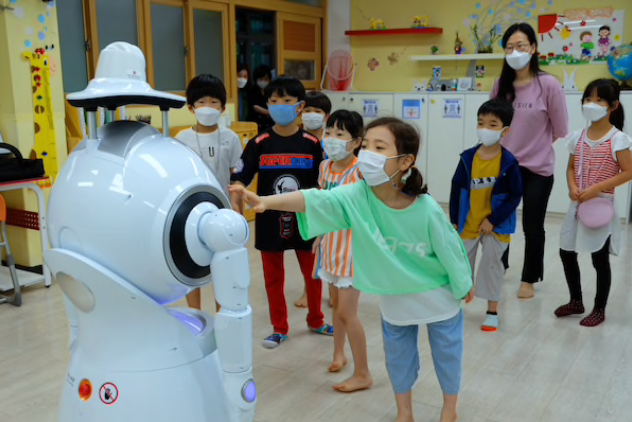
Jul 09. 2020Students practice dance moves with a robot at Wooam Elementary School in Seoul. MUST CREDIT: Washington Post photo by Min Joo Kim
By The Washington Post · Simon Denyer, Akiko Kashiwagi, Min Joo Kim · WORLD, TECHNOLOGY, HEALTH, ASIA-PACIFIC TOKYO -As the coronavirus pandemic rewrites the rules of human interaction, it also has inspired new thinking about how robots and other machines might step in.
The stuff of the bot world – early factory-line automation up to today’s artificial intelligence – has been a growing fact of life for decades. The worldwide health crisis has added urgency to the question of how to bring robotics into the public health equation.
Nowhere is that truer than in Japan, a country with a long fascination with robots, from android assistants to robot receptionists. Since the virus arrived, robots have offered their services as bartenders, security guards and deliverymen.
But they don’t necessarily need to supplant humans, researchers say. They can also bridge the gap between people mindful of social distance – now or when the next major contagion hits.
Want to drop in on your elderly parents but are afraid of passing on a coronavirus infection? Maybe you’re missing your grandchildren, and finding Zoom chats a little limiting?
Ideas are brewing.
– Hugging the bot
The “newme” robot developed by Japanese company Avatarinis basically a tablet computer on a stand, with wheels. The user controls the avatar from a laptop or tablet, and his or her face shows on the avatar’s screen.
“It’s really like teleporting your consciousness,” said founder and CEO Akira Fukabori. “You are really present.”
Already available commercially, Avatarin’s robotshave been used by doctors to interact with patients in a Japanese coronavirus ward; by university students in Tokyo to “attend” a graduation ceremony; and by fans of the Yomiuri Giants baseball team to remotely interview their favorite players after games held in empty stadiums.
There are even avatar robots that have just arrived in the International Space Station.
But it’s the way the robot is already being used by families separated by the coronavirus that really underscores the heart of the technology – starting with the family of the company’s chief operating officer, Kevin Kajitani, whose parents live in Seattle.
“His parents can’t always come and visit their grandson,” Fukabori said. “But they always access the avatar, and can even chase their grandson. And the grandson really hugs the robot.”
Avatarin is part of Japan’s ANA airline group, and the company has joined with the X Prize Foundation to launch a $10 million, four-year contest for companies to create more complex robots that could further develop the avatar concept.
“You need to move,” Fukabori said. “This is really important, because we forget the freedom of this mobility. You can just walk around, and people will talk to you about really, really natural things. That creates human trust. That isn’t as easy in WebEx or Zoom, where if you don’t know each other it’s really hard to keep talking.”
Work is underway on prototypes that allow users to control a remote robot through virtual reality headsets and gloves that allow the wearer to pick up, hold, touch and feel an object with a distant robotic hand, with potential uses ranging from space exploration to disaster relief or elderly care.
But Fukabori said the cheaper, lightweight avatars offer more immediate and affordable uses. What sets this project apart from existing avatar robots, the company says, is the ability for users to access the robots easily from a laptop, by renting them out rather than having to buy them.
Avatarin hopes to install the avatars in more hospitals and in elderly-care centers, shops, museums, zoos and aquariums. The company also aims to have 1,000 in place for next year’s Tokyo Olympics.
– Cleaning patrol
In Tokyo, robotics lab ZMP has been developing three small bots to help compensate for Japan’s shrinking labor force, employing the same technology as self-driving cars.
A delivery robot aims to transport goods ordered online from local warehouses to customers’ doors; a patrol robot, with six cameras, does the job of a security guard; a self-driving wheelchair can be programed to take users to specific destinations. The wheelchair is already available and approved for use on Tokyo streets. The others still await official permission to venture out alone in public.
Now, the patrol robot has been adapted so it can also disinfect surfaces as it patrols, and is attracting interest from Tokyo’s Metro stations as well as other businesses.
In May, Prime Minister Shinzo Abe noted surging demand for unmanned deliveries and pledged to carry out tests to see if delivery robots were safe to use on roads and sidewalks by the end of the year.
Even the self-driving wheelchair can come into its own amid a coronavirus-filled world, the company said, potentially helping elderly people move around more independently without a helper who might be a vector for the virus.
“Before corona, most customers wanted to reduce workers,” said ZMP’s chief executive, Hisashi Taniguchi. “But after corona, our customers changed drastically. Now, they want to accelerate unmanned systems.”
– Bot bartender
Qbit Robotics, also in Tokyo,has programmed a robotic arm and hand to interact with customers and serve them coffee, mix cocktails or even serve a simple cup of instant pasta.
President and chief executive Hiroya Nakano said he aims not to replace human interaction but to supply robots that can communicate and entertain in a “friendly” way.
While robots can sometimes seem disturbing and alien to Westerners, they tend to be seen in a more welcoming light by many Japanese people, Nakano said.
“Until now, expectations have been high for what robots can do in the future, but they haven’t been able to do what humans do,” he said. “But now we are living with the coronavirus, the idea of no contact or automation has become especially important. And I feel there is an extremely high expectation for robots to meet that demand.”
– And one can dance, too
In South Korea, a Chinese-made robot is already greeting children in Seoul’s schools as they reopen.
The Cruzr, with eyes that beam a neon-blue light and a video screen on its chest, takes kids’ temperatures and reminds them to follow anti-virus rules.
“Please wear your mask properly,” the robot told a student last week at Wooam Elementary School whose mask wasn’t covering his nose.
Chinese robotmaker UBTech launched Cruzr in 2017 as a humanoid service robot for businesses, but the pandemic has given it added value as a personal assistant free from infection risks.
It is also being used by medical institutions for mass temperature screening, patient monitoring and medical record keeping, helping overwhelmed medical workers.
In June, Seoul’s Seocho district government deployed Cruzr robots to the district’s 51 public schools, helping reduce the burden on overworked teachers.
Before the robot came to school, teachers had taken kids’ temperatures as they arrived, creating long lines and raising infection risks from human contact. Now, the robot checks the temperature of multiple students as they walk by and immediately sounds an alarm if anyone has a fever.
“At first, students were ill at ease with the robot greeting them at the school gate, but in a matter of weeks, students have embraced it as part of the school community,” said Yoo Jung-ho, head of Wooam’s science department.
At the school, students waved toward the robot at the gate as they walked into the school, and nodded in agreement when it reminded them about the mask rules.
The robot can also provide basic academic help and entertain students by teaching them simple dance moves.
“Of course, robots can’t replace teachers at classrooms yet, but there is significant and rising potential for ‘contactless’ teaching with the pandemic,” Yoo said.
Nine-year-old Lee Hye-rin says she “befriended” the robot after they danced together.
“When I first saw the robot standing in place of our teachers greeting us at the entrance, I found it cold and disorienting,” Lee said. “But this robot is actually the same height as I am and also displays goofy dance moves, and I realized I can befriend him and share a fun time.”
But Lee feels the robot is not so friendly when it orders her to wear her mask properly.
“If I fail to follow the mask rule, my teacher’s warning will be followed with a smile telling me to behave better in the future, but the robot doesn’t smile when it warns me about the mask,” she said.
Amazon will disclose merchant names to discourage rogue sales
Jul 09. 2020
By The Washington Post · Jay Greene · NATIONAL, BUSINESS, TECHNOLOGY SEATTLE – Amazon notified sellers Wednesday they will no longer be able to anonymously hawk goods on its U.S. e-commerce site as of Sept. 1.
While Amazon said it was making the change to “help customers make informed shopping decisions,” the move could also help curb sales of dangerous and counterfeit items that have plagued the site in recent years. It comes just weeks before Amazon chief executive, Jeff Bezos, is scheduled to testify before the House Judiciary antitrust subcommittee along with the CEOs of Facebook, Google and Apple. (Bezos also owns The Washington Post.)
An Amazon spokeswoman did not respond to a request for comment.
The company announced the change in a post on the site where it shares information with the third-party merchants who list products on its site. Those sellers account for the majority of physical merchandise sold on the site, as much as 58 percent in 2018, Bezos wrote in a letter to shareholders last year.
Often the names of third-party sellers on the site are an odd collection of letters that have no relation to the company’s actual name. And many of those sellers choose not to provide details about where they are located.
But sellers do provide that information to Amazon when they establish their business accounts. The company, though, hasn’t previously required the disclosure in the United States, even though it does in Europe, Japan and Mexico.
Amazon didn’t explain the reason for making the change now.
“Amazon doesn’t do random things, just to try to help consumers,” said Juozas Kaziukėnas, chief executive of the e-commerce research firm Marketplace Pulse.
Kaziukėnas said the company may have made the move to get ahead of the upcoming hearing, which promises to be a high-profile spectacle that’s part of lawmakers’ wide-ranging antitrust probe into the tech industry. It also comes as the Trump administration has targeted counterfeit sales from foreign companies, alleging in a 54-page report in January that online marketplaces such as Amazon have become haven for counterfeiters that’s both undermined U.S. firms and hurt consumers.
Amazon has long lamented the scourge of counterfeits, and has said it spends hundreds of millions of dollars a year to police its site for fake goods. Last fall, The Post spent $164 on Amazon to pick up a handful of products that used logos and unique designs from brands such as Hermès, Gucci and Louis Vuitton to determine if they were fake. Each item was counterfeit.
And last year, Federal Trade Commissioner Rohit Chopra raised concerns about whether Amazon committed “widespread deception” by selling thousands of products without any warnings despite federal agencies deeming those goods to be unsafe, deceptively labeled or banning them altogether. Those concerns came after a Wall Street Journal investigation found 4,152 unsafe items listed for sale on Amazon.
Forcing merchants to disclose their business names and addresses could discourage rogue sellers from listing products on the site. Generally, sellers need to prove their identity to Amazon by also providing documentation such as bank statements and utility bills that also include their names and address, Kaziukėnas said.
Amazon has always prioritized having the broadest selection of products as a key advantage over rivals, even if it meant the company couldn’t always control the quality of products available. Disclosing seller identities will likely reduce selection, eliminating accounts from sellers who want to remain anonymous.
“For Amazon to do this is a big deal,” said Rob Dunkel, chief executives of the data-analytics firm 3PM Solutions that works with brands to spot counterfeits online.
The disclosure will likely lead brands, such as luxury bag makers or pricey running shoe firms, to target sellers that aren’t authorized to sell their products through Amazon, said James Thomson, a former senior manager in business development at Amazon and now partner at brand consultancy Buy Box Experts.
Facebook’s own civil rights auditors said its policy decisions are a ‘tremendous setback’
Jul 09. 2020
By The Washington Post · Elizabeth Dwoskin, Cat Zakrzewski · NATIONAL, BUSINESS, TECHNOLOGY, RACE, MEDIA
The civil rights auditors Facebook hired to scrutinize its civil rights record on Wednesday delivered a long-awaited and scathing indictment of the social media giant’s decisions to prioritize free speech above other values, which they called a “tremendous setback” that opened the door for abuse by politicians.
The report criticized Facebook’s choice to leave several posts by President Donald Trump untouched, including three in May that the auditors said “clearly violated” the company’s policies prohibiting voter suppression, hate speech and incitement of violence. The report also found that Facebook provides a forum for white supremacy and white nationalism.
The conclusions by Facebook’s own auditors are likely to bolster criticism that the company has too much power and that it bends and stretches its rules for powerful people. Although Facebook frequently says it listens to experts when making judgment calls, the auditors found that is not always the case on critical matters of free expression.
“When you put free expression on top of every other consideration, I think civil rights considerations take more of a back seat,” said Laura Murphy, a civil rights lawyer and independent consultant who led the two-year audit. Murphy worked with a team from civil rights law firm Relman Colfax, led by partner Megan Cacace.
The report was prompted by years of complaints by civil rights groups that the company foments hatred, stemming back to when the social network was used to organize the 2017 “Unite the Right” march in Charlottesville, Va. Since then, Facebook has become more aggressive about taking down hate groups’ posts, but it has also hardened its stances on protecting free speech, setting up a tension that the auditors said was undermining Facebook’s efforts to improve its service.
Chief executive Mark Zuckerberg’s unwavering position on free expression is isolating Facebook and leaving it at a perilous crossroad months before the U.S. presidential contest. He has been condemned widely for it: by thousands of employees last month who protested the decision to leave up one of Trump’s posts, and now by major advertisers boycotting the social network as part of a campaign known as “Stop Hate For Profit.” Civil rights leaders who met with Zuckerberg on Tuesday to discuss the boycott said the company did not appear to be ready to change. Facebook’s counterparts in Silicon Valley, including Snapchat, Reddit and Twitch, are taking a tougher tack when policing Trump and his most extreme supporters.
The Facebook-commissioned report potentially carries more weight than the other criticisms of Facebook on civil rights because the social network granted the auditors extensive access to its systems and executives, and it encompassed feedback from more than 100 civil rights groups. However, it provides no guarantee that Facebook will make major changes to its policies or practices.
“Being a platform where everyone can make their voice heard is core to our mission, but that doesn’t mean it’s acceptable for people to spread hate. It’s not,” Facebook Chief Operating Officer Sheryl Sandberg wrote in a blog post in response to the report. “We have clear policies against hate – and we strive constantly to get better and faster at enforcing them.”
The report comes on the heels of a meeting Facebook held with the organizers of a fast-growing boycott of more than 1,000 advertisers, who have several demands of Facebook, including hiring a top-level executive who will ensure that the global platform does not fuel racism and radicalization. The timing of the publication of the long-anticipated report led the civil rights groups organizing the boycott to say Facebook was attempting to use it to draw attention away from their demands, which also include ending exceptions for politicians. The organizers called the Tuesday meeting “disappointing.”
Facebook denied that it was trying to deflect attention from the boycott.
On Wednesday the company said it had taken down accounts tied to longtime Trump friend and former campaign adviser Roger Stone after finding that he violated Facebook’s rules by using more than 100 accounts and pages to manipulate public debate.
Facebook’s auditors faulted the social network for making policy decisions that undermine civil rights progress. They said Facebook failed to improve the experience of people of color who use the platform. They also said the company had delayed acting on calls to hire experts in civil rights to senior leadership positions, noting recent decisions over hate speech were made by senior executives who lacked specific civil rights expertise and nuanced understandings of race – and that certain decisions were made against the objections of the auditors.
In the May posts about voting, Trump called use of mail-in ballots in Nevada and Michigan “illegal” and “substantially fraudulent.”
Because mail-in ballots were lawful forms of voter registration in both states, the auditors “vehemently expressed” their views to Facebook that the posts were prohibited by the company’s voter interference policy, which bans false representations about voter registration methods, the report said.
But senior executives at Facebook found that the posts did not break the policies, ignoring the conclusions of the auditors, their own voting rights consultant, and the broader civil rights community, the report noted. Instead, the company’s executives interpreted the posts to mean Trump was accusing state officials of acting illegally, which it considers to be permissible criticism. That “constrained reading” of its own rules “was both astounding and deeply troubling,” the auditors said, “hurtling [Facebook] down a slippery slope” in which basic facts about how to vote can be freely misrepresented.
“With only months left before a major election, this is deeply troublesome as misinformation, sowing racial division and calls for violence near elections can do great damage to our democracy,” the auditors wrote.
The auditors also challenged Facebook’s decision to let stand another May post by Trump in which he said, “when the looting starts, the shooting starts,” invoking a civil rights era reference to describe the military potentially entering the protests in Minnesota.
Civil rights advocates believe the comment about shooting people for stealing or looting appeared to encourage law enforcement to commit unlawful capital punishment against protesters. The choice to leave the post up led to an employee uprising and helped fuel the boycott.
Twitter chose to add fact-checking and warning labels to the same messages.
Facebook has made some concessions, including copying Twitter by developing fact-checking labels of its own. The auditors praised the concessions but said they did not go far enough.
Civil rights groups began reaching out to Facebook in 2015, when self-proclaimed white nationalists were attacking black activists on the platform, said Jade Magnus Ogunnaike, deputy senior campaign director at Color of Change, one of the groups behind the ad boycott. Then, in 2017, far-right extremists created an event page on Facebook to promote the Unite the Right march in Charlottesville, where a white supremacist drove his car into protesters, killing one.
Under pressure from civil rights groups, Facebook banned terms such as “white nationalism” and took down various accounts of far-right leaders. But extremist activity has morphed, and civil rights activists have said Facebook has been slow to react. For example, a violent far-right movement known as the boogaloo flourished on Facebook this year, despite numerous requests from civil rights advocates to remove the groups. Facebook banned these groups last week.
The auditors also noted that Facebook’s decision to leave Trump’s “looting” post up has already encouraged copycat calls for violence, including political and merchandise ads that “looters” and “ANTIFA terrorists” can or should be shot by armed citizens. Facebook removed the ads, which had received more than 200,000 clicks.
Civil rights leaders said the release of the report is by no means an “end game” in their efforts to change the social network. Vanita Gupta, president and chief executive of the Leadership Conference on Civil and Human Rights, said that work is increasingly critical in light of the intense polarization sweeping the country amid the pandemic and widespread protests against racism.
“There is so much at stake in this moment for the platform to get it right, for our democracy and for our communities,” she said. “The work is going to continue. We’re going to continue to press, to push to make these changes even after the final report comes out.”
It remains to be seen what changes Facebook will make in light of the report. The audit noted that Facebook had made progress by creating policies against interfering in the voting process and in the census, and had made historic legal settlements over discrimination in its ad targeting systems as well as with content moderators who suffer psychological harms from the work. The auditors also praised Facebook’s decision to create a target of increasing the number of black executives by 30% over the next five years, and to create a team to uncover algorithmic bias.
But the report said Facebook has a long way to go to incorporate civil rights, including changing its approach so the harms from speech are as valued as free speech, creating an extensive civil rights infrastructure of executives and managers within the company, and investing more resources in areas of bias and discrimination in its products and policies. The auditors also asked a for commitment from Facebook to explore how the platform foments white supremacy in a manner that goes beyond merely banning the terms “white separatism” and “white nationalism.” Finally, it called on Facebook to interpret its voter suppression policies more strongly, noting the recent exceptions for Trump.
Murphy said she hopes Facebook will adopt some of the audit’s recommendations, but she noted that it will take continued advocacy and pressure to ensure that it happens.
“I just can’t predict which issues are going to make it across the finish line,” she said.
Zuckerberg has frequently said Facebook should not be in the position to make many of the most complex judgment calls over free speech issues, and has called for a governmental regulatory body to set universal standards. The company is funding an independent external oversight board, which will be able to make decisions about whether content should be removed from Facebook and play a key role in setting precedent about content policy at Facebook. The board is expected to begin its work this summer.
Thammasat student creates app that can help speed up probe into shooting cases
Jul 08. 2020Dr Charturong Tantibundhit
By The Nation
A student from Thammasat School of Engineering (TSE) has come up with an innovative application that can speed up forensic analysis of cartridge casings in shooting incidents, providing an accurate analysis in 62 seconds compared to the month-long process currently used.
Asst Prof Dr Charturong Tantibundhit revealed that his student had researched and developed the innovation “Check the bullet with AI”. He said it was the world’s first application that could inspect the bullet at the actual location of the gun and display accurate analysis in 62 seconds using artificial intelligence (AI) technology. The investigation process currently takes about 30 days, involving instruments and experts.
The application introduces the use of AI to help in data processing and analysis, Charturong said.
In the inspection procedure, the cartridge case is taken from the incident then put into tools with motors that are controlled by a hardware system, and a smartphone is used to take pictures of the de the bullet for the AI before opening the tool. The motor of the tool will operate at 360 degrees rotation to capture panoramic images within 62 seconds. The system then analyses and displays the results about the shots that were fired and the brand of gun used.
The research tested samples of 898 ammunition from guns of eight brands. The research received cooperation from the PhD Faculty of Science of Chulalongkorn University, National Police, and the Institute of Forensic Science. Accuracy of results were as high as 91-98 per cent depending on the gun brand, Charturong said.
However, the app “Check bullet with AI” is still being trialled, which must be used in parallel with the analysis of the original results to achieve the highest accuracy.
Thailand has a relatively high gun crime rate, averaging 30,000 to 40,000 cases per year.

 President Trump



 Students practice dance moves with a robot at Wooam Elementary School in Seoul. MUST CREDIT: Washington Post photo by Min Joo Kim

 Dr Charturong Tantibundhit
.jpg)

