SpaceX rocket booster misses its landing #ศาสตร์เกษตรดินปุ๋ย

#ศาสตร์เกษตรดินปุ๋ย : ขอบคุณแหล่งข้อมูล : หนังสือพิมพ์ The Nation

https://www.nationthailand.com/edandtech/30382300?utm_source=category&utm_medium=internal_referral

SpaceX rocket booster misses its landing

Feb 17. 2020
By The Washington Post · Christian Davenport · NATIONAL, SCIENCE-ENVIRONMENT

A rocket booster that SpaceX hoped would make its 50th successful landing after launch on Monday missed the autonomous ship in the Atlantic Ocean where it was supposed to come down, the company said during an internet broadcast.

For decades, rocket boosters had been ditched into the ocean after propelling their payloads to orbit. But SpaceX has sought to change that dynamic by developing a rocket that could not only blast off to space, but then autonomously reorient itself and fly back to Earth, touching down with pinpoint precision.

Monday’s launch went off smoothly, the company said, and its booster fell back through the atmosphere, slowing itself down by refiring its engine. But a camera on board the floating platform, known as an autonomous spaceport droneship, showed that the booster did not touch down.

“We clearly did not make the landing this time,” Lauren Lyons, a SpaceX engineer, said during the live broadcast. SpaceX had successfully landed its booster 49 times previously.

The launch from Cape Canaveral delivered 60 satellites that the company hopes will become part of a constellation of thousands in low Earth orbit that are intended to beam the Internet to remote corners of the world not served by broadband. The satellites deployed as expected, the company said.

With Monday’s launch, SpaceX has now launched 300 small satellites that are part of what it calls its Starlink constellation, as the company hopes to transform itself into an Internet service provider. Companies such as OneWeb and Amazon also plan to launch constellations of their own, raising fears about possible collisions in space as Earth orbit becomes crowded with many new spacecraft. (Amazon CEO Jeff Bezos own The Washington Post.)

Monday’s launch at 10:05 a.m. was the fourth flight of the booster in the past year. It was not immediately clear why the landing did not go as planned.

China’s startups on the ropes after virus freezes funding #ศาสตร์เกษตรดินปุ๋ย

#ศาสตร์เกษตรดินปุ๋ย : ขอบคุณแหล่งข้อมูล : หนังสือพิมพ์ The Nation

https://www.nationthailand.com/edandtech/30382211?utm_source=category&utm_medium=internal_referral

China’s startups on the ropes after virus freezes funding

Feb 15. 2020
By Syndication Washington Post, Bloomberg · Lulu Yilun Chen

China’s highest-flying technology startups are struggling to stay afloat after the coronavirus outbreak threatened to paralyze critical venture capital funding.

Investment in an industry that runs on face-to-face contact and gut instinct has fallen off a cliff since the epidemic erupted in January. Venture capital funds slashed startup investment by 60% in January from a year ago, London-based consultancy Preqin estimates. That’s because angel investors and venture capitalists accustomed to road-testing new technology or grilling entrepreneurs in person now shun interaction and work from home.

China’s tech industry — which prides itself on honing online communications from social media to mobile payments — is thus ironically stumbling thanks to the lack of the most basic forms of human contact. If the situation persists — and there are few signs that stringent nationwide quarantine measures will unwind soon — that jeopardizes a swath of the millions of startups that collectively represent an important growth driver for the world’s second largest economy. It’s a double-whammy for an industry that in 2019 grappled with volatile capital, a slowing economy and U.S.-Chinese tensions.

“As an entrepreneur who went through SARS in 2003, I fully understand the challenges entrepreneurs face,” Neil Shen, the founding partner of Sequoia Capital China, said in a statement. “We will fully stand by to provide help and support to the companies we backed in any way possible,” said Shen, regarded by many as one of the country’s most prominent tech investors.

A backlash against China’s tech champions in 2019 had begun damping a decade or more of go-go optimism and investment that fueled one of the fastest and largest creations of wealth the world has seen. Trade curbs imposed by Washington soured investor interest, suppressing deal flow. On a global stage, WeWork’s implosion fanned caution around potentially overblown tech valuations. The euphoria that created more than 100 unicorns, or billion-dollar firms, in China dissipated toward the end of last year.

The outbreak was the last thing China’s tech sector needed.

“This hasn’t been the start to the year of the rat that China was hoping for,” said Ee Fai Kam, head of Preqin Asian operations, adding that the setback is “coming on the back of a bruising 2019 when trade and tech tensions with the U.S. caused investors to exercise an abundance of caution.”

Following the Lunar New Year break, some of the country’s most prolific investors – including those at Matrix Capital and Genesis Capital — confined themselves to home, calling off meetings and mothballing visits to companies. “A lot of our projects require on-site due diligence and we are wary to push forward deals without it,” explained Snow Hua, a managing partner at Cherubic Ventures.

Others are trying to engage and mitigate the damage to their existing portfolio companies through virtual conference calls. Sequoia China is planning to organize two investment sessions for early-stage startups via the conferencing service Zoom. As of Wednesday, investors from more than 50 venture capital houses had signed up.

At the same time, red-hot sectors from artificial intelligence to ride-hailing and online property are reeling. On Thursday, China’s largest company by market value, Alibaba Group Holding, warned of a significant hit to revenue growth in the March quarter from an epidemic that’s wreaking havoc across broad swathes of the Chinese economy. Didi’s daily active users fell 54.1% on Jan. 27 compared with Jan. 16, before the Lunar New Year break, according to data compiled by Aurora Mobile.

Even those benefiting from a short-term spike in orders — such as online grocery delivery firms — are wary of longer-term fallout. 58 Home, the maid and home-maintenance service owned by a Chinese Craigslist equivalent, is said to have delayed its planned U.S. initial public offering after the coronavirus outbreak crippled customer demand. Others such as Uber-backed Didi Chuxing or rental startup Danke may begin to suffer as the capital winter drags on.

“It’s going to be a tremendous challenge for a lot of startups,” said Wang Jun, chief financial officer for fresh produce delivery firm Missfresh. “It’s winter time for capital flow, and companies need to produce blood on their own to become cash-positive.”

Pentagon drops opposition to new rules that would further restrict tech sales to Huawei #ศาสตร์เกษตรดินปุ๋ย

#ศาสตร์เกษตรดินปุ๋ย : ขอบคุณแหล่งข้อมูล : หนังสือพิมพ์ The Nation

https://www.nationthailand.com/edandtech/30382179?utm_source=category&utm_medium=internal_referral

Pentagon drops opposition to new rules that would further restrict tech sales to Huawei

Feb 15. 2020
By The Washington Post · Ellen Nakashima, Jeanne Whalen, David J. Lynch

WASHINGTON – The Pentagon has dropped its objections to a Commerce Department proposal to further restrict U.S. technology sales to Chinese telecom giant Huawei, raising the odds that the proposals will advance, according to people familiar with the matter.

The Department of Defense had previously opposed Commerce’s recommendation, saying it would ultimately hurt U.S. semiconductor companies, which the Pentagon relies on to help produce cutting-edge military tech.

Huawei 5G tie-up will not disrupt intelligence-sharing, U.S. officials say

But after pressure from Commerce officials and members of Congress, the Pentagon has reversed course, according to the people familiar with the government discussions, who requested anonymity to discuss confidential matters.

The proposal is expected to be discussed again at a Feb. 28 cabinet-level meeting.

“DoD supports a collaborative interagency process that allows the facts and concerns of all parties to be heard before adopting potential major regulatory changes,” said Sue Gough, a Pentagon spokesperson. “We will have nothing to provide until that process has concluded and a decision on this issue has been made.”

One person familiar with the discussions said the Treasury Department still has some objections to Commerce’s proposals. Treasury officials didn’t immediately respond to a request for comment.

The Trump administration has spent months attempting to block Huawei’s growth as a large seller of telecom network equipment and cell phones. The White House calls Huawei a security risk, saying China’s ruling Communist Party could tap Huawei equipment installed overseas to spy on the West – allegations Huawei denies.

Frustrated that U.S. actions don’t seem to have derailed Huawei’s business, the Commerce Department recently proposed tightening the crackdown on the Chinese company.

Last year, the U.S. added Huawei to a trade blacklist, which banned exports from the U.S. to the Chinese company. Some companies skirted that rule by exporting chips and other components to Huawei from their overseas facilities.

The Commerce Department now wants to close that loophole by tightening regulations on the overseas shipments. Currently, foreign-made components may be sold to Huawei if they contain up to 25 percent American content that is governed by export controls. Commerce wants to lower that limit to 10 percent.

The Pentagon and semiconductor industry last month objected to Commerce’s idea, saying it would further deprive U.S. tech companies of sales and undermine their research and development.

Huawei has been a large buyer of U.S. components for years, saying it spent $11 billion on U.S. technology in 2018, before the export ban. Since the ban, Huawei says it has shifted some of its component buying to companies in other countries and has scrambled to produce more of its own chips and other parts.

Some in the tech industry fear the ban will cause a wide swathe of Chinese buyers to shift purchases away from U.S. chip makers, which have traditionally dominated the industry, claiming about half the global market.

The Trump administration “may not like the fact that China is more than a third of American chip revenue, but there’s no alternative to it and without it we simply will not be competitive,” said one semiconductor-industry executive who opposes the Commerce proposal.

“We continue to urge the administration to not pursue counterproductive policies that ultimately do nothing but harm U.S. semiconductor leadership, which is critical to national security and the broader economy,” John Neuffer, chief executive of the Semiconductor Industry Association, said Friday.

After the Pentagon objected, the Commerce Department’s director of policy, Earl Comstock, urged Pentagon officials including Under Secretary for Policy John Rood to change their minds, one person familiar with the deliberations said.

Three Republican senators and China hawks also wrote to Secretary of Defense Mark Esper asking for an explanation on the Pentagon’s reported objections.

“Huawei is an arm of the Chinese Communist Party and should be treated as such,” Sens. Ben Sasse of Nebraska, Tom Cotton of Arkansas and Marco Rubio of Florida wrote in their Jan. 24 letter.

On Friday, Senator Rick Scott, R-Fla., proposed legislation that mirrors the Commerce proposal, cutting to 10 percent the amount of American content a foreign-made product may contain if it is to be sold to a blacklisted company.

“Companies in the United States should not be allowed to sell to Huawei, and my legislation will further restrict their ability,” the senator said in a statement.

Criminal prosecutors to drop trade secret charges against former Fitbit employees #ศาสตร์เกษตรดินปุ๋ย

#ศาสตร์เกษตรดินปุ๋ย : ขอบคุณแหล่งข้อมูล : หนังสือพิมพ์ The Nation

https://www.nationthailand.com/edandtech/30382178?utm_source=category&utm_medium=internal_referral

Criminal prosecutors to drop trade secret charges against former Fitbit employees

Feb 15. 2020
By The Washington Post · Reed Albergotti 

SAN FRANCISCO – Prosecutors in Northern California plan to drop charges against several former FitBit employees accused of receiving stolen trade secrets from their former employer, according to a person familiar with the matter, raising new questions about how fiercely law enforcement will continue to prosecute tech industry employees for alleged theft of trade secrets.

Prosecutors charged six former Jawbone employees nearly two years ago for allegedly absconding with confidential documents when they left the company for rival Fitbit. Jawbone, which had sued Fitbit over the allegations, has since filed for bankruptcy and ceased operations. Fitbit agreed to be acquired by search engine giant Google in November for $2.1 billion.

Jawbone launched its first fitness bracelet in 2011, while rival Fitbit came out with its first version in 2013. The two companies’ products competed head-to-head, but Fitbit was able to win a larger share of the market, parlaying the success into a successful initial public offering in 2015. Jawbone accused Fitbit that same year of stealing its intellectual property and violating its patents, charges Fitbit vehemently denied. Jawbone filed for bankruptcy in 2017 and the case settled.

Federal prosecutors brought criminal charges against the former Jawbone employees the following year. The evidence against the employees centered around Jawbone company documents that had been housed on their personal computers.

Last week, a federal jury acquitted Katherine Mogal, one of the six former Jawbone employees charged in the trade secrets cases, handing prosecutors a rare and resounding defeat. Prosecutors also quietly dropped charges against one other employee charged in the prosecutions.

The case has some similarities to the prosecution of Anthony Levandowski, the former Google employee who left the company to start an autonomous trucking company called Otto. When Otto was acquired by Uber, Levandowski’s former employer sued the ride hailing company for alleged theft of trade secrets. That lawsuit settled out of court in February 2018. But prosecutors in the Northern district brought criminal charges against Levandowski in August of last year, accusing him of taking confidential information from Google. If the case goes to trial, he could face ten years in prison.

Cases brought against employees like Aleynikov and Levandowski have been controversial, in part because the nature of the modern workplace often necessitates the transfer of company information to personal computing devices like iPads and home computers during the normal course of work. When an employee leaves, it’s difficult to determine whether that employee purposely stole information or simply possessed it.

Google allowed Levandowski, for instance, to work on a personal start-up while also working on Google’s top-secret self-driving car division.

Silicon Valley has a rich tradition of employees leaving large companies to start smaller ones, often in competition with their former employers. That tradition goes back at least as far as the 1950s, when the “traitorous eight” left Shockley Semiconductor to form Fairchild Semiconductor, fueling an explosion of innovation and new companies, such as Intel and Advanced Micro Devices.

California law prohibits the enforcement of “non compete” clauses in employment contracts. In other states, those clauses prevent employees from leaving and creating start-ups. While the inability to enforce non competes is at times an annoyance to large employers in California, the law has helped spur growth in the innovation economy.

The former Fitbit employees and Levandowski were charged under the Economic Espionage Act, passed by Congress in 1996 in part to combat state-sponsored industrial espionage. While the law has been used to help curb countries like China from stealing secrets from U.S. companies, it has also been used to punish employees who leave one U.S. company for another, allegedly taking proprietary information with them.

One of the most famous cases was the prosecution of Sergey Aleynikov, a Goldman Sachs employee sentenced in 2011 to eight years in federal prison for taking computer code to a high frequency trading start-up. Aleynikov’s conviction was overturned on appeal.

Huawei 5G tie-up will not disrupt intelligence-sharing, U.S. officials say #ศาสตร์เกษตรดินปุ๋ย

#ศาสตร์เกษตรดินปุ๋ย : ขอบคุณแหล่งข้อมูล : หนังสือพิมพ์ The Nation

https://www.nationthailand.com/edandtech/30382174?utm_source=category&utm_medium=internal_referral

Huawei 5G tie-up will not disrupt intelligence-sharing, U.S. officials say

Feb 15. 2020
File Photo/Syndication Washington Post, Bloomberg

File Photo/Syndication Washington Post, Bloomberg
By The Washington Post · Loveday Morris, Michael Birnbaum, Ellen Nakashima 

MUNICH – Britain’s decision to allow Huawei into its 5G network will not disrupt overall intelligence-sharing with the United States, U.S. officials said Friday, in comments that may allay European concerns over reprisals.

The United States has been lobbying European nations to exclude Huawei from helping to build their next generation of wireless networks, but it has faced an uphill battle, with the United Kingdom announcing last month that it will allow the firm to play a role. Washington would still have to take a “hard look” at the impact said Robert Blair, a senior adviser to President Donald Trump, but the flow of intelligence would not be affected.

“There will be no erosion in our overall intelligence-sharing,” he said.

The comments appeared at odds from those from other officials in the administration, coming a day after Richard Grenell, Trump’s ambassador to Germany, reasserted that a German decision to allow 5G into their network would mean Washington would not be able to share intelligence at the same level.

The United States see Huawei’s 5G participation as a fundamental security threat, but its efforts to bring Europe into line with its thinking come amid particularly thorny transatlantic relations. European countries that might once have been willing to extend some goodwill toward following U.S. requests are becoming increasingly obstreperous, frustrated by what leaders see as Trump’s go-it-alone approach.

Some European politicians discount the U.S. warnings about Huawei, saying that they are simply part of Trump’s broader trade war with Russia. Or they say that everyone spies, and that the United States is little different from China.

On Friday, it was clear that German leaders were deeply mistrustful of Trump’s approach to global affairs, as one after another stepped to the podium at an influential security-focused conference in Munich to say that world affairs were slipping back to a might-makes-right era.

“We are witnessing an increasingly destructive dynamic in international politics,” Germany’s ceremonial president Frank-Walter Steinmeier said. “Year by year we are moving further way from the goal: international cooperation in order to create a more peaceful world.”

The topic of 5G factored high in discussions on Friday. Europe, by increments, has adopted a more skeptical stance toward using Huawei equipment for its 5G networks. The European Commission last month announced a sophisticated set of guidelines that its 27-member nations can use to decide whether to invest in Chinese equipment.

Although the E.U. “tool kit” is nonbinding, the guidelines, if followed, would have the likely effect of pushing China out of the 5G market. It could give countries the political cover to push back against Beijing – and it could create pressure for countries that do choose Huawei to explain their reasoning.

Germany is yet to announce its official position, but Chancellor Angela Merkel’s Christian Democratic Union published a position that stopped short of a total ban but was still more cautious toward the Chinese manufacturer than British policymakers. It was a shift toward skepticism of Beijing following a sharp, months-long debate among lawmakers in the party.

To add weight to its case the United States is also trying to present other countries with alternatives to Huawei by ramping up cooperation with other companies in the private sector including Samsung, Ericsson and Nokia, Blair said. He described such moves as part of a new initiative “try to put together innovators, disrupters, big data, big tech, to chart out the next generation of 5G.”

He said the exact shape of the cooperation with the private sector was still being discussed but would take place in a matter of “months” rather than “years.”

“At this point it’s political, what can everybody bring to the table?,” he said. “It’s past notional, it’s not down to the nitty-gritty.”

There have been conflicting signals from the Trump administration over its strategy to foster competition with Huawei. Last week, Attorney General William Barr suggested the United States invest in Nokia and Ericsson to buoy their market prospects. The following day, however, Vice President Mike Pence dismissed the suggestion.

The four major U.S. wireless carriers – AT&T, Verizon, Sprint and T-Mobile – have all pledged not to use Huawei in their 5G networks, and the Chinese firm is basically shut out of the American market, except for some small regional carriers. The major carriers have been using Nokia, Ericsson and the South Korean firm Samsung for their mobile networks.

Eric Sayers, a vice president at Beacon Global Strategies consulting firm, said Congress has been exploring options to develop private-sector alternatives for the past year. For instance, a recent bipartisan bill would encourage support for U.S. innovation in 5G with $1 billion to fund western alternatives to Huawei. “This is messaging legislation and a strong signal of the bipartisan support for investing federal dollars in the 5G race,” he said, adding, however, that action on the bill this year is unlikely.

“[The U.S. government working with companies] continues to be an idea, but I have no evidence to say that we’ve come any closer to an actual plan,” Sayers said.

Speaking at the Munich Security Conference on Friday, House Speaker Nancy Pelosi (D-Calif.) also weighed in on the issue of 5G. Choosing Huawei would be choosing “autocracy over democracy” she said, adding that there was bipartisan agreement on the threat it poses.

The remarks come in the wake of Justice Department announcement Thursday that it had indicted Huawei, four subsidiaries and its chief financial officer, Meng Wanzhou, on charges of racketeering and conspiracy to steal trade secrets. The U.S. attorney for the Eastern District of New York accused the company of a decades-long effort to steal intellectual property from six American companies, including by offering bonuses to employees for obtaining confidential information.

The charges come in addition to those brought last year against the defendants for bank fraud, wire fraud and violations of Iran sanctions. Huawei has denied all the charges.

Google’s Waze deal is a likely target in new FTC antitrust sweep #ศาสตร์เกษตรดินปุ๋ย

#ศาสตร์เกษตรดินปุ๋ย : ขอบคุณแหล่งข้อมูล : หนังสือพิมพ์ The Nation

https://www.nationthailand.com/edandtech/30382168?utm_source=category&utm_medium=internal_referral

Google’s Waze deal is a likely target in new FTC antitrust sweep

Feb 15. 2020
The Google logo at the World Economic Forum (WEF) in Davos, Switzerland, on Jan. 19, 2020. MUST CREDIT: Bloomberg photo by Simon Dawson.

The Google logo at the World Economic Forum (WEF) in Davos, Switzerland, on Jan. 19, 2020. MUST CREDIT: Bloomberg photo by Simon Dawson.
By Syndication Washington Post,  Bloomberg · Mark Bergen, Ben Brody 

The Federal Trade Commission just ordered major technology companies to fork over details on waves of small acquisitions made during the last decade. A more sizable deal is also seen as a target for the regulator: Google’s $1.1 billion purchase of mapping app Waze.

The FTC quickly approved the 2013 transaction, but antitrust experts say the regulator will take a second look because it combined two popular digital mapping services under the same corporate roof, eliminated a fast-growing Google rival and solidified the internet giant’s grip on valuable data.

Bilal Sayyed, the FTC’s director for the Office of Policy Planning, told reporters on Tuesday that the agency is planning to examine many deals that were reviewed in the past, while declining to share specific examples.

“Certainly, Waze is one of them,” said Robert Litan, a partner at Korein Tillery and former Justice Department antitrust official. Google declined to comment.

Google has acquired dozens of startups over the years to add technical talent, fill product holes, gather new users and accumulate more data. Few of these transactions rang traditional antitrust alarm bells, but in aggregate they helped the company build the western world’s largest online search, digital mapping and advertising businesses. Global watchdogs are now investigating whether this dominance is harming business customers and consumers. Reassessing past acquisitions is part of this effort, and the Waze deal is a clear candidate.

“It was literally Google acquiring its number one competitor in maps,” said Sally Hubbard, director of enforcement strategy at the Open Markets Institute, which is pushing for a crackdown on big internet platforms. “It was a bad deal that should have been blocked.”

Back in 2013, the acquisition was a strategic coup. Google faced two existential threats at the time: social media and smartphones. Social networks, like Facebook, were stealing eyeballs and advertising, while mobile apps risked displacing key Google services, including its digital maps, that were mainly used on desktop computers. Waze was riding both trends. The startup’s mobile app drew in dedicated fans who posted frequent updates on traffic and interacted with one another, generating social and location-related data in new ways that Google couldn’t match.

When Google announced the deal, Mark Mahaney, an analyst at RBC Capital Markets, said the “move eliminates Waze as a potential acquisition target for competitors who could use the app’s collection of data and 50 million users to bolster their own location-based products.”

Antitrust regulators in the U.K. launched a more in-depth investigation of the deal, asking Google to keep Waze separate from the rest of its businesses while conducting the probe. The final report from the Office of Fair Trading, published in December 2013, cited concerns from other companies that Google was knocking out a threat to its mapping service. One complainant said “the acquisition removed Google’s closest competitor.”

Trustbusters didn’t have to rely on rivals. Waze Chief Executive Officer Noam Bardin offered the same assessment two months before joining Google. “We’re the only reasonable competition to [Google] in this market of creating maps that are really geared for mobile, for real-time, for consumers — for the new world that we’re moving into,” he said at an industry conference.

In late 2012, Apple Chief Executive Officer Tim Cook suggested his customers should use map apps, including Waze, sparking a surge of downloads.

By 2013, the Israeli startup was close to a deal to pre-install its app on devices made by an unnamed smartphone company, according to the U.K. investigation. There was also the potential to work with Facebook to enable people to chat and meet up with friends driving to the same location, which could have given Waze more users, the report said. Google’s acquisition abruptly halted those initiatives.

The regulator concluded that the deal would not damage competition in the U.K., citing Apple’s Maps app as a rival. But last year, it asked economists to evaluate some of its past decisions, including the Waze ruling. That study found that the U.K. agency didn’t consider how Google and Waze would make money from their maps — even though this was already relevant when the deal happened.

“The merger with Waze might have made Google an even more relevant provider of location data, reinforcing its competitive position for the provision of online advertising across all its services,” according the study from consulting firm Lear.

European regulators have since targeted the data that big internet companies collect as a competition issue. If the FTC takes a similar approach, the agency could probe how much of Waze’s driving data feeds back into Google’s ads business. “These free map apps are just data-suction tools,” Hubbard said. “Regulators are starting to figure it out.”

Google has kept Waze a separate service, but the internet giant has used data from the app to improve its ads, according to RBC’s Mahaney. “New ad formats in Google Maps have clear similarities to existing formats in Waze (coincidence?),” the analysts wrote in a September note to investors. “Google has now collected enough data through Waze to effectively roll out broader solutions for advertisers in Google Maps and provide them attractive returns on investment without severely impacting the user experience.”

Fiona Scott Morton, a Yale University economist and former Justice Department antitrust official, said Waze may be of particular interest to the FTC because location data makes Google’s dominant Search advertising much more potent. “Another party that wanted to be good at search advertising would need a good map,” she added.

On Tuesday, the FTC demanded internal documents from Google, Facebook, Apple, Amazon.com Inc. and Microsoft Corp. to see if they “are making potentially anticompetitive acquisitions of nascent or potential competitors.”

The regulator is eyeing deals that weren’t reported under the Hart-Scott-Rodino (HSR) Act, which requires companies to tell enforcement agencies about acquisitions of a certain size. While Google declared plans to buy Waze, it never filed the purchase under HSR, likely relying on an exemption related to the startup’s lack of U.S. revenue at the time.

The FTC can investigate deals even when there’s no HSR filing. The agency also has the power to probe acquisitions that it cleared in the past. In some ways, the recent attention on the tech sector in Washington and Europe is an attempt to revisit the earlier laissez-faire approach to industry consolidation.

“They weren’t examined carefully by the agencies,” said Scott Morton. “Now that they understand that these companies have acquired market power, they’re interested in finding out how that happened.”

Sony is struggling with PlayStation 5 price due to costly parts #ศาสตร์เกษตรดินปุ๋ย

#ศาสตร์เกษตรดินปุ๋ย : ขอบคุณแหล่งข้อมูล : หนังสือพิมพ์ The Nation

https://www.nationthailand.com/edandtech/30382160?utm_source=category&utm_medium=internal_referral

Sony is struggling with PlayStation 5 price due to costly parts

Feb 15. 2020
Attendees use Sony Corp. PlayStation 4 (PS4) game consoles at the Tokyo Game Show 2019 in Chiba, Japan, on Sept. 12, 2019. MUST CREDIT: Bloomberg photo by Kiyoshi Ota.

Attendees use Sony Corp. PlayStation 4 (PS4) game consoles at the Tokyo Game Show 2019 in Chiba, Japan, on Sept. 12, 2019. MUST CREDIT: Bloomberg photo by Kiyoshi Ota.
By Syndication Washington Post, Bloomberg · Takashi Mochizuki 

Scarce components have pushed the manufacturing costs for Sony’s next PlayStation to around $450 per unit, forcing a difficult price-setting decision in its battle with Microsoft Corp., according to people with knowledge of the matter.

The Japanese conglomerate is preparing to gradually replace the six-year-old PS4 console, releasing its PlayStation 5 the same holiday season its archrival debuts the upcoming Xbox Series X. Sony typically finalizes a console’s price in February of the release year, followed by mass production in the spring. With the PS5, the company is taking a wait-and-see approach, said the people, asking not to be named because the details are private.

The PS4, released in 2013 at a retail price of $399, was estimated by IHS Markit to cost $381 to manufacture. With the $450 unit cost and a similar gross margin, the PlayStation 5’s retail price would have to be at least $470. That would be a hard sell to consumers, considering Sony’s most expensive machine now is the $399.99 PS4 Pro and is often discounted, according to Macquarie Capital analyst Damian Thong.

“Consumers will benchmark their expectations based on the PS4 Pro and PS4,” Thong said. “If Sony prices above that, it would likely be to balance a need to offset higher materials cost, against risk to demand.”

Sony declined to comment.

The company’s biggest headache is ensuring a reliable supply of DRAM and NAND flash memory, with both in high demand as smartphone makers gear up for fifth-generation devices, according to people familiar with Sony’s operations. Samsung Electronics just announced its Galaxy S20 product range, each variant of which will have 5G and a minimum of 12GB of RAM in the U.S.

Videogame companies often sell hardware at thin margins or even at a loss because they profit from lucrative game software and recurring online subscription services. Sony’s Chief Executive Officer Kenichiro Yoshida has said the business should be judged by the number of active users, not the number of hardware units sold. Some Sony games staff think it should sell the new console at a loss if necessary to match Microsoft’s price, while other Sony executives would prefer to make money as the company did with the PS4.

“We must keep PlayStation 5’s bill of materials under our control and we need to make the correct number of units in the initial production,” Sony’s Chief Financial Officer Hiroki Totoki said at an earnings briefing earlier this month.

Most of the components for the console have been locked down, the people said, including the cooling system, which is unusually expensive at a few dollars per unit. Typically, companies would spend less than a dollar, but Sony opted to lavish more on making sure heat dissipation from the powerful chips housed inside the console isn’t an issue.

The ongoing coronavirus outbreak has had no impact so far on preparations for PlayStation 5 production, they said. The company has yet to decided how many PlayStation 5 units it will make in the first year, they added.

Separately, Sony plans to release a new version of the PlayStation VR virtual-reality headset, tentatively scheduled after the PlayStation 5 goes on sale, the people said.

Sony has already canceled some previously planned features for a new mirrorless camera due this year owing to the constrained DRAM supply, several people with knowledge of the matter said.

Sony executives are voicing patience about the next console’s pricing as they anticipate the transition to be a gradual one, said people familiar with its day-to-day operations. Many of the games launched for the PlayStation 5 will also be available to play on the predecessor machine, so revenue from software and related network services is expected to keep the business performance intact. Microsoft and Sony are both expanding their respective online subscription services, revenue from which may allow them greater flexibility on hardware pricing.

People within the PlayStation business unit said a key factor in deciding the ultimate PlayStation 5 retail price will be where Microsoft sets its price for the next-generation Xbox Series X. Microsoft is widely expected to hold that information back until the E3 gaming expo in Los Angeles in June.

There is pressure from CFO Totoki for Sony to provide more transparency and information in the buildup to the PS5’s release, which has caused some consternation internally. Asked about when he expects Sony to provide guidance on the gaming business outlook for the new fiscal year, Totoki said the plan is no different from the recent past, meaning the guidance can be expected around the end of April.

If the company takes longer than usual, analysts may look to its next investor relations meeting to glean hints about the new console’s retail price. The company held that meeting in late May last year.

Facebook, Google ‘profit from doing customers harm,’ says Epic Games CEO Tim Sweeney #ศาสตร์เกษตรดินปุ๋ย

#ศาสตร์เกษตรดินปุ๋ย : ขอบคุณแหล่งข้อมูล : หนังสือพิมพ์ The Nation

https://www.nationthailand.com/edandtech/30382056?utm_source=category&utm_medium=internal_referral

Facebook, Google ‘profit from doing customers harm,’ says Epic Games CEO Tim Sweeney

Feb 13. 2020
By The Washington Post · Gene Park

LAS VEGAS – The platform wars need to end, and players must be able to connect with each other easier, said Epic Games CEO and founder Tim Sweeney. Otherwise, the 20s of the 21st century would be a “lost decade.”

Sweeney gave the keynote at the DICE Summit Wednesday, a talk that was pitched as a discussion of the future of the games industry. He took the opportunity to air his concerns about closed platforms – not just in gaming, but across the Internet.

“It’s a mind virus, this idea that publishers should ‘own’ the customer or have a monopoly on the customer relationship through some form of login or e-commerce,” said Sweeney. “We need to give up our attempts to each create our own private walled garden and private monopoly and agree to work together and recognize that we’re all far better off if we connect our systems to grow our social graphs together.”

Last year, Epic Games released its own new digital storefront. The store has stirred up controversy by offering exclusivity deals to game developers and publishers in what critics have described as an effort to undercut its direct competitor in the space, Valve’s Steam storefront. The Epic Games Store allows sign-in connectivity to a number of other platforms, including Xbox Live, PlayStation Network and Facebook.

Sweeney’s most biting comments were left for Facebook and Google, two companies he has not been shy about criticizing in the past.

“What we have now is a massive scale devolvement of industries that are based on adversarial business models, businesses that profit from doing customers harm, and doing their supportive ecosystems harm,” Sweeney said. “Facebook and Google have been leaders in this trend. They give you a service for free, and they make you pay for it in the form of currency that’s dearer than money . . . loss of privacy and loss of freedom.”

Sweeney said the games industry must lead in shifting Silicon Valley away from anti-consumer models and practices, such as loot boxes. He noted that the industry engages in predatory practices similar to Las Vegas’ gambling industry, except with zero promise of any money returning to the player.

“We have to ask ourselves as an industry: what do we want to be when we grow up? Do we wanna be Las Vegas, or do we want to be worldwide, highly respected creators of entertainment products customers can trust?” Sweeney said.

Sweeney also advocated for more open platforms and cross-platform economies. Fortnite, an Epic Games property, allows purchases on one platform (be it a game console like PlayStation or your smartphone) to be available on any other platform. Activision’s Call of Duty franchise introducing cross-platform play with its latest Modern Warfare title (allowing players on different gaming platforms to play together) was a sign of progress, he said, while also noting that players who bought the game on Xbox should have it available for play on other platforms as well.

Sweeney recalled the difficult conversations Epic had with Sony, Microsoft and Nintendo when asking them to work together to make Fortnite a universal, standardized experience. Developers big and small, he said, must be prepared to have more “uncomfortable conversations” if the industry is to achieve this vision.

Renee Gittins, executive director of the International Game Developers Association, said Sweeney’s comments about publishers and studios working together make a lot of sense.

“I think a lot of progress is based around uncomfortable conversations, and when you’re pushing forward to try to do new things, it is uncomfortable,” Gittins said.

Epic Games is still working to achieve these goals, said Sweeney. Fortnite hosted an in-game concert by the electronic musician Marshmello last year that was viewed by 10 million people. Sweeney described an ideal end goal as one where any performer or musician could host their own concert without significant coordination with Epic Games.

“We can go a lot further with the creation tools built into games, and where this is ultimately headed is games becoming more open platforms for creators to build their own stuff, independent of the companies,” Sweeney said. “In the future, we’d like for any musician to hold their concert of that sort without having to coordinate with us.”

He also called traditional display advertising obsolete. Display ads (such as 15-second ads before a YouTube video) distract from the content viewers actually want to engage with; Sweeney said he hoped for more natural cooperation with intellectual property holders that doesn’t detract from the core product. He pointed to Fortnite’s collaboration with Marvel and Star Wars, where players can simply use the characters from these respective brands without ever interrupting play.

Sweeney then dove into the topic of discourse around gaming companies. He briefly aired his bewilderment at the idea of people choosing where to buy chicken sandwiches based on a company’s politics, referring to Chick-fil-A’s support of anti-gay groups. To that end, he called for a separation of church and state as it pertains to politics and video game publishers.

“I think we’re seeing a lot of controversy of political censorship of social media. To get through that we need to divorce ourselves from politics,” Sweeney said. “When we’re making decisions on content moderation, we should very clearly establish rules as almost a judicial branch of the company.”

It’s unclear what prompted the comments. Epic Games was one of the few big publishers who said they’d stand by their player’s rights to express any political opinion in response to Blizzard’s controversial handling of a competitive Hearthstone player who broadcast his support for the protesters in Hong Kong last year.

Sweeney later took to Twitter to clarify his comments.

Samsung’s new phones bring 100-times zoom, folding screens, higher prices #ศาสตร์เกษตรดินปุ๋ย

#ศาสตร์เกษตรดินปุ๋ย : ขอบคุณแหล่งข้อมูล : หนังสือพิมพ์ The Nation

https://www.nationthailand.com/edandtech/30382001?utm_source=category&utm_medium=internal_referral

Samsung’s new phones bring 100-times zoom, folding screens, higher prices

Feb 12. 2020
The Samsung Galaxy S20 Ultra, left, contains an internal optical zoom lens not available on the Galaxy S20+.  Washington Post photo by Jonathan Baran

The Samsung Galaxy S20 Ultra, left, contains an internal optical zoom lens not available on the Galaxy S20+. Washington Post photo by Jonathan Baran
By The Washington Post
Geoffrey A. Fowler

SAN FRANCISCO – Samsung’s newest smartphones come in two flavors: expensive and more expensive.

Samsung's Galaxy S20 lineup includes the $1,000 S20 with a 6.2-inch screen, left, the $1,200 S20+ with a 6.7-inch screen and the $1,400 S20 Ultra with a 6.9-inch screen - the largest ever on a Galaxy S phone. Washington Post photo by Jonathan Baran

Samsung’s Galaxy S20 lineup includes the $1,000 S20 with a 6.2-inch screen, left, the $1,200 S20+ with a 6.7-inch screen and the $1,400 S20 Ultra with a 6.9-inch screen – the largest ever on a Galaxy S phone. Washington Post photo by Jonathan Baran

At its “Unpacked” event here on Tuesday, the world’s largest smartphone maker introduced a new model called the Galaxy S20 that touts ultrafast 5G and a camera with enough zoom for a spy. A second new smartphone called the Galaxy Z Flip opens and closes like a flip phone from 2003, using a cutting-edge folding-screen technology.

And with prices ranging from $1,000 to $1,400, either one is hard to justify as much more than a luxury.

I had a chance to spend a little time with the Galaxy S20 ahead of its launch. The flip phone, teased during an Academy Awards commercial, is expected to be announced later on Tuesday.

– – –

Z Flip

Samsung’s new phones showcase some sexy, if largely unproven, technology. But first we need to talk about runaway prices. Last year’s Galaxy S10 line started at $750. Just two years ago, the world gasped when Apple unveiled its top-of-the-line iPhone X for $1,000. But this year’s entry-level Galaxy S20, which goes on sale Feb. 21, starts at $1,000 – and then jumps to $1,200 for a model called the S20+. Then it hits $1,400 for the Z Flip and a version called the S20 Ultra with a maxed-out screen and camera features.

Sure, advanced technology can be expensive, and Samsung isn’t the only one raising prices. But the reality is that phonemakers are also desperate to prop up profits at a time more of us are choosing to just hold on to our old phones. Between 2016 and 2018, the average Galaxy S phone owner waited an additional four months to upgrade, according to Samsung. And for good reason: Recent smartphones have proved durable while Silicon Valley and South Korea’s best new product ideas have felt more like iterations.

Samsung’s pitch with the Z Flip, which arrives in stores Friday, is a smartphone that finally doesn’t look just like last year’s phone. Opened up, the Z Flip looks like a standard Samsung smartphone with a 6.7-inch screen. But then it folds down the middle without a seam, thanks to a special kind of folding OLED-screen technology. The appeal is that a smaller phone is easier to hold and stuff into a pocket. With a slightly stiff hinge, you can also sit the phone at a 90-degree angle to use it as two screens, or to take a selfie without a tripod or extended arm.

There’s also a retro appeal to having a phone that snaps shut. Motorola, which made the iconic Razr flip phone in 2003, also recently tried bringing it back as a folding-screen smartphone. Samsung tried this folding-screen trick last year with its Galaxy Fold, which switched between a tablet and skinny smartphone. But that $2,000 phone was marred by durability concerns and shipped to customers with a list of warning about how to not break it.

Samsung says it improved the durability of the Z Flip with a new kind of ultra-thin bending glass to protect it from scratches. (The Fold used plastic.) The Z Flip hinge has new fibers that Samsung says will keep dust and particles out. The company says the phone can withstand being opened at least 200,000 times – which sounds like a lot, but also means your smartphone comes with fixed lifespan.

– – –
The Galaxy S20 Ultra features three back cameras, including one with an optical zoom buried sideways inside the phone. Next to them, on the right, there's also a flash and a depth sensor used to assist focus. Washington Post photo by Jonathan Baran

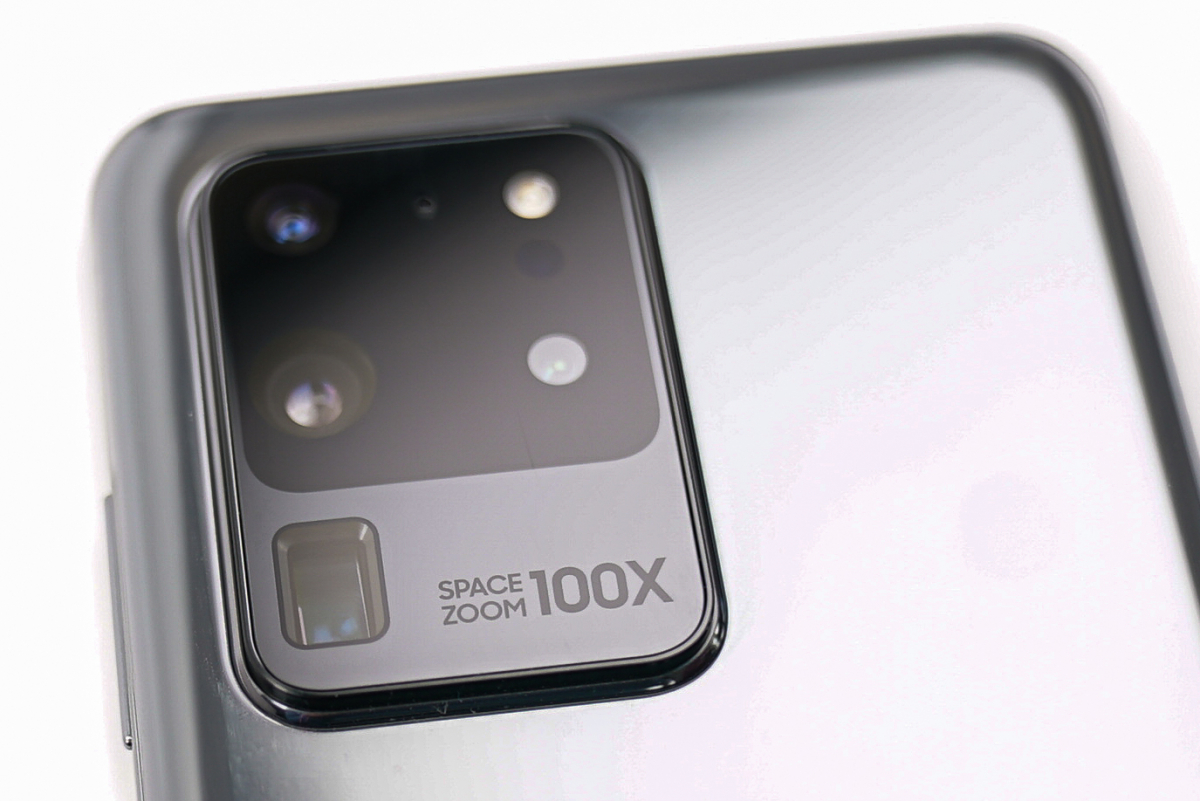
The Galaxy S20 Ultra features three back cameras, including one with an optical zoom buried sideways inside the phone. Next to them, on the right, there’s also a flash and a depth sensor used to assist focus. Washington Post photo by Jonathan Baran

Galaxy S20

For its 2020 flagship Galaxy S line, Samsung is trying to create a sense of upgrade urgency. It employed a hyperbolic naming convention, skipping from last year’s S10 right over the numbers 11 and 12 and all the teens to the S20. Take that, iPhone 11 . . . I guess?

The S20 lineup is also the first from Samsung to include support for 5G network service in all its models. That sounds like a reason to upgrade, but may be less than you’d think in the United States. I didn’t get to test the S20’s 5G capabilities in my preview of it, because I wasn’t in an area of San Francisco with 5G service. Chances are, you also don’t live or work in an area covered by 5G yet, either. Even in Manhattan, for example, Verizon’s coverage map shows it only works in a few blocks and parks. Everywhere else, you get 4G LTE service or less, depending on your carrier.

(Also, buyer beware: The entry-level S20 model doesn’t support a kind of 5G technology used in the United States by Verizon networks, so loyal Verizon customers should only consider the S20+ and Ultra models.)

You might justify buying a phone that supports 5G now as future-proofing. Or you could just wait another year for when the technology is improved. Perhaps by then apps and services will have invented some truly killer uses for the network tech on a smartphone, beyond faster movie downloads and gaming.

The tech leap we can actually use in the S20 is a new camera. All flagship phones these days have multiple lenses and improved night photography. So Samsung doubled down on a different skill in its camera war with Apple: zooming.

The specifications here are ludicrous. Both the S20 and S20+ can zoom up to 30 times, compared with 10 times on an iPhone 11 Pro. On the S20 Ultra, the zoom goes all the way up to 100 times. It’s enough to photograph the pupil in the eye of someone standing 10 feet away – or to snap Alcatraz Island while standing on a pier in San Francisco a mile and a half away.

This much magnification is impressive on a phone. Samsung accomplished its zoom feat by using new high-resolution sensors for its cameras. Most phones shoot 12 megapixels. The S20 and S20+ both capture up to 64 megapixels. That records any scene in more detail and lets the phone crop in on areas to simulate a zoom lens. The S20 Ultra sensor goes up to 108 megapixels. (Did I mention that these specs are ludicrous?)

On top of that, the S20 Ultra also has a periscope. Really: It’s hidden inside and expands sideways with a mirror to provide four-times optical zoom, similar to technology we’ve seen from Samsung rival Huawei.

Many photo buffs don’t think twice about spending a few hundred extra bucks on a camera. But I have serious questions about how all of this will perform in the real world. During my hands-on time with the S20, using all that zoom felt a bit like trying to press an elevator button with a 5-foot pole. You have to hold super still or prop the phone up against something. And for all of us who aren’t professional spies, how often do you actually need to zoom in that much?

The S20’s camera has one other useful trick up its sleeve: A mode Samsung calls “Single Take” does the shooting for you. Just hold up your camera for 10 seconds, moving around to different interesting angles. Then the phone uses artificial intelligence to pull out up to 14 of the best still shots and clips. I would have called this “Blowing Out Birthday Candle” mode.

There is one final bit of good news: If these features and prices sound a bit like overkill, Samsung will also be selling last year’s still-excellent Galaxy S10 line for $150 off. That means you can get one for as little as $600, and you won’t need a zoom lens to see all the money you saved.

Microsoft criticizes Amazon’s ‘sensationalist and politicized rhetoric’ in Pentagon cloud lawsuit #ศาสตร์เกษตรดินปุ๋ย

#ศาสตร์เกษตรดินปุ๋ย : ขอบคุณแหล่งข้อมูล : หนังสือพิมพ์ The Nation

https://www.nationthailand.com/edandtech/30381999?utm_source=category&utm_medium=internal_referral

Microsoft criticizes Amazon’s ‘sensationalist and politicized rhetoric’ in Pentagon cloud lawsuit

Feb 12. 2020
President Donald Trump greets Satya Nadella, chief executive of Microsoft, and Jeff Bezos, chief executive of Amazon and owner of The Washington Post, during an American Technology Council roundtable in June 2017. MUST CREDIT: Washington Post photo by Jabin Botsford

President Donald Trump greets Satya Nadella, chief executive of Microsoft, and Jeff Bezos, chief executive of Amazon and owner of The Washington Post, during an American Technology Council roundtable in June 2017. MUST CREDIT: Washington Post photo by Jabin Botsford
By The Washington Post · Aaron Gregg 

Seattle-based computing giant Microsoft has criticized its rival Amazon for employing “sensationalist and politicized rhetoric” in a lawsuit over a lucrative military contract known as JEDI, according to court records made public Monday.

Microsoft’s comments, included in a motion to partially dismiss a protest filed by Amazon, paint the clearest picture yet of how the company will defend its surprise win in the Joint Enterprise Defense Infrastructure procurement. Microsoft was awarded the contract in late October after an 11th-hour intervention by President Donald Trump prompted Defense Secretary Mark Esper to reexamine the Pentagon’s approach.

For weeks, Amazon has charged that Microsoft’s allegedly inferior cloud computing technology could not possibly have won in a fair competition. It argues that the results were skewed by “repeated public and behind-the-scenes attacks” from Trump and is seeking to depose Esper and the president, among others. (Amazon founder Jeff Bezos owns The Washington Post.)

Microsoft’s attorneys said Amazon’s claims are not supported by evidence and should be rejected.

“Without a compelling case on the merits of a traditional bid protest, [Amazon Web Services] tries to make this case all about President Trump,” Microsoft’s attorneys wrote in a filing unsealed Monday.

Amazon “has alleged zero facts – nothing – plausibly indicating that any DoD official involved in the JEDI procurement, at any level, was actually influenced by the alleged anti-Bezos statements in any way,” they wrote.

Amazon spokesman Drew Herdener said the company disagrees with Microsoft’s motion.

“AWS believes that all of its protest grounds are valid, and that it’s important that the numerous evaluation errors and blatant political interference that impacted the JEDI award decision be reviewed,” Herdener said in an email.

Trump’s interest in the contract came after a long-running legal and lobbying campaign by Oracle, whose federal business is threatened by the broader shift to cloud-based computing systems.

The company’s lobbying operations seemed to bear fruit on the eve of a planned contract award by the Pentagon last summer. Trump said in a July 18 news conference that he had received “tremendous complaints” from companies that compete with Amazon, specifically naming Oracle, IBM and Microsoft. Around that time an Oracle lobbying document labeled “A Conspiracy To Create A Ten Year DoD Cloud Monopoly” reached the president’s desk, The Post and CNN reported.

In late July during his first week on the job, Esper launched a review of the Pentagon’s broader approach to the JEDI contract, telling The Post that he wanted to “take a hard look” at the contract and that he had heard complaints from the White House and members of Congress.

As part of that review, Esper met with at least one person, whose name was redacted, who was closely involved in the bid evaluations, according to court records. Those briefings covered the JEDI program and the different options available to the Pentagon, a Defense Department spokeswoman said Tuesday.

Then, on Oct. 7, Esper completed paperwork recusing himself from the competition, forwarding major decisions on the contract to Deputy Defense Secretary David Norquist. His office has said the decision to recuse was made “out of an abundance of caution” to avoid any concerns regarding his impartiality, because his son was employed with one of the original bidders.

Despite Esper’s meetings with procurement officials, the Defense Department has insisted that his review was strictly limited to the broader strategy around JEDI and that it in no way touched on the evaluation of specific bids.

In its motion to depose Trump, the company is seeking information related to comments recounted in a recent book by a former speechwriter of former Defense Secretary James Mattis, retired Navy Cmdr. Guy Snodgrass, who wrote that Trump had sought to “screw” Amazon out of the contract and that Mattis had demurred. His claims have not been independently verified.

Amazon’s bid protest has relied primarily on the president’s own public statements. The company cited a February 2016 campaign rally in Texas, in which Trump said Amazon would “have problems” if he were elected. The company is also citing a Fox News segment against Amazon as well as Trump’s statement that he had heard “tremendous complaints” from Amazon’s competitors.

In its motion to dismiss, made public Monday, Microsoft called the president’s comments irrelevant, arguing that none of them directly mention the JEDI procurement.

“Virtually none of the public statements cited by AWS in its complaint mentions the JEDI procurement in any way,” Microsoft’s lawyers wrote. “Nor does the complaint make even a single factual allegation that President Trump ever spoke directly to any identified DoD procurement officers about the JEDI procurement, much less instructed them to award the contract to Microsoft.”

Microsoft further argued that Amazon should have raised its concerns over the Defense Department’s handling of the contract at the time that they occurred, rather than waiting for a contract to be awarded.

Also this week, two nonprofits, Protect Democracy and Citizens for Responsibility and Ethics in Washington, filed briefs in support of Amazon’s request to depose Trump.

“The plaintiffs in this case have credibly alleged that the President personally intervened in a government-contracting process to punish a critic,” Protect Democracy wrote in its legal brief. “If true, this would be a grave abuse of power in its own right that would be broadly chilling to anyone who wishes to exercise their right to dissent against the government.”

The Defense Department is expected to file a separate brief in the coming weeks explaining its position.