นอกจากเรื่องราคารถ EV ในปัจจุบันที่ยังค่อนข้างสูงแล้ว อีกข้อจำกัดสำคัญที่ ทำให้คนไทยลังเลที่จะตัดสินใจซื้อรถ EV มาใช้งานคือสถานที่ชาร์จไฟ
โดยปัจจุบัน สถานีชาร์จรถ EV มีของการไฟฟ้านครหลวง, การไฟฟ้าส่วนภูมิภาค, ปตท. และ EV Any where ที่เป็นของบริษัทเอกชน จุดที่ตั้งส่วนใหญ่ยังเทียบจำนวนไม่ได้กับปั๊มน้ำมัน
AstraZeneca provides immunity for at least a year after single dose: UK study
A third dose of the Vaxzevria vaccine, or AstraZeneca, also “results in higher neutralising activity against the Alpha, Beta and Delta variants”
Asub-analysis from the Oxford-led COV001 and COV002 trials with Vaxzevria (or AstraZeneca) has shown induced strong immune responses following either a prolonged second dose interval of up to 45 weeks or after a third booster dose, according to University of Oxford results published on The Lancet website.
In Thailand, the UK and other countries, Vaxzevria is known as AstraZeneca.
“An extended interval between the first and second dose of Vaxzevria of up to 45 weeks resulted in up to an 18-fold increase in antibody response, measured 28 days after the second dose,” a press release said detailing the results.
“With a 45-week interval between the first and second dose, antibody titres were four times higher than with a 12-week interval, showing that a longer interval is not detrimental but can derive stronger immunity.
“In addition, a third dose of Vaxzevria given at least 6 months after a second dose boosted antibody levels six fold and maintained T-cell response. A third dose also resulted in higher neutralising activity against the Alpha, Beta and Delta variants,” the trials reportedly showed.
Both the late second dose and the third dose of Vaxzevria were “less reactogenic” than the first dose.
“This should come as reassuring news to countries with lower supplies of the vaccine, which may be concerned about delays in providing second doses to their populations,” said Prof Sir Andrew J Pollard, chief investigator and director of the Oxford Vaccine Group.
“There is an excellent response to the second dose, even after a 10-month delay from the first,” he added.
“Demonstrating our vaccine generates a robust and durable immune response is important for providing confidence in longer-term protection,” said Sir Mene Pangalos, BioPharmaceuticals R&D executive vice president.
The analysis included volunteers aged 18 to 55 years who were enrolled in the COV001 and COV002 trials and had received either a single dose or two doses of AstraZeneca.
Vaxzevria, formerly AZD1222, was co-invented by the University of Oxford and its spin-out company, Vaccitech. It uses a replication-deficient chimpanzee viral vector based on a weakened version of a common cold virus (adenovirus) that causes infections in chimpanzees and contains the genetic material of the Sars-CoV-2 virus spike protein. After vaccination, the surface spike protein is produced, priming the immune system to attack the Sars-CoV-2 virus if it later infects the body.
The vaccine has been granted a conditional marketing authorisation or emergency use in more than 80 countries across six continents as a two-dose regimen given four to 12 weeks apart for adults aged 18 years and over. More than 600 million doses of AstraZeneca have been supplied to 170 countries worldwide, including more than 100 countries through the Covax Facility.
COV001
COV001 is a single-blinded, randomised, controlled Phase I/II trial to determine safety, immunogenicity and efficacy of the Covid-19 vaccine candidate AZD1222 in up to 1,077 healthy adults in five trial centres in the United Kingdom. Participants aged 18-55 years received either a single dose or two-doses of AZD1222 at 5×10¹⁰ viral particles or a single dose of a meningococcal conjugate vaccine MenACWY as a control vaccine.
Participants had blood samples drawn and clinical assessments for safety as well as immunogenicity at day 0, 28 and will also be followed on day 184 and 364. In addition, participants enrolled in the phase 1 component of the study and in the two dose groups, had visits at 3, 7, 14 and 28 days after each vaccination.
COV002
COV002 is a single-blinded, multi-centre, randomised, controlled Phase II/III trial assessing the safety, efficacy and immunogenicity of AZD1222 in 12,390 participants in the UK. Trial participants were aged 18 years or over, healthy or have medically stable chronic diseases and are at increased risk of being exposed to the Sars-CoV-2 virus. Participants received one or two intramuscular doses of a half dose (~2.5 x10¹⁰ viral particles) or full dose (~5×10¹⁰ viral particles) of AZD1222 or comparator, meningococcal vaccine MenACWY.
Participants had blood samples drawn and clinical assessments for safety as well as immunogenicity at multiple time points up to one year post-vaccination. Suspected cases with compatible symptoms were tested for virological confirmation by Covid-19 PCR test. In addition, weekly swabbing is done for detection of infection and assessment of vaccine efficacy against infection.
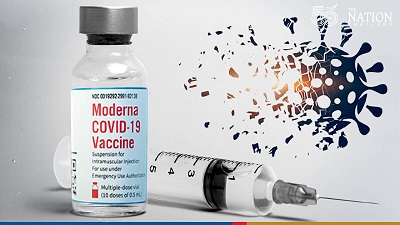
Moderna says vaccine works against delta variant, as WHO warns of global spread
The coronavirus vaccine developed by U.S. biotech firm Moderna is effective against the highly contagious delta variant, the company said in a release Tuesday, offering some hope even as the World Health Organization warned that the variant has now spread to at least 96 countries.
Moderna said that blood samples from fully vaccinated individuals produced antibodies against multiple variants and that researchers measured only a “modest reduction in neutralizing titers” against the particularly virulent delta, which was first identified in India.
“As we seek to defeat the pandemic, it is imperative that we are proactive as the virus evolves,” Moderna chief executive Stéphane Bancel said in a statement. “These new data are encouraging and reinforce our belief that the Moderna COVID-19 Vaccine should remain protective against newly detected variants.”
The company, whose vaccine uses messenger RNA technology and requires two doses, submitted the data to the bioRxiv preprint server ahead of peer review. Moderna last month also signed an agreement to provide the United Nations-backed Covax initiative, which seeks the equitable distribution of coronavirus vaccines worldwide, with 500 million doses beginning later this year.
As much of the world still awaits coronavirus vaccine supply, the delta variant is tearing through unvaccinated populations everywhere from Britain to the United States to South Africa.
It has reached 96 countries, the WHO said in a weekly epidemiological update Tuesday, a number it warned was probably an underestimate as most nations lack the genome-sequencing capacity needed to identify virus variants.
According to the WHO, delta is 55 percent more transmissible than the virulent alpha variant first identified in Britain last year, a version that spurred infection waves in multiple countries. Now, the delta variant “is expected to rapidly outcompete other variants and become the dominant variant over the coming months,” the WHO said.
On Wednesday, France’s leading government scientific adviser said in a radio interview that the country was likely to suffer a fourth wave of infections caused by the delta variant, which now accounts for at least 20 percent of new cases there.
But “it will be much more moderate than the previous three waves because the level of vaccinations is different compared to before,” Jean-François Delfraissy told French public radio, according to a Reuters translation of his remarks.
More than 63 percent of adults in France have received at least one dose of a coronavirus vaccine, the French Health Ministry says, with 41 percent fully inoculated.
Some countries with similarly high vaccination rates, including Britain and Israel, are now grappling with new outbreaks of the delta variant but say that widespread immunization has helped mitigate some of the pathogen’s worst effects.
In places such as Africa, however, where about 1 percent of the population is fully vaccinated, the variant is helping give rise to new infections and deaths. According to the WHO, new coronavirus cases in the African region increased by 33 percent over the past week, with covid-19 deaths jumping 42 percent.
In Russia, where vaccine uptake remains stubbornly low, authorities on Wednesday reported a record number of covid-related deaths for the second straight day, following an unprecedented surge in new cases that officials have blamed on the delta variant.
“The Delta variant will continue to complicate timelines for reaching a less disruptive new normal in countries with high vaccination rates as well as those with low rates,” said Scott Rosenstein, special global health adviser at the New York-based political risk firm Eurasia Group.
For lower-income nations with sluggish inoculation campaigns, Rosenstein said in a briefing note, “the risks of overwhelmed healthcare systems are the highest they have been since the beginning of the pandemic.”