Thailand needs to do more work if it wants to become a regional leader in personalised healthcare, according to a new study.
The Asia-Pacific Personalised Health Index is a data-driven policy tool created by multinational healthcare giant Roche to measure the readiness of health systems to adopt personalised healthcare – “enabling the right care to be tailored to the right person at the right time”.
The index, which is part of Roche’s FutureProofing Healthcare initiative led by 15 experts across Asia-Pacific, should be of interest to policymakers currently working to transform Thailand into a global medical hub.
Topping the index ranking of 11 countries is Singapore’s health system, which scored highest on 27 indicators of personalised health. Thailand was ranked 7th, ahead of Malaysia, China, India and Indonesia. The index also covers Australia, South Korea, Taiwan and New Zealand.
The company said it uses public data supplemented with input from health authorities to offer a picture of local, national, and regional strengths and needs. The aim, said Roche, was to enable data-driven decision-making for future health systems that are fit for purpose.
Singapore scored top for its high levels of digital maturity, comprehensive national strategies, strong digital infrastructure and innovation capacity. Taiwan (2nd), Japan (3rd) and Australia (4th) also performed well in overall readiness, said Roche. However, Thailand and other lower-scoring territories faced challenges of urban-rural disparities and building digital infrastructure, said the company.
Table: Overall Asia Pacific Personalised Health Index 2020 performance
“Personalised healthcare has the potential to improve the lives of millions of people across Asia-Pacific,” said Jeremy Lim, director of Global Health and associate prof at the National University of Singapore, who helped develop the index.
Hailing the creation of digital health solutions like tele-medicine during the Covid-19 crisis, he said more work was needed across the region to realise these benefits.
“The Personalised Health Index builds a clearer picture of the current readiness of health systems and enables countries to build on their strengths, identify key areas of opportunity for improvement and identify best practice from other countries on individual measures. It helps jump start conversations about what action is needed today to shape resilient, personalised and sustainable health systems that work better for future generations,” said Lim.
“ฉลองตรุษจีน” ชวนมาวาร์ปรับความปัง แลนด์มาร์คกลางกรุง กับ Teleport Dragon “มังกรเงินแห่งความโชคดี” ในงาน “CENTRAL THE GREAT CHINESE NEW YEAR 2021”
ห้างเซ็นทรัล จัดงาน “CENTRAL THE GREAT CHINESE NEW YEAR 2021” (เซ็นทรัล เดอะ เกรท ไชนีส นิวเยียร์ 2021) วาร์ปช้อปโปรดี มั่งมีรับตรุษจีน เพื่อเฉลิมฉลองตรุษจีนปีวัวทอง ภายใต้คอนเซ็ปต์ Luck, Love, Hope และ Freedom ที่ห้างเซ็นทรัลทุกสาขา ระหว่างวันที่ 29 ม.ค. – 21 ก.พ. 64 ครั้งแรก! ที่เนรมิตห้างเซ็นทรัลชิดลมให้เป็นห้างแห่งความสุขและความโชคดี พร้อมเสริมมงคลกับไฮไลต์ “มังกรเงินแห่งความโชคดี” ที่ผ่านการสร้างสรรค์ผลงานโดย กันตภณ เมธีกุล หรือ “Gongkan” ศิลปินไทยชื่อดังจากนิวยอร์ก ที่ร่วมงานระดับโลกมากมาย
อาทิ นิวยอร์ก ไทเป เซี่ยงไฮ้ ปักกิ่ง โตเกียว และล่าสุดที่กรุงเทพฯ กับการออกแบบผลงานสุดเอ็กซ์คลูซีฟ Central X Gongkan “มังกรเงินแห่งความโชคดี” วาร์ปข้ามมิติมามอบความสุขให้กับทุกคน โดยนอกห้างเซ็นทรัลชิดลม โอบล้อมไปด้วยมังกรเงินอันทรงพลังมามอบความโชคดี และเสริมมงคลให้ทุกคน “หัวและหางมังกร” ตั้งตระหง่านอยู่ด้านนอกห้าง ส่วน “ลำตัวหรือท้องมังกร” ถูกตั้งไว้ที่บริเวณชั้น 1 ภายในห้างเซ็นทรัลชิดลม นอกจากนี้ภายในห้างยังตกแต่งไปด้วย The Great Chinese Lantern โคมไฟนับพัน บริเวณโถงเปียโน ที่มีความสูง 30 เมตร เทียบเท่าตึก 7 ชั้น อีกหนึ่งไฮไลต์ ซึ่งโคมไฟเป็นสัญลักษณ์แห่งความโชคดีและรุ่งเรือง และกิจกรรมเสริมมงคล อาทิ โชว์เชิดสิงโต แป๊ะยิ้ม ลอดท้องมังกร ฯลฯ เพื่อความโชคดีและสิริมงคล
รวิศรา จิราธิวัฒน์ ประธานบริหารฝ่ายการตลาด บริษัท สรรพสินค้าเซ็นทรัล จำกัด ในเครือเซ็นทรัล รีเทล เผยว่า “ด้วยปีนี้เทศกาลตรุษจีน และวาเลนไทน์ อยู่ในช่วงเวลาเดียวกัน ห้างเซ็นทรัลจึงจัดงาน Central The Great Chinese New Year 2021 เพื่อเป็นการเฉลิมฉลองช่วงเวลาแห่งความสุขและความเป็นสิริมงคลให้กับทุกคน ภายใต้คอนเซ็ปต์ Luck, Love, Hope และ Freedom ที่มีทั้งเรื่องความรัก ความโชคดี และการใช้ชีวิตในสถาการณ์ตอนนี้ ซึ่งปีนี้เราได้ร่วมกับ คุณก้องกาน ศิลปินไทยชื่อดังจากนิวยอร์ก ที่ผ่านงานระดับโลกมาแล้วมากมาย มาร่วมสร้างสรรค์ผลงาน “มังกรเงินแห่งความโชคดี” ที่วาร์ปข้ามมิติมามอบความสุขให้กับทุกคน โดยไฮไลต์ของปีนี้คือ Teleport Dragon ที่ห้างเซ็นทรัลชิดลม ซึ่งหัวมังกรและหางมังกรจะโชว์อยู่ด้านนอกห้าง ส่วนท้องมังกรอยู่ด้านในห้าง อีกทั้งยังมีผลงาน Teleport ของคุณก้องกานซึ่งมีอีกหลายคาแรกเตอร์ ที่ต้องรอติดตามชม
นอกจากนี้ยังได้เนรมิตบรรยากาศภายในห้างด้วย The Great Chinese Lantern โคมไฟนับพัน ซึ่งเป็นสัญลักษณ์แห่งความโชคดีและรุ่งเรือง อีกทั้งมีไชนีส มาร์เก็ต ที่รวมสินค้าไอเท็มมาให้ได้เลือกช้อปเพื่อเพิ่มความเฮงรับตรุษจีน อาทิ กระเป๋า เครื่องสำอาง ของตกแต่งบ้าน เสื้อผ้า เพื่อให้ลูกค้าได้มาเลือกช้อปสิ่งใหม่ๆ เพื่อความเป็นสิริมงคลตามความเชื่อของชาวจีน ตลอดจนมอบโปรโมชั่นพิเศษรับตรุษจีนสามารถ เลือกช้อปได้ทั้งหน้าร้านและออนไลน์ นอกจากนี้เรายังเตรียมเซอร์ไพรส์พิเศษให้กับลูกค้าเซ็นทรัล
กับมังกรเงินแห่งความโชคดี ที่จะวาร์ปไปแจกความสุขกันต่อในสาขาอื่นๆ ไม่ว่าจะเป็น เซ็นทรัล แอท เซ็นทรัลเวิลด์, เซ็นทรัลลาดพร้าว เซ็นทรัลปิ่นเกล้า, เซ็นทรัลพระราม 2 และโรบินสันพระราม 9 ก่อนจะกลับมาวาร์ปต่อที่เซ็นทรัลชิดลมในปีหน้า สำหรับตรุษจีนนี้อยากให้คนไทย และคนไทยเชื้อสายจีนมีความสุข สมหวัง พร้อมทั้งออกมาจับจ่ายใช้สอยเพื่อความเป็นสิริมงคลกันได้ในงาน Central The Great Chinese New Year 2021 พร้อมรับโปรโมชั่นดีๆ ต้อนรับตรุษจีนที่เราตั้งใจมอบความพิเศษนี้ให้กับลูกค้าห้างเซ็นทรัลทุกคน” วริศรา กล่าวทิ้งท้าย
1. 19th Century ‘Jamawar’ Kashmir Shawl Fragment with Linear Alternating Boteh Motifs ผลิตขึ้นใน ค.ศ.1850 (พ.ศ. 2393) 2. 19th Century ‘Jamawar’ Kashmir Shawl Fragment, with Linear Boteh in the Center and Elongated Motifs at the Borders ผลิตขึ้นใน ค.ศ.1850 (พ.ศ. 2393) 3. 19th Century ‘Jamawar’ Kashmir Shawl, with Boteh Motifs with Orange Border ผลิตขึ้นใน ค.ศ.1860 (พ.ศ. 2403)
4. 19th Century ‘Jamawar’ Kashmir Shawl, with Boteh Motifs with Orange Border ผลิตขึ้นใน ค.ศ.1850-1860 (พ.ศ. 2393 – 2403) 5. 19th Century ‘Jamawar’ Kashmir Shawl, with Abstract Spear Shaped Motifs and Black Borderผลิตขึ้นใน ค.ศ.1870 (พ.ศ. 2413) 6. 19th Century ‘Jamawar’ Kashmir Shawl Fragment, with Bent-Tip and Spear Form Boteh Motifsผลิตขึ้นใน ค.ศ.1890 (พ.ศ. 2433)
A single-shot coronavirus vaccine from pharmaceutical giant Johnson & Johnson was 66% effective at preventing moderate and severe illness in a massive global trial, findings released Friday show. But its performance was stronger in the United States and weaker in South Africa, where a worrisome coronavirus variant now dominates – a complicated result that reflects the evolution of the pandemic.
The results, reported in a news release, put a third vaccine on the horizon in the United States – one with logistical advantages that could simplify distribution and expand access to shots in the United States and worldwide.
Johnson & Johnson is expected to apply for emergency use authorization from the Food and Drug Administration next week. If the review follows the path of two earlier vaccine candidates, the shot could be authorized and available to the public by late February or early March.
The company has a $1.5 billion agreement with the federal government to support vaccine development and deliver 100 million doses to the United States by the end of June. But manufacturing lagged projected milestones earlier this month, and company officials declined to provide additional information on the pace of doses likely to be available month by month.
A communication challenge lies ahead for Johnson & Johnson and public health officials. Though less effective in its 44,000-person trial than 90-percent-plus effective vaccines made by Pfizer-BioNTech and Moderna, the Johnson & Johnson shot was tested at the height of the pandemic, in areas of the world where the virus had changed in ways that can elude parts of the immune response.
The vaccine was 72% effective at protecting against moderate to severe illness in the United States, but it was 66% effective in Latin America and 57% effective in South Africa, where concerning variants have taken root. It was 85% effective overall at preventing severe disease.
In the clinical trial, all cases of covid-related hospitalization and death – the outcomes that most people would like to avoid – were among participants who had received placebo shots.
The logistical advantages of the Johnson & Johnson vaccine should not be underestimated, experts said, particularly at a time when the pursuit of broad immunity to the virus through vaccines has assumed new urgency with the emergence of variants, sparking concerns that mutant viruses might escape vaccines, treatments and naturally acquired immunity.
“Vaccinating fast is going to be the message now, and vaccinating fast to reduce transmission and reduce the chance you have additional mutations,” said Paul Stoffels, chief scientific officer for Johnson & Johnson. “The crisis is now hospitalization and death.”
The one-shot vaccine could be a “game changer,” according to Jonathan Temte, a vaccine expert at the University of Wisconsin School of Medicine and Public Health, because it can be stored for months at refrigerator temperature instead of the ultracold or frozen temperatures that have complicated the rollout of other coronavirus vaccines. The single shot could streamline the vaccination effort, freeing mass vaccination clinics from the need to recall people for boosters and the logistical complications accompanying that.
“Back in July and August, I was hoping we would see a vaccine that was 60% effective – in my mind, that would be great. And now we have had two that have hit the ball out of the park and set expectations spectacularly high, and that’s not fair because we don’t need a home run all the times we’re up to bat,” Temte said. A solution to the pandemic, he said, isn’t a perfectly effective vaccine, but a vaccination campaign that can reach large swaths of the population as quickly as possible – comparing it to a baseball team that wins with steady base hits and bunts, not just home runs.
The FDA said a vaccine must be at least 50% effective to be authorized, a bar the Johnson & Johnson shot appears to have cleared, although the data will undergo careful and more detailed review by career FDA scientists and an outside panel of experts. Safety data will also be carefully reviewed, although the company said the shot had tolerable side effects, including fever and no serious safety concerns. There were no cases of anaphylaxis.
If the Johnson & Johnson shot is authorized, it would diversify the supply beyond two companies, something that many experts have hoped for in case of manufacturing delays or production lines going down because of contamination or other unexpected events. Temte recalled a shortage of the Hib vaccine given to children starting in late 2007, when problems with one manufacturer took production offline for more than a year, leaving the United States reliant on a single company.
Johnson & Johnson will manufacture its vaccine in the Netherlands and through partnerships with firms such as Emergent BioSolutions, a contract development and manufacturing company headquartered in Gaithersburg, Md.
The new vaccine uses a different technology than the two authorized vaccines in the United States, broadening the suite of tools to block the virus. The Johnson & Johnson vaccine employs a harmless cold virus to deliver a gene that carries the blueprint for the spiky protein found on the surface of the coronavirus. The virus infects cells, which then follow the genetic instructions to construct a replica of the coronavirus spike.
In contrast, the Pfizer and Moderna vaccines use a strip of genetic material called messenger RNA to instruct cells to build the spiky protein found on the surface of the coronavirus.
In both cases, the immune system learns to recognize the real virus by mustering an immune response to the spike.
The vaccine technology was able to move quickly into trials because it was preceded by decades of research.
In the early days of gene therapy, scientists hoped to use viruses to deliver good copies of genes that were missing or malfunctioning in people with diseases such as sickle cell anemia or cystic fibrosis. But the harmless cold virus they were experimenting with, an adenovirus, presented a major problem: It triggered an immune response.
Hildegund C.J. Ertl, an immune system expert and vaccine scientist at the Wistar Institute, said that when a scientific colleague working on gene therapy asked for her expertise, she told him, “Forget about gene therapy, what you have is a vaccine.”
Scientists began to explore those cold viruses as a vaccine technology, particularly against HIV. In the early 2000s, when physician-scientist Dan Barouch set up his lab at Beth Israel Deaconess Medical Center in Boston, he aimed to invent an HIV vaccine, immersing himself in a corner of science that he describes as “an esoteric, slightly geeky area of research, that most people didn’t really care about too much.” In 2003, he partnered with a Dutch biotech company called Crucell and for two months lived in the Holiday Inn in Leiden in the Netherlands, learning how to grow and purify adenoviruses.
Barouch’s lab selected one particular adenovirus, Ad26, to deliver the payload of genetic material that he hoped would teach the immune system to block HIV. That HIV vaccine, more than 15 years in the making, is now in clinical trials run by Janssen, a division of Johnson & Johnson that acquired Crucell.
But years of basic scientific work developing an adenovirus into an HIV vaccine, a notoriously difficult virus, built the scaffolding for a rapid response to new threats.
When a mosquito-borne virus caused babies to be born with abnormally small heads in 2015, the adenovirus technology became the framework for a Zika vaccine. That candidate was put back on the shelf as the threat receded, but it helped build confidence that a single shot could provide lasting immune response. Johnson & Johnson leveled the technology against Ebola, and a vaccine was approved by the European Medicines Agency last year.
“What we learned from Zika is we could go quickly, and that a single shot of the vaccine” led to durable immune responses, Barouch said. “That concept weighed heavily on us exactly a year ago in early January 2020, when it was feared that we had a problem with a new coronavirus.”
Barouch’s laboratory gathered at the Museum of Science in Boston on Jan. 10 for their annual retreat. They briefly discussed a mysterious new pneumonia that had sickened a few dozen people in China and killed one, considering whether they might need a vaccine. Later that night, Kathryn Stephenson, a physican-scientist at Beth Israel Deaconess, saw that Chinese scientists had uploaded the genome of the new coronavirus on Twitter and flagged it for Barouch. The team sprang to work, designing a dozen different potential vaccines.
Two weeks later, Barouch talked with Johan Van Hoof, global therapeutic head of vaccines at Janssen, about joining forces. An agreement was finalized in four days, shortcutting a process that Barouch said normally would have taken four months, if not 14 months.
It wasn’t just the academic work that laid the groundwork for rapid development of a coronavirus vaccine. Gert Scheper, compound development team leader for Janssen Vaccines & Prevention, said that as the company worked on the technology over the years, it had begun scaling up manufacturing. That meant work had been done to learn how to grow the virus, not in a 50-liter vat for small clinical trials, but to a more massive 900-liter vat being used to manufacture the coronavirus vaccine.
“We could make use of that know-how,” Scheper said. While he and others at the company have been steadily working on vaccines against HIV, RSV and other diseases, he said the pandemic changed everything.
“Then came covid, and for sure there’s been a clear change in perspective within the company – and all the eyes are on us now,” Scheper said.
Johnson & Johnson has a separate ongoing trial of two doses of the vaccine, because studies have demonstrated that a second dose can boost the immune response even higher.
But much of the debate over the next weeks is likely to be about how to best use a vaccine with a different efficacy profile and easier logistics. Experts warned that clinical trial results can’t be directly compared, because of differences in how the trials are designed and when and where they are conducted. But anticipate that people will anyway.
Some people may want to choose which vaccine they get, asking whether they should wait for a more effective vaccine or skip the two-dose vaccine until a more convenient single shot is available, even as public health officials underscore that getting more people vaccinated with any authorized vaccine is the priority.
Jose Romero, health secretary of Arkansas and chairman of an advisory committee to the Centers for Disease Control and Prevention, said vaccines of different efficacy might end up targeted to different populations. He laid out a hypothetical scenario in which one vaccine was 90% effective and another was 60 to 70%.
“I’d want to use the vaccine with higher efficacy in my most vulnerable population,” Romero said. “I’d think about 60 to 70% efficacy in a younger population where we know that the secondary morbidity and mortality is much lower.”
WASHINGTON – A coronavirus vaccine made by Maryland biotech company Novavax proved effective at stopping infections in global hot spots where concerning variants are dominant, the company announced Thursday. But warning signs lurked amid those findings: The protective effect of the vaccine was substantially muted in South Africa, where a worrisome virus variant is in wide circulation.
The data, presented by company news release, is ominous news for other vaccine developers. They have been scrambling to determine whether current vaccines would remain effective against the variant found in South Africa and are designing new versions in case the virus can break through the protection provided by the shot. The data is the first, highly anticipated evidence of how well a vaccine performs against variants that have drawn global concern.
The company also noted that a third of the participants in its South African trial appeared to have already been infected with the original variant of coronavirus, based on antibodies in their blood when they were vaccinated. Some of those people became infected again, according to the company, suggesting that natural immunity generated by an infection might not fully protect against the new variant.
“The South African variant is looking like it’s going to be a far more complicating factor than we had hoped,” said Peter Jay Hotez, dean for the National School of Tropical Medicine at Baylor College of Medicine. Hotez is developing a different coronavirus vaccine and said his team has designed one against the South African variant.
In a United Kingdom trial, where the B.1.1.7 variant has become dominant, the vaccine was 89% effective, and about half the infections were with the variant.
In a smaller and less definitive South African trial where nearly all the participants who got sick were infected with the variant first identified in that nation, the vaccine was 49% effective. But the company underscored that when looking only at people not infected with HIV, the efficacy was 60%.
“I think the constructs for all current vaccines are similar; thus, I will expect similar results,” said David Ho, a professor of microbiology and immunology at Columbia University.
Laboratory tests had suggested that the immune response elicited by vaccines made by Moderna and Pfizer-BioNTech would be diminished against the variant first identified in South Africa. A 49% effective vaccine against a particularly difficult variant could still hold merit – the Food and Drug Administration had drawn the line for efficacy at 50% – but it clearly speeds up the urgency in developing a vaccine targeting the variant.
“It really signals that we really can’t take it for granted that these vaccines will work as well against all variants and that we need to really have systems in place that allow us to monitor them, just like how we monitor [to make] flu vaccine every year,” said Natalie Dean, an epidemiologist at the University of Florida.
This month, Novavax began developing a new version of its vaccine targeting the variant identified in South Africa and expects to select a design and begin small-scale production within weeks, chief executive Stanley Erck said, with trials to begin in the second half of the year. Novavax is one of the vaccines supported by the American government, including $1.6 billion for clinical development and a prepurchase of 100 million doses. A large phase 3 trial is ongoing in North America.
“The 60% reduced risk against COVID-19 illness in vaccinated individuals in South Africans underscores the value of this vaccine to prevent illness from the highly worrisome variant currently circulating in South Africa, and which is spreading globally,” Shabir Maddi, executive director of the Vaccines and Infectious Diseases Analytics Research Unit at Wits University said in a statement. Maddi is a principal investigator in the Novavax coronavirus vaccine trial in South Africa.
“This is the first COVID-19 vaccine for which we now have objective evidence that it protects against the variant dominating in South Africa,” Maddi said.
Data from a late-stage trial of a Johnson & Johnson vaccine candidate, which was partly conducted in South Africa and Brazil, is expected within days and will provide greater clarity about how the current generation of vaccines perform against variants.
Time to double mask or upgrade masks as coronavirus variants emerge, experts say
Health & BeautyJan 28. 2021Danny Ryan, 27, is pictured wearing two masks on Wednesday near his home in Washington, D.C. Double masks are becoming a real possibility as a new virus variant makes its way from England, South Africa, and Brazil into the U.S. MUST CREDIT: Washington Post photo by Sarah L. Voisin.
By The Washington Post · Fenit Nirappil
Wear your mask is becoming wear your masks.
The discovery of highly contagious coronavirus variants in the United States has public health experts urging Americans to upgrade the simple cloth masks that have become a staple shield during the pandemic.
The change can be as simple as slapping a second mask over the one you already wear, or better yet, donning a fabric mask on top of a surgical mask. Some experts say it’s time to buy the highest-quality KN95 or N95 masks that officials have long discouraged Americans from purchasing to reserve supply for health care workers.
As with other parts of the pandemic response, the U.S. lags behind other parts of the world when it comes to masks. Several Asian countries, including Singapore and South Korea, have mass-produced high quality masks to send directly to residents. In recent weeks, European countries have begun mandating medical grade masks in public settings as the B.1.1.7 strain first identified in the United Kingdom threatens to ravage communities; British scientists estimate it could be as much as 70% more transmissible.
“The existence of more transmissible viruses emphasizes the important of us upping our game and doing not more of the same, but better of the same,” said Tom Frieden, the former director of the Centers for Disease Control and Prevention. Frieden has called for people to wear higher quality masks. “Yes, that is confusing to people, but the key is to share what we know when we know it and be frank about what we don’t know.”
Anthony Fauci, the nation’s top infectious-disease expert, touted double masking during a Monday appearance on the “Today” show, saying two layers “just makes common sense that it likely would be more effective.”
While individual public health officials are calling for new mask habits, the federal government has not.
The CDC has not revised its mask guidance encouraging Americans to choose well-fitting masks with “two or more layers of washable, breathable fabric” and to avoid surgical masks and other face coverings meant for health care workers.
President Joe Biden has embraced masks as a core strategy for ending the pandemic, mandating face coverings on planes, airports and all federal buildings. But he has not called for a medical-grade mask mandate or mass production of high-quality masks.
The CDC and White House did not immediately respond to requests for comment.
Some public health experts said the federal government should have prioritized certifying or manufacturing better masks earlier so Americans don’t have to fend for themselves to avoid counterfeits or upgrade their own.
The Trump administration last March coordinated with underwear makers to send five masks to every household, officials told The Washington Post, but the plans fell apart because of logistical and other concerns, including complaints the mask looked like underwear and jockstraps.
Abraar Karan, a physician at Brigham and Women’s Hospital and Harvard Medical School has, since last spring, called on government and industrial leaders to mass produce comfortable, effective masks. He said the country could have avoided its current situation, where Americans are learning how to better protect themselves largely alone.
“This seems just like the rest of our covid tragedy: We just don’t have answers, we just put out fires constantly and we are asking people to do things on their own,” Karan said. “You’ve always needed better masks. We needed better masks from the start.”
Linsey Marr, a Virginia Tech engineering professor who has researched mask effectiveness, said the public has better tools to reduce viral loads getting into the air and into bodies.
Without a medical-grade face covering, Marr said people can get the best, simplest protection by wearing a cloth mask tightly on top of a surgical mask. They can also make a three-layer mask by cutting a high-efficiency filter, such as a vacuum bag, to place between two tightly-woven fabric masks.
The difference is like getting two recommended doses of coronavirus vaccines instead of one – the additional mask offers more fulsome protection against the virus.
“Those standard cloth masks might be around 50% effective in terms of protecting yourself,” Marr said. “Maybe that was good enough before when combined with distancing and trying to avoid being in crowded indoor spaces.”
Masks are among the simplest tools in the fight against covid-19, the disease caused by coronavirus, but also among the most politically fraught. Some have turned masks into a symbol of government overreach.
Federal officials, including Fauci, were criticized when they urged people to cover their face after initially advising against masks in the early weeks of the pandemic. Many experts said the changing guidance made sense as the shortage of protective equipment for health care workers eased and scientists better understood the spread of the virus – including that it is spread by asymptomatic people. But the initial confusion has been used to cast doubt on the proven efficacy of masking and the broader government response to the pandemic.
“So in other words Fauci and everybody else really has no idea what to do or what is safe,” former Major League Baseball player Jordan Schafer tweeted in response to a news article about the scientist recommending two masks. “Fauci has told us not to wear a mask, to wear one mask, and now to wear two masks. Can we just get transparency please and accurate info.”
Cady Fusté of Seattle started wearing a cloth mask over a surgical mask this month. She made the shift at the advice of her mother’s doctor because of a double lung transplant that makes her mother at higher risk to succumbing to the virus.
“Science evolves. It makes total sense to me,” said Fusté, 35, who works in photo production. “If you think about it, if you can still smell someone’s perfume, it’s probably not that effective to something that’s airborne. A thin layer of cotton is probably not as ideal as a surgical mask.”
Behavioral psychologists say public health authorities must be mindful of backlash as they start to shift mask guidance. When people living through a crisis are confused, they often stick to their habits.
“When you look at leaders and you see mixed messages like the ones you’ve seen in the past, you tend to latch on to the ones that make you feel comfortable,” said David Abrams, a social and behavioral health professor at New York University and former National Institutes of Health official.
Abrams said it is essential to acknowledge that the guidance is changing and to be patient if people do not change their behavior immediately.
“Let’s face it: This is changing very quickly and science is making progress and sometimes we even make mistakes and correct them,” Abrams said. “There’s nothing wrong with that or learning how to do something better. The double masking is a good example of that.”
Linda Aldoory, a public health communications researcher at the University of Maryland College Park, said there may be no swaying people who already lost faith in the government to change their mask behavior, which is why other messengers should be enlisted.
“If we could get every famous influencer and celebrity to wear new masks and wear double masks . . . that might actually be a great way to start a new social norm to getting the kind of masks they want worn,” Aldoory said.
Danny Ryan, a 27-year-old who works in communications in Washington, D.C., said he was swayed to switch to two cloth masks in part after he saw President Joe Biden and Vice President Kamala Harris doubling up in recent weeks. He also reconsidered the protection of a single mask after seeing his breath while waiting outside for a coronavirus test, although experts say that’s not a sign of a malfunctioning mask.
“It just stuck in my head they are wearing two masks, protecting them underneath and maybe more above,” said Ryan, who now keeps extra masks by his door handle. “To be perfectly honest, I just feel safer doing it with updates in the news about the new variants.”
Biden’s moves to boost vaccine supply won’t sate soaring demand
Health & BeautyJan 28. 2021Doses of the Moderna covid-19 vaccination at a drive-thru clinic at the Richard M. Borchard Regional Fairgrounds in Robstown, Texas, on Jan. 26, 2021. MUST CREDIT: Bloomberg photo by Eddie Seal.
By Syndication Washington Post, Bloomberg · John Tozzi, Riley Griffin, Josh Wingrove
The Biden administration’s move Tuesday to boost the supply of covid-19 vaccines in coming weeks amounts to opening the faucet a little wider: Even with the extra flow, demand for the shots will still swamp supply for months unless the U.S. can open another spigot.
President Joe Biden said the U.S. would ship at least 10 million doses for the next three weeks, a 16% increase over the current level. That pace means tens of millions of Americans who are now eligible for the shot — those 65 and older in many states — will still have to wait.
Biden also announced plans to increase the country’s longer term supply of the vaccines. The administration said it is “working to” purchase 200 million more doses, 100 million each from Pfizer and Moderna, for delivery over the summer. That will bring the total U.S. supply of the two-dose vaccines to 600 million shots, enough to vaccinate 300 million Americans by summer’s end, the administration said.
The new purchases are being made under options from the federal government’s existing contracts with the companies and will be paid for with funds Congress previously allocated, according to a person familiar with the situation.
Yet even with the added supply, the number of Americans who are vaccinated in the months ahead may ultimately be determined by the number of doses provided by drugmakers.
On Tuesday, Pfizer Chief Executive Officer Albert Bourla said in an interview that the company will be able to supply the U.S. with 200 million Covid-19 vaccine doses by the end of May, two months sooner than previously expected. That’s because of a change in the vaccine’s label that allows health-care providers to extract an additional dose from each vial.
Still, the best chance for a dramatic increase in supply may come in the weeks ahead, as Johnson & Johnson prepares to ask U.S. regulators to clear its experimental Covid-19 vaccine for emergency use.
As he was announcing the supply increase, Biden played down expectations for vaccines to bring a swift end to the pandemic, urging Americans to wear masks and warning that the U.S. will reach 500,000 deaths next month.
“The brutal truth is it’s going to take months before we can get the majority of Americans vaccinated — months,” Biden said Tuesday at the White House.
Biden, who has been in office for one week, is building on the vaccine rollout started by former President Donald Trump under the Operation Warp Speed program.
The U.S. has administered the first dose of the two-shot vaccines to more than 20 million Americans. Even using the entire near-term supply of 10 million doses a week, it would take months to inoculate the more than 200 million Americans prioritized for the first phases. That includes all essential workers, people 65 and older, and adults with medical conditions.
In December, before vaccinations started, Biden pledged to deliver 100 million shots in the first 100 days of his presidency. The U.S. surpassed that pace in the first days of his administration, essentially letting Biden start at his own finish line. The country has administered 23.5 million Covid vaccines and is vaccinating people at a rate of 1.25 million a day in the past week, according to the Bloomberg Vaccine Tracker.
That’s led some to call the initial goal too modest. Biden said Monday that he thinks the U.S. can reach 1.5 million vaccinations per day during this period.
The White House walked back a prediction Biden made Monday that any American who wants a shot could get one in the spring. Instead, Anthony Fauci, a Biden adviser and the nation’s top infectious disease doctor, said eligibility will open then but the process of vaccinations will stretch on for months.
“Everybody won’t be eligible this spring, as you all know, even as the CDC continues to provide updated guidance,” White House Press Secretary Jen Psaki said Tuesday.
Biden has made curbing the pandemic his top priority and is pressing Congress for a $1.9 trillion aid package, which includes more funding for vaccination efforts. Republicans have so far been cool to the proposal, and Senate Majority Leader Chuck Schumer said Tuesday he will begin advancing a version that can pass with only Democratic votes next week if there isn’t a breakthrough.
J&J could report efficacy data from a late-stage trial of 45,000 participants before the end of the week. The drug giant’s vaccine would be the first to offer its full protection with only one shot, simplifying mass vaccination efforts.
According to J&J’s top scientist, U.S. regulators could authorize it for emergency use in March. The still-experimental vaccine generated a long-lasting immune response in an early safety study, published in the New England Journal of Medicine earlier this month. That provided a glimpse at how it may perform in the real world.
J&J aims to have a total of seven manufacturing facilities, many of which are contract manufacturers, up and running by the end of the second quarter, Chief Financial Officer Joseph Wolk said in an interview Tuesday.
Wider Eligibility
On the demand side, many states have prioritized vaccination to those 65 and older, a move encouraged by both the Trump and Biden administrations. That decision, intended to keep vaccines from lingering unused, now means that there’s not nearly enough for everyone who qualifies.
A 16% increase in the existing supply is “not going to make much of a difference to us at all,” Maryland Gov. Larry Hogan said in a news conference Tuesday, before Biden’s announcement.
The state went from administering 12,000 doses a day to 18,000 a day, he said.
Shortages are occurring across the country. New York City last week canceled thousands of appointments because there weren’t enough doses available.
The new supply “will move the needle some,” said Houston Health Department Director Stephen Williams. “The reality is that we will be in better position when one or two more vaccines get approved so we’d have more sources to access.”
























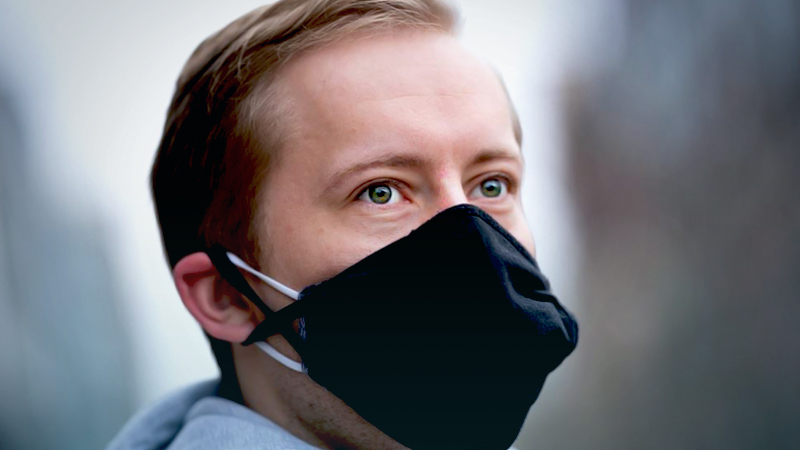 Danny Ryan, 27, is pictured wearing two masks on Wednesday near his home in Washington, D.C. Double masks are becoming a real possibility as a new virus variant makes its way from England, South Africa, and Brazil into the U.S. MUST CREDIT: Washington Post photo by Sarah L. Voisin.
 Doses of the Moderna covid-19 vaccination at a drive-thru clinic at the Richard M. Borchard Regional Fairgrounds in Robstown, Texas, on Jan. 26, 2021. MUST CREDIT: Bloomberg photo by Eddie Seal.
