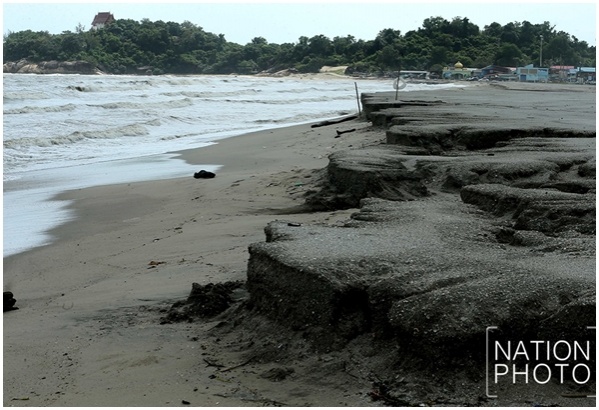
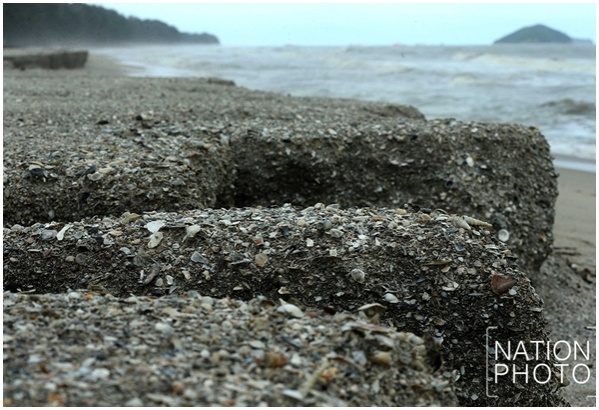
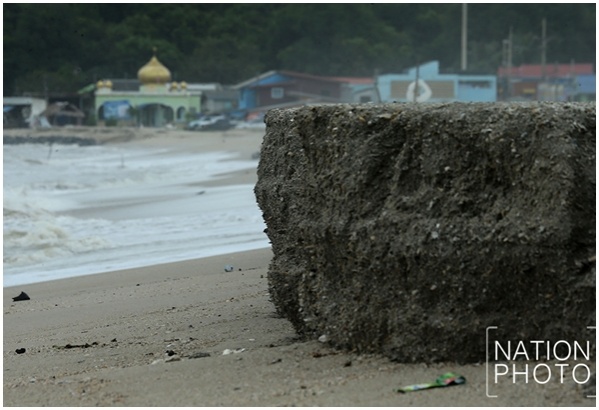
Strong winds at Chalatat Beach Songkhla The seaside of the sand began to disappear again.
November 26, 2020 – 7:55PM
Strong winds at Chalatat Beach Songkhla The seaside of the sand began to disappear again.
On November 26, 2020, The Beach Of Chalathat Beach It is a popular tourist destination in Muang, Songkhla province. It is being tested for its strength and durability from the airwaves again.
After being filled by the Royal Navy, the sand from the sea was replaced. Despite the increase in lost man areas, the south is in the face of heavy monsoon rains almost every day. Repeatedly, the airwaves in the middle of the sea are strongly approaching the shore. The beach has been very eroded. Local residents were concerned that the sand was reclamation. How long will it last for the cruelty of nature?
Pandemic Thanksgiving plans pivot after a surge in coronavirus cases
Health & BeautyNov 25. 2020Cat Lanigan, 23, and her roommates made the decision to take extra precautions, including not eating out, in preparation to travel to see their families at Thanksgiving. MUST CREDIT: Photo by Amanda Voisard for The Washington Post.
By The Washington Post · Emily Davies · NATIONAL, HEALTH, HEALTH-NEWS
Just two weeks ago, Dena Nihart finalized plans to meet dozens of relatives for Thanksgiving dinner beneath a tent in North Carolina’s Outer Banks. They agreed to quarantine for 14 days before the holiday and rent 10 tables so they could separate by household during the big meal.
But then, last Monday, Nihart’s body began to ache. By Wednesday, she could barely hold up her head. And by Friday, as Nihart waited for her coronavirus test results with cases surging around her, her family had canceled Thanksgiving altogether.
“It just sucks,” Nihart said from her bedroom, where she had just placed an online order for a turkey breast. The 45-year-old, who works for a construction company, will spend the holiday alone in her apartment in Arlington, Va.
Families across the region were willing to do almost anything to see one another for Thanksgiving this year. After a long and lonely summer, the number of coronavirus cases seemed to be just low enough by fall that it appeared as though they could find a way to safely gather for the holiday. The recent spike in community spread, however, has thrown a wrench into even the best laid plans. Newly sickened, exposed or fearing the rampant spread of the virus, people in D.C. and beyond say they are canceling their Thanksgiving plans and preparing for Turkey Day at home.
One area epidemiologist called off a trip to New Jersey a few weeks ago, and is now searching for a park at a halfway point to meet her family for a distanced tailgate. Another couple canceled their dinner reservations in an outdoor tent in favor of a carryout meal. Two roommates, 24 and 25, decided to have a wine night instead of traveling home to Texas. And a deacon whose pastor exposed him to the coronavirus last weekend is preparing for a quiet night alone.
The last-minute pivots are in line with new guidance from the Centers for Disease Control and Prevention, which on Thursday recommended against traveling or gathering for the holiday. Agency officials stressed that 1 million new cases were reported in the country in the week before Thanksgiving and warned that small gatherings of friends and relatives could accelerate the outbreak. Leaders in the Washington region echoed the guidance multiple times leading up to the holiday, pleading with their constituents to opt for virtual celebrations.
Still, many area residents are hoping to get together with loved ones be it outdoors or in small numbers. Thousands of people preparing to see relatives and friends lined up at coronavirus testing sites across the District over the past week. The number of people tested daily has risen from fewer than 2,000 during the summer to as many as 4,200, said Christopher Geldart, the city’s director of public works.
On Thursday, Cat Lanigan stood with her laptop in hand about halfway through a line that wrapped around five blocks from a coronavirus testing site in Northeast Washington.
Two weeks ago, Lanigan, 23, and her three roommates decided to condense their pod and stop eating at restaurants to prepare to go home for the holidays. They all were getting tested before traveling home to see older parents and family members.
“I feel like I just need to go home with people I can feel safe with,” she said. “I just feel so much instability right now. Covid changes. The political landscape changes. It’s mental health.”
Lanigan plans to drive home Tuesday to reunite with her immediate family of five, a far cry from her standard 40-person holiday gathering, but a comfort nonetheless.
Danielle Quarles, 41, a director of clinical research in Arlington, decided to abandon plans to see family near New York because of the rising number of coronavirus cases. Instead, she will drive her kids to meet up with their cousins at a park in Philadelphia if they all receive negative coronavirus tests.
“We know that winter is going to be hard and we won’t have opportunities to do it very often as covid continues to surge and the weather is cold,” she said. “So we really just wanted to find a way to let the kids see each other.”
The cousins plan to roam the park in masks and munch on pre-packed turkey.
Others faced with spending the holiday alone have turned to volunteer organizations to find community. Liana Ruiz, 22, who tutors a pod of students in Arlington, has only her cat, Yuki, left as Thanksgiving company after her parents forbade her from coming home because of coronavirus concerns.
She signed up for multiple shifts with Food & Friends, a local nonprofit organization that prepares and delivers meals to thousands of Washington-area residents.
Martha’s Table, a longtime D.C. charity, has more than 100 volunteers signed up for its annual Community Harvest Dinner. This year, the thousands of expected attendees will walk up or drive through to receive meals.
Only a few days away from Pandemic Thanksgiving, some locals are still deciding where, and with whom, they will spend the holiday.
Tyrus Williams, 24, stood at the end of a snaking line for a coronavirus test Thursday afternoon, his first trip out of the house since he received a positive diagnosis two weeks prior. His body aches were gone, congestion cured. But the test would help determine whether he could travel home for his favorite holiday.
Every year, Williams spends months looking forward to Thanksgiving, when many people gather at his family home in Massachusetts. This year, he hoped that at least a subset of the annual group would get tested and quarantine so they could get together for a big meal and hours of watching football on the couch.
“How am I feeling? I’m upset. This is my favorite holiday, and now it’s not going to be a thing,” Williams said before asking an emergency medical services professional near him whether enough tests were available that day (they were).
But it was not only Williams’s test that stood between him and a semi-normal Thanksgiving. On Wednesday, his mom began to feel sick.
“And she does all the cooking, so if she has covid,” he said, “no one is doing Thanksgiving.”
By The Washington Post · Lena H. Sun · NATIONAL, HEALTH, HEALTH-NEWS
WASHINGTON – The federal government plans to send 6.4 million doses of pharmaceutical giant Pfizer’s coronavirus vaccine to communities across the United States within 24 hours of regulatory clearance, with the expectation that shots will be administered quickly to front-line health-care workers, the top priority group, officials said Tuesday.
Gen. Gustave Perna, who oversees logistics for Operation Warp Speed, the Trump administration’s effort to speed up treatments and vaccines, told reporters that state officials were informed Friday night of the allocation, which is based on each state’s overall population.
The amount would cover a portion of the nation’s 20 million health-care workers, let alone the U.S. population of 330 million. But Perna said “a steady drumbeat” of additional doses will be delivered as manufacturing capacity ramps up in each successive week.
With increased prospects that federal regulators will authorize the Pfizer vaccine on an emergency basis as early as mid-December, and the first shots administered before the end of the year, Operation Warp Speed has begun to release more details about the massive and complicated distribution effort to immunize tens of millions of Americans.
U.S. government officials are on track to have 40 million doses of vaccines from Pfizer and a second company, biotech firm Moderna, by the end of the year, enough to vaccinate 20 million people. (Each vaccine requires two doses). It is likely to be April before the general public begins to get vaccinated.
The initial 6.4 million doses also includes vaccines that would go to five federal agencies – the Bureau of Prisons, the Defense and State departments, Indian Health Service, and the Veterans Health Administration – that receive allocations directly from the federal government.
States and territories now have the necessary information to “plan and figure out where they want the vaccine distributed” in the first shipment, Perna said. States are supposed to designate their top five sites capable of receiving and administering the Pfizer vaccine, which must be stored at ultracold temperatures of minus-70 Celsius (minus-94 Fahrenheit), and has exacting handling protocols. The ultracold temperature is significantly below the standard for most vaccines of 2-8 degrees Celsius (36-46°F).
Many states have designated large hospital systems to be the first places to receive vaccines because they have ultracold freezers and can efficiently vaccinate many people. The minimum order for the Pfizer vaccine is 975 doses; for Moderna’s, with a storage temperature that does not require such freezers, the minimum order is 100.
Once a vaccine is cleared by the FDA, an independent advisory panel to the Centers for Disease Control and Prevention – the Advisory Committee on Immunization Practices – will hold a public meeting within 48 hours to vote on final recommendations for the vaccine’s use and who should get the first shots. Health-care workers will be the first priority, the group has said. About 3 million residents of long-term care facilities are also likely to be included in that first phase. Next in line will be an estimated 87 million other essential workers, including first responders, teachers and grocery workers; more than 100 million adults with high-risk medical conditions; and about 53 million adults over the age of 65.
Within 24 hours of FDA action, doses will be “propositioned” at the sites designated by each state to give the shots to the first groups.
Pfizer has been conducting dry runs of each step, from vaccine delivery to opening Pfizer’s GPS-tracked special containers to vaccine storage, Perna said. The company began working last week with four states – Rhode Island, New Mexico, Tennessee and Texas – to familiarize personnel with storage and handling requirements. These dry runs do not include actual vaccines or the dry ice that will be used to keep the vials cold. Additional rehearsals in coming weeks will include dry ice, a federal health official said, speaking on the condition of anonymity because the person was not authorized to speak publicly.
Those “lessons learned” are being shared with other officials, Perna said. There was “initial hesitation” from some personnel at the sites, he said, but “we expect to see growing confidence in people that are using it.”
Americans will receive the vaccine free. The federal government is paying for much of the delivery and vaccine administration costs. But funding remains a big issue for state and local officials, who are asking Congress for at least $8 billion for vaccination efforts; to date, $200 million in federal funds has been sent to state, territorial and local jurisdictions to help them prepare. Federal officials are sending another $140 million in December.
Jeff Duchin, a top official at the Seattle and King County health department, said the more than $10 billion in taxpayer dollars spent on development of covid-19 vaccines by Operation Warp Speed was appropriate.
“But it’s been more like Operation Status Quo with respect to providing the federal funding needed for state and local health departments to actually get vaccine to the population, including the initial priority populations and ultimately, to as many people as possible,” he said in an email Tuesday.
State and local officials say much of the critical planning and implementation work needed for distribution is not adequately funded or staffed. That work includes planning with a broad range of health-care providers for the necessary training and upgrading information systems to vaccinate hard-to-reach and undeserved populations, Duchin said.
Health-care providers also need to track allocations and vaccinations administered, and ensure that people come back for second doses. Public health officials also need to do outreach with local communities that are hesitant about getting the vaccine, he said.
“Tens of millions of dollars are needed for this work in our county and state,” he said. “In addition, this work is tasked to local and state public health departments and workers, who have been grappling with this pandemic nonstop for months and are running on fumes.”











 Cat Lanigan, 23, and her roommates made the decision to take extra precautions, including not eating out, in preparation to travel to see their families at Thanksgiving. MUST CREDIT: Photo by Amanda Voisard for The Washington Post.