A health worker injects a volunteer during clinical trials for a coronavirus vaccine in Hollywood, Fla., in September. (Eva Marie Uzcategui/Bloomberg News)
By The Washington Post · Lena H. Sun · NATIONAL, HEALTH, HEALTH-NEWS State health officials are expressing frustration about a lack of federal financial support as they face orders to prepare to receive and distribute the first doses of a coronavirus vaccine by Nov. 15, even though one is not likely to be approved until later this year. The officials say they don’t have enough money to pay for the enormous and complicated undertaking.
State officials have been planning in earnest in recent weeks to get shots into arms even though no one knows which vaccine will be authorized by the Food and Drug Administration, what special storage and handling may be required and how many doses each state will receive.
Despite those uncertainties, the Centers for Disease Control and Prevention is asking states to be prepared to “preposition” doses in key locations throughout the country. Officials want to move quickly once the FDA authorizes a vaccine and a CDC advisory panel issues recommendations on which populations should be vaccinated, according to a letter the CDC sent Monday to state preparedness and immunization officials.
As part of that effort, the CDC is asking states to provide by Tuesday critical information, including a list of each jurisdiction’s top five sites capable of receiving and administering a vaccine that must be stored at ultracold temperatures of minus-70 Celsius (minus-94 Fahrenheit). The letter refers to the vaccine only as Vaccine A, but industry and health officials have identified it as Pfizer’s candidate.
Pfizer chief executive Albert Bourla said Tuesday that “hundreds of thousands” of doses had already been produced and that a first look at the data would occur soon. Pfizer will not apply for any authorization of its vaccine sooner than the third week of November, when it will have sufficient safety data.
“We acknowledge that you are being asked to do unprecedented work,” wrote Nancy Messonnier, director of the CDC’s National Center for Immunization and Respiratory Diseases, which is leading the CDC’s role in vaccine distribution. She added: “This is a new planning ask.”
State officials say they have been trying to raise the issue with federal officials but have received little response.
“It is absolutely ridiculous that the administration, after spending $10 billion for a Warp Speed effort to develop a vaccine, has no interest in a similar investment in a Warp Speed campaign to get the vaccine to every American as quickly as possible after it is approved,” said Michael Fraser, executive director of the Association of State and Territorial Health Officials.
Operation Warp Speed is the federal initiative, funded by more than $10 billion of taxpayer money, to fast-track development of coronavirus countermeasures.
“The now accelerated timeline underscores the need to address the issue of funding for state and territorial health agencies to make this all work,” Fraser said. “There are many other costs that have no clear way to be paid for at this point.”
Local officials still need to recruit thousands of people to staff vaccine clinics and enroll and train providers. They also have to ramp up information technology and data systems to track vaccine inventory and ordering to ensure people get the correct doses at the right times – most vaccines will require two shots – and to monitor for adverse events. They will need to develop locally tailored vaccination communications campaigns, too.
“States have received some funding, but it’s not nearly enough” to support the scale, scope and speed that is needed, said Claire Hannan, executive director of the Association of Immunization Managers, whose members direct public health immunization programs throughout the country.
States and territories have received $200 million from the CDC to do planning, they said. In the next emergency supplemental funding package, they are asking Congress for at least $8 billion for coronavirus vaccination and $500 million for seasonal influenza vaccine operations, they said in a recent letter to congressional leaders.
Recruiting and training workers for coronavirus vaccination campaigns will cost at least $3 billion. Another $1.2 billion will be needed for cold supply chain management, $1 billion for arranging additional vaccination sites and $500 million for data information system upgrades.
Last month, CDC Director Robert Redfield testified before a congressional committee that roughly $6 billion is needed for the CDC to support states for coronavirus vaccine distribution, which will take place in phases, well into next year.
Natalie Baldassarre, a spokeswoman for the Department of Health and Human Services, CDC’s parent agency, said the CDC has already sent $340 million to states to support flu and coronavirus vaccine planning and distribution. She said the most significant costs of delivering and administering a vaccine will be covered by the federal government and other sources. McKesson Corp., under contract with CDC, will ship vaccines and related supplies to sites where shots will be administered. Pharmacy and insurance reimbursement will cover additional costs, she said.
The CDC plans to send states an additional $140 million before the end of the year, said an HHS official who spoke on the condition of anonymity Thursday because an announcement is pending.
Without additional federal money, “it’s kind of like setting up tent poles without having the tent,” Nirav Shah, director of Maine’s Center for Disease Control and Prevention, said during a recent call with reporters.
Even officials in conservative states say they can’t distribute vaccines without federal help, especially as tens of millions of doses are expected to become widely available next spring and summer.
“As far as trying to reach all populations with an effective vaccine, that’s going to be a real challenge,” Thomas Dobbs, state health director for Mississippi, said on the same call.
The nation’s governors, who are scheduled to speak Friday with HHS Secretary Alex Azar, have been seeking more federal dollars for months. The bipartisan National Governors Association sent a letter to the White House on Oct. 18 with questions about funding.
“Before you hand the baton to the governors, called ‘administer the vaccine,’ the governors need to know what resources? What funding? What is the timetable? What can they expect?” New York’s Democratic governor, Andrew Cuomo, said during a conference call with reporters last week.
“We sent 35 questions to the president,” said Cuomo, chairman of the governors group. “We have gotten no answer.”
Michael Bars, a White House spokesman, said Thursday evening Cuomo has missed the White House’s last 17 governors-only briefings, including a 75-minute vaccine briefing joined by nearly 50 governors and senior officials overseeing the vaccine development process. “It’s unfortunate that the governor would engage in politically-motivated attacks that obstruct the federal planning process than meaningful collaboration to save lives,” Bars said.
At the request of President Donald Trump, Bars said HHS Secretary Alex Azar and the Warp Speed leadership offered a meeting or call with Cuomo on Sunday but that Cuomo declined.
Cuomo’s office did not immediately respond Thursday evening to a request for comment.
HHS officials said senior leaders of Warp Speed also briefed New York State Health Commissioner Howard A. Zucker last month. HHS is also working with the CDC to respond to the governors’ questions. The CDC has already provided assistance to each jurisdiction, including near daily check-ins, weekly conference calls and, in some cases, on-site support, Baldassarre said. The CDC has also answered nearly 400 questions from jurisdictions, she said.
Administration officials have been seeking additional money from Congress, but bipartisan talks aimed at getting a deal on broad coronavirus relief have fallen apart. Prospects for reviving them are uncertain.
If Congress does not provide more funding, HHS is able to transfer money designated for other uses, such as hospital and small-provider relief, to help with vaccine distribution at the state level, according to a health-care industry source familiar with HHS funding decisions who spoke on the condition of anonymity to share internal discussions.
Health & BeautyOct 29. 2020Carlton Coates Jr. and his wife, Juanette Long-Coates, hold a photo of his sister, Carol, 46, and his mother, Dale, 66. MUST CREDIT: Photo by Amanda Andrade-Rhoades for The Washington Post
By The Washington Post · Michael E. Miller · NATIONAL, HEALTH, POLITICS Marine One landed on the White House lawn just before dusk. As its rotors came to a halt, the helicopter’s door swung open and out stepped Donald Trump.
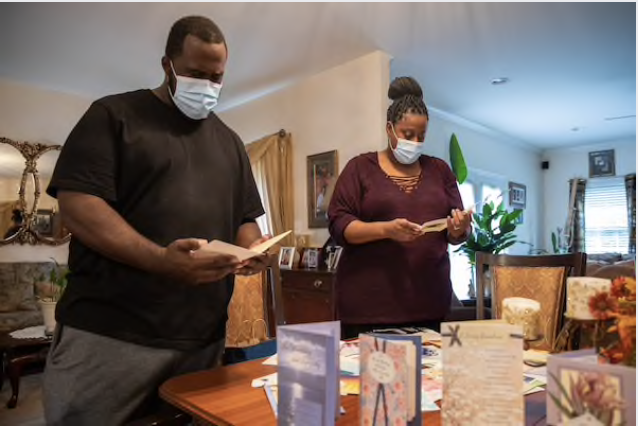
Carlton Coates Jr. and Juanette Long-Coates sort out condolence cards after his sister, Carol, and his mother, Dale, died of covid-19 just days apart. MUST CREDIT: Photo by Amanda Andrade-Rhoades for The Washington Post
The president had just spent three days in Walter Reed National Military Medical Center recovering from covid-19, the disease caused by the novel coronavirus. And in a scene that would be set to dramatic music and tweeted to his 87 million followers, he climbed the steps to a White House balcony, took off his face mask and recorded a video urging the country not to fear the deadly disease.
“Don’t let it dominate you,” he said into a camera on the evening of Oct. 5. ” . . . We have the best medical equipment. We have the best medicines. All developed recently. And you’re gonna beat it.”
Thirty miles away, Carlton Coates Jr. sat in an Annapolis, Md., funeral home, staring at the casket that contained the body of his older sister.
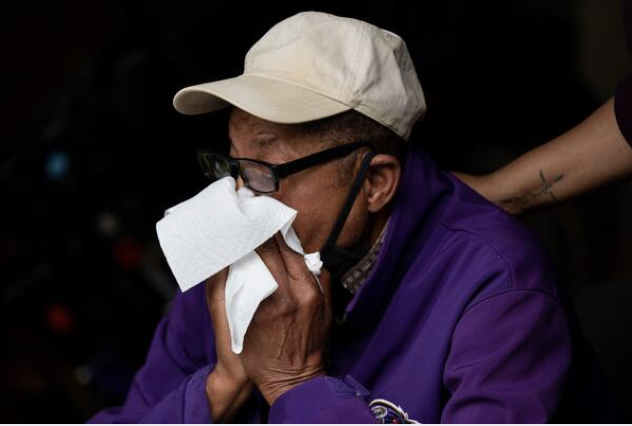
Juanette Long-Coates comforts Ernest Davis, 74, over the loss of Dale, his fiancee. She was “a very jolly person, always smiling,” said a former co-worker. MUST CREDIT: Photo by Amanda Andrade-Rhoades for The Washington Post
Carol Coates had battled covid-19 at the same time as the president. But instead of a suite at Walter Reed, the 46-year-old Black teacher self-isolated in the basement of her family’s home. And instead of the experimental cocktail of antibodies that Trump was given, she received get-well cards from her fifth-grade students.
Carol had taught nine miles from the White House. But her illness unfolded in what seemed like a different universe than the one the president described.
The virus has killed more than 227,000 people in the United States, but it has hit some communities harder than others. Blacks and Hispanics are nearly three times as likely as Whites to contract the disease, according to the Centers for Disease Control. And African Americans are more than twice as likely to die of it.
“Don’t let it take over your lives,” Trump said during his triumphal homecoming video.
Yet for many people of color in the United States, the coronavirus has already taken the life of someone they loved.
It would take even more from Carlton Coates.
His phone buzzed during his sister’s funeral, but the 43-year-old truck driver ignored it. It was only when he returned home and saw people gathered in the driveway that he knew something else had gone wrong. As they stepped out of the car, his fiancee pulled him aside.
“I hate to tell you this,” she said, “but your mom passed away.”
– – –
Carol Coates and her mother, Dale, could hardly have been closer. They lived in the same house outside of Annapolis, along with Carlton and his fiancee. They loved the same music and colorful clothes.
Carol draped her mother in jewelry. Dale talked about her daughter so much that colleagues who’d never met Carol felt like they knew her.
“They were inseparable,” Carlton said.
It’s not clear how the coronavirus crept into the pretty house with blue shutters in Anne Arundel County. But when it did, it was little surprise that both mother and daughter got sick.
The family had been vigilant ever since Maryland Gov. Larry Hogan, a Republican, had shut down much of the state on March 12 – the same day Trump insisted the pandemic was “going to go away,” a claim he has made dozens of times.
By then, a member of Carol and Carlton’s congregation was already sick with covid-19 and would soon be put on a ventilator. Within a few weeks, a couple connected to Dale’s church would die of the disease.
“As the saying goes, ‘When White folks catch a cold, Black folks catch pneumonia,’ ” said the Rev. Stephen Tillett, Dale’s pastor at Asbury Broadneck United Methodist Church.
The Coates family feared the virus, especially because Dale’s 74-year-old fiance and her 84-year-old mother also lived with them. But with four members of the household going to work throughout the pandemic, they wouldn’t be able to escape it.
Dale was one of two Black receptionists at a predominantly White retirement home called Sunrise Senior Living in Annapolis, where the 66-year-old was known for having a personality as bright as her outfits.
“She was a very jolly person, always smiling,” recalled Carolyn Muir, who left Sunrise in 2018 to return to her native England, but not before Dale introduced her to the wonders of go-go and gospel.
As the pandemic deepened – hitting one nursing home after another and eventually infecting four residents and nine employees at Sunrise – Dale kept working despite her worries over falling ill. Sunrise Senior Living said in a statement that it has been vigilant in preventing the spread of the coronavirus, giving employees masks and other personal protective equipment and testing them weekly.
“Thank you, God, I had a negative test,” Dale would say when she returned home from work, Carlton recalled.
He was still working, too, hauling construction materials and machine parts for projects that never stopped. And so was his fiancee, who worked in a dental office that remained open.
Carol hadn’t gone into Adelphi Elementary School in Prince George’s County since mid-March. But she still spent hours each day in front of her computermaking sure her fifth-graders – many of whom were English language learners or in special education – had access to the Internet and course materials.
Carol also kept her part-time job selling costume jewelry. She called the side business Carol’s Sassy Accessories, posting photos or videos on social media and, when the pandemic ebbed, setting up a display table in parks on weekends. She sent her mother to Sunrise in rhinestone-covered necklaces and matching earrings.
“She loved to make people look good,” said her boyfriend, Anthony Wilson. The $5 pieces of jewelry were never going to make her rich. But Carol enjoyed when friends came to the park or tuned in online for “Wear It Well Wednesdays” and “Sassy Sundays.”
She brought the same energy to her classes when they resumed online in August. She could no longer hug her students or play music while they worked. But she could still coax them into opening up with “Figure Me Out Friday” puzzles and songs where students rapped about their weekend plans.
“I’ve been teaching for 16 years,” said her co-teacher, Alan Konlande. “She had different tricks that I had never seen before.”
Carol was careful to wear a mask and sanitize her hands, Wilson said. But one day in mid-September she called him to say she wasn’t feeling well and was going to get tested for the coronavirus.
She was shocked when it came back positive, he said.
Carol told Konlande she had the virus but kept teaching, even as she coughed and sniffled through class.
“Our last day working together on Zoom, I just noticed when she turned her head, she didn’t look well,” Konlande recalled.
After he repeatedly urged her to take time off, she reluctantly agreed.
On Sept. 24, her students emailed her get-well cards.
“Dear Ms. Coates, I hope you feel better!” one girl wrote next to a cartoon drawing of a teacher in front of a chalkboard. “We miss you and hope to see you next monday.”
“I am so glad i took your advice and took off,” she wrote Konlande that night. “I slept for like 3 days straight. Fever, aches and chills no appetite.”
“Keep resting,” he replied. “This is no joke.”
“I realize now how serious it is,” she answered, adding that she felt “a little better” and was hoping to return the next week.
Friends and family members left food at the top of the basement stairs, including bottles of her favorite orange juice, Florida’s Natural.
Two floors up, Dale was also struggling. She had long suffered from arthritis and carpal tunnel syndrome, her son said. But now she was so exhausted she could hardly get out of bed. She, too, had tested positive and stayed home from work. Her fiance, Ernest Davis, brought her food and slept on the floor next to her bed.
On Sunday, Sept. 27, Dale was so weak that Davis called 911.
Her family watched from a distance as she was loaded into an ambulance and taken to Anne Arundel Medical Center. Stuck in the basement, Carol couldn’t even say goodbye.
“Is mom back yet?” she texted her brother a few hours later.
Doctors were going to keep her at the hospital on fluids and oxygen before releasing her, he replied.
“Wow,” she wrote.
When Wilson chatted with Carol on FaceTime that evening, she looked as healthy as she had in a couple of days. She was sorting jewelry and watching football. She was worried about her mother but she said she felt fine.
The couple had made plans to celebrate her birthday the following weekend in Virginia Beach, and Carol was determined to recover in time. What she didn’t know was that Wilson was planning to propose.
But when Wilson texted her “good morning pooh” the next day, she didn’t reply.
He called her but she didn’t answer.
“Just checking in on you,” texted her co-teacher, Konlande. “How are you feeling?”
He also heard nothing.
Carlton was at work that afternoon when he received a worried call from Wilson, who still hadn’t reached Carol.
Carlton dialed his 15-year-old daughter and asked her to check on her auntie. But when the teenager shouted down into the basement, there was only silence.
Carlton told her to put on a mask and gloves, and then watched on FaceTime as his daughter descended into the basement and looked into Carol’s bedroom.
“I just saw my daughter’s face,” he recalled. “She just peeked in there and then ran back upstairs, kind of traumatized.”
For the second time in as many days, an ambulance pulled up to the house with blue shutters. But this time, there would be no trip to the hospital.
Carlton was driving when he received a call from his fiancee, Juanette Long, who had come home after the final fitting for her wedding dress to find her future sister-in-law wasn’t breathing.
“She’s gone,” she told him.
That night, the couple went to see Dale at the hospital, where she had been moved to the intensive care unit. Her son said she was being given convalescent plasma and remdesivir, an antiviral drug that the president would also receive, but not the experimental antibody cocktail made by Regeneron, which Trump would credit with his recovery.
Relatives had warned Carlton not to tell his mother that her firstborn child was dead for fear she would have a heart attack. But doctors said it was better for that to happen at the hospital than after she left.
And so, after asking how she was feeling, they broke the bad news.
“Oh no. Oh, my God. My baby girl,” Dale replied, according to her son.
For three days, Carlton struggled to sleep and eat while making funeral arrangements for Carol. When he and Juanette went back to visit Dale on the evening of Oct. 1, they found her oxygen tube had been replaced by an oxygen mask. A doctor warned them that her blood oxygen levels were still dangerously low.
When Dale spoke, however, she seemed upbeat.
“She was praising and worshiping God, lifting up her hands,” Carlton recalled.
At one point, he and his mother sang Carol’s favorite gospel songs through their masks.
But when he called to check on her the next day, a nurse told him that Dale was being put on a ventilator.
“I love you,” he told her over the phone. “Be strong. Hang in there. I need you.”
“OK,” she replied before slipping into sedation.
Within a few hours, Trump would be whisked to Walter Reed.
By the time the president was released three days later – feeling, he said, “better than 20 years ago” – Dale and her daughter were both dead.
– – –
“There is a time for everything,” Tillett said on Oct. 13 as he stood behind Dale’s silver casket, which had just been closed to the sound of wailing. “A time to be born and a time to die; a time to plant and a time to uproot; a time to weep and a time to laugh; a time to mourn and a time to dance.”
Again and again, the pandemic had brought his community pain, Tillett said. Including members of his congregation and their relatives, Dale was the seventh person connected to his church to die of covid-19.
But amid the mourning there had been moments ofmuch-neededjoy, he noted.
Two days earlier, Carlton had stood at the front of his church, holding a microphone as Juanette walked down the aisle in her white dress.
“The stars have all aligned,” he crooned as around 100 guests looked on in masks. “And right now is the perfect time to say I love you.”
The last time he had sung had been at his mother’s hospital bed, when she had made him promise he wouldn’t cancel the wedding.
“Make sure you have a memorial table for Carol,” she had said.
Instead, the memorial table had been for her, too.
As he finished his eulogy, Tillett told a few dozen mourners at the William Reese & Sons Mortuary to turn to their faith.
“The enemy doesn’t get the final say,” he said. “Covid doesn’t get the final say.”
Sitting in the front row, Juanette squeezed her new husband’s hand.
The virus had taken so much from them. And yet, a week after his release from Walter Reed, the president was already back on the campaign trail. The day before Dale’s funeral, Trump had held his first rally since his hospitalization.
“Now they say I’m immune,” he told the crowd of more than 2,000, most of whom did not wear masks. “I feel so powerful. I’ll walk into that audience. I’ll walk in there. I’ll kiss everyone in that audience.”
Carlton and Juanette had danced just once at their abbreviated wedding. But after touting coronavirus “cures” and promising 100 million vaccine doses by year’s end, the president walked to the end of the stage and began to shimmy.



































 Carlton Coates Jr. and his wife, Juanette Long-Coates, hold a photo of his sister, Carol, 46, and his mother, Dale, 66. MUST CREDIT: Photo by Amanda Andrade-Rhoades for The Washington Post