Ebola outbreak in Congo finally wanes #ศาสตร์เกษตรดินปุ๋ย

#ศาสตร์เกษตรดินปุ๋ย : ขอบคุณแหล่งข้อมูล : หนังสือพิมพ์ The Nation

https://www.nationthailand.com/lifestyle/30382153?utm_source=category&utm_medium=internal_referral

Ebola outbreak in Congo finally wanes

Feb 14. 2020
By The Washington Post · Max Bearak 

ADDIS ABABA, Ethiopia – The second-biggest Ebola outbreak in history, which has upended life in eastern Congo’s North Kivu and Ituri provinces since August 2018, infecting nearly 3,500 people and killing about 2,250, is down to its last chain of transmission.

Despite ongoing violence that has hampered the response from its outset, and that has spiked again recently, new cases have dwindled. At its height last May, hundreds were contracting the disease every week.

The waning of the Ebola outbreak comes as a new one captures global attention – and potentially funding, too. Global health officials have warned that while the novel coronavirus, now known as covid-19, racks up thousands of new cases a day, the hard work of ending the Ebola outbreak and preventing another is far from over.

“Funding needs [for the Ebola response] have not as yet been fully met, and currently there is a risk there will not be funding for WHO activities beyond February,” said Margaret Harris, a World Health Organization spokeswoman.

On Wednesday, an independent committee that advises the WHO unanimously agreed that the Ebola outbreak “still constitutes a public health emergency of international concern” – a designation that was recently extended to the covid-19 outbreak.

Ebola and covid-19 are vastly different viruses; Ebola can be transmitted only through exchange of bodily fluids, but it killed nearly 70 percent of those who contracted it in eastern Congo.

The WHO’s director general, Tedros Adhanom Ghebreyesus, said Thursday that covid-19 “might have adverse consequences for the [Ebola] response efforts through diminishing focus” on it.

While the WHO, the U.S. Centers for Disease Control and Prevention, a constellation of nonprofits and the Congolese Health Ministry have mounted a relentless campaign to contain Ebola, little has been done to shore up the region’s health system, which is sorely lacking in even the most basic infrastructure. Ebola is endemic to Congo’s rainforest, and the likelihood of future outbreaks is high.

“Only half of health facilities have access to water,” said Tedros. “Strengthening a health system may not be as sexy as responding to an outbreak, but it is equally important.”

Almost all of this month’s cases have been reported in the restive city of Beni, which has also been besieged by an Islamist militia that calls itself the Allied Democratic Forces, or ADF.

In late October, the Congolese military launched an offensive against the ADF, complicating the Ebola response and sparking a wave of retaliatory attacks that have killed hundreds of civilians. The offensive has been lauded by Congo’s president, Félix Tshisekedi, as nearly flushing the group out of Beni and the surrounding region, but a resurgence of ADF attacks in February has cast doubt on those claims.

Harris, the WHO spokeswoman, said that while officials were confident in asserting that only one chain of Ebola transmission remains, ongoing violence has made it impossible to reach some areas that have had cases over the past few months.

“Given the lack of access in some areas like Lwemba, it’s possible that there are other areas where there could be cases that we are not aware of, but it’s unlikely,” she said.

With the end of the outbreak in sight, some of the response’s protocols have shifted as resources have been freed up from emergency activities. Now, patients can be afforded a greater degree of comfort, instead of being confined to Ebola treatment centers where the dead and dying were present.

“Everyone who has been in contact with someone confirmed to have Ebola is now offered the option of voluntary isolation – meaning that if they would like, they can be accommodated in a guesthouse where they are provided with food and health support – so that they can be monitored as closely as possible, and if they develop symptoms they can be brought to care as quickly as possible,” Harris said. “Most people are taking up this offer.”

In addition to a shortfall of investments in eastern Congo’s health infrastructure, a large funding gap exists for an ongoing measles outbreak in the same region that has killed 6,300 people in far less time than Ebola.

Peace is also unlikely to return soon to the region, known as the Great Lakes for its defining geographical feature, as competition over minerals heats up between the Congolese, Ugandan, Rwandan and Burundian governments and local militias aligned with them.

“The Great Lakes region is increasingly on edge. Distrust is rife among Burundi, Rwanda and Uganda, all of which have connections to insurgents in eastern Congo,” said a recent report by the International Crisis Group. Plans by Congo’s Tshisekedi to invite armies from those countries to help defeat the ADF and other groups heightens the chances for an intensification of conflict.

“Were Burundian, Rwandan and Ugandan forces given a green light” to operate in Congo, the report said, “the danger would be all the graver, raising the specter of an interlocking proxy war wherein each Great Lakes country is backing its rivals’ enemies.”

How climate experts think about raising children who will inherit a planet in crisis #ศาสตร์เกษตรดินปุ๋ย

#ศาสตร์เกษตรดินปุ๋ย : ขอบคุณแหล่งข้อมูล : หนังสือพิมพ์ The Nation

https://www.nationthailand.com/lifestyle/30382189?utm_source=category&utm_medium=internal_referral

How climate experts think about raising children who will inherit a planet in crisis

Feb 15. 2020
Parents should help their children envision a future that is happy and safe, climate scientist Sarah Myhre says - but to do that, they must first process their own sense of fear and loss. MUST CREDIT: Photo by Jovelle Tamayo for The Washington Post

Parents should help their children envision a future that is happy and safe, climate scientist Sarah Myhre says – but to do that, they must first process their own sense of fear and loss. MUST CREDIT: Photo by Jovelle Tamayo for The Washington Post
By The Washington Post · Caitlin Gibson · NATIONAL, FEATURES

n the midst of a winter that hasn’t felt much like one, as the coldest temperatures retreated to the highest latitudes, Jedediah Britton-Purdy carried his 5-month-old son, James, outside their home in New York City to bask in the unseasonable warmth.

As a professor of environmental law at Columbia University, Britton-Purdy was acutely aware of the ominous implications of the city’s record highs. As a new father, what was there to do but revel in his child’s first true sense of springtime?

"It's really important to let kids know that they were born into a changing world, that they did not betray the world by being born, and that they are born into a time where they can do profound good," says scientist Sarah Myhre, shown with her 6-year-old son, Ansel, and her fiance, Zac Reynolds. MUST CREDIT: Photo by Jovelle Tamayo for The Washington Post

“It’s really important to let kids know that they were born into a changing world, that they did not betray the world by being born, and that they are born into a time where they can do profound good,” says scientist Sarah Myhre, shown with her 6-year-old son, Ansel, and her fiance, Zac Reynolds. MUST CREDIT: Photo by Jovelle Tamayo for The Washington Post

“These are the first beautiful days he is feeling: We walk out in the warm sun, we laugh together, we look at a tree,” Britton-Purdy says. “Yet the experience is infused with all of this harm, all of this damage that has made this beautiful, beautiful day that I’m having with him.” He sighs. “We really haven’t figured out, he and I, what to do with that yet.”

What to do with that – a world that is breaking down, and a child who is growing up? Parents are meant to be guardians and guides, the ones to help their offspring make sense of the present and envision a future. Philosophically, and practically, this is a daunting task in the best of times – and these are not the best of times, particularly if one happens to be a climate scientist, or an environmental justice activist, or anyone whose profession demands a constant, clear-eyed acknowledgment of the damage wrought by the climate crisis.
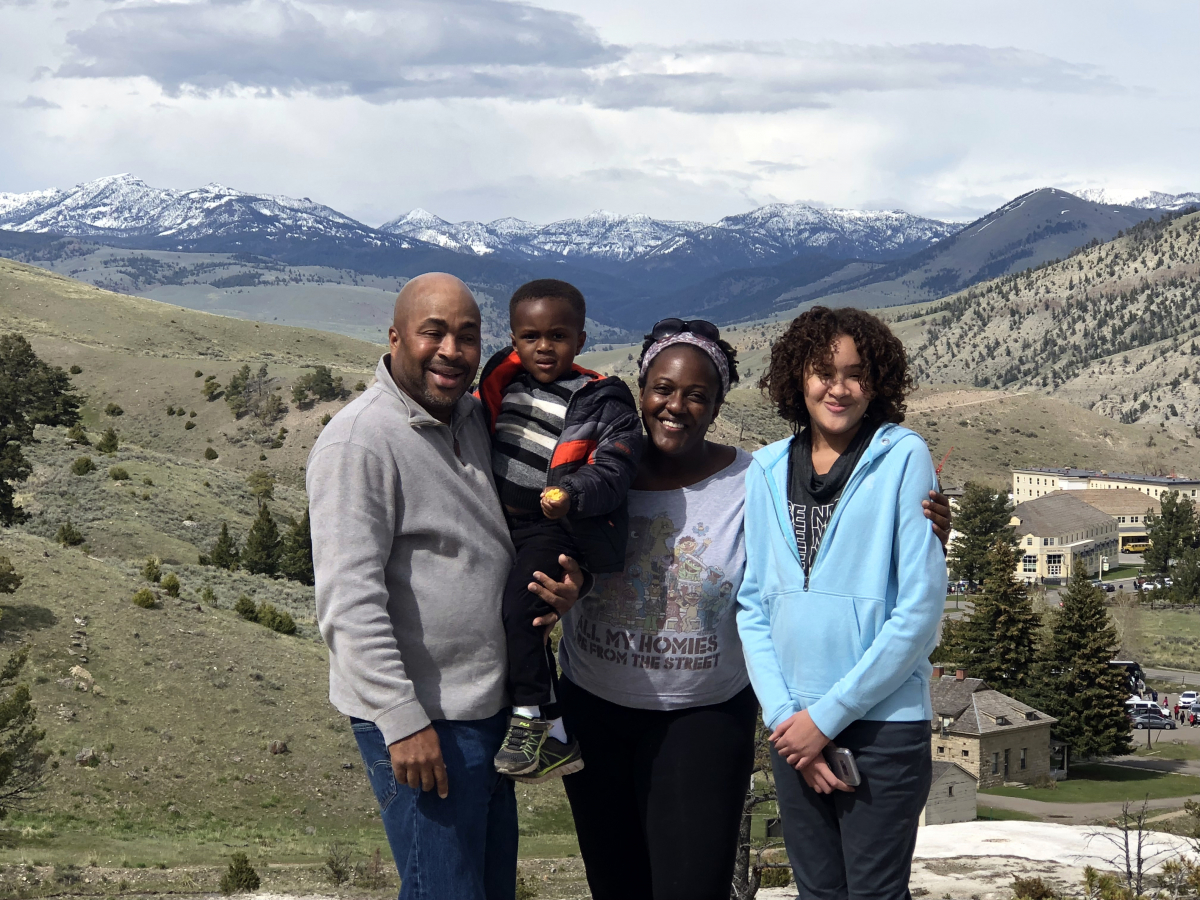
"I do not want my children operating in fear. I do not want them operating in a mind-set that all hope is lost," says Heather McTeer Toney, center with her family on a visit to Yellowstone National Park. MUST CREDIT: Family photo

“I do not want my children operating in fear. I do not want them operating in a mind-set that all hope is lost,” says Heather McTeer Toney, center with her family on a visit to Yellowstone National Park. MUST CREDIT: Family photo

But this clarity can also be a gift, one that forces a sincere engagement with the problem. When Britton-Purdy became a father, his perception of the world and the threats against it shifted; the crisis, he says, took on a new immediacy.

“My own temperament is that I’ve always been able to go on, even with a sense of loss, and have kind of a cheerful attitude toward the future as a practical matter,” he says. “But now that I feel personally and intimately anchored in the future in a different way, I feel a different kind of fear. The fear is right up against my heart in a way that makes it harder to think about what comes next.”

After the birth of her son four years ago, climate scientist Kate Marvel experienced what she calls “a very profound revelation.” Marvel’s work for NASA and Columbia University involves projecting the future – not predicting, she emphasizes, but presenting possibilities of what could happen. Those projections once felt abstract. “But then I’m realizing, ‘Oh my God, somebody I love is going to be 35 in 2050,’ ” she says. “And that was just a very visceral thing for me.”

One day last year, Marvel and her son stepped aboard the shuttle that runs between Grand Central Terminal and Times Square in New York City, and found themselves surrounded by a brilliant, bustling coral reef; the subway car was wrapped in an ad for David Attenborough’s “Our Planet” series. Her little boy was awestruck.

“And I remember thinking, suddenly: This may be the closest thing he ever sees to an actual coral reef,” she says. “I felt a jolt at that.”

But Marvel does not dwell on those sorts of thoughts, and when people ask her, as they often do, whether she is filled with existential dread as a climate scientist and a mother, she tells them emphatically that she is not. Her work has taught her that what matters is what we do right now, and the urgency of that edict leaves no room, no time for despondence.

“I think, when a lot of people talk about climate change and having kids, they’re looking to the future and despairing,” she says. “For me, it makes me look at the present and be incredibly resolved.”

– – –

In the face of potential climate catastrophe, some have questioned whether it’s moral to become a parent – is such a burden fair to the broken planet, or to the child who would inherit it? But Sarah Myhre, a climate scientist in Seattle and the mother of a 6-year-old son, rejects this line of thinking. You can’t save humanity by abandoning it, she says, and these sorts of messages are harmful to the children who are already here.

“Kids are listening to that, and what they hear is that their presence in this world is a violation of the world itself,” she says. “It’s really important to let kids know that they were born into a changing world, that they did not betray the world by being born, and that they are born into a time where they can do profound good and have really transcendent, powerful impacts on the world.”

That is what she’ll tell her son, when he’s old enough to ask about his future; for now, Myhre is focused on helping her son become the strongest, kindest person he can be.

“I believe that the through line for us, as communities, as individuals, is the humanity that we bring to solving problems,” she says. “Our ethic of care, our empathy, our stewardship of one another. And so I think that stewarding that particular aspect of my son’s internal life is really important to me, so that he is coming to the world with a robust, empathetic, integrated sense of self.”

This means that her family prioritizes quality time together, she says. “I have made a large pivot in my life, as a parent, toward the cultivation of joy on a daily basis,” she says. “It’s easy to say and a lot harder to do – because joy requires us to be vulnerable, it requires us to be in the moment.”

Joy is what Britton-Purdy wants for his son, too, and so he will pause on a walk to place the infant’s fingers against the knobby bark of a tree, and someday he will show his child how to use a knot of twigs to dam the flow of creekwater, the way he once did as a young boy on the farm in West Virginia where his family still lives. He will teach James to marvel at nature wherever he can find it.

“I want James to have an intimate foreground of experience that is really connected with the life of things, and the amazing wonder of living things, and not have his first thought be that it’s all going away,” Britton-Purdy says.

And when it is time to talk about what is going away, he will remind his son that things have always been going away, that the natural world has been inexorably altered by humanity for centuries. Britton-Purdy wants James to knows this: that beauty and change and loss have always coexisted.

“We have to not exaggerate or distort what it was like, or the nature of what’s being lost,” he says, “or else we will fall into a nostalgia for a world that never was.”

There is resilience to be found in an honest accounting of our past, says Heather McTeer Toney, a former regional Environmental Protection Agency administrator and national field director for Moms Clean Air Force. As an environmental justice activist and African American woman, she wants to instill the perseverance and perspective of her ancestors in her 3-year-old son and 14-year-old daughter: “We’ve had no choice other than to figure out how we’re going to adapt and live,” she says. “This is not new to us.”

Sometimes, after her children have gone to bed, she and her husband talk about where they should take the kids, the places they should see quickly, before they are irreparably changed. But when she speaks to her children about what lies ahead, there is no lingering in sorrow; she is determined that they will thrive.

“My entire ancestral line is built on, ‘You have to figure out how to make it work, how to survive, because no one is going to help you,’ ” she says. “I do not want my children operating in fear. I do not want them operating in a mind-set that all hope is lost. That is not my mind-set.”

A rash of violent storms recently swept through their town in Mississippi, and when the house lost power, Toney saw her teenager immediately reach for a flashlight and her smartphone. The storms, Toney says, have become more frequent lately, more severe, and she knows this pattern will worsen in the years ahead. She watched her daughter cradling her phone and thought of what would happen when, eventually, the battery died.

Toney’s response was pragmatic: She would show her daughter where the candles were kept, and teach her to make her own light.

– – –

How do we tell our children stories about the lives they might live, and the planet they will live on, with an ending that is still filled with possibility?

“It is true that everything is going to have to change, and it’s going to change one way or another – either because we’re undergoing profound climatic shifts, or because we’re going to have to change the way we get energy and the way we run society,” Kate Marvel says. “Especially for young people who have these amazing imaginations, that gives them space to dream. And I think right now we’re really just focusing on the nightmares.”

Parents must help their children imagine a future that is happy and safe, Sarah Myhre agrees – but to do that, they must first process their own sense of fear and loss. “If parents can’t transcend and make sense out of their feelings, and derive action and meaning from their feelings, then they are stuck,” she says, “and they are going to transpose that stuckness, that anxiety, onto their children.”

This has always been the work of parenting, all the more essential now in extraordinary times: to hold a steady balance between grief and gratitude, to find a way to move with purpose through a world that brims with both beauty and heartbreak.

Myhre feels this tension most in the North Cascades, where the snowline is receding steadily up the mountainsides – where, in recent years, the ski resorts she grew up frequenting have sometimes opened late and closed early. Throughout her formative years, there was nowhere that brought Myhre greater joy, and it has become her son’s favorite place, too. But someday in his adulthood, she knows, he won’t be able to ski on those slopes anymore.

“There is this finite and precious window that he’s in right now,” she says, “and it’s going to shut.”

This winter, Myhre has taken her child to the mountains every chance she gets. With each visit, his movements become more self-assured, more confident, more ecstatic. She follows through the snow, watching her son and his world transforming.

Richmond grapples with high eviction rate #ศาสตร์เกษตรดินปุ๋ย

#ศาสตร์เกษตรดินปุ๋ย : ขอบคุณแหล่งข้อมูล : หนังสือพิมพ์ The Nation

https://www.nationthailand.com/lifestyle/30382159?utm_source=category&utm_medium=internal_referral

Richmond grapples with high eviction rate

Feb 15. 2020
Civil Process Sgt. Larry Trotter and Deputy John Vaughan enter an apartment that had received an eviction order in Richmond, Va. MUST CREDIT: Washington Post photo by Luis Velarde.

Civil Process Sgt. Larry Trotter and Deputy John Vaughan enter an apartment that had received an eviction order in Richmond, Va. MUST CREDIT: Washington Post photo by Luis Velarde.
By The Washington Post · Luis Velarde

RICHMOND, Va. – “Sheriff’s office! Anybody home?” yelled a sheriff’s deputy with his hand over his gun, his holster unsnapped.

Deputy John Vaughan opened the door of an apartment that was empty enough to make his voice echo. A red scooter and an old crib were the only items left.

“Cleared!” he yelled after inspecting each room. The apartment complex’s custodian, who had been waiting outside, was allowed in and quickly began to change the locks.

Laurette Turner looks at her cellphone as she tries to find cheap hotels around Richmond, Va. MUST CREDIT: Washington Post photo by Luis Velarde.

Laurette Turner looks at her cellphone as she tries to find cheap hotels around Richmond, Va. MUST CREDIT: Washington Post photo by Luis Velarde.

The same scene was witnessed 14 times by a Washington Post reporter one November morning in this state capital, which according to data collected at Princeton’s Eviction Lab has the second-highest eviction rate in the country.

The Richmond City Sheriff’s Office had a light load that day: 55 eviction orders. On more typical days, the number jumps to 70 or higher, officials said.

In Southwood, a neighborhood where rents range from $500 to $800 a month for two-bedroom townhouses and apartments, advocates say it has become common to see people cram their belongings in plastic bags, place them in car trunks and leave their apartments before a handful of deputies come to knock on their door.

For many, these scenes are not new.

Advocates and experts say the eviction tradition in Richmond and other Southern cities and towns dates back generations, and has affected black communities the most.

“There has been a housing crisis, an eviction crisis and a displacement crisis for several decades,” said Benjamin Teresa, co-director of the RVA Eviction Lab at Virginia Commonwealth University, who has studied housing issues in Virginia and other Southern states.

He points to laws favoring landlords like “pay or quit,” which allows landlords to launch eviction proceedings five days after the payment grace period (other states provide up to 30 days).

Teresa said minority communities in Richmond are subjected to predatory lending and discrimination, especially renters who use federal housing vouchers. Landlords can refuse to accept vouchers, and he said landlords who do accept them often steer tenants to housing in poor neighborhoods.

With a new Democratic majority in the General Assembly, advocates were hoping for ambitious housing reform across the commonwealth this year. More than a dozen measures were introduced to tackle housing issues, but none “explicitly deals with eviction,” said Christie Marra, a family and housing attorney with the Virginia Poverty Law Center.

She said most of the focus has been on giving tenants tools to ensure their housing is safe and habitable, cap fees assessed after late rent payments and force landlords to make or pay for repairs.

A measure requiring landlords to provide tenants a list of their rights and responsibilities at the beginning of the lease term was approved by the Senate with bipartisan support and is awaiting action by the House.

The Senate unanimously approved and sent to the House a bill that would give tenants the right to make essential repairs and deduct them from their rent if a landlord refuses or does not take care of the issue within 14 days.

Another bill, proposed by state Sen. Scott Surovell, D-Fairfax, would allow judges to expunge eviction records from cases that were dismissed or withdrawn by the landlord. Such records can make it hard for renters to secure leases in the future. The bill passed the Senate unanimously and is expected to be heard in the House next week.

And despite opposition, the House approved 61 to 37 a bill that bans landlords from refusing housing vouchers as payment. The measure was referred to the Senate.

Marra said the legislation is leading the state in the right direction.

“I think we all needed time to see what could get done in some of these other areas,” she said. “And then regroup once this session ends to try to really focus on gathering together groups of tenants in the high evicting areas to hear directly from them.”

– – –

A few days after Vaughan searched the apartment with the red scooter, Laurette Turner, 64, sat at the end of a hotel bed on the other side of Richmond. She was talking to yet another employee of a housing organization that aims to help evictees.

She was evicted in June, along with her daughter and three grandchildren, from a government-subsidized apartment complex where she had lived for more than eight years, mostly on disability payments and government assistance.

Turner said the property managers at Townes at River South apartments lost two of her rent payments; staff at the complex said they were unable to comment on her case.

For more than six months, Turner sought help from nonprofits and government organizations in searching for permanent housing. Having an eviction on her rental record meant many landlords turned her away, she said, so cheap hotels were often the only option.

She compared rates, called reception desks, negotiated with case managers for enough funding to stay for a few days or a week. Each time she needed to leave, she moved her family’s belongings in plastic bags.

“Everybody thinks the homeless are the people on the street or the people walking up and down the street for money. Or people sleeping in their cars,” she said in her room at the Quality Inn in Northside Richmond. “But it’s more than that.”

Before Christmas, she found a landlord willing to rent them a townhouse for six months. “It has three bedrooms, one bath, living room, dining area and kitchen with washer and dryer hookups,” she texted a Washington Post reporter. “Thank God for his grace and mercy.”

Turner has been trying to get the landlord to install a washer and dryer, and hopes to extend the lease until the end of 2020. She also wants to pay a credit repair service she saw on television, which she believes could get the eviction erased from her record.

“I’m going to find out,” she said Tuesday.

Those carrying out removals were unaware an eviction epidemic was plaguing their hometown until Princeton’s Eviction Lab study, which found that the 10 U.S. cities with the highest eviction rates included five from Virginia: Richmond, Hampton, Newport News, Norfolk and Chesapeake.

“It was an eye-opener,” said Civil Process Sgt. Larry Trotter. “We have five deputies and we’re at number two. It’s not a number you celebrate. Nobody was celebrating.”

The attention, he says, prompted roundtable discussions with Democratic Gov. Ralph Northam and local officials, who sought his input on how to decrease the eviction rate. He believes, however, those efforts were flawed.

“The ones at the roundtables should have been the judges, and the ones who make these laws,” Trotter said. “Everybody wants a quick fix. There is no quick fix to it.”

Trotter, who is black and grew up in Petersburg, a city 21 miles south of Richmond, said he became a deputy sheriff because he wanted to help society and give law enforcement a positive light in his community.

” I wanted to be the person that people can say, ‘Okay, he has a badge, but he’s still him. He has a badge, but he’s not out here abusing me,’ ” he said. “Because that’s what I seen coming up.”

Years ago, Trotter was on the other side of an eviction order. He was unemployed and recovering from knee surgery when he was put out of his apartment.

He lived in his car and sent his family to stay with his in-laws.

He draws from his personal story to try to help those he evicts, telling them that instead of putting blame on others, they should instead learn what options are available and ask, “Where do I go from here?”

He carries pamphlets in his shirt pocket with information on legal and housing services, and even talks to evictees about openings at the Sheriff’s Office.

“I can do no more, no less with the power that I’m given,” Trotter said. “You don’t want to put people out, but you have to because you have to do your job.”

The Nook: Love Frankie offers escape for mentally troubled young people #ศาสตร์เกษตรดินปุ๋ย

#ศาสตร์เกษตรดินปุ๋ย : ขอบคุณแหล่งข้อมูล : หนังสือพิมพ์ The Nation

https://www.nationthailand.com/lifestyle/30382014?utm_source=category&utm_medium=internal_referral

The Nook: Love Frankie offers escape for mentally troubled young people

Feb 12. 2020
Rebecca ‘Frankie’ Mok and Matt Love, founders

Rebecca ‘Frankie’ Mok and Matt Love, founders
By The Nation

It’s been estimated that 2.62 million people in Thailand are dealing with mental illness in isolation. The lack of social support can worsen mental illness in multiple ways, including relapse, slow response to treatment, mood disorders and, in worst cases, can lead to suicide.

Young people are the most affected by this isolation, struggling due to a lack of networks and safe spaces where they might share their experiences. One million young Thais deal with clinical depression every day and 3.5 per cent of the youth population struggles with anxiety disorders, unable to reach out for help.

Social-change creative agency Love Frankie, in partnership with Acorn & Associates and TQPR, have introduced the Nook, a free-to-visit pop-up space that hosts workshops, sharing circles and coaching in wellness practices.

“Our own independent research looking into key barriers young people face about mental health in Thailand found out that many young Thais long for safe spaces to share and receive guidance, but there are very few such places,” said Love Frankie co-founder Rebecca Frankie.

Initially at Yelo House, the Bangkok warehouse-turned-creative space, from February 29 to March 3, daily from 9am to 8pm, the Nook will host more than 30 activities.

These will include art therapy workshops by Persona Studio and Labaai, group discussions facilitated by Aristotle’s Café, talks with experts like Amornthep Sachamuneewongse, founder of Sati App, and wellness activities led by Cat Lau, Karma Break and Mindful Sparks.

Mahanakhon SkyWalk dangles ‘Love at first height’ to couples in love #ศาสตร์เกษตรดินปุ๋ย

#ศาสตร์เกษตรดินปุ๋ย : ขอบคุณแหล่งข้อมูล : หนังสือพิมพ์ The Nation

https://www.nationthailand.com/lifestyle/30382040?utm_source=category&utm_medium=internal_referral

Mahanakhon SkyWalk dangles ‘Love at first height’ to couples in love

Feb 12. 2020
By THE NATION

Mahanakhon SkyWalk, Thailand’s highest observation deck and rooftop, invites couples to experience “Love at First Height” from the 78th floor rooftop of the iconic pixelated building.

Couples can enjoy photo moments against colorful romance-inspired balloon and LED light decorations on the 74th floor indoor observation deck before sending a souvenir post-card from Bangkok’s highest postbox.

Enjoy DJ and live outdoor entertainment on Thailand’s highest rooftop from 5pm onwards. Experience an adventurous and exhilarating walk across a glass tray floor, and enjoy a panoramic 360-degree view of Bangkok’s sunset and skyline from 314 meters.

The “Love at first height” package includes entry for two adults, a limited-edition photo album and keychain souvenir, a postcard—to be sent from Bangkok’s highest postbox on the 74th floor, two mocktails and a traditional Thai snack on the 78th floor rooftop for the price of Bt2,200 per couple during 8-16 February 2020.

The iconic attraction is open daily from 10 am to midnight.

Move over, pot: Psychedelic companies are about to go public #ศาสตร์เกษตรดินปุ๋ย

#ศาสตร์เกษตรดินปุ๋ย : ขอบคุณแหล่งข้อมูล : หนังสือพิมพ์ The Nation

https://www.nationthailand.com/lifestyle/30381967?utm_source=category&utm_medium=internal_referral

Move over, pot: Psychedelic companies are about to go public

Feb 11. 2020
By Syndication Washington Post, Bloomberg · Kristine Owram · BUSINESS, HEALTH

The first companies developing medical treatments from psychedelic drugs like LSD, ketamine and the active ingredient in magic mushrooms are gearing up to list on Canadian stock exchanges.

Mind Medicine Inc., which is undertaking clinical trials of psychedelic-based drugs, intends to list on Toronto’s NEO Exchange by the first week of March, said JR Rahn, the company’s co-founder and director. A NEO spokesman confirmed the listing, which is pending final approvals.

The company plans to list via a reverse takeover under the ticker MMED. It’s not yet generating revenue and is targeting a valuation of approximately $50 million, Rahn said. Mind Medicine counts former Canopy Growth Corp. co-chief executive officer Bruce Linton as a director and Shark Tank star Kevin O’Leary as an investor.

“Our ambition is to be one of the first publicly listed neuro-pharmaceutical companies developing psychedelic medicines,” Rahn said in a phone interview.

For those who are still getting used to legal marijuana, the idea of publicly traded companies working with psychedelic drugs like MDMA and psilocybin, which is derived from magic mushrooms, may sound a bit out there.

Yet a growing number of companies are conducting clinical trials of psychedelic treatments for everything from depression to post-traumatic stress disorder, and some have recently received the blessing of the U.S. Food and Drug Administration. This has created a legal way for these companies to conduct research on otherwise illegal drugs, opening the door to public listings.

In late 2018, the FDA gave “breakthrough therapy” status to a psilocybin treatment developed by London-based Compass Pathways Ltd. for clinical depression, expediting the development process.

Meanwhile, Toronto-based Mind Medicine is preparing a Phase 2 clinical trial into the use of a psychedelic called ibogaine to treat opioid addiction, which will be conducted in New York and governed by the FDA.

Compass Pathways declined to comment on whether it’s planning a public listing, but the company is “always looking at options to ensure continued growth and funding,” chief communications officer Tracy Cheung said in an email.

The Canadian Securities Exchange, which has become the go-to bourse for U.S. cannabis companies that can’t list in their home country, is also expecting listings from psychedelic drug companies in 2020.

The FDA has “given clearance for a variety of trials at this point and it looks like they are going to be expanding that framework,” said Richard Carleton, CEO of the Canadian Securities Exchange. “If that is the case then I’m certain we’ll see our first issuers probably before the middle of the year.”

There’s growing investor interest in psychedelics, said Ronan Levy, executive chairman of Field Trip Psychedelics Inc. Field Trip is building a network of clinics focused on ketamine-enhanced psychotherapy, with the first one opening in Toronto next month and others planned for New York City and Los Angeles. It’s also conducting research into psilocybin at the University of the West Indies in Jamaica.

Last week, Field Trip closed a Series A financing round that raised $8.5 million from a variety of investors including cannabis-focused asset manager Silver Spike Capital and Harris Fricker, the former CEO of GMP Capital Inc., which helped a number of marijuana companies go public.

The funding round attracted interest from all over the world, including “some very large Silicon Valley tech investors and entrepreneurs,” Levy said.

Field Trip is considering a public listing, although Levy also sees further opportunities to raise private funding, he said. Unlike cannabis, which remains federally illegal in the U.S., the work psychedelic companies are doing is legal. This creates “greater opportunity to access growth capital from private investors in the U.S. who may not touch cannabis,” he said.

It also sets the industry apart from cannabis, which has seen stock prices collapse amid slower-than-expected sales in Canada and ongoing federal illegality in the U.S.

“I think that the psychedelics industry could be much bigger than the cannabis industry because it’s going to attract institutional capital and already is starting to,” Rahn said. “It’s also going to be a more concentrated space because the barriers to entry are much higher.”

Journalist Ezra Klein: ‘The more you’re tied to the news cycle, the harder it is to actually step away from that’ #ศาสตร์เกษตรดินปุ๋ย

#ศาสตร์เกษตรดินปุ๋ย : ขอบคุณแหล่งข้อมูล : หนังสือพิมพ์ The Nation

https://www.nationthailand.com/lifestyle/30381974?utm_source=category&utm_medium=internal_referral

Journalist Ezra Klein: ‘The more you’re tied to the news cycle, the harder it is to actually step away from that’

Feb 11. 2020
Ezra Klein is a political journalist, blogger and co-founder of and editor-at-large at Vox. MUST CREDIT: Photo for The Washington Post by Chloe Aftel

Ezra Klein is a political journalist, blogger and co-founder of and editor-at-large at Vox. MUST CREDIT: Photo for The Washington Post by Chloe Aftel
By Special To The Washington Post · KK Ottesen 

Ezra Klein, 35, is a political journalist, blogger, commentator, and co-founder of and editor-at-large at Vox. He has also been a columnist for The Washington Post. His book “Why We’re Polarized” was published in January. He lives in Oakland, California.

Q. You were an early political blogger back when that was just starting out. What led to your interest in politics and to political journalism in the first place?

A. I had a history teacher once who said that there are certain moments when you feel the fists of history tightening around you. And I think 9/11 was a moment for me when I realized that whether or not I was interested in politics, it was going to be interested in me. So that was when I really started paying attention in a deeper way and trying to understand and figure things out. And I was doing this blog because I thought a lot about politics, and I wanted to talk to people about it, and blogging was a way to do that. I thought I would be a political staffer of some kind, work on the (Capitol) Hill or on campaigns. It was only later that it became clear that my path in politics was going to be in writing and in journalism, not working for candidates. Because I actually hated doing that.

Q. Why did you hate that? You worked on Howard Dean’s campaign, right?

A. I was an intern on Howard Dean’s campaign. Nothing against Howard Dean, who I respect greatly. And supporting candidates is, obviously, essential to make change in the system. But it just wasn’t my way. On campaigns, what you had to do was fall in line behind whatever some candidate said, thought or did. I was interested in trying to understand problems and solutions, and wanted to be able to honestly investigate, find conclusions, convey them to people and work toward them. I would be on the campaign, and they’d come out with a policy. And some other candidate would come out with a plan that I thought was better. And you can’t say, “Well, you know, John Kerry’s or John Edwards’ plan is really the way to go.” [Laughs.] But – and I cannot stress enough – I was an intern on this campaign. Nobody gave a s— what I thought. I was in the field office sending bumper stickers to people.

Q. In your book, you talk about the dangers of polarization, but obviously the media has had a large role in amplifying certain voices and increasing that polarization.

A. Something that I thought a lot about when starting Vox was that we wanted to make this argument that what’s most important isn’t always what’s new. But we also wanted to explain the news. And those two things have some amount of conflict to them. The more you’re tied to the news cycle, the harder it is to actually step away from that. And then, that begins being driven by social media and Donald Trump and trolls and other players and powers that make pretty bad decisions about what we should all be focusing on. Then all of a sudden you might be explaining news that would be better if you were simply ignoring in favor of other important topics. But that’s really hard to do when everybody else is covering something, and so it looks weird to your audience if you don’t cover it.

I’ve come to think a lot about the way we are trapped and manipulated by an incoherent definition of “newsworthiness.” And the way that we think in journalism that our power comes from covering things positively or negatively. But it actually comes from amplifying things. A lot of our power is just what we shine the spotlight on. And if other people understand how to make us shine the spotlight on the worst actors and things and controversies then, even if we’re doing good work about those bad actors and bad things and bad controversies, we might be adding to the toxicity of the system. So for me, a lot of my work was just trying to figure out ways that we can do good journalism adapting to the moment and the technology and how media manipulators are actually operating.

Q. You’ve pointed out that because of broken systems of accountability we can’t get bipartisan support for even really big challenges, like the impeachment process now.

A. There is a high school civics theory that the way American government is structured is competition between branches. You’ll still find that today is high school civics textbooks. And it just isn’t true. The way our government today is structured is competition between parties – two parties. And they compete across branches and enlist themselves in the other branches to help. So Donald Trump is being impeached by Democrats, functionally. And he’s enlisted congressional Republicans to help. And Mitch McConnell has been very clear that he is going to do everything he can to help Donald Trump out. The system is not built to work under those conditions. But that is how it works.

At the beginning of every single policy argument I’ve ever covered, I’ll sit in these rooms with people on the left and people on the right and people in the middle and people on the far left and Libertarians, and there’s a lot of agreement, ways to make almost anything a bit better for most people. And then, by the end of a highly public process, it’s just a party-line vote. It’s incredibly polarizing. Polarization makes you afraid of what the other party will do. And all of that zone of compromise is gone. We’re like Lucy with the football, where every time we restart, we think it’s going to be different. You know, Barack Obama with his massive grass-roots army and the aftermath of a financial crisis and his once-in-a-generation set of political talents. Well, surely, he can bring the country together. OK, maybe not. Well, Donald Trump, this disruptive force. A wrecking ball to the system. A populist Republican who will inaugurate this new era. Surely, he’ll change it. And then, no, he becomes the most polarizing president ever. And now either Joe Biden is going to heal our souls or Bernie Sanders is going to set off a political revolution. You know, name your theory.

At some point, we need an answer for why we seem to end up in the same place. It starts to become clear that if you just throw more people at the same system, they’re going to have more or less the same outcome. And so, the long generational project is somehow changing the system.

Q: On a personal level, why did you need to write a book on polarization?

A: What I was trying to do for myself, as a reporter and somebody who tries to understand these things, was rebuild a model of politics almost from the ground up. A model robust enough to explain Obama and Trump’s presidencies – how they’re connected to each other, and how they are symptoms and subject to these broader forces that are also affecting the media, affecting how we run campaigns, affecting even how we speak to and treat and love each other.

And so, the impetus was: I don’t understand this. I don’t understand why this is working this way. And for me, the great gift of journalism is being able to then say, “OK, I’m going to try to figure it out.”

Scientists hope antiviral drug being tested in China could help patients #ศาสตร์เกษตรดินปุ๋ย

#ศาสตร์เกษตรดินปุ๋ย : ขอบคุณแหล่งข้อมูล : หนังสือพิมพ์ The Nation

https://www.nationthailand.com/lifestyle/30381935?utm_source=category&utm_medium=internal_referral

Scientists hope antiviral drug being tested in China could help patients

Feb 11. 2020

http://www.washingtonpost.com/video/politics/trump-says-chinas-president-told-him-heat-generally-kills-viruses-like-the-coronavirus/2020/02/10/

By The Washington Post · Carolyn Y. Johnson, Adam Taylor
China tentatively returned to work Monday after an extended Lunar New Year shutdown precipitated by the coronavirus outbreak, but with deaths from the epidemic continuing to rise, much of the country remained at a standstill, and many were working from home.

.
https://www.washingtonpost.com/video/politics/trump-chinas-president-says-heat-generally-kills-viruses-like-the-coronavirus/2020/02/10/f24867f2-b361-4e08-8a01-abffebc4725f_video.html

https://www.washingtonpost.com/video/c/embed/f24867f2-b361-4e08-8a01-abffebc4725f
.

Chinese health officials announced Monday that 103 more people died from coronavirus, bringing the total global death toll to 1,013. The health ministry in Hubei province also confirmed 2,097 new cases of the disease, which has now sickened more than 42,000 people around the world, the majority in mainland China. More than 6,000 remained in critical condition in the hospital, officials said.

The outbreak has claimed 974 lives in Hubei province, the epicenter of the public health crisis. A Japanese citizen and an American citizen were recorded dead in Wuhan over the weekend.

More than 25,000 people remained hospitalized in mainland China, and roughly 76,000 were under medical observation, according to Chinese officials.

In Japan, an additional 65 people on board a quarantined cruise ship have tested positive for the virus, according to Japan’s Health Ministry. Pressure is mounting to test everyone on the ship now docked in Yokohama, where 135 people are known to have been infected. Eleven Americans are among the additional people, the cruise ship operator said Monday.

Earlier, U.S. officials confirmed that physicians in Wuhan, China, began testing an experimental drug called remdesivir last week.

The drug, made by Gilead Sciences, was successfully used on the first U.S. patient, a 35-year-old man in Snohomish County, Washington. He recovered, but a single case can’t determine the extent to which the drug may have contributed.

Although remdesivir failed an ebola clinical trial, it has shown promise in laboratory tests against other coronaviruses, including severe acute respiratory syndrome (SARS) and Middle East respiratory syndrome (MERS).

Timothy Sheahan, an assistant professor of epidemiology at the Gillings School of Global Public Health at the University of North Carolina at Chapel Hill, said that instead of developing a new drug for each emerging virus, the hope is that remdesivir could be broadly useful and work against multiple coronaviruses.

“I think starting a clinical trial is essential for determining if this drug will work” against the coronavirus, Sheahan said.

One of the clinical studies will test remdesivir on infected patients who are in the hospital but do not have severe symptoms. The other will test it on people with severe infections, who are on supplemental oxygen or have other complications.

Gilead is providing the drug to Chinese researchers at no charge, according to spokeswoman Sonia Choi.

An advance team of World Health Organization experts has arrived in China to help lay the groundwork for a larger team, officials from the organization said Monday.

The team is led by Bruce Aylward, a Canadian physician and epidemiologist, who previously worked on the WHO’s response to the 2014 ebola outbreak in West Africa.

“Bruce and his colleagues will be working with their Chinese counterparts to make sure we have the right expertise on the team to answer the right questions,” Tedros Adhanom Ghebreyesus, the WHO director general, told reporters at a daily news conference.

Officials from the WHO declined to be drawn into specifics about what Aylward’s team would be doing in China, describing the members as medical professionals who would be given a large degree of autonomy to coordinate with local counterparts.

“The team is there first and foremost to learn,” said Michael Ryan, executive director of the WHO health emergencies program.

Tedros had made a trip to Beijing for preliminary talks with President Xi Jinping and Chinese officials in late January, during which it was agreed that an international mission would be sent, but subsequent deliberations over its format lasted weeks.

Some public health experts have criticized the Chinese government for initially misleading the world about the threat posed by the outbreak.

“We were deceived,” Lawrence Gostin, a professor of global health law at Georgetown University who also provides technical assistance to the WHO, told The Washington Post.

A new disease-transmission model created by University of Toronto researchers suggests that the coronavirus epidemic started in November, one month earlier than commonly believed.

The model uses open-access data to replicate epidemiological scenarios, allowing the researchers to test some narratives about the outbreak.

Although it is only a model, it may provide a plausible explanation for how the virus was able to spread so quickly – useful in the absence of hard evidence.

“You can’t get up to that level of cases if the epidemic started in December even if you pushed the reproduction really high,” David Fisman, a professor in the Dalla Lana School of Public Health and one of the model’s creators, said in a statement.

In China on Monday, emergency service workers were soaking cars, buildings and airplanes with disinfecting spray in an attempt to eliminate the virus from the city of Wuhan, where the epidemic began.

It’s unclear how effective the method is, especially considering that the entire region is under a travel lockdown and many people are not venturing outside.

Thus far, experts think the coronavirus is largely transmitted by close person-to-person contact and respiratory droplets. “Some coronaviruses can persist on surfaces, but I usually don’t think of a street as a surface I worry about,” Rivers said.

Hong Kong’s Center for Health Protection announced early Tuesday that it would be evacuating some residents of an apartment building after two people were diagnosed with coronavirus, despite living in apartments 10 stories apart.

Officials said engineers from Hong Kong’s housing department would investigate the sewage system in the building to see whether it could have been the source of the virus’s spread.

During the 2003 SARS outbreak, more than 300 people were infected in the Amoy Gardens apartment complex in Kowloon, Hong Kong, eventually leading to a quarantine of the apartment complex. Officials later said that the outbreak had spread through bathroom drainpipes.

Some 3,600 passengers and crew were allowed to disembark from a ferry quarantined in Hong Kong on Sunday after all 1,800 crew members tested negative for the virus. It was feared the crew members might have come into contact with infected passengers on a previous trip.

In Washington, President Donald Trump said Monday that Xi reassured him that the cases of coronavirus are likely to dwindle during warmer months.

“He feels very confident, he feels very confident,” Trump said. “And he feels that, again as I mentioned, by April, or during the month of April, the heat generally speaking kills this kind of virus. So that would be a good thing.”

Trump made the remarks during a meeting with governors at the White House. He had spoken with China’s leader on the phone Friday.

In Canada, the coronavirus will “undoubtedly” have a “real” impact on the economy, the country’s finance minister said Monday.

Delivering a keynote address at a meeting of the Economic Club of Canada in Alberta, Bill Morneau said the virus is likely to disrupt supply chains and hit Canada’s tourism sector. He also noted that oil prices have fallen 15% since the outbreak began because of a decrease in demand and fewer flights traveling to and from China.

There have been seven confirmed cases of the coronavirus in Canada.

Russian health authorities are monitoring more than 20,000 people in their country for signs of the virus, including 6,000 Chinese citizens. Two cases of the virus have been found so far.

Russia’s Federal Anti-Monopoly Service warned Monday of “economic looting” by retailers seeking to take advantage of the crisis, with a sharp increase in the cost of medical masks across Russia.

“The vast increase in retail prices for medical masks in 68 regions of the Russian Federation has all the indications of ‘economic looting’ during a period of increased demand,” the FAS said in a statement.

Russian President Vladimir Putin said last week that pharmacies that price-gouged on medicines and medical masks should have their licenses canceled.

A top Chinese diplomat has been quarantined by Russian authorities as a safety precaution, Interfax news agency reported Monday.

The diplomat, Consul General Cui Shaochun, had arrived in Yekaterinburg on Thursday to take up his new post but had not yet met with any Russian diplomats, according to Interfax.

Li Ka-Shing, the richest person in Hong Kong with , has pledged a donation of $12.9 million to help Wuhan, the city at the center of the coronavirus outbreak.

The donation was made through the Li Ka Shing Foundation, which announced the news Monday that it would be making the donation “in support of the frontline healthcare professionals battling the Novel Coronavirus outbreak in Wuhan.”

Li, who has an estimated net worth of $29.4 billion, is one of Asia’s best-known philanthropists. His charitable organization is the second largest private and individual-led foundation in the world, after the Bill & Melinda Gates Foundation.

On Thursday, the Gates Foundation announced that it would commit $100 million toward the global response to the coronavirus epidemic. A number of other wealthy figures have pledged money to help in the fight against the outbreak.

The Jack Ma Foundation, established by and named after the Chinese billionaire and co-founder of Alibaba Group, pledged $14.4 million toward fighting the outbreak in late January. The funding will primarily go toward vaccine research underway at Chinese institutions. Other big names donating millions in funds include the online food delivery company Meituan Dianping, logistics subsidiary Cainiao Global and Tencent Charity Foundation. Alibaba’s payment and health subsidiaries are also offering loans and free services to affected people.

Love in the time of coronavirus, quarantines and travel bans #ศาสตร์เกษตรดินปุ๋ย

#ศาสตร์เกษตรดินปุ๋ย : ขอบคุณแหล่งข้อมูล : หนังสือพิมพ์ The Nation

https://www.nationthailand.com/lifestyle/30381877?utm_source=category&utm_medium=internal_referral

Love in the time of coronavirus, quarantines and travel bans

Feb 10. 2020
By The Washington Post · Miriam Berger · WORLD, HEALTH
There’s nothing like a quarantine or an international travel ban to test a relationship.

Gabrielle Autry, a 26-year-old American from Georgia living with her Chinese boyfriend in Hangzhou, China, suddenly experienced this firsthand. Hangzhou is the capital of Zhejiang province, one of the worst-hit by the coronavirus outbreak that has killed at least 720 people and infected more than 34,000 in China since December. The world around her is on lockdown.

But although Autry had the choice to leave because of her U.S. citizenship, she stayed. Her boyfriend, now effectively trapped along with many other Chinese nationals by travel restrictions, would otherwise have had to stay alone in their shared apartment.

“I’m not leaving, even though I can,” she told The Washington Post. “It wouldn’t be the right thing to do for our relationship, just to leave him.”

Their bond has weathered the first storm. But their reality is far from romantic.

As China and governments around the world impose hastily concocted quarantines, travel bans and evacuations, mixed-nationality couples and families looking to leave China have found themselves divided by citizenship status. Frustration and anxiety is running high as people struggle to navigate emergency measures meant to contain the virus, but which critics say have stoked xenophobia and public panic.

Monte Gisborne, a Canadian citizen whose wife and stepchild are visiting relatives in the Chinese city of Wuhan, the epicenter of the epidemic, had hoped that they would get seats on a plane evacuating Canadians. He said Canada excluded his wife and child because they are Canadian permanent residents, not citizens. “Aren’t we a Canadian family?” he asked.

Getting out of China, no matter one’s nationality, is getting harder and harder. Airlines around the world are canceling flights. Countries are imposing bans on people traveling from China. Within the country, movement between and within cities is highly restricted. Chinese regulations and diplomatic relations have further complicated some efforts by governments to evacuate their citizens.

On Jan. 31, the Trump administration issued stringent new travel restrictions, effectively barring entry to any non-U.S. citizens who recently traveled in China and imposing a 14-day quarantine on returning U.S. citizens. Chinese nationals who are spouses or immediate family members of a U.S. citizen are exempt from the ban.

Autry and her boyfriend, Li, who spoke on the condition that only his last name be used to protect his privacy given sensitivities around the virus, had been set to travel to Hong Kong to get engaged. The couple met while she was studying in China. Two years later, “he’s part of my family,” she said.

Then the virus hit. Autry first heard about it from the U.S. media and Reddit, she said, while news from China was censored. The two decided to proactively self-quarantine and began limiting trips outside their apartment. After a few weeks, officials formally banned any unnecessary travel.

These days, the guards at Autry’s apartment complex take her temperature before and after she steps out for a moment to pick up delivered groceries, she said. Inside, life is fairly boring: Li works remotely, she studies Chinese and they play video games. But at least they’re together.

“I can’t imagine being alone in this kind of situation,” she said. “(Leaving), it’s not something I would even consider.”

Others have been separated, though not by choice.

Gisborne’s wife, Daniela Luo, and their daughter, 9-year-old Dominica, were visiting Luo’s family in Wuhan when the quarantine took effect. Gisborne had not joined the trip.

As permanent residents of Canada, Luo and her daughter have nearly all the rights of Canadian citizens; however, Canada only allows permanent residents seats on flights out if they are accompanying a minor who is a Canadian citizen – so Luo and her daughter suddenly don’t count. They have no option but to remain in Wuhan.

“If there is a reason for the criteria, it has not been made clear to us,” Gisborne said. “I really need clear information from my government.”

Gisborne is gripped by fear and anxiety about what his daughter and wife have to endure. “Who would not be afraid for their family and try and do whatever they can?” he said.

Countless families have faced a maddening array of international barriers.

Kai Huang, a Canadian citizen, had to decide whether to leave Wuhan or stay with his 78-year-old mother, a permanent Canadian resident not allowed on the Canadian flight, he told the Canadian Broadcasting Corp. Two weeks ago, British authorities first told Natalie Francis, a British citizen working in Wuhan, that her 3-year-old son, Jamie, who is a dual British-Chinese citizen, would not be allowed to leave on the flight with her because of his Chinese citizenship.

“It really wasn’t up until the very last minute that she got some assurance there was a strong possibility her and Jamie would be allowed on the flight,” Francis’s aunt, Michele Carlisle, told the BBC.

Back in China, Autry said her boyfriend’s family doesn’t trust reports from the Chinese government. They are also extremely distrustful of the United States, which Chinese media and officials have accused of using the outbreak to weaken China. It’s uncomfortable, she said, but it hasn’t had an effect on their relationship.

“They said no, their issues are with the American government and not with me,” she said.

As you age, strength training can be vital in staying healthy and independent #ศาสตร์เกษตรดินปุ๋ย

#ศาสตร์เกษตรดินปุ๋ย : ขอบคุณแหล่งข้อมูล : หนังสือพิมพ์ The Nation

https://www.nationthailand.com/lifestyle/30381875?utm_source=category&utm_medium=internal_referral

As you age, strength training can be vital in staying healthy and independent

Feb 09. 2020
By Special To The Washington Post · Amanda Loudin · HEALTH
When an intruder broke into the Rochester, New York, home of 82-year-old Willie Murphy a few months ago, he was met with a big surprise. Murphy, a diminutive but powerlifting woman, quickly jumped into action, using her strength to pummel the intruder with a broom and send him running for the door.

Not surprisingly, the story went viral as people embraced the images of the elderly Murphy flexing her muscles for the cameras.

While older men and women needn’t become powerlifters, athletes like Murphy who lift massive weights, experts say strength training – using weights heavier than you might expect – can be an important component of a healthy future.

Beginning about age 30, men and women lose muscle mass at about the rate of 10 percent per decade until about 50, when that loss accelerates to 15 percent per decade, according to research.

By the eighth decade, the loss of muscle mass – known as sarcopenia – and strength can be severe, greatly affecting quality of life by increasing the odds of falls and bone breaks that can cascade into other medical problems.

“When we talk about bone health and falls, we talk about three factors: fall, fragility and force,” says Matt Sedgley, sports medicine physician with the MedStar Orthopaedic Institute. “Participating in weight-bearing and resistance-training exercises helps develop muscle mass. This may help treat fragility conditions like osteoporosis. So if you fall you have stronger bone density. It may also lead to more cushioning when you do fall.”

Building strength can also help with the ability to stay independent as someone ages. “Strength declines rapidly if it’s not maintained,” says Seth Larsen, a Fort Worth-based primary care physician and certified strength and conditioning coach. “Without it, daily activities like picking up a bag of groceries, opening a kitchen cabinet or getting in and out of a chair can become difficult.”

Resistance training can be part of the antidote, but picking up five-pound dumbbells and doing a few biceps curls won’t get you where you need to be, Larsen says.

“In daily life, you’re going to need to lift things bigger than five pounds all the time, You might also need to catch yourself from falling, or get yourself off the floor. Both require far more strength,” he says.

For the best results, experts say a varied, heavier workload is needed.

“In most cases, what people think of as strength training really isn’t,” says Chris Nentarz, a Buffalo-based physical therapist. “If you want to offset age-related muscle loss, you need to be working at an intensity of 60 percent to 80 percent of your maximum load (meaning the highest amount you can lift). You can’t recruit your muscles if you aren’t working hard enough.”

Larsen agrees. “If you don’t overload your tissues, they won’t respond,” he says. “If you continue using the same weights and rep scheme, you’ll actually go backwards. The body wants and needs to be challenged.”

Before embarking on a program of heavier weight training, however, it’s important to get a medical checkup, particularly if the person is middle aged or older, with a focus on heart health to ensure it can handle the demands, Larsen says. And it’s important to assess whether there are any muscular problems or bone issues that need to be worked with before starting a new regimen. “The approach should be very individualized,” he says. “If vascular health is good, there’s not much off limits, but you need to start simple and progress.”

After that, finding a qualified trainer, gym or coach is the best place to learn how to lift weights without injury and also obtain guidance for progression to heavier loads.

Many gyms offer basic weightlifting classes using everything from barbells, dumbbells and kettlebells, or, in larger gyms, even a TRX system, a suspension system of straps that taxes you with body weight.

At the heart of a good strength routine, says Larsen, are several moves. “You need to be able to push, pull, hinge at the hips, carry and squat,” he says. “And as you age, you must be able to get up off the floor in case you fall. This is what saves lives.”

Developing good balance is also important, and something you can work on with your strength routine. Mortality rates within a year of a hip fracture in populations over 60 range between 14 percent and 58 percent.

“The most common algorithms to assess fall risk recommend strength and balance exercises whether you are found to have low, moderate or high risk for falls,” Sedgley says. If it is not challenged, balance disappears with age. Strength moves that meet this need include those like a split squat – where one leg is in front in a lunge position – with a barbell you are able to handle comfortably on your back/shoulders.

The good news is that to make the strength and balance gains you need, you won’t have to invest a massive amount of time.

“Three to four sessions a week that include 20 to 30 minutes of intense training does it,” Nentarz says. “Use some of that time to practice your moves with good form.” Especially for beginners, a trainer can help discern the right starting weight as well as watch your form to help you make adjustments and ensure you are executing the moves properly.

Larsen adds that good form is key and should serve as a guiding principle. “Your workload should be determined by your ability to complete it with the proper form,” he says.

Another guiding principle is progressing in small increments. “We know that spikes in volume or intensity increases the risk of injury,” Nentarz says. “In general, this means increasing either at a rate of about 10 percent week to week.”

If you begin chest pressing using an empty barbell pole – weighing 35 pounds for women/45 for men – then you’d go up 3.5 pounds/4.5 pounds the next week, assuming you have proper form at the lower weight and have performed the exercise several times the previous week so your muscles are prepared.

Michele Greenfield, 58, has been active all her life – including as a collegiate swimmer.

Since college, she has been a runner and has weight trained. But two years ago, she felt like her strength-training routine had stagnated, so she began taking group fitness classes that included a large element of strength training at a nearby gym.

Today, she says her legs have more muscle tone, her back is stronger and her overall body composition has changed.

And progressing to lifting much heavier weights has made a difference. “I don’t need to return to the strength level of my college days, but I want to take advantage of the things I can control as I age,” she says.

“I see some of the older people in my life and how they have to work to do simple things, like getting out of the car,” she says. “I feel confident in my strength and movement and I want to stave off losses as long as possible.”

As for Willie Murphy, the 5-foot powerlifter who bested the intruder, she told NBC’s “Today” show that she began powerlifting in her mid-70s to stay healthy, fit and independent.

“When it snows in Rochester, guess who’s doing the snow? Me,” she said in the interview.