It is too soon for the World Health Organisation (WHO) to refer to monkeypox subvariants as clades, an expert virologist said.
WHO met virologists and public health experts earlier this month, and they decided that the Congo Basin and West African subvariants will be referred to as Clade I and Clade II respectively.
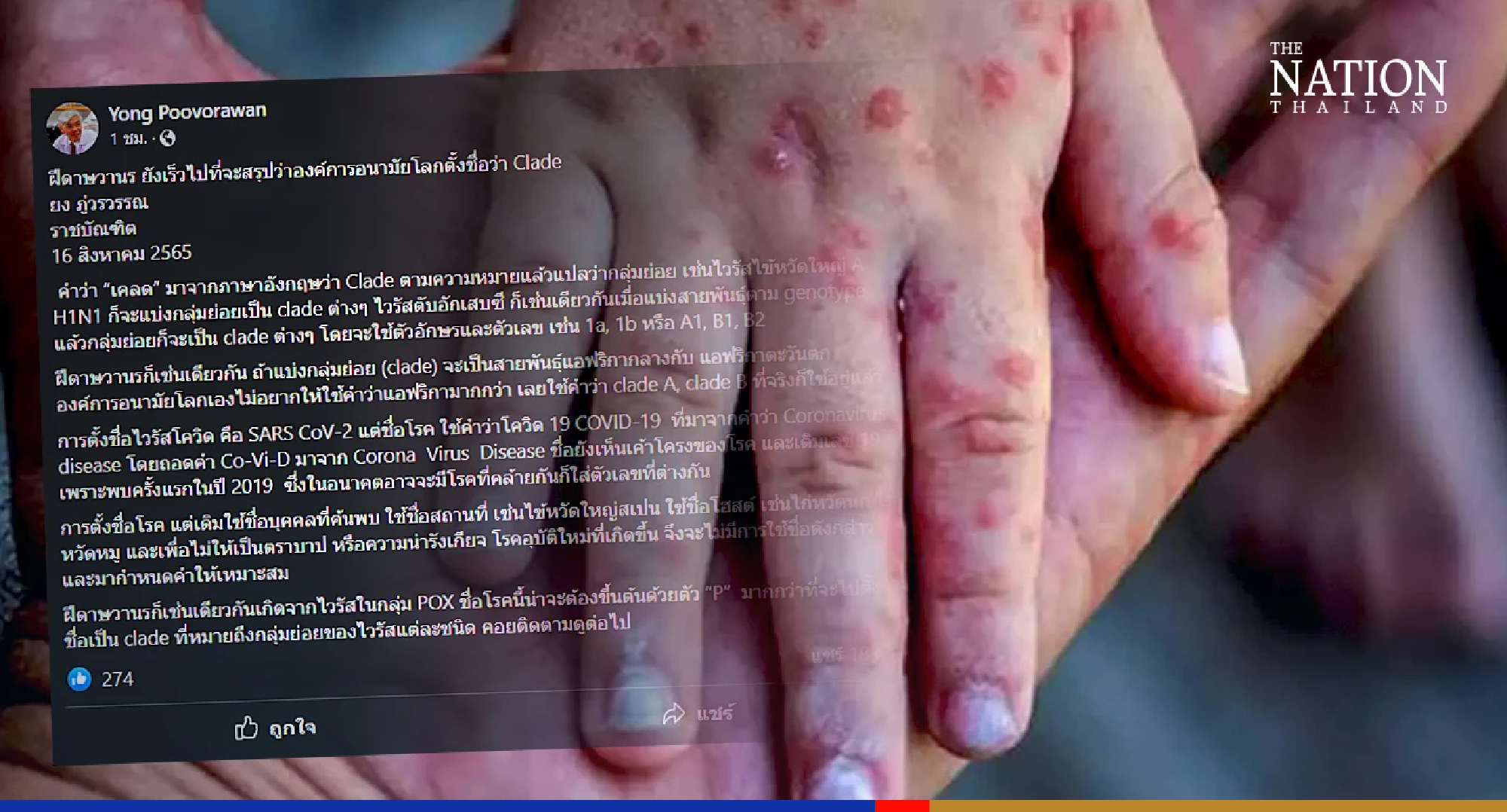
In a Facebook post on Tuesday, Dr Yong Poovorawan pointed out that the word “clade” means a subgroup and subvariants of a virus are normally named with numbers and alphabets, like influenza A H1N1 or Hepatitis C.
Dr Yong said WHO decided to call the two variants Clade I and Clade II because it wanted to avoid reference to Africa. However, he said, WHO is still looking for a new name for monkeypox to prevent stigmatisation, so referring to the subvariants as just Clade I and Clade II can be quite confusing.
He explained that previously diseases were named after places where they were first found like the Spanish Flu or the host of the virus such as avian or swine flu. However, this system of naming new viruses has been dropped to prevent targeting.
Dr Yong, who hails from Chulalongkorn University’s Faculty of Medicine, said monkeypox comes from the virus in the pox group, so its name should start with a P. He said this is better than wrongly referring to a subvariant as just a “clade”.
He also explained that a different nomenclature is used when naming viruses. For instance, SARS CoV-2 is the virus’s name, while Covid-19 is the name of the disease. In this case, Covid is an acronym of the full name, while 19 refers to the year the virus was discovered.
The World Health Organisation (WHO)’s move to rename the monkeypox virus will help prevent cultural and social discrimination, the vice chair of the Public Health Commission said on Sunday.
Chalermchai Boonyaleephan said renaming monkeypox is much like renaming Covid-19, which was initially called the “Wuhan virus”. Then US president Donald Trump also began calling it the “Chinese virus”, sparking a conflict between the two countries.
He said that WHO’s system of renaming Covid-19 variants based on the Greek alphabet has also helped people forget the country of origin.
“Once people become familiar with the Greek alphabet, they forget the origin. Like Omicron variant was originally found in South Africa,” he said.
He added that it would be interesting to see what Thailand will call monkeypox once it is renamed.
The move to rename the virus came after monkeys were attacked recently in Brazil over fears of transmission. In a press conference last week, WHO spokesperson Margaret Harris pointed out that the transmission is between humans and the virus came from rodents.
The WHO also renamed the two variants of the virus on August 8. Now the Central African or Congo Basin clade and the West African clade will be referred to as Clade I and Clade II respectively. WHO also decided that Clade II comprises two distinct subclades.
Last week I had the opportunity to be a bird leader for the EEC (Environmental Education Centre) bird camp organised with the Green World Foundation. The youth bird camp lasted only three days and two nights, but for me it was an unforgettable experience. It made me feel very energised and excited about being a bird leader for the first time.
Early in the morning we started birding around the hotel where we stayed. The kids seemed to be a little chaotic, this made me somewhat concerned about my ability to handle the birding activity with small children.
In the afternoon, we planned to go to Ban Pak Phli, which is located in Tha Ruea subdistrict, Pak Phli district in Nakhon Nayok province. It is about 60 kilometres from Khao Yai National Park to the south. It is also known as a migration spot for The Black-eared Kite that migrates from Siberia around November to March. Although this is not the migration season, it is a field and wetland where resident birds can be found and a very interesting ecosystem as well. I was quite concerned at first whether we would be able to go through the activity well or not, but it turned out to be an afternoon filled with fond memories of being among the next generation who were learning many essential skills to know and love nature.
That afternoon made me realise how important the youth are for the climate conservation movement. As they started to learn to be comfortable in the open air, they slowly looked over the vast fields and saw the wonders of the area. Their gaze, gestures, and behaviour made me irresistibly excited. Each of them had a different personality, uniqueness and rhythm. There was Petch, a young boy who is always interested and excited when he sees birds and always has a question; Perth, a bird photographer of the team; Pun and Praow; and Mark, the youngest one of our group, who was quick-witted and brought laughter to our team throughout the day.
The excitement was rising as the afternoon sun reminded us that the day would end soon. More and more, the children kept asking for detailed explanations about each bird. I tried to explain to them by showing them concrete examples right in front of us. While I was explaining the different styles of weaving between Asian Golden Weaver and Baya Weaver, there was a constant sound of excitement from the gang. To my surprise, they started to develop the skill to quickly and accurately identify the bird species themselves.
By the end of the day, there was a small flock of Little Cormorant flying 10 each, 20 each, I added that sometimes they might fly back to their nests in flocks of 100. Suddenly, the Little Cormorant started to gradually increase to 100, flying over and passing us. The children were extremely excited to see such a spectacular sight. Even I was amazed with how unexpected and unpredictable life and all living beings can be. The children’s energy and excitement reminded me so much of myself on the day that I first realised and understood the thrill of the natural world.
Back then, it did not start from an immediate interest in nature. Actually it began with my mixed emotions of being lost, dazed and confused about life in general. My head was filled with questions that seemingly no one could answer. Fortunately, I got a chance to join the Nature Connection workshop led by the renowned naturalist, Saranarat Kanjanavanit. The workshop aimed to help us understand and communicate with nature. The venue was at NuNiiNoi Wetland located at Chiang Dao sub-district in Chiang Mai province. At the five-day workshop we had to relearn and practice how to walk, look, observe, listen deeply, and even taste our surroundings. We had to dare ourselves to open up and sharpen our senses to be more vulnerable and receptive.
That experience with Saranarat was like opening the door to the wonderful world of nature for me. I had a chance to enjoy observing lichens (the plantlike organism made up of an algae or cyanobacterium and a fungus growing in symbiotic association) just like when I was a little kid. I had a chance to explore the creek nearby with all its living organisms, after a long absence from the activity. Most importantly, I also had a chance to spend time with myself surrounded by other friends who had been through this exact same experience. It gradually guided me to find the answers to my unending questions. I slowly found the answers. The feeling of loss, anxiety, daze and confusion started to gradually dissipate and finally vanished.
The experience I gained from that Nature Connection workshop not only provided me with an answer, or short-term skills, but also on the long-term skills residing inside me up until now. Those skills included approaching living animals slowly and paying respect to all living creatures, the skill of being in some natural setting for the whole day without any feeling of boredom since we knew that there always is something we could observe, look at, and deeply feel the wonder of nature.
After I got back from the workshop, I became clearer about my purpose. I again fell in love with birding and observing the living things around me. There were times during my early teens that I refused natural perception. I just kept myself in a car while waiting for other family members to go birding. At that time, I felt I was indifferent and lacked any enthusiasm towards nature and, perhaps, the world itself. When I look back, it is a frightening and scary feeling for me. I started to lose appreciation for all that beauty. I started to ignore nature’s value and the things without which we would not be able to exist as well.
I was so fortunate to regain those magic feelings. I returned to do many activities, some were new activities that I had never experienced before. My life has become a journey of new and endless discoveries. I have become a totally new person. I do really feel that when one feels lost, one can find the answer, by spending more time observing those living things around us. They would provide us with both answers and some new questions at the same time.
Every day will become a new day, just like that morning when I spotted the Common Flameback (Dinopium Javanese) which was a common resident. I spent time observing it until it flew out. The moments when it used its beak to peck the tree to build a nest or forage for food filled me with joy. Watching the bird climbing the tree in order to peck on different spots made me understand about its way of life. Many times there was only one tree but it would be full of various birds for us to fully observe until they left. As the birds eventually flew away, we could still spend more time with that tree by learning more about their plants. This kind of experience transforms our living moments to be a bit of a haiku.
Bringing yourself to be in nature and observe these wonderful living things leads us towards many open doors that would provide an answer we would never expect.
If we need the young generation to be interested in protecting and appreciating the invaluable nature, we need to take them outdoors. That short moment of excitement in nature will be the beginning for them to see, appreciate, know, love, feel love, and slowly lead to the feeling of yearning to protect nature as much as they can. All of this is not for the feeling of being a master or ownership of nature, but for accepting ourselves as a small part of the universe. I believe in that we would find our purpose and our reason for living as well.
A senior virologist revealed four important facts about the LayV virus that was found recently in China.
In a Facebook post on Thursday, Dr Anan Jongkaewwattana, director of the National Centre for Genetic Engineering and Biotechnology’s Veterinary Health Innovation and Management Research Group, said that a Chinese research team had published a study before the news came out.
He summarised four interesting facts from the study published in the New England Journal of Medicine.
1. LayV’s full name is Langya henipavirus and it is in the paramyxovirus family, the same as measles and mumps viruses.
He said that there are also severe viruses in this family, such as Nipah and Hendra, which have a high fatality rate. However, their spread has been limited because the host dies quickly.
2. The first human patient was found in China at the end of 2018 and around 35 people have been infected so far.
Interestingly, there was no cluster of spread or group, which indicates that the virus might not be able to transmit from human to human yet.
3. The scientists suspected that shrews were the most obvious carriers of the virus. However, other animals could also be a source.
4. The symptoms are similar to influenza, such as fever, aches, and fatigue. The virus could also impair the functioning of the liver and kidneys in some patients, but there was no instance of death yet.
Anan concluded that humans could contact the LayV virus from animals while there was no evidence of human-to-human transmission yet. Patients also usually have weak symptoms and there were no deaths yet.
He accused the media of sensationalising facts about the Nipah virus and making the disease look dangerous in order to sell news.
A top virologist has said that human beings will have to live with Covid-19 forever, though the virus would be less severe as we would build immunity against it.
In a Facebook post on Thursday, Dr Yong Poovorawan of Chulalongkorn University’s Faculty of Medicine, said it was a natural law, citing several diseases that had spread in the past, including smallpox and plague.
He said that the available knowledge and the medical field at that time were not modern as in the current era, but humanity could still survive until today as the pandemics did not last for a long time like Covid-19.
Explaining the survival instinct, Yong explained that once upon a time rabbits used to destroy a lot of crops so humans used a severe virus to kill rabbits and that became an epidemic for them.
A lot of rabbits died but some of them built immunity to the virus and survived to reproduce in large numbers as in the past.
Looking back at history, he said that most disease outbreaks lasted only a year with a lot of cases, such as cholera or the Spanish flu. It later became the seasonal flu but there were a lot of fatalities, accounting for around 1 per cent of the population, especially vulnerable groups.
He said that almost everyone is likely to get influenza once in three years and all three — influenza A (H1N1 and H3N2) and influenza B — within nine years.
Therefore, children aged under 9 who have not received any influenza vaccines should get the vaccine twice at one-month intervals, he suggested.
However, those aged over 9 who had been infected with influenza before should get a booster dose.
Yong said that it would be similar with Covid-19, as most people were likely to be infected in three years.
Currently, the medical field has improved a lot. Most people will be infected with the disease, like influenza. He added that most viral diseases in children are only severe in vulnerable groups.
As people have been fighting against Covid-19 for two and a half years, humans have developed, treated, and prevented the virus. People are aware that vaccination cannot stop the spread of the virus, but it will reduce the severity of the symptoms.
He added that a lot of people would be infected in later phases, which could be many tens of thousands of cases. Counting the number of those who had only mild or no symptoms and did not take a test, it could be a hundreds of thousands of cases.
Therefore, the problem lies with vulnerable groups as the number of hospitalisations is around 2,000 to 3,000 with 20 to 30 deaths.
He concluded that Covid-19 will stay with us forever, but we will be able to live with it because it will be less severe while we would have better immunity due to vaccines, previous infections and better medicines.
Meanwhile, the number of fatalities will decrease and will be the same as other respiratory diseases.
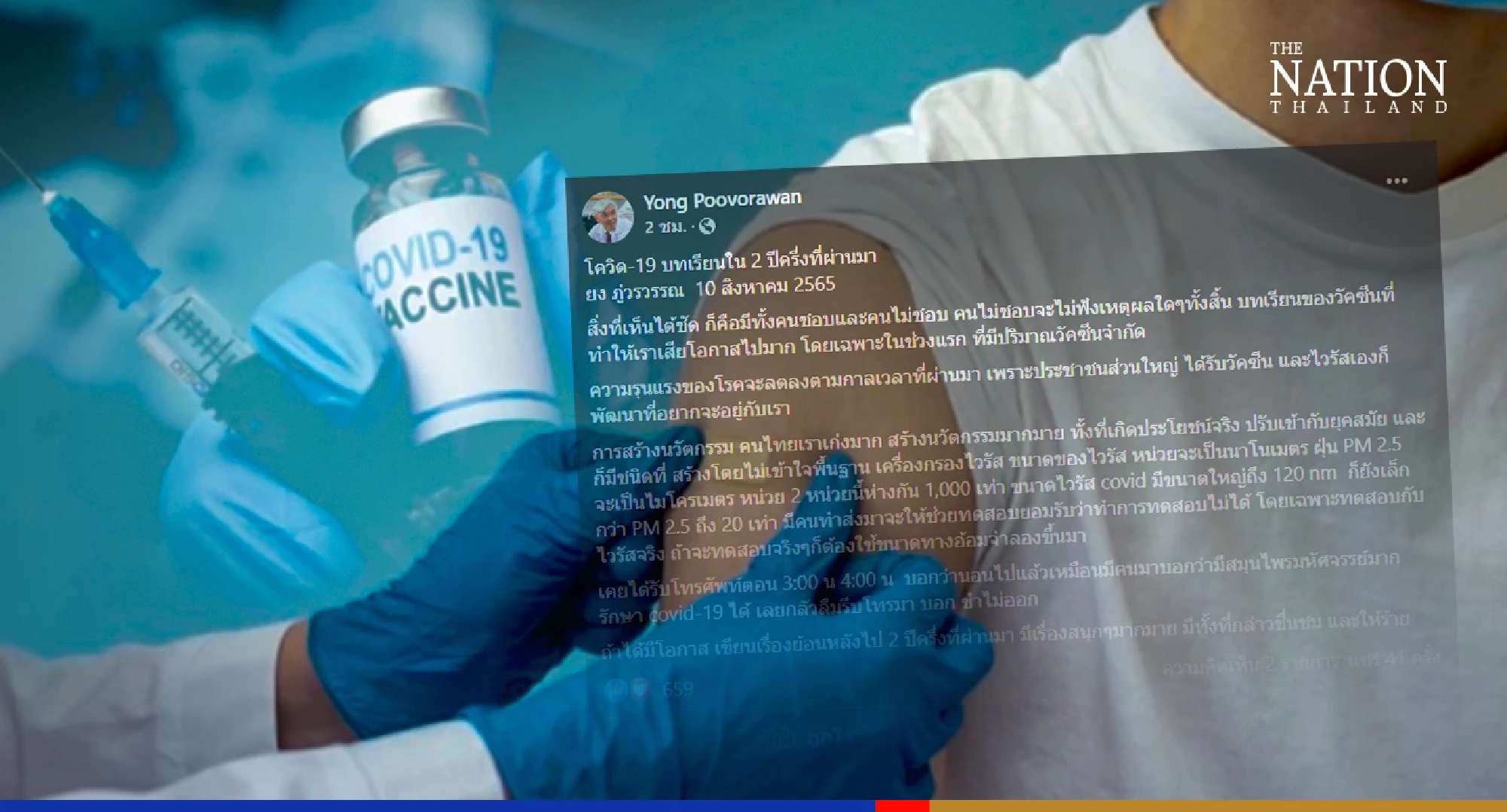
An expert virologist talked about how Covid-19 has changed Thailand in the past two-and-a-half years.
In a Facebook post on Wednesday, Dr Yong Poovorawan of Chulalongkorn University’s Faculty of Medicine said while some people preferred vaccines, some did not and they would not listen to reason. Therefore, Thais lost a lot of opportunities, especially in the early stages when vaccines were limited.
He noted that the severity of the disease has dropped over time as most people are now fully vaccinated even though the virus keeps mutating.
Thais are fully capable of creating innovations, Yong said. Several innovations have proved practical but some have been created without understanding, such as a virus filter.
A unit of the virus is measured in nanometres, while PM 2.5 fine dust is measured in micrometres. These two units are different from each other by a thousand times, the virologist said.
Yong explained that the Covid-19 virus is 120nm, which is 20 times smaller than PM 2.5 dust particles.
The doctor said someone had asked him to test the virus filter with the actual virus, but he said it could not be done and only a simulation could be carried out.
He also mentioned that there was a caller who woke him from sleep at 3 or 4am, claiming to have an “amazing herb” that could cure Covid-19. Yong said he did not find that funny.
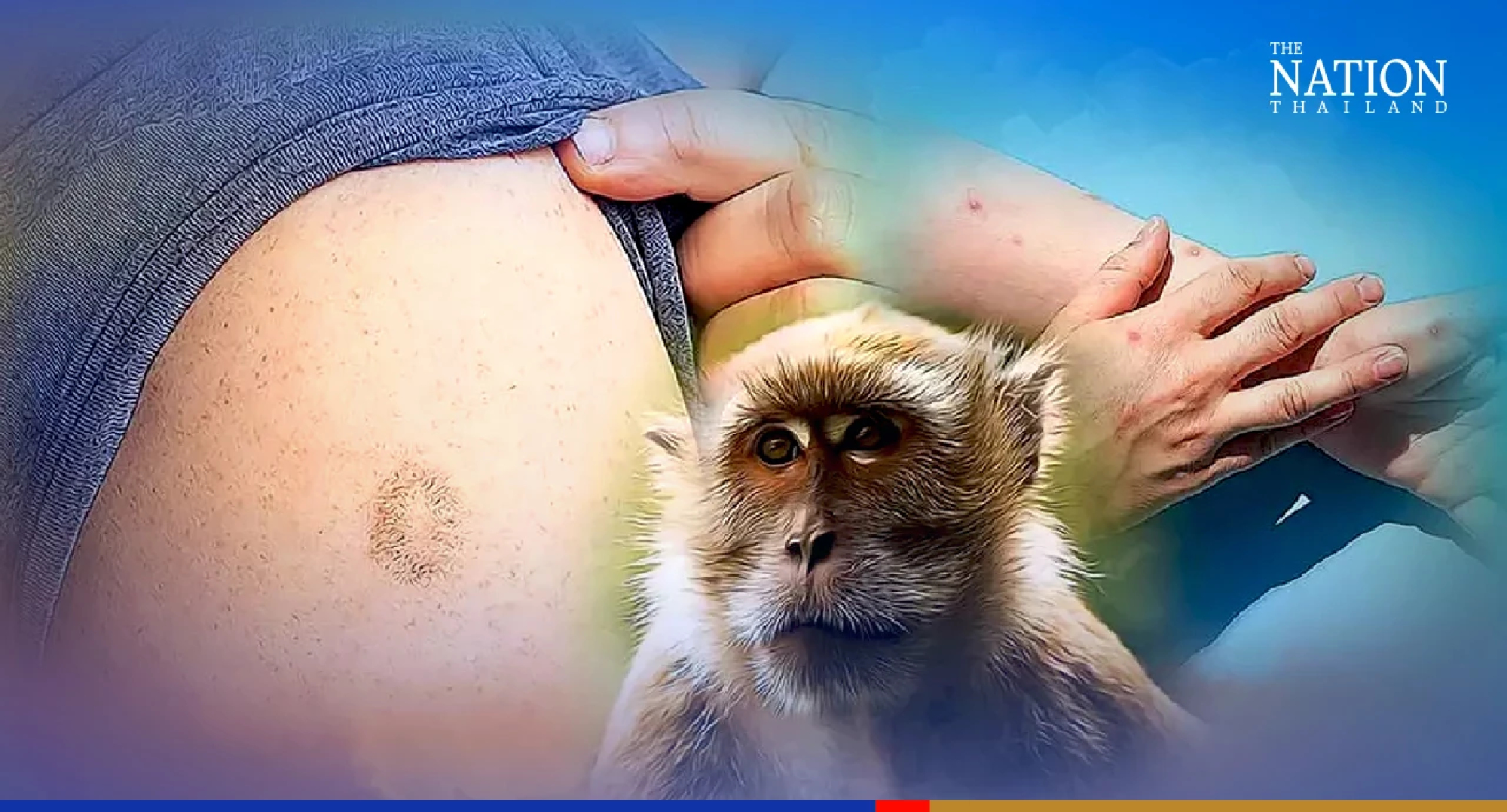
The smallpox vaccine that most people received as children have enough immunity against monkeypox for at least 88 years, an immunologist said.
In a Facebook post on Sunday, Dr Chontavat Suvanpiyasiri, a dermato-immunologist at Samitivej Sukhumvit Hospital, cited a study published in the American Journal of Medicine in 2008.
The study, “Immunity from Smallpox Vaccine Persists for Decades”, is available on https://bit.ly/3vOZZVp.
The study covered 246 people aged between 13 and 88, of whom 209 had been vaccinated against smallpox at least once, eight had got smallpox as children, while 29 had no history of infection or vaccination.
The study found that those vaccinated or previously infected recorded no drop in antibodies against the disease for up to 88 years. It also found that 97 per cent of the participants had enough immunity against smallpox.
Hence, the study concluded that most people who have been vaccinated against smallpox are immune to monkeypox, while those who received a booster jab did not have significantly higher immunity.
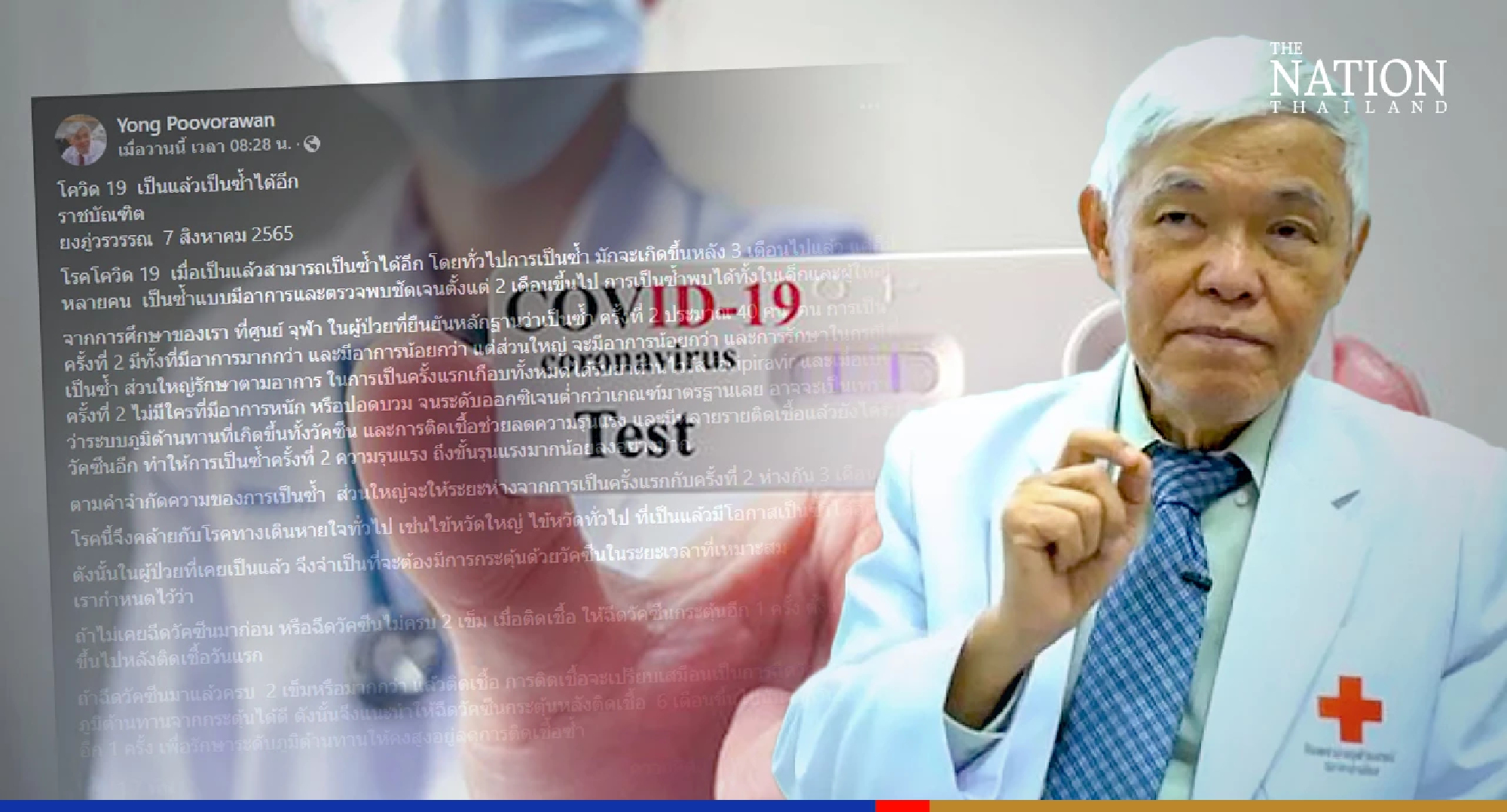
An expert virologist has warned people that getting a Covid-19 infection does not mean they will not get infected again.
In a Facebook post on Sunday, Dr Yong Poovorawan said most people are at risk of getting reinfected within three months after recovering, though some former patients were reinfected after just two months.
He was citing the Chulalongkorn University’s Centre of Excellence in Clinical Virology study on 40 people who were infected for a second time.
The study covered reinfected patients with mild symptoms as well as those with severe symptoms, though most had mild symptoms. Patients who had been prescribed the antiviral Favipiravir during their first infection received symptomatic treatment in the second round.
He added that no patients developed severe symptoms or pneumonia or a lower than normal oxygen level.
Dr Yong said he believes that immunity derived from vaccines and previous infections kept the symptoms mild. Also, he said, many people got vaccinated after their first infection, and this also reduced the severity of the second infection.
Covid-19 is like other respiratory diseases, which means recovered patients can get infected again after three months so they should receive a booster dose when appropriate, he said.
He also advised unvaccinated people to get a jab within three months of being infected, and those who have received two jabs or more should get a booster shot six months after being infected.
A top virologist shed some light on why monkeypox patients develop pus-filled cysts on their bodies, especially in the genital area.
In a Facebook post on Saturday, Dr Yong Poovorawan said the disease had first surfaced in Africa, where it was transmitted to humans from animals like rodents. The disease was then spread among humans via direct contact or the respiratory system.
The disease can enter the bloodstream and lymph nodes via a scratch on the skin, and patients can develop fever, fatigue and swollen lymph nodes.
After that, the patients develop cysts on the external parts of their body like arms, legs and head before it spreads to the torso.
Yong said 98 per cent of monkeypox patients found outside Africa are men, and 40 per cent developed boils on their genitals or nearby.
Recent studies show that monkeypox is most often transmitted sexually, and Dr Yong said that though most patients are male adults at present, the disease will soon spread to women and become difficult to control in the future.
However, he said, it is still 100 times more difficult to contract monkeypox when compared to Covid-19, so only people in high-risk groups will be infected in the early phase.
A booster shot provides the same level of immunity against Covid-19 to people whose first two shots have been either inactivated or mRNA vaccines, a top virologist said.
In a Facebook post on Friday, Dr Yong Poovorawan said he and his team have been studying the administration of Covid-19 vaccines in Thailand for the past year and a half.
His latest study, titled “Immunogenicity of the BNT162b2 COVID-19 vaccine as a third dose (booster) following two doses of different primary series regimens in Thailand”, was published in the National Library of Medicine (NIH) website (https://pubmed.ncbi.nlm.nih.gov/35920191/) on Wednesday.
The subjects of the study were people who had received an mRNA booster shot (Pfizer) after receiving the first two jabs in Thailand.
He said people who had received two shots of the inactivated vaccines, especially Sinovac, developed similar immunity against Covid-19 as those whose first two jabs had been mRNA vaccines.
His team also studied the effects of different boosters on people whose first two vaccines were a combination of Sinovac and AstraZeneca.
This study, titled “Effects of boosted mRNA and adenoviral-vectored vaccines on immune responses to omicron BA.1 and BA.2 following the heterologous CoronaVac/AZD1222 vaccination”, was published on the NIH website (https://pubmed.ncbi.nlm.nih.gov/35924475/) on Thursday.
This study shows that all booster doses provide similar immunity against the BA.1 and BA.2 subvariants.
Dr Yong and his team also studied the administration of the India-produced Covovax and the US-manufactured Novavax vaccines as a booster.
Results of this study showed that those who have received two doses of these inactivated vaccines had developed similar immunity as those who had received two mRNA jabs.
In the post, Dr Yong said that so far, 20 studies led by him and his team had been published in international medical journals and some governments implemented his suggestions. For instance, he said, the Public Health Ministry here adopted the mix-and-match vaccine formula, while the World Health Organisation based its advice on some of his studies.






 SootinClaimon.Com