Fujifilm to launch advance focus broadcast lens in spring 2020

ศาสตร์เกษตรดินปุ๋ย : ขอบคุณแหล่งข้อมูล : หนังสือพิมพ์ The Nation

https://www.nationthailand.com/edandtech/30375097

Fujifilm to launch advance focus broadcast lens in spring 2020

Aug 21. 2019
By The Nation

77 Viewed

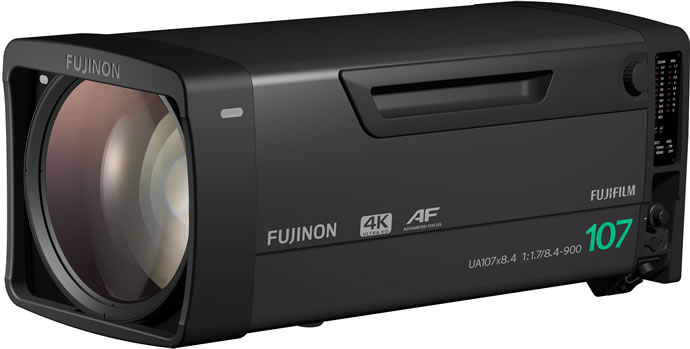
Fujifilm has announced the development of the 4K-compatible broadcast lens FUJINON UA107×8.4BESM AF (UA107×8.4 AF). The box-type broadcast lens UA107×8.4 AF is the world’s first 4K-compatible broadcast lens to feature the AF function.

The UA107×8.4 AF 4K-compatible broadcast lens features a phase-detection AF sensor and its dedicated algorithm developed with technological expertise fostered with Fujifilm’s X Series and GFX series of digital cameras. It will offer the Advanced Focus AF function, achieving fast and accurate auto-focus with the response speed of 0.5 seconds and outstanding capability in tracking a moving subject, according to a release on Wednesday.

The lens offers a 107× ultra-high magnification zoom, covering a broad range of focal lengths from 8.4mm in wide-angle to 900mm in ultra-telephoto, giving it the ability to capture a subject at a long distance.

The lens uses the Floating Focus system, which controls multiple lens groups according to shooting distance, to minimise performance fluctuations based on differences in working distance, thereby delivering sharp footage from close-up to infinity.

The use of a nine-blade diaphragm achieves an aperture shape closer to a perfect circle. This creates beautiful soft lights and natural bokeh into the video expressions. The 4K-compatible broadcast lens UA107×8.4 AF is due to be released in the spring of 2020.

Taiwanese tech firms demonstrate support for smart cities

ศาสตร์เกษตรดินปุ๋ย : ขอบคุณแหล่งข้อมูล : หนังสือพิมพ์ The Nation

https://www.nationthailand.com/edandtech/30375083

Taiwanese tech firms demonstrate support for smart cities

Aug 21. 2019
VIPs on stage launching the Smart City Industry Forum.

VIPs on stage launching the Smart City Industry Forum.
By The Nation

153 Viewed

The System Integration Promotion Alliance (SIPA), a program from Taiwan’s Industrial Development Bureau (IDB) brought innovative smart city and IoT companies is in Bangkok this week to attend the Smart City Industry Forum and the Taiwan-Thailand Industrial Collaboration Summit (TTICS).

The summit is being hosted by the Ministry of Economic Affairs (MOEA) Industrial Development Bureau (IDB) in partnership with the Institute for Information Industry (III) and the Thai Internet of Things Association (TIOT) to foster collaboration between the two regions’ smart city sectors.

At TTICS, Sinotech Engineering Consultants signed a memorandum of understanding with AMATA Corporation to create development trials in Thailand around smart city projects. This cooperation will lead to the clustering of innovative technologies with strong commercial outcomes.

Vivian Huang, director general of the International Division at III, told participants about Taiwan’s capacity to support smart cities. “This time, SIPA has brought more than 10 market-ready system integration solutions ranging from transportation to farming. We are ready to work closely with our partners to help the world innovate on the future of cities and tech,” Huang said at the event.

Dr Lo Cheng-Fang, chairman and chief executive of GEOSAT Aerospace & Technology Inc, gave a keynote speech on the potential for drone technology to improve smart city applications. In addition to GEOSAT, six other companies are attending the smart city week in Bangkok, namely ACTi Corporation, Cal-Comp Electronics (Thailand), Chicony Power Technology, Forecraft USA, Galaxy Software Services Corporation and Guali Tech Inc. They can be found at the ASEAN Smart Cities Network (ASCN) conference and exhibition that runs from tomorrow (August 22) through Saturday.

The System Integration Promotion Alliance (SIPA) brings together the best technology in Taiwan to find the strongest partner projects around the world. Across six areas, including Smart Transportation, Smart Healthcare, Smart Security, Smart Energy Conservation, Smart Agriculture and Smart Retail, the SIPA platform brings together relevant partners to accelerate solutions.

Huawei continues to see growth, aims to launch new OS

ศาสตร์เกษตรดินปุ๋ย : ขอบคุณแหล่งข้อมูล : หนังสือพิมพ์ The Nation

https://www.nationthailand.com/edandtech/30375084

Huawei continues to see growth, aims to launch new OS

Aug 21. 2019
By Jirapan Boonnoon
The Nation

132 Viewed

Huawei expects to generate double-digit revenue growth in the Thai market by the end of this year, its country director announced on Tuesday, adding that the firm also launched a new operating system (OS) named HarmonyOS, which has cost more than Bt40 billion in research and development, by the end of this year.

Ingmar Wang, country director at Huawei Consumer Business Group (Thailand) said that Thailand is important tier 1 market for Huawei as evidenced by its record-breaking success with the P30 series in the first half of 2019. For the second half, it aims to maintain its position and bring technology, IOT products and devices to Thai consumers as well as smartphones.

“We want to maintain our position and our double-digit growth,” said Wang.

Huawei business in Thailand is divided into 3 categories: network carrier, enterprise and consumer products.

Wang noted that the top five products on the Thai market are smartphones, tablets, wearable devices, accessories and desktop computers respectively.

The new HarmonyOS is a microkernel-based, distributed operating system designed to deliver a cohesive user experience across all devices and scenarios and is anticipated to open new opportunities for the brand.

“We believe hundreds of devices will use HarmonyOS. We have a bright future,” said Wang, adding that the firm is not yet bundling its new OS with Huawei smartphone as it views the Android OS is priority.

“Huawei has made great contributions in Android. HarmonyOS is our second plan in case we cannot use Android in the future. HarmonyOS development has started in 2017 and we have a 5-year plan to develop the system. Last year, Huawei invested Bt6 billion (RMB 1 billion) in developing the foundation and supporting developers. This year, Huawei invested Bt34 billion (US$1 billion), 80 per cent of it outside China. I think the IT business will eventually be merged with the IOT business, which is why Huawei has developed HarmonyOS, which syncs everything together,” he said

The firm has also introduced a smart TV that works with HarmonyOS to the Chinese market and is considering introducing it to the Thai market next year.

James Lu, senior manager of EMUI product marketing at Huawei Consumer Business Group, said that HarmonyOS is a lightweight, compact operating system with powerful functionality, and it will first be used for smart devices like smart watches, smart screens, in-vehicle systems, and smart speakers. Huawei aims to establish an integrated and shared ecosystem across devices, create a secure and reliable runtime environment, and deliver a holistic intelligent experience across every interaction with every devices in the near future.

Moreover, the HarmonyOS also offers a shared communications platform, distributed data management, distributed task scheduling, and virtual peripherals.

The HarmonyOS will depend on a dynamic ecosystem of apps and developers. To encourage broader adoption, Huawei will release HarmonyOS as an open-source platform worldwide. Huawei will also establish an open-source foundation and an open-source community to support more in-depth collaboration with developers.

“In the future era of multiple scenarios and multiple devices, application developers need to change when the requirements are changed,” said Lu.

New chatbot to make Facebook friendly for the visually impaired

ศาสตร์เกษตรดินปุ๋ย : ขอบคุณแหล่งข้อมูล : หนังสือพิมพ์ The Nation

https://www.nationthailand.com/edandtech/30375073

New chatbot to make Facebook friendly for the visually impaired

Aug 20. 2019
By Jirapan Boonnoon
The Nation

207 Viewed

Facebook Thailand is partnering up with local organisations like Read for the Blind and Help Us Read as well as chatbot creators Hbot help give visually impaired people in Thailand better access to social media.

Manaschuen Kovapirat, Facebook Thailand’s communications manager, said that most of the over 700,000 visually impaired people in Thailand lack support or access to communication tools. Hence, Facebook has joined up with Read for the Blind to create a Facebook page that provides tutorials on creating audio books and gives volunteers a chance to join the cause.

“Our aim is to ensure that visually impaired people can manage their Facebook page and engage easily with volunteers,” Manaschuen said.

Cholathip Yimyong, co-founder of Read of the Blind and Help Us Read, who also manages related Facebook pages, said the visually impaired often struggle to find the basic help they need each day, adding that the new bot, Ready, which is available through Facebook Messenger, will help them connect effectively. This new bot also cuts down on manual input and boosts volunteer engagement.

Natwut Amornvivat, co-founder of Read for the Blind and Help Us Read, said Facebook is helping establish a sense of commitment and support for the visually impaired in Thailand.

Currently, the Read for the Blind Facebook page has more than 187,000 members and the newly created bot for messenger helps Facebook find more volunteers who want to help out.

Chayanith Srinark, CEO of HBOT, said as a solutions partner, he believes all businesses should have access to technology that can help them leapfrog their current benchmarks.

Sleek, slim and incredibly smooth, the new Galaxy Note10+ is to die for

ศาสตร์เกษตรดินปุ๋ย : ขอบคุณแหล่งข้อมูล : หนังสือพิมพ์ The Nation

https://www.nationthailand.com/edandtech/30375015

Sleek, slim and incredibly smooth, the new Galaxy Note10+ is to die for

Aug 20. 2019
Samsung Galaxy Note10 compared to Note10+ (beneath).

Samsung Galaxy Note10 compared to Note10+ (beneath).
By Paisal Chuenprasaeng
The Nation

527 Viewed

A powerful smartphone with a large and beautiful display, the Samsung Galaxy Note10+ boasts excellent quality quad rear cameras and plenty of tools that will allow you to stretch your creativity to the max.

It’s sleek and smooth too, just 7.9mm thick and with a large 6.8-inch full display that curves down on both left and right edges.

Its Bluetooth S-Pen is nicely hidden at the right bottom of the smartphone and it can be taken out and ready for use with just a light push.

The Note10+ has a generous amount of working memory or 12 gigabytes of RAM and comes with 256 GB of internal storage that can be expanded by up to one terabyte with a microSD card, which shares the second SIM slot.

It is powered by Samsung’s flagship Exynos 9825, an octa-core CPU that packs a lot of horsepower into a small package. It consists of two 4th generation custom CPUs – two Cortex-A75 cores running at 2.7 GHz for optimal performance, and four Cortex-A55 cores running at 2.4 GHz for greater efficiency as well as two dual custom running at 1.9 GHz.

I tested the Note10+ with the AnTuTu benchmark app v 7.2.3 and it got an impressive score of 353,041. As at August 18, AnTuTu reports that the Note10+ in my hands beat 87 per cent of users of the app that post results to the ever-growing online database of Android users. Any smartphone or tablet that scores up to 300,000 points on AnTuTu benchmark is already impressive for its performance.

During the test, I found the Note10+ was very fast. The touchscreen and menus were very responsive. Applications and games ran fast and smoothly. For example, the Rangnarok Mobile game, which requires a lot of resources and often disconnects on mobile devices, an smoothly on the Note10+ and the game rarely disconnected during my trial.

For game playing, the Note10+ has a slimmer, newly designed vapour chamber cooling system, improved AI, and enhanced NPU or Neural Processing Unit that provides game players with a smooth gaming experience with reduced lag.

For gamers who want to add some personality to their streams, or vloggers wanting to enhance their tutorials, the Galaxy Note10 introduces the Screen recorder. This allows you to easily capture what’s on the screen, use picture-in-picture to add reactions, and employ the S Pen to annotate as you record for a more entertaining and engaging video.

Samsung boasts that with its fast octa-core processor and plenty of memory, the Note10+ has the performance of a desktop computer. While that is difficult to prove or disprove, the Note10 does extend Samsung DeX’s capabilities, making it easier for you to work between your phone and a PC or Mac. With a simple, compatible USB connection, you can drag and drop files between devices, and use your favourite mobile apps with a mouse and a keyboard, while keeping your data secure on the phone through Samsung Knox security technology.

Moreover, the Note10+ integrates Link to Windows directly into the Quick Panel. With one click, you can connect to a Windows 10 PC. Then, you can see notifications, send and receive messages, and review recent photos without pausing to look down at the phone.

And the Exynos 9825 is integrated with a fast LTE modem for truly speedy downloads of up to 2 Gbps. I tested it with Ookla Speedtest app and got download speed of 95 Mbps and upload speed of 37.3 Mbps. Files were downloaded very fast and my snapshots were backed up to my Google Photos in no time. The Internet connection was tested on TrueMove H’s LTE network.

The Note10+ comes with fast wireless connection as well and supports up to the latest Wi-Fi protocol of 802.11ax.

I particularly liked the edge-to-edge Cinematic Infinity Display, which is nearly bezel-less. It has an in-display cut out for the front camera that’s small and centred.

Taken wint Note10+

The Galaxy Note10+ uses Samsung’s award-winning Dynamic AMOLED display that features HDR10+ certification and Dynamic Tone Mapping to allow photos and videos to appear brighter than previous Note devices and with a wide color range. The Eye Comfort display reduces blue light without affecting colour quality for comfortable viewing.

During the test, I found the screen displayed high-resolution photos with impressive colours. HD video clips were beautiful.

I enjoyed watching HDR YouTube clips on the Note10+. Movies streamed via the TrueID TV app and iflix app were smooth and sharp.

The Note10+ comes with four rear cameras and one front camera. The front camera has 10 megapixel resolution with a f/2.2 aperture lens.

One of the four rear cameras is the main camera and this has wide-angle dual f/1.5, a f/f2.4 aperture lens and 1 megapixel resolution. Another is an ultra wide camera with f/2.2 lens that has 123-degree angle and 16 MP resolution. The third one is a 12MP telephoto camera with f/2.1 aperture lens while the fourth one is a depth camera that provides the data to create professionally blurred backgrounds with the Bokeh effect.

I found the main camera captured beautiful shots. The dual aperture design allows the camera to adjust to the surrounding light automatically. The f/.1.5 aperture helped to capture dark scenes with bright results while f/2.4 aperture kept things sharp in bright daylight.

The camera uses AI technology in the Scene Optimiser function of the auto mode, which is called “Photo” mode. The Scene Optimiser allows the camera to recognise popular subjects and use Local Tone Mapping function to adjust settings for sharp and clear results.

The Scene Optimiser recognises 30 scene modes: Face, Baby, Person, Dog, Cat, Food, People, Beaches, Sky, Mountain, Sunset, Sunrise, City, Snow, Waterfall, Watersides, Scenery, Stage, Vehicles, Drinks, Flowers, Trees, Greenery, Animal, Shoes, Backlit, Indoor, Text, Clothes, and Night view.

If you want to capture shots of outstanding subjects with blurred background, you can use the Live Focus mode that provides a slide bar for adjusting blurriness of the background in real time.

If you prefer panorama shots, you will love the Ultra Wide Camera that features 123-degree field of vision. You’ll have a wider view without having to step far away from your subjects. And the telephoto 12MP camera allows you to get close to your subjects with 2x optical zoom.

Its front camera also captures beautiful selfie shots. And the depth camera of Note10+ is useful to work with Quick Measure app and AR intelligence to allow you to measure objects easily. You simply start the Quick Measure app and point the camera to the object you want to measure and a 3D outline with length figures pop up. Or you can easily draw an imaginary line on an object to measure it.

The Galaxy Note series is well-known for its S Pen stylus pen, which is connected to the smartphone via Bluetooth, You can use the S Pen button to remotely take a photo with the Note10+. And now S Pen supports motion gestures for using with the app that is linked to it. For example, when you use the S Pen to remotely control the camera, you can change the shooting mode. Or you can move the S Pen clockwise or counterwise to change the camera angle and capture a close-crop group shot or wider scene.

The stylus pen coupled with computing power of Note10+ lets you can use the smartphone as a video editing studio. You can shoot good quality video with blurred background and the video camera has good quality microphone that lets you capture sounds around you clearly.

The video camera also has super steady function that predicts movement by pulling from a library of over a million frames to reduce shakiness. And there’s a full editing studio to allow you to insert transitions to video clips, add subtitles, change the speed and add illustrations with the S Pen.

The Note10 + comes with effective Face Recognition and Ultrasonic fingerprint that allow you to securely unlock your phone. I found that the Face Recognition allowed me to unlock the phone very fast.

The Note10+ also comes with a large 4,300 mAh battery that allowed me to comfortably survive a day of use. It supports Super Fast Charging technology and Fast Wireless Charing 2.0.

Samsung Galaxy Note10+ with 256GB storage retails for Bt37,900, and with 512GB storage for Bt40,900.

Key specs:

Network: LTE Cat. 20

OS: Android 9.0

Processor: Exynos 9825 octa-core processor

Memory: 12 GB

Storage: 256GB, expandable with microSD card by up to 2TB

Display: 6.8-inch Quad HD+ Dynamic AMOLED Infinity-O Display with 3040×1440 pixel, HDR10+ Certified

Cameras: Rear: Quad Camera: Ultra Wide: 16MP F2.2 (123°); Wide-angle: 12MP 2PD AF F1.5/F2.4 OIS (77°); Telephoto: 12MP F2.1 OIS (45°); DepthVision Camera: VGA; Front: 10MP 2PD AF F2.2 (80°)

Connectivity: Wi-Fi 802.11 ac/ax, VHT80 MU-MIMO, Bluetooth v5.0

GPS: Galileo, Glonass, BeiDou

Sensors: Accelerometer, Barometer, Ultrasonic Fingerprint Sensor, Gyro Sensor, Geomagnetic Sensor, Hall Sensor, Proximity Sensor, RGB light sensor

Authentication: Fingerprint sensor, Face recognition

Battery: 4,300 mAh with Super Fast Charging

Dimensions: 77.2 x 162.3 x 7.9mm

Weight: 196g

Huawei 5G technology the best option for Southeast Asia: experts

ศาสตร์เกษตรดินปุ๋ย : ขอบคุณแหล่งข้อมูล : หนังสือพิมพ์ The Nation

https://www.nationthailand.com/edandtech/30374991

Huawei 5G technology the best option for Southeast Asia: experts

Aug 19. 2019
Photo by China Daily

Photo by China Daily
By The Nation

239 Viewed

Southeast Asian countries eyeing the promise of 5G connectivity to boost economic development are open to Chinese telecommunications company Huawei among others, experts told China Daily.

Economic considerations and a strategic foreign policy element are among the reasons why Southeast Asian countries have adopted a relative openness toward Huawei, said Amalina Anuar, an analyst with the Centre for Multilateralism Studies at the S Rajaratnam School of International Studies at Singapore’s Nanyang Technological University.

“Huawei’s 5G technology is generally reputed to be both advanced and relatively more affordable,” Anuar said. “Having a multivendor approach and avoiding exclusion of Huawei is considered a more balanced policy option so that Asean members don’t have to choose sides.”

Huawei Technologies is the world’s largest telecommunications equipment maker and second-largest smartphone vendor. It has been targeted by the United States on allegations of espionage even with no evidence amid the Sino-US trade conflict. Huawei has denied all the accusations.

“Frankly, I can’t really see any sort of ground for these allegations in terms of security,” said Jake Saunders, vice-president of Asia-Pacific advisory services at ABI Research, a market intelligence company. “If you really want to make communications more secure, individual companies can put on their own encryption layer to secure traffic.”

Fifth-generation mobile technology enables gigabit speeds and more powerful connectivity. It is expected to account for 15 per cent of global mobile connections by 2025, while Asia-Pacific is on track to becoming the world’s largest 5G region, according to telecoms lobby group GSMA.

“It becomes necessary for Southeast Asian countries to explore the possibilities offered by 5G for the next generation,” said Farlina Said, analyst with the Foreign Policy and Security Studies programme at the Institute of Strategic and International Studies in Malaysia, noting 5G can be conducive for ASEAN to build the Smart Cities Network, as it will benefit disaster management, education delivery and sustainability.

ASEAN countries, which collectively form the world’s sixth-largest economy, have always been important markets for world business, and Huawei has been active in the region for 20 years. At a conference earlier this year, James Wu, president of Huawei Southeast Asia, said 5G was expected to provide Southeast Asia with industry opportunities worth $1.2 trillion, with the number of 5G subscribers likely to reach 80 million.

In February, Thailand launched a Huawei 5G test network in Chonburi. After an agreement signed in April by Cambodia’s Ministry of Posts and Telecommunications on the development of 5G, Cambodia’s Smart Axiata announced it had partnered with Huawei to build the country’s 5G network.

Huawei said in July that it has secured 50 commercial 5G contracts and has shipped more than 150,000 base stations to markets around the world.

“Huawei is very much at the cutting edge. They innovate … and they are also very competitive on price, so that is why Huawei can be such a prominent player,” said Saunders at ABI Research. “The attitude in Southeast Asia is that they want choice. That is the heart of the matter.”

For 5G’s full potential to be reached, policies must balance both security and development needs, Nanyang Technological University’s Anuar noted.

“Southeast Asia will choose its 5G solution provider based on its own interests, (and because) choosing sides is not a desirable option for ASEAN,” Anuar said.

Plan to block unlicensed cell phones immature: Ombudsman

ศาสตร์เกษตรดินปุ๋ย : ขอบคุณแหล่งข้อมูล : หนังสือพิมพ์ The Nation

https://www.nationthailand.com/edandtech/30374917

Plan to block unlicensed cell phones immature: Ombudsman

Aug 17. 2019
A man holds a smartphone. The government expects to enhance its supervision of the cell phone market by validating communication gadgets through their International Mobile Equipment Identity Code (IMEI). (Shutterstock/Framesira)

A man holds a smartphone. The government expects to enhance its supervision of the cell phone market by validating communication gadgets through their International Mobile Equipment Identity Code (IMEI). (Shutterstock/Framesira)
By The Jakarta Post
Asia News Network

317 Viewed

The government’s plan to block the use of unlicensed cell phones entering Indonesia is immature and detrimental to the public interest, says the Indonesian Ombudsman.

The Ombudsman noted some oddities in the initiative after a recent meeting with the Communications and Information Ministry to examine the ministry’s draft for a regulation on the matter.

“It is not substantiated and neglects people’s interests,” said Alvin Lie, an Ombudsman official, during a seminar at the institution’s headquarters in Jakarta on Thursday.

“Some technical aspects are not properly [regulated], while a ministerial regulation should be technical,” he said, without specifying which points the Ombudsman had examined.

The Industry Ministry, the Trade Ministry and the Communications and Information Ministry will simultaneously issue ministerial regulations to enhance their supervision of the cell phone market by validating the gadgets through their International Mobile Equipment Identity Code (IMEI).

The regulations, aimed at protecting domestic industries and increasing national income, are expected to be issued on Aug. 17, when Indonesia celebrates its 74th year of independence

“The regulation is misdirected,” Alvin said. “If it aims to secure state revenue, we all know that the tariff on cell phone imports has been reduced to 0 percent in 2018,” he said.

Around 20 percent of smartphones in the domestic market are sold illegally without registration or certification from the authorities, according to the Indonesian Cell Phone Association (APSI). This situation resulted in an estimated Rp 2.8 trillion of foregone tax revenue. (asp)

AI provides virtual hand in sorting trash

ศาสตร์เกษตรดินปุ๋ย : ขอบคุณแหล่งข้อมูล : หนังสือพิมพ์ The Nation

https://www.nationthailand.com/edandtech/30374909

AI provides virtual hand in sorting trash

Aug 17. 2019
The AI automation trash bins. CHINA DAILY

The AI automation trash bins. CHINA DAILY
By China Daily
Asia News Network

356 Viewed

Waste sorting is becoming less of a burden in China, especially with artificial intelligence helping streamline the process.

Shanghai enacted its compulsory waste sorting law on July 1, and announced a plan to expand AI’s application in trash sorting as part of the city’s attempt to become a national and global leader in the technology.

Shanghai, host of the 2019 World Artificial Intelligence Conference from Aug 29-31, announced the application scenario of AI-powered autonomous waste sorting on July 2 along with the expansion of 27 other new AI applications.

Trash bins that use AI to automatically sort and properly organize garbage have been set up in Shanghai’s AIsland, a dedicated hub for AI innovation and application in Zhangjiang Science and Technology City, Pudong New Area. Established in May, the 66,000-square-meter hub is the first of its kind nationwide.

According to the scenario detailed in Shanghai Chengtou Holding Co’s “application of AI technology in the classification of domestic waste”, trash cans will eventually be able to distinguish between various kinds of waste and alarm users if they sort trash incorrectly. Garbage trucks will be able to identify different trash cans and process them accordingly. In waste disposal transfer stations, robots will collect recyclable trash and put it into recycling devices after inspecting it. Residents can also use apps to command robots to collect their trash.

Tao Junjie, director of Shanghai Chengtou’s department of science, technology and information, said the company currently handles final disposal of waste.

“Improper disposal by households brings challenges to our final disposal. We hope AI can help improve waste sorting in the very beginning of trash disposal,” Tao told Shanghai-based newspaper Jiefang Daily.

Jin Lei, founder of Alpheus Intelligence & IOT Technology Co in Kunshan, Jiangsu province, a company dedicated to AI-assisted waste sorting solutions, considered AI applications in the field as feasible to help China deal with its heaping trash challenge.

“Trash sorting is imperative in China. People are taking action but it will take quite a while for the culture to set in. We need AI to accelerate the process because we can’t wait,” Jin said.

In addition to waste sorting, the 28 new scenarios recently announced by Shanghai also cover many other fields such as smart buildings, smart businesses, smart driving and other scenarios that focus on tackling hard technological issues.

Officials said the scenarios will help create a comprehensive AI application cluster in Shanghai and the city will collect solutions from global AI companies to solve problems.

Wu Jincheng, chairman of the Shanghai Municipal Commission of Economy and Informatization, said the city will strive to open more application scenarios and encourage the latest achievements in AI.

With rich application scenarios, Shanghai has been vigorously promoting the development of AI in recent years, attracting industry leaders like Microsoft, IBM and Alibaba.

The city is eyeing a global AI hub with plans to expand the scale of its industry.

Prince of Songkla University to test and research 5G

ศาสตร์เกษตรดินปุ๋ย : ขอบคุณแหล่งข้อมูล : หนังสือพิมพ์ The Nation

https://www.nationthailand.com/edandtech/30374883

Prince of Songkla University to test and research 5G

Aug 16. 2019
By THE NATION

348 Viewed

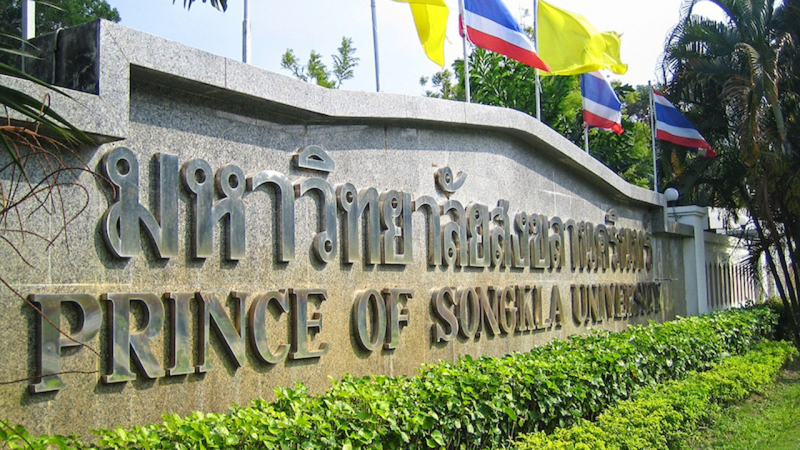
Prince of Songkla University’s Faculty of Engineering has signed a memorandum of understanding with the National Broadcasting and Telecommunications Commission (NBTC) to set up a 5G testing and research centre in the university.

The faculty has also been put in charge of setting up the regulatory sandbox for 5G testing.

Assoc Professor Dr Tanit Chalermyanont, dean of the engineering faculty and chair of the committee tasked with the 5G testing and setting up a research centre, said: “The engineering faculty is ready to drive the 5G initiative, which is consistent with the road map for NBTC. We have a modern curriculum for telecommunications that has been certified by the Council of Engineers for Electrical Communication Engineering. We also have professors and researchers from various fields collaborating as interdisciplinary teams. We can link their research to this 5G infrastructure.

“Many uses of great potential have been included in this project such as tele-health systems, security, intelligent transportation system, Industrial 4.0, smart farm, internet of things (IoT), and big data. We believe this 5G project will bring broad and concrete benefits to not just entrepreneurs but also to our communities, especially in the South.

“Those who want to join us in any activities or in testing products or anything related to 5G can submit a request to participate through the 5G regulatory sandbox coordinator.”

Huawei sets sights on leading in AI technology

ศาสตร์เกษตรดินปุ๋ย : ขอบคุณแหล่งข้อมูล : หนังสือพิมพ์ The Nation

https://www.nationthailand.com/edandtech/30374870

Huawei sets sights on leading in AI technology

Aug 16. 2019
By The Nation

247 Viewed

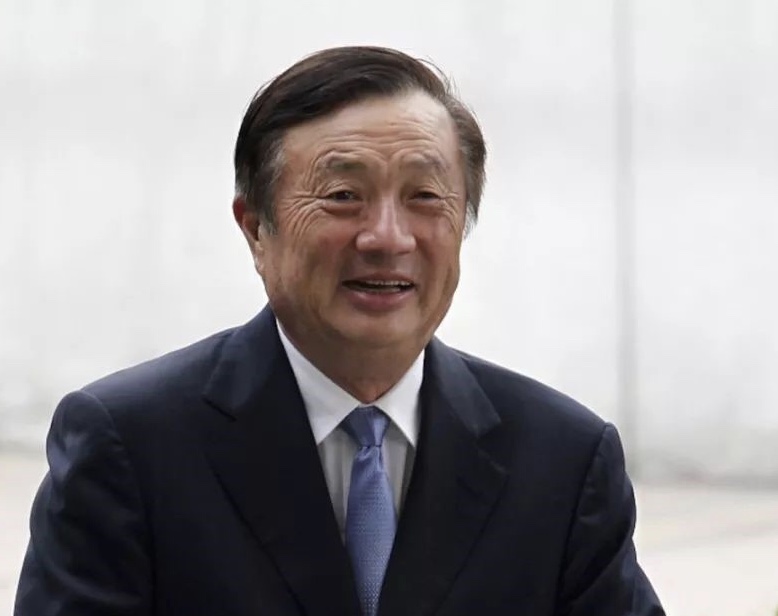
Huawei is aiming beyond 5G and has set its sights on the artificial intelligence (AI) industry, said Ren Zhengfei, founder of the Chinese tech company. He said, “5G is a side dish while AI is the main dish, which will be the core strategic development for Huawei.” He was speaking during an internal conference, according to the state outlet, the Global Times.

In August, Huawei unveiled its artificial intelligence (AI) innovation centre in Suzhou, east China’s Jiangsu province. The new centre will prioritise testing innovative applications of AI in the fields of smart city building and the development of intelligent industries.

The 5G network is a tool that offers high bandwidth, low latency and supports AI research and development, said Ren, who compared 5G and AI to a screwdriver and a car, saying that “a screwdriver can make a car, but it is not a car”.

The development of AI technology has now reached a new era. In 10 to 15 years, AI will catch up with the average level of human intelligence. In two or three years, practical AI applications will become pervasive.

“The development of AI needs the support of supercomputing, super-large capacity data storage and super-speed connection. The US has supercomputers and super storage, but it doesn’t have super-speed connections due to an inadequate fibre optic network, which makes the US a step behind in the AI industry,” Ren said.

The CEO said that the company has confidence it will withstand targeting actions taken by the US government. “We are suffering the pain, but we will head to victory,” he said. “How the steel was tempered, how our staff is tempered amid US pressure. We will not only survive, we will win in the end,” the Huawei founder declared to all the company’s employees.

Ren vowed that Huawei will draw additional talented people to its research and development team, so that can make the company can achieve even greater victories in the coming five years.

For instance, Huawei paid $229,800 (Bt7.2 million) to three talented undergraduate students who had won at the ASC Student Supercomputer Challenge. In July, Huawei offered an annual salary of up to 2 million yuan ($290,000) to eight PhD graduates and talents from home and abroad.

Besides introducing new talent, Huawei also raised the salaries of its giant crops of scientists. The tech giant now has more than 700 mathematicians, 800 physicists and 120 chemists, in addition to a team of 15,000 experienced researchers.

“AI will develop in a wider range of areas and we need to attract an increasing number of excellent mathematicians to join us,” said Ren during an interview.