An exhibition titled “With Love for the Nation”, which celebrates the 90th birthday of Her Majesty Queen Sirikit the Queen Mother on August 12, officially opened on Tuesday at Rattanakosin Exhibition Hall in Bangkok’s Phra Nakhon district.
The exhibition will run until August 15.
The opening ceremony, held at 5pm on Tuesday, was presided over by Prime Minister Prayut Chan-o-cha. Also present at the ceremony were Deputy Prime Minister Wissanu Krea-ngam, Interior Minister Anupong Paochinda, Culture Minister Itthiphol Khunpluem, Education Minister Trinuch Thienthong and Bangkok Governor Chadchart Sittipunt.
“With Love for the Nation” is an interactive exhibition divided into five “rooms”:
Room 1: The concepts of land, water and forests that are behind royal projects
Room 2: A multimedia show of HM Queen Sirikit’s work and achievements
Room 3: Royally initiated projects of Her Majesty from the past until the present
Room 4: The success and benefits of royal projects for both public and private sectors
Room 5: The works of HM King Bhumibol Adulyadej the Great and how Her Majesty Queen Sirikit helped carry on his aspirations.
To celebrate Her Majesty’s birthday, the government is also organising activities on Ratchadamnoen Klang Avenue through August. The activities include booths selling traditional food and OTOPs, demonstration booths for Thai desserts and handicrafts, a stage featuring traditional masked dance, and a free space for children.
Chiang Rai’s Mae Fah Luang Airport announced on Tuesday night that its attempt to remove a stranded Boeing 737-800 aircraft from its runway was unsuccessful.
It said that while officials were towing the plane, the left landing gear collapsed due to the ground sinking because of heavy rains.
The airport then issued a notice to airmen that it would extend the runway closure from the previous August 3 to 10pm on August 5. All flights to and from the airport from August 3-5 are therefore cancelled.
Affected passengers can contact airlines via the following numbers/website to seek remedy:
Nok Air Flight DD108 from Bangkok’s Don Mueang Airport had skidded off the runway as it tried to land in heavy rain at Mae Fah Luang Airport on Saturday night.
The aircraft had 164 passengers and six crew on board, who were later transported safely to the terminal.
On Tuesday, airport director Squadron Leader Somchanok Tiamtiabrat had said the airport, Nok Air and Thai Airways International aircraft recovery teams would remove the plane from the runway in the evening and the airport would reopen on Wednesday – if nothing else went wrong.
The Public Health Ministry reported on Wednesday (August 3) that over the past 24 hours, 2,432 Covid-19 patients have been admitted to hospitals, one of whom has arrived in Thailand from abroad.
The death toll has risen by 32, while 2,472 patients have recovered and discharged from hospitals.
The number of cumulative cases in the country since January 1, 2022, stands at 2,373,124 with 9,765 deaths.
The country’s total caseload from Covid-19 stands at 4,596,559 – 4,543,156 of whom have recovered, 21,940 are still in hospitals and 31,463 have died.
Separately, another 4,079 people were given their first Covid-19 shot in the last 24 hours, 8,023 their second shot and 31,778 a booster, bringing the total number of Covid-19 vaccine doses administered nationwide to 141,680,300.
According to Worldometer, confirmed cases globally had risen to 584.35 million on Wednesday, 554.98 million of whom have recovered, 22.94 million are active cases (42,210 in severe condition) and 6.42 million have died.
Thailand ranks 28th in the global list of most cases, which is topped by the US with 93.31 million, followed by India with 44.06 million, France with 33.92 million, Brazil with 33.89 million and Germany with 31.04 million.
The Expressway Authority of Thailand (Exat) on Tuesday started testing its barrier-less and card-free toll system on the Bang Na-Chon Buri expressway.
The system will be tested at certain toll gates from Tuesday to Saturday.
In normal practice, motorists will have to receive a card from an official at an entrance and the card will be used to calculate the toll at the exit gate. The new system will require no card and there will be no barrier to block motorists at the gate.
Exat said its new system will take photos of vehicles passing through the gate and the photos will be used to automatically calculate the toll fee at the exit.
The new system is expected to prevent delays at the toll gates and allow smoother flow of vehicles.
The Cabinet earmarked 2.021 billion baht on Tuesday for reimbursing hospitals that have treated and provided Covid-19 vaccines to people not entitled to free medical services.
Government spokesman Thanakorn Wangboonkongchana said the funds will be used to reimburse hospitals that have treated or vaccinated non-Thais for Covid from October 2021 to June 2022.
Of the budget, 1.923 billion baht will cover treatment expenses, while 98 million baht will cover the vaccination cost.
Initially, hospitals could not claim reimbursement from the National Health Security Office (NHSO) because the treatment and vaccines were provided to either stateless or non-Thai persons who did not contribute to the Social Security Services.
Thanakorn added that another 14.51 billion baht has been set aside to cover risk allowance, overtime and extra-work payments to medical personnel in six projects related to the handling of the Covid-19 pandemic.
He said the funds will be allocated to the Emergency Health Division, the Public Health Permanent Secretariat, the Medical Services Department, the Medical Sciences Department, the Mental Health Department and the Health Department.
The Cabinet on Tuesday approved a budget of 1.249 billion baht to train people in part-time occupations to help them through economic hardship.
The budget will fund three-month courses to equip people with skills such as hairdressing, packaging design, auto repair, air conditioner repair, sewing, and making household tools. The skills training aims to attract 700,000 participants in 400 local communities and generate total income of at least 12.49 billion baht.
Department of Industrial Promotion has been tasked with running the training from its 12 regional centres nationwide. The courses will run until September.
Government spokesperson Traisulee Traisoranakul said the programme would help boost income for households, especially among those who lost their jobs during the Covid-19 epidemic. The skills training could also be developed into full-time careers, she added.
The budget will be divided to cover five categories:
– Training in production-related subjects for 350,000 people (529.9 million baht);
– Training in packaging design for 270,000 people (476.28 million baht);
– Training in services and technical subjects for 40,000 people (67.56 million baht);
– Training in business development for 40,000 people (48.56 million baht);
Highlighting India’s robust economic health despite the pandemic and the geo-political situation, India’s Finance Minister Nirmala Sitharaman on Monday said there was no question of India getting into stagflation or recession like other major economies of the world.
In her reply to the debate in the lower house of Parliament on price rise, Sitharaman said, “We have never seen a pandemic of this kind. All of us were trying to make sure that people in our constituencies were given extra help. I recognise that everybody — MPs and state governments have played their role. Otherwise, India would not be where it is compared to the rest of the world.”
“So, I fully credit the people of India for this. Even against adversity, we are able to stand up and be recognised as the fastest-growing economy,” she said.
The Finance Minister emphasised that due to the measures taken by the government, India is in a much better position than most countries.
“India remains the fastest-growing economy in the assessment of global agencies. This House, irrespective of the party, should feel proud of the country and its people. State governments have helped,” she stated in the Lok Sabha.
Referring to a survey, Sitharaman said there is zero possibility of India getting into recession.
Sitharaman said gross domestic product (GDP) of the US fell 0.9 per cent in the second quarter following a 1.6 per cent decline in the first quarter. “They have started calling it an unofficial recession. There is no question of India getting into recession or stagflation,” said the minister.
“The pandemic, the second wave, Omicron, Russia-Ukraine [war], and even today the largest suppliers of components in China are under lockdown, in spite of that, we have held inflation well within 7 per cent or below. That has to be recognised,” she told the lawmakers.
She further said, “Some 4,000 banks in China are reported to be going bankrupt. In India, the gross NPAs [non-performing assets] of scheduled commercial banks is at a five-year low of 5.9 per cent in 2022. So our NPAs are improving. The government’s debt-to-GDP ratio in many countries is in triple digits including Japan, Greece, Bhutan, Singapore, the US, Portugal, Spain, France, Sri Lanka and Canada. But [India’s] the central government very consciously controlled its debt and it is at 56.29 per cent of the GDP at the end of 2021-22 compared to the 59.9 per cent revised estimate that year.”
In July 2022, the minister said the country had garnered the second highest level of revenue of 1.49 lakh crore [149 billion] ever since the introduction of the goods and services tax. “In April 2022, it was 1.67 lakh crore rupees [167 billion rupees, 76 billion baht], which was the highest we had reached. This is the fifth consecutive month that collections have been above 1.4 lakh crores rupees [140 billion],” she said.
Quoting former Reserve Bank of India (RBI) governor Raghuram Rajan, she said, “On Saturday, Raghuram Rajan said that the RBI has done a good job in increasing foreign exchange reserves in India, insulating India from problems being faced by neighbouring countries such as Pakistan and Sri Lanka.
“Differentiating India from its vulnerable neighbours, Raghuram Rajan further added that ‘New Delhi is less indebted’, calling it a good sign, the minister said.
Amid Sitharaman’s reply to the debate on price rise, opposition Congress party members walked out of the house.
The Statesman
Asia News Network
Asia News Network: The Nation (Thailand), The Korea Herald, The Straits Times (Singapore), China Daily, The Jakarta Post, The Star and Sin Chew Daily (Malaysia), The Statesman (India), Philippine Daily Inquirer, Yomiuri Shimbun and The Japan News, Gogo Mongolia, Dawn (Pakistan), The Island (Sri Lanka), Kuensel (Bhutan), Kathmandu Post (Nepal), Daily Star (Bangladesh), Eleven Media (Myanmar), The Phnom Penh Post and Rasmei Kampuchea (Cambodia), The Borneo Bulletin (Brunei), Vietnam News, and Vientiane Times (Laos).
From heads of state to ordinary citizens, people make their thoughts known through social media. Currently, the monitoring of postings remain the responsibility of the platform operators that manage social media. But a battle is raging over transparency and accountability on these platforms.
In February last year, Masato Fujisaki, 38, a part-time university lecturer who writes a column for a magazine, was stunned to receive a notice from Twitter saying that due to an allegation of copyright infringement, his account had been frozen.
He could not open his Twitter account and had no idea what he had done.
But reading between the lines of the notice and Twitter’s regulations, he determined that the image of a brand-new travel bag he had posted a few days earlier had been a DMCA violation.
The DMCA is the Digital Millennium Copyright Act, which took effect in the United States in 2000.
The act exempts social media companies from legal liability as long as they remove postings claimed to be copyright infringements.
Twitter has been freezing the accounts against which the claims were made, without being required to verify the authenticity of the allegations.
There have been many cases in which this situation was exploited, with someone filing a false claim of copyright infringement to purposely get another person’s account frozen. Fujisaki was the victim of such an act.
His account was unfrozen four days later. Presumably, the fake allegation had been withdrawn, but Twitter offered no explanation beyond the initial notice.
“The person making the fake report is the bad guy, but I find it unacceptable that a place for discussion and commentary can be taken away without explanation,” Fujisaki said indignantly. “It is also strange that we are being affected by U.S. law.”
Responsibility for disclosure
In many developed countries including Japan, the removal and monitoring of harmful information are left up to the discretion of platforms such as Twitter and Facebook.
This is because some harmful information is not necessarily illegal, and legal restrictions could infringe on freedom of speech.
Twitter freezes 1.5 million accounts a year worldwide, and Facebook deleted 95.5 million posts last year for slander and hate speech alone. That said, neither company has ever disclosed how they monitor information and other regulatory factors.
This stance is facing criticism in Japan as well. In February of this year, the Internal Affairs and Communications Ministry’s council examining platform services held an online meeting with employees of platform operators.
Pressed by council members to disclose the number of staff members tasked with monitoring postings in Japan, “We cannot say because of safety issues with our staff” was a common response.
Twitter and Google refused to even disclose the number of users in Japan. That drew a strong rebuke from Ryoji Mori, a lawyer on the council, who said, “As long as they do business in Japan, they have a responsibility to disclose information.”
Facebook’s ‘Supreme Court’
In the face of snowballing criticism, Facebook has finally begun to move toward greater transparency.
The company established an Oversight Board to review appeals from users, and in May last year announced 20 experts from Europe, the United States and Asia would serve on it.
It has been dubbed a “Supreme Court” because it has the power to overturn Facebook’s decisions.
In January, the board announced the results of its first review, in which it invalidated four of five cases of deletion.
It ruled that criticism of France’s measures against the novel coronavirus and images of women’s breasts to raise awareness of breast cancer were not violations of the rules.
Kuniko Ogawa, director of the division in charge of consumer policy at the ministry, keeps a close eye on the moves of platform operators.
“If they continue to be reluctant to disclose information, the movement to force accountability through laws will grow around the world,” Ogawa said. “We are at a crossroads right now.”
The Japan News
Asia News Network
Asia News Network: The Nation (Thailand), The Korea Herald, The Straits Times (Singapore), China Daily, Jakarta Post, The Star and Sin Chew Daily (Malaysia), The Statesman (India), Philippine Daily Inquirer, Yomiuri Shimbun and The Japan News, Gogo Mongolia, Dawn (Pakistan), The Island (Sri Lanka), Kuensel (Bhutan), Kathmandu Post (Nepal), Daily Star (Bangladesh), Eleven Media (Myanmar), The Phnom Penh Post and Rasmei Kampuchea (Cambodia), The Borneo Bulletin (Brunei), Vietnam News, and Vientiane Times (Laos).
Opposition from the education community and parents against the Ministry of Education’s elementary school entry age reorganization plan is intensifying.
On Friday, at the meeting with President Yoon Suk-yeol, Education Minister Park Soon-ae reported the plan to gradually lower the enrollment age at elementary schools to 5 years old starting as early as 2025. The plan was never mentioned in Yoon’s campaign pledges or in state affairs announced at the presidential transition committee stage.
Educators and parents have criticized the abrupt announcement, calling it an “amateur way to handle the administration.”
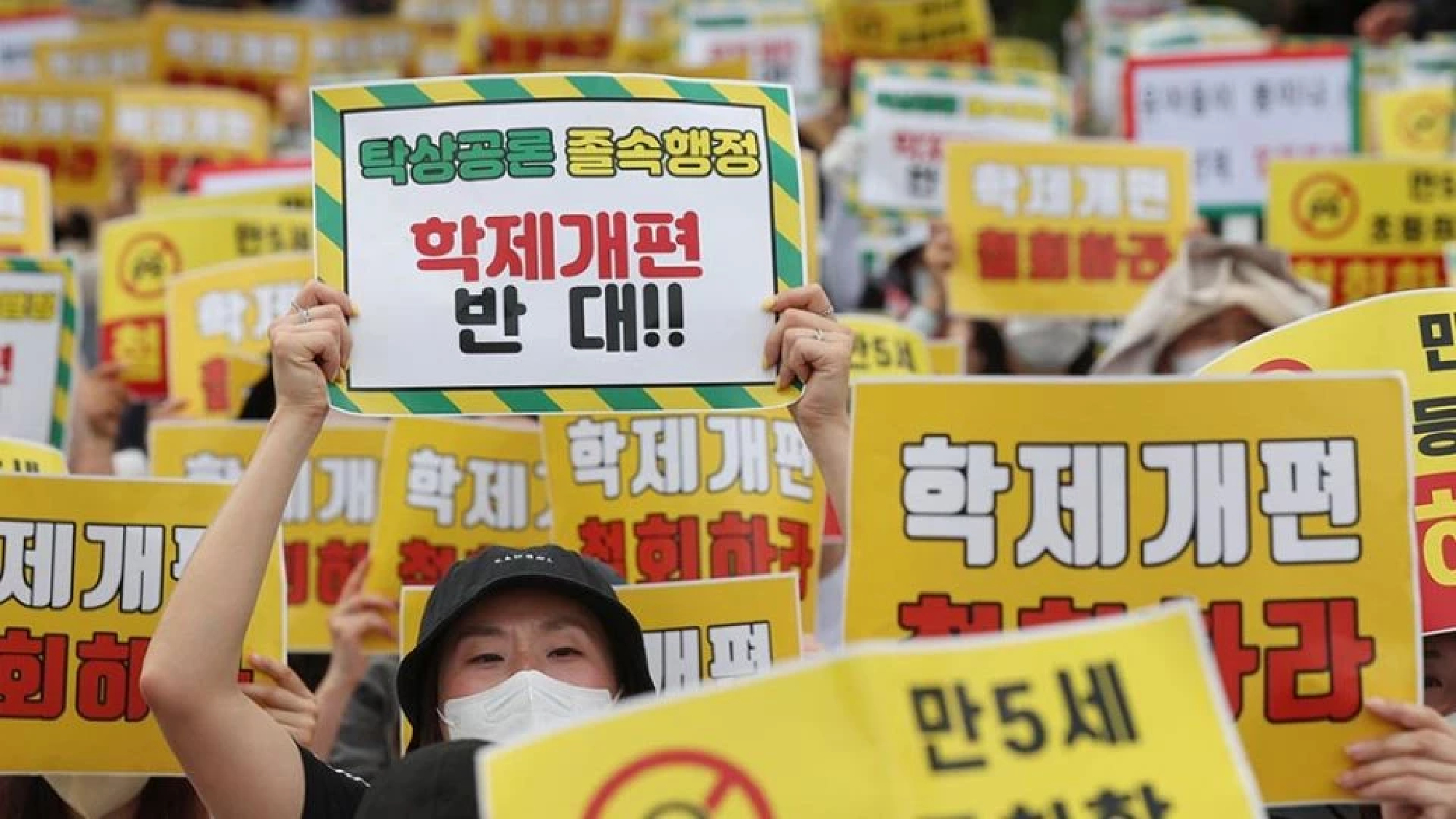
Around 40 civic groups representing kindergartens, school teachers and parents launched a united association, held a rally in front of the presidential office in Yongsan-gu, central Seoul, to demand the withdrawal of the plan on Monday. Rally organizers anticipated that 450 people would attend the event, but more people than expected showed up despite the intense heat, according to police. “Early entry in school at the age of 5 is inappropriate considering the children’s cognitive and emotional development stage,” an official from the association said.
The group also said that economic needs were being prioritized over the well-being of children. “It is not an educational decision to have a 5-year-old child to sit and study just to provide more manpower 20 years later. It is a policy without any concerns about a child’s happiness, right to play, right to learn and the right to grow,” the official said at the rally.
Rally organizers said that the protest will continue until the Education Ministry withdraws the reform plan.
The group began gathering signatures online on Saturday, and it had drawn 105,290 participants as of Monday morning. Various mother-exclusive online communities are also encouraging members to sign the petition.
Two major teachers’ unions — Korean Federation of Teachers’ Associations and the Korean Teachers and Education Workers Union — also voiced objection over the weekend. The Gyeonggi branch of the KTU issued a statement in opposition Monday, claiming that it is state-run child abuse to make a 5-year-old sit at a school desk for 40 minutes straight.
Minister Park appeared on a radio show Monday morning to respond to some of the concerns raised by educators and parents.
She firmly denied that lowering the admission age was a policy to resolve low birth rates and so that people could enter the workforce earlier. ”It is only to ensure fair opportunities for children from the start,” she said.
She underlined that kindergarten and elementary school systems vary depending on the country and that 5-7 years old is a transition period with children of differing levels of proficiency.
“We are considering alternatives such as flexible class hours for the smooth introduction of classes for 5-year-olds. There are plans to guarantee care service until 8 p.m. for the first and second graders of elementary school,” she added.
Park Da-som, chairman of the National and Public Kindergarten Teachers’ Union, who also appeared on the radio Monday morning, hit back at the minister’s explanation. “How can early school entrance be a bridge to resolving the educational gap?”
“If that is really the purpose of this absurd plan, it would be better to make the early childhood education system mandatory,” Park added.
Lee Jung-Youn
The Korea Herald
Asia News Network
Asia News Network: The Nation (Thailand), The Korea Herald, The Straits Times (Singapore), China Daily, Jakarta Post, The Star and Sin Chew Daily (Malaysia), The Statesman (India), Philippine Daily Inquirer, Yomiuri Shimbun and The Japan News, Gogo Mongolia, Dawn (Pakistan), The Island (Sri Lanka), Kuensel (Bhutan), Kathmandu Post (Nepal), Daily Star (Bangladesh), Eleven Media (Myanmar), The Phnom Penh Post and Rasmei Kampuchea (Cambodia), The Borneo Bulletin (Brunei), Vietnam News, and Vientiane Times (Laos).
The world’s population has grown at a fast pace during the past two centuries. The global population was only 1 billion in the early 19th century but it increased to 6.14 billion at the turn of this century and is inching towards 8 billion today.
According to World Population Prospects 2022, which the United Nations released on July 11, the global population is projected to reach 8 billion on November 15.
The UN report said that it took around 37 years for the global population to double, from 2.50 billion in 1950 to 5 billion in 1987. But it will take 72 years for the global population to double from 5 billion in 1987 to 10 billion by 2059.
The authorities should also reform the labour market and expedite the transition of the economy from high-speed growth to high-quality development.
The global population is projected to peak at about 10.4 billion in 2100 and remain steady or decline after that. However, China’s population will decline faster than many other countries. China’s population crossed 1 billion in the 1980s, while its total fertility rate dropped from 6.0 before the 1970s to 1.3 in 2020 despite the introduction of the two-child policy in 2015.
Also, since India’s total fertility rate is 2.0 (in 2021) and it has a population as large as China’s, it will overtake China as the most populous country in 2023, according to a UN report.
Such demographic changes can influence the underlying growth rate of an economy. Although the overall wealth inequality between developed and developing countries remains high, most countries are achieving or have achieved modernisation.
So demography will, once again, play a decisive role in the size of economies, not least because population growth contributes to overall growth of the labour force; a large population allows a country to build more infrastructure facilities, which can reduce the costs of manufacturing, transportation and research; and a populous country has a bigger domestic market which is conducive to its further development.
Also, demography directly affects a country’s politics, overall national strength and soft power. As such, China’s total low fertility rate and ageing population will create some new challenges for its economic development.
The average life expectancy in China has increased from 40 in 1950 to 78.2 in 2021-while the total fertility rate has been falling. China started to become an ageing society in 2000 when Chinese people aged 65 or above exceeded 7 per cent of the total population. The number rose to 13 per cent in 2021-and by 2050, older adults will account for more than one-third of the total population.
Besides, China’s strict family-planning policy, introduced after the launch of reforms and opening-up, played a role in accelerating population ageing and peaking of its population earlier than expected. While most developed countries got rich before they became ageing societies, China’s population is ageing before getting rich, prompting the leadership to address the problems associated with a rapidly ageing population at the critical moment of the country’s development.
Population ageing will cause labour shortage, making China lose its demographic dividends, with the retirement of the 1960s “baby boomers”, posing a daunting challenge to the pension system, as meeting their needs could greatly raise debt.
China’s falling birth rate and rapidly ageing population can also be attributed to improved living standards. Unlike the period prior to 1979 when the government introduced its strict family-planning policy, Chinese people today are less willing to have children, leading to declining total fertility rate. China’s demographic trend is similar to that in other East Asian countries, which have not adopted any family-planning policies.
The declining number of women of childbearing age and the unwillingness of most couples to have more than one child because of the high costs of raising kids have further aggravated the situation. To address the problem of an ageing population, the government needs to further reform its family-planning policy, build a family-friendly society and encourage people to have more children by reducing the high costs of raising a child rather than simply giving subsidies.
The authorities should also reform the labour market and expedite the transition of the economy from high-speed growth to high-quality development. In the long run, the government needs to accelerate industrial upgrading, transition from labour-intensive to technology-intensive manufacturing, and take pre-emptive measures to prevent economic downturn due to shortage of labour.
And to facilitate the economy’s transition, the leadership needs to increase investment in education and human resources, improve the quality of the labour force to increase productivity, as well as take advantage of the country’s massive domestic market to propel healthy development of the economy amid the changing global landscape.
China Daily
Asia News Network
Asia News Network: The Nation (Thailand), The Korea Herald, The Straits Times (Singapore), China Daily, Jakarta Post, The Star and Sin Chew Daily (Malaysia), The Statesman (India), Philippine Daily Inquirer, Yomiuri Shimbun and The Japan News, Gogo Mongolia, Dawn (Pakistan), The Island (Sri Lanka), Kuensel (Bhutan), Kathmandu Post (Nepal), Daily Star (Bangladesh), Eleven Media (Myanmar), The Phnom Penh Post and Rasmei Kampuchea (Cambodia), The Borneo Bulletin (Brunei), Vietnam News, and Vientiane Times (Laos).



 The new system is expected to prevent delays at the toll gates and allow smoother flow of vehicles.