Zipmex Thailand, a crypto-trading platform, announced at 6pm on Wednesday that the withdrawal of baht and crypto currency on its platform has been suspended temporarily.
It announced that various situations, fluctuations and several incidents in the cryptocurrency and problems with major trading partners of the company prompted Zipmex Thailand to suspend all withdrawals.
It said the suspension was necessary to protect the stability of the platform and withdrawals will be suspended until further notice.
The announcement on its Facebook was shared by over 1,400 times in 40 minutes and drew over 500 angry comments.
But by 7.30pm, the company issued another announcement, saying the platform was working to re-enable withdrawal and could be resumed by 8pm.
With a goal of transforming into logistics 4.0, Thailand Post Distribution (THPD) on Wednesday signed MoU with Singapore-based smart mobility firm, Swat Mobility, to jointly research the use of Artificial Intelligence (AI) and machine learning in delivery load and route optimisation.
The partnership is expected to not only strengthen the logistics operations of THPD through the improvement of load utilisation and route planning optimisation but also become a crucial part of driving a shift to carbon-neutral mobility.
Under the agreement, Swat Mobility will use its AI-powered system to automate the management of route planning and optimise vehicle load utilisations for THPD. It is aimed at putting in place a more efficient planning process that will increase productivity and customer satisfaction while reducing the number of vehicles used in these deliveries.
Peera Udomkitsakul, CEO of THPD Co said that Swat smart solutions will align with its plan to launch a platform for small farmers and community enterprises in the last quarter of this year. The new service is aimed at reducing backhaul waste and energy consumption and also offers farmers good and affordable transport options.
Meanwhile, Swat technology will support THPD’s project to expand B2B logistics service.
“We strive to be a model Thai logistics provider that adopts cutting-edge technology to provide efficient transport systems on par with foreign companies. In addition, the new operating procedures will help reduce the logistics costs of customers and promote sustainability with mitigation of carbon footprint,” said Peera.
Arthur Chua, executive chairman and co-founder of Swat Mobility Co, said that this partnership, more than achieving outcomes beyond increased productivity, is driven by a common desire to create a positive impact through vehicles and mileage reduction. Sustainability and resource-use efficiency are priorities that Swat actively strives toward with the use of technology.
“Mileage reduction has always been at the core of Swat’s technology, and so is the corresponding decrease in carbon emissions. We provide AI-powered technology that optimises your mileage and vehicle usage as well as tools that amplify your environmental impact.”
For reduction of operating costs, Chua said that Swat Mobility has done a similar project with other logistics providers, showing that its smart solutions could reduce the number of vehicles by 50 per cent.
Currently, Swat Mobility has launched its solutions in eight countries with the main focus on Thailand, the Philippines and Japan. Swat Mobility has progressively secured the interests of key Thai stakeholders in the automotive, manufacturing and FMCG industries, following its expansion into the market in 2021 with the support of Enterprise Singapore.
“If we want to bring technology to real life in different countries, we need to act on many unique parameters and need unique operational tools.”
Chua pointed out that the company is moving forward to build more parameters to customise solutions for the different needs of customers. So far, we have done over 200 kinds of customisations to fix different countries, different industries and different using patterns. We’re moving forward to build more and more parameters to make customised solutions,” said Chua.
In 2021, Swat Mobility was listed on the Forbes Asia “100 to Watch” list as a notable startup on the rise in the Asia-Pacific region.
Production and sale of Foremost pasteurised milk has been suspended since July 1 to cope with changes in Thailand’s dairy market, its manufacturer FrieslandCampina (Thailand) announced on Wednesday.
The announcement came after the “Foremost Thailand” Facebook page administrator, in reply to a netizen’s query, said that Foremost pasteurised milk was not currently being produced.
The company said that it had closed its Lak Si plant on July 1, adding that the company has considered this issue thoroughly in line with business strategies.
FrieslandCampina (Thailand) vowed to produce and sell high-quality dairy products to meet Thai consumers’ demand via various brands, such as Foremost UHT, Foremost Omega, Falcon, Debic, Ship and My Boy.
The company also vowed to continue promoting good nutrition among Thais.
“The company will assist employees affected by the closure of the Lak Si plant to the fullest,” the announcement read.
The Dutch multinational launched its Thai arm in 1956, gaining the largest market share in the dairy segment riding Thais’ increasing thirst for sterilised milk, UHT milk, and pasteurised milk.
However, FrieslandCampina (Thailand) suffered a net loss of 1.36 billion baht in 2021, down 180 per cent from the 289.45 million net profit it made in 2020, according to Department of Business Development data.
On April 29, 2022, Mitsubishi Motors (Thailand) Co., Ltd., led by Mr. Eiichi Koito, President and CEO, together with Mr. Egathi Rattana-Aree, Executive Vice President, Human Resources & General Administration Unit, donated the first solar system to Namphong Hospital in Khon Kaen province as part of its latest environmental project, ‘Solar for Lives’, as well as efforts to promote clean energy in the public health sector and propel Thailand toward a carbon-neutral society. Flagship electric car – Mitsubishi Outlander PHEV has also been lent to the hospital to be used for its medical services.
Mr. Eiichi Koito, President & CEO of Mitsubishi Motors (Thailand) said, “Our goal in putting solar system in community hospitals across Thailand is to increase the opportunities of Thai people to access good health services while promoting the government’s strategic goals in bringing Thailand towards a balanced carbon society. The project has been initiated through a strong partnership among the Ministry of Public Health, the Electricity Generating Authority of Thailand (EGAT), and the Thailand Greenhouse Gas Management Organization (TGO) to enhance a collaboration between government and private sector to achieve our target which are to support the installation of solar system for approximately 40 community hospitals by 2032, also can reduce carbon emissions more than 17,300 tons throughout the project and save up to 400,000 baht per year in power expense for each hospital.”
“Namphong Hospital was chosen as the first hospital due to its urgent need to expand its facilities to accommodate more patients, as well as the hospital’s location where direct sunlight shines, which helps solar panels produce power more efficiently. We believe solar system will benefit the local community members for both health and environment which associate with our CSR direction: To contribute and grow with Thai Society in 3 areas: Education, environment, and health,” added Mr. Koito.
Under the project, Mitsubishi Motors Thailand is responsible for solar system installation and yearly maintenance.
Namphong Hospital, founded in 1971, is located on Mittraphap Road. The hospital serves residents of numerous districts, including Namphong, Khao Suan Kwang, Ubonrat, Kranuan, Mueang, and Non Sa-ard, 24 hours a day, seven days a week.
Besides the solar system, Mitsubishi Motors Thailand has also lent one unit of Mitsubishi flagship electric car, Outlander PHEVs, for Namphong Hospital to be used for its medical services. The vehicle is an environmental friendly vehicle which can provide a maximum 1,500 watts to electronic appliances for outdoor activities and as a reliable source of electricity in an emergency or blackout. As the car runs by electricity generated by solar system of the hospital, it can demonstrate the example of sustainable and renewable energy eco system as well.
On June 13, 2022, Mitsubishi Motors expanded its ‘Solar for Lives’ project by providing the solar system to the second community hospital, Phaya Mengrai Hospital in Phaya Mengrai District, Chiang Rai province. The company also provided Mitsubishi Outlander PHEVs for the hospital to be used for medical services, which include serving communities in the 20 km. radius of the hospital, thanks to their capacity of running 55 km. on electricity alone and up to 500 km. when using both electricity and gasoline.
The 60-bed Phaya Mengrai Hospital treats outpatients at around 400 persons per day and 10 inpatients daily. It has 7 doctors and 52 medical professionals providing healthcare to local people in Phaya Mengrai and nearby districts.
Mr. Eiichi Koito, President & CEO of Mitsubishi Motors (Thailand) said “Phaya Mengrai Hospital was selected to join the ‘Solar for Lives’ project’ as it requires power support to cope with increasing patients in the communities. Furthermore, the hospital is located in an area that receives sunlight directly, which helps maximize the efficiency of solar panels. We are confident that the solar system will help improve local people’s quality of life as well as promote the community awareness of environmental conservation.”
Mitsubishi Motors Thailand commits to its environmental goal of supporting Thailand in becoming carbon neutral. There are a number of green programs in place to reduce carbon emissions throughout all of manufacturing operations, including Reforestation, Solar for Lives project, and production of the electric car – Outlander PHEV that made its debut in Thailand in 2020. The company also installs a rooftop solar system at our Laem Chabang factory in Chon Buri, the largest manufacturing center outside of Japan, which can reduce carbon emissions about 6,100 tons per year.
The bloodbath for cryptocurrency investors – who have lost an estimated US$1.7 trillion (62 trillion baht) since October – has seen global interest swing to stablecoin as a potentially safer bet.
Stablecoin is pegged and backed by a real-world asset (usually dollars), for which it can be redeemed.
So could it be the answer for Thailand’s growing crypto market, which has been left battered and bruised by the crash?
Attempting to answer that question is USD Coin issuer Circle, which has partnered with Thai crypto exchange Bitkub to educate locals about its stablecoin.
Jeremy Allaire, founder and CEO of Circle, said the power of digital currency and blockchain will eventually take over financial services such as borrowing, lending and investing. These traditional services will eventually be offered via digital assets and crypto, he added.
“We see a very big opportunity to promote USD Coin in Thailand and Bitkub is the strongest partner to do that for us. But we have other ideas for things that we can do together in future and so this is the start of our partnership,” said Allaire.
Speaking at the MOU-signing ceremony in Bangkok yesterday, he said his company would focus first on educating and marketing to promote the use of USDC in trading and decentralised finance (DeFi).
However, Allaire sees a bigger future for USDC in Thailand.
“I think we are optimistic that this can be a long-term partnership that we are just at the start of.”
Circle has chosen Thailand as its launch point for USDC in Southeast Asia.
However, Allaire accepts plenty of education will be needed before people here understand how the stablecoin works, as well as its uses and benefits.
He adds that Thailand’s adoption of crypto is currently in the “speculation phase”.
“Now the next important phase is what I call the utility value phase. It’s when the technology becomes useful in everyday life [beyond speculation].”
As its name suggests, USDC is pegged to the US dollar.
According to Circle, the total amount of USDC in circulation as of June 30 was just over 55.5 billion (55,569,519,982). It adds that the coin is backed by reserve assets of $55.7 billion – $13.58 million in cash at US banks and $42.1 billion in US treasury bonds. Circle says this means that its customers could redeem all USDC in one day.
The digital coin is managed by a consortium called Centre, which was founded by Circle and includes members from the cryptocurrency exchange Coinbase and Bitcoin mining company Bitmain.
Circle has also applied to the US Securities and Exchange Commission to be listed as a public company. The commission is currently examining its application.
Thailand’s export growth in the second half of this year is expected to slow down from 12.9 per cent in the first five months, the Export-Import Bank of Thailand (Exim Thailand) said on Thursday.
Overall exports during the year are expected to expand by 6-7 per cent amid the rising inflation which has pushed up the prices of goods as well as business and transportation costs, Exim Thailand president Rak Vorrakitpokatorn said.
He also announced the launch of “Exim Index”, a business research innovation that presents forward-looking export prospects based on 25 indicators in five dimensions: demand, supply, prices, market sentiment, and the bank’s trade finance.
He pointed out that the Exim Index as of June this year was 100.63, down slightly from 100.90 in May.
“This reflected a slowing export trend in line with the declining economic outlook of trade partners, concerns over recession and inflation among consumers and investors, impact on exporters’ costs from global supply chain disruptions, and decelerating expansion of trade finance transactions,” he said.
Rak advised Thai entrepreneurs to make adjustments to cope with the rising costs by upgrading their products, production processes and marketing guidelines to meet market trends and the demands of consumers in the new era.
He also advised entrepreneurs to manage risks by diversifying products in various markets and penetrating new frontiers, such as countries under the Regional Comprehensive Economic Partnership.
Rak added that Exim Thailand is fully ready to support Thai entrepreneurs in fighting rising costs and managing risks through the “Hybrid Model: Rejuvenate export amid rising costs, drive investment towards new industries”. The measures include:
Maintaining the interest rate with the prime rate held at 5.75 per cent per annum to relieve the cost burden on Thai entrepreneurs.
Exim Export Ready Credit, a new credit facility with a maximum credit line of 5 million baht, minimum interest rate of 4.5 per cent per annum in the first six months, and instalment repayment term not exceeding three years for Thai entrepreneurs to boost liquidity for export and related businesses.
Financial facilities to support market diversification, upgrading of products in response to global trends with demand for green, digital and health products; domestic and overseas investments, particularly development of infrastructure, and new industries that enhance research and development for Thai goods, such as industries conducive to bio-circular-green economy and S-curve industries.
Risk management tools for international trade and investment, such as export credit insurance to safeguard against non-payment by foreign buyers, investment insurance, and foreign exchange forward contract services.
Exim Thailand Pavilion, an online trade channel on world-leading e-commerce platforms.
“This is certainly a testament to our determination in pursuing our role as Thailand Development Bank tasked to perform beyond banking with development of innovations in providing financial and non-financial services,” he said.
“We aim to empower Thai entrepreneurs to brave challenges, capture opportunities and deal with emerging risks in the global markets,” he added.
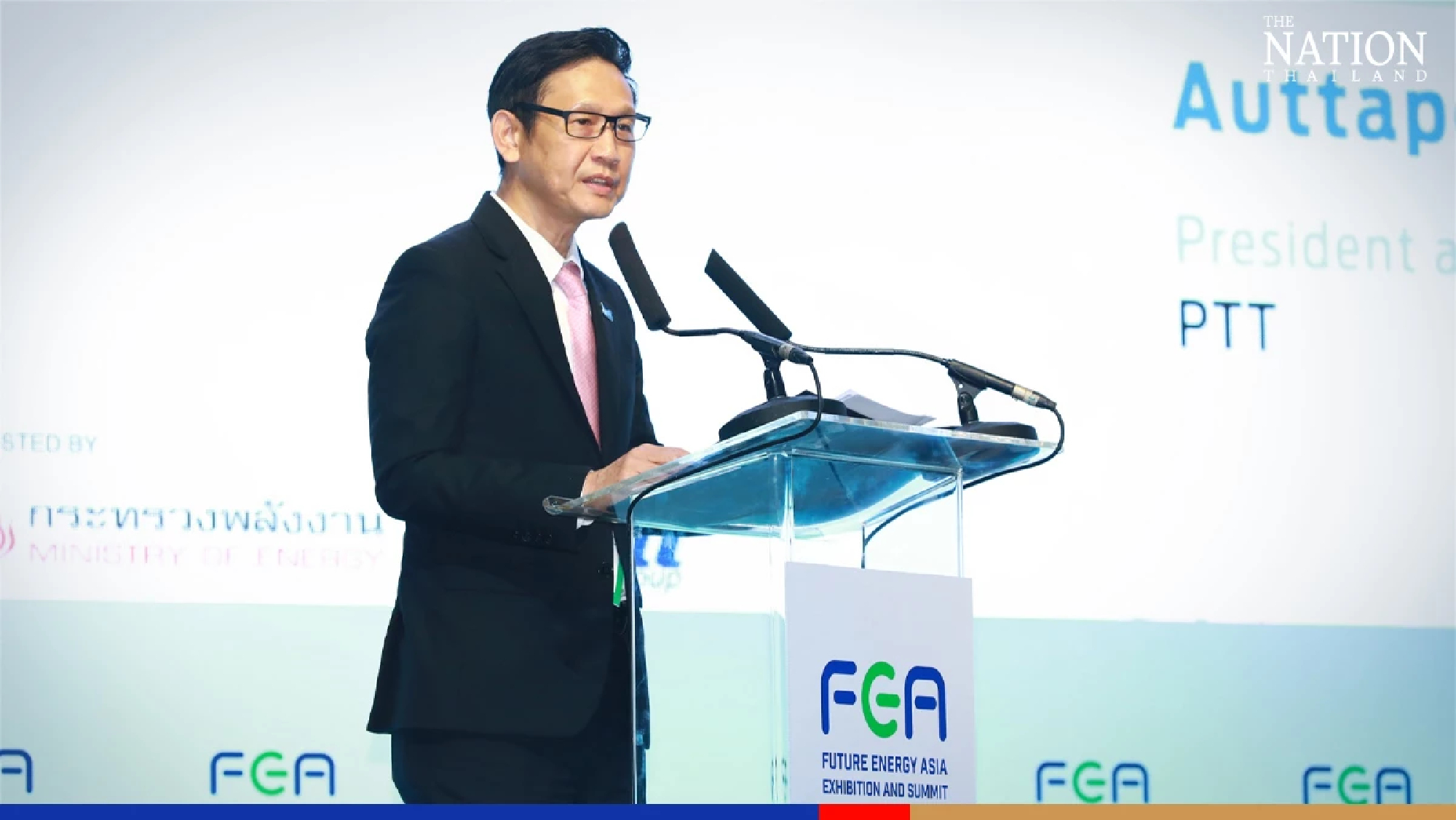
PTT, Thailand’s largest energy conglomerate, has outlined a roadmap for Thailand’s long-term energy security.
Auttapol Rerkpiboon, president and chief executive officer of PTT Public Company Limited, stated during his opening speech at “Future Energy Asia Exhibition and Summit” on Wednesday that the energy giant aimed to make Thailand a liquified natural gas (LNG) hub in Asia over the next few decades.
Although people worldwide realise the urgent need to reduce their dependence on fossil fuel energy, businesses and households at present have huge demands for any kind of energy to move on, said Auttpol.
He explained that of the three categories of fossil fuels — coal, oil, and LNG — natural gas is the cleanest and most eco-friendly, and there is plenty to meet market demand.
“We need natural gas, such as LNG, during this energy transition period from cancelling the use of oil and coal to using renewable energy, such as wind, solar cells, and electricity,” Attapol added.
The hub would be a centre for selling and buying LNG, which means Thailand would purchase LNG from other producers, prepare it for use, and re-export it to other countries in need, such as Japan, China, Cambodia and Laos.
He stated that Thailand’s infrastructure, such as ports and pipelines, are ready to support these processes. He expected that by 2030, the country would export 9 million tons of LNG.
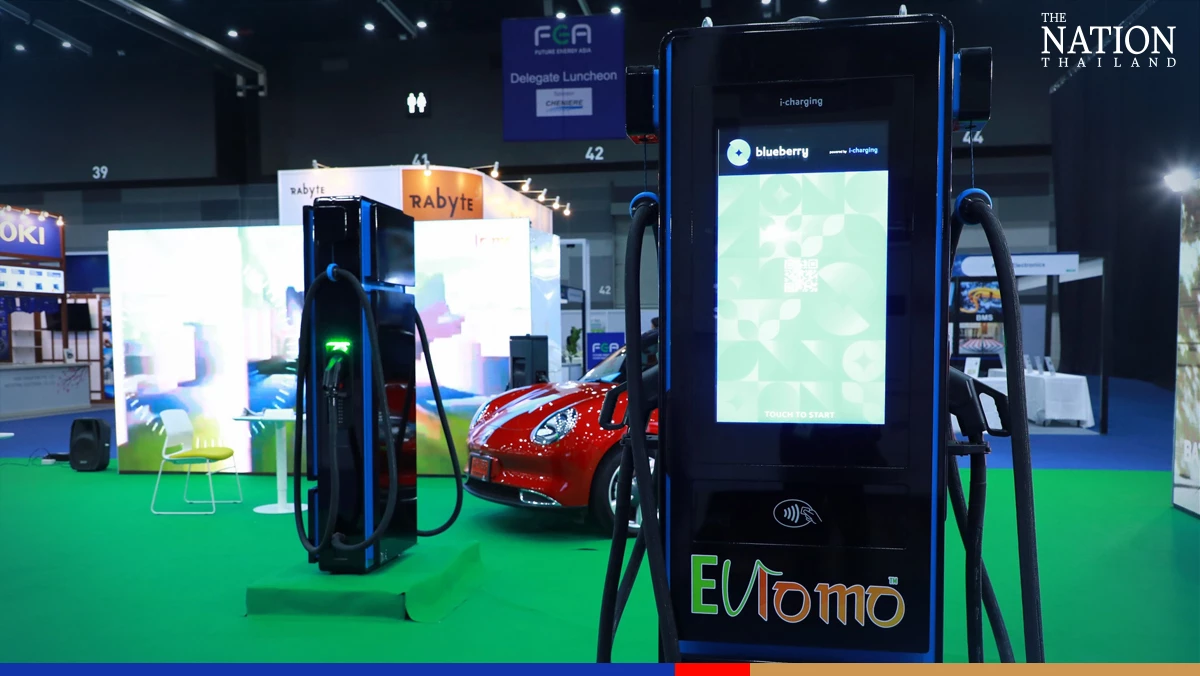
Making Thailand the region’s LNG hub is part of PTT’s plan to secure and sustain Thailand’s energy industry. He revealed that the company had made significant investments in future energy, including renewable energy, energy storage and system-related, EV value chain such as EV charging stations and EV factories, and hydrogen power.
The objective of these investments is to ensure that Thailand maintains its competitiveness during the energy transition period while also being prepared to seize new opportunities when future energy arrives.
Under the concept of “Powering Life with Future Energy and Beyond”, Auttapol insisted energy security is key to achieving energy sustainability.
Thailand needs to supply enough energy for domestic consumption before considering export, and PTT looks forward to investing in renewable energy and related technology abroad, he said.
Apparently, energy sustainability is a critical solution to the current global energy crisis situation like climate change. Countries worldwide, including Thailand, have announced targets to achieve carbon neutrality in 2050 and reach net zero greenhouse gas emissions in 2065.
To achieve such pathways, concrete measures and serious action plans are required.
“PTT’s new vision, ‘Future Energy and Beyond’, will not only invest in future energy but also invest in other new businesses, such as life sciences, electric vehicles, AI, robotics and digitalisation. The proportion of investments in future businesses will reach 30 per cent by 2030,” said the PTT CEO.
Recently, PTT joined Foxconn, the leading Taiwanese tech firm, to build an EV factory in Thailand. The factory will be finished and ready to produce all designs of EV cars by the first quarter of 2024.
Auttapol believes that by working closely with the government sector, PTT could help shape the country’s energy landscape, improve energy consumption and utilisation, and make energy accessible to all.
The baht opened at 36.58 to the US dollar on Wednesday, strengthening from Tuesday’s close of 36.61.
The currency is expected to move between 36.50 and 36.70 during the day, predicted Krungthai Bank market strategist Poon Panichpibool.
Poon said the dollar might remain stable or even weaken if the market jumps into a risk-on state.
He believes the baht will not weaken past its resistance level of 36.70-36.80 if foreign investors purchase risky Thai assets again.
However, the baht could fluctuate and fail to strengthen because the market is ready to slide back into a risk-off state due to concerns over economic slowdown and worse-than-expected performance by listed companies, Poon said.
Also, investors believe the US Federal Reserve may push the interest rate up by a fair bit, he said.
Moreover, the energy crisis in Europe is a concerning factor in the short term.
Poon advised close monitoring of this situation because the euro might weaken further and cause the dollar to strengthen if Russia halts or decreases the amount of energy sent to Europe.
He also advised investors to use hedging tools such as options to manage risks in a highly volatile currency market.
The government is making constant efforts to boost the country’s digital economy, Digital Economy and Society Minister Chaiwut Thanakamanusorn said on Wednesday.
He made the remark during the censure debate after Pheu Thai Party’s Loei MP Saran Timsuwan accused Chaiwut of his failure in dealing with various types of cybercrimes, such as call centre scams, data hacking and online gamblings.
Saran claimed that Chaiwut focused on using his authority to protect the government’s stability until cybercrimes caused people to be at risk of losing properties, and damaged the country’s economy.
“Thailand has become a country that draws scammers to seek benefits, but we haven’t seen the government’s efforts to deal with them,” Saran said.
He added that call-centre scams also lead to human trafficking as many people have been deceived into becoming a part of call-centre gangs to continue scamming.
Chaiwut denied Saran’s accustations, saying that every country faces similar issues in the internet era.
He said many committes have been formed to deal with cybercrimes so far, such as the National Cyber Security Committee that is responsible for supervising agencies possessing important data, such as financial institutions and hospitals.
He added that Thailand has enforced the Personal Data Protection Act on June 1 to protect people’s personal data while performing online transactions.
“I admit that call centre scams are a big issue because I have received a lot of complaints so far,” he said.
“What I want to do is arrest call-centre gangs. It would be easy if call-centre gangs lived in Thailand, but they live in neighbouring countries.”
He added that the ministry has cooperated with Cambodian agencies to tackle call-centre scams.
He also confirmed that the government led by Prime Minister Prayut Chan-o-cha wants to deal with this issue as soon as possible.
Apart from protecting people from cybercrimes, this move will also help boost confidence among business operators, stimulate the digital economy and generate revenue for Thais, he added.
Transport Minister Saksayam Chidchob vehemently denied on Wednesday that he owned a construction firm that won 1 billion baht worth of projects from his ministry in the past two years.
Saksayam, a main censure target on the first day of the no-confidence debate on Tuesday, was responding to allegations by Move Forward party-list MP Pakornwut Udompipatskul and Prachachart Party secretary-general and list MP Tawee Sodsong.
The two alleged Saksayam used a nominee to hold 99 per cent of shares in Buri Charoen Construction and the nominee was none other than his employee.
But Saksayam insisted the company was owned by his friend, Supawat Kasemsut.
He said Supawat transferred the money to him on three different occasions – first 35 million baht, then another 35 million and subsequently 49 million for the shares worth 119.5 million baht.
Saksayam said the sale of shares had no documentary record because Business Development Department rules exempted the submission of such documents.
“The company was sold on March 28, 2019, and it has nothing to do with me now,” Saksayam insisted.
The minister said he did not report the proceeds from the sale of the company to the National Anti-Corruption Commission because the sale took place before he became transport minister on May 5, 2019.
The opposition also alleged that Buri Charoen Construction bagged a lot of Transport Ministry projects because of “bidding collusion”, but Saksayam dismissed the allegations.
He said it was impossible for any rigging to take place at the Transport Ministry because his ministry used an e-bidding system to prevent collusion and the ministry would severely punish any wrongdoers.
Saksayam also dismissed allegations that the Transport Ministry shelled out an unusually high amount of the construction budget to Buri Ram.
He said the ministry’s projects were proposed by the Highways Department and the Rural Roads Department, and they were screened by several levels of officials, including the permanent secretary.
During the past ten years, Buri Ram has received a lower budget under the Transport Ministry compared to allocations to other provinces such as Ayuthaya, Nakhon Pathom and Nakhon Ratchasima, Saksayam said.
He explained that Buri Ram would receive a high portion of the budget in fiscal 2023 because it had been given a lower portion of money for development in previous years.
Saksayam said some construction projects in the 2023 fiscal year were continued from earlier ones that started before he became the transport minister.
He added that the Highways Department and the Rural Roads Department complied with the law and bidding regulations and there were up to 35 construction contractors that won projects from the two departments, not just Buri Charoen Construction.
Responding to the allegation that his father, Chai Chidchob, encroached on a plot of land owned by the State Railway of Thailand (SRT), Saksayam admitted that his father did live on a disputed plot of land on Buri Ram’s Kradong Mountain.
But, Saksayam said, his father had filed a lawsuit with the Central Administrative Court against the SRT and the Land Department to claim ownership and the court had accepted the case for review.
The minister said his father lived on a different plot and not the one involved in a Supreme Court case that the SRT had won after an ownership dispute, so the opposition has cited inaccurate information, he said.
Saksayam also denied that development projects under the Motorway-Rail Map masterplan would overlap with existing transport projects.
He denied that the masterplan had already commissioned a huge budget of 5.77 trillion baht. He said the plan was aimed at solving transport problems by systematically linking all major routes around the country and investments would be carried out gradually.
In conclusion, Saksayam said the opposition spent more than four hours attacking him but failed to provide correct and comprehensive information to the public.