Vietnam imposes lockdown in city, as Covid cases continue to surge in Asean
The ongoing surge in Covid cases across Southeast Asia continued unabated on Friday, although the number of deaths declined, collated data showed.
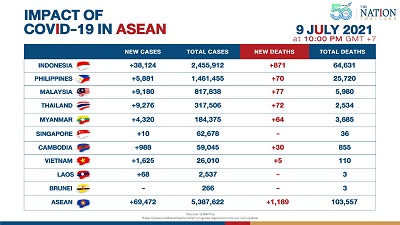
Asean reported 69,472 new cases on Friday, higher than Thursday’s 66,286, though deaths were lower at 1,189, from Thursday’s 1,334.
The number of Covid-19 cases in the region crossed 5.38 million, while the death toll has risen to 103,557.
Indonesia’s public health minister said that the Moderna vaccine would arrive on Sunday and would be distributed starting next week at the earliest.
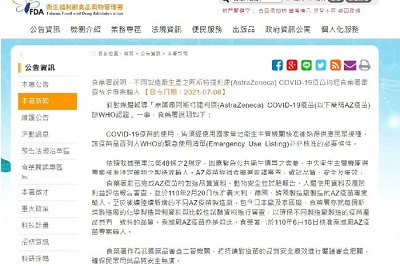
Meanwhile, Indonesia’s medical association reported that 210 doctors have died due to Covid-19 from January to July 9 this year. Of these, 20 had received two doses of Sinovac, prompting the association to express concerns over the vaccine’s efficacy.
Vietnam’s government announced a two-week lockdown in Ho Chi Minh City which has a population of over 9 million. People are only allowed to leave their homes to buy food, drugs and for emergency reasons. Service and manufacturing industries are allowed to continue but all public transport has been suspended. The government’s decision came after the country saw over 1,000 new cases on four consecutive days, most of which were from HCM City and were the Delta variant of the virus.
Pfizer developing COVID-19 booster shot to target Delta variant
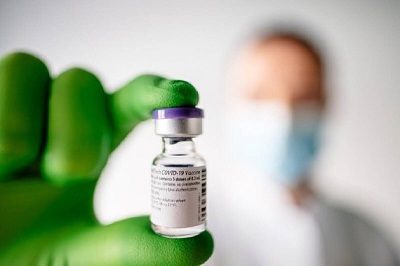
Pfizer and BioNTech said they believe a third shot of their current two-dose vaccine has the potential to preserve the “highest levels” of protection against all currently known variants, including Delta, but they are “remaining vigilant” and developing an updated version of the vaccine, media reported.
Pfizer and BioNTech said they are developing a COVID-19 booster shot intended to target the highly transmissible Delta variant, according to U.S. media reports on Thursday.
Concerns continue to rise as the Delta strain has already become the dominant variant in the United States, causing increasing infections.
The two companies said they believe a third shot of their current two-dose vaccine has the potential to preserve the “highest levels” of protection against all currently known variants, including Delta, but they are “remaining vigilant” and developing an updated version of the vaccine, according to a CNBC report.
“These findings are consistent with an ongoing analysis from the companies’ Phase 3 study,” the companies said in a statement. “That is why we have said, and we continue to believe that it is likely, based on the totality of the data we have to date, that a third dose may be needed within 6 to 12 months after full vaccination.”
Clinical studies could begin as early as August, subject to regulatory approvals, the companies said.
Executives from Pfizer and BioNTech have said people will likely need a booster shot, or third dose, within 12 months of getting fully vaccinated because they expect vaccine-induced immunity to wane over time.
The Covid crisis in Southeast Asia worsened on Thursday with a record increase in new cases, collated data showed.
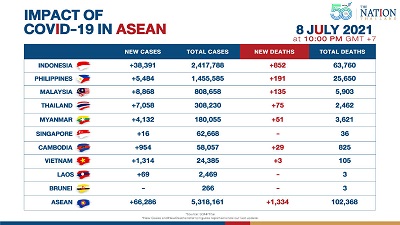
Asean reported 66,286 new cases on Thursday, higher than Wednesday’s 58,275, as Indonesia, Malaysia, Thailand and the Philippines saw a big jump in Covid-19 patients.
Deaths were at 1,334, decreasing from Wednesday’s record number of 1,430.
The number of Covid-19 cases crossed 5.31 million across the region since the outbreak, while the death toll climbed to 102,368.
Indonesia reported a more than 4,000 jump in new cases, from 34,379 on Wednesday to 38,391 on Thursday.
Malaysia reported 8,868 new cases and 135 deaths on Thursday, bringing cumulative cases in the country to 808,658 and the death toll to 5,903.
Daily cases in Malaysia exceeded 8,000 despite a nationwide lockdown for more than a month.
Cambodia reported 954 new cases and 27 deaths on Thursday, bringing cumulative cases in the country to 58,057 and total deaths to 825.
The government spokesman announced that about 90 per cent of the population in Phnom Penh had been vaccinated, increasing the possibility of starting a travel bubble programme in the city.
U.K. probes Chinese takeover of countrys biggest chip plant
Britains national security adviser will examine the takeover of the countrys biggest semiconductor plant by a Chinese-owned company after lawmakers said it could threaten the countrys high-tech future.
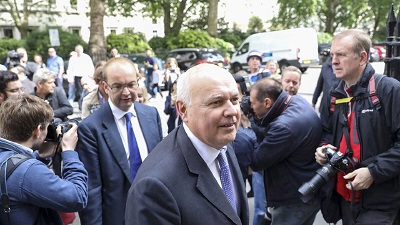
Iain Duncan Smith, U.K. lawmaker, in London on June 12, 2019. MUST CREDIT: Bloomberg photo by Chris Ratcliffe.
Nexperia acquired Welsh-based Newport Wafer Fab, which makes semiconductors mainly for the car industry, on Monday.
“We are looking into it. I have asked the National Security Adviser to review,” Prime Minister Boris Johnson told Parliament on Tuesday.
The U.K.’s Enterprise Act gives the government 30 days to either allow the deal to proceed or call it in for scrutiny. Nexperia’s parent company Wingtech Technology Co. Ltd. said in a statement earlier that the deal faces “uncertainties.”
Beside supplying automotive plants, Newport Wafer has been focusing on more advanced compound semiconductors that are at the heart of technologies such as 5G and facial recognition. The company also has strong ties to a number of U.K. universities.
Johnson told parliament that National Security Adviser Stephen Lovegrove will “judge whether the stuff that they are making is of real intellectual property value and interest to China, whether there are real security implications.”
On Thursday, a U.K. government spokesman said that “we are going to monitor the situation closely and wouldn’t hesitate to take further action if necessary.”
“The government needs to call this in and block it,” said former Conservative Party leader Iain Duncan Smith in an interview. “This yet again shows that despite the legislation, despite all the earlier tough talk, the government is looking two ways on China. This sale is an investment disaster.”
Vetoing the deal could antagonize Beijing and signal a hardening of Britain’s stance on Chinese investments in the chip industry, which is at the center of a trade war between the U.S. and China.
While Johnson has blocked China’s Huawei Technologies Co. from taking part in Britain’s 5G wireless rollout, the government has tended to take a lighter-touch approach with chip industry deals.
Officials have waved through the sale of most of the U.K.’s major semiconductor firms including Arm Ltd., acquired by Japan’s SoftBank Group Corp. in 2016, and Imagination Technologies, which went to a Chinese-backed private equity firm in 2017.
A new law was passed this year giving sweeping powers for the government to intervene if takeovers are deemed a threat to national security. Ministers will have five years to scrutinize transactions and have powers to unpick them if they are judged a threat.
Although Newport Wafer is one of the U.K.’s largest fabrication plants — where semiconductors are made — it remains tiny compared to facilities in the U.S. and Asia, with annual revenue of 49.4 million pounds ($68.2 million), according to the latest U.K. accounts.
Nexperia has been a customer of Newport Wafer for several years, a spokesman for Netherlands-based Nexperia said in an emailed reply to questions from Bloomberg.
“Newport has a proven track record and has unparalleled experience with advanced power and semiconductor technologies,” said the spokesman. “With the acquisition, Nexperia is guaranteeing its own supply chain.”
Nexperia was spun out of NXP Semiconductors NV in 2017 and acquired by a Chinese consortium led by Beijing Jianguang Asset Management Co. Ltd. In 2018, Wingtech — which produces mobile phones and tablets — bought a controlling stake in Nexperia for $3.6 billion.
“I think this should be called in under the legislation,” former cabinet minister and Tory MP Damian Green said in an interview, referring to the Newport Wafer sale. “It’s clear this type of manufacturing facility lies at the heart of many industries of the future and it will be very important to our long-term resilience as a high-tech country.”
Published : July 09, 2021
By : Syndication Washington Post, Bloomberg · Kitty Donaldson, Alex Morales
President Joe Biden said he gave his Russian counterpart a tough message on the need to stop cyberattacks when they met in Geneva last month. Vladimir Putin said he couldnt agree more.
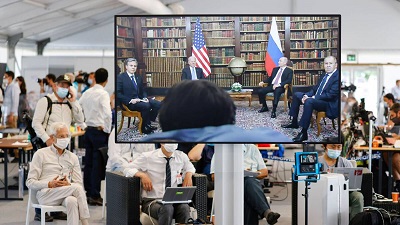
Journalists watch a broadcast feed of the start of the meeting between Vladimir Putin, Russia’s president, second right, and U.S. President Joe Biden, second left, Sergei Lavrov, Russia’s foreign minister, right, and Antony Blinken, U.S. secretary of state, left, in Geneva on June 16, 2021. MUST CREDIT: Bloomberg photo by Stefan Wermuth.
But less than a month later, hackers from Russian military intelligence were breaching the computers of the U.S. Republican National Committee, Bloomberg News reported Tuesday.
The Kremlin denied involvement in the latest attack, as it has in all previous ones, but that did nothing to relieve the pressure on Biden from critics of his efforts to repair relations with Russia.
For Moscow, cyber weapons are just one of the tools used in the increasingly fierce standoff with the U.S., and warm words at a presidential summit aren’t enough to change that, according to former officials and analysts.
Just last week, Putin signed off on a new National Security Strategy that called for the use of such “asymmetric” tactics in response to “unfriendly actions” of other nations. A Russian law passed earlier this year formally categorizes the U.S. as unfriendly.
“Hacker attacks are the simplest tool for Moscow to deploy,” said Gleb Pavlovsky, who worked as a Kremlin political adviser during Putin’s first decade in power until 2011. While sophisticated operations to breach computer security take time to prepare “they could have been ready, just waiting for the go-ahead at the right time,” he said.
Russia’s U.S. Ambassador Anatoly Antonov said Wednesday that Moscow wasn’t involved in hacks against U.S. infrastructure and that cybersecurity issues are likely to be a topic of discussion when U.S. and Russian officials meet as soon as next week for another round of dialogue.
“Don’t forget there is a lot of mistrust between the United States and Russia, there are a lot of problems,” Antonov said on Bloomberg Television’s “Balance of Power” with David Westin. “We are in close contact with various agencies of the United States.”
There is “ongoing high-level engagement from our national security officials with the Russian government” about cyber attacks, White House Press Secretary Jen Psaki told reporters Wednesday.
Putin on June 30 accused the U.S. of playing a role in the U.K.’s decision to send the destroyer HMS Defender into Black Sea waters claimed by Russia, triggering threats of military action from Moscow.
“This provocation was full-scale, it was carried out not only by the British but by the Americans too,” he said on national television.
The hacking attacks may have been a kind of retaliation, according to Pavlovsky, the former Kremlin aide.
While Russian military capabilities are far below those of the U.S., “in the eyes of the Kremlin and the security hawks who have a big role in geopolitical policy, cyber-instruments are a new weapon in their arsenal,” said Tatiana Stanovaya, founder of political consultancy R.Politik.
Moscow hopes to reach a broad truce with Washington, said Sergei Markov, a political consultant to the Kremlin. Still, “Russia is very actively preparing for a cyber-war with the U.S., so that if the U.S. declares such a war on it, Russia can carry out a retaliatory strike.”
What Moscow may see as defense or routine intelligence work can be cast as offense in Washington.
“So soon after a summit in which Biden was trying to get the Russians to stop being actively meddlesome and police their own community this will become a political issue,” said Mark Galeotti, senior associate fellow at the Royal United Services Institute in London. “The news is now about malign Russian cyber-activity and this poses a challenge to Biden.”
Published : July 09, 2021
By : Syndication Washington Post, Bloomberg · Henry Meyer
Taiwan extended its soft lockdown while easing some of its covid curbs as the government weighs the need to revive the domestic economy against risks posed by the global spread of the delta variant.
A vaccination center in Taipei administering AstraZeneca vaccines donated by Japan, on June 15, 2021. MUST CREDIT: Bloomberg photo by I-Hwa Cheng
Sporting venues such as gyms and golf courses, along with national parks, scenic areas, museums and movie theaters, will be allowed to reopen from Tuesday, the Central Epidemic Command Center said in a statement. Restaurants, night markets and food courts can host socially distanced customers. But bars and swimming pools will stay closed, and people must continue to wear masks in public.
There were just 18 newly confirmed domestic cases Thursday, the lowest number since May 13, according to Taiwan Centers for Disease Control data, as the soft lockdown measures succeeded in curbing the island’s worst outbreak of covid-19.
“We have had fewer than 10 cases from unknown sources on four days over the past week, and about three cluster infections in the community,” Health Minister Chen Shih-chung said at Thursday’s briefing. “We are on the verge of being able to lower the covid alert level. That’s why we need to be more careful and keep it at the current level, while easing some measures.”
While easing certain measures, the government extended the so-called level 3 alert to July 26, with indoor family and social gatherings limited to five people and outdoor ones to 10. Under the curbs, which have been in place since May 19, schools and recreational facilities including bars have been shut, and restaurants were only allowed to serve takeout.
Heath authorities are remaining cautious after a handful of infections of the delta variant were reported, a strain that has complicated the U.K.’s reopening and forced some countries to reimpose curbs.
“We are not ready to downgrade the covid-19 alert level yet” despite the local outbreak being under control, cabinet spokesperson Lo Ping-cheng said at briefing Thursday. But as the number of new cases has dropped from its peak in May, “it’s necessary to ease some controls to give industries like domestic consumption and services a breather.”
The restrictions are hurting retail spending and threatening jobs, even as the broader economy expanded 8.92% from a year earlier in the first quarter, the fastest pace in over a decade, on exports of semiconductors and other high-value products.
Restaurant and dining industry revenue slumped 19.1% in May from a year earlier, according to the economics ministry. Unemployment in Taiwan rose to its highest level in almost eight years in May, according to a government statement this week, which said there were 489,000 people out of work. Workers in food and beverage and hospitality sectors took the hardest hit.
Despite planning to ease rules, health authorities have emphasized the focus remains on containing the pandemic. Chen has said that rather than a piecemeal relaxation of curbs in different areas, “any changes would apply islandwide.”
There are some local rules as well, with Taipei having only just reopened its world-famous night markets, though with takeout services only, along with fewer food stands, daily temperature checks, and compulsory registration of customers. Authorities want people to have normal lives with a minimum of controls even before covid cases drop to zero, Taipei City Mayor Ko Wen-je said on Facebook earlier this month.
Taiwan confirmed the first locally transmitted delta cases in Pingtung County last month, after a woman and her grandson returned from Peru. The cluster totaled 17 as of Wednesday, with 13 confirmed to have the delta variant.
Delta could be a problem for Taiwan, which has inoculated only about 12% of its population so far. The government aims to vaccinate 20% to 25% of the population by the end of July, President Tsai Ing-wen said this week.
With a population of 23.5 million, Taiwan has had roughly 15,000 cases and just over 700 deaths from covid-19. At one point the island was close to the top of Bloomberg’s covid Resilience Ranking of economies that have best handled the pandemic. It then slid as the virus got a foothold, plunging in the most recent ranking which included steps taken to reopen to the outside world.
“Let’s see whether we can downgrade the covid alert level on July 26. That’s our real goal,” Chen said Thursday. “Let’s work together on that.”
Published : July 09, 2021
By : Syndication Washington Post, Bloomberg · Cindy Wang
Africa had its worst week of the coronavirus pandemic, with cases jumping 20% in seven days, and the situation is expected to intensify, according to Matshidiso Moeti, the World Health Organizations Africa director.
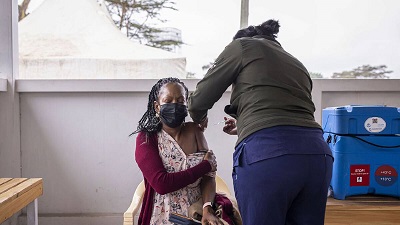
A resident receives a dose of the AstraZeneca Covid-19 vaccine at Mbagathi Hospital in Nairobi, Kenya, on July 6, 2021. MUST CREDIT: Bloomberg photo by Patrick Meinhardt.
“For Africa the worst is yet to come as the fast moving third wave continues to gain speed and new ground in countries,” Moeti said on a conference call. The end of this wave “is still going to be several weeks away.”
During the week to July 4 a record 251,000 coronavirus cases were recorded in Africa and cases are now doubling every 18 days, she said.
Sixteen African countries are now officially seeing a virus resurgence. That’s as the highly-transmissible delta variant has spread across the continent and is now dominating in many regions, said Tulio de Oliveira, the director of Krisp, a South African genome sequencing institute.
The current upsurge also comes while less than 2% of Africans are now fully vaccinated, meaning that hundreds of millions of people are still vulnerable to infection and severe illness.
Still, vaccine deliveries from the Covax vaccine-sharing initiative are gathering momentum, Moeti said. After almost grinding to a halt in May and early June, more than 1.6 million doses were delivered through Covax to the continent in the past two weeks and more than 20 million Johnson & Johnson and Pfizer shots are expected to arrive imminently from the U.S., she said.
Significant donations from Norway and Sweden are also currently being finalized and France will be sending 300,000 of the shots developed by AstraZeneca to Kenya and Somalia on Thursday, Moeti said.
“Covax had been working tirelessly to clinch dose-sharing pledges and procurement deals with manufacturers to ensure Africans get their vaccines,” Moeti said. “With much larger deliveries expected to be arriving in July and August, as a region we must use this time to prepare to rapidly expand the roll-out.”
Published : July 09, 2021
By : Syndication Washington Post, Bloomberg · Janice Kew