Rescue crews scour unstable rubble in search of survivors
SURFSIDE, Fla. – The search for survivors in the ruins of a collapsed, 12-story condominium here has been painstaking and precarious: Every moved piece of debris could cause another to shift. Workers are wary of dousing still-flaring fires with too much water, fearful added weight might send wreckage tumbling down on someone stuck below.
“We’re dealing not only with the exposed elements of the structure itself, but voids and the continuous threats of collapse,” said Obed Frometa, a lieutenant on the Miami-Dade search and rescue team who helped plan the effort.
Pictured on Friday, June 25, 2021, in Surfside, Fla., specialists are working with dogs trained to detect live human scent from floors away.
Photo by Zack Wittman for The Washington Post
Piece by piece, layer by layer, that effort continued Friday, with hundreds of emergency workers scouring the debris for any signs of life. At least 35 of the most accessible victims have already been rescued and sent to the hospital. Four have been confirmed dead and 159 people remained unaccounted for. Now crews are focused on probing deeper into the heaps of concrete and metal in hopes of finding anyone trapped further down.
Outside the wreckage, family and friends of the missing clung to hope as the chances of survival dimmed. The wait has been agonizing. But proceeding with extreme caution is the only option at this point.
“There’s still an anticipation of live victims,” said Dave Downey, former fire chief of Miami-Dade Fire Rescue. “They’re doing everything necessary to locate and extract them.” Downey said crews were “surgically” removing large blocks of concrete in search of “void spaces” where victims may be boxed in. Large objects such as refrigerators, air conditioning units, sofas or hunks of concrete may be propping up parts of the collapsed material enough to create pockets that prevent survivors from being crushed.
“They have to be cautious of everything in the surrounding area and the likelihood of a secondary collapse,” Downey said.
The margin for error is slim as teams of canine specialists, engineers, medics, and other highly trained first responders navigate the pulverized remains. Even a slight misstep could send more rubble crashing down. Harsh weather has further complicated the work, with thunderstorms threatening to flood or destabilize the structure.
The team leading the operation is the Miami-Dade-based Urban Search and Rescue Florida Task Force 1, an 80-person unit regarded as one of the world’s leading search and rescue outfits.
Formed in the 1980s, the task force is part of the Federal Emergency Management Agency’s network of rescue teams that get dispatched to large-scale disasters on hours notice. The disasters it has responded to include the Sept. 11, 2001, terrorist attacks, Hurricane Katrina, and the 2010 Haiti earthquake.
“These are the best first responders in the world,” Miami-Dade County Mayor Daniella Levine Cava said in a news conference Friday. “These are the ones that are sent to trouble spots.”
This time, the task force is working in its own backyard, alongside crews from other agencies.
Downey, who served on the task force for decades, said he’d never seen a building come crashing down like Champlain Towers South did early Thursday. But “the aftermath is something that all the responders have trained for,” he said.
To help with the search, specialists are working with dogs trained to detect live human scent from floors away. They may also use fiber optic cameras to peer into the debris or deploy listening devices so sensitive they can pick up a human heartbeat.
If they find a survivor, structural engineers will help determine how best to get in. Sometimes that means boring in through the side, sometimes taking layers off the top, Downey said.
Once crews can access the victim, medics typically need to administer intravenous fluids or even blood before they can pull the person out. This happens even if the victim is still pinned down. “Most often, if we can get an arm or a leg, we can start an intravenous line,” Downey said.
It’s crucial to work carefully in such circumstances, Downey said, because survivors could die if they’re moved too quickly. Toxic concentrations of acids can build up in the tissues of people who are crushed or trapped for long periods. Abruptly freeing a person can cause the substances to flood throughout the body and potentially lead to organ failure – a complication sometimes called “grateful dead syndrome.” Getting two or three bags of fluid into a victim before extracting them can be lifesaving.
ADVERTISEMENT
Downey said he was grateful the crews didn’t have to contend with aftershocks that come when an earthquake destroys infrastructure. But they’re facing strong wind off the ocean, which could loosen debris and rattle parts of the structure. Rain was also beating down throughout the day, forcing crews to take steps to prevent flooding.
By Friday afternoon, the rescue crews had been at it all day with heavy machinery and diamond-tipped drills, working in shifts beneath the hot sun and then, torrential rain.
Sweat poured down workers’ faces as they lined up for bottles of water, or sat under a tent with plates of pasta, pizza or a chicken sandwiches, while rescue dogs who were also taking a breather looked their way. Others waited to get out of their gear, smelling of fire and whatever contaminants still burned in the rubble. A small drone flew overhead as a priest walked over to one exhausted-looking firefighter and gave him a hug. For some, the scene conjured the aftermath of the 2001 terrorist attack on the World Trade Center in New York – something rescue workers learn about when they are taught about how to deal with “a pancake collapse,” in which floors fall on top of one another.
Frometa wasn’t at the World Trade Center. But some of the older members of the team were, he said. “A lot of those similarities are here, and I’m sure some of our senior members are having recollections of Sept. 11,” he said.
Eventually, commanders will have to decide whether to move into the recovery phase, a transition that comes when crews have exhausted the search for the living.
“It’s a very difficult decision to make,” said Downey. “The ultimate goal with search and rescue is to bring closure. We hope that means bringing out survivors. And, if not, we want to bring closure to the families.”
Published : June 26, 2021
By : The Washington Post · Antonio Olivo, Hannah Knowles, Derek Hawkins
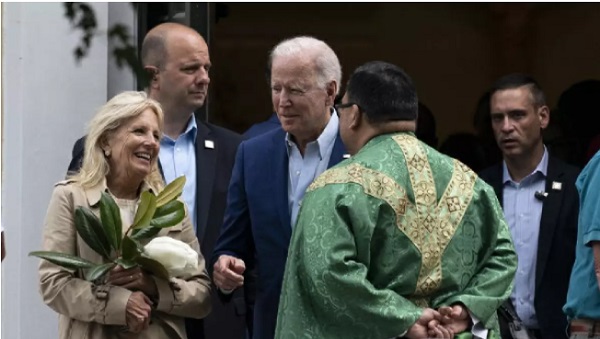
After controversy, U.S. Catholic bishops announce no national policy on withholding Communion from politicians
Days after a vote that triggered a tsunami of Catholic debate about Communion and politics, leading U.S. Catholic bishops working on an upcoming document about the sacrament are now de-emphasizing direct confrontation with President Joe Biden or other Catholic politicians who support abortion rights.
Seventy-five percent of members of the U.S. Conference of Catholic Bishops voted during their annual spring meeting on June 17 to go ahead with the drafting of a position paper on the “meaning of the Eucharist,” the core ritual of the Catholic faith, believed to be the presence of Jesus. Before the vote, live on Zoom, dozens of bishops debated the fact that the proposal for the document was a response to the election of Joe Biden, a weekly Mass-attending Catholic who supports abortion rights.
Catholic teaching opposes abortion.
During the three-day meeting of the U.S. bishops and in its aftermath, the bishops made conflicting statements about the document’s intention.
The idea for the document came from a committee the USCCB created after the November election in order to deal with the “problem” of Biden and his abortion policy, and what some bishops see as a confusing scandal for other Catholics watching the country’s most prominent member of their faith.
During the meeting many bishops said Biden was exacerbating what many faith leaders see as an already big problem: most U.S. Catholics, polls show, don’t attend Mass weekly and don’t believe in the supernatural aspect of Communion. But many other bishops pushed back to say there shouldn’t be a special emphasis on abortion and politicians, and such a document would politicize the sacrament.
Also during the meeting, bishops noted some letters exchanged between the Vatican and U.S. bishops before this spring meeting. The letters reflected discussion about a possible “national policy” on “worthiness” for Communion and possibly addressing in particular Catholic politicians who support abortion, euthanasia and other practices forbade by Catholic teaching.
Four days after the vote, on June 21, the USCCB released a Q&A excising past mention of Biden, a national policy or a focus on abortion.
“There will be no national policy on withholding Communion from politicians. The intent is to present a clear understanding of the Church’s teachings to bring heightened awareness among the faithful of how the Eucharist can transform our lives and bring us closer to our creator and the life he wants for us,” the Q&A said.
It said the document will be focused on the call of “all Catholics” to “support human life and dignity and other fundamental principles of Catholic moral and social teaching.”
Also on June 21, Bishop Kevin Rhoades, chair of the Doctrine Committee that will oversee the creation of a draft document, told a Catholic news site that the document will be addressed to “all Catholics” – not just politicians. He said it will also focus on “Eucharistic consistency,” and canon law that forbids from Communion people who are “conscious of serious sin” or “publicly unworthy,” the laws read.
“These disciplinary laws have a medicinal, rather than punitive, purpose,” he told Our Sunday Visitor.
Requests for comment from Rhoades and the USCCB were not returned Friday.
Jayd Henricks, a former top lay officials with the USCCB, said Friday his read is that while Biden’s election may have been the catalyst for the document’s creation, it’s part of a much longer concern among bishops about Catholics not understanding or connecting with this core sacrament. The wording of “national policy,” he said, was more about “giving guidance on a national level.”
Bishops arguing against a document as too narrow and too penalty-focused, Hendricks said, “were arguing against a straw man, a red herring.”
Bishop Shawn McKnight, of Jefferson City, Mo., who had argued during the USCCB meeting against going ahead with the document, Friday said the Q&A was a good sign. The “needle shifted a little bit,” he said, away from a document aimed at a national policy and restrictions.
ADVERTISEMENT
He also noted that Rhoades said there will be regional meetings of bishops this year in order to get more feedback.
McKnight said a general document on the Eucharist is “very appropriate,” one that focuses on “How do we attract people and make the beauty of what it means to us more evident to our young people and for them to understand why it’s so significant, instead being focused on who can and who cannot receive.”

 สหประชาชาติเผยสถานการณ์ความรุนแรงในเมียนมาส่งผลให้มีประชาชนอพยพแล้วกว่า 2 แสนราย
 นักวิจัยแดนมังกรเผยแอนติบอดีจากวัคซีนจีน 2 ตัวประสิทธิภาพลดลงเมื่อเจอเชื้อสายพันธุ์เดลต้า
 รู้จัก Abdala วัคซีนชนิด 3 เข็มจากคิวบา ประสิทธิภาพสูง 92.28%
 การปราบปรามเหมือง Bitcoin อย่างหนักของรัฐบาลจีนทำให้นักขุดพากันย้ายไปต่างประเทศ
 กรุงโคเปนเฮเกนของเดนมาร์กคว้าที่ 1 เมืองที่ประชากรมีคุณภาพชีวิตดีประจำปีนี้
 ญี่ปุ่นเตรียมส่งมอบวัคซีนแอสตราเซเนกาให้ชาติอาเซียนเริ่มสัปดาห์หน้าเป็นต้นไป
 ชิลีเตรียมศึกษาฉีดวัคซีนเข็มที่ 3 หลังคุมโควิด-19 ไม่อยู่แม้ฉีดวัคซีนไปกว่าครึ่งประเทศแล้ว
 พบหลุมศพนิรนามอีก 751 หลุมใกล้กับโรงเรียนประจำสำหรับเด็กพื้นเมืองในแคนาดาหลังเพิ่งพบ 215 หลุมเร็วๆ นี้