G-7 takes stronger stand against China, at U.S. urging #SootinClaimon.Com

#SootinClaimon.Com : ขอบคุณแหล่งข้อมูล : หนังสือพิมพ์ The Nation.

https://www.nationthailand.com/international/40001987

G-7 takes stronger stand against China, at U.S. urging


CARBIS BAY, England – As Group of Seven leaders wrapped their three-day summit here on Sunday, President Joe Biden said democratic governments face a defining challenge: to show they can meet tests such as global health crises and climate change better than autocracies such as China and Russia.
G-7 takes stronger stand against China, at U.S. urging

“Ithink we’re in a contest, not with China per se, but a contest with autocrats, autocratic governments around the world, as to whether or not democracies can compete with them in a rapidly changing 21st century,” Biden told reporters during the first news conference of his first foreign trip as president.

He pointed out China and Russia for reprobation after working here to enlist U.S. allies in what he has repeatedly cast as the existential battle of the 21st century.

The theme is hardly a new one for Biden, who returns to it frequently and has used several key moments in his presidency to outline what he views as the generational struggle between democratic and autocratic nations.

The question of how to deal with China is divisive, and while Western leaders have criticized Beijing’s treatment of the Uyghurs in Xinjiang, in briefings with reporters during the summit, it was clear there were tensions over the language the group should adopt.

Biden urged the leaders of the G-7 industrialized nations to take a harsher public stance, confronting China over its use of forced labor. But some leaders, including those of Germany, Italy and Japan, have been reluctant to take on China too forcefully.

“We recognize the right of China to be an important economy,” said Italian Prime Minister Mario Draghi on Sunday, “but we question how China does it.”

G-7 takes stronger stand against China, at U.S. urging

Senior U.S. officials on briefing calls with reporters stressed that the White House was trying to offer an approach that was more carrot than stick by presenting the world with an alternative more appealing than the approach of China.

In the summit-concluding communique issued Sunday, G-7 leaders announced they would create alternative funding to China’s massive “Belt and Road Initiative,” a trillion-dollar infrastructure program focused on the developing world.

They also said they would work together to challenge China’s “non-market policies,” and they called on Beijing to respect human rights in Xinjiang and Hong Kong, pushed for greater transparency on the origins of the coronavirus and raised concerns about tensions in the Taiwan Strait and the South China Sea.

The language fell short of an explicit condemnation of China’s human rights practices.

Still, Beijing has chafed at the group’s new focus on the country. “The days when global decisions were dictated by a small group of countries are long gone,” a spokesman for the Chinese embassy in London said Sunday. “We always believe that countries, big or small, strong or weak, poor or rich, are equals, and that world affairs should be handled through consultation by all countries.”

The G-7 leaders also endorsed a global minimum tax on multinational corporations and pledged to donate 1 billion vaccine doses to poorer countries. Biden hinted that the United States might make another substantial donation of doses next year.

British Prime Minister Boris Johnson rejected criticism that the G-7’s vaccine pledge didn’t go far enough. Former British prime minister Gordon Brown has said 11 billion doses are needed.

“We are going flat out and we are producing vaccines as fast as we can,” Johnson said.

Biden implored China to allow the international community access to the laboratories in Wuhan, where the coronavirus was detected in December 2019. Biden said he has not reached a conclusion about whether the coronavirus spread from a lab leak or from animals, but he said transparency is critical to preparing for future pandemics.

“We have to have access,” he said. “The world has to have access.”

Biden, in the middle of his eight-day, three-country trip abroad, flew overseas determined to demonstrate leadership on the world stage and, in turn, competence and command back home.

Save for coronavirus logistics – social distancing, sporadic face masks, rigorous coronavirus testing for the U.S. delegation – perhaps the most striking part of the first G-7 summit in the post-Trump era was its sheer normalcy, and even the bland scriptedness that undergirded most of the proceedings.

Gone were the threats to invite Russia back into the group or to withdraw from NATO, hallmarks of the combative diplomacy favored by former president Donald Trump.

Yet the shadow of Trump lingered, with the Europeans having watched with alarm the Jan. 6 insurrection at the U.S. Capitol and them being fully aware that another populist figure, from the left or the right, could easily emerge victorious in 2024.

Biden’s message, which he delivered repeatedly – to U.S. troops on arriving in Britain on Wednesday, to French President Emmanuel Macron in scenic Carbis Bay on Saturday, to reporters on Sunday – was “America is back.” European leaders received it with a mixture of skepticism and relief.

Biden also used the trip to reassert his brand of personal diplomacy, rekindling relationships he nurtured for years as a senator and vice president, and spending one-on-one time with leaders such as Johnson and Macron, whom he knows less well.

The leaders used their three days in Cornwall – a picturesque but surprisingly poor part of the country – to discuss challenges such as the coronavirus and climate change.

The United States said it would contribute 500 million doses of the Pfizer-BioNTech vaccine, half the group’s vaccine commitment to poorer nations. The effort, which some health experts described as an encouraging start but as insufficient for getting control of the pandemic globally, will help counter charges of a “vaccine apartheid,” in which a small group of wealthy nations hoards vaccine doses and fares better than poorer countries.

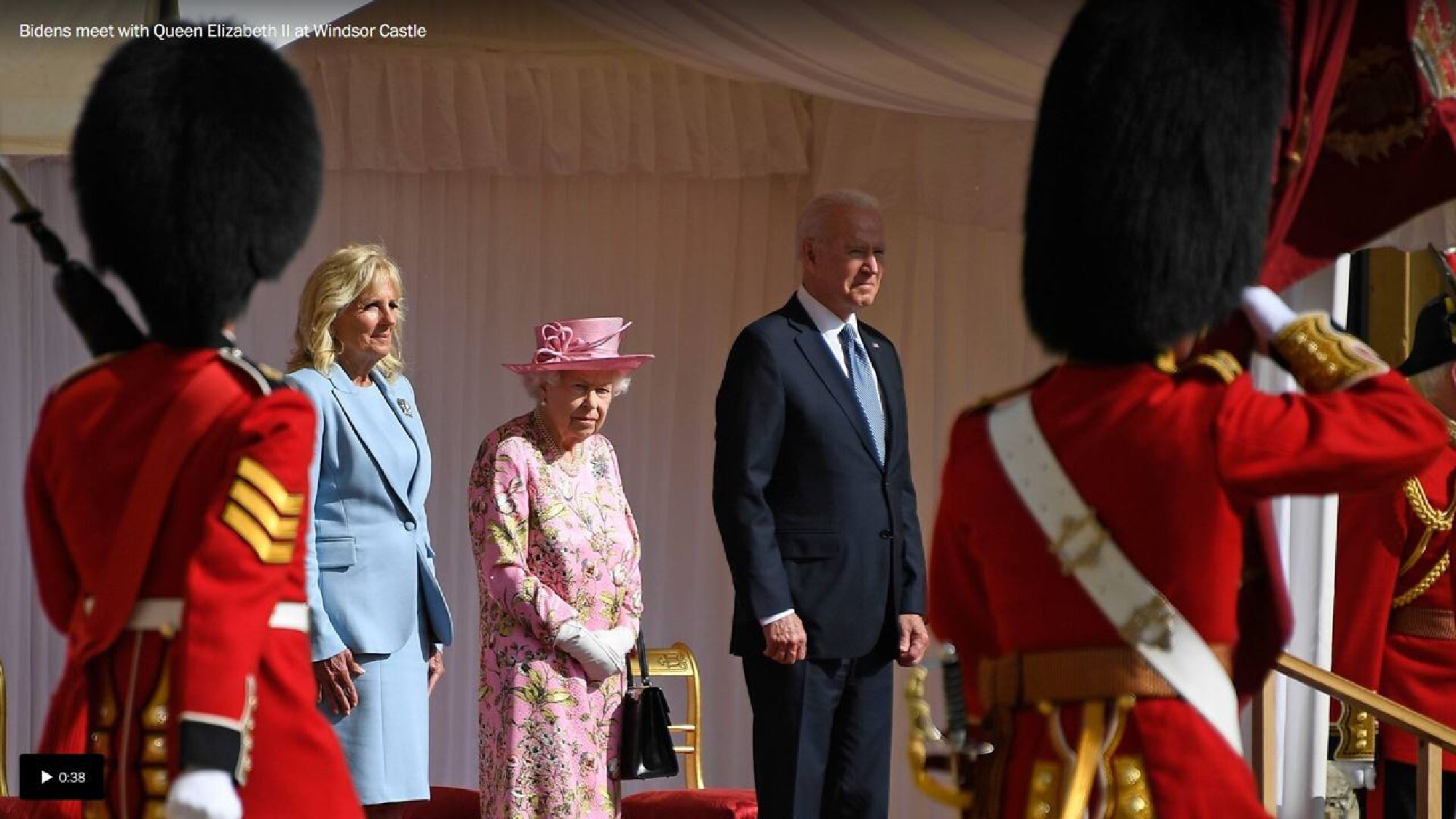
On Sunday afternoon, Biden traveled to Windsor Castle, about 25 miles west of London, for tea with Queen Elizabeth II.

ADVERTISEMENT

Biden, 78, told reporters afterward that the 95-year-old monarch reminded him of his mother.

“I don’t think she’d be insulted, but she reminded me of my mother, the look of her and just the generosity,” he said.

Biden will continue on to Brussels for a NATO summit and European Union meeting this week, before finishing his trip with a high-stakes encounter Wednesday with Russian President Vladimir Putin.

Published : June 14, 2021

By : The Washington Post · Karla Adam, Ashley Parker, Tyler Pager, John Hudson

Central American women are fleeing domestic violence amid a pandemic, but few find refuge in U.S. #SootinClaimon.Com

#SootinClaimon.Com : ขอบคุณแหล่งข้อมูล : หนังสือพิมพ์ The Nation.

https://www.nationthailand.com/international/40001986

Central American women are fleeing domestic violence amid a pandemic, but few find refuge in U.S.


After four years of beatings, humiliation and sexual abuse, María de Jesús mustered the courage to leave the man who would punch her in the face for even changing her clothes to go outside, saying she could only look pretty for him.

Central American women are fleeing domestic violence amid a pandemic, but few find refuge in U.S.

Then the death threats began.

“You will never, ever be happy,” her ex-boyfriend told her on the phone in December. “And when I find you, I will disappear you and your entire family.”

María de Jesús packed her bags and fled Guatemala City with her 11-year-old son on a cold night weeks later. She paid a smuggler and trekked north to the U.S.-Mexico border, where she hoped the Biden administration, promising a more humanitarian approach toward migrants, would welcome a domestic violence survivor like herself into the country.

“The only solution was to be far away where I didn’t feel scared every day,” said Maria de Jesus, 39, who declined to give her last name out of security concerns.

She is among scores of Central American women fleeing brutal violence from boyfriends, spouses and others in one of the world’s most dangerous regions for women who have recently arrived at the southern U.S. border only to find they now encounter an uphill battle to be let in.

Though President Joe Biden quickly signed several executive orders to roll back some of President Donald Trump’s most draconian policies – including one that sent asylum seekers back to Mexico to await their court hearings – a number of other restrictive measures and rulings that directly affect domestic violence survivors remain in place.

Biden has ordered a review of the entire asylum system to determine whether authorities provide protection to those fleeing domestic or gang violence “in a manner consistent with international standards.” Vice President Kamala Harris visited Central America this past week, vowing to commit millions of dollars to address the root causes of migration while also delivering a stern message: Don’t come.

“You will be turned back,” she warned.

Those words still may do little to persuade thousands of women who remain at risk in a region with deeply rooted machismo, entrenched corruption and a weak rule of law. Violence against women has increased in many parts of Latin America during the pandemic, as services like shelters shut down and women were forced to stay with their aggressors during lockdowns, women’s rights groups and international organizations say.

“It was a pressure-cooker stress where there was pre-existing violence and then no escape route,” said Meghan López, vice president for Latin America at the International Rescue Committee, which works with organizations in the region.

Women like María de Jesús who are already at the border, meanwhile, are in limbo. She is currently living at a migrant shelter in Tijuana, anxiously waiting for her humanitarian parole request to be reviewed.

“If they deny it I have nowhere to go and no idea what to do,” she said in an interview with The Washington Post.

A spokesperson for the Department of Homeland Security said in a statement to The Post that they are working to a rebuild a “decimated” immigration system for one that “treats people more humanely and keeps families together.”

“We are moving swiftly to rebuild, but it’s going to take time,” the spokesperson said.

Central America, the region most of the women seeking asylum in the United States are fleeing, has the highest violent death rates for women in the world, according to data collected by the Small Arms Survey, which tracks violence globally.

According to a 2019 survey by the United Nations’ Gender Equality Observatory for Latin America and the Caribbean, Honduras and El Salvador, two countries hard hit by back-to-back hurricanes last year, have two of the highest rates of femicides per 100,000 in Latin America.

Data gathered by the IRC show that in the fall of 2020, requests from across the region for women’s services and protection information doubled.

Central America’s deep economic contraction, slow recovery from the storms, violence and rumors that the Biden administration would allow new arrivals in all fueled the biggest migrant surge in 20 years.

But in the midst of a heated debate in the U.S. over how to respond to the crisis, the odyssey of women fleeing violence, and domestic abuse in particular, has often been overlooked.

Last month a coalition of immigration advocacy groups, including the Center for Gender and Refugee Studies at the University of California, sent a letter to Attorney General Merrick Garland and urged him to restore protections for women and families fleeing persecution and torture.

Karen Musalo, the center’s director, said some of these “backwards” rulings “take us back to the “Dark Ages” in terms of women’s rights. She pointed to a 2018 decision by former attorney general Jeff Sessions that established that “generally” claims “pertaining to domestic violence or gang violence perpetrated by non-governmental actors will not qualify for asylum.”

The case involved a Salvadoran woman, known as AB, who said she had been sexually, emotionally and physically abused by her husband for years, reversing an appeals court ruling that found her eligible for asylum.

“It created an avenue for judges or asylum granters who were already not inclined to granting it, to have the basis to do it and disregard individual circumstances,” said Musalo, who was also a defense layer on the AB case.

The case became a symbol of an administration that slammed its doors shut and turned away scores of immigrants that were not only fleeing gang violence, poverty and climate devastation, but in the case of many women, brutal aggression from their partners in countries where domestic abuse is pervasive.

Asylum seekers interviewed by The Post say they sought protection in their own countries and decided to leave as a last resort, disputing criticism that they migrate to the United States solely in search of better economic opportunities.

Such was the case for women like AB, who asked to be identified only by her initials for fear of reprisal from immigration authorities. She said she endured years of violence and sexual assault from her ex-husband and left El Salvador in 2014 after multiple failed attempts to escape his wrath by moving houses and cities.

“I didn’t know anything about this country. I just knew it was a faraway place where people feel safe,” the 50-year-old Salvadoran said in a recent interview. “Staying meant dying.”

With her case still pending eight years after she first crossed the border, AB reflected on the grueling process of her quest for protection.

“This wait has been so sad and stressful,” she said. “I have traveled to all the courts, done everything I have been asked to show that I did not come here to steal anyone’s job or food, that I came here because I was trying to save myself.”

Being separated from her three children, whom she left behind after her husband threatened her with a handgun, has been the biggest torment, she said.

“If I knew everything that was going to happen, maybe I would have preferred to die,” she said in tears.

Prior to the Trump administration and Sessions’s decision, survivors of domestic violence had a lesser threshold to overcome and their cases often prevailed when they proved that their countries lack the resources or willingness to offer them protection from their abusers, experts say.

“Now people are not even afforded that level of process and are just being tossed away,” said Margaret Cargioli, an attorney with the Immigrant Defenders Law Center, a social justice law firm in California.

While experts argue the Sessions ruling has created an additional hurdle for domestic violence victims, it did not rule out protection completely, as these cases are decided on a case-by-case basis by immigration court judges.

Court data does not record the grounds for asylum claims, making it difficult to get a quantifiable sense of how these policies have impacted immigration court rulings on domestic violence cases.

Amid the pandemic and the recent surge of migrants at the border, Biden has continued one of the most controversial Trump policies, known as Title 42, which indefinitely closed the border to “nonessential” travel, citing emergency health concerns due to the pandemic.

While technically migrants at the southern border can still seek protection under U.S. law, the order has translated into approximately 700,000 rapid expulsions – including families and unaccompanied minors – since March of last year, without due process or access to asylum, according to immigration advocacy groups and experts.

Cargioli said the current restrictions are doing more harm than good.

“If Title 42 has to do with health safety, how can a system that is purported to save lives, instead put them in peril?” she asked. “It is illogical.”

Only a small number have been allowed into the country for humanitarian reasons that can include health concerns or being at imminent harm or risk of torture, according to immigration advocates.

Sitting in a hotel in San Diego, 19-year-old Rosie from Honduras remembered the many failed attempts to escape her ex-boyfriend’s house, where he would keep her captive, rape her and forced her to cut any contact with her family or friends, she told The Post in a recent interview.

If she managed to sneak out of the house, he would drag her by her hair through the dirt roads back inside, she said.

The journey to the U.S. was traumatic: Rosie said she was sexually assaulted in Guatemala as she tried to make her way north.

More than two months after being apprehended at the border and deported to Mexico, she was temporarily allowed in on May 10 under a humanitarian parole, said Cargioli, who is representing her case.

Now in the U.S., she said she dreams of becoming a doctor.

“I felt I could breathe for a minute, and finally stop feeling scared all the time,” she said, sobbing.

She faces a potentially years-long wait for her case to be resolved and could still be denied protection, which keeps her awake at night.

Advocates say the vast majority of domestic violence victims arriving at the border have virtually no chance of gaining protection while restrictions are still in place.

Most end up staying in Mexico in cramped tent cities or shelters, some of them falling prey to organized crime groups or migrant smugglers. Others end up going back to the dangers they are trying to escape.

In Tijuana, María de Jesús anxiously waits to find out what will happen with her humanitarian parole request, which would allow to await her asylum process in Indiana, where her sister lives.

ADVERTISEMENT

She can’t fathom going back to Guatemala, still traumatized by the ex-boyfriend who used to create fake Facebook profiles to get information of her whereabouts.

“For so long I thought violence was my destiny,” she said. “I just hope that I am wrong.”

Published : June 14, 2021

By : The Washington Post · Paulina Villegas

D.C. region tries to boost vaccine uptake among law enforcement #SootinClaimon.Com

#SootinClaimon.Com : ขอบคุณแหล่งข้อมูล : หนังสือพิมพ์ The Nation.

https://www.nationthailand.com/international/40001985

D.C. region tries to boost vaccine uptake among law enforcement


As the Washington, D.C., regions coronavirus vaccination efforts continue, public health officials are homing in on segments of the population slow to get the shot – such as law enforcement officers.

D.C. region tries to boost vaccine uptake among law enforcement

While no comprehensive surveying has been done in the region, Virginia officials say less than half of State Police troopers are vaccinated and about 50 percent of corrections officers in the state have been vaccinated.

Large police departments have slightly better rates, with 58 percent of officers vaccinated in the District of Columbia and 65 percent vaccinated in Prince George’s County, Md. Montgomery County, Md.’s high countywide vaccination rate is mirrored among its officers, about 71 percent of whom have gotten the shot.

That’s better than some areas around the country – such as Las Vegas, Atlanta and Columbus, Ohio, where roughly one-third of officers were vaccinated as of early last month.

The reasons are varied, and experts say hesitancy among officers is similar to hesitancy among groups in the wider population.

Warren Eller, chair of the Department of Public Management at John Jay College of Criminal Justice, said distrust of the government and by extension the vaccines, exacerbated by conspiracy theories and reports that he said have “over-highlighted” potential side effects, contribute to hesitancy. That’s in addition to exploitation of Black men in the Tuskegee experiment and the testing of birth control on Puerto Rican women.

“Officials telling some communities, ‘Trust us, we’ve got something for you to take,’ hasn’t always turned out all that well,” Eller said.

The viral numbers in the region have fallen significantly from the highs seen during peaks in the pandemic, such as around the winter holidays. The seven-day average of new cases per 100,000 on Saturday fell to 1.69 in Maryland and 1.82 in Virginia, rates not seen since the start of the pandemic. The number was 1.84 in D.C. as of Friday, last seen in March 2020.

But experts say in a pandemic, any unvaccinated officer in the field is still taking a risk. After shutdowns started 15 months ago, law enforcement officers remained on the job, responding to 911 calls, performing CPR and other activities that placed them in close contact with the public, and running jails and prisons, congregate settings that are particularly vulnerable to outbreaks.

At least three officers in Virginia have died of covid-19, including a sergeant with the Fairfax County Sheriff’s Office who helped lead a team at the jail that sanitized and sterilized coronavirus-infected areas, according to a tribute on the sheriff’s office website.

In the early days of vaccinations, when governments tightly controlled which groups got the shots first, advocates for law enforcement in Virginia successfully lobbied Gov. Ralph Northam to move first responders up on the eligibility pyramid, just below health-care workers.

“Law enforcement, they face a lot of threats each and every day, and this is one where we can actually diminish the risk by providing vaccine to all of them,” said Brian Moran, the Virginia secretary of public safety and homeland security, who favored accelerating access.

But not every officer was eager to get the shot.

Some areas have tried to make getting vaccinated as easy as possible for law enforcement.

The Fairfax County Sheriff’s Office set up clinics at the jail in the early days, and leaders have hosted Zoom meetings to encourage vaccination, sheriff’s office spokeswoman Andrea Ceisler said. She declined to share the office-wide vaccination rate.

The Virginia State Police, which has hosted on-site clinics and had its own medical staff administer shots, anticipates its vaccination rate will grow as outreach continues, spokeswoman Corinne Geller said.

In Montgomery County, Earl Stoddard, director of the office of Emergency Management and Homeland Security, said vaccinations were first offered at the public safety training academy that officers know well, by fire and rescue staffers with whom they already work closely.

Stoddard said his own vaccination appointment turned into an impromptu reunion with chiefs of several local departments, who all happened to be there at the same time.

The county also hired a behavioral health scientist who revised the tone and content of all employee communications. Having the county executive or another high-ranking official address officers was not as well received as hearing from a peer, Stoddard said the scientist advised them.

“Treating them like equals in the way we address the message was very helpful,” Stoddard said. “(Appealing) to their sense of community and the fact that we are serving residents, this is part of a collective effort.”

Dana Schrad, executive director of the Virginia Association of Chiefs of Police, said chiefs and sheriffs in urban areas are more likely to be vaccinated than their rural counterparts, who may consider the risk of transmission in a less populated area to be lower or view vaccines differently.

“Our officers are people, too, so we hear the same concerns that some of the general public has expressed,” she said. That includes concerns about the Food and Drug Administration issuing emergency use authorization for the vaccines as opposed to full approval, questions about efficacy, and unfounded theories about the vaccines causing sterility or changing one’s DNA.

At the height of the pandemic, her organization and others representing police, deputies, firefighters and EMTs pushed for legislation to have coronavirus exposure covered by workers’ compensation insurance. However, she said, now that vaccines are readily available, the unvaccinated may not qualify for coverage.

Although statewide vaccination numbers among officers are not available, John Jones, executive director of the Virginia Sheriffs’ Association, said the small number of masked faces he saw at his organization’s conference last week in Williamsburg leads him to believe most are vaccinated.

“We’re having events. There’s a buffet line, people are sitting close together. They’re talking,” he said. “What I see is back to normal.”

However, Danny Avula, the state vaccine coordinator, spoke at the conference to encourage departments to talk to employees frequently about the importance of being vaccinated, especially in a congregate setting like a jail or prison. He also asked them to make vaccination available repeatedly and offer incentives, like money or the ability to skip quarantine if exposed.

ADVERTISEMENT

“We do just need to keep this in front of people,” he said, adding that the recent low viral numbers may give people a false sense of comfort. “It doesn’t feel important now, but we absolutely have to do everything we can do to avoid a resurgence through December, January and February.”

Published : June 14, 2021

By : The Washington Post · Jenna Portnoy

Israel approves new governing coalition, ending Benjamin Netanyahus 12-year tenure #SootinClaimon.Com

#SootinClaimon.Com : ขอบคุณแหล่งข้อมูล : หนังสือพิมพ์ The Nation.

https://www.nationthailand.com/international/40001984

Israel approves new governing coalition, ending Benjamin Netanyahus 12-year tenure


JERUSALEM – For the first time in 12 years, Israeli lawmakers voted Sunday to install a government led by someone other than Benjamin Netanyahu, breaking a two-year electoral deadlock, marking a likely shift toward the political center and ending – for now – the reign of the countrys longest-serving prime minister, and one of its most consequential.

Israel approves new governing coalition, ending Benjamin Netanyahus 12-year tenure

Araucous parliament, interrupted frequently by shouts of “shame” and “liar” from outgoing conservative lawmakers, voted by the narrowest of margins – 60-59 – to give power to an unlikely coalition of parties from the right, center and left of Israel’s spectrum. The votes elevated Naftali Bennett, an Orthodox leader of Israel’s religious-nationalist movement and a former Netanyahu ally, as the country’s new prime minister.

“We are incapable of sitting together – what is happening to us?” Bennett pleaded before the vote over boos and catcalls as his own children flashed him heart symbols from the visitors’ gallery. “I am proud of sitting with people who have very different opinions. We have decided to take responsibility.”

Several conservative members were ejected from the session. They included extremist right-wing lawmaker Itamar Ben-Gvir, a disciple of the banned Kahane Party who was elected to the Knesset with help from Netanyahu.

Under the coalition’s power-sharing deal, Bennett is to be replaced in the top job after two years by Yair Lapid, a centrist politician and former TV news anchor who clinched the second largest number of votes after Netanyahu’s Likud party in March.

Lapid brokered the power-sharing deal among eight parties with little in common beyond a determination to end the contentious rule of Netanyahu, who has clung to power despite being on trial for corruption and failing to secure a majority after four inconclusive elections in two years.

Lapid scrapped his own speech and instead apologized to his 86-year-old mother for the heckling.

“I assumed you would be able to get over yourselves,” Lapid told his fellow lawmakers. “Instead, she and every other Israeli citizen is ashamed of you and reminded why it’s time for you to be replaced.”

The government breaks new ground by including the first independent Arab party to sign on to an Israeli governing coalition. The Islamist Ra’am party, which was courted by both Netanyahu and Lapid, has demanded new programs and spending for Arab citizens of Israel, who account for about 20% of the population.

Meanwhile, ultra-Orthodox parties will not be part of the government for the first time, with two brief exceptions, since 1977. Their absence, after forming an unshakable foundation for Netanyahu’s governments, could endanger the controversial grip of ultra-Orthodox rabbis on religious and family law and the community’s exemption from compulsory military service.

Netanyahu delivered a bellicose parting shot to Bennett and his allies, belittling the coalition as incapable of maintaining his record of economic growth, relative peace and standing up to U.S. pressure to acquiesce to a renewed nuclear deal with Iran.

“I’ll be back,” Netanyahu told lawmakers. “Try to ruin our wonderful economy as little as possible so we can fix it as quickly as possible when we return.”

Netanyahu compared the Biden administration’s push to renew the Iran deal to the U.S. failure during World War II to bomb the Nazi trains that took European Jews to the gas chambers.

“Bennett hasn’t got the international standing, the integrity, the capability, the knowledge and he hasn’t got the government to oppose the nuclear agreement,” Netanyahu said. “An Israeli prime minister needs to be able to say no to the leader of the world’s superpower.”

President Joe Biden spoke with Bennett after the vote to offer his “warm congratulations,” the White House said.

“My administration is fully committed to working with the new Israeli government to advance security, stability, and peace for Israelis, Palestinians, and people throughout the broader region,” Biden said in a statement. He didn’t mention Netanyahu.

The new government ends 12 consecutive years of Netanyahu rule, a period during which Israel has enjoyed a flourishing tech boom, relative quiet on the country’s periodically explosive fronts from Lebanon to Gaza, and no return of a general Intifada among Palestinians of the West Bank. A 12-day air war with Hamas in Gaza last month was thought likely to derail the new coalition, but the parties resumed negotiations almost immediately after a May 21 cease-fire.

But the tenure of Netanyahu, who also served as prime minister for three years in the 1990s, also produced political tumult that has dragged increasingly disillusioned and exhausted Israelis through an unprecedented cycle of elections, stalemate and acrimony.

Although Netanyahu’s Likud party won the most votes in three of the four elections since April 2019, his usual coalition of ultra-Orthodox and nationalist parties failed to secure the majority needed to form a government. Netanyahu has remained atop a caretaker government that has been largely paralyzed since the end of 2018. Even a short-lived emergency unity government that formed last year in the midst of the coronavirus pandemic failed to pass a budget.

As the government remained effectively frozen, Netanyahu was indicted and began a trial on charges of bribery, fraud and breach of trust that has further divided an acutely polarized Israel.

Netanyahu’s devoted base of supporters echo his claims that a politically biased deep state has concocted a witch hunt against him. On the other side of the divide are those who say his attacks on the judiciary, demonization of opponents and refusal to step aside are corroding institutions and Israel’s rule of law.

Tensions spiked in the run-up to Sunday’s vote, sparking fears of violence in a country still raw from the 1995 assassination of Prime Minister Yitzhak Rabin by a right-wing extremist.

Netanyahu called the new coalition a “dangerous, left-wing government.” Religious-nationalist rabbis called on supporters to “do anything” to prevent it from taking power.

Protesters demonstrated outside of lawmakers’ homes; death threats spurred police to assign them security details.

Israel’s Shin Bet, the internal security service, issued a rare warning last week that the uptick in incitement could turn lethal.

In the midst of surging hostilities, Bennett said in recent interviews that his government will not seek to change policy on hot-button issues such as Israeli settlements in the West Bank, state benefits granted to ultra-Orthodox families or peace with Palestinians. He and Lapid, as they take turns in the role of prime minister, will effectively have veto power over each other’s major initiatives, which will in theory limit the government to consensus actions. They have pledged to approve a budget within 140 days.

While Likud lawmakers expressed hope for a last-minute collapse of the coalition, some began gingerly to jockey for leadership in a post-Netanyahu party. Health Minister Yuli Edelstein has reportedly begun testing his support; former Jerusalem mayor Nir Barkat held an event for 5,000 Likud activists last week. Barkat said he is only preparing in case Netanyahu decides to retire, something the 71-year-old has not announced.

Political observers say Netanyahu’s continued presence in parliament as leader of the opposition could help the new government, given that aversion to his bellicose style is the glue that holds the coalition together. In any case, Netanyahu’s Likud and his allies enter the minority as practiced and well-organized opponents of the fledgling government.

ADVERTISEMENT

“We are going to be the most ferocious opposition that Israel has ever known,” Likud faction chairman Miki Zohar told the daily newspaper Maariv.

The new government launches at a time of flaring sectoral tensions at home and looming threats abroad. The new ministers face an immediate challenge Tuesday, when a planned march by Jewish nationalists through Arab areas of Jerusalem’s Old City could spark a resumption of clashes with Palestinians.

Israel, with Egyptian brokers, is also negotiating a longer-term cease-fire with Hamas in hope of preventing a return to the fighting that killed almost 250 Gazans and 12 Israelis.

The incoming security and diplomatic teams – led by returning Defense Minister Benny Gantz and Lapid, who will serve two years as foreign minister – are watching uneasily as Washington pushes for a renewed Iran deal, a move strongly opposed in Jerusalem. Israel’s new mission in Washington will be tasked with repairing strained relations with the Biden administration and Democratic majorities in Congress left behind by Netanyahu’s tilt in recent years toward Republicans.

The reported details of the coalition agreement include a measure that would limit the term of future prime ministers to two terms, or eight years, which would prevent future runs such as Netanyahu’s record-setting 15 years. The lawmakers could also consider barring departing prime ministers for a four-year “cooling-off” period before they run again, outraging Netanyahu’s supporters.

Published : June 14, 2021

By : The Washington Post · Steve Hendrix, Shira Rubin

เผยแผนการ G7 จะมอบวัคซีนโควิด 1 พันล้านโดส #SootinClaimon.Com

#SootinClaimon.Com : ขอบคุณแหล่งข้อมูล : หนังสือพิมพ์โพสต์ทูเดย์

https://www.posttoday.com/world/655407

วันที่ 13 มิ.ย. 2564 เวลา 15:45 น.

เผยแผนการ G7 จะมอบวัคซีนโควิด 1 พันล้านโดสข้อมูลที่ได้รับการเปิดเผยจากร่างแถลงการณ์ก่อนสรุปผลการปรชุมสุดยอดผู้นำ G7 เอ่ยถึงแผนการกระจายวัคซีนนับพันล้านโดส แต่ไม่ได้ระบุว่าจะให้ใครบ้าง

สำนักข่าวรอยเตอร์รายงานจากคาร์บิสเบย์ ประเทศอังกฤษ เมื่อวันที่ 13 มิถุนายน กลุ่มประเทศ G7 จะจัดหาวัคซีนป้องกันโรคโควิด-19 จำนวน 1,000 ล้านโดสในปีหน้า และทำงานร่วมกับภาคเอกชน กลุ่ม G20 และประเทศอื่นๆ เพื่อเพิ่มการสนับสนุนในช่วงหลายเดือนข้างหน้า

“คำมั่นสัญญาตั้งแต่เราพบกันครั้งสุดท้ายในเดือนกุมภาพันธ์ 2021 รวมทั้งที่นี่ในคาร์บิสเบย์จะมอบ 1 พันล้านโดสในปีหน้า” แถลงการณ์ระบุ

“เราจะทำงานร่วมกับภาคเอกชน, G20 และประเทศอื่นๆ เพื่อเพิ่มการสนับสนุนนี้ในช่วงหลายเดือนที่จะมาถึง” แถลงการณ์ดังกล่าว

แหล่งข่าวสองแห่งกล่าวว่าร่างดังกล่าวทำการสรุปโดยนักการทูตที่ทำงานจนดึกในคืนวันเสาร์เพื่อเจรจาจนผ่านข้อตกลงดังกล่าว

แหล่งข่าวยังเผยว่านอกจากนี้ G7 ยังมุ่งมั่นที่จะส่งออกวัคซีนในสัดส่วนที่มีนัยสำคัญต่อไป

แหล่งข่าวยังเผยว่าG7 ยังมุ่งมั่นที่จะอนุญาตให้ใช้สิทธิโดยสมัครใจและการผลิตวัคซีนทั่วโลกที่ไม่แสวงหากำไร ทั้งนี้ สิทธิโดยสมัครใจ หรือ Voluntary Licensing เป็นการอนุญาตที่ผู้ถือสิทธิบัตรมอบให้กับบริษัทผลิตยาสามัญ ให้ผลิตยาหนึ่งๆ ได้โดยไม่เสียค่าลิขสิทธิ์ในฐานะที่เป็นยาสามัญชนิดหนึ่ง ซึ่งในกรณีนี้หมายถึงวัคซีน

แหล่งข่าวยังเผยว่า G7 ยืนยันการสนับสนุนโครงการ ACT-A และ COVAX ในฐานะช่องทางหลักในการจัดหาวัคซีนให้กับประเทศที่ยากจนที่สุด

แหล่งข่าวยังเผยว่า G7 สนับสนุนการอภิปรายเกี่ยวกับการขยายแผนการ ACT-A [แผนงานเพื่อเร่งการผลิตและแจกจ่ายวัคซีน] ที่จะบังคับในปี 2022 ความคืบหน้าจะมีการรายงานต่อ G20 ในกรุงโรม

Photo by JACK HILL / POOL / AFP

ยักษ์ใหญ่การเงินสหรัฐเขยิบเข้าหา Crypto-Bitcoin อย่างระวังตัว #SootinClaimon.Com

#SootinClaimon.Com : ขอบคุณแหล่งข้อมูล : หนังสือพิมพ์โพสต์ทูเดย์

https://www.posttoday.com/world/655397

วันที่ 13 มิ.ย. 2564 เวลา 13:18 น.

ยักษ์ใหญ่การเงินสหรัฐเขยิบเข้าหา Crypto-Bitcoin อย่างระวังตัวการลงทุนใน Bitcoin และสกุลเงินดิจิทัลอื่น ๆ ยังคงเป็นเกมที่มีความเสี่ยง ซึ่งกฎเกณฑ์สามารถเปลี่ยนแปลงได้อย่างมาก แต่ผลตอบแทนอาจเป็นกอบเป็นกำ

เพื่อตอบสนองต่อภาวะที่กลืนไม่เข้าคายไม่ออกนี้ ยักษ์ใหญ่ทางการเงินชั้นนำของสหรัฐหลายรายหลบเลี่ยงที่จะลงทุนในคริปโต แต่ก็มีบริาทจำนวนมากขึ้นที่กำลังดำเนินการอย่างระมัดระวังในโลกที่กำลังเติบโตของสินทรัพย์ดิจิทัล

“คำแนะนำส่วนตัวของผมกับคนอื่นๆ ขอให้อยู่ห่างจากมัน” เจมี่ ไดมอน (Jamie Dimon) ผู้บริหารระดับสูงของ JPMorgan Chase กล่าวเมื่อเร็วๆ นี้ ก่อนเสริมว่า “นั่นไม่ได้หมายความว่าลูกค้าไม่ต้องการมัน”

JPMorgan ซึ่งเป็นธนาคารรายใหญ่ที่สุดของสหรัฐในด้านสินทรัพย์ กำลังประเมินว่ามันสามารถช่วยลูกค้าทำธุรกรรมในสกุลเงินดิจิทัลได้อย่างไร ไดมอนกล่าวถึงเรื่องนี้เมื่อเดือนที่แล้วในการประชุมประจำปีของธนาคาร

ก่อนหน้านี้มันเป็นแค่การนำเสนอด้านการลงทุนที่นิยมกันในหมู่ผู้เชี่ยวชาญด้านคอมพิวเตอร์ สกุลเงินดิจิทัลกำลังจุดประกายความสนใจมากขึ้นในหมู่นักลงทุนกระแสหลัก หลังจากที่ราคา Bitcoin พุ่งสูงขึ้นอย่างมากในปี 2020 และต้นปี 2021

เมื่อวันพฤหัสบดีที่ผ่านมา State Street ยักษ์ใหญ่ด้านการเงินที่มีความน่าเชื่อถือสูงได้ประกาศการจัดตั้งแผนกการเงินดิจิทัลใหม่

เมื่อวันพุธ หัวหน้าบริษัทการค้าออนไลน์ Interactive Brokers ได้ให้คำมั่นที่จะเปิดการซื้อขายสกุลเงินดิจิทัลออนไลน์บนแพลตฟอร์มภายในสิ้นฤดูร้อน

เช่นเดียวกับคู่แข่งอย่าง Charles Schwab และ Fidelity ขณะนี้ Interactive Brokers ไม่ได้ให้บริการซื้อขาย Bitcoin บนแพลตฟอร์มของตน แม้ว่าจะให้ทางเลือกแก่ลูกค้าในการลงทุนในสินทรัพย์บางประเภทซึ่งรวมถึงคริปโตอื่นๆ หรือ Bitcoin futures

นักลงทุนที่ต้องการแลกเปลี่ยน Bitcoin สามารถหันไปหา Robinhood หรือผู้เชี่ยวชาญด้านสกุลเงินดิจิตอล Coinbase

ForUsAll แพลตฟอร์มที่จัดการบัญชีเกษียณสำหรับธุรกิจขนาดเล็ก เมื่อวันจันทร์ที่ผ่านมาได้ประกาศข้อตกลงกับ Coinbase ซึ่งช่วยให้ลูกค้าสามารถลงทุนได้ถึง 5% ของยอดคงเหลือในสกุลเงินดิจิทัล

ธนาคารเพื่อการลงทุน Morgan Stanley กล่าวในเดือนมีนาคมว่าจะอนุญาตให้ลูกค้ามีฐานะในระดับหนึ่งสามารถลงทุนในกองทุน Bitcoin ในขณะที่ Goldman Sachs ได้จัดตั้งทีมที่ทุ่มเทให้กับการซื้อขายคริปโตโดยเฉพาะ

ผู้บริหารระดับสูงของ Wells Fargo, Citigroup และ Bank of America กล่าวในการพิจารณาของรัฐสภาเมื่อปลายเดือนพฤษภาคมว่าพวกเขากำลังเข้าไปร่วมวงตลาดสกุลเงินดิจิทัลด้วยความระมัดระวัง

Fidelity Investments ซึ่งก่อตั้งแผนกสินทรัพย์ดิจิทัลในปี 2018 เพื่อดำเนินการซื้อขายสกุลเงินดิจิทัลสำหรับกองทุนป้องกันความเสี่ยงและนักลงทุนสถาบันอื่นๆ ได้ยื่นเอกสารต่อหน่วยงานกำกับดูแลหลักทรัพย์ของสหรัฐอเมริกาสำหรับกองทุนซื้อขายแลกเปลี่ยน Bitcoin (ETF)

การเคลื่อนไหวนี้อาจขยายการลงทุนในสกุลเงินดิจิทัลไปยังนักลงทุนรายย่อยในวงกว้างขึ้น

อย่างไรก็ตาม บริษัททางการเงินจำนวนมากไม่เต็มใจที่จะเข้าไปลงทุนเกี่ยวข้องกับตลาดมืดที่เป็นเหตุให้หน่วยงานกำกับดูแลของสหรัฐอเมริกาและทั่วโลกหันมาจับตาและเตือนการลงทุนเกี่ยวกับคริปโต

นอกจากนี้ยังมีความผันผวนน่าากังวลง โดย Bitcoin เริ่มต้นในปี 2021ที่ประมาณ 30,000 ดอลลาร์ และแตะ 63,000 ดอลลาร์ในเดือนเมษายน ก่อนที่จะร่วงกลับมาที่ 34,000 ดอลลาร์ในเดือนมิถุนายน

“นักเก็งกำไรและผู้ที่ทุกข์ทรมานจาก FOMO (ความกลัวที่จะพลาด) จะยังคงแห่กันไปที่คริปโตต่อไปโดยหวังว่าจะได้รับผลตอบแทนมหาศาล” เอียน เจนดเลอร์ (Ian Gendler) จากบริษัทวิจัย Value Line กล่าว

แต่เจนดเลอร์เรียกร้องให้ลูกค้าหลีกเลี่ยงการลงทุนในสกุลเงินดิจิทัล โดยอ้างถึงความเสี่ยงที่เพิ่มขึ้นและการไม่มีสินทรัพย์ที่จับต้องได้ เมื่อเทียบกับการนำเงินไปลงทุนในสินค้าโภคภัณฑ์หรือบริษัท Bitcoin และเงินดิจิทัลอื่นๆ ไม่ได้รับการสนับสนุนจากรัฐบาลด้วยเช่นกัน

“สกุลเงินดิจิทัลนั้นคุ้มค่ากับสิ่งที่นักลงทุนรายต่อไปยินดีจ่ายเท่านั้น” เขากล่าว

ถึงกระนั้น หลายคนในด้านการเงินไม่มองว่าสกุลเงินดิจิทัลเป็นปรากฏการณ์ชั่วคราว

“เราเชื่อว่า Bitcoin และสินทรัพย์ดิจิทัลในวงกว้างนั้นเป็นสินทรัพย์ประเภทใหม่ที่กำลังจะเกิดขึ้น ซึ่งมีแนวโน้มที่จะอยู่ที่นี่ต่อไป” คริส คิวเปอร์ (Chris Kuiper) รองประธานของ CFRA Research กล่าว

CFRA คาดว่า “ธนาคารขนาดใหญ่และสถาบันการเงินขนาดเล็กจะปรับใช้พวกมันต่อไป โดยเฉพาะอย่างยิ่งในขณะที่โครงสร้างพื้นฐานและกรอบกฎหมาย/การกำกับดูแลยังคงอยู่ระหว่างการกำหนดขึ้นมา” คิวเปอร์กล่าวเสริม

คณะกรรมการบาเซิลซึ่งประสานงานด้านกฎระเบียบระหว่างธนาคารกลาง ในสัปดาห์นี้ได้เสนอกฎใหม่ที่จะกำหนดให้ธนาคารต้องจัดสรรเงินทุนสำหรับการลงทุนสกุลเงินดิจิทัล

แกรี เจนสเลอร์ (Gary Gensler) หัวหน้าคนใหม่ของสำนักงานคณะกรรมการกำกับหลักทรัพย์และตลาดหลักทรัพย์กล่าวว่าเขาต้องการสนับสนุนการคุ้มครองนักลงทุนคริปโตโดยบอก CNBC ว่านักลงทุนเหล่านั้น “ไม่ได้รับการคุ้มครองอย่างเต็มที่เหมือนในตลาดทุนหรือในตลาดสินค้าโภคภัณฑ์ซื้อขายล่วงหน้า”

Photo by Marco BELLO / AFP

ผู้เชี่ยวชาญชี้วัคซีนจีนมีประสิทธิภาพต้านโควิด-19 ชนิดกลายพันธุ์ #SootinClaimon.Com

#SootinClaimon.Com : ขอบคุณแหล่งข้อมูล : หนังสือพิมพ์โพสต์ทูเดย์

https://www.posttoday.com/world/655377

วันที่ 13 มิ.ย. 2564 เวลา 10:34 น.

ผู้เชี่ยวชาญชี้วัคซีนจีนมีประสิทธิภาพต้านโควิด-19 ชนิดกลายพันธุ์วัคซีนจากจีนที่แพร่หลายในขณะนี้คือจากบริษัท Sinopharm และ Sinovac

ปักกิ่ง, 12 มิ.ย. (ซินหัว) — เมื่อวันศุกร์ (11 มิ.ย.) ผู้เชี่ยวชาญด้านสาธารณสุขของจีนแถลงข่าวว่าวัคซีนป้องกันโรคติดเชื้อไวรัสโคโรนาสายพันธุ์ใหม่ (โควิด-19) ของจีน มีประสิทธิภาพ “อย่างมาก” ในการปกป้องประชาชนจากเชื้อไวรัสฯ ชนิดกลายพันธุ์ ที่พบในอินเดีย

เฝิงจื้อเจี้ยน ผู้เชี่ยวชาญจากศูนย์ควบคุมและป้องกันโรคแห่งชาติจีน ระบุว่าเชื้อไวรัสฯ ชนิดกลายพันธุ์ ซึ่งมีต้นกำเนิดจากอินเดียและแพร่กระจายรวดเร็วกว่าเดิม เป็นต้นตอของการระบาดในกว่างโจว เมืองเอกของมณฑลกว่างตง (กวางตุ้ง) ทางตอนใต้ของจีน

สำหรับกลุ่มผู้ป่วยโรคโควิด-19 ที่ได้รับการยืนยันผลของการระบาดระลอกล่าสุดในกว่างตง พบผู้ป่วยที่ไม่ได้ฉีดวัคซีนมีอุบัติการของการเกิดอาการรุนแรงสูงกว่าผู้ป่วยที่ฉีดวัคซีนแล้ว “อย่างชัดเจน” ซึ่งพิสูจน์ว่าการฉีดวัคซีนยังคงมีประสิทธิภาพป้องกันเชื้อไวรัสฯ ชนิดกลายพันธุ์

เฝิงเรียกร้องการดำเนินมาตรการป้องกันและควบคุมโรคระบาดอย่างรอบด้านเพิ่มเติม ขณะเร่งรัดการฉีดวัคซีนเพื่อยับยั้งการระบาดของโรคโควิด-19 ในกว่างตง

ทั้งนี้ คณะกรรมการสุขภาพแห่งชาติจีนระบุว่ามีการฉีดวัคซีนป้องกันโรคโควิด-19 ทั่วจีนมากกว่า 845.2 ล้านโดสแล้ว เมื่อนับถึงวันพฤหัสบดี (10 มิ.ย.) ที่ผ่านมา

เนื้อหาข่าวโดยความร่วมมือกับสำนักข่าวซินหัว

Photo by STR / AFP

อดีตเจ้าหน้าที่ไล่ล่า UFO เผยพวกมันแทรกแซงนิวเคลียร์สหรัฐ #SootinClaimon.Com

#SootinClaimon.Com : ขอบคุณแหล่งข้อมูล : หนังสือพิมพ์โพสต์ทูเดย์

https://www.posttoday.com/world/655375

วันที่ 13 มิ.ย. 2564 เวลา 10:19 น.

อดีตเจ้าหน้าที่ไล่ล่า UFO เผยพวกมันแทรกแซงนิวเคลียร์สหรัฐก่อนที่กระทรวงกลาโหมสหรัฐหรือเพนตากอนจะเปิดเผยรายงานเรื่อง UFO ก็มีการแพลมข้อมูลของเจ้าหน้าที่ที่เกี่ยวข้องเป็นระยะ

ลูอีส เอลิซอนโด (Luis Elizondo) อดีตผู้อำนวยการโครงการระบุตัวตนภัยคุกคามจากอากาศยานขั้นสูง (Advanced Aerospace Threat Identification Program หรือ AATIP) ของกระทรวงกลาโหมสหรัฐเปิดเผยว่า วัตถุบินที่ระบุตัวตนไม่ได้หรือ UFO มักทำให้อาวุธนิวเคลียร์ในสหรัฐใช้การไม่ได้

เขาบอกกับ Washington Post ว่า “เราเคยเจอเหตุการณ์ที่ UAP เหล่านี้เข้ามาแทรกแซงและทำให้ความสามารถด้านนิวเคลียร์ของเราออฟไลน์”

ทั้งนี้ UAP หมายถึง Unidentified Aerial Phenomena ปรากฏการณ์ทางอากาศที่ไม่ปรากฏหลักฐาน ซึ่งเป็นคำที่ผู้เชี่ยวชาญมักใช้แทนคำว่า UFO (Unidentified Flying Objects)

ตามความเข้าใจของเขา มีหลักฐานเพียงพอ ณ จุดนี้ที่ชี้ว่าากาศยานที่ระบตัวตนไม่ได้เหล่านี้มีความสนใจในเทคโนโลยีนิวเคลียร์ของสหรัฐ เช่นเดียวกับความสามารถในการดัดแปลงแก้ไขเทคโนโลยีนิวเคลียร์ด้วย

“ตอนนี้ในประเทศนี้ เรามีเหตุการณ์ที่ UAP เหล่านี้เข้ามาแทรกแซงและทำให้ความสามารถด้านนิวเคลียร์ของเราต้องออฟไลน์” เอลิซอนโดกล่าวกับ Washington Post โดยเสริมว่า “ผมคิดว่า ณ จุดนี้มีข้อมูลเพียงพอที่จะแสดงให้เห็นว่ามีความสนใจ ในเทคโนโลยีนิวเคลียร์ของเรา มีศักยภาพที่จะเข้าไปยุ่งเกี่ยวกับเทคโนโลยีนิวเคลียร์นั้นได้’

“เราเห็นความสนใจ (ของวัตถุประหลาด) เกี่ยวกับความสามารถด้านนิวเคลียร์ของเรา และเรามีความรู้สึกที่แปลกประหลาดจริงๆ … ผมไม่รู้ว่าคุณเรียกมันว่าความสนใจได้หรือไม่ แต่ดูเหมือนว่าจะมีความเกี่ยวข้องกับน้ำ และยานพวกนั้นมีแนวโน้มที่จะถูกพบเห็นได้ในและรอบๆ น้ำ” เอลิซอนโดกล่าว

ในส่วนของเทคโนโลยีของยานปริศนา เอลิซอนโดบอกพวกมันมีความเร็วที่มีความเร็วเหนือเสียง มีความสามารถในการเปลี่ยนทิศทางได้ทันที

“ผมหมายความว่ามนุษย์สามารถทนต่อแรง 9 G หรือเครื่องบินที่ดีที่สุดของเราสามารถต้านทานได้ประมาณ 16 G พวกนี้สามารถทำได้ 3-, 4-, 600 G ระหว่างการบิน” เอลิซอนโดกล่าว

เขายกตัวอย่างเทคโนโลยีอากาศยานของสหรัฐคือ เครื่องบินรบ SR-71 Blackbird ถ้าเกิดอต้องเลี้ยวขวาด้วยความเร็ว 3,200 ไมล์ต่อชั่วโมง มันต้องใช้ระยะทางเท่ากับครึ่งหนึ่งของรัฐโอไฮโอในการหักเลี้ยวด้วยความเร็วขนาดนั้น

ทั้งนี้ การเปิดเผยของเอลิซอนโดเกิดขึ้นหลังจากการเปิดเผยบางส่วนของรายงานประเมินของกระทรวงกลาโหมสหรัฐเกี่ยวกับ UFO ซึ่งมีกำหนดจะเปิดเผยภายในวันที่ 25 มิถุนายน รายงานอ้างว่าไม่มีหลักฐานที่เป็นรูปธรรมเกี่ยวกับเทคโนโลยีของมนุษย์ต่างดาวที่อาจเป็นสาเหตุของปรากฏการณ์ทางอากาศที่แปลกประหลาด

เขากล่าวว่าจนถึงเมื่อเร็ว ๆ นี้มีความเป็นไปได้เพียงสามอย่างเท่านั้นที่ทำให้เห็นอากาศยานที่แปลกประหลาดเหล่านี้ ประการแรกคือมันเป็นเทคโนโลยีลับของสหรัฐที่เก็บเป็นความลับไไว้แม้แต่คนในประเทศไม่เคยรับรู้

ความเป็นไปได้ประการที่สองคือ เทคโนโลยีดังกล่าวเป็นรูปแบบของเทคโนโลยีที่เป็นปฏิปักษ์จากต่างประเทศซึ่งสามารถบรรลุขั้นก้าวกระโดดทางเทคโนโลยีได้ และเล็ดรอดจากการรับรู้โดยงานข่าวกรองของสหรัฐได้

และข้อสามก็อาจเป็นเรื่องที่อธิบายไม่ได้ นั่นคือมันเป็น UFO จริงๆ

Photo by Handout / DoD / AFP

พรรคฝ่ายค้านเกาหลีใต้สร้างประวัติศาสตร์เลือกคนรุ่นใหม่ชิงเก้าอี้ผู้นำ #SootinClaimon.Com

#SootinClaimon.Com : ขอบคุณแหล่งข้อมูล : หนังสือพิมพ์โพสต์ทูเดย์

https://www.posttoday.com/world/655353

วันที่ 12 มิ.ย. 2564 เวลา 18:30 น.

พรรคฝ่ายค้านเกาหลีใต้สร้างประวัติศาสตร์เลือกคนรุ่นใหม่ชิงเก้าอี้ผู้นำชัยชนะของหนุ่มวัย 36 ถือเป็นสร้างประวัติศาสตร์การเมืองใหม่ของเกาหลีใต้
อีจุนซอก (Lee Jun-seok) นักการเมืองวัย 36 ปี สร้างประวัติศาสตร์หน้าใหม่ของการเมืองยุคใหม่ของเกาหลีใต้ด้วยการได้รับเลือกเป็นผู้นำพรรคพลังปวงชน (People Power Party) ซึ่งเป็นพรรคฝ่ายค้านสายอนุรักษนิยม คนใหม่ กลายเป็นผู้นำพรรคการเมืองที่อายุน้อยที่สุดในประวัติศาสตร์เกาหลีใต้

อีซึ่งเป็นบัณฑิตวิทยาการคอมพิวเตอร์จากมหาวิทยาลัยฮาร์วาร์ดกล่าวสุนทรพจน์รับตำแหน่งว่า งานใหญ่ที่สุดคือการชนะการเลือกตั้งปรดะธานาธิบดีที่จะมีขึ้นช่วงต้นปีหน้า และสัญญาว่าจะยุติการเมืองที่สร้างความแตกแยกและรุนแรงที่ชาวเกาหลีใต้ต้องเผชิญมายาวนาน

ทั้งนี้ อีจุนซอกเคยเป็นเจ้าของกิจการรุ่นใหม่ก่อนเข้าสู่เส้นทางการการเมืองในปี 2011 และต่อมายังได้รับเลือกเป็นสมาชิก สภาอภิรัฐมนตรีที่อายุน้อยที่สุดของพรรค และไม่เคยได้รับเลือกเป็นผู้แทนราษฎรเลยนับตั้งแต่เล่นการเมือง

ทว่า หลังจากเขานั่งตำแหน่งผู้นำพรรคก็ทำให้คะแนนความนิยมของพรรค People Power Party พุ่งขึ้นสูงสุดในรอบ 6 ปี หลังจากเสื่อมความนิยมนับตั้งแต่การอภิปรายถอดถอนอดีตประธานธิบดี พัคกึนเฮ

ผู้เชี่ยวชาญด้านการเมืองเผยว่า ชัยชนะของอีสะท้อนความเกลียดชังการเมืองแบบเดิมๆ ของชาวเกาหลีใต้ และความต้องการให้เกิดการเปลี่ยนแปลงรากฐานของทั้งพรรครัฐบาลและพรรคฝ่ายค้าน

ด้านทำเนียบประธานาธิบดีเผยว่า ประธานาธิบดี มุนแจอิน ต่อสายแสดงความยินดีกับอีโดยกล่าวว่า “ผมคิดว่ามันเป็นสัญญาณของการเปลี่ยนแปลง ไม่เพียงแต่การเมืองเท่านั้น แต่ยังรวมถึงประเทศของเราด้วย และแม้ว่าจะหลีกเลี่ยงการเผชิญหน้าไม่ได้ในระดับพรรคการเมือง เราหวังว่าพรรค (People Power Party) จะให้ความร่วมมือกับรัฐบาล”

Photo by KIM Min-Hee / various sources / AFP

Asean sees rise in new Covid cases but fewer deaths #SootinClaimon.Com

#SootinClaimon.Com : ขอบคุณแหล่งข้อมูล : หนังสือพิมพ์ The Nation.

https://www.nationthailand.com/international/40001963

Asean sees rise in new Covid cases but fewer deaths


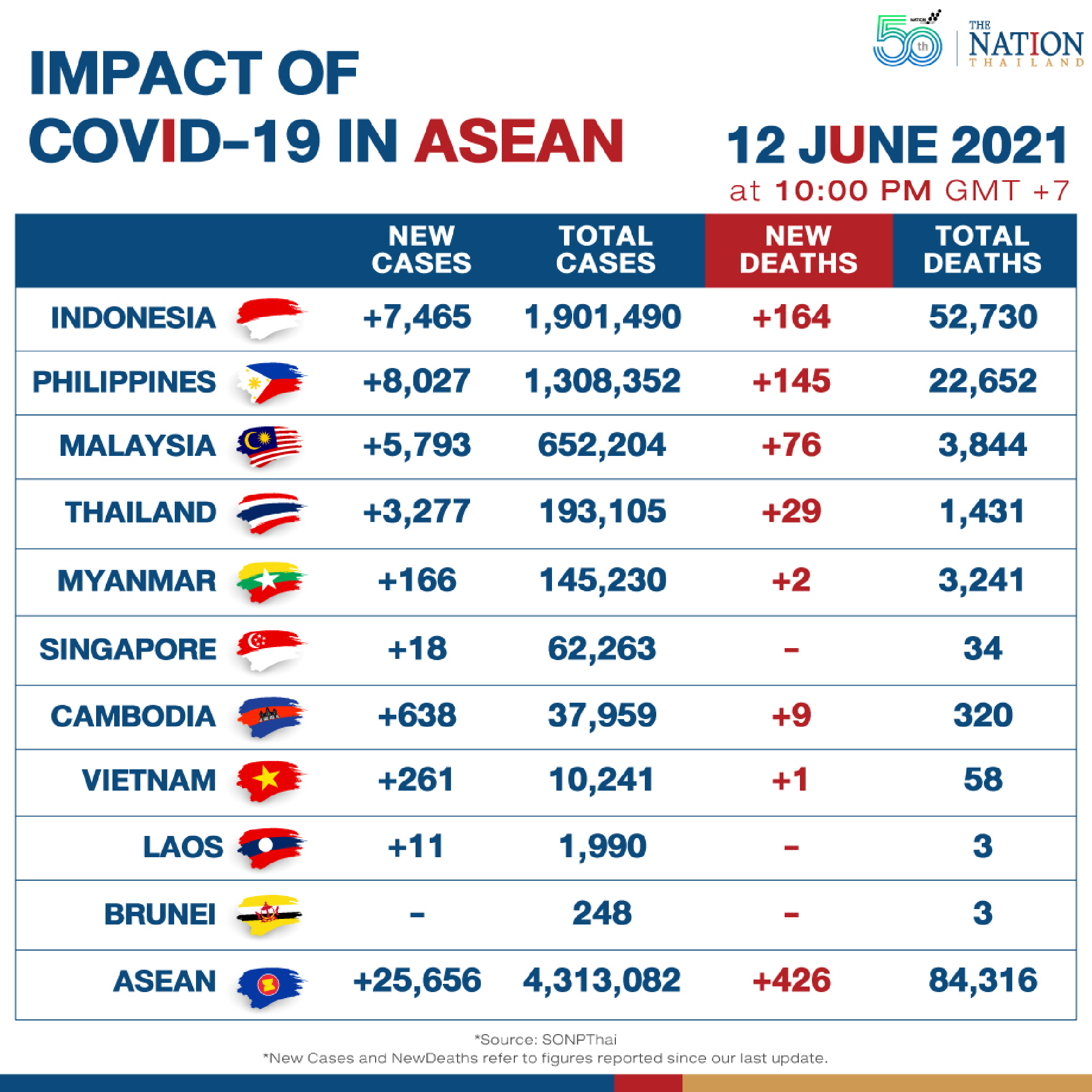
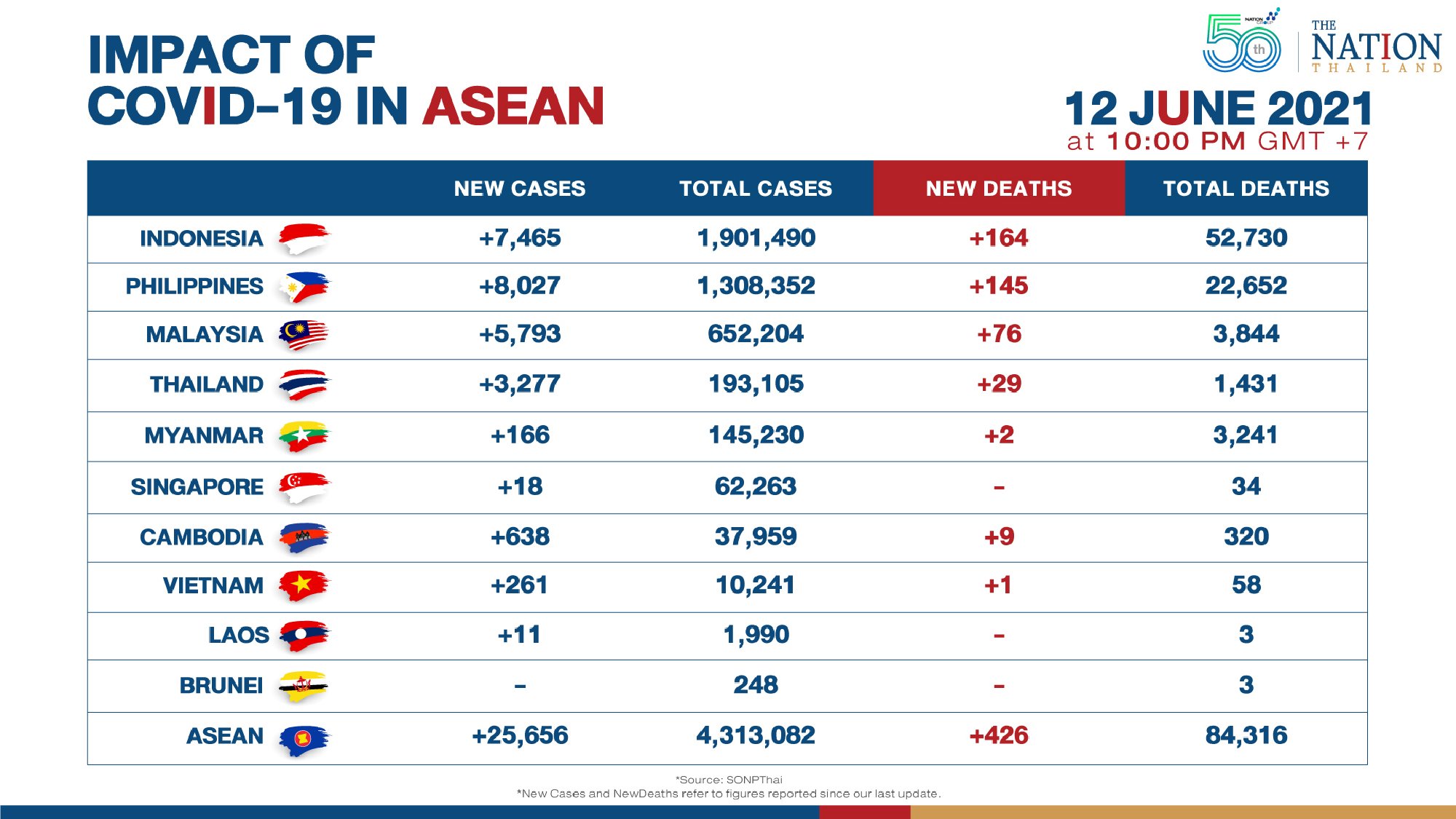
The number of new Covid-19 patients in Asean countries on Saturday rose by 25,656, up from 25,181 on Friday, while 426 patients died, compared to 464 the previous day.

Asean sees rise in new Covid cases but fewer deaths

Total Covid-19 cases since the outbreak rose to 4,313,082 and 84,316 people have died.

Malaysia reported 5,793 new cases and 76 deaths on Saturday, bringing cumulative cases in the country to 652,204, while 3,844 have died.

During the country’s lockdown, stringent preventive measures have been imposed for public transportation, such as allowing only one passenger inside a taxi.

Vietnam reported 261 new cases and one death on Saturday, bringing cumulative cases in the country to 1,024 and deaths to 58.

Ho Chi Minh City announced acceleration of vaccine procurement in a bid to inoculate more than half of the city’s population by the end of this year.

Asean sees rise in new Covid cases but fewer deathsAsean sees rise in new Covid cases but fewer deaths

Published : June 13, 2021

By : The Nation