Productive meeting with Prime Minister @Prayutofficial today as we reaffirmed the importance of the U.S.-Thai alliance, addressed economic and security challenges, including the COVID-19 pandemic, and discussed democracy and human rights. pic.twitter.com/BKf3zvu7Lk— Wendy R. Sherman (@DeputySecState) June 2, 2021
กว่าชาวโลกจะรู้ว่ามีโครงการนี้อยู่ ก็ต้องรอจนถึงปี 2014 เมื่อสำนักข่าว Washington Post นำเรื่องนี้มาเปิดโปงโดยอาศัยข้อมูลจากเอกสารลับที่สโนว์เดนนำออกมาเผยแพร่
โธมัส เวกเนอร์ ฟริส ผู้เชี่ยวชาญด้านข่าวกรองจาก University of Southern Denmark บอกกับ AFP ว่า การแฉครั้งล่าสุดนี้เป็น “จิ๊กซอว์ชิ้นใหม่” และ “มันคือเรื่องฉาวทำนองเดียวกันกับที่เยอรมนีเคยช่วยสหรัฐสอดแนมเมื่อไม่กี่ปีก่อน”
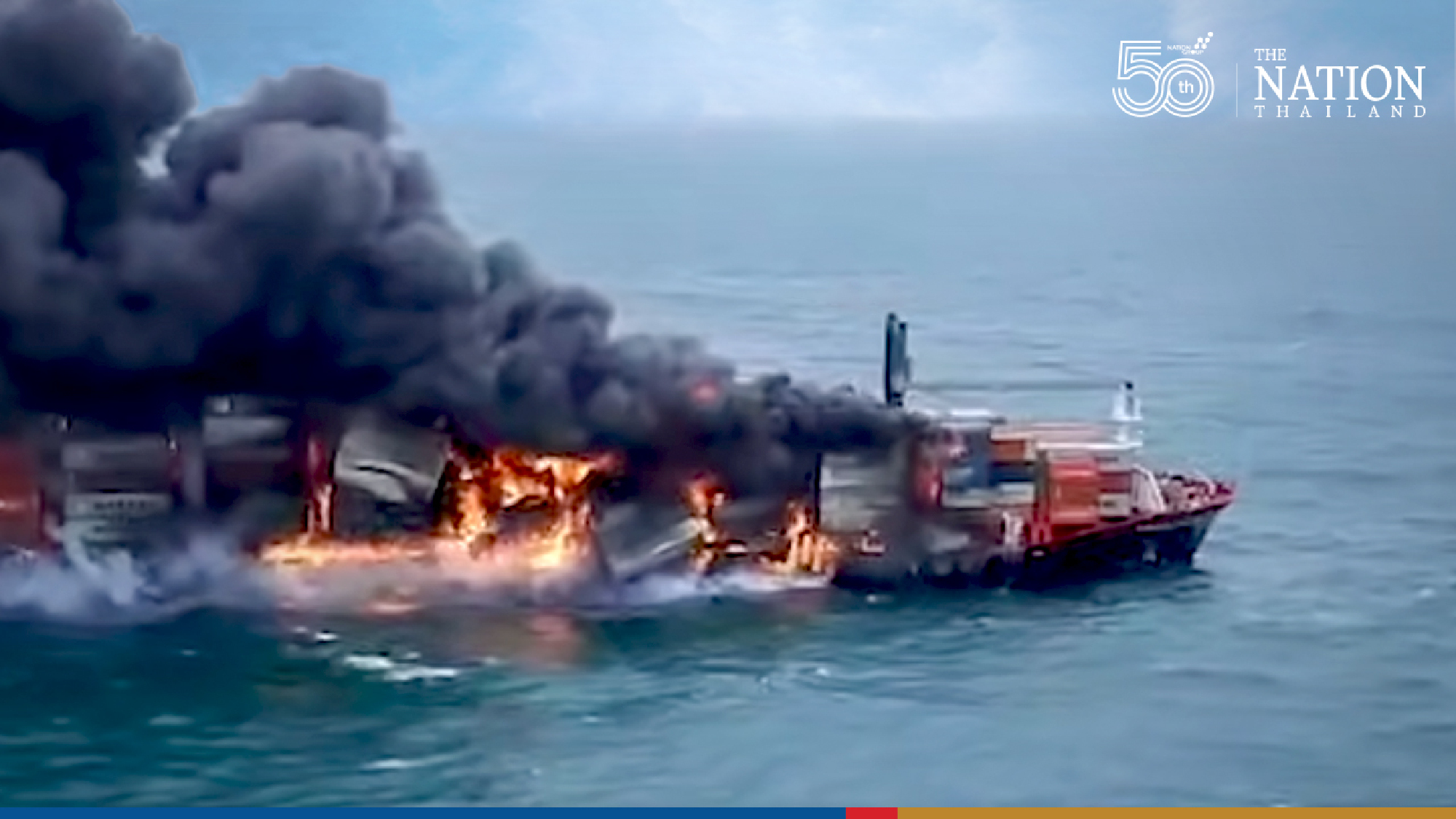
Ecological disaster looms as ship with dangerous goods aboard sinks off Sri Lankan coast
A fire-ravaged container ship began to sink off the western coast of Sri Lanka on Wednesday, increasing the likelihood that oil and dangerous goods will leak into the ocean and exacerbate what is already one of the worst environmental crises in the countrys history.
“The ship is going down,” said navy spokesperson Indika de Silva, Agence France-Presse reported. “The stern of the ship is underwater, the water level is above the deck.”
“As parts of the vessel are underwater, there is greater risk of pollution,” wrote Andrew Leahy, a spokesperson for X-Press Feeders, which operates the ship, in a message to The Washington Post. “The aft of the vessel is sitting on the bottom.”
A tugboat tried to tow the Singapore-flagged MV X-Press Pearl to deeper water Wednesday without success, he added.
The Sri Lankan navy had warned of severe pollution if the ship were to go down at its current location just outside the port of Colombo, the South Asian country’s largest city.
Billions of tiny plastic pellets, or “nurdles,” that the ship was carrying floated into the sea after the fire started and began to blanket Sri Lanka’s yellow-sand beaches, reaching as far as 75 miles to the south. Dead fish, birds and sea turtles began to wash up on shore. Scientists have warned that ocean currents could eventually carry the pellets to beaches on the other side of the island nation, killing more wildlife and damaging sensitive ecosystems.
The X-Press Pearl is also carrying around 350 metric tons of fuel oil and the sinking further alarmed environmentalists, who were struggling to understand the amount and impact of debris already shed by the ship.
“This is the worst possible scenario,” said Muditha Katuwawala of Pearl Protectors, a Sri Lankan marine conservation organization. “With [the ship] sinking, what happens is that all that oil might come out … that is going to be so much more pollution.”
The cargo ship was loaded in Dubai and bound for Malaysia, according to an X-Press Feeders account of the incident. The crew noticed a leak in a container of nitric acid and asked to offload it at both the western Indian port of Hazira and the Qatari port of Hamad, but those requests were denied, the company said.
The origins of the fire go back to May 20, when the crew noticed smoke rising from the cargo hold, according to a company statement. The smoke quickly gave way to flames that enveloped part of the X-Press Pearl. Powerful explosions rocked the ship, forcing the evacuation of its crew.
Of the 1,486 containers aboard the ship before the blaze, 81 contained dangerous goods, including 25 metric tons of nitric acid, according to X-Press Feeders.
Authorities suspect the nitric acid was the source of the fire. The Sri Lankan navy has said the ship was also carrying caustic soda, sodium methoxide and methane.
Katuwawala said precise contents of the ship were not completely known – there is an ongoing police investigation into the incident – adding to uncertainty over the ecological impact of the disaster.
“We don’t know if there are additional containers [of plastic pellets] inside that could spill out,” he said, estimating that 3 billion to 4 billion tiny granules had already leaked. “If it sinks, all those containers, whatever the cargo is inside, will spill out.”
Johnson says lockdown easing on course but urges caution
Boris Johnson indicated his government remains on course to lift lockdown restrictions this month, a day after the U.K. recorded no new Covid-19 deaths for the first time since the pandemic began.
“Ican see nothing in the data at the moment that means we cannot go ahead” with the fourth and final stage of unlocking the economy in England on June 21, the British prime minister said in a pooled interview Wednesday. “But we’ve got to be so cautious,” he warned, given the recent rise in infections.
With the U.K. registering more than 127,000 coronavirus deaths since the start of the pandemic, the highest total in Europe, the zero fatalities reported on Tuesday is being viewed as a highly symbolic moment — even though the daily death toll is likely to creep up again due to reporting delays over last weekend’s public holiday.
The positive news has bolstered calls from business and members of Johnson’s ruling Conservative Party to stick to the prime minister’s own “road map” for easing restrictions.
But Johnson stopped short of promising to do so, saying data on the effectiveness of the vaccines to protect against a new virus strain remains “ambiguous.”
“The best the scientists can say at the moment is we just need to give it a little bit longer” before making a decision, he said.
Ministers will analyze data on hospitalizations and deaths over the next two weeks, with a special focus on the impact of the so-called Delta virus variant first identified in India. Cases have been rising again in recent weeks, and the government wants to see that the link between infections and serious illness has been broken by the vaccination drive.
The final stage of Johnson’s “road map” aims to remove all legal limits on social contact, which would see nightclubs reopen, crowds pack out stadiums again, and large-scale weddings and festivals take place.
Pressure is building on Johnson to stick to the schedule. The Independent Business Network, which represents family-run firms, said the case for delaying the U.K.’s “freedom day” was “entirely without merit.”
“To not reopen would impede our economic opportunities and be devastating for sectors including entertainment and hospitality, who have already been decimated by three consecutive lockdowns,” IBN chairman John Longworth said in an emailed statement, adding that all of the most vulnerable people will have been vaccinated by June 21.
Pleas from business were backed up by John Bell, a professor of medicine at Oxford University who advises the government’s vaccine task force. The latest figures look “pretty good,” he told the BBC on Wednesday. “I’m pretty encouraged by what I see.”
Bell said a “balance” is needed as new strains emerge. “If we scamper down a rabbit hole every time we see a new variant, we’re going to spend a long time huddled away,” he said. “This disease is here to stay, probably forever.”
Iain Duncan Smith, the former Conservative leader, said the vaccines are proving to be a “very strong protection” against the virus. “What we’re doing here is we will be delaying for a reason that completely escapes me,” he told Times Radio.
The U.K. is expected to hit the milestone of three quarters of adults receiving their first dose of the vaccine on Wednesday, with Hancock expected to hail the achievements of scientists and the National Health Service at a speech to the Jenner Institute at the University of Oxford, which developed a coronavirus vaccine in collaboration with AstraZeneca Plc.
“I was told a vaccine had never been developed against any human coronavirus,” he will say, according to his office. “We dared to believe, and we started early.”
Published : June 03, 2021
By : Syndication Washington Post, Bloomberg · Emily Ashton
Melbourne lockdown extended another seven days as covid cluster grows
Melbournes lockdown will be extended beyond the initial seven days announced last week as authorities struggle to contain a Covid-19 cluster thats grown to 60 and is more infectious than seen in the Australian citys previous outbreaks.
The current restrictions will remain in place in Melbourne for a further seven days, Victoria state acting Premier James Merlino told reporters in Melbourne on Wednesday. The lockdown in the city and the rest of the state started on Friday. Restrictions in regional areas of Victoria are proposed to begin easing from 11:59pm on Thursday.
“If we let this thing run its course, it will explode,” Merlino said. “We’ve got to run this to ground because if we don’t, people will die.”
The city of 5 million people has been the epicenter of Australia’s battle to eliminate Covid-19 cases within the community, and is now in its fourth lockdown since the pandemic began. The current cluster originated from a breach in a hotel in neighboring South Australia state being used to quarantine Australians returning from overseas.
The outbreak shows the limitations of Australia’s strategy to eliminate the virus from the community through tight border controls. While day-to-day life for most Australians has largely returned to normal this year, cases have sometimes leaked into the community, triggering localized lockdowns and internal travel bans implemented by states and territories that have caused upheaval to the retail and tourism industries.
In a bid to ease pressure on Melbourne businesses, the Victorian government has announced support for small and medium-sized businesses of $357 million (A$460 million). Prime Minister Scott Morrison’s federal government has ruled out further financial support.
Morrison’s government is under pressure to relocate quarantine facilities away from hotels in the central business districts of major cities by funding purpose-built facilities in regional areas. He’s also been criticized for a slow rollout of the vaccine program, with about 4.3 million people in the nation of 26 million so far receiving their first jab.
Mark Butler, the health spokesman for the opposition Labor party, told reporters in Canberra on Wednesday that it was estimated the state’s lockdown could be costing the national economy about A$1 billion a week.
Morrison’s government should “be seeking proposals for a network of facilities to take the pressure off our hotel system, which is leaking the virus almost on a weekly and fortnightly basis and was built for tourism purposes,” Butler said.
‘We have stepped up to the plate in supporting business and the federal government needs to do exactly the same thing,” Victoria’s Merlino said, calling for wage subsidies for workers waylaid by the lockdown. “Victorian businesses are absolutely devastated by this lockdown, as are families and businesses.”
Genome sequencing has confirmed the cases in Victoria are from the variant that was first detected in India. Merlino said in a separate statement on Wednesday that authorities had discerned that one in 10 current cases had caught the variant of the virus now spreading in Victoria from a stranger.
“People brushing against each other in a small shop,” he said. “Getting a take-away coffee from the same cafe. Being in the same place, at the same time for mere moments. Just walking past someone you’ve never met can mean the virus is jumping to a whole new network.”
Published : June 03, 2021
By : Syndication Washington Post, Bloomberg · Jason Scott
The number of Covid-19 cases in Southeast Asia crossed 4.07 million, with 22,747 new cases reported on Wednesday, higher than Tuesday’s 20,360, while there were 507 more deaths, an increase from Tuesday’s 307.
Covid-19 deaths in Asean now stand at 79,702.
Malaysia saw 7,703 new patients and 126 deaths on Wednesday, bringing the cumulative cases in the neighbouring country to 587,165, while the death toll was 2,993.
Analysts predicted that the number of deaths in Malaysia could reach 26,000 by September, with at least 200 daily deaths from June to August.
Singapore reported 31 new cases on Wednesday, bringing the cumulative cases there to 62,100 patients and a total of 33 deaths. So far, 61,481 people have been cured and discharged.
The city-state’s Public Health Ministry has allowed private hospitals to import the Sinovac vaccine after it was approved by the World Health Organisation for emergency use.
NASA targets Venus with plans to send its first probes there in more than 30 years
For years, Mars has been all the rage at NASA. The space agency sent a series rovers there, including Perseverance, a car-sized vehicle that landed earlier this year with a small helicopter attached to it. The space agency has been focused as well on the moon and has vowed to return astronauts there in the coming years for the first time since 1972.
But on Wednesday NASA administrator Bill Nelson said the space agency would set its sights on a world that has not received much attention in decades: Venus, the fiery mystery of a planet that’s Earth’s closet planetary neighbor. In an address at NASA headquarters, Nelson said the agency would send not one but two missions there in an effort hailed by scientists as long overdue.
NASA has not sent a probe to Venus in more than 30 years despite its relative proximity and the belief among many that studying what takes place there might help scientists better understand Earth. Though Venus is “hot, hellish and unforgiving” in NASA’s words, it has “so many characteristics similar to ours.”
Nelson said the missions would study “how Venus became an inferno-like world capable of melting lead at the surface. . . . We hope these missions will further our understanding of how Earth evolved and why it’s habitable when others in our solar system are not.”
To investigate how Venus evolved, NASA said it is funding two missions. One, dubbed DAVINCI+, would send a probe plunging through the planet’s dense atmosphere to understand why it is, as NASA said, “a runaway hothouse compared to the Earth’s.” The mission’s name is an acronym for Deep Atmosphere Venus Investigation of Noble Gases, Chemistry and Imaging Plus.
The mission would also study whether the planet ever had an ocean and take high-resolution images of the surface in an effort to understand if the planet’s surface is made up of plates that shift over eons similar to the makeup of Earth.
The second mission is called VERITAS and would map Venus’ topography with radar to chart its elevations as well as map infrared emissions to study rock types. VERITAS stands for Venus Emissivity, Radio Science, InSAR, Topography, and Spectroscopy.
“It’s astounding how little we know about Venus, but the combined results of these missions will tell us about the planet from the clouds in its sky through the volcanoes on its surface all the way down to its very core,” said Tom Wagner, a scientist at the space agency who was involved in picking the missions. “It will be as if we rediscovered the planet.”
The Venus missions were chosen among a group of finalists that also included a mission that would have explored Jupiter’s moon, Io. Another would have studied Triton, an active icy moon of Neptune.
But Venus, which Nelson said was “an emerging area of research for NASA,” won the day. NASA said it would award approximately $500 million for each of the Venus missions for development, and that they would launch in the 2028-2030 time frame. Lockheed Martin would design, build and operate both spacecraft, the company said.
The Soviet Union was intensely interested in Venus, sending more than 30 spacecraft to fly by or land on the planet between 1961 and 1985, according to a timeline posted on the NASA website. NASA, which sent probes into the Venusian atmosphere in 1978, last dispatched a spacecraft to Venus in 1990. That craft, Magellan, orbited the planet for four years, mapping it, before plunging into the atmosphere and burning up.
JBS works to restart meat processing plants, easing fears of price increases and shortages
JBS said its systems are coming back online after a massive cyberattack threatened to knock out significant pieces of its global meat supply network, easing worries that the breach would usher in shortages and higher beef and pork prices.
The ransomware attack, which the FBI attributed Wednesday to a Russian-linked group known as both REvil and Sodinokibi, came as consumers already are paying more for steaks, chops and roasts. The coronavirus pandemic disrupted operations for many meat processors, creating production bottlenecks just as demand was surging.
“We saw on Tuesday that prices did not freak out, and what that tells you is that it’s not going to make prices skyrocket,” said Grady Ferguson, senior research analyst at Gro Intelligence. “Right now, it looks like they are getting back on track,” he said, adding “there is not going to be empty store shelves and people looting for hot dogs and things like that.”
In a statement late Tuesday, the Brazil-based company said the “vast majority” of its plants would be operational Wednesday. The breach affected all of its U.S. meatpacking facilities, according to the United Food and Commercial Workers International Union, and JBS had suspended operations at its nine beef processing plants. Several of its pork, poultry and prepared-food plants were working Tuesday, and its beef plant in Canada had started running again.
The size of JBS’s operations heightened concerns of a major market shock. As the world’s largest meat supplier, the company runs more than 150 facilities and processes nearly one-quarter of the nation’s beef and one-fifth of its pork.
“It would have been extremely costly if this attack had been a little more pernicious,” Ferguson said.
The hack was the latest targeting a critical piece of infrastructure, underscoring the vulnerability of corporations, government agencies and civil society groups. Three weeks ago, a ransomware attack on Colonial Pipeline disrupted the East Coast’s fuel network, setting off panic buying and temporary gasoline shortages across several states.
Like in the pipeline hack, the suspected perpetrators of the JBS breach have links to Russia. “We have attributed the JBS attack to REvil and Sodinokibi and are working diligently to bring the threat actors to justice,” the FBI said in a statement. “We continue to focus our efforts on imposing risk and consequences and holding the responsible cyber actors accountable.”
Assaf Dahan, the head of Nocturnus Threat Research at Cybereason, said REvil is known for targeting big companies, which presumably have the resources to pay a large ransom and the financial incentive to restore operations swiftly.
“The REvil cartel usually goes for the big fish,” he said. “They are known for asking for ludicrous amounts of money from the victims, in the millions.”
Ransomware attacks have become a lucrative enterprise for hackers, who find ways into companies’ networks through phishing or by exploiting outdated technology. Once they gain access, criminal hackers will commonly take control of key parts of an organization’s systems and demand a ransom to unlock them.
Hackers walked away with $4.4 million in the Colonial ransomware attack, according to chief executive Joseph Blount. Federal officials have linked the breach to a Russian-based group called DarkSide that researchers say has extracted $46 million in ransom payments so far this year. Though acknowledging the payment was “highly controversial” because it might incentivize bad actors to pursue more attacks, Blount said it was “the right thing to do for the country,” given the critical importance of his company’s infrastructure.
The Colonial breach prompted President Joe Biden to press Moscow to take “decisive action” against ransomware networks operating out of Russia. “They have some responsibility to deal with this,” he said.
After JBS informed the White House of the cyberattack Sunday, U.S. officials engaged directly with their Russian counterparts. The FBI considers combating cybercrime one of its highest priorities.
Biden is scheduled to meet with Russian President Vladimir Putin in Geneva this month.
JBS did not respond to inquiries Wednesday about the status of its plants. But the chief executive of its U.S. operations said the company was “not sparing any resources to fight this threat,” according to a statement released Tuesday.
“We have cybersecurity plans in place to address these types of issues and we are successfully executing those plans,” CEO Andre Nogueira said.
The attack on a major industry player comes as an array of companies grapple with extraordinary consumer demand and supply disruptions tied to the ongoing public health crisis.
“This year, demand has been off the charts,” said Steve Meyer, consulting economist for the National Pork Producers Council and the National Pork Board. Meyer pointed to the rounds of stimulus checks and the rebounding of the food service sector as factors driving up the demand for meat.
While food production is one of the nation’s 16 critical infrastructure sectors as defined by the Department of Homeland Security, the harvesting of animal meat poses unique supply chain challenges.
Livestock must be raised and fed, and unlike with crops, producers have fewer options to store the animals when the logistical pipeline gets backed up.
“If corn demand goes down, you leave it in the bin, and it stays the same, but animals, you can’t do that to them,” Meyer said.
“Cybersecurity is going to be an awfully big issue,” he said. “I have to think we are going to see more of this instead of less, and that is going to be a problem for all of us.”

 รมช.ต่างประเทศสหรัฐเยือนไทยพร้อมหารือแนวทางสู้โควิด ความสัมพันธ์ระหว่างประเทศ ความมั่นคงในภูมิภาค ตลอดจนสิทธิเสรีภาพของประชาชน
 แม้จะเคยถูก เอ็ดเวิร์ด สโนว์เดน แฉว่าสอดแนมพันธมิตร แต่สหรัฐก็ไม่เคยยอมรับตรงๆ และไม่เคยหยุดจนกระทั่งถูกเปิดโปงอีกครั้ง
 ผู้นำจีนสั่งเจ้าหน้าที่ช่วยกันปรับภาพลักษณ์ประเทศให้ดูน่าเชื่อถือและเป็นมิตร
 เมื่อบ้านร้างล้นเมืองส่งผลให้ญี่ปุ่นต้องงัดโปรโมชั่นลดแลกแจกแถม