Nearly one-third of new Covid-19 cases in Asean reported in Malaysia
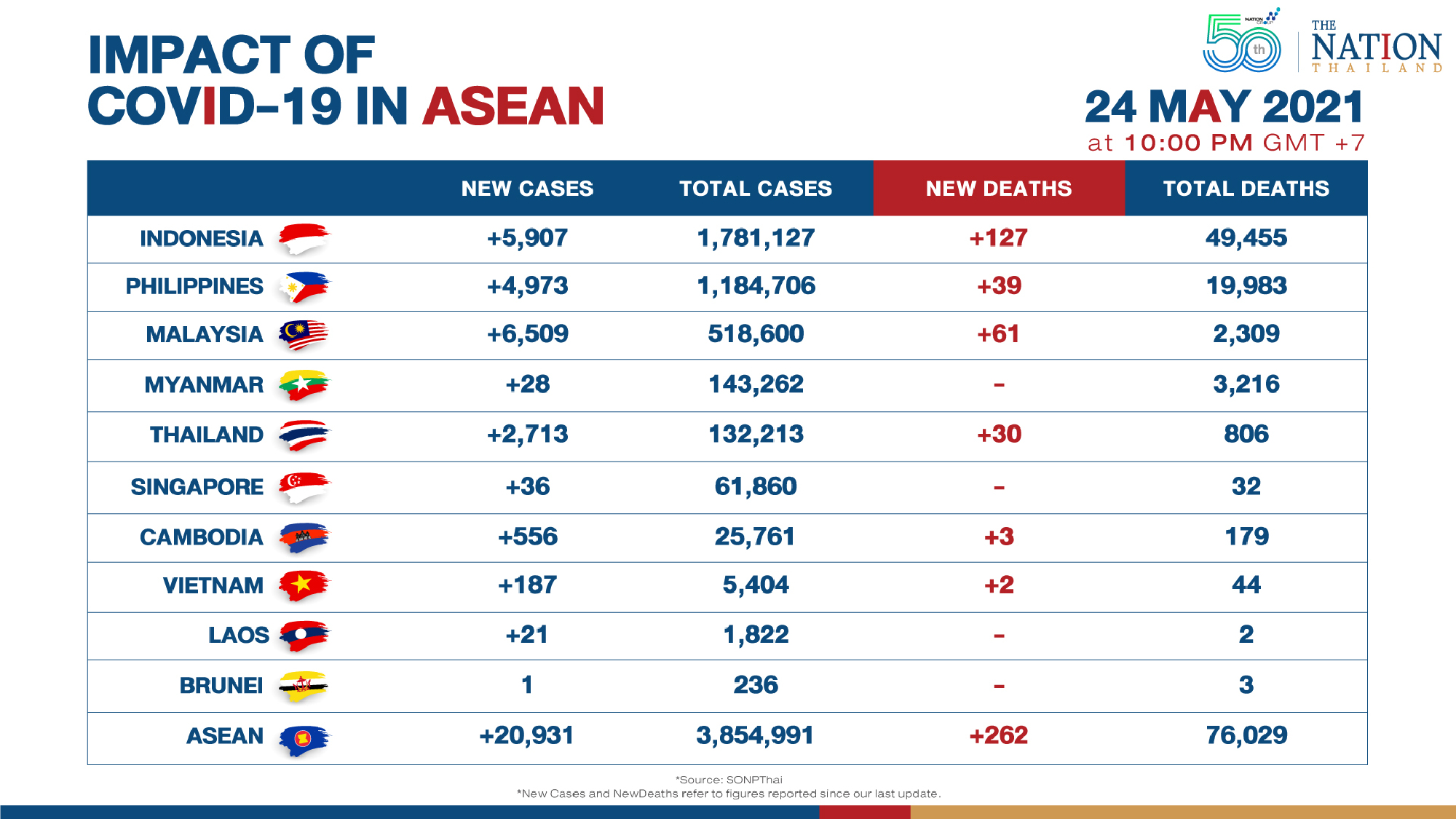
The number of Covid-19 cases and deaths in Southeast Asia on Monday saw a slight increase over the previous day, as per collated data.
Asean reported 20,931 new cases on Monday, slightly higher than Sunday’s 19,462, while 262 people died, up from the previous day’s 237.
Total cases in the region since the outbreak rose to 3.85 million, while deaths are now at 76,029.
Malaysia reported 6,509 infections, nearly one-third of total cases in the region, and a record single-day death toll of 61. Cumulative cases in the country rose to 518,600 and 2,309 patients have died.
The Malaysian Ministry of Labour has ordered construction sites to reduce labourers to not more than 60 per cent, while local authorities have been told to adjust working hours depending on the outbreak situation.
Cambodia reported 556 new cases and three deaths on Monday, as cumulative cases in the country increased to 25,761 patients and 179 deaths. So far, 18,359 people have been cured and discharged.
The governor of Phnom Penh said he was considering bringing back curfew measures if the number of infections continued to rise and people still ignored disease control measures.
As hurricane season looms, Biden doubles funding to prepare for extreme weather
WASHINGTON – President Joe Biden will announce Monday afternoon that hes doubling the amount of money the U.S. government will spend helping communities prepare for extreme weather events, while launching a new effort at NASA to collect more sophisticated climate data.
While the $1 billion in funding is a fraction of what taxpayers spend each year on disasters, it underscores a broader effort to account for the damage wrought by climate change, and curb it. Last week the president signed an executive order instructing federal agencies to identify and disclose the perils a warming world poses to federal programs, assets and liabilities, while also requiring federal suppliers to reveal their own climate-related risks.
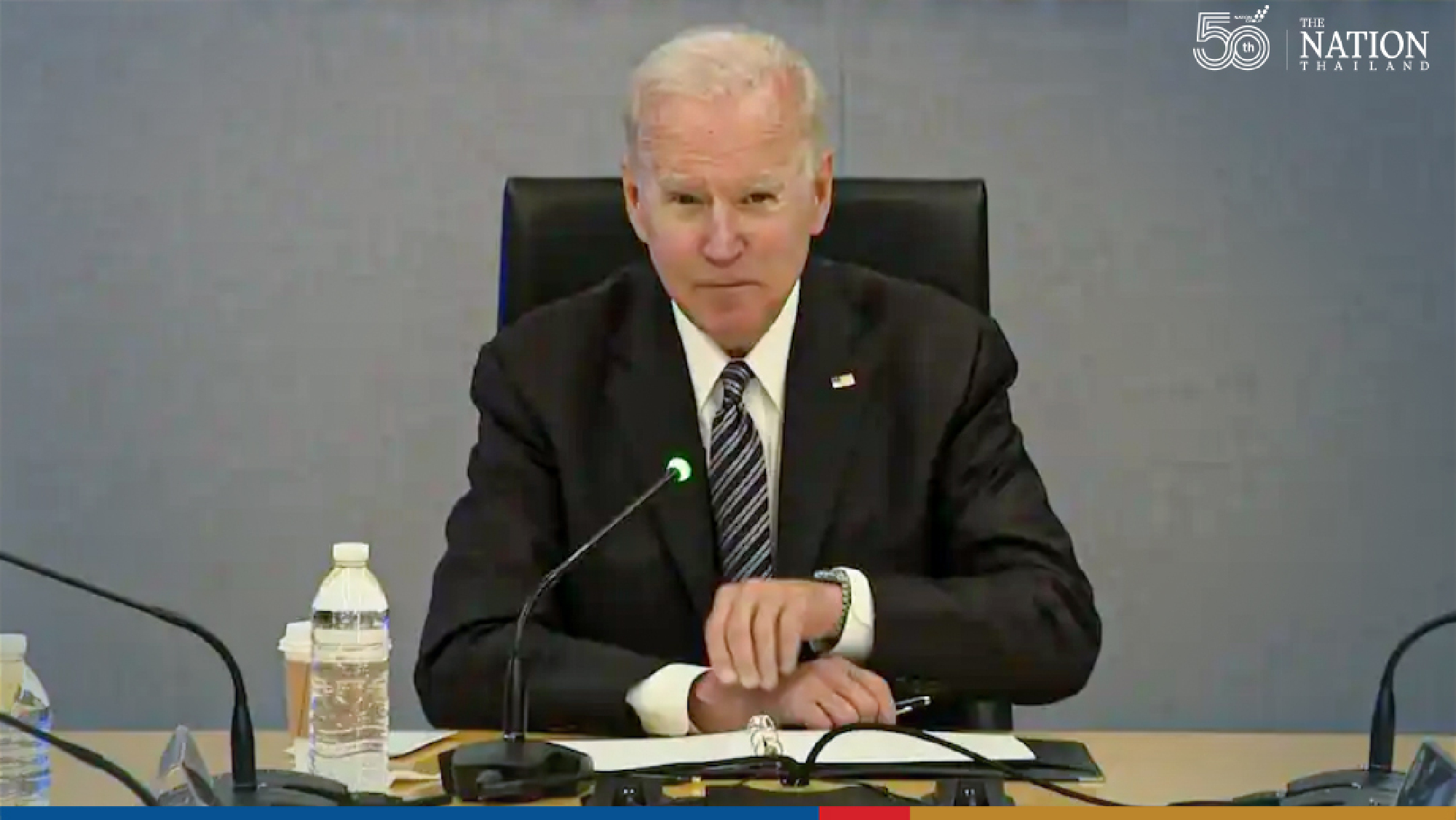
The president will make the announcement during a visit to the Federal Emergency Management Agency’s headquarters Monday afternoon, where he will receive a briefing on this year’s outlook for the Atlantic hurricane season.
The Building Resilient Infrastructure and Communities (BRIC) program helps communities prepare in advance for hurricanes, wildfires and other natural disasters. The administration will target roughly 40% of the additional money to disadvantaged areas.
In a phone interview Monday, White House National Climate Adviser Gina McCarthy said that Biden’s actions will help convey to Americans how the climate has already changed and what the United States must do to respond to it.
“That’s really going to make this climate issue real and relevant to people,” she said. “We just have to prepare for this, and the president is a realist. This is the world we’re living in.”
Monday’s hurricane briefing, McCarthy said, marked a sharp departure from how President Donald Trump approached extreme weather events. In a 2019 incident known as “Sharpiegate,” Trump and his deputies pressured the National Oceanic and Atmospheric Administration to contradict its own experts and say the path of Hurricane Dorian would severely impact Alabama. He also repeatedly questioned the link between rising temperatures and more frequent and intense wildfires.
“This meeting is not just sitting around talking about policies. It’s all about listening to what science tells us, and how we can be prepared for those real-world impacts,” McCarthy said. “It’s telling people what they need to hear about what’s happening in their world, but also responding with a robust whole-of-government approach.”
Last week, NOAA said it expects another hectic season – one that will come on the heels of the busiest such season on record in 2020.
The past year saw a startling 30 named storms, including a half-dozen major hurricanes, surpassing a record set in 2005. A dozen tropical storms and hurricanes made landfall in the United States during the past year. Five of those made landfall in Louisiana, leaving multibillion dollar disasters and plenty of heartache in their wake.
But emergency officials will probably have little time to catch their breath. NOAA’s outlook last week said a 60% chance exists for an above-average storm season this year, with a 70% probability of 13 to 20 named storms.
The administration will also start developing a new NASA mission concept for an Earth System Observatory, which will deploy advanced technology in space so scientists and policymakers can better understand the interactions between Earth’s atmosphere, land, ocean and ice.
McCarthy said the initiative “brings together a lot of streams of evidence that will allow better predictions and ones that are more localized.”
“In the big picture, I think understanding and preparing for extremes is the core of the climate challenge,” said Stanford University Professor Chris Field, who chairs the school’s Woods Institute for the Environment, in an email. “Extreme events are always the sharp end of the climate spear. But they are also super challenging to understand and forecast.”
Field, who has co-chaired the Intergovernmental Panel on Climate Change working group on managing the risks of extreme weather events, noted that current climate models are better at predicting average conditions than extreme events.
“If we want to understand where things are headed with climate-change impacts, understanding and forecasting extreme events is where we need to go,” he said, adding that one of the complications is that some climate-related events, such as wildfires, have multiple causes.
2020 not only marked a record hurricane season, it also saw a startling number of billion-dollar disasters, according to a NOAA report released early this year. That research found that such catastrophes in the United States alone amounted to $95 billion from 22 separate billion-dollar events. The previous record for billion-dollar disasters was 16 in 2011 and in 2017.
Severe wildfires raged in the West, burning millions of acres and entire neighborhoods.
The year marked the most severe wildfire season across the West to date, with California logging five of its six biggest wildfires in state history. Hurricanes and tropical storms battered parts of the Gulf Coast.
In addition, 2020 essentially tied 2016 as the hottest year on record, according to scientists. It also capped the hottest decade in recorded history.
Published : May 25, 2021
By : The Washington Post · Juliet Eilperin, Brady Dennis
India braces for second hurricane-strength storm in 10 days
For the second time in 10 days, India is set to be slammed by a powerful cyclone, or a hurricane-equivalent storm, bringing the risk of damaging winds, storm surge and heavy inland rainfall. The system, known as Yaas, is currently only a tropical storm as it swirls over the Bay of Bengal. But it is expected to intensify into a high-end Category 1-strength tempest before its midweek landfall along Indias northeast coast.
The anticipated landfall comes just nine days after Gujarat, India, was slammed by Extremely Severe Cyclonic Storm Tauktae, which made landfall last Monday Eastern time as a high-end Category 3-equivalent storm with 125 mph winds. Its landfall coincided with a report of the nation’s deadliest day of the covid-19 pandemic, a staggering 4,329 deaths recorded.
At least 86 people were killed by the storm, which caused an estimated $2.1 billion in damage, according to RMSI, a global catastrophe risk management consultancy.
Now a new system is brewing, not in the Arabian Sea but rather to the east of India. Tropical Storm Yaas had winds of 40 mph early Monday Eastern time, making it a borderline tropical storm. But it is set to intensify steadily over the coming days, and it should wrap into a solid hurricane-strength cyclone by late Tuesday as landfall nears. It was located about 400 miles away from its imminent landfall location early Monday, moving north-northwest at about 4 mph.
The India Meteorological Department has hoisted rainfall and wind warnings for the states of Odisha and West Bengal. Local authorities have been working to ensure the safety of oxygen generation plants amid the ongoing covid-19 crisis.
On satellite, the storm had a robust shield of cloud cover spiraling into it from the west, but bare ocean could be seen through gaps in low-level clouds east of the center. That’s usually a sign of dry air, but in this case, the environment surrounding Yaas is saturated, save for a narrow strip of dry air east of the storm at 30,000 feet. As such, it looks like Yaas’s lopsided appearance isn’t so much an indicator of obstacles impeding Yaas’s development as it is a symptom of the storm’s gradual maturation.
While sea surface temperatures are warm and sufficiently toasty to support a strong cyclone, a change of wind speed and/or direction with height, known as wind shear, is working to disrupt Yaas’s circulation. That effect is being somewhat counteracted by effective northerly outflow, or the evacuation of air exiting the storm at high altitudes, which allows the system to ingest more air and strengthen.
Together, the effects roughly balance out, meaning Yaas will probably strengthen right up to the point of landfall. The Joint Typhoon Warning Center is calling for Yaas to be a 90 mph Category 1-equivalent storm with gusts to 115 mph as it moves ashore overnight Tuesday into early Wednesday.
Right now, it’s looking like the states of Odisha and West Bengal are at greatest risk for a direct strike from Yaas; computer models are in good agreement regarding the anticipated track of the storm. Winds gusting over 80 mph are likely where the storm makes landfall, with perhaps a 3- to 6-foot storm surge east of the center.
Atop the increase in sea level, large waves could exacerbate flooding concerns in coastal areas.
“Tidal waves of height 2 to 4 meters above astronomical tide are likely to inundate low lying coastal areas of . . . Parganas, Medinipur, Balasore, Bhadrak, Kendrapara and Jagatsinghpur Districts around the time of landfall,” the India Meteorological Department wrote.
If the storm comes ashore where currently simulated, it could pose a surge problem for cities such as Haldia and Kolkata. They are situated on the Hooghly River, which opens to a bay at the coastline. An onshore southerly flow could push water into the bay and inundate some coastal areas.
The surge is unlikely to reach Kolkata, but high water downstream may back up the Hooghly River, which will simultaneously be working to drain heavy rainfall. A broad 3 to 6 inches of rain is likely east of the center, with 6 to 12 inches possible west of the circulation.
The two cities are among many in the region largely dependent on fishing and marine commerce. Offshore waves could top 60 feet during the height of the storm, prompting a stern warning to mariners.
“The fishermen are advised not to venture into central Bay of Bengal during 24th – 25th May and into north Bay of Bengal and along and off north Andhra Pradesh-Odisha-West Bengal-Bangladesh coasts from 24th – 26th May,” cautioned the India Meteorological Department.
The storm should dissipate by late Wednesday or early Thursday as it drifts inland to the northwest, bringing some rain showers to the high terrain of northern India to close out the workweek.
Cancer patients, other ill Gazans await Israels permission to leave for treatments
GAZA CITY, Gaza – As the Gaza Strip slowly re-connected with the outside world after an 11-day battle between Israel and Hamas, patients with urgent medical needs were still waiting Monday for Israels permission to leave the enclave for surgeries, transplants or cancer treatments that were interrupted by the fighting and unavailable in Gaza.
Physicians, families and advocates urged that border crossings be reopened for medical cases before the most vulnerable patients become critically ill or die.
Late Monday, the Israeli military said that patients with permits for medical treatments would be allowed to cross into Israel beginning Tuesday morning as part of the resumption of normal border operations, including the passage of humanitarian teams, medical equipment, food and fuel.
On the fourth day after a cease-fire ended the near-constant rocket launches into Israel and Israel’s retaliatory bombardment, more supplies of fuel and medical equipment entered Gaza through checkpoints in Israel and Egypt.
At least seven workers from humanitarian and aid groups, who had been blocked from entering, also arrived in Gaza on Sunday, according to the Association of International Development Agencies, an umbrella group of agencies in Jerusalem. But many of the groups are waiting for border openings to become more predictable before sending larger teams or specialists, the group said, to prevent their staff from being stranded inside the enclave.
No medical patients have been allowed to leave through the Erez Crossing into Israel during the limited hours that Israeli officials have opened to checkpoint to journalists or diplomats. That means many patients who missed critical appointments over the last two weeks still do not know when they will be able to reach their doctors.
The Gaza Health Ministry office that facilitates outside medical care was crowded Sunday with patients and families trying book new appointments and secure their exit permits.
Hussein Najjar, a fisherman from southern Gaza, said his 61-year-old mother has grown weak and depressed since missing her regular chemotherapy treatment in East Jerusalem’s Augusta Victoria Hospital for colorectal and lung cancer.
“Even if we get an appointment today, we don’t know when the crossing will be open and she will be able to go,” Najjar said. “She’s looking for a way to survive, and we can’t find it.”
The family situation was made even more difficult when Najjar’s boat was destroyed along with several others when an Israeli missile struck a harbor during the bombardment, he said. His family of seven, including his father and ailing mother, are surviving on a monthly donation of about $50 a month from Oxfam International, he said.
Gaza’s impoverished health system cannot provide many of the treatments needed by the most serious medical cases. There are no radiation treatment facilities in Gaza, for example, leaving cancer patients to seek that and other basic therapies in hospitals outside the enclave.
The Health Ministry said it makes appointments and processes exit permits for about 100 patients a day, 90% f them for hospitals in the West Bank and the rest for facilities in Israel, Jordan and Egypt.
They system is cumbersome at best, according to Mazin Hindi, the physician who runs the outside referral program. When there is a military escalation, it fails entirely, he said. Patients who need lifesaving treatments or surgeries can wait weeks for Israeli authorities to give the green light, sometimes not before it is too late.
“It’s very difficult on a human level,” Hindi said. “I feel like the patient in front of me is like my own mother, my own wife, my own child, and there is nothing I can do. I am helpless at times like this.”
The latest disruption is only the latest in an inefficient treatment network that often fails patients, according to Eman Shanan, an advocate for women cancer patients. Between Israeli restrictions, the lack of financial support from Hamas and the Palestinian Authority and the personal cost of transportation, many patients face hurdles to treatment that are sometimes insurmountable.
Covid-19 only made the situation worse, Shanan said. Cancer patients, who are often immune-compromised, were scared to travel for months. Seventeen thyroid patients she works with have not had treatment in more than a year because quarantine requirements in Egypt and Jordan meant they would be potentially apart from their young children for weeks.
“The war just made it worse,” said Shanan, head of the Gaza-based Aid and Hope Program for Cancer Patient Care. “Nobody is caring about cancer patients.”
Published : May 25, 2021
By : The Washington Post · Steven Hendrix, Hazem Balousha
Singapore approves covid breath test with 1-minute result
A breath test designed to detect covid-19 and give accurate results within one minute has been approved for use in Singapore, the National University of Singapore said in a statement.
The test, developed by NUS spinoff start-up Breathonix, works much like a standard breathalyzer test that police might use to see if an erratic driver is drunk. A person blows into a one-way valve mouthpiece, and compounds in the person’s breath — think of it as a breath signature — are compared by machine-learning software to the sort of breath signature expected from someone who’s Covid-positive.
Accurate tests at that speed could be key to unlocking a travel sector that’s crucial for Singapore’s economy but has slowed to a crawl during the pandemic. Even as the U.S. and parts of Europe begin to reopen with higher viral caseloads, Singapore and other “Covid-Zero” countries in Asia have been hesitant to open borders and have cracked down harshly on any sign of flare-ups.
The breathalyzers “may potentially facilitate opening the borders in the longer run, but of course that’s up to the ministry’s assessment,” said Du Fang, the company’s chief operating officer. Travelers from countries defined as low-risk “can just simply do a breath test, and then they can easily enter into Singapore and we can open the borders to those green countries sooner.”
Singapore will use the breathalyzers in a deployment trial to screen some incoming travelers from Malaysia, the Straits Times reported. Anyone who tests positive in the breath test would be screened in a confirmatory PCR swab test. Singapore currently screens entrants with antigen rapid tests, which would continue alongside the breathalyzers.
The tests will sell for $3.80 (S$5) to $15 (S$20) each, Du Fang said.
The Breathonix test so far has undergone two clinical trials in Singapore and another in Dubai. It achieved a sensitivity of 93% and specificity of 95% in one early Singapore-based pilot study that involved 180 patients.
Published : May 25, 2021
By : Syndication Washington Post, Bloomberg · Derek Wallbank
E.U. promises swift retaliation after Belarus forces airliner to land, detains dissident
RIGA, Latvia – Belarus on Monday was facing international isolation, with European leaders discussing measures to deal a crushing blow to the economy and the White House calling for an investigation, a day after Belarusian authorities forced down a civilian jet and pulled off a dissident journalist.
Outrage mounted about the brazen move by Belarusian President Alexander Lukashenko, who on Sunday sent a MiG-29 fighter jet to snatch a Ryanair plane out of the sky as it was flying from Athens to Vilnius, Lithuania, and arrest one of its passengers, Roman Protasevich, the founder of an opposition media outlet. Protasevich faces 12 years or more in prison.
The power play set a fearsome precedent for journalists and political opponents, who must now worry about flying through the airspace of repressive regimes, even if they are moving from one free capital to another.
The move was a “brazen affront to international peace,” White House press secretary Jen Psaki said, saying that the Biden administration is demanding an international investigation.
The United States condemns Lukashenko’s “regime” for “ongoing harassment and arbitrary detention of journalists simply for doing their job,” she said at a White House briefing.
Transportation Secretary Pete Buttigieg told CNN the safety of flight paths over Belarus should be assessed. Britain, Ukraine, Lithuania and Latvia all asked commercial air traffic to avoid Belarusian airspace, to protect their citizens from what some officials called state-sponsored hijacking.
And E.U. leaders were discussing economic retaliation against Belarus at a prescheduled summit in Brussels on Monday. Latvian Foreign Minister Edgars Rinkevics said in an interview with The Washington Post that he and others would seek “harsh economic sanctions,” far beyond measures currently in place, in a bid to isolate Lukashenko and starve his regime of funds.
“Yesterday I think was the test of the West,” Rinkevics said. “But it was also a show of force and confidence to his own people and the opposition: ‘Look, I can come and get you anyway.’ This is an inter-European flight, from Athens to Vilnius, with a European company performing the flight, with a person who is under European protection because he is an opposition activist. This is a direct attack against Europe.”
Lithuanian authorities have taken the lead on the investigation into the incident, interviewing the Ryanair crew to try to understand the sequence of events that forced them to make a steep bank turn within minutes of the Vilnius airport, which is just over the border from Belarus. The Lithuanians are also trying to verify the identity of three passengers who stayed behind in Minsk along with Protasevich and a woman reported to be his girlfriend, both of whom were forced to remain in Belarus. A spokeswoman for the prosecutor general’s office, Elena Martinoniene, said that 126 people were aboard the plane when it departed from Athens, but 121 people landed in Vilnius.
Verifying the identity of the passengers could help Western officials understand whether Belarus pulled off the operation itself, or whether it had help from Russia, a possibility some officials were not ruling out on Monday.
“This was a major operation. These were skilled professionals, skilled guys on board,” a senior European official said, speaking on condition of anonymity to discuss the details of the investigation.
British Transport Secretary Grant Shapps instructed his country’s civilian aviation authority to ask U.K. airlines to avoid Belarusian airspace “to keep passengers safe,” he wrote on Twitter. He said he had suspended permits for Belavia, Belarus’s national carrier, to operate in Britain.
The Ukrainian ban on flights to Belarus and on Ukrainian-registered aircraft from flying above Belarus was also likely to have a significant impact on regional passenger traffic as well, since Belarus became the main air corridor between Ukraine and Russia after direct flights between those countries were cut off after hostilities began in 2014.
E.U. leaders converging on Brussels for a pre-scheduled summit on Monday were considering multiple responses, including banning Belavia flights and declaring Belarus’s airspace unsafe, according to diplomats and other officials involved in the discussions. Economic sanctions could include full-scale bans on doing business with Belarus’s biggest companies, state-owned operations that are crucial to keeping Lukashenko afloat.
All explanations for the forced landing of the plane other than to detain Protesevich “are completely implausible,” German Chancellor Angela Merkel told reporters on her way into the meeting, saying that there would “certainly” be new sanctions.
European Commission President Ursula von der Leyen called the forcing down of the plane “outrageous behavior” and said that what happened was a “hijacking.”
Fresh accounts of what happened were still surfacing on Monday.
People on the flight told Lithuanian media that they had the sensation of a sudden evasive maneuver – a loop that reversed the plane’s course and sent it on a path toward Minsk. Some thought it was because of weather.
Belarusian authorities appear to have engineered a false bomb threat against the airplane.
“It was intercepted, there was effectively warning given to the pilots and crew that there was a security risk on board, and then the plane was escorted by military jet to the Minsk airport, which was not the closest airport,” Irish Foreign Minister Simon Coveney told Ireland’s RTE radio on Monday.
Passengers who were sitting close to Protasevich said he became intensely anxious as he realized that the plane was landing in the Belarusian capital, where the plane was surrounded with police, military vehicles and firefighters.
“It was obvious that he was beginning to panic,” Marius Rutkauskas, a passenger sitting in the row ahead of Protasevich, told Lithuania’s LRT broadcaster. “He said, ‘the death penalty awaits me in Belarus.'”
Authorities came aboard the aircraft and took Protasevich off first, witnesses said. Then they commanded everyone to disembark. Passengers were searched and held for hours before they were allowed back on the plane – without Protasevich or Sofia Sapega, a Russian citizen studying at the European Humanities University in Vilnius and who some news accounts identified as his girlfriend. The university said in a statement Monday that she had also been detained and called for her release.
Coveney called the incident “aviation piracy” and said only one or two people were actually arrested from the plane, but five or six stayed on the ground in Belarus. “So that certainly would suggest that a number of other people who left the plane were secret service,” he said. “We don’t know from what country, but clearly linked to the Belarusian regime.”
In a statement posted on the Belarusian Foreign Ministry’s website, spokesman Anatoly Glaz said Belarus would “guarantee full transparency” and is open to receiving experts and presenting materials on what happened.
There is “no doubt that the actions of our competent authorities were also in full compliance with the established international rules,” he said, criticizing the “openly bellicose” statements from European leaders.
Later on Monday, a Belarusian official appeared on state television to read out what he said was the threat they had received to the safety of the plane, which he said was from “Hamas soldiers” demanding an Israeli cease-fire in Gaza. European officials gave little credibility to the announcement from Artem Sikorsky, the director of the Aviation Department of the Ministry of Transport and Communications.
Lukashenko has already waged a campaign of violence and repression for months, following August elections in which he arrested most of his opponents, then, according to Western observers, falsified results to produce a crushing victory against the lone remaining candidate.
Svetlana Tikhanovskaya, the candidate, fled into exile in Lithuania. It was her visit to Athens last week that brought Protasevich to Greece from Vilnius, where he also lives in exile.
The European Union imposed sanctions following the election and the crackdown. But Sunday’s actions – which European officials said they were certain had been approved by Lukashenko – crossed a new line. There appeared to be little precedent for a nation-state to use its military to force down a commercial flight for political ends.
Ryanair CEO Michael O’Leary called the situation a “state-sponsored hijacking,” and told Ireland’s new radio on Monday that Belarusian authorities had appeared intent on removing Protasevich and his traveling companion, who Belarusian opposition media said was his girlfriend.
“We believe there were some KGB agents offloaded at the airport as well,” O’Leary said, without explaining how he knew that. Belarus’s feared security service is still known by its old Soviet abbreviation, unlike Russia’s.
But despite his concern, Ryanair continued to fly over Belarusian airspace on Monday, with a flight from Cyprus to Estonia entering Belarusian territory even though several other airlines rerouted away from the country.
A spokesman for the airline did not immediately reply to a request for comment.
Lukashenko has been Belarus’s heavy-handed ruler since 1994. Protasevich became his enemy for helping to organize the protests against his widely doubted election win.
Analysts said the situation could drive the Belarusian leader closer to the Kremlin, with which he has long had an up-and-down relationship. The Kremlin has long pushed for the two countries to form a unified state – something they agreed to in 1999 but have not fully implemented, in part because Lukashenko has dragged his feet.
Now the economy may be left without alternatives. As Lukashenko has cracked down on all forms of opposition, including media, he has been emboldened by Russia’s support. Although the E.U. has already sanctioned Lukashenko and other Belarusian officials, Minsk is dependent on Moscow, which issued a $1 billion loan to Belarus in December.
“I would assume that in this circumstance, Russia will help, and Lukashenko relies on Russia to help,” said Artyom Shraibman of Sense Analytics, a Minsk-based political consultancy. “He’s now a very anti-Western actor, and he thinks that these anti-Western actions must be rewarded or covered up by Moscow.”
Russian President Vladimir Putin is scheduled to meet with Lukashenko in the Black Sea resort city of Sochi this week.
A spokeswoman for the Russian Foreign Ministry, Maria Zakharova, said that “what’s shocking is that the West calls the incident in the airspace of Belarus ‘shocking.'” In a statement on Facebook, she listed other aviation incidents that she said drew a muted response.
The Kremlin declined to comment.
Protasevich’s Nexta and Nexta Live channels on Telegram, a popular social media and messaging app, became a main source for news during the demonstrations as Belarusian authorities often moved to shutter Internet and mobile service. Telegram continued to work during the outages, and Nexta, then run by Protasevich, became a resource for where, when and how to protest. It went on to expose police brutality against protesters.
In November, Belarus placed Protasevich and Nexta’s founder, Stepan Putilo, on a terrorist watch list, charging him with three protest-related crimes that could land him in prison for more than 12 years. Protasevich and Putilo were the only Belarusian citizens on the list at the time.
Franak Viacorka, an adviser to Tikhanovskaya, said on Twitter that he and the former opposition candidate took the same Ryanair flight from Athens to Vilnius just a week earlier.
“We were lucky we got to Vilnius safely,” he said. “After [Sunday’s] incident, Belarusian airspace must be closed for international flights, the perpetrators – brought to justice.”
A number of Russian officials praised the move. Lawmaker Vyacheslav Lysakov wrote on his Telegram that it was a “brilliant special operation” by Belarus’s state security services. Kremlin propagandist Margarita Simonyan, the editor in chief of the government-funded TV channel RT, formerly Russia Today, said on Twitter that Lukashenko “performed beautifully,” adding that she is envious of Belarus.
Published : May 25, 2021
By : The Washington Post · Michael Birnbaum, Isabelle Khurshudyan
George Floyds family gathers in Minneapolis to mark one year since his death
MINNEAPOLIS – Members of George Floyds family took to the streets Sunday to mark the one-year anniversary of his death, marching with hundreds of people, including activists and others who have lost loved ones to the hands of police, in the first of multiple events planned across the country to remember him and rally for racial justice.
Several of Floyd’s siblings and his children returned to the steps of the Hennepin County Government Center, where just weeks ago a jury found former Minneapolis police officer Derek Chauvin guilty of murder and manslaughter in Floyd’s death and where three other former officers charged in his killing are set to go on trial next year.
While many praised Chauvin’s conviction, calling it a first step toward “justice,” the family spoke of enduring loss and continued questions about why Floyd died.
“I still don’t know why,” said Bridgett Floyd, his younger sister, who now runs a memorial foundation in her brother’s name. Taking the stage at a rally before the march, she spoke of the family’s pain and how their lives had changed in the “blink of an eye.”
“It’s been a long year. It’s been a painful year,” Bridgett Floyd said. “That officer doesn’t understand what he took from us.”
Floyd was remembered a year after his death sent millions across the country into the streets in some of the largest sustained protests in American history. Minneapolis, the city at the center of that movement, continues to struggle with its own reckoning over policing and racial justice.
His younger sister joined other speakers – including the Rev. Al Sharpton and civil rights attorney Ben Crump, who represents the Floyd family – who said the fight for justice continues, even with Chauvin’s conviction.
Speaking before an audience that included several elected officials, including Minnesota Gov. Tim Walz and Minneapolis Mayor Jacob Frey, both Democrats, Crump called out dozens of names of other Black men and women who had been killed by police, including Daunte Wright, a 20-year-old Black man who was shot by a suburban Minneapolis police officer during a traffic stop last month during Chauvin’s trial.
“We are better than this, America. We need to have a more just America!” Crump said.
He pointed to the disproportionately violent response of police across the country when it comes to Black people, compared with White suspects, citing several recent cases where Black men have been shot at and killed while running away from the police.
“What is it about a Black man running away from the police that it is the most dangerous thing in America?” Crump asked, looking directly toward Frey and other elected officials who sat nearby.
He and Sharpton called for additional police policy changes nationwide, including the passage of the George Floyd Justice in Policing Act – which has been approved by the U.S. House but has languished in the Senate. Floyd’s family has been invited to the White House on Tuesday to meet with President Joe Biden, which Sharpton described as a “nice” gesture, but not enough.
“George Floyd should not go down in history as someone with a knee on his neck, but as someone who broke the chain of police brutality and illegality,” Sharpton said.
Floyd died May 25, 2020, when he was restrained, handcuffed and facedown, on a South Minneapolis street during an investigation in a 911 call about a fake $20 bill that had been passed at a local market. Chauvin pressed his knee into Floyd’s neck and back as Floyd begged for breath and ultimately went limp while two other officers – Alexander Kueng and Thomas Lane – restrained Floyd’s back and legs. A fourth officer, Tou Thao, held back bystanders who sought to intervene.
Chauvin is scheduled to be sentenced on June 25. Kueng, Lane and Thao, who are charged with aiding and abetting murder and manslaughter, are scheduled to go on trial in March. All four are also facing federal civil rights charges in the case.
Published : May 25, 2021
By : The Washington Post · Holly Bailey, Paulina Villegas
“คริปโตเคอร์เรนซี่กำลังจะดิ่งเหวในเร็ว ๆ นี้หรือไม่? ไม่จำเป็น” ครุกแมนเขียนใน New York Times “ ความจริงอย่างหนึ่งที่ทำให้แม้แต่คนขี้ระแวงคริปโตอย่างผมต้องหยุดคิดก็คือความทนทานของทองคำในฐานะทรัพย์สินที่มีมูลค่าสูง”





 กองทัพประชาชนในรัฐกะยาปะทะดุเดือดกับทหารเมียนมาพร้อมบุกโจมตีฐานทัพยึดอาวุธยุทโธปกรณ์
 อองซานซูจีลั่นวาจาต่อต้านความพยายามยุบพรรค NLD ระหว่างปรากฏตัวต่อศาลด้วยตนเองเป็นครั้งแรกนับตั้งแต่รัฐประหาร
 ขณะที่นักลงทุนทิ้ง Bitcoin หันไปซบทองคำทำทะยานขึ้น สะท้อนช่วงขาลงของคริปโตกำลังทำให้ราคาทองคำทะยานขึ้นมา

