The World Health Organization (WHO) and its partners are seeking to expand the capacity of low- and middle-income countries (LMICs) to produce Covid-19 vaccines and scale up manufacturing to increase global access to these critical tools to bring the pandemic under control.
The WHO will facilitate the establishment of one (or more, as appropriate) technology transfer hub(s) that will use a hub and spoke model (REF) to transfer a comprehensive technology package and provide appropriate training to interested manufacturers in LMICs. This initiative will initially prioritise the mRNA-vaccine technology but could expand to other technologies in the future, the WHO said.
The intention is for these hubs to enable the establishment of production process at an industrial or semi-industrial level, permitting training and provision of all necessary standard operating procedures for production and quality control. It is essential that the technology used is either free of intellectual property constraints in LMICs, or that such rights are made available to the technology hub and the future recipients of the technology through non-exclusive licences to produce, export and distribute the Covid-19 vaccine in LMICs, including through the Covax facility, WHO said.
Preference will be given to applicants who have already generated clinical data in humans, as such clinical data will contribute to accelerated approval of the vaccines in LMICs, the WHO said.
It is anticipated that WHO will work with funders and donors to mobilise financial support to establish the hubs and, as they are being established, to support the transfer of technology to selected manufacturers in LMICs, taking into consideration the need to establish permanent vaccine production capacity in regions where this is currently mostly absent, the WHO said. This broader objective will ensure that all WHO regions will be able to produce vaccines as essential preparedness measures against future infectious threats, it added.
To support this activity, WHO is seeking expressions of interest from:
1. Small/middle-sized (public or private) manufacturers of medical products (drugs, vaccines or drug substances) preferably, but not exclusively, in LMICs, which could host a Covid-19 mRNA hub.
2. Owners (public or private) of technology and/or intellectual property rights. These may be academic institutions, pharmaceutical companies, non-governmental organisations or any other entity willing to contribute these to a technology transfer hub, under the auspices of WHO, to enable production of mRNA-based Covid-19 vaccines in LMICs.
Entities willing to be considered as a technology transfer hub, or able to provide the necessary know-how, process training, and intellectual property rights, are invited to provide a brief summary of their capacity, and their interest in participating in the establishment of a Covid-19 vaccine technology transfer hub to: Martin Friede (friedem@who.int) and Raj Long (rlong@who.int)
By The Washington Post · Sean Sullivan, Seung Min Kim, Tyler Pager
WASHINGTON – President Joe Biden on Friday all but abandoned a pledge to enable tens of thousands of refugees fleeing danger abroad to come to the United States this year, then abruptly backtracked after drawing a furious response from human rights advocates and fellow Democrats.
In a directive issued early Friday, the administration announced it would leave the cap on refugees at 15,000, the record-low ceiling set by President Donald Trump. But after hours of blistering criticism from allies, White House press secretary Jen Psaki reversed the announcement, issuing an unusual statement saying the order had been “the subject of some confusion.”
Psaki said that Biden would actually set the final cap – which sets the refugee allotment through the end of September – by May 15, and that while the White House expects it will be higher than Trump’s ceiling, it was “unlikely” to rise to the 62,500 that Biden had put forward with some fanfare in February.
Psaki said Biden could not keep that promise because the Trump administration had “decimated” the refugee program. But advocates dismissed that explanation as unpersuasive, saying the Biden team was more likely seeking to abandon the pledge amid concerns about the political criticism surrounding the current surge of migrants to the southern border.
“It’s deeply disappointing that the administration elected to leave in the place the shameful record low of its predecessor,” said Krish O’Mara Vignarajah, president and chief executive of Lutheran Immigration and Refugee Service, a resettlement agency working with the government.
Biden’s new decree – known formally as an emergency presidential determination – did move away from Trump-era policies by changing the regional allocation of refugees. Under Trump’s directive, strict restrictions were placed on accepting refugees from certain African and majority-Muslim countries.
The tortuous maneuvering reflected growing concern about immigration inside the White House, according to people with knowledge of the decision-making process, who cited worries about expanding the refugee program at a moment when critics are pummeling Biden with claims that he is too soft in his policies and rhetoric. The president is struggling to contain the soaring number of migrants arriving at the southern border, which has caused significant anxiety inside the West Wing, according to people with knowledge of the situation.
Some of those people pointed to Ron Klain, Biden’s chief of staff, as a driving force behind the president’s announcement that he would keep the Trump-era caps. A senior administration official denied that Klain engineered the initial decision and said instead that the chief of staff was a driving force behind Psaki’s clarification. All of these officials spoke on the condition of anonymity to discuss private deliberations.
Biden’s long-delayed decision-making has resulted in hundreds of canceled flights for refugees, including a pregnant mother who missed the window to travel, and it has cast many people into limbo who had organized their lives around coming to the United States after Biden signaled a new direction, according to advocates and Democratic lawmakers.
Biden’s directive Friday was greeted with anger from Democrats and leaders of the resettlement agencies that work with the government, some of whom equated his approach to Trump’s. The decision prompted the most forceful denunciations from his own party that Biden has experienced as president.
“This Biden Administration refugee admissions target is unacceptable. These refugees can wait years for their chance and go through extensive vetting. Thirty-five thousand are ready. Facing the greatest refugee crisis in our time there is no reason to limit the number to 15,000,” Sen. Richard Durbin of Illinois, the second-ranking Senate Democrat and a close Biden ally, said in a statement. “Say it ain’t so, President Joe.”
For all the furor, the political effect of Biden’s move was unclear. While he met a torrent of outrage from Democrats, some conservatives suggested that the impulse to hold off on a dramatic increase in refugees showed sensitivity to the politics of immigration.
“This reflects Team Biden’s awareness that the border flood will cause record midterm losses *if* GOP keeps issue front & center,” tweeted Stephen Miller, a chief architect of Trump’s hard-line immigration platform.
Republicans who have struggled to dent Biden’s popularity when it comes to his handling of the coronavirus pandemic and the economy have increasingly focused on immigration, suggesting that the president has botched the situation on the border and is responsible for an influx of migrants that is hard to control.
Biden did make some changes to Trump’s order. His revised regional allocations include 7,000 spots for refugees from Africa and 3,000 from Latin America. While those moves garnered some praise, they were drowned out by the chorus of Democrats from across the political spectrum who lambasted the president’s decision and raised concerns about whether Biden would fulfill his prior commitment to lift the cap on refugees to 125,000 beginning in October.
Underlying the stormy reaction was the feeling among Democrats that harshness toward migrants and refugees was central to what they disliked about Trump. Biden was expected to usher in a return to a more welcoming United States, one that provided a haven for suffering and persecuted people from around the world.
Biden’s initial decision Friday, to some Democrats, seemed to contradict that promise as well as the president’s rhetoric promising a more tolerant country.
Before Friday’s announcement, Senate Foreign Relations Committee Chairman Robert Menendez, D-N.J., prepared a letter to Biden, urging him to lift Trump’s refugee cap expeditiously and warning that the delay had already had “serious repercussions.” Menendez called the 15,000 limit that Biden has retained for now “appallingly low.”
Menendez was joined by prominent liberal lawmakers. “There are simply no excuses for today’s disgraceful decision,” tweeted Rep. Ilhan Omar, D-Minn., who lived in a refugee camp in Kenya as a child after her family fled civil war in Somalia.
“Completely and utterly unacceptable,” added Rep. Alexandria Ocasio-Cortez, D-N.Y.
Rep. Pramila Jayapal, D-Wash., a naturalized U.S. citizen who was born in India, issued a blistering statement calling Biden’s move “unconscionable.”
The White House acknowledged that the turbulent situation on the border played a role its decision-making process, citing the demands it has placed on the Office of Refugee Resettlement.
“We have to ensure that there is capacity and ability to manage both,” said Psaki under questioning during a briefing, referring to the border surge and the refugee pressures. White House officials said the pandemic and the challenge of rebuilding a system the previous administration shredded were also factors.
But representatives of resettlement agencies working with the government were not convinced by these explanations, pointing out that the refugee system is entirely distinct from the arrangement used to process would-be migrants at the border. Jenny Yang, vice president for advocacy and policy at World Relief, said the White House’s reasons amounted to a “completely faulty excuse.”
The U.S. refugee program is aimed at people displaced from their countries because of severe conditions such as genocide, civil war, and other political, religious or racial persecution. Admission is a multistep process that begins outside the United States. That is in contrast to the asylum program, which allows migrants to apply upon arriving at the border.
Refugees go through a vetting process that can take years. Once approved, they are often paired with organizations that work to arrange transport and resettlement in the United States. Until the Trump era, the United States regularly resettled tens of thousands of refugees annually and led the world in accepting refugees.
Presidents have broad leeway in administering the program. While they must notify congressional leaders of their plans, they do not need their approval to set annual caps on how many refugees can come. Biden delivered a speech at the State Department on Feb. 4 in which he announced his intention to move sharply away from Trump’s strict policies.
“It’s going to take time to rebuild what has been so badly damaged,” he said in the address. He announced that he would raise the annual cap on refugee admissions to 125,000 for the next fiscal year and move swiftly toward a “down payment” soon.
On Feb. 12, the State Department submitted a report to Congress on the president’s proposal for the rest of the fiscal year, which would override Trump’s directive. The report, the culmination of an interagency process including the State Department, the Department of Homeland Security and the Department of Health and Human Services, outlined how the Biden administration wanted to raise the refugee cap to 62,500 people.
In the past, signing the emergency declaration has been viewed as a formality, as the report reflects the consensus of the three agencies responsible for refugees. But Biden never signed the declaration, and people familiar with the process said they could not recall a time when a president enacted a presidential determination that was different than the report to Congress.
In early March, the State Department had to cancel flights it had booked to bring approved refugees to the country because Biden had not yet signed the presidential determination. The flights, people with knowledge of the situation said, reflected the department’s expectation that Biden would quickly sign the order to lift the cap.
The United States has accepted more than 3 million refugees since 1980, according to the State Department. That system has a history that defies political labels. Many resettlement agencies are religiously based, including some sponsored by evangelical Christians and mainstream denominations, alongside nonpartisan charitable groups.
Refugee resettlement has been a bipartisan priority for decades and at times has included strong ideological overtones, such as a Republican-backed program to resettle large numbers of Soviet Jews during the Cold War.
According to a report released recently by the International Rescue Committee, the Biden administration has admitted only 2,050 refugees at the halfway point of this fiscal year and is on pace to accept the lowest annual number of refugees of any modern president.
Biden’s backtrack is in contrast to many other areas of foreign policy and national security where the new president has pointedly reversed Trump, arguing that the United States should be a moral and humanitarian leader for the world.
“This is incredibly disappointing. The U.S. is the most powerful nation in the world and we can’t do better?” said Ali Noorani, executive director of the National Immigration Forum.
By The Washington Post · Kim Bellware, Mark Guarino, Robert Klemko
CHICAGO – The fatal police shooting of a 13-year-old Adam Toledo has the city bracing for protests as a mayor who campaigned on police accountability searches for answers and progressives renew their call for “radical” police reforms.
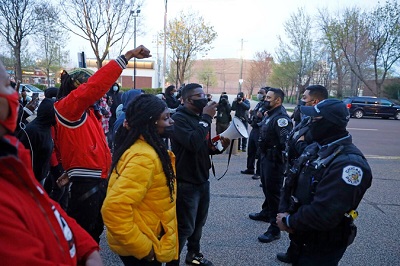
A protest began Friday evening in Little Village, a predominantly Mexican American community on the West Side of the city where Toledo grew up, posing an earlier-than-expected challenge for a police department and a city gearing up for a potential violent reaction to the conclusion of the Minneapolis trial of Derek Chauvin, whose killing of George Floyd last year ignited nationwide protests.
On Thursday, Chicago authorities released police body camera and surveillance footage of Officer Eric Stillman chasing Toledo on March 29 then firing a bullet into his chest. Toledo died at the scene despite the efforts of Stillman and other responding officers to revive him.
The video shows Toledo, who is Latino, carrying an object police say was a firearm during the chase, but tossing it behind a fence and raising his hands in the split-second before he is fatally wounded. Police spokesman Tom Ahern described the shooting as an “armed confrontation” in a tweet on the day of the killing.
“At the time Adam was shot, he did not have a gun. OK?” said Toledo’s family’s attorney, Adeena Weiss-Ortiz, at a news conference Thursday. “If he had a gun, he tossed it.”
In early April, in the wake of Toledo’s killing but before release of the videos, Chicago Mayor Lori Lightfoot, a Democrat, had called for reform of the department’s foot chase policy.
Lightfoot said she found the video incredibly difficult to watch. “I say that not only as a mother of a 13-year-old myself but as a mother who is deeply passionate about protecting our young people,” she said Thursday. “We all must proceed with deep empathy and calm and importantly, peace.
“This is an important moment for us to take stock, to listen, and then to reinvest in strategic ways that will really improve the quality of young people’s lives,” she said.
Illinois state Rep. La Shawn Ford, a Democrat whose district includes the far West Side of Chicago, said Lightfoot must embrace radical police reform now.
“This was bound to happen,” said Ford, “because we have not been strong enough in fighting for and implementing reforms in the city of Chicago. And it will happen again.
“We’re going to need a mayor to understand that we need radical changes in . . . policing in Chicago. She has to make sure she puts policies in place that control behaviors . . . or people will lose their children. This is like a war on the family and the community.”
Ford has been calling for critical race theory education for law enforcement officers, many of whom have “never ever lived around Black people or Brown people, yet they spend most of their day overseeing them in their eyes.” Critical race theory, in part, says that institutions such police departments are inherently racist.
Ford along with Illinois’ House Black Caucus of 30 legislators have pushed for an end to qualified immunity for police with a bill that opens up individual officers to civil litigation if they violate individual rights. The measure also would require local municipalities to disclose information about settlements resulting from law enforcement violations. The bill passed the House Restorative Justice Committee in late March.
Others are skeptical of what they see as incremental efforts to change the police.
“We are in a position where we’re trying to move the discussion toward real systemic change, not more reform,” said Chicago activist Ja’Mal Green, who participated in a protest outside the Chicago police headquarters on the South Side on Friday. “Policing in America doesn’t work. The system of policing must be taken down and we must start over.”
The Invisible Institute, a journalism nonprofit which tracks officer complaints and other police data in Chicago, said Stillman, who is White, has had three complaints filed against him since 2017 and four use-of-force reports in that span.
Stillman, who joined the department in 2015, is assigned to the 10th district on the city’s predominantly Black and Latino West Side. The complaints against him were for search-related conduct, according to the records. One complaint was determined “unfounded,” one was closed with no finding and a third is pending investigation. In the use-of-force reports, all four subjects were Black men in their late 20s or older.
Several hundred protesters who rallied in Little Village Friday evening carried signs and banners calling for ‘Justice for Adam,’ Lightfoot’s resignation and the abolition of the police department. Families of people who were killed by the department shared their stories and rallied support for continued pressure on police and city officials.
Sandra Nevarez, whose son of Marc Nevarez was fatally shot by police in October, pleaded for officials to let young people suspected of wrongdoing have their day in court. “Illinois doesn’t have the death penalty. Is [the Chicago Police Department] now the death penalty?” Nevarez asked the crowd. “Let these kids go to court. Let them defend themselves. Let them bury their parents, not the parents bury their kids.”
According to a public opinion survey by the Chicago Index taken in March before Toledo’s shooting, 73% of respondents indicated they thought the city is on the “wrong track” while just 16% of respondents rated Lightfoot’s performance as “excellent or good.”
The Chicago Police Department fared slightly better in the survey, with 37% of respondents saying they were “satisfied or very satisfied” with the police force.
India Jackson, 20, said people in the Chicago’s youth activist community are struggling ahead of Friday night’s protests.
“Everyone is drained that this keeps happening,” said Jackson, who leads communications for GoodKids MadCity, a youth-organized group on the city’s South and West Sides that is among the organizers of Friday evening’s protest. “But this is a different type of heartbreak because Adam Toledo was a child.”
Groups like GoodKids MadCity are pushing for the defunding and eventual disbandment of the Chicago Police Department.
Jackson said she was “floored” when news emerged in February that Lightfoot had spent $281.5 million in federal covid-19 relief money on personnel costs for CPD, a move that angered not only activists but progressive members of the Chicago City Council. The city’s budget department said money went to officers who staffed airport coronavirus screenings, a virus field hospital at McCormick Place, virus testing sites across the city and resident wellness checks.
“Criticism comes with the job of mayor but this one’s just dumb,” Lightfoot told reporters at the time.
Jackson said, “We want [city leaders] to invest those funds into our community: schools, housing, food banks, medical centers. People are suffering from poverty and the CPD is sitting on a billion dollars.”
There has not been a critical mass of calls for Lightfoot to resign in the same way former mayor Rahm Emanuel faced widespread condemnation over his handling of the video release in the 2014 police shooting of Laquan McDonald, a landmark shooting in the rise of the Black Lives Matter movement.
WASHINGTON – American and Georgetown universities joined a growing list of universities this week in requiring students who return in the fall to get a coronavirus vaccine.
As vaccine eligibility expands and schools come closer to reopening for the fall, at least a dozen campuses have shared plans to mandate vaccines. Some, including Georgetown and AU, are also considering requirements for faculty and staff.
But the announcements have raised questions over the validity of such requirements, as well as access. International students, particularly in countries where coronavirus vaccines are not widely available, could run into challenges securing inoculations, college leaders acknowledge.
Despite the potential obstacles, the announcement at American was met with excitement, said Eric Brock, a junior and student body president. He said students have encouraged the university to enact a mandate.
“Personally, I feel safe coming back to campus knowing that those vaccines are going to be required,” said Brock, who has been taking classes remotely from his home in Phoenix. “I couldn’t be happier.”
AU president Sylvia Burwell, who served as health and human services secretary under President Barack Obama, said Wednesday that vaccines will be an important piece of the school’s plan to reopen campus in the fall.
“While public health measures like face coverings and physical distancing will likely be part of our fall operations, robust vaccination in our community will enable us to expand activities and interactions that enrich the educational, research, and social experiences that are fundamental to AU,” Matthews wrote in a statement.
Like other schools that have unveiled vaccine requirements, AU will make exceptions for students with medical or religious reasons, Burwell said.
While schools are expecting students to be inoculated for the fall, many students in other countries do not have access to vaccines that have been authorized in the U.S., Burwell said. Officials are determining how to handle those cases, she said.
International students who have not yet received vaccines will be directed toward clinics in the U.S. when they arrive in the fall, according to Burwell.
Georgetown shared similar guidance with international students, according to a message sent to the community this week.
Vaccine requirements have gained popularity in recent weeks as access in the United States has widened. Every adult is expected to be eligible for a shot by Monday.
Universities are hopeful that students will secure their doses by the time school starts in late summer.
Eric Feldman, a law professor at the University of Pennsylvania’s Carey Law School, said he believes schools have legal standing should their mandates be challenged.
“It may not be unambiguous in the legal text that universities can require the vaccination of students, but I think we have many, many years of precedent,” Feldman said.
A student sued the University of California in 1925, claiming he met all the school’s attendance requirements, except for the smallpox vaccination mandate. A judge sided with the university. A 2015 California law that required vaccines for schoolchildren withstood legal challenges as well.
Feldman called the pushback about the coronavirus vaccines’ emergency authorization “overblown.”
“The FDA didn’t provide emergency-use authorization at the last minute without having a very robust set of data that demonstrates the safety and efficacy of the vaccine,” Feldman said. “In terms of emergency-use authorization, the universities are on pretty safe ground.”
More schools are expected to join AU and Georgetown. Maryland’s attorney general recently advised that the state’s university system can legally mandate vaccinations, according to a letter sent to state Sen. James Rosapepe, D-Prince George’s, whose district includes the University of Maryland at College Park.
A decision has yet to be announced but Jay Perman, the system’s chancellor, told the Board of Regentson Fridaythat he supports the notion of requiring returning students to have vaccines.
He cited difficulties enforcing social distancing in residence halls, and said students risk spreading the virus through their interactions in classes, during extracurricular activities and at gatherings.
“I’ve already said that widespread vaccination is the way to resume some semblance of normal operations this fall,” Perman said.
WASHINGTON – The National Institutes of Health on Friday removed restrictions that the Trump administration imposed on research using fetal tissue, allowing university researchers and government scientists freer rein to use material from elective abortions when studying diseases and possible treatments.
A brief update for outside scientists from the NIH director’s office said the Department of Health and Human Services was reversing a 2019 decision that had required applicants for federal grants and contracts involving fetal tissue to undergo an extra layer of review by an ethics advisory board.
In a separate notice emailed Friday, NIH told its internal scientific and clinical directors that it was lifting a Trump-era ban on using federal money to buy human fetal tissue for biomedical studies by government employees.
The announcement, foreshadowed the day before by HHS Secretary Xavier Becerra, marks a profound shift in science policy and social values from former president Donald Trump to the three-month-old Biden administration.
The White House remained silent Friday about NIH’s move. Yet rescinding the restrictions on federal support for fetal tissue research conforms to the oft-stated pledge by President Joe Biden and his top health advisers – largely in the context of trying to defeat the coronavirus pandemic – that they will place primacy on science.
Two years ago, the question of whether government money should continue to be invested in studies relying on cells from aborted fetuses became a major collision point between social conservatives and the nation’s scientific community.
In 2019, Trump overrode the advice of his HHS secretary, Alex Azar, by blocking the use of NIH funds to purchase fetal tissue for use in government research labs. For outside researchers, the ban was less explicit, saying any application for a NIH grant or contract involving fetal tissue would need to be screened by a new ethics advisory board, if the application was deemed worthy on its scientific merits.
The Trump administration did not form the panel for about a year. When it did, most of its members strongly identified with opposition to abortion. The board convened once last summer before disbanding. It reviewed 14 proposals and recommended rejecting all but one.
Behind the scenes, senior figures at NIH were known to disagree with the two-part restrictions, though they did not speak against them publicly.
NIH’s actions Friday rescind the central parts of the Trump-era policy but do not entirely restore rules to the way they had been. The 2019 rules compelled academic and other outside scientists applying for grants or contracts to start including extensive justification of why human fetal tissue was needed for the work and why other research methods were inadequate. Scientists complained the justification took up too much space in grant proposals and contract applications with a length limit.
Friday’s changes leave in place the requirement for that extensive justification, according to proponents and opponents of the rewritten rules.
The policy change immediately flipped the politics surrounding federal fetal tissue policy. Scientists and their representatives who decried the Trump administration rules are celebrating their demise. Meanwhile, abortion opponents who advocated the last administration’s policy Friday are bemoaning that it is now abandoned.
“The scientific community appreciates that the Biden administration is lifting the arbitrary restrictions on promising biomedical research using human fetal tissue,” Christine Mummery, president of the International Society for Stem Cell Research, said in a statement. Saying that NIH should be “insulated from political interference,” Mummery said Friday’s actions were a “return to evidence-based policymaking.”
Lawrence S.B. Goldstein, a senior researcher at the University of California at San Diego and the only member of the Trump administration’s ethics advisory board who has used fetal tissue in his work, said, “It’s an unqualified win. . . . Hopefully, all those great research projects will come back that were killed by the ethics advisory board.”
Goldstein said, “I hope we are not going to enter an era of policy yo-yo as we change administrations,” but he added, “For the moment, I am happy.”
On the other hand, Tom McClusky, president of March for Life Action, an antiabortion advocacy group, said the research that the new rules will help permit “is a gross violation of human dignity. . . . The government has no business creating a marketplace for aborted baby body parts.”
Tony Perkins, president of the like-mindedFamily Research Council, condemned Becerra as “a fanatical advocate for abortion.”
David Prentice, another member of the ethics advisory board and research director of the antiabortion Charlotte Lozier Institute, said, “It’s a sad turn of events. . . . Now, taxpayer funds will be used for research that is poor ethics and poor science. We’ve just backed away from any sort of ethical consideration around this issue.”
Prentice said that under Friday’s turnabout, “We’re trafficking in aborted fetal tissue for antiquated experiments.” He contended that fetal tissue is less effective in research than adult stem cells, artificially grown groups of cells known as organoids and other material not derived from aborted fetuses.
Asked whether Lozier or other organizations opposed to fetal tissue research might legally challenge the Biden rules, Prentice said, “At this point, we are reviewing all possible avenues.”
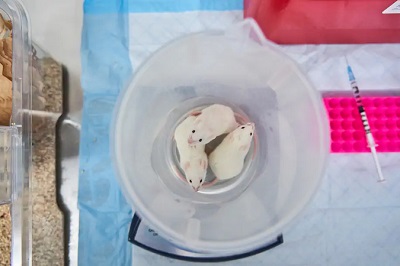
The role of fetal tissue in biomedical research extends to the 1950s, when Swedish researchers developed a polio vaccine by using fetal cells. In the late 1980s, scientists developed the technique of breeding mice with deficient immune systems and transplanting into them small amounts of immune system tissue from aborted fetuses.
These “humanized” mice grow the equivalent of a human immune system. They have become crucial lab animals in studying several major diseases, including therapies for HIV, cancers, neurological problems, sickle cell disease and eye disorders. NIH, by far the largest funding source for biomedical research in the United States, has paid for most of this work. Last year, a federal researcher was blocked from using fetal tissue to try to develop treatment for covid-19, the disease caused by the coronavirus.
Friday’s updated NIH guidance for outside researchers said HHS and NIH “will not convene another NIH Human Fetal Tissue Research Ethics Advisory Board.” It said researchers applying for federal grants or contracts involving work with fetal tissue still must obtain consent from the tissue’s donor, may not pay for such tissue and must follow all other federal, state or university requirements.
For scientific studies undertaken by government employees, a one-paragraph email from Michael M. Gottesman, NIH’s deputy director for “intramural” – or internal – research said guidelines “will return to their previous state.” Human fetal tissue, the email said, “may again be used” in NIH’s laboratories.
Work that requires new purchase of fetal tissue “from all previously-approved sources may be conducted,” the notice said. Projects approved for use of fetal tissue before June 2019, when Trump changed the rules “will be reinstated without further review.”
The Biden administration has been making piecemeal changes to conservative health-related policies of its predecessors.
In February, federal health officials rescinded a Trump administration policy allowing states to ask for permission to require some low-income residents to work or prepare for jobs to qualify for Medicaid. Instead of cutting back on efforts to urge Americans to enroll in Affordable Care Act health plans, the current administration created an unprecedented extended sign-up period, then lengthened it from three months to six months.
Biden officials had not publicly discussed a pending change in the rules for fetal tissue research until Thursday. Testifying at a budget hearing on Capitol Hill, Becerra said an announcement from NIH was imminent, and he made clear the direction it would take, thought not the details.
“We believe that we have to do the research it takes to make sure that we are incorporating innovation and getting all of those types of treatments and therapies out there to the American people,” Becerra said.
ถั่น มยิ้นต์ อู (Thant Myint-U) ผู้เขียนหนังสือ “The Hidden History of Burma” กล่าวกับ AFP ว่าสถานการณ์ปัจจุบันจะเปิดโอกาสให้กลุ่มติดอาวุธชนกลุ่มน้อยต่างๆ กดดันรัฐบาลกลางให้มุ่งสู่การปกครองระบอบสหพันธรัฐได้

 Johnson & Johnson ขอให้ผู้ผลิตวัคซีน COVID-19 ของคู่แข่งตรวจสอบความเสี่ยงในการแข็งตัวของเลือด จากการรายงานของ WSJ
 สหรัฐไม่เอาเรื่องเวียดนามกับไต้หวันตามคาด ชี้เกณฑ์ถึงแต่หลักฐานจับผิดไม่เพียงพอ

 รองเท้ารักษ์โลกสัญชาติฝรั่งเศสที่เคารพทั้งมนุษย์และสิ่งแวดล้อม
 ขณะที่ชนกลุ่มน้อยเห็นโอกาสมากขึ้นจากการวมพลังกันเพื่อต่อต้านศัตรูเดียวกันนั่นคือกองทัพ
 ประเทศไทยและไต้หวันกำลังจะเป็นคู่ค้าของสหรัฐรายล่าสุดที่จะเจอข้อหานี้ในรายงานที่จะออกมาในอีกไม่นาน

