1. เกือบหนึ่งสัปดาห์แล้วที่เรือ Ever Given ยังติดและขวางคลองสุเอซ ความพยายามที่จะปล่อยเรือจากการเกยตื้นยังไม่เป็นดอกเป็นผลชัดเจน นักวิเคราะห์ด้านการขนส่งคาดการณ์ว่าการจราจรติดขัดขนาดมหึมาทำให้การค้าโลกต้องพบกับความสูญเสียไปเกือบ 10,000 ล้านดอลลาร์ทุกวัน และคาดการณ์กันวามันอาจจะลากยาวนานหลายสัปดาห์
2. การแก้ปัญหาเรือติดเป็นคอขวดขวางคลองขึ้นอยู่กับความสามารถของทีมกู้ภัยในการดูด/ตักทราย โคลน และหินที่ Ever Given ติดอยู่และเพื่อแบ่งเบาภาระของเรือให้เพียงพอที่จะช่วยให้ลอยได้อีกครั้ง ในขณะที่เรือลากจูงพยายามผลักและดึงเรือให้เป็นอิสระ เบื้องต้นโมฮัมเหม็ด มอสเซลฮี เจ้าของบริษัท First Suez International ซึ่งเป็นบริษัทโลจิสติกส์ทางทะเลที่คลองกล่าวว่าทีมนักดำน้ำได้ตรวจสอบตัวเรือแล้วและยังไม่พบความเสียหาย
5. อย่างไรก็ตาม ร.อ. นิค สโลน (Nick Sloane) ปรมาจารย์ด้านการกอบกู้ชาวแอฟริกาใต้และเป็นผู้นำปฏิบัติการเพื่อกู้เรือสำราญ Costa Concordia ที่ล่มในปี 2555 นอกชายฝั่งอิตาลีกล่าวกับ The New York Times ว่างานกู้เรือส่วนใหญ่มองไม่เห็นบนบก ทีมผู้เชี่ยวชาญด้านการกู้เรือชาวดัตช์ 8 คนและสถาปนิกทหารเรือที่ดูแลปฏิบัติการจะต้องสำรวจเรือและก้นทะเลและสร้างแบบจำลองคอมพิวเตอร์ที่จะช่วยให้สามารถทำงานรอบเรือได้โดยไม่ทำให้เกิดความเสียหาย
9. นอกจากจะต้องกู้เรือให้ลอยลำอีกครั้งแล้ว กัปตัน พอล ฟอรัน (Capt. Paul Foran) ที่ปรึกษาทางทะเลที่เคยทำงานเกี่ยวกับปฏิบัติการกู้เรืออื่นๆ กล่าวกับ The New York Times ว่าพวกเขาจะต้องเคลียร์เรือลำอื่นๆ ออกจากพื้นที่ด้วยซึ่งถือเป็นความพยายามในการประสานงานครั้งใหญ่ และพวกเขาจะต้องตระหนักถึงความเป็นไปได้ที่การเกยตื้นของ Ever Given ทำให้ก้นทะเลเปลี่ยนรูปแบบไป และทำให้เรือลำอื่นผ่านพื้นที่ได้ยากขึ้นแม้Ever Given จะถูกเคลื่อนย้ายไปแล้วก็ตาม
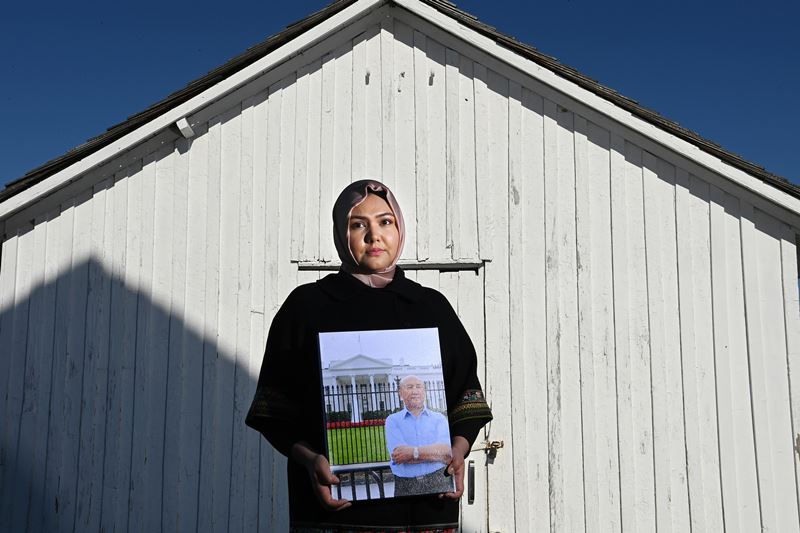
InternationalMar 28. 2021Kalbinur Gheni, 35, is pictured near her home in Northern Virginia. She says her sister, Renagul Gheni, is detained in a forced-labor camp in China. MUST CREDIT: Washington Post photo by Sarah L. Voisin.
By The Washington Post · Meagan Flynn
WASHINGTON – Weeks before then-Secretary of State Mike Pompeo accused China of committing genocide against Uyghur Muslims, Kalbinur Gheni met him in his office in Foggy Bottom.
She had three minutes to tell him about her sister, Renagul, and how she was sentenced to a Chinese internment camp for 17 years for praying and reading the Koran.
“I could hear my heart beat,” Kalbinur said, describing the Dec. 3 session. “I told him, ‘This is only one example happening to millions of families back home.’ “
The encounter encapsulated the reason Kalbinur moved last year from Boston to Northern Virginia: to be as close as possible to the people in power, believing they could help free her sister.
Renagul, 39, is one of more than a million Uyghurs who have been detained in internment camps in China, where they have been subject to abuse, forced labor and indoctrination, according to the U.S. State Department.
Family members in Northern Virginia – one of the largest diasporas of Uyghurs in the United States – are largely powerless to help them. Speaking out, even from here, can carry grave risks of reprisal by China, which is why many choose to stay silent. But some, like Kalbinur, have taken the risk, bringing their stories to the highest echelons of government.
“Nobody wants to cry for anyone, but if it happens to you, what can you do?” Kalbinur said. “We can let people hear us, because back home nobody can.”
In recent weeks, their advocacy has seen several significant victories.
Some diplomats and lawmakers are pushing the Biden administration to boycott the 2022 Winter Olympics in Beijing. Members of Congress from both parties have brought bills to ensure that U.S. companies don’t profit from Uyghur forced labor, and to fast-track protections for Uyghur asylum seekers in the United States.
Rep. Jennifer Wexton, D-Va., who introduced one of those bills in the House, said hearing directly from Uyghurs in her Northern Virginia district is what has compelled her to prioritize the legislation.
“I was just so horrified that I wanted to do something about it,” she said in an interview. “They didn’t know if their family members were alive or dead. They weren’t even able to reach out to them to see if they were safe.”
The Biden administration has not yet unveiled specific actions it plans to take to hold China accountable. But both Secretary of State Antony Blinken and the White House have echoed Pompeo’s determination that China is committing genocide – statements that make Kalbinur believe she and other Uyghur advocates are finally being heard.
“We were saying – we were screaming – for the last four years that this is genocide,” she said.
Still, as Kalbinur learned soon after meeting with Pompeo, the louder she yelled, the more China paid attention to her.
And the more Kalbinur had to ask herself: Was it really worth it?
Kalbinur Gheni holds a photo of her sister, Renagul Gheni, and her nephew, Radiljan Abla. MUST CREDIT: Washington Post photo by Sarah L. Voisin.
The last time Kalbinur spoke to her sister – an art teacher and married mother of two – was four years ago. Kalbinur was in Malaysia, studying for her PhD in business management, when her mother and Renagul appeared on a frantic WeChat video call. Their eyes were puffy and red.
“They just kept telling me, just take care of yourself,” Kalbinur said, and that they would not be able to call for a while.
For the next two years, calls and texts to her family went unanswered.
Finally, a college friend in Beijing learned that Renagul had been detained in what the Chinese government then called a “reeducation center.” It was located just a short walk from their home in the Xinjiang Uyghur Autonomous Region, Kalbinur said.
China denies mistreating Uyghurs or committing genocide, and the Chinese Embassy in Washington did not answer questions from The Washington Post about specific cases. Xinjiang officials said at a Feb. 1 news conference that the camps are intended as an “active exploration of preventive anti-terrorism and deradicalization.”
Sean R. Roberts, a foreign affairs professor at George Washington University and author of “The War on the Uyghurs: China’s Campaign Against Xinjiang’s Muslims,” said local officials seeking to forcibly assimilate Uyghur Muslims with Han Chinese can define virtually any practice of Islam as extremism.
“It’s a frightening prospect that has framed all of the policies towards this region in the last four years,” Roberts said. “There is this recurring theme about ‘preventive’ counterterrorism, which is obviously very problematic. . . . It becomes thought police very quickly.”
In the spring of 2019, Kalbinur fled Malaysia for Boston. At night, she used sleeping pills to stifle fears about Renagul. “I imagine every day, my sister, how she’s coping. Every day, what she’s eating,” Kalbinur said. “Are they going to torture her today? Are they giving her food?”
She shared her situation with only a few close Uyghur friends she met on Facebook – until October 2019, when she was invited to an event at the University of Rochester focused on China’s treatment of the Uyghurs.
Did she want to speak out?
Kalbinur took a deep breath. She decided it was time.
– – –
For many Uyghurs, the decision to come forward can be years in the making.
Subi Mamat Yuksel tried to hide her anxieties from her family after her father went missing, detained on the day he and his wife were supposed to fly to the United States for a visit.
After her toddler noticed her distress, she put Post-it notes around the house reminding herself to smile. She grew more restless around dusk, knowing that it was dawn back home and that her WeChat messages could light up any minute with bad news.
“Every night I would start having panic attacks,” said Yuksel, who lives in Manassas. “What’s going to happen? What news am I going to hear?”
For two years, she stayed quiet. Until her father – a former Xinjiang forestry official – was sentenced to life in prison, accused of being a “two-faced separatist” disloyal to the Chinese Communist Party.
“Then I realized we waited way too long,” Yuksel said. She made the leap into the public eye in February 2020, at an event hosted by the Uyghur Human Rights Project.
She had come to Northern Virginia in 2007 while on a student visa, in search of the Uyghur community her brother had told her about, with its plethora of familiar restaurants and even a Uyghur school.
But this was her first time working with D.C.-based advocacy groups, and the first time she realized how many in her community shared her situation. “I felt so guilty, for two years that I passed without speaking out,” she said. “Finally when I was standing with other Uyghurs holding their family’s pictures, I felt like I was doing something right.”
By September, with her baby on her lap, Yuksel was telling her story to Wexton over Zoom.
The congresswoman keeps a Uyghur hat on prominent display in her Capitol Hill office – a gift from constituents, and a daily reminder of the people depending on her help.
She was recently named to the Congressional-Executive Commission on China, which monitors human rights abuses. Wexton has reintroduced her Uyghur Forced Labor Disclosure Act, which puts the onus on U.S. companies to audit supply chains to ensure they aren’t exploiting Uyghurs. And earlier this month, she joined Rep. Ted Deutch, D-Fla., in introducing a bill to expedite the asylum process for Uyghurs.
“These are people who are in legal limbo,” Wexton said. “They don’t have a voice, and so I was determined to be their voice.”
The desire to punish China over its treatment of the Uyghurs has become a rare bipartisan force in Congress. In January, the Trump administration blocked all cotton and tomato products from Xinjiang from entering the country. The Uyghur Forced Labor Prevention Act, sponsored by Sen. Marco Rubio, R-Fla., and Rep. Jim McGovern, D-Mass., would block the import of all goods from the Xinjiang region on the presumption that they are tainted by forced labor, unless a company can prove otherwise.
It passed the House last session, but did not get a vote in the Senate. That could change this year, as pressure builds for the Biden administration to address the genocide allegations – and curb China’s economic influence.
A White House spokeswoman said last month that the administration was evaluating what measures were needed to “ensure that products made with forced labor do not enter U.S. supply chains.”
“Uyghurs and other ethnic minorities have suffered unspeakable oppression at the hands of China’s authoritarian government,” said Emily Horne, a spokeswoman for Biden’s National Security Council. “China has engaged in gross human rights violations that shock the conscience and must be met with serious consequences.”
Subi Mamat Yuksel holds a photo of her father, Mamat Abdullah, who has been sentenced to life in prison in China. MUST CREDIT: Washington Post photo by Matt McClain.
After Kalbinur’s speech at the University of Rochester, young people lined up to talk to her – first a Jewish student whose grandmother survived a Nazi concentration camp, then a Chinese student who said he was sorry. Finally, Kalbinur said, “I felt like I wasn’t alone in this.”
Emboldened, she started a Twitter account, peppering Chinese officials with questions: “Where is my sister? Where is our millions of Uyghurs?”
She traveled with other Uyghurs by bus from Boston to meet with lawmakers in Washington as they considered the Uyghur Human Rights Policy Act, which passed in June and requires the federal government to track China’s abuses against the Uyghurs.
Soon she decided to move to Northern Virginia, to live in Congress’s backyard.
But as she continued to speak out online, police in her family’s town contacted her through her brother’s WeChat account multiple times, imploring her, “You need to think about your family.”
Her brother reached out himself – probably under duress, Kalbinur said – pleading with her to stop her activism. It was her first contact with any family member since 2017.
Eventually, Kalbinur said, she told the officials she would stop – if they released her sister.
After she met with Pompeo, the intimidation escalated, Kalbinur said.
A Chinese official who went by the name “Ali” contacted her through a family member’s WeChat account in January.
At first he didn’t say what he wanted, according to copies of the messages provided to The Post.
“Then help me find my sister,” Kalbinur wrote to him in Mandarin. “You guys are supposed to know everything. She’s not supposed to just disappear like that.”
She said that she had been reading about the wrongful imprisonment of Uyghurs in headlines every day, and that she knew her sister was among them.
“Lies, definitely don’t believe,” Ali wrote back.
“I don’t want to believe it, but my sister has been missing for almost three years,” Kalbinur responded. “How can you ask me to believe?”
He called Kalbinur on the phone and stayed on the line for 92 minutes. Why did she go to Pompeo? he asked. Because China wouldn’t help me, Kalbinur said. He tried to convince her it was safe to come home. Kalbinur told him she knew it wasn’t.
Then he had a proposition, Kalbinur said: He would prove her sister was okay, if she behaved. If she would be quiet.
She hung up, and didn’t need to think any further.
On March 2, she told Renagul’s story to a United Nations human rights panel.
“When you lose the most valuable things in your life, what’s left?” she said. “Nothing left. I don’t have any fear anymore.”
ISMAILIA, Egypt – The global economic troubles triggered by a giant container ship stuck in the Suez Canal worsened Saturday with the blockage of more ships carrying billions of dollars of goods. But hopes also grew that favorable tidal conditions could help free the Ever Given as a U.S. Navy team was expected to arrive this weekend to assist in the operation.
Meanwhile, Egyptian authorities publicly acknowledged for the first time that an initial investigation that found that the ship beached because of strong winds in a dust storm might not have been entirely accurate.
At a news conference Saturday, Lt. Gen. Osama Rabie, head of Egypt’s Suez Canal Authority, said that such “a significant incident” typically has many causes.
“The weather was one reason, but maybe there was a technical error, or a human error,” he said, adding that the probe into the grounding was continuing.
By Saturday, the potential for a full-blown economic calamity was palpable – the canal is a vital global portal, carrying 13 percent of all global trade via ships ferrying $9.5 billion in goods each day.
A total of 321 vessels – carrying crude oil, cars, livestock and other commodities – were stuck in a massive maritime traffic jam at both ends of the 120-mile waterway, as well as in the middle, according to Leth Agencies, the canal’s service provider.
Two days ago, the number was 156.
A drive along the canal Saturday, between the cities of Ismailia and Suez, found scores of massive ships carrying containers and other cargo, some seemingly the size of the Ever Given, stalled in the waterway.
More than 100 additional ships in the Red and Mediterranean seas were en route to the canal, said analysts, though a growing number of vessels were being diverted around the southern tip of Africa as concerns grew that getting the Ever Given afloat again could take weeks.
The ship is wedged sideways in a single-lane stretch of the canal, stuck in sand and mud roughly four miles north of the waterway’s southern entrance.
On Friday night, the ship’s Japanese owner, Shoei Kisen, offered a bit of hope by suggesting that tidal movements over the next few days looked favorable enough for another attempt to dislodge the Ever Given. Yukito Higaki, the company’s president, told reporters in western Japan that the ongoing dredging of the banks and sea floor to refloat the ship could be assisted by a high tide, which would raise the water in the canal and potentially help float the ship off the mud it’s mired in.
On Saturday, 14 tugs were still trying to free the vessel, said Leth Agencies, noting unconfirmed reports by Egyptian media outlets that the ship’s propeller and rudder had been freed by the salvage equipment, which includes a specialized suction dredger capable of shifting 70,600 cubic feet of sand an hour.
If the rising tide doesn’t help free the vessel, Shoei Kisen said in a statement Saturday that it would consider removing its containers to reduce the vessel’s weight and thereby help it float again.
Later Saturday, Hend Fathy Hussein, spokeswoman for the Suez Canal Economic Zone, wrote in a Facebook post that the ship’s rudder had begun moving again.
“The locomotives are now full force and the ship is starting to operate its machines, but it hasn’t been floating yet,” she said.
Rabei, of the Suez Canal Authority, said in a statement late Friday night that the “complex technical process” could require “multiple attempts” to free the Ever Given, which was heading to the Netherlands when it grounded.
The statement came hours after the authority welcomed assistance from the United States to reopen the canal.
“We have equipment and capacity that most countries don’t have and we’re seeing what we can do and what help we can be,” President Biden told reporters. The U.S. Navy plans to send a team of dredging experts to the canal to assess the problem as early as this weekend, CNN reported, citing Pentagon sources.
Bernhard Schulte Shipmanagement, which is responsible for managing the ship’s crew and maintenance, said in a statement that there have been no reports of “pollution or cargo damage and initial investigations rule out any mechanical or engine failure as a cause of the grounding.” Two more large tugboats were scheduled to arrive Sunday to assist in dislodging the ship, the company said.
The focus of the operations, it said, was to remove sand and mud from around the port side of the vessel’s bow, which is stuck in the canal’s eastern bank. High-capacity pumps, the company added, would be used to reduce water levels in the ship’s forward void space and bow thruster room, making the vessel lighter and more maneuverable.
There are two canal pilots aboard to guide the ship through the canal. The 25-member crew – all Indian nationals – were safe and accounted for and remained onboard, “working closely with all parties involved to refloat the vessel,” the company said.
On Saturday, more shipping companies appeared to be losing confidence that the canal would be unblocked soon.
“Vessel-tracking data shows evidence that container lines are starting to take the long routes around southern Africa on the backhaul to Asia, rather than wait for the Suez Canal to reopen,” Lloyd’s List Intelligence, a maritime analysis firm, said in a tweet.
The list included the Ever Given’s sister ship, the Ever Greet, which was traveling from Malaysia to Europe and was diverted by either its Japanese owner or its Taiwan-based operating firm toward the Cape of Good Hope, according to satellite data.
The unprecedented bottleneck at or near the canal could strain global supply chains that are already stressed by the coronavirus pandemic.
On top of the need to shuttle raw materials to industrial manufacturers and pharmaceutical companies, shipping firms are grappling with extraordinary demand for consumer products, which has created a scarcity of empty containers.
The containers aboard many of the ships, with goods mostly from China, are destined for consumers in the United States and northern Europe.
Goldman fraud-claim case will test Supreme Court shaped by Trump
InternationalMar 28. 2021The statue “Contemplation of Justice” by sculptor James Earle Fraser behind temporary security fencing outside the U.S. Supreme Court in Washington, D.C., on March 12, 2021. MUST CREDIT: Bloomberg photo by Al Drago.
By Syndication Washington Post, Bloomberg · Greg Stohr, Robert Schmidt
The U.S. Securities and Exchange Commission sent Goldman Sachs shares tumbling by 13% in a single day in 2010, when it accused the firm of defrauding customers by selling them a mortgage-backed investment that was secretly designed to fail.
Eleven years later, shareholders who lost money that April day are before the U.S. Supreme Court in a case that could deal an even more sweeping blow to investors. In an argument set for Monday, Goldman Sachs will urge the court to put new limits on class action shareholder suits, and toss out a case that seeks to recoup potentially billions of dollars.
Investor advocates say they’re nervous ahead of the first Supreme Court clash over shareholder lawsuits since former president Donald Trump appointed three justices and created a 6-3 conservative majority. The court is scheduled to rule by late June.
“I am very concerned, and very concerned where this particular court might come out,” said Lynn Turner, a former SEC chief accountant.
The investors, led by the Arkansas Teacher Retirement System, say they were deceived by Goldman Sachs’ repeated public assurances that it was being vigilant about avoiding conflicts of interests. They say the assurances proved to be false, as details emerged about a group of so-called collateralized debt obligations, known as CDOs, including the Abacus portfolio that was at the center of the SEC suit.
The SEC said in its lawsuit that Goldman Sachs created and sold Abacus without disclosing that the hedge fund Paulson & Co. helped pick the underlying securities and bet against the vehicle.
Later that year, Goldman paid $550 million to settle with the SEC, a record amount for a Wall Street firm. Though Goldman didn’t admit wrongdoing, the firm said it made a “mistake” in not disclosing the Paulson & Co. role, an unusual acknowledgment in an SEC case.
Wall Street’s peddling of CDOs remains a touchstone of the global financial crisis, evidence to many that clients’ interests came second to the massive profits bankers were making for themselves. Much of the 2008 economic collapse was fueled by losses suffered by banks and hedge funds that owned the complex securities. Ultimately, the U.S. government was forced to provide a $700 billion taxpayer-financed bailout for the financial industry.
Investigations by the SEC, Congress and the Department of Justice quickly followed, causing a drop in the share prices of Goldman Sachs and other banks at the time.
Goldman was featured in a scathing report on CDOs by a Senate panel, and former Chief Executive Officer Lloyd Blankfein was among several employees hauled up to Capitol Hill to testify. At a 2010 hearing, the panel’s now-retired chairman, Michigan Democrat Carl Levin, blasted the executives over an internal email that labeled one of the securities Goldman was selling as “one sh**ty deal.”
“Your people think it’s a piece of crap and go out and sell it,” Levin said at the hearing. “We’re talking about betting against the very thing that you’re selling, without disclosing that to your client.”
The Supreme Court case centers on the rules the court has crafted to determine whether shareholders have enough in common with one another to press a securities-fraud suit as a class action.
In 1988, the top court said judges can presume that investors all relied on any public misrepresentations when they bought shares. But that ruling also said defendants can rebut that presumption — and block certification of the class action — by showing that the statements had no impact on the share prices.
Goldman Sachs says its assurances about conflicts were so “generic” they couldn’t possibly have been responsible for propping up the stock price. The statements included promises in regulatory filings that the firm had “extensive procedures and controls that are designed to identify and address conflicts of interest” and that “our clients’ interests always come first.”
The “extreme generality of the alleged misstatements makes it exceedingly unlikely that the statements had any impact on the stock price,” Goldman told the Supreme Court in court papers.
But a divided federal appeals court said the bank had to wait to make that argument and couldn’t use it as a reason to block class action status. A two-judge majority said Goldman was improperly “smuggling” an argument about the materiality of its statements into the class-action analysis.
The suing investors have partial support from the Biden administration and the SEC. The government says the appeals court should have considered Goldman’s contention that its assurances were too generic to prop up the share price. But the U.S. also says Goldman and its allies are going too far in seeking a categorical rule that some types of statements are legally incapable of affecting stocks.
“Courts considering particular facts may appropriately credit evidence that seemingly generic statements would have been significant to the trading decisions of reasonable investors,” acting U.S. Solicitor General Elizabeth Prelogar said in court papers.
Investor advocates say a ruling in Goldman Sachs’ favor could leave companies free to mislead investors with impunity.
“It runs to whether or not when you’re investing your money into the markets, you can trust them, you can have confidence that they’re giving you accurate, complete information, and they’re not omitting any facts,” said Turner, the former SEC accountant. “All too often, we’ve seen where management has put out false facts to hype their stock.”
University of Michigan law professor Adam Pritchard, a former SEC official who joined a brief supporting Goldman, called the shareholder activists’ concerns “nonsense,” and said the court is likely at most to take a middle ground in its decision. Part of the problem, he said, is that the case focuses on “trivial, procedural questions” that the justices, with little expertise in securities law, won’t fully comprehend.
“They will not do anything useful,” said Pritchard, who’s recently written a book on the Supreme Court and securities law. “They are in over their heads.”
The case is Goldman Sachs v. Arkansas Teacher Retirement System, 20-222.
The pandemic is creating a ‘postwar boom’ for luxury carmakers
InternationalMar 28. 2021The $3.6 million Bugatti Chiron Pur Sport. MUST CREDIT: Bloomberg photo by Hannah Elliott.
By Syndication Washington Post, Bloomberg · Hannah Elliott
Famously reticent to disclose how many cars they sell or at what amount of profit, luxury automakers are finding it difficult lately to avoid crowing-just a little bit-about how well they did in 2020.
“Let’s just say we began 2020 with the strongest order bank since 2003-and we started this January with 50% more orders than last January,” Bentley’s Adrian Hallmark said on a videoconference call with journalists on March 23. The British company delivered 11,206 vehicles in 2020, up 1.8% year-over-year-and the highest output in its 101-year history.
“Our sales right now are some 30% above last year, even bearing in mind last year was a record,” Hallmark continued. “It would take an even bigger asteroid than the Covid one to knock us off track again.”
Indeed, any 2020 sales divots have hardly seemed to register to the highly optimistic chief executive officers of the world’s most prestigious automotive brands. They are already looking to capitalize in the next decade on the “lost year” that gave them their strongest positioning ever.
On a videoconference call on March 15, Bugatti’s Stephen Winkelmann was downright upbeat as admitted he was “surprised” at how well the 112-year-old French brand had weathered the pandemic. “Bugatti did incredibly well,” he said. The brand traditionally does not disclose specific sales results, but Winkelmann characterized 2020 as the company’s “third record-breaking year in a row.”
Even the normally taciturn Germans couldn’t resist a little glow, with Porsche boss Oliver Blume calling Porsche’s results a “fantastic accomplishment” at the end of “an exceptional year” during a March 18 reporter roundtable. Revenue at the 90-year-old brand reached an all-time high of 28.7 billion euros ($34 billion) in 2020, surpassing 2019 by more than 100 million euros.
Meanwhile, annual global profits at Lamborghini, over which Winkelmann also presides, were higher in 2020 than in any previous year. And while sales at most luxury brands dipped from 2019-down 11% at Lamborghini; down 3% at Porsche; down 10% at Ferrari-the drops came from weeks-long forced production and showroom shutdowns during the coronavirus pandemic, factors well out of executive control. Bentley, an outlier, shut down for seven weeks at the cost of $10 million lost per week and still recovered to deliver more vehicles than ever before, Hallmark said.
“We are not seeing recessionary behavior. We are seeing postwar boom,” he said.
While millions of people are facing economic loss with the help of stimulus checks, the rich have been minting money as never before. It’s a post-covid, K-shaped recovery that favors luxury goods, including cars.
As far back as July 2020, analysts at Technavio predicted that the U.S. luxury car market would grow by 6.7 million units from 2020 to 2024. In its 2021 annual report, Statista projected U.S. revenue in the segment to reach $6.9 billion this year alone. It helps that the pandemic is making the overall car market healthier, thanks to streamlined buying processes, reduced redundancies, and executives forced to get flexible (and more practical) about future strategies.
“History suggests demand for super-luxury sports cars will remain robust, despite a covid-19-related global recession,” said Michael Dean, head of automotive analysis for Bloomberg Intelligence in a March 16 analysis. Results such as Ferrari’s 27% share-price gain in 2020 and Lamborghini’s already full order book for the first nine months of 2021 testify to that strength.
Lamborghini performed so well last year, in fact, that close observers such as Dean and others have suggested that parent company Volkswagen may be positioning it for an initial public offering alongside favored-son Porsche, which Bloom recently called an “interesting” option. An emphasis on “limited special series” models, which with multimillion-dollar price tags are highly profitable, mimics the strategy set by Ferrari. The 81-year-old Italian brand went went public with great success in 2015.
Even Aston Martin, which suffered a disappointing IPO in 2018 followed by disruptive executive upheaval, seems to have set itself up for a brighter future. A 1.3 billion pound ($1.79 billion) refinancing in December and recent alliance with Mercedes, combined with the release of the DBX SUV, have set the company up to become free-cash flow positive by 2023, Dean said. “Aston Martin is no longer on the critical list,” he wrote in March.
A positive pipeline of limited editions such as the Valkyrie and Valhalla will also be key in 2021 to improving Aston’s margin trajectory, he said: “Only a few brands are capable of selling high-margin, $1 million-plus-priced limited-edition supercars, and that club includes Aston Martin, Ferrari, Lamborghini and Porsche. The contribution from a single Valkyrie supercar, priced at 2.4 million pounds, is equivalent to selling 19 Vantage V8s, whose disappointing sales in 2019 were a key reason for volumes down.”
Rolls-Royce, meanwhile, may be an exception to the luxury car bonanza, delivering approximately 3,750 automobiles in 2020, down far more than its peers year-over-year at 26%. The decline came in part from unfortunate timing, said Martin Fritsches, Rolls-Royce Motor Cars Americas president and CEO, in an email, blaming the transition from the first-generation Ghost (discontinued in 2019) to the second-generation sedan for the bulk of the loss.
“We were gearing up for new Ghost in the midst of Covid shutdowns, however we continued to see strong demand for new Rolls-Royces and ended the year with the highest level of future orders ever for the brand,” said Fritsches. “Orders for commissions today extend well into the third quarter.”
One factor bolstering such success during what for many felt like a global meltdown has been wild growth in China. Bentley sales in China doubled in 2020, according to Hallmark; China will become Lamborghini’s second-biggest market by the end of 2021, Winkelmann said.
General market concentration (Aston Martin partnering with Mercedes, say, or Porsche and Rimac working together) can only help more.
Worldwide, “a significant growth of tangible luxury offerings in vehicles, shifting consumer preferences from sedans to SUVs, and increasing disposable incomes of consumers have been propelling the demand for luxury cars” since the Covid-19 pandemic, Mordor Intelligence wrote in its annual report.
Stock market volatility has also had investors running for hard assets-even the classic car market burgeoned during lockdowns, with auction houses and websites that specialize in collectable cars like the McLaren Senna and Bugatti Chiron Pur Sport seeing peak visitors and rare Italian mid-century exotics selling like gangbusters.
Purveyors of such elite engineering who were curious enough to ask their clients why they’re buying such expensive cars during a pandemic have received a relatively simple and unexpectedly identical explanation-down to the very wording. Call it the covid-19 carpe diem effect.
“I was asking my clients why,” Winkelmann said. “They told me: ‘We had more time to think about our future and what is happening next, we were deciding where to put our money, and-well, why not?’ “
Hallmark said each person who bought the $2 million Bentley Bacalar told him something similar: “After all of this, life is going to get back to some kind of normal, and I’d rather be in the car than not in that car,” Hallmark relayed.
Pandemic shopping habits are giving inflation experts a headache
InternationalMar 28. 2021A woman carries shopping baskets at a grocery store in the Brooklyn borough of New York on Oct. 5, 2020. MUST CREDIT: Bloomberg photo by Mark Kauzlarich.
By Syndication Washington Post, Bloomberg · Alex Tanzi
Financial markets are obsessed with where inflation is headed. Statisticians are struggling to figure out where it’s at.
The pandemic has created major headaches for the people whose job it is to determine the rate of inflation right now, and set the benchmarks that will be used to measure it in the future. They face two fundamental problems.
First, gauges like the Consumer Price Index are based on a “basket” of stuff that Americans typically spent their money on in the past — which looks quite different from what people have been buying in the pandemic year.
Second, the standard way of compiling inflation numbers is to visit stores and check their asking prices. Researchers haven’t been able to do that during lockdown, leaving holes in the data. And a lot of shopping has in any case shifted online, where prices can be tailored to individual shoppers and subject to rapid change — making them harder to measure.
These are more than just technical issues. The incomes of almost 80 million Americans, from recipients of social security and food stamps to workers in collective wage agreements, are tied in some way to the CPI. When it fails to capture changes in the cost of living, their budgets can get squeezed. (The Federal Reserve uses a different measure of inflation, based on more up-to-date spending patterns, so its interest-rate decisions are less affected by the measurement problem.)
The economy’s rapid rebound from the pandemic slump has triggered concern about an accompanying rise in inflation. Data published Wednesday showed measures of prices paid and charged by U.S. business rose to records in March.
For the technicians of inflation, the immediate challenge is the basket problem.
“In effect, CPI weights suffered sudden obsolescence when the pandemic arrived,” Marshall Reinsdorf, an economist in the International Monetary Fund’s statistics department, said in a November presentation.
For example, dining out accounts for 6.3% of the U.S. CPI basket — but Reinsdorf estimates that a measure of spending habits during the pandemic would have lowered that weighting by almost half. Meanwhile, Americans have been spending more on food at grocery stores, where prices accelerated last year.
Economist Alberto Cavallo, who teaches at Harvard Business School, has created a U.S. inflation gauge for the covid-19 era, using a basket based on credit-card transactions that reflect what Americans have been buying. It has consistently delivered a higher reading than the official CPI, and topped 2% last month for the first time since the pandemic began.
In the normal run of things, the Bureau of Labor Statistics — which compiles the headline inflation numbers in the U.S. — would update its CPI basket at the start of next year to reflect 2020 consumption patterns. But that could create new problems — by enshrining untypical spending habits as a benchmark for future inflation.
The bureau is considering adjusting its usual procedures, BLS economist Jonathan Church said by e-mail. Alternatives include pretending 2020 never happened and sticking with data from prior years, or adjusting the Covid-era numbers based on secondary sources, says Randal Verbrugge, a senior economist at the Federal Reserve Bank of Cleveland. Either way, there’s a risk of introducing further mismeasurements.
Global peers face similar problems. The Organization for Economic Cooperation and Development is due to publish some advice for member states.The second issue revolves around data collection. The BLS employs about 400 researchers who collect information about prices via two main surveys: one is focused on businesses that sell goods and services, and the other asks landlords and tenants about rent payments.
Before the pandemic, more than 70% of data in the first survey — and some 40% of the second one — was compiled during in-person visits, a mix that had been fine-tuned over the years. But last month, 84% of the price data was collected online, with the rest coming from telephone surveys — while the rent survey was conducted entirely by phone.
“These factors resulted in an increase in the number of prices considered temporarily unavailable and imputed,” the bureau said in its latest CPI report. “Many indexes are based on smaller amounts of collected prices than usual.”
The prices of peanut butter, lemons and broccoli were left blank in the national numbers for February. The data on new-car prices in Detroit, known as Motor City, was deemed “inadequate for publication.”
While the price inspectors should soon be able to go back to the stores, consumers may choose not to. The shift to e-commerce accelerated during the pandemic: it accounted for 19% of core U.S. retail sales in the fourth quarter of 2020, up almost 4 percentage points from a year earlier.
Competition between online and traditional retailers is reckoned to put downward pressure on inflation. But Harvard’s Cavallo says his index of online prices has been rising rapidly since November, a shift that hasn’t been reflected in the CPI.
And broader problems with measurement may emerge, because online sellers can easily customize prices for individual buyers and adjust them thousands of times a day via algorithms.”It does pose a challenge for a statistical agency,” says Verbrugge at the Cleveland Fed. “How do they get their hands on the actual prices that consumers are being charged?”

 เมื่อหลายสัปดาห์ก่อนราคาของ Bitcoin เคยพุ่งขึ้นมาถึง 60,000 ดอลลาร์ก่อนจะถอยลงมาเรื่อยๆ การถอยครั้งนั้นทำเอานักลงทุนบ้านแตกไปเลยก็มี
 ศิลปวัตถุที่หาชมได้ยากจากยุคราชวงศ์จีน บางชิ้นเป็นตราประทับของบุคคลสำคัญในประวัติศาสตร์


 ในเวลาที่รายงานชิ้นนี้ถูกเขียนขึ้น เป็นเวลาเกือบหนึ่งสัปดาห์แล้วหลังจากเรือ Ever Given เกยตื้นชนเข้ากับตลิ่งคลองสุเอซจนทำให้การขนส่งสินค้าทางเรือต้องหยุดชะงัก


 ผู้บัญชาการทหารพันธมิตรสหรัฐประณามการสังหารประชาชนของกองทัพเมียนมา
 นักการเมืองจากการเลือกตั้งและทูตต่างประเทศชี้ “วันแห่งความหวาดกลัวและความอัปยศ”
 Kalbinur Gheni, 35, is pictured near her home in Northern Virginia. She says her sister, Renagul Gheni, is detained in a forced-labor camp in China. MUST CREDIT: Washington Post photo by Sarah L. Voisin.


 The statue “Contemplation of Justice” by sculptor James Earle Fraser behind temporary security fencing outside the U.S. Supreme Court in Washington, D.C., on March 12, 2021. MUST CREDIT: Bloomberg photo by Al Drago.
 The $3.6 million Bugatti Chiron Pur Sport. MUST CREDIT: Bloomberg photo by Hannah Elliott.
 A woman carries shopping baskets at a grocery store in the Brooklyn borough of New York on Oct. 5, 2020. MUST CREDIT: Bloomberg photo by Mark Kauzlarich.

