อย่างไรก็ตามการแถลงครั้งนี้ส่งผลให้ชาวเอเชียหลายคนไม่พอใจโดยเฟซบุ๊กแฟนเพจ Asians Never Die ได้แชร์คำแถลงการณ์ของเจ้าหน้าที่ตำรวจท่ามกลางผู้เแสดงความคิดเห็นจำนวนมากมองว่าเป็นเหตุผลที่ฟังไม่ขึ้น
They’re trying to blame his “sexual addiction?” Here’s the thing, if you bust in multiple Asian spas firing your weapon, you KNOW the victims are gonna be Asian women. FOH! This is a hate crime. https://t.co/ysW54CymLc— Tim Chantarangsu (@TimothyDeLaG) March 17, 2021
โดยในการประกาศระดมทุน Series A เมื่อเดือนมกราคมที่ผ่านมาบริษัทสามารถระดมทุนได้ถึง 24.5 ล้านเหรียญสหรัฐหรือกว่า 700 ล้านบาทจากนักลงทุน 3 รายนำโดย ARCHina Capital
ด้วยสโลแกนที่ว่า “Sleep smarter. Wake up healthier.” (นอนหลับอย่างชาญฉลาด ตื่นขึ้นมาอย่างมีสุขภาพดี) กับเตียงที่จะทำให้ทุกคนหลับลึก หลับยาว ตื่นอย่างสดชื่น ด้วยเครื่องมือที่ใช้งานง่ายและสามารถปรับให้เข้ากับสไตล์การนอนของแต่ละคน
REM Sleep หรือช่วงหลับฝันเป็นช่วงเวลาที่สำคัญมากที่สุดในการนอนไม่ว่าจะเป็นการพัฒนาระบบประสาท การเรียนรู้และความจำ การฟื้นฟูและซ่อมแซมร่างกาย แต่หลายครั้งที่เราสูญเสียช่วง REM Sleep ไปเพราะการสะดุ้งตื่นจากการไม่สบายตัวแต่เตียงตัวนี้จะช่วยขจัดปัญหานั้นไปได้
ฟูกนอนที่มาพร้อมกับเทคโนโลยี AI ขั้นสูงที่สามารถทำความเข้าใจการนอนที่แตกต่างเฉพาะแต่ละบุคคลเพื่อช่วยในการนอนหลับมีประสิทธิภาพมากยิ่งขึ้น ไม่ว่าจะเป็นการตรวจจับอัตราการเต้นของหัวใจและรูปแบบการหายใจเพื่อประเมินช่วงเวลาในการนอนของเรา จากนั้นคุณสมบัติการระบายความร้อนจะค่อยๆ ลดอุณหภูมิลงเพื่อนำเราไปสู่ขั้นหลับสนิท
ท่าทีของสีจิ้นผิงถือเป็นการส่งคำเตือนอย่างตรงไปตรงมาว่ารัฐบาลกำลังเตรียมลงมือเพิ่มเติมเพื่อควบคุมอิทธิพลของบริษัทเอกชนที่ใหญ่ที่สุดและมีอำนาจมากที่สุด ซึ่งคำว่าเศรษฐกิจแพลตฟอร์มหมายถึงยักษ์ใหญ่บนมือถือและอินเทอร์เน็ตที่ให้บริการแก่ผู้คนนับร้อยนับล้าน ซึ่งรายแรกที่โดนลงดาบไปคือ Alibaba Group Holding Ltd. และ Ant Group Co. ของแจ็ค หม่า
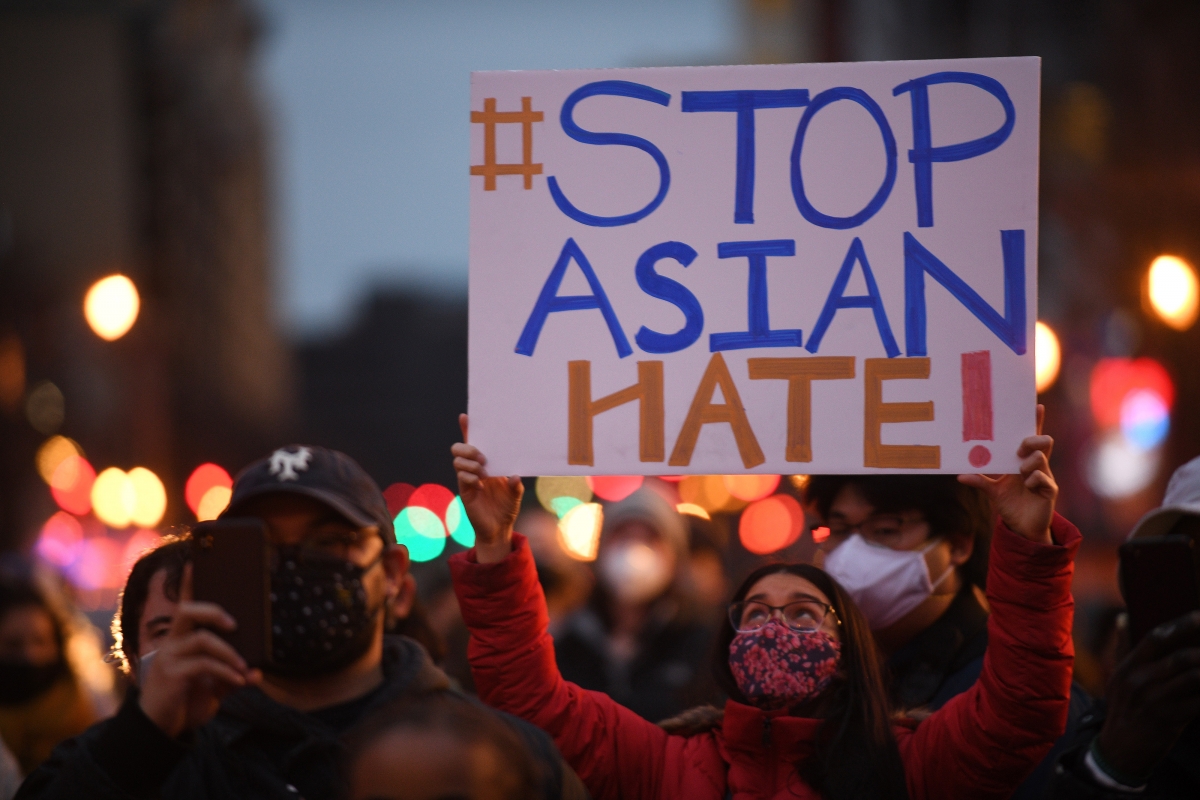
WASHINGTON – President Joe Biden has sought to blunt a reported surge in anti-Asian bias incidents by ordering the federal government not to use xenophobic language to describe the coronavirus and calling accounts of “vicious hate crimes” during the pandemic “un-American.”
But Asian American leaders are warning that a deepening geopolitical confrontation between the United States and China is contributing to the heightened suspicion, prejudice and violence against their communities in ways that could continue to intensify even after the pandemic begins to subside.
Advocates called Biden’s rhetorical efforts a welcome corrective to former president Donald Trump, who railed against the “China virus” and “kung flu.” Yet the broadening conflict among the world’s two largest economies – on trade, defense, 5G networks, cybersecurity, the environment, health security and human rights – has contributed to a growing number of Americans calling China the “greatest enemy” of the United States, according to a Gallup poll this week.
The survey found that 45% of respondents named China as the top threat, more than twice as many as a year earlier, when the country was ranked on par with Russia. Democrats and Republicans have voiced bipartisan support for a tougher U.S. policy, including economic sanctions on Beijing over cyber intrusions, human rights violations and crackdowns on democracy in Hong Kong.
“When America China-bashes, then Chinese get bashed, and so do those who look Chinese. American foreign policy in Asia is American domestic policy for Asians,” said Russell Jeung, a history professor at San Francisco State University who last year helped found Stop AAPI Hate, short for Asian American and Pacific Islanders, an advocacy group that has tallied more than 3,000 incidents of bias and hate during the pandemic.
“The U.S.-China cold war – and especially the Republican strategy of scapegoating and attacking China for the virus – incited racism and hatred toward Asian Americans,” Jeung said.
A number of violent assaults on Asian Americans over the past two months, including some that went viral after being caught on video, have drawn political and media attention to escalating fears over public safety. The slaying of eight people, including six women of Asian descent, at three Georgia spas on Tuesday sparked demands for an urgent response from authorities. Police arrested Robert Aaron Long, a White man, in connection with the killings and cited as a potential motive Long’s interest in eliminating “sexual temptation.”
Not all of the cases appear to have a link to anger over the pandemic or were necessarily motivated by racial resentment. But advocates said they have collected enough anecdotal evidence through self-reporting portals set up last year by community groups to illustrate that attacks are spiking.
And they are fearful that the intensifying competition between Washington and Beijing is contributing to scapegoating of Asian Americans in echoes of earlier periods of widespread hostility during geopolitical tumult and heightened nationalism in the United States.
They pointed to the Chinese Exclusion Act in 1882 that banned the immigration of Chinese laborers amid national economic anxiety, the internment of more than 120,000 Japanese Americans during World War II, and attacks on mosques and Muslim Americans in the wake of 9/11.
“For as long as Asians have been in America, we’ve been scapegoated, treated as outsiders and seen as untrustworthy. Too often, these prejudices are exploited for political gain,” said Christopher Lu, who served as White House Cabinet secretary and deputy labor secretary in the Obama administration. “As troubling as our current situation is, I am concerned that things are going to get much worse as U.S.-China tensions grow.”
Asian American leaders acknowledged the need for the United States to develop a tougher strategy to counter the Chinese Communist Party’s influence campaign across the globe. The question, advocates said, is how the federal government and elected officials speak publicly about the challenge and how far they go to counter it.
Trump sought to blame Beijing for the outbreak of the pandemic, employing xenophobic language that was echoed by his supporters and other Republican officials and condemned by Democrats.
But in April, weeks after the onset of the pandemic, Biden also drew heat from Democratic Congress members and community groups for a campaign advertisement that accused the 45th president of having “rolled over for the Chinese” in managing the coronavirus and cast China as a looming threat.
Biden’s campaign apologized for the language and aired a revised version of the ad. But the episode illustrated the intensifying effort of both parties to appear tougher on Beijing.
“It is clearly a difficult line to walk, however I do believe there is a way of disagreeing with China’s policies without denigrating the Chinese people themselves,” said Rep. Judy Chu, D-Calif., chair of the House Congressional Asian Pacific American Caucus.
Chu praised Biden for issuing an executive action in January aimed at barring federal agencies from blaming China for the pandemic and instructing the Justice Department to improve data collection on hate crimes. In a prime-time address to the nation last week about his administration’s coronavirus response, Biden decried attacks and harassment against Asian Americans who have been “forced to live in fear for their lives just walking down streets.”
“It must stop,” Biden said.
White House aides, including domestic policy adviser Susan Rice and senior adviser Cedric Richmond, met virtually with Asian American advocacy groups two weeks ago to hear their concerns. They pledged to use the power of the administration to combat violence but offered few specifics, according to activists who participated who, like others, spoke on the condition of anonymity to discuss a private conversation.
Chu and others have pushed Biden to elevate more Asian Americans to high-level jobs in his administration, noting there is only one Cabinet-level official of East Asian descent, Katherine Tai, who was confirmed Wednesday as U.S. trade representative.
Attorney General Merrick Garland met with advocates on a video call Wednesday that lasted about 45 minutes, telling them he recognized that regardless of whether the Georgia killings were racially motivated, he understood the larger context in which the crime took place and the sense of alarm within the community, according to a person who participated.
Asian American leaders have raised questions about the Justice Department’s “China Initiative,” launched by the Trump administration in 2018, to amplify ongoing U.S. government efforts to counter the Chinese government’s attempts to steal billions of dollars a year in U.S. intellectual property.
Advocates have said the program has led to unfair racial profiling of scientists and academics of Chinese descent. They pointed to the case of University of Kansas researcher Franklin Tao, a permanent U.S. resident who was indicted in 2019 and accused of failing to disclose an alleged teaching contract with a Chinese university while conducting federally funded research. His lawyers have denied the charges.
“Publicly available information suggests at least 60 cases that have been filed had a reference to the China Initiative. Only a quarter of them have actually involved charges of espionage,” said John Yang, executive director of Asian Americans Advancing Justice, which has advocated on behalf of Tao, whose case is pending. Yang’s organization has asked the Biden administration to put a moratorium on the program and conduct a review of it.
“This goes to the perpetual foreigner stereotype we always talk about,” Yang said, “where in various points in history, we are targeted unfairly.”
Justice Department officials met with Asian American advocates two weeks ago, but they declined to comment on the future of that program. They have pledged to develop new grant programs for local police agencies to report on hate crime data and efforts to translate federal hate crime reporting portals into Chinese and other Asian languages.
At her confirmation hearing last week, Lisa Monaco, Biden’s nominee for deputy attorney general, offered credit to the Trump administration for focusing on cyberthreats from China and said she expects to “double down” on the strategy. “This is an area I think we have a great deal more to do,” she told senators.
On Wednesday, the Biden administration announced economic sanctions against two dozen Chinese and Hong Kong officials. The move came in advance of Secretary of State Antony Blinken’s first meeting with Chinese counterparts in Alaska later this week.
Last week, during a House Foreign Affairs Committee hearing, Rep. Ted Lieu, D-Calif., asked Blinken about concerns among some advocacy groups that restrictions on assignments for U.S. diplomats has disproportionately blocked Asian American Foreign Service officers from work in Asian countries.
“It sends a false message that people who look like me would be more disloyal,” Lieu told Blinken, who said he shared the concerns about inequities in the system. “As you manage the relationship with China, I want to remain vigilant that fear of a foreign country does not negatively impact the Asian American community.”
Asian Americans see shooting as a culmination of a year of racism
InternationalMar 18. 2021A pedestrian walks in the neighborhood of Chinatown in Manhattan, N.Y., on Wednesday, March 17, 2021. Police said the Atlanta, Ga.-area suspect told them the shooting was not racially motivated, but to many Asian Americans, the intent seemed clear: Six of the eight victimes were Asian women, and the shooter targeted spas known for employing Asians. Photo by Jeenah Moon for The Washington Post
By Silvia Foster-Frau, Marian Liu, Hannah Knowles, Meryl Kornfield The Washington Post
As Helen Kim Ho learned that a White man with a self-described sex addiction was charged with killing eight people – including six Asian women – at spas in the Atlanta area on Tuesday, she imagined the stereotypes of Asian women that must have run through his head.
“We’re not really Americans, we’re perpetually foreigners, and that idea plays out with women as being oversexualized,” said Ho, a Korean American and a founder of the advocacy group Asian Americans Advancing Justice in Atlanta. “All of that had to have played out in this man’s own mind. In addition to the unspoken notion that Asian people are easy targets.”
Atlanta police said the suspect told them his actions were not racially motivated – even though the shooter targeted businesses known for employing Asians, and six victims were Asian women. The suspect claimed he had a “sex addiction,” according to police, and wanted to eliminate temptation, which sounded to many women as if their sexuality was somehow to blame.
The gunman’s intent seemed crystal clear to Asians living in Atlanta and across the nation who have long had to confront stereotyping, hateful harassment and even violence – and who say things have gotten even worse amid the coronavirus pandemic.
For Asian women, the moment felt particularly threatening.
A vigil and march to remember and honor the eight lives lost Tuesday in Atlanta, Ga., takes place in the Chinatown area of the District of Columbia on Wednesday, March 17, 2021. Photo by Astrid Riecken for The Washington Post
As soon as Crystal Jin Kim heard about the shooting, she reached out to her mother and father, who immigrated to the United States from Korea. In a text, she urged them “to be safe, to be careful, and to pray.”
She thought about rescheduling one of their upcoming doctor appointments, and she worried about her mother going to work at a small business in the Atlanta area – she asked that the type of business not be named for fear of her mother being targeted.
“Since I was a kid I’ve heard racial slurs yelled at me or my parents, or witnessed my parents being treated as if they were stupid because their English isn’t perfect, even though my mom’s English is really good,” said Kim, a second-generation Korean American. “Those small moments really add up. I don’t think we’ve ever spoken up against those small moments. . . . It’s easier to try not to think about it, or to try to let it go. To try to bury the hurt.”
People have leaned out of cars to scream “Asian!” at her, she said, and she has gotten comments about how she must like Jackie Chan, the Hong Kong martial artist and actor. As an Asian woman, she said men often ascribe characteristics to her that don’t reflect her personality – that’s she’s a pushover, or soft-spoken.
“Really, I’m not – I’m very talkative and extroverted,” Kim said. “It’s just people having these assumptions and treating me like a perfect Asian girl. Not even a woman, but a girl.”
David Palumbio-Liu, a Stanford professor and author of “Asian/American: Historical Crossings of a Racial Frontier,” said there is a long history, extending well before the Vietnam War, of the fetishization of and murderous intent toward Asian women. He cited the Broadway musical “Miss Saigon,” which critics have said romanticizes an imperialistic relationship and portrays Asian women as acquiescent and self-sacrificing.
The suspect “said it wasn’t racially motivated, but on the other hand, he’s going specifically to these spas where Asian women work precisely to serve the sexual fantasies of white males,” Palumbio-Liu said in an interview, “so to disentangle them is really to do a disservice to the fact that these things are so linked together.”
The shooting made visible the worst-case scenarios many Asians living in the United States had feared. Many sadly expressed a similar sentiment: We knew this was coming.
The coalition Stop AAPI Hate has been documenting anti-Asian attacks since the pandemic started last March and says there have been nearly 3,800 hate-fueled incidents against the Asian American and Pacific Islander community in the U.S. – a number the group says is likely a fraction of the true number. About 3 in 10 Asian adults said they’ve experienced jokes or slurs about their race or ethnicity during the pandemic, according to Pew Research – the highest percent among all races.
More than 68% of documented reports of anti-Asian harassment and violence since the beginning of the coronavirus pandemic have been from women.
“I’ve never been this afraid to be Asian in America,” said Dorothy Kuo, 38, who attempted to explain to her 6-year-old daughter what had happened in their community.
“I told her ‘Mommy is having a hard time focusing today because last night there were eight people killed.’ I just told her, honestly, what happened,” said Kuo, who is Korean American, like several of the victims.
Kuo said she felt it was important to tell her daughter so she understands the world she’s stepping into, one in which she might have to be more careful as an Asian woman.
“I’ve been refused seating at a restaurant,” Kuo said, “and even then I’ve never felt what I feel now.”
Jane Kim Coloseus, 32, grew angry Wednesday when Atlanta police declared it was too soon to say whether the slayings were racially motivated.
“As an Asian woman, it brings out a lot of the experiences or harassment we have received throughout our lives in general, and just have that completely invalidated because of what the suspect is saying,” said Coloseus, a Korean American who is executive director of the nonprofit Her Term, which recruits women to run for office in Georgia.
She has long felt like she had to be more guarded – whether it’s in the workplace or walking down the street – because of anti-Asian sentiments and the sexualization of Asian women’s bodies. Asians have long been part of the fabric of the United States, she said, yet have “been kept on the sidelines as the model minority,” their voices ignored or muted.
“To me the equation is pretty straightforward,” she said of the shooter’s intent. “It is racially motivated.”
WASHINGTON – The Biden administration said Wednesday that it has served subpoenas on Chinese companies to seek information on possible national-security risks, showing that at least some of the Trump administration’s tough policies on China are taking root in the new administration.
The announcement of the subpoenas came as Secretary of State Antony Blinken and national security adviser Jake Sullivan prepared to meet their Chinese counterparts in Anchorage, Alaska, on Thursday, the first administration meeting with Chinese officials.
In issuing the subpoenas, the Commerce Department is implementing an executive order signed by President Donald Trump in May 2019 that allowed the executive branch to prohibit the purchase of foreign-made communications equipment or services that could pose national-security risks.
The Commerce Department declined to list which companies it subpoenaed, saying only that they “provide information and communications technology and services (ICTS) in the United States.”
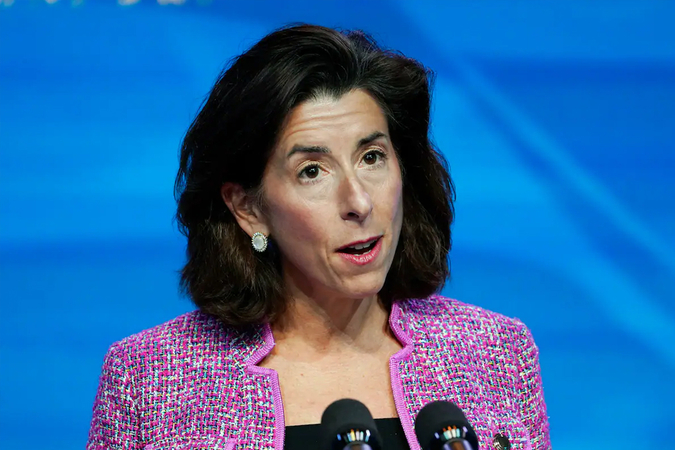
“The Biden-Harris Administration has been clear that the unrestricted use of untrusted ICTS poses a national security risk,” Commerce Secretary Gina Raimondo said in a statement.
“In issuing subpoenas today, we are taking an important step in collecting information that will allow us to make a determination for possible action that best protects the security of American companies, American workers, and U.S. national security,” she said. “The administration is firmly committed to taking a whole-of-government approach to ensure that untrusted companies cannot misappropriate and misuse data and ensuring that U.S. technology does not support China’s or other actors’ malign activities.”
One trade lawyer speculated that the list of subpoena recipients could potentially include the five companies the Federal Communications Commission last week deemed threats to national security – Huawei, ZTE, Hytera Communications., Hangzhou Hikvision Digital Technology, and Dahua Technology.
A Trump-era law requires the FCC to maintain a list of communications equipment that poses “an unacceptable risk to national security.”
Huawei, which has rejected accusations that it presents security risks, declined to comment on the subpoenas. The other companies could not immediately be reached for comment.
Rod Hunter, a lawyer with Baker McKenzie and a former national security official in the George W. Bush administration, said the timing of the announcement, a day before the Anchorage talks, appeared significant.
“It’s kind of interesting they are doing it on the eve of the meeting,” he said. “You have to think this is not by accident they are issuing it now.”
The Trump administration designed the executive order to close what it saw as a gap in U.S. regulation. Other laws allowed the government to stop the military or other federal agencies from purchasing certain technology, or to stop foreign companies from acquiring sensitive U.S. technology companies.
The May 2019 executive order, which comes into full force this month, after the publication of the implementing rules, adds a layer of regulation by allowing the government to stop U.S. companies from buying some equipment or services from entities deemed risky.
“The rule closes the circle at addressing threats to U.S. critical infrastructure by foreign telecom equipment that cannot be addressed by export controls, foreign direct investment controls, or procurement limitations,” said Kevin Wolf, a former senior Commerce official who is now a partner at the law firm Akin Gump Strauss Hauer & Feld.
SEOUL – The Biden administration made a pitch to South Korean officials on Wednesday for greater collaboration with the United States and Japan as they counter China, a course that could be challenging after years of disagreements between Seoul and Tokyo.
Secretary of State Antony Blinken and Defense Secretary Lloyd Austin visited Seoul as part of the administration’s first overseas trip and shortly before Thursday’s high-stakes meeting between a U.S. delegation led by Blinken and senior Chinese officials in Anchorage, Alaska. The United States is expected to confront Beijing on several issues, including its increasingly aggressive military posture, documented human rights abuses and economic pressure on other countries.
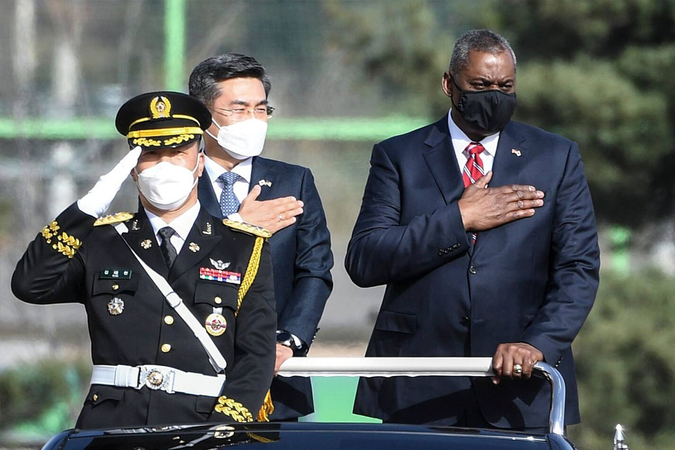
Austin, the retired Army general who Biden selected to be defense secretary, took in a South Korean military ceremony that saw him pass by troops in brightly colored uniforms in a convertible, then lauded South Korea as a “critical partner for our shared priorities in the region,” including upholding “the rules-based international order.”
U.S. officials have said repeatedly that China wants to upset that order, which includes a network of alliances and partnerships devoted to keeping peace that dates back to shortly after World War II.
“You have become a key provider of security and stability in the Indo-Pacific region, and for that we are grateful,” Austin said in opening remarks at a bilateral meeting with Suh Wook, the South Korean defense minister.
The defense secretary added that “given the unprecedented challenges” created by North Korea and China, the U.S.-South Korean alliance “has never been more important.”
Pentagon spokesman John Kirby said in a statement on Wednesday after the meeting that Austin and Suh discussed issues that included “how to rejuvenate trilateral security cooperation,” a reference to collective efforts with Japan.
Ned Price, a State Department spokesman, said in a separate statement that Blinken “affirmed the importance of trilateral cooperation among the United States, Japan and the Republic of Korea in ensuring a free and open Indo-Pacific.”
Similar themes came up in Tokyo, which Austin and Blinken also visited this week. At a news conference with Austin and senior Japanese officials, Blinken said “greater trilateral cooperation” with South Korea “will make us stronger.”
But there are still challenges in making that happen.
While the United States has close relationships with both countries that includes tens of thousands of U.S. troops based in each of them, Japan and South Korea’s history includes conflict on and off for centuries, and strains in recent years on several fronts. They include continued disagreements about how to address World War II-era abuses of Korean women by Japanese soldiers, maritime territorial disputes, and what to call the Sea of Japan, the body of water between the two nations.
Japan and South Korea have joined the United States at times to counter North Korea, including flying fighter jets over the Korean Peninsula in a combined show of force.
Victor Cha, an expert on the region who served in the administration of President George W. Bush, said in a call with reporters last week that Japan-Korea relations “are about at the worst they’ve ever been.” Among the issues Cha cited was a 2019 dispute in which South Korea threatened to stop sharing intelligence with Japan before agreeing to continue to shortly before a deal between the two countries was set to expire.
“This will certainly be, I think, maybe not as much a public part of the discussion, but I think it’ll certainly be something that the United States will impress upon both allies privately, that we need the relationship to improve,” said Cha, a senior vice president at the Center for Strategic and International Studies in Washington.
A senior defense official, asked in Seoul about the discussion, said that the trilateral relationship between the United States, South Korea and Japan is important. The official, speaking on the condition of anonymity because of the sensitivity of the issue, said it ideally includes not only information sharing, but looking for ways to increase the ability of the countries to operate together.
One option that has been floated in Washington is inviting South Korea to join the Quadrilateral Security Dialogue, known as the “Quad.” The coalition, which includes India, Australia, Japan and the United States, is focused on shared security concerns.
South Korea has not been asked to join it by the United States and was not again on Wednesday in the meeting between Austin and Suh, the senior defense official said.
Joining would come with challenges for South Korea, whose largest trade partner is China. In 2017, after the United States deployed a Terminal High Altitude Area Defense missile-defense system on South Korea, China responded by cutting into its tourism and sales in South Korea. They eventually mended ties, focusing instead on threats posed by North Korea.

 บริษัทญี่ปุ่นอนุญาตพนักงานลาพักใจเพราะอกหักจากศิลปินที่ตนชื่นชอบหรือแม้กระทั่งลาไปกรี๊ดไอดอลก็ได้
 ชาวเอเชียยังติดใจมือปืนกราดยิงสปาสหรัฐอ้างไม่ได้เหยียดเอเชียแต่มีพฤติกรรมเสพติดเซ็กซ์
 เมื่อสหรัฐเปลี่ยนนโยบายใหม่ การแทรกแซงเมียนมาจึงไม่เกิดขึ้น – การเยือนเอเชียครั้งแรกของ รมว.ต่างประเทศสหรัฐยังพุ่งประเด็นไปที่จีนซึ่งเป็นไม้เบื่อไม้เมากันมานาน แทบจะไม่แตะปัญหาการเมืองในเมียนมา
 การนอนหลับอาจเป็นส่วนเล็กๆ ในชีวิตประจำวันแต่ส่งผลกระทบต่อร่างกายมหาศาล นวัตกรรมชิ้นนี้จะช่วยให้การนอนของเรามีประสิทธิภาพมากยิ่งขึ้น


 สมาคมสงฆ์เมียนมาแตกหักกับรัฐบาล ขอกองทัพหยุดใช้ความรุนแรงกับประชาชน
 ทำเอาหนาวๆ ร้อนๆ ไปตามๆ กันเมื่อผู้นำของประเทศออกโรงเตือนเอง หลังรัฐบาลเริ่มการลดอำนาจบริษัทเทคโนโลยีในจีน
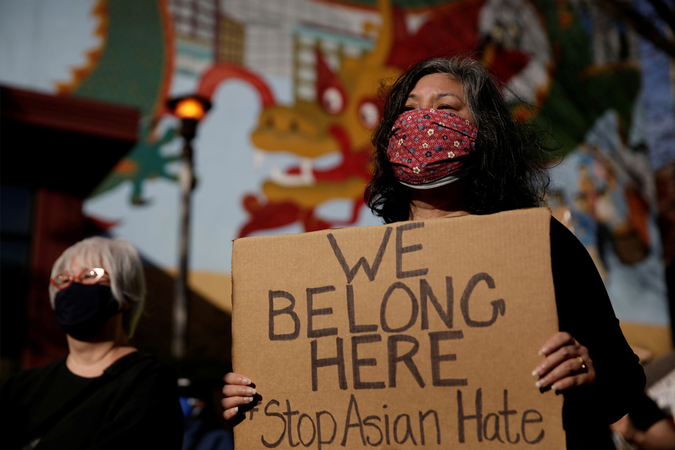
 A pedestrian walks in the neighborhood of Chinatown in Manhattan, N.Y., on Wednesday, March 17, 2021. Police said the Atlanta, Ga.-area suspect told them the shooting was not racially motivated, but to many Asian Americans, the intent seemed clear: Six of the eight victimes were Asian women, and the shooter targeted spas known for employing Asians. Photo by Jeenah Moon for The Washington Post