เดาลัตเดียจึงไม่ใช่แค่ซ่องและเพราะมันใหญ่พอๆ กับเมืองหนึ่งมันจึงเป็น Sin city ของบังกลาเทศ และเพราะเรื่องติดขัดทำให้ไม่สามารถจัดงานศพตามหลักศาสนาให้กับหญิงค้าบริการที่นี่ได้ เพราะผู้นำศาสนาไม่อนุญาติเนื่องจากเห็นว่าการค้าประเวณีเป็นเรื่องผิดศีลธรรม เมื่อพวกเธอตายจึงต้องฝังทั้งๆ ที่ไม่มีพิธีและยังเป็นหลุมศพที่ไร้ชื่อเสียงเรียงนาม
สำนักข่าว Bloomberg รายงานว่าบริษัท Meitu Inc. (เหม่ยถู) ของจีนเดินตามรอยบริษัท Tesla Inc. ด้วยการกลายเป็นบริษัทล่าสุดที่ลงทุนในสกุลเงินดิจิทัลเนื่องจากมูลค่าของเงินดิจิทัลกำลังพุ่งทะยานไม่หยุด
รายงานจาก South China Morning Post ระบุว่า JD Technology ซึ่งเป็นสาขาฟินเทคของบริษัทอีคอมเมิร์ซยักษ์ใหญ่ของจีน JD.com Inc. มีแนวโน้มที่จะถอนคำร้องสำหรับการเสนอขายหุ้นต่อสาธารณะครั้งแรก หรือ IPO ในตลาดหุ้นเซี่ยงไฮ้ เป็นสัญญาณล่าสุดที่แสดงให้เห็นถึงความกลัวการควบคุมอย่างเข้มงวดของรัฐบาลจีนต่ออุตสาหกรรมการเงินออนไลน์ที่กำลังเติบโต และความกลัวนี้ทำให้ตลาดหุ้นของจีนมีปฏิกริยาด้านลบไปเมื่อสัปดาห์ก่อน ก่อนที่สัญญาณจะเป็นรูปธรรมในสัปดาห์นี้
อุตสาหกรรมฟินเทคของจีนเผชิญกับการตรวจสอบข้อเท็จจริงที่เข้มงวดมากขึ้นจากรัฐบาลนับตั้งแต่มีการเปิดตัวกฎระเบียบใหม่เกี่ยวกับการปล่อยสินเชื่อของผู้บริโภคในเดือนพฤศจิกายนซึ่งนำไปสู่การระงับการเสนอขายหุ้นของบริษัท Ant Group Co.ของแจ็ค หม่า อย่างกะทันหันที่วางแผนไว้ว่าจะระดมทุน 35,000 ล้านเหรียญสหรัฐในตลาดหุ้นฮ่องกงและเซี่ยงไฮ้
Online funerals, Zen apps keep Japan’s Buddhist temples afloat
InternationalMar 09. 2021Tsukiji Hongwanji is a four-century-old temple near Tokyo’s old fish market. MUST CREDIT: Bloomberg photo by Noriko Hayashi
By Syndication Washington Post, Bloomberg · Ayai Tomisawa
Memorial services held online. Zen meditation apps. Buddhist temple-led matchmaking services.
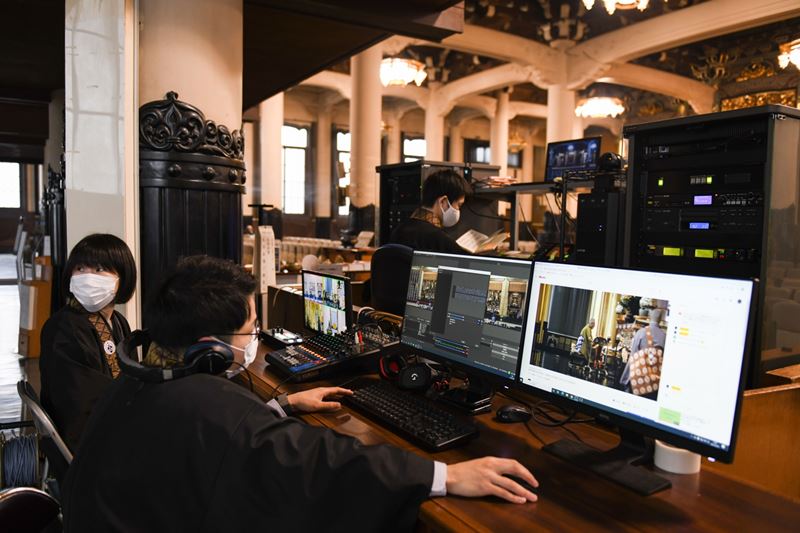
Staff operate computers during a live broadcast of an online memorial service at Tsukiji Hongwanji temple in Tokyo. MUST CREDIT: Bloomberg photo by Noriko Hayashi
As the coronavirus pandemic forces institutions around the world to change the way they do things, those new endeavors are some of the ways that Buddhist groups in Japan are trying to survive. Their temples are part of the landscape: there are about 77,000, more than the number of Japan’s ubiquitous convenience stores.
covid-19 has caused further pain for Buddhist organizations already struggling in recent years due to Japan’s shrinking population and sagging interest in religion among the young. One estimate is that temples’ total income has halved in the five years to 2020. And now the virus has kept believers at home, reducing donations they make for services such as memorials for the deceased.
Buddhist temples have thrived in Japan for more than a millennium. But they need money to operate, and the pandemic has prompted some priests and monks to think of new ways to generate income. It’s a reflection of the way that industries worldwide from travel to dining and retail are having to improvise as covid-19 restrictions batter their usual business.
Ryosokuin, a Zen temple with more than 660 years of history in Kyoto, is one such innovator. Faced with a drop-off in services such as memorials and a plunge in tourism, the organization boosted its online operations. It developed a meditation app that’s been downloaded more than 15,000 times that it expects to eventually monetize, and it’s organized an online Zen meditation community called UnXe, meaning “cloud-sitting.”
“When we lost visitors and donations fell, we realized that our conventional way of supporting our operations no longer works,” said Toryo Ito, deputy chief priest at the temple. “We need to adapt to a management style which meets with the times.”
Tsukiji Hongwanji in Tokyo is venturing into areas that staid temples aren’t traditionally known for, like a cafe, matchmaking services and yoga classes. MUST CREDIT: Bloomberg photo by Noriko Hayashi
Buddhism has a history stretching back to the sixth century in Japan, but few periods have brought such challenges. Over a third of temples may disappear by 2040 as the population ages, according to Kenji Ishii, a religious studies professor at Kokugakuin University in Tokyo.
Temple income is falling, too. The total figure likely dropped about 51% since 2015 to $2.4 billion (263 billion yen) in 2020, according to estimates by Hidenori Ukai, the chief priest at the Shokakuji temple in Kyoto and a freelance journalist.
The pandemic is adding to financial troubles across a broad swath of Japanese society. While the economy is recovering, a state of emergency in major cities has continued to weigh on consumer spending. And businesses that serve customers face-to-face such as retailers have been hit especially hard, resulting in a spate of bankruptcies for restaurants and hotels.
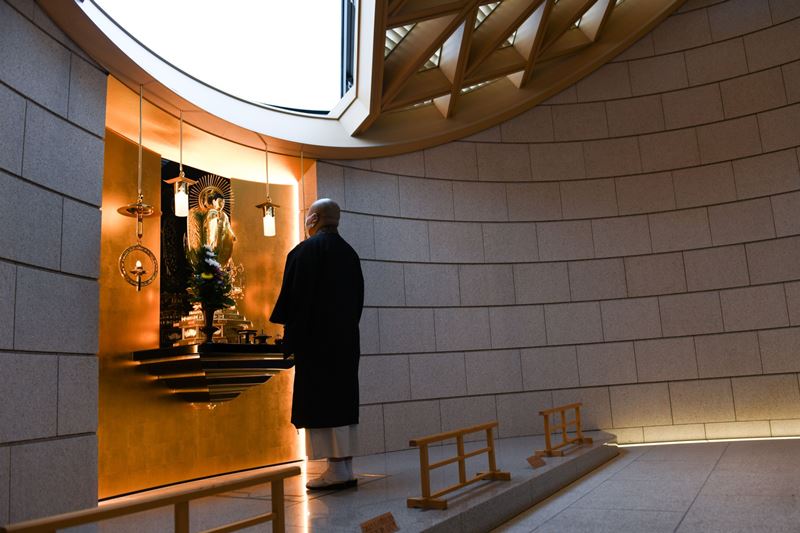
A priest offers a prayer at Tsukiji Hongwanji temple in Tokyo. MUST CREDIT: Bloomberg photo by Noriko Hayashi
Tsukiji Hongwanji, a four-century-old temple near Tokyo’s old fish market, is another organization trying to make the best of the virus period. It started online memorial services last May for families that don’t want gatherings for the deceased, and has done about 70 such events, according to Yugen Yasunaga, a representative director and priest at the temple.
The organization is also venturing into areas that staid temples aren’t traditionally known for, like matchmaking services, a cafe and yoga classes, said Yasunaga, who worked in a major Japanese bank for more than two decades before starting his career at Tsukiji Hongwanji.
“Just like Amazon.com responds to the various needs of customers online, a temple can do the same,” he said.
Another area that Japanese religious institutions are increasingly exploring is environmental, social and governance investing. Tokuunin, a Zen Buddhist temple in central Tokyo, bought 40-year social bonds sold by the University of Tokyo.
“At a time when we can barely get any returns from long-term savings, we’re happy that we can contribute to helping society while earning enough returns to cover inflation,” said Yuzan Yamamoto, its chief priest.
LONDON – Harry and Meghan, the Duke and Duchess of Sussex, described the British royal family in their sensational interview with Oprah Winfrey as frozen, distant, enfeebled and dysfunctional – in other words, everything the monarchy is portrayed to be on Netflix’s “The Crown.”
But perhaps what made the interview so surprising was the suggestion that the monarchy hasn’t learned from its mistakes, and that it remains especially out-of-touch on issues such as mental health and racism.
There had been hope in Britain that Meg and Haz would be change agents – that the addition of an American, biracial, self-proclaimed feminist to the royal family would shake things up in a good way. And when the couple announced last year that they were giving up their roles as “senior royals,” there was disappointment among fans of a more modern monarchy that they had given up on that mission.
Yet in the interview that aired Sunday night in the United States and Monday night in Britain, the couple suggested that the palace and the royal family just didn’t get it – the depth of the racism in the British press and on social media, or the potential for Meghan to connect with the multiracial British Commonwealth.
The televised conversation had echoes of the famous 1995 BBC interview with Harry’s mother, Princess Diana. In that exchange, Diana told journalist Martin Bashir about her bulimia and not getting support from the palace or her husband, Prince Charles, who was having an affair. Nearly two years later, Diana died in a car crash, chased by paparazzi.
Meghan suggested she had Harry’s full support. But she told Winfrey she felt abandoned by the palace while she was hounded by tabloids and death threats, to the point where life in the gilded bubble felt “unsurvivable” and she considered suicide as the best way out.
Meghan claimed she was rebuffed each time she begged for help – for the palace’s PR apparatus to come to her defense, for professional psychological support, for a continued security detail.
The runaway royals mostly blamed the press and the palace operators – a kind of royal “deep state” of flacks and spinners – for their decision to flee to America.
Though they also pointed fingers at family members. Meghan said a female royal relative advised she lay low because she was oversaturated in the media, though she’d only been out twice in four months. Harry revealed that his father, heir-to-the-throne Prince Charles, at one point stopped taking his calls and played a role in cutting off Harry’s financial support and security protection. There is “a lot of hurt that happened,” said the son.
And then there was the biggest headline grabber: Meghan’s account that, when she was pregnant with her first child, a family member prompted “concerns and conversations about how dark his skin might be when he’s born.”
That claim may be particularly difficult for the royal family’s reputation, both in America and in Britain, which has its own version of a Black Lives Matter movement.
Meghan declined to identify the family member, saying, “I think that would be very damaging to them.” Harry wouldn’t say, either.
On Monday, Oprah relayed that the prince would only tell her that it is not his grandmother, Queen Elizabeth II, or his grandfather, Prince Philip – which turned eyes toward Charles or Harry’s brother, William, as the culprit.
As of Monday night, the palace had not responded to the interview. Meghan’s estranged father, Thomas Markle, is scheduled to give an interview to ITV’s “Good Morning Britain” with Piers Morgan on Tuesday.
In shielding the popular queen and her husband, who is currently hospitalized, Harry and Meghan may have been shielding themselves from criticism, too.
“If they had dared attack the Queen, they would have forfeited an enormous amount of sympathy,” royal historian Robert Lacey told the Guardian newspaper.
Charles, however, is relatively unpopular, and Lacey said the interview could have implications for his eventual kingship.
The interview represented “an enormous clash of cultures and values, a clash of generations, a psychological clash between the stiff upper lip and the wobbly lower chin,” Lacey told the Guardian. “Will young Australians, or Canadians, for example, want a King Charles III who refused to take calls from his son when he was in emotional distress?”
Meghan said the reality of being a royal isn’t like the fairy tales she grew up with as an American. But later in the interview, she compared herself to a fairy-tale character, Ariel, the rebellious little mermaid who falls in love with a human prince but must give up her voice for a chance to be with him.
Meghan said she was not silent, but silenced by the crown.
“I just wish that we would all learn from the past,” Harry said, suggesting a parallel between his wife and his mother, in their ability to connect with people around the world – and the resentment that caused within the family.
Harry suggested that Meghan would have been an especially potent implement of soft power in British Commonwealth countries – some of which have majority-Black, Brown and Asian populations, from the centuries when England ruled the waves and was a dominant slave-trading empire.
“Here you have one the greatest assets to the Commonwealth the family could have ever wished for,” he said. But the palace never learned how to use her.
Among their fans and in some media accounts, Harry and Meghan had gotten credit for doing things their own way – for orchestrating a more private birth for their son, for declining titles for him, for staking out their own financial independence.
But in their Winfrey interview, the couple suggested that those and most other decisions were imposed on them. Archie wasn’t offered the title of prince, and the family cut them off financially.
The couple stressed they mostly just wanted to get along, to do their job, to be protected from negative press and to cut ribbons and endorse charities in peace. Perhaps it was us on the outside that saw them as crusaders and outliers, when the couple wanted more ordinary roles, as they said to Winfrey.
Meghan said when the couple smiled at events, they were just being “good at their jobs,” playing for the cameras, even as they were hurting inside.
Early reaction in Britain focused on Meghan’s confession that she felt suicidal – though the tabloids themselves were not accepting any blame.
Criticizing the press is usually a good play by politicians and celebrities, and the couple excoriated the tabloids. But there was a tricky bit here.
The British popular press give British readers what they want, which is saucy, catty, royal news – and a lot of it. Their readers are seen as patriotic, nationalist, flag-waving and pro-monarch. The very same people who lined up and wept at Princess Diana’s funeral procession were the very same people who bought the Daily Mail every day – and bathed in the salacious palace travails.
Harry tried to make a distinction. In an outtake that aired Monday morning, the prince told Winfrey, “The U.K. is not bigoted, the U.K. press is very bigoted.”
But it is hard to decouple the two: Could a racist tabloid press exist without a willing readership?
Harry said the royal family – even his father and brother – live in constant fear of the British tabloids and newspapers, some owned by powerful media moguls such as Rupert Murdoch.
And although he has been able to escape the confines of the monarchy, his father and brother don’t have that luxury.
“They are trapped, they don’t get to leave,” Harry said. “And I have huge compassion for that.”
Microsoft attack blamed on China morphs into global crisis
InternationalMar 09. 2021A Microsoft office in Mountain View, Calif., on Jan. 22, 2021. MUST CREDIT: Bloomberg photo by David Paul Morris.
By Syndication Washington Post, Bloomberg · William Turton, Jordan Robertson
A sophisticated attack on Microsoft’s widely used business email software is morphing into a global cybersecurity crisis, as hackers race to infect as many victims as possible before companies can secure their computer systems. The attack, which Microsoft has said started with a Chinese government-backed hacking group, has so far claimed at least 60,000 known victims globally, according to a former senior U.S. official with knowledge of the investigation. Many of them appear to be businesses caught in a wide net the attackers cast as Microsoft worked to shut down the hack.
The European Banking Authority became one of the latest victims as it said Sunday that access to personal data through emails held on the Microsoft server may have been compromised. Others identified so far include banks and electricity providers, as well as senior citizen homes and an ice cream company, according to Huntress, a Ellicott City, Maryland-based firm that monitors the security of customers, in a blog post Friday. One U.S. cybersecurity company which asked not to be named said its experts alone were working with at least 50 victims, trying to quickly determine what data the hackers may have taken while also trying to eject them. The rapidly escalating attack came months after the SolarWinds breaches by suspected Russian cyberattackers, and drew the concern of U.S. national security officials in part because the latest hackers were able to hit so many victims so quickly. Researchers say in the final phases of the attack, the perpetrators appeared to have automated the process, scooping up tens of thousands of new victims around the world in a matter of days.
Washington is preparing its first major moves in retaliation against foreign intrusions over the next three weeks, the New York Times reported, citing unidentified officials. It plans a series of clandestine actions across Russian networks — intended to send a message to Vladimir Putin and his intelligence services — combined with economic sanctions. President Joe Biden could issue an executive order to shore up federal agencies against Russian hacking, the newspaper reported. “We are undertaking a whole of government response to assess and address the impact,” a White House official wrote in an email on Saturday. “This is an active threat still developing and we urge network operators to take it very seriously.”
The Chinese hacking group, which Microsoft calls Hafnium, appears to have been breaking into private and government computer networks through the company’s popular Exchange email software for a number of months, initially targeting only a small number of victims, according to Steven Adair, head of the northern Virginia-based Volexity. The cybersecurity company helped Microsoft identify the flaws being used by the hackers for which the software giant issued a fix on Tuesday.
The result is a second cybersecurity crisis coming just months after suspected Russian hackers breached nine federal agencies and at least 100 companies through tampered updates from IT management software maker SolarWinds. Cybersecurity experts that defend the world’s computer systems expressed a growing sense of frustration and exhaustion.
“The good guys are getting tired,” said Charles Carmakal, a senior vice president at FireEye, the Milpitas, California-based cybersecurity company.
Asked about Microsoft’s attribution of the attack to China, a Chinese foreign ministry spokesman said Wednesday that the country “firmly opposes and combats cyber attacks and cyber theft in all forms” and suggested that blaming a particular nation was a “highly sensitive political issue.”
Both the most recent incident and the SolarWinds attack show the fragility of modern networks and sophistication of state-sponsored hackers to identify hard-to-find vulnerabilities or even create them to conduct espionage. They also involve complex cyberattacks, with an initial blast radius of large numbers of computers which is then narrowed as the attackers focus their efforts, which can take affected organizations weeks or months to resolve.
In the case of the Microsoft bugs, simply applying the company-provided updates won’t remove the attackers from a network. A review of affected systems is required, Carmakal said. And the White House emphasized the same thing, including tweets from the National Security Council urging the growing list of victims to carefully comb through their computers for signs of the attackers. Initially, the Chinese hackers appeared to be targeting high value intelligence targets in the U.S., Adair said. About a week ago, everything changed. Other unidentified hacking groups began hitting thousands of victims over a short period, inserting hidden software that could give them access later, he said.
“They went to town and started doing mass exploitation — indiscriminate attacks compromising exchange servers, literally around the world, with no regard to purpose or size or industry,” Adair said. “They were hitting any and every server that they could.”
Adair said that other hacking groups may have found the same flaws and began their own attacks — or that China may have wanted to capture as many victims as possible, then sort out which had intelligence value.
Either way, the attacks were so successful — and so rapid — that the hackers appear to have found a way to automate the process. “If you are running an Exchange server, you most likely are a victim,” he said.
Data from other security companies suggest that the scope of the attacks may not end up being quite that bad. Researchers from Huntress examined about 3,000 vulnerable servers on its partners’ networks and found about 350 infections — or just over 10%. While the SolarWinds hackers infected organizations of all sizes, many of the latest batch of victims are small-to medium-sized business and local government agencies. Organizations that could be most impacted are those that have an email server that’s running the vulnerable software and exposed directly to the internet, a risky setup that larger ones usually avoid.
Smaller organizations are “struggling already due to Covid shutdowns — this exacerbates an already bad situation,” said Jim McMurry, founder of Milton Security Group, a cybersecurity monitoring service in Southern California. “I know from working with a few customers that this is consuming a great deal of time to track down, clean and ensure they were not affected outside of the initial attack vector.”
McMurry said the issue is “very bad” but added that the damage should be mitigated somewhat by the fact that “this was patchable, it was fixable.”
Microsoft said customers that use its cloud-based email system are not affected. The use of automation to launch very sophisticated attacks may mark a new, frightening era in cybersecurity, one that could overwhelm the limited resources of defenders, several experts said.
Some of the initial infections appear to have been the result of automated scanning and installation of malware, said Alex Stamos, a cybersecurity consultant. Investigators will be looking for infections that led to hackers taking the next step and stealing data — such as e-mail archives — and searching them for any valuable information later, he said.
“If I was running one of these teams, I would be pulling down email as quickly as possible indiscriminately and then mining them for gold,” Stamos said.
By Syndication Washington Post, Bloomberg · Saleha Mohsin
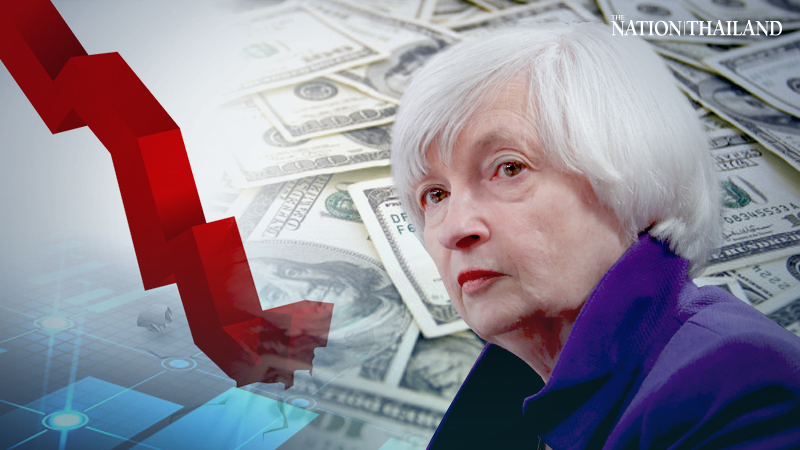
Treasury Secretary Janet Yellen dismissed fears that President Joe Biden’s $1.9 trillion pandemic-relief bill is so big that it will cause an inflation problem as she seeks to push the recovery deeper into the U.S. labor market to address long-standing economic disparities.
Yellen called the impact on women and minorities from covid-19 “absolutely tragic.” She repeatedly has rejected concerns that Biden’s stimulus is excessive given the economy’s signs of recovery, and that runaway inflation could damage the economy.
“I really don’t think that’s going to happen,” she said Monday on MSNBC. Inflation before the pandemic “was too low rather than too high,” she noted. “If it turns out to be inflationary, there are tools to deal with that,” she said of the stimulus package.
Treasury yields have soared over the past month as investors built into their outlook a faster trajectory for economic growth and prices in the wake of the bigger-than-expected spending bill.
Yellen said the most urgent action is the House’s vote Tuesday on passing the Senate’s revisions to pandemic-relief bill. Speaker Nancy Pelosi, D-Calif., has predicted approval.
That legislation includes enhanced unemployment benefits until Sept. 6 and stimulus checks for those earning $80,000 or less, and it makes student-loan relief tax-free.
“We have a K-shaped recovery going on, in which high-income people are doing much better than those at the bottom of the economic ladder — low-wage workers and minorities,” Yellen said. The problem predates the coronavirus but was “made immeasurably worse by the pandemic.”
The unemployment rate for Blacks, who have a disproportionate share of lower-wage jobs and of union membership, was double that of Whites during much of the past 50 years in part because policymakers pulled back support just as the benefits of growth started reaching lower-income workers, to avoid runaway inflation.
Federal Reserve Chair Jerome Powell has pledged not to allow the same mistake to be repeated, while his predecessor, Yellen, is preparing to turn from crisis-relief efforts to jobs creation through what the administration calls a “build back better” program that includes infrastructure spending.
U.S. payrolls remain down by more than 9 million compared with the peak before covid-19 struck. The Black unemployment rate climbed to 9.9% in February even as the overall rate fell to 6.2%.
Yellen reiterated her expectation for the relief plan to return the U.S. to “full employment” next year.
Kristalina Georgieva, who heads the International Monetary Fund, during an event with Yellen on Monday applauded what she called the U.S.’s “very progressive” policies.
Speaking on International Women’s Day, Yellen and Georgieva highlighted the importance of addressing inequalities faced by women — and of bringing more of them into the field of economics.
Women “have to take care of children who can’t be at school. We’re really concerned about permanent scarring from this crisis,” Yellen said.

 มันคือ “ซิน ซิตี้” ที่ใหญ่ที่สุดแห่งหนึ่งของโลก และเมื่อเจอเขากับโควิดชีวิตของคนในนี้ยิ่งยากลำบากมากขึ้น


 หวงอี้เมิ่ง (Huang Yimeng) มหาเศรษฐีจีนคนใหม่ที่ได้รับโชคจากความไม่ลงรอยของ Huawei และ Tencent
 คริปโตเคอร์เรนซี่กำลังฮ็อตขึ้นมาเรื่อยๆ ไม่เฉพาะแค่บิตคอยน์เท่านั้น แต่คริปโตฯ สกุลอื่นๆ ก็เริ่มได้รับความสนใจมากขึ้นจากนักลงทุนสถาบัน
 บริษัทฟินเทคในเครือของบริษัท JD มีแนวโน้มที่จะถอนการเสนอขายหุ้นครั้งแรกจากการายงานของสำนักข่าว SCMP ทำให้ความกังวลเรื่องบรรยาการควบคุมธุรกิจการเงินในจีนยิ่งชัดเจนมากขึ้น
 แกนนำชี้ ถ้าทำงานและค้าขายต่อไปจะเป็นประโยชน์ต่อกองทัพ จนมีกำลังที่จะปราบปรามพลังของชาวเมียนมา
 เจ้าชายแฮร์รีและเมแกน มาร์เคิล เปิดเผยเรื่องราวในราชวงศ์อังกฤษกับทอล์กโชว์อเมริกันชื่อดัง
 Tsukiji Hongwanji is a four-century-old temple near Tokyo’s old fish market. MUST CREDIT: Bloomberg photo by Noriko Hayashi



 A Microsoft office in Mountain View, Calif., on Jan. 22, 2021. MUST CREDIT: Bloomberg photo by David Paul Morris.