By The Washington Post · Amy B Wang, Felicia Sonmez
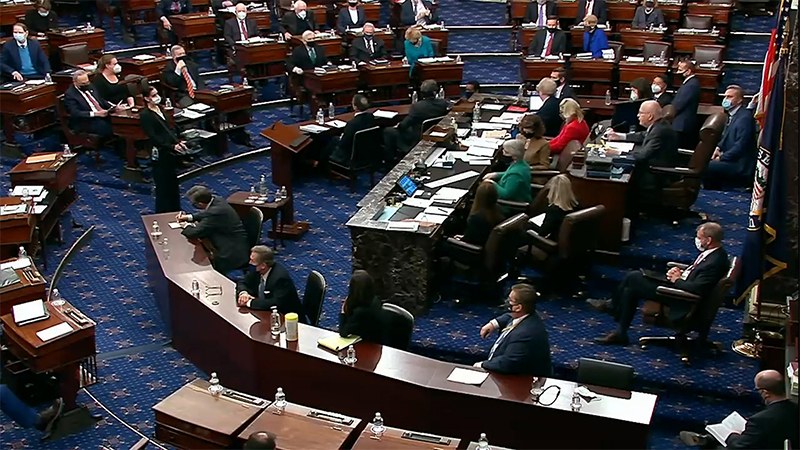
WASHINGTON – Of the 57 “guilty” votes that rang out on the Senate floor Saturday, only one – uttered by Sen. Richard Burr, R-N.C. – elicited gasps from around the chamber.
The North Carolina Republican had given no previous indication he was leaning toward voting to convict former president Donald Trump for inciting an insurrection, after a pro-Trump mob overran the U.S. Capitol on Jan. 6 in a violent siege that left five people dead.
But the days-long trial had convinced Burr of Trump’s culpability, he said in a statement afterward.
“The evidence is compelling that President Trump is guilty of inciting an insurrection against a coequal branch of government and that the charge rises to the level of high crimes and misdemeanors. Therefore, I have voted to convict,” Burr said. “I do not make this decision lightly, but I believe it is necessary. By what he did and by what he did not do, President Trump violated his oath of office to preserve, protect, and defend the Constitution of the United States.”
Ultimately Burr was joined by six of his GOP colleagues, who voted alongside all 50 Democrats to convict Trump. However, it fell short of the number of votes needed – two-thirds of the senators present – for Trump to be convicted. In a 57 to 43 vote, the Senate acquitted Trump of the charge of inciting an insurrection, concluding the former president’s second impeachment trial.
Burr, along with Sens. Bill Cassidy of Louisiana, Susan Collins of Maine, Lisa Murkowski of Alaska, Mitt Romney of Utah, Ben Sasse of Nebraska and Patrick Toomey of Pennsylvania were the Republicans who voted with Democrats to convict Trump.
Burr acknowledged that he had believed the trial to be unconstitutional when he started. However, Burr said he had made his decision as an impartial juror, believing the question of constitutionality to be established precedent after the Senate voted to proceed with the trial.
Cassidy had late last month also voted against the constitutionality of the trial but changed his mind Tuesday after considering arguments from the House impeachment managers and from Trump’s defense. The Louisiana senator left the chamber before the vote was done Saturday.
In a lengthy statement, Sasse blasted Trump’s repeated lies about the election having been stolen from him and and also defended the constitutionality of the trial.
“The president abused his power while in office and the House of Representatives impeached him while he was still in office,” Sasse said. “If Congress cannot forcefully respond to an intimidation attack on Article I instigated by the head of Article II, our constitutional balance will be permanently tilted. A weak and timid Congress will increasingly submit to an emboldened and empowered presidency. That’s unacceptable. This institution needs to respect itself enough to tell the executive that some lines cannot be crossed.”
Immediately after the vote concluded, Toomey told reporters it was the “right call” to vote to convict Trump but gave no further comments. In a statement issued later, he acknowledged he had voted for Trump but that Trump’s behavior after the election “betrayed the confidence millions of us placed in him.”
“As a result of President Trump’s actions, for the first time in American history, the transfer of presidential power was not peaceful. A lawless attempt to retain power by a president was one of the founders’ greatest fears motivating the inclusion of the impeachment authorities in the U.S. Constitution,” Toomey said. “His betrayal of the Constitution and his oath of office required conviction.”
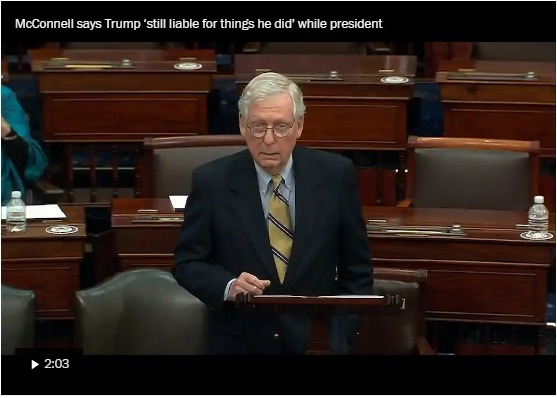
But it was Senate Minority Leader Mitch McConnell, R-Ky., who voted to acquit Trump, who gave a befuddling speech on the Senate floor afterward, arguing the former president is “practically and morally responsible” for provoking the Jan. 6 attack on the Capitol – but that the Senate was upholding the Constitution by acquitting him.
“The Senate’s decision today does not condone anything that happened on or before that terrible day,” McConnell said. “It simply shows that senators did what the former president failed to do: We put our constitutional duty first.”
Trump, by contrast, appeared to take his acquittal as a vindication of his actions before, during and after the Jan. 6 attack. In a statement, Trump called his second impeachment by the House “another phase of the greatest witch hunt in the history of our Country” and hinted at a return to national politics.
McConnell spent much of his remarks condemning Trump’s actions and directly linking them to the Jan. 6 insurrection. The former president’s supporters, he argued, launched their violent attack “because they had been fed wild falsehoods by the most powerful man on Earth, because he was angry he lost an election.”
“There’s no question – none – that President Trump is practically and morally responsible for provoking the events of the day,” McConnell said at one point. “No question about it.”
He argued, however, that it was beyond the power of the Senate to hold Trump accountable for those actions.
“This body is not invited to act as the nation’s overarching moral tribunal,” McConnell said. “We’re not free to work backward from whether the accused party might personally deserve some kind of punishment.”
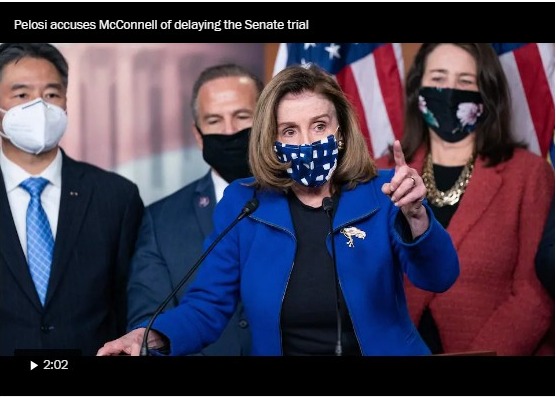
Immediately after Trump’s impeachment by the House last month, McConnell blocked the Senate from swiftly beginning a trial while Trump was still in office. At the time, McConnell said Trump had “simply no chance” of a “fair or serious trial” before Joe Biden’s inauguration Jan. 20.
But on Saturday, McConnell sought to deflect blame for that decision.
“Speaker [Nancy] Pelosi’s own scheduling decisions conceded what President Biden publicly confirmed: A Senate verdict before Inauguration Day was never possible,” he said.
In January, McConnell’s office informed aides to then-Minority Leader Charles Schumer, D-N.Y., that he would not agree to immediately reconvene the Senate to begin a trial, despite pressure from Schumer to invoke rarely used emergency powers that allow the two Senate leaders to unilaterally reconvene.
Without mentioning his own role in blocking an earlier trial, McConnell said Saturday that he might have voted differently if Trump were still president.
“If President Trump were still in office, I would have carefully considered whether the House managers proved their specific charge,” he said.
Biden’s vaccine push runs into distrust in the Black community
InternationalFeb 14. 2021Michelle Chester administers a coronavirus vaccine to Dr. Yves Duroseau at Long Island Jewish Medical Center on Dec. 14. MUST CREDIT: photo for The Washington Post by Sarah Blesener.
By The Washington Post · Cleve R. Wootson Jr., Frances Stead Sellers
Former Tuskegee, Ala., mayor Johnny Ford rolled up his right sleeve and smiled behind his mask as the first dose of coronavirus vaccine entered his arm – a televised display of faith he hoped would save Black families from suffering.
Ford became mayor soon after the disclosure of the infamous Tuskegee Study of Untreated Syphilis in the Negro Male in 1972, and he spent years seeking justice for victims of the abominable government-run program. Now he’s trying to persuade Black people that vaccines fast-tracked by that same government are not only safe, but vital.
Ford, whose wife nearly died of the virus this winter, is frustrated that so many African Americans are still resisting the vaccine. “For those folks who want to stand around and debate, let them debate,” Ford said. “I’m sorry for them and regret that they want to do that. But if they don’t want to take it, then please move out of the way of those who do want to take it.”
The vaccine hesitancy that Ford is fighting has emerged as a crucial test for the Biden White House, which has repeatedly said racial equity will be central to his presidency. The administration is planning a sweeping campaign to promote the vaccine to minorities, but activists like Ford say the problem is already critical.
Cameron Webb, Biden’s senior policy adviser for covid-19 equity, acknowledged the administration is “swimming upstream” when it comes to vaccine hesitancy. He said it is working to get information into the hands of influencers and community leaders who can spread the word and dispel rumors.
Biden addressed the issue directly Thursday when he visited the National Institutes of Health, where he was hosted by NIH Director Francis Collins and Anthony S. Fauci, who is spearheading the administration’s covid-19 response.
“I know people want confidence that it’s safe. Well, listen to Dr. Fauci. I did. I got my shots,” Biden said. “It’s safe. And we need more people to get vaccinated to beat this pandemic.”
Resistance to the vaccines is not limited to minorities. A hard-line anti-vaccine movement based on misinformation, for example, uses emotional appeals on social media to win over Americans of various political stripes.
Vaccination disparities can result from lack of access as well as hesitancy, said Robert A. Bednarczyk, a professor of global health and epidemiology at Emory University. “We talk food deserts,” Bednarczyk said. “Do we know where physician deserts are? Where nurse deserts are?”
Another factor is “vaccine gentrification,” said White House covid-19 adviser Andy Slavitt: Inoculation sites will be set up to provide easy assess to underserved or minority communities, only to have wealthier suburbanites drive in and use them.
But hesitancy among African Americans is a particular source of concern to a government that’s become more sensitive to the inequities imposed on Black communities for centuries. The pandemic has had an outsized effect on people of color – killing Black Americans at nearly three times the rate of White Americans – and the White House wants to use the unprecedented national vaccination drive to help address that disparity.
Biden has invoked the Defense Production Act to increase vaccine supplies and marshaled federal resources to balloon the number of vaccination sites. Last Tuesday, the administration announced it would ship vaccines directly to local health centers in underserved communities.
But such scaling-up efforts will not amount to much if people don’t take the vaccines.
Vaccine hesitancy has declined over time, to the relief of many activists, but it is still significant. While the data is uneven on who is getting the vaccine, according to a recent Kaiser Family Foundation poll, 43% of Black adults say they plan to “wait and see until it has been available for a while, to see how it is working for other people” – compared to 31% of the overall population who say that.
Such delays can be dangerous, especially as new virus variants emerge that may be less affected by the current vaccines. Fauci said hesitation by Black Americans means a vulnerable population could “suffer doubly.”
“We can’t fail at this,” Fauci said in an interview. “We’ve got to get a substantial proportion of the African American population to embrace the idea of vaccines.”
He added, “It would be really tragic . . . if a demographic group that has already suffered disproportionately from this terrible pandemic should – for reasons that are understandable but unfortunate – feel that they don’t want to take the one tool that can prevent them from getting infected, from getting sick, and from dying.”
Fauci has spent months trying to debunk vaccine myths with Black audiences. He has videotaped conversations with NBA star Stephen Curry. Since last summer, he has been dialing into Zoom gatherings of Black churches to answer congregants’ questions.
He often finds himself addressing the misconception that political pressure prompted vaccine-makers to skip safety steps. Other unfounded worries tilt toward the conspiratorial: that mRNA vaccines can alter a person’s DNA, make people infertile, or allow the government to track a person’s movements.
The Biden administration says it will soon launch a full-scale persuasion program aimed at minorities. While Fauci will play a role, he and other officials concede that the White head of a public health agency might not be the best person to reach Black and brown audiences.
“Who is giving the vaccine – and where you are getting it – matters,” said Ala Stanford, who founded the Black Doctors Consortium in April to address health disparities through testing and now vaccination.
She praised Vice President Kamala Harris for getting a vaccine on television, but said even such role models have less impact than a neighbor, relative or friend.
“The vice president matters,” Stanford said. “But it matters more that your barber got it.”
The Department of Health and Human Services is running ads about the vaccine and other virus safeguards on 2,300 radio stations, 40 of them minority-owned. HHS is also targeting minority audiences in newspaper ads and providing experts to host Facebook Live town halls sponsored by the Black Coalition Against Covid-19.
The Centers for Disease Control and Prevention, for its part, is funding campaigns by groups like the National Urban League, the National Council of Negro Women and the Conference of National Black Churches. And it’s partnering with retired football stars Warren Moon and Franco Harris, in hopes that “trusted messengers” can increase vaccine confidence.
Outside government, the Ad Council, a nonprofit run by the advertising industry, has prepared videos featuring doctors from diverse backgrounds. In one of them, Valerie Montgomery Rice, president and dean of the Morehouse School of Medicine, says it’s critical to have Black doctors involved in the vaccine push.
“This will go a long way to building the trust we need between the underrepresented minority communities and the health system at large,” she says.
But such efforts are up against decades of mistrust stemming from government abuse of Black bodies in the name of science. For 40 years, government-financed doctors allowed syphilis to run unchecked through Black test subjects in the Tuskegee experiments, knowing for much of that time that penicillin would cure them.
In 1951, doctors biopsied a cancerous tumor in a woman named Henrietta Lacks, cells that became the first immortalized cell line. The cells have been used in many experiments and continue to feature in medical research today – even though Lacks, a Black woman, never consented and was not compensated.
And J. Marion Sims became “the father of modern gynecology” by experimenting on enslaved women without anesthesia. A statue honoring his achievements stood in New York’s Central Park until 2018.
That history is now being compounded by wariness of the record speed at which the coronavirus vaccines were created. Several versions were midwifed by “Operation Warp Speed,” a government program shepherded by former president Donald Trump, who made no secret of wanting a fast cure at almost any cost, at one point tweeting at an official, “Get the dam vaccines out NOW.”
The best antidote, said Webb, the Biden adviser, is communication from trusted figures.
“We’re not trying to sell anybody a vaccine, but I believe that if people have accurate, truthful information about what we know and what we don’t know, they’ll make the decision that’s in their best interest,” Webb said. “There are a lot of myths and disinformation out there that clouds that picture, so part of our work is helping to sift through all that.”
Part of the sifting, Webb stressed, is ensuring that minority and underserved communities actually have a steady supply of vaccines; it’s no use convincing people that a vaccine is necessary, after all, if they can’t get it.
Early vaccination data has been spotty, in part because not all recipients report their race or ethnicity. But the figures that do exist suggest racial disparity has already crept into inoculation efforts.
In New York City, for example, 12 percent of people over 65 who received at least one dose of vaccine were Black, even though Blacks make up 22 percent of the city’s over-65 population.
For Ford, the former Tuskegee mayor, the goal for the next few months is clear: convince as many people as possible to take the vaccine.
The virus tore through his family this winter, pinballing the former mayor and his ailing wife from hospital to hospital as she tried to beat an infection that nearly killed her. Ford spent nights in a cot by her bedside while doctors debated putting her on a ventilator. As he cared for his wife, they missed the funeral of his first cousin, who succumbed to covid.
In his 50 years in office – as mayor, state representative and now city councilman – Ford figures he’s built up a lot of credibility, which he now intends to put on the line to motivate his community.
“The disease does not discriminate,” Ford said. “Whether you are a judge or a mayor or Black or White, it doesn’t care. I can testify to how dangerous this disease is. And that’s why my life’s work now is convincing other Black people that they should be tested and receive the vaccine as soon as possible.”
The vaccine, he said “may not be perfect. But it’s way better than getting covid.”
Australia faces the unthinkable: Life without Google
InternationalFeb 14. 2021The Google logo in an arranged photograph on Jan. 22, 2021. Bloomberg photo by David Gray.
By Syndication Washington Post, Bloomberg · Angus Whitley, Georgina McKay
Imagine a world without Google, the search engine so pervasive it’s the starting point for more than five billion queries a day. That’s the reality facing Australia, where the tech giant is threatening to unplug its homepage in a standoff with the government.
Google opposes a planned law that would force the company and Facebook to pay Australian publishers for news content. The Internet juggernaut’s ultimatum to local lawmakers — change the legislation, or else — has left a digital vacuum hanging over a nation that essentially knows just one way to navigate the web. Google runs 95% of Internet searches in Australia.
Potential fallout from the spat goes far beyond Australia for Alphabet Inc.-owned Google, whose dominance of global advertising has made it a target for watchdogs worldwide. If the company backs down in Australia, the pay-for-news law risks becoming a template for jurisdictions including Canada and the European Union that are following the quarrel and keen to shorten Google’s lead.
But disabling what is arguably the world’s most famous website would hand all of Australia to rivals, including Microsoft’s Bing and DuckDuckGo, which have failed to dislodge Google as the gateway to the web. These search-engine competitors would suddenly have a playground for development and a foothold to advance on the global stage.
Software-engineering student Patrick Smith exemplifies Australia’s Google dependency. The 24-year-old from Canberra said he sometimes racks up 400 Google searches a day to help with his studies, catch up on news and look up recipes. Smith said his browser from the previous day shows 150 searches — in the space of just five hours.
“The prospect of Google search disappearing is frightening at best,” Smith said. “It’s quite reflexive of me to Google something, anything, that I’m even mildly not sure of.”
Searching for ‘best beach Sydney’ shows the variance in performance among Google’s competitors. DuckDuckGo’s first result was an ad for a hotel more than 1,000 kilometers away in Queensland, with Sydney beach reviews listed below a second ad link. Search Encrypt, which touts its data-protection capability, said: ‘It looks like there aren’t any great matches.’ Bing’s initial suggestion was Bondi Beach Post Office. Only Google returned a real beach, Bondi, first up.
The world-first legislation will be considered by Australia’s parliament from the week starting Feb. 15 after a key senate committee recommended Friday that the bill be passed.
“The government expects all parties to continue to work constructively towards reaching commercial agreements,” Treasurer Josh Frydenberg said in a statement welcoming the senate report.
People visit Bondi Beach in Sydney on Oct. 13, 2020. MUST CREDIT: Bloomberg photo by Brent Lewin.
The government says the local media industry — including Rupert Murdoch’s News Corp. and Sydney Morning Herald-publisher Nine Entertainment Co. — has been bled of advertising revenue by the tech giants and should be paid fairly for content.
Google argues it drives traffic to their websites, and that being forced to pay to display snippets of news breaks the principle of an open Internet. It also opposes the law’s final-offer arbitration model that determines how much it should pay publishers.
Facebook has said it may stop Australians from sharing news on its platform if the law is enacted, an unprecedented step.
Australia’s entire economic output is less than Alphabet’s $1.4 trillion market value, so it may be surprising the distant and tiny market is suddenly so important. But the Internet titans are so keen to avoid Australia setting a global precedent that Alphabet Chief Executive Officer Sundar Pichai and Facebook’s Mark Zuckerberg broke into their diaries in recent weeks for phone hookups with Prime Minister Scott Morrison or his ministers.
Sniffing an opportunity, Microsoft President Brad Smith and CEO Satya Nadella also reached out.
Grabbing the free hit, Smith told Morrison that Microsoft would invest to “ensure Bing is comparable to our competitors.” This week, Smith wrote in a blog post Thursday that the U.S. should adopt its own version of the Australian law.
DuckDuckGo, a search engine that says it doesn’t track its users, is also trying to cash in.
“There’s a growing global demand for privacy online and Australians don’t have to wait for government action” to stop using Google, DuckDuckGo said by email. Search Encrypt says its results expire after 30 minutes of inactivity.
Non-profit alternatives have also been suggested. The Australian Greens party this month asked the government to consider setting up a publicly owned search engine rather than let Microsoft muscle in. “We should not seek out another foreign giant to fill the gap,” said Senator Sarah Hanson-Young.
To be sure, Australia wouldn’t be the first Google-free nation in the world. In China, where the site is blocked, Baidu is the leading search engine.
But Australia would stand out as a westernized democracy without access to the site and Google’s departure could set the nation back years in terms of fast access to information.
With two decades of data in the vault, and processing an estimated 5.5 billion searches a day, Google is regarded as peerless in tailoring results for individuals and their idiosyncracies.
“Bing is not going to be able to compete with Google in terms of quality out of the blocks,” said Daniel Angus, Brisbane-based associate professor in digital communication at Queensland University of Technology. “Australians might have to relearn how to use search.”
Google again performed best under the search, ‘australia leader,’ showing Morrison and his Liberal party at the top of the page — sourced from an official government site. Bing gave similar details, though took it from Wikipedia. DuckDuckGo prominently displayed ads for team leader jobs in Western Australia, with photos of Morrison and his title sporadically appearing when the search is refreshed. Search Encrypt drew a blank once more.
There are signs Google’s hardline stance may be softening. Morrison said his meeting with the company was “constructive” and “should give them a great encouragement to engage with the process.” Google declined to comment on the meeting, though said in a statement it proposes compensating publishers through its News Showcase product, under which the company pays select media outlets to display curated content.
Some older Australians who’ve lived in a pre-Google world have fewer concerns. Gino Porro, the 58-year-old owner of the Li’l Darlin bar and restaurant in Sydney’s Darlinghurst, uses Google and hasn’t heard of any other search engines. But he sees a return of word-of-mouth recommendations instead of online reviews if Google shuts down its homepage. “Customer service is important, not Google,” he said.
But back in Canberra, Googling student Smith is uneasy about the possible shutdown and how well a replacement would perform.
“I honestly feel that my life would become significantly more difficult,” he said.
This crypto kid had a $23,000-a-month condo. Then the Feds came.
InternationalFeb 14. 2021An engineer walks by mining rigs at the Evobits crypto farm in Cluj-Napoca, Romania, on Jan. 22, 2021. MUST CREDIT: Bloomberg photo by Akos Stiller.
By Syndication Washington Post, Bloomberg · Chris Dolmetsch
Stefan Qin was just 19 when he claimed to have the secret to cryptocurrency trading.
Buoyed with youthful confidence, Qin, a self-proclaimed math prodigy from Australia, dropped out of college in 2016 to start a hedge fund in New York he called Virgil Capital. He told potential clients he had developed an algorithm called Tenjin to monitor cryptocurrency exchanges around the world to seize on price fluctuations. A little more than a year after it started, he bragged the fund had returned 500%, a claim that produced a flurry of new money from investors.
He became so flush with cash, Qin signed a lease in September 2019 for a $23,000-a-month apartment in 50 West, a 64-story luxury condo building in the financial district with expansive views of lower Manhattan as well as a pool, sauna, steam room, hot tub and golf simulator.
In reality, federal prosecutors said, the operation was a lie, essentially a Ponzi scheme that stole about $90 million from more than 100 investors to help pay for Qin’s lavish lifestyle and personal investments in such high-risk bets as initial coin offerings. At one point, facing client demands for their money, he variously blamed “poor cash flow management” and “loan sharks in China” for his troubles. Qin, now 24 and expressing remorse, pleaded guilty in federal court in Manhattan on Feb. 4 to a single count of securities fraud.
“I knew that what I was doing was wrong and illegal,” he told U.S. District Judge Valerie E. Caproni, who could sentence him to more than 15 years in prison. “I deeply regret my actions and will spend the rest of my life atoning for what I did. I am profoundly sorry for the harm my selfish behavior has caused to my investors who trusted in me, my employees and my family.”
The case echoes similar cryptocurrency frauds, such as that of BitConnect, promising people double-and triple-digit returns and costing investors billions. Ponzi schemes like that show how investors eager to cash in on a hot market can easily be led astray by promises of large returns. Canadian exchange QuadrigaCX collapsed in 2019 as a result of fraud, causing at least $125 million in losses for 76,000 investors.
While regulatory oversight of the cryptocurrency industry is tightening, the sector is littered with inexperienced participants. A number of the 800 or so crypto funds worldwide are run by people with no knowledge of Wall Street or finance, including some college students and recent graduates who launched funds a few years ago.
Qin’s path started in college, too. He had been a math whiz who planned on becoming a physicist, he told a website, DigFin, in a profile published in December, just a week before regulators closed in on him. He described himself on his LinkedIn page as a “quant with a deep interest and understanding in blockchain technology.”
In 2016, he won acceptance into a program for high-potential entrepreneurs at the University of New South Wales in Sydney with a proposal to use blockchain technology to speed up foreign exchange transactions. He also attended the Minerva Schools, a mostly online college based in San Francisco, from August 2016 through December 2017, the school confirmed.
He got the crypto bug after an internship with a firm in China, he told DigFin. His task had been to build a platform between two venues, one in China and the other in the U.S., to allow the firm to arbitrage cryptocurrencies.
Convinced he had happened upon a business, Qin moved to New York to found Virgil Capital. His strategy, he told investors, would be to exploit the tendency of cryptocurrencies to trade at different prices at various exchanges. He would be “market-neutral,” meaning that the firm’s funds wouldn’t be exposed to price movements.
And unlike other hedge funds, he told DigFin, Virgil wouldn’t charge management fees, taking only fees based on the firm’s performance. “We never try to make easy money,” Qin said.
By his telling, Virgil got off to a fast start, claiming 500% returns in 2017, which brought in more investors eager to participate. A marketing brochure boasted of 10% monthly returns — or 2,811% over a three-year period ending in August 2019, legal filings show.
His assets got an extra jolt after the Wall Street Journal profiled him in a February 2018 story that touted his skill at arbitraging cryptocurrency. Virgil “experienced substantial growth as new investors flocked to the fund,” prosecutors said.
The first cracks appeared last summer. Some investors were becoming “increasingly upset” about missing assets and incomplete transfers, the former head of investor relations, Melissa Fox Murphy, said in a court declaration. (She left the firm in December.) The complaints grew.
“It is now MID DECEMBER and my MILLION DOLLARS IS NOWHERE TO BE SEEN,” wrote one investor, whose name was blacked out in court documents. “It’s a disgrace the way you guys are treating one of your earliest and largest investors.”
Around the same time, nine investors with $3.5 million in funds asked for redemptions from the firm’s flagship Virgil Sigma Fund LP, according to prosecutors. But there was no money to transfer. Qin had drained the Sigma Fund of its assets. The fund’s balances were fabricated.
Instead of trading at 39 exchanges around the world, as he had claimed, Qin spent investor money on personal expenses and to invest in other undisclosed high-risk investments, including initial coin offerings, prosecutors said.
So Qin tried to stall. He convinced investors instead to transfer their interests into his VQR Multistrategy Fund, another cryptocurrency fund he started in February 2020 that used a variety of trading strategies — and still had assets.
He also sought to withdraw $1.7 million from the VQR fund, but that aroused suspicions from the head trader, Antonio Hallak. In a phone call Hallak recorded in December, Qin said he needed the money to repay “loan sharks in China” that he had borrowed from to start his business, according to court filings in a lawsuit filed by the Securities and Exchange Commission. He said the loan sharks “might do anything to collect on the debt” and that he had a “liquidity issue” that prevented him from repaying them.
“I just had such poor cash flow management to be honest with you,” Qin told Hallak. “I don’t have money right now dude. It’s so sad.”
When the trader balked at the withdrawal, Qin attempted to take over the reins of VQR’s accounts. But by now the SEC was involved. It got cryptocurrency exchanges to put a hold on VQR’s remaining assets and, a week later, filed suit.
By the end, Qin had drained virtually all of the $90 million that was in the Sigma Fund. A court-appointed receiver who is overseeing the fund is looking to recover assets for investors, said Nicholas Biase, a spokesman for acting Manhattan U.S. Attorney Audrey Strauss. About $24 million in assets in the VQR fund was frozen and should be available to disperse, he said.
In South Korea when he learned of the probe, Qin agreed to fly back to the U.S., prosecutors said. He surrendered to authorities on Feb. 4, pleaded guilty the same day before Caproni, and was freed on a $50,000 bond pending his sentencing, scheduled for May 20. While the maximum statutory penalty calls for 20 years in prison, as part of a plea deal, prosecutors agreed that he should get 151 to 188 months behind bars under federal sentencing guidelines and a fine of up to $350,000.
That fate is a far cry from the career his parents had envisioned for him — a physicist, he had told DigFin. “They weren’t too happy when I told them I had quit uni to do this crypto thing. Who knows, maybe someday I’ll complete my degree. But what I really want to do is trade crypto.”
Scientists had already determined that the variant of the novel coronavirus first detected in November in the United Kingdom – known as B.1.1.7. because of its molecular makeup – was probably 30 to 70% more transmissible than the typical version of the virus causing covid-19.
They also knew, based on preliminary data, that the variant appeared relatively more deadly for the growing number of people catching it.
U.K. scientists now say its probably 30 to 70% more deadly based on a follow-up study by the government released Friday that assessed a larger sample size of covid-19 patients and also found a higher rate of hospitalization.
The variant is “associated with an increased risk of hospitalization and death compared to infection” with other forms of the virus, according to the study, which drew from multiple databases across England.
There are still many unknowns: The data available to study has noteworthy gaps among critical demographics, such as nursing homes, and provides an incomplete tally of infections, a problem persisting throughout the pandemic. But it does underscore how – even with efforts to fast-track fighting the virus – scientific data takes time to gather and access, despite the pressing need for information.
In the months since the variant was first reported – and the weeks since British Prime Minister Boris Johnson initially said it appeared to be deadlier – the highly-transmissible form of the virus has spread to more than 80 countries, including the United States, and become the dominant strain in some parts of England. It has led to overwhelmed hospitals, disrupted travel and business, and necessitated a return to lockdowns in cities across Europe, even as coronavirus vaccination programs roll out to inoculate millions of people. Scientists sequencing the virus have also detected several other highly-transmissible variants, such as one that was first documented in South Africa.
The rapid spread of variants led Britain in January to institute a comparatively longer and stricter lockdown than the country’s previous ones. As The Washington Post reported, other countries in Europe who first reported surges in cases this winter have recently seen declines in their rates of transmission after prolonged shutdowns were put in place to prevent further spread of the B.1.1.7 variant.
Alongside lockdowns, some countries in Europe also increased their face-mask requirements and recommendations in response to initial reports about the threat of the variants. On Wednesday, the U.S. Centers for Disease Control and Prevention issued new guidelines urging people to wear two cloth masks or medical grade masks, when available, to limit the chance of spreading or contracting the various forms of the virus in circulation.
So far, the makers of the Moderna and Pfizer-biotech coronavirus vaccines have said their products remain effective against the latest forms of the virus. Studies of these variants and the various vaccines under development or emergency use are ongoing.
Oxford University announced Friday it started testing its coronavirus vaccine in children as young as six in a move that expands coronavirus vaccine trials to the youngest age group yet.
The Oxford trial will include 300 child volunteers ages 6 to 17, with 240 of them receiving the vaccine co-developed with drugmaker AstraZeneca; the remaining participants will receive a control meningitis vaccine that has been proven safe in children but is expected to mimic similar side effects of a covid-19 shot, the university said in a statement.
Before the Oxford/AstraZeneca trial, testing had not included children younger than 12. Three other companies – Pfizer, Moderna and Janssen – have announced plans to start trials for younger children this spring.
Only the Pfizer-BioNTech and Moderna vaccines have been authorized in the United States thus far. Johnson & Johnson has a single-shot vaccine that could be authorized in March. U.S. regulators are still waiting for more trial data before approving the Oxford-AstraZeneca vaccine, which is already in use in the European Union.
Even with clinical trials for younger patients underway, children are not expected to widely receive the vaccine for months and may not until 2022. Richard Malley, a senior physician in the Division of Infectious Diseases at Boston Children’s Hospital said he does not expect vaccinations in children to start until next calendar year
“We really want to make sure they’re safe and well-tolerated in children, particularly when there’s a low risk-benefit ratio,” Malley told The Washington Post Saturday. Coronavirus has not shown itself to be as dangerous in most children as it is in older adults, making it less critical to race out testing for children.
“The risk-benefit calculus you have to do should lead you to want to do this only if it’s extraordinarily safe in pediatric populations,” he said.
The Oxford trial’s small sample size of 300 children who span a decade in age is meant to serve as a jumping-off point and not the final word on how the vaccine will be tolerated by young patients.
Malley said in a 300-person trial, the purpose is to determine what he called a “global response” and tell researchers at a high level if the vaccine is safe, well-tolerated and able to produce an immune response in children.
While the development and rollout of various coronavirus vaccine candidates has occurred at an unprecedented speed, clinical trials expanding now to younger children follow the standard pattern of all vaccine testing, Malley said.
“In any vaccine study, you’re generally starting with healthy adults and slowly move into different age categories going up or down to make sure it’s safe for other adults,” Malley said.
For some health experts, the timeline of expanding clinical trials to teenage and younger patients has been disappointingly slow, particularly given the strength of the safety data for adults who have taken the vaccine.
American Association of Pediatrics President Sally Goza wrote to federal leaders in September arguing pediatric trials were essential for curbing the pandemic, given the potential of older children to be vectors for the disease.
“While some studies have shown that children under the age of 10 may be less likely to become infected and less likely to spread the virus to others, more recent data suggest children older than 10 years may spread SARS-CoV-2 as efficiently as adults,” Goza wrote.
Malley, the Boston Children’s Hospital doctor, said even though children are roughly half as likely as an adult to transmit coronavirus, inoculating younger populations is crucial to achieving herd immunity.
“When you read that kids are less likely to transmit, it’s roughly by a factor of two – so it’s not zero,” he said, noting that the virus variants that have emerged may further change the equation.
Malley also points to the fact that while children broadly have not suffered severe or lingering illness from covid-19 the way adults have, some children have developed acute respiratory failure and multisystem inflammatory syndrome, or MIS-C – a rare but serious illness than be fatal or leave children with lasting heart damage.
So far in the United States, at least 11,000 children and teenagers have been hospitalized and at least 215have died, according to a Jan. 28 report from the American Academy of Pediatrics.
“Even though these are rare, they can be catastrophic,” Malley said. “If the vaccine is safe and can be tolerated, it can save lives.”
?? WARNING: this video is hard to watch. Another shocking attack in Oakland’s Chinatown. 8th and Harrison Streets. Outside the Asian Resource Center. 20+ robbery/assault incidents in the neighborhood according to the Chinatown Chamber president. https://t.co/9bo9PzuqiLpic.twitter.com/8h6dkNA1TG— Dion Lim (@DionLimTV) February 4, 2021
นอกจากนี้ ผู้เชี่ยวชาญของ WHO หลายรายยังเผยเป็นเสียงเดียวกันว่า เจ้าหน้าที่จีนยังขอให้ทีมของ WHO ยอมรับคำข้อมูลเกี่ยวกับต้นตอของเชื้อไวรัสจากทางรัฐบาลจีน รวมทั้งข้อมูลที่ยังไม่ได้รับการพิสูจน์ที่ว่าเชื้อโคโรนาไวรัสแพร่จากต่างประเทศเข้ามายังจีน

 เตือนประชาชนห้ามช่วยแกนนำ รื้อฟื้นกฎแจ้งคนไปมาหาสู่กันตอนค่ำ
 Michelle Chester administers a coronavirus vaccine to Dr. Yves Duroseau at Long Island Jewish Medical Center on Dec. 14. MUST CREDIT: photo for The Washington Post by Sarah Blesener.
 The Google logo in an arranged photograph on Jan. 22, 2021. Bloomberg photo by David Gray.

 An engineer walks by mining rigs at the Evobits crypto farm in Cluj-Napoca, Romania, on Jan. 22, 2021. MUST CREDIT: Bloomberg photo by Akos Stiller.


 เหตุการณ์ที่คนเอเชีย รวมทั้งคนไทยถูกทำร้ายร่างกายในสหรัฐในเวลาไล่เลี่ยกัน ทำให้ประเด็นเหยียดเชื้อชาติถูกพูดถึงอีกครั้ง
 ธนาคารเมียนมาหลายแห่งเริ่มมีปัญหาการให้บริการ เนื่องจากพนักงานพากันหยุดงานประท้วงกองทัพ
 นักวิทยาศาสตร์จีนไม่ยอมเปิดเผยข้อมูลดิบเกี่ยวกับการระบาดของ Covid-19

