By Syndication Washington Post, Bloomberg · Jinshan Hong
Hong Kong will allow restaurant dining-in services until 10 p.m. and relax other social-distancing rules after the Chinese New Year, as the city tries to move past a winter wave that’s throttled the economy.
The city will permit four people per dining table, doubling from the current limit of two, starting from Feb. 18, if the virus remains contained over the Lunar New Year, officials said at a briefing on Wednesday. Venues ranging from indoor and outdoor sports centers, beauty parlors, theme parks and cinemas will also be allowed to reopen.
“We are cautiously positive on the epidemic,” Food and Health Secretary Sophia Chan said. “If Hong Kong residents continue to observe social-distancing rules, following this trend, we hope we can resume normal life after Lunar New Year.”
Hong Kong will require staff virus tests if businesses want to reopen. The government is also discussing relaxing the public gathering rule to four people as well, from the current limit of two, according to Chan.
The Asian financial hub has seen cases fading to a few dozens in the past week, after Hong Kong deployed compulsory testing and neighborhood lockdowns in an attempt to achieve zero cases in the community. The closure of schools and some businesses has been in place for over two months, and has been extended into the New Year holidays.
A panel of experts on Wednesday postponed a decision on recommending a second vaccine for the city. It announced they will seek more data from Sinovac Biotech Ltd. on its vaccine before it meets again in two weeks to review its emergency use application.
The vaccine developed by BioNTech SE and Pfizer Inc. already received a greenlight last month. The city is expected to start its inoculation program as early as the end of February.
Myanmar faces wider business fallout after Kirin retreat
InternationalFeb 11. 2021A demonstrator holds up a National League for Democracy (NLD) flag during a protest outside the Embassy of Myanmar in Bangkok, Thailand, on Feb. 1 2021. MUST CREDIT: Bloomberg photo by Andre Malerba.
By Syndication Washington Post, Bloomberg · Faris Mokhtar, Philip J. Heijmans, Chanyaporn Chanjaroen
Myanmar’s political upheaval is prompting global companies from Japan to Thailand to dial back operations in the country, spurring concern about a widening business fallout.
From beer maker Kirin Holdings Co. to an early backer of gaming firm Razer Inc., companies and investors are weighing the impact of a military coup that’s thrust the once- thriving nation into a state of emergency. The turmoil is prompting multinationals like Thailand’s biggest industrial developer to delay investment plans, a harbinger of things to come should the chaos deepen.
Western nations are applying pressure on the newly installed military government of the Southeast Asian country, once regarded as greenfield territory for everything from oil and gas to leisure resorts. With the U.S. reiterating plans to renew sanctions, it could cause a rippling effect among businesses, threatening $5.5 billion in foreign investment in a country that just a few years ago was on the path to democracy.
“It will definitely get bigger as these corporations get on board the leave-first-and-ask-questions-later bandwagon,” Justin Tang, head of Asian research at United First Partners in Singapore.
Myanmar has been attracting more outside investment in recent years after posting double-digit economic growth in the early part of the last decade. Bordering the massive markets of India and China, Myanmar has abundant natural resources, including oil and gas, gold, silver and precious stones. The population of about 57 million people is greater than South Korea’s, and not far off Italy’s.
Among recent foreign deals, CVC Capital Partners reached an agreement in December to buy Myanmar’s biggest telecommunications tower company for close to $700 million. The deal for Irrawaddy Green Towers was the second-biggest in the country, trailing only the acquisition of Myanmar Distillery group by a unit of Thai Beverage. Singapore’s sovereign wealth firm GIC and Norway’s Norfund bought a 30% stake in Yoma Bank for 131 billion kyat ($92.1 million) last April.
Nations with the most at stake from the instability include Singapore, Myanmar’s largest foreign investor, accounting for almost 34% of approved investment by dollar value, according to a World Bank report in December. Yoma Strategic Holdings, a Singapore-listed conglomerate that gets almost all its revenue from Myanmar, has plunged by a third this year.
Singapore is monitoring the situation closely, said a spokesperson for Enterprise Singapore, a government agency that helps companies grow overseas.
The turmoil is creating a rippling effect across industries. Kirin ended its joint-venture partnership with the nation’s largest brewer Myanma Economic Holdings Public Co., which has ties to the military. The company isn’t planning to entirely exit the country, where its operations accounted for just 1.7% of revenue in 2019.
Lim Kaling, the founding investor of Singapore-based gaming firm Razer, is disposing of his one-third stake in a joint venture that owns RMH Singapore Pte Ltd. RMH owns 49% of Virginia Tobacco Co. in Myanmar, while Myanma Economic Holdings Ltd. — owned by the military — holds the balance. “I hope for a time when I can be an investor in the country and its people once more,” Kaling said in a statement on Monday.
Amata Corp., one of Thailand’s biggest industrial land developers, delayed some investment plans after it won approval from the government to proceed on several projects.
“The investment outlook of Myanmar doesn’t look good,” Viboon Kromadit, the company’s chief marketing officer, said last week. “Possible sanctions by the international community will definitely affect foreign companies’ confidence.”
Singapore-listed energy company Interra Resources Ltd. may face labor disruptions at the Chauk and Yenangyaung plants due to the protests, the company said in a filing to the Singapore Exchange.
Rights groups have called on a boycott of companies believed to be owned by the country’s military. There are 134 companies owned by two of Myanmar’s military-run holding firms — Myanma Economic Holdings and Myanmar Economic Corp. — according to data compiled by Bloomberg.
The unrest will lower the country’s economic growth this fiscal year to 3%, from a previous estimate of 4.5%, according to estimates from Malaysia’s Malayan Banking Bhd.
“A military coup has dealt a severe blow to Myanmar’s economic recovery and political stability,” economists Linda Liu and Chua Hak Bin said in a note. Investment “will likely fall given heightened uncertainty and freeze on fresh investments from Western countries.”
Companies adopting a wait-and-see approach include:
– Thailand’s energy company, PTT Exploration & Production, is closely monitoring the political situation but doesn’t expect the internal strife to affect its operations or plans, senior vice president for finance Orachon Ouiyamapun said at an investor presentation on Tuesday.
– Australian & New Zealand Banking Group Ltd. said it has a small presence in the Southeast Asian country and is monitoring the situation closely, a spokesperson said.
– Singapore’s Oversea-Chinese Banking Corp.’s branch continues to operate in the country, said Patrick Chew, head of operational risk management.
Chinese investors, on the other hand, could benefit from the upheaval. They tend to have a higher risk tolerance compared with those from other regions, according to an analysis by Fitch Solutions Country Risk & Industry Research. That means there’s a “chance they may take the opportunity to expand their reach in the country as other investors stay cautious.”
WASHINGTON – President Joe Biden announced Wednesday that the United States would impose economic sanctions on the leaders who carried out a military coup in Myanmar and voiced support for crowds risking arrest to protest the ouster of elected officials in the Southeast Asian nation.
The move marks Biden’s first implementation of new sanctions, a punitive tool with varying effectiveness. The White House did not announce names of current and former military leaders who will be targeted or other details.
Biden said he had approved an executive order “enabling us to immediately sanction the military leaders who directed the coup, their business interests, as well as close family members.”
Biden said his order will block the generals’ access to some $1 billion in assets in the United States.
It is not yet clear whether the United States is going after the country’s longtime military chief, Min Aung Hlaing, who is now the nation’s de facto leader, or how onerous the new penalties will be on military figures thought to control assets in other countries. Many senior military leaders in Myanmar are already under sanctions imposed in protest of military action against the Muslim Rohingya minority.
“The military must relinquish power it seized and demonstrate respect for the will of the people of Burma,” the president said at the White House, using another name for the country.
Biden also renewed the U.S. call for the elected leadership to be released, including deposed de facto leader Aung San Suu Kyi.
The military took power by force on Feb. 1, claiming that the victory by Suu Kyi’s pro-democracy political party had been fraudulent. Military leaders promised a new election in one year and placed Suu Kyi and others in detention.
“The people of Burma are making their voices heard, and the world is watching,” Biden said. “We’ll be ready to impose additional measures and we’ll continue to work with our international partners to urge other nations to join us in these efforts.”
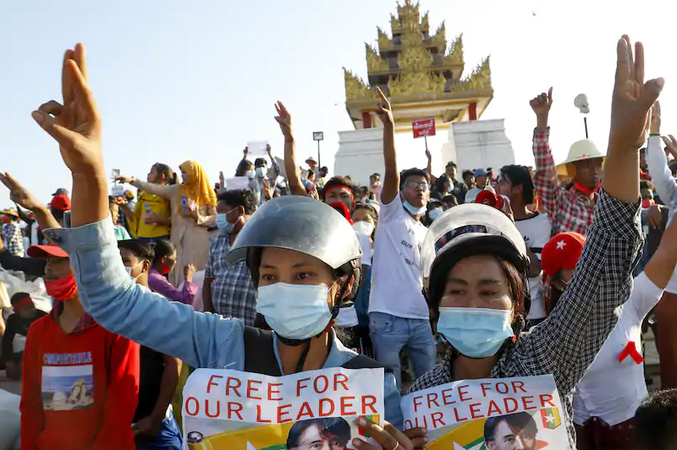
Demonstrators have filled city streets in Myanmar, demanding that the military restore civilian leadership and release more than 150 political detainees. The protests have continued despite the threat that authorities might use military force to clear the crowds.
On Sunday, demonstrators in Yangon massed near the iconic Sule Pagoda, the site of major pro-democracy uprisings in previous decades, defied the military by holding up three fingers in a gesture of resistance popularized by the “Hunger Games” series.
In response to the protests, the military has banned gatherings of more than five people and implemented a curfew from 8 p.m. to 4 a.m. in Yangon and Mandalay, the country’s two biggest cities. The military also banned the use of Facebook, Twitter and Instagram for citizens “until further notice.”
The events appeared to end a march toward democratic rule in Myanmar over the past decade. The military, long the most important nonreligious institution in the country, had gradually relinquished direct control over the government, released Suu Kyi from house arrest and invited foreign investment, including from the United States.
The Obama administration had encouraged these efforts, dropping some sanctions and broadening its diplomatic and economic outreach. As vice president, Biden had supported those moves.
On Wednesday, Biden noted that U.S. efforts to encourage democracy in Myanmar have been bipartisan and said his administration had consulted with Senate Minority Leader Mitch McConnell, R-Ky.
National security adviser Jake Sullivan spoke to McConnell on Wednesday morning about the latest U.S. efforts related to Myanmar, a McConnell aide said.
“I appreciate the President’s ongoing engagement with Congress on prompt and practical steps to restore democracy in Burma,” McConnell said in a statement. “I hope all nations that respect democracy and the rule of law will join the U.S. in imposing meaningful costs and accountability on the junta.”
Across a range of global issues, the Biden administration has stressed its emphasis on coordinating with U.S. allies to address the biggest challenges the country faces. When asked why Biden’s sanctions announcement did not coincide with measures from U.S. allies, State Department spokesman Ned Price suggested that such moves would be imminent.
“As you hear more from our partners, it’ll be very clear that what we are collectively rolling out will impose steep and profound costs on those responsible for this coup,” Price told reporters Wednesday.
In recent days, Secretary of State Antony Blinken has raised the Biden administration’s “deep concern over the coup in Burma” during his discussions with Asian partners in the region, including in calls with the foreign minister of Singapore on Tuesday and with Vietnam’s foreign minister and deputy prime minister last Thursday.
TAIPEI, Taiwan – For the World Health Organization, its fact-finding mission to China left many questions on the possible origins of the pandemic. In Beijing, however, the outcome was framed Wednesday as something solid: vindication and triumph.
The WHO’s headline announcement – that it would rule out the possibility the virus accidentally leaked from a Wuhan lab – was hailed by Chinese officials and in state media as effectively silencing claims that China was hiding secrets and trying to deflect blame.
But some prominent public health experts in the West questioned whether China offered enough freedom for the WHO team to investigate fully Wuhan’s piece of the global pandemic puzzle.
Tuesday’s WHO statement “put an American conspiracy theory to rest,” China’s Global Times newspaper said. The official Reference News called the visit by the U.N. health agency a showcase of China’s “positive, scientific, cooperative attitude.”
Zeng Guang, chief epidemiologist at the Chinese Center for Disease Control, even tried to turn the tables. Other locations in the world, particularly U.S. labs, must be investigated next, said Zeng, because “historically the United States … launched biological and chemical warfare.”
“China was the big winner,” said Yanzhong Huang, a senior fellow for global health at the Council on Foreign Relations. “We understand that they are doing their work within the parameters of the government. But you don’t want to jump to a conclusion based on several hours of conversation with Chinese scientists.”
As the WHO mission departs China this week, it has yielded scant new public information about the pandemic’s roots. The joint Chinese-WHO team mirrored the generally accepted scientific view that the coronavirus most likely jumped from bats to an intermediary species before infecting humans.
It also echoed China’s official position on several contested theories without offering meaningful new evidence.
The WHO team reiterated the Chinese view that it is possible the virus was carried by frozen food, a hypothesis that is hotly debated among researchers and could imply the virus was brought into China from another country.
The officials concurred with Chinese counterparts that the virus could have been spreading around the world before erupting in December 2019 in Wuhan. And they emphatically ruled out a lab mishap after asking Wuhan lab officials if they thought it were possible.
The comments have revived skepticism among the international agency’s critics, as well as the Biden administration, about the value of the politically fraught trip coordinated by Chinese officials, and cast a cloud over a WHO team that is now expected to move on to other regions, possibly Southeast Asia, in the quest to learn more about the virus.
At the State Department, a spokesman said the United States would continue to collect its own information “rather than rush to conclusions that may be motivated by anything other than science,” while White House spokeswoman Jen Psaki called for putting separate, U.S. experts in China.
Jesse Bloom, a virologist at the Fred Hutchinson Cancer Research Center, was “surprised to see some members of the team dismiss the accidental lab leak theory while seeming to suggest, without any specific evidence, the possibility that frozen food might have played a role.”
“I remain agnostic about the origins of SARS-CoV-2,” said Bloom, referring to the virus’ official name. “But it’s important to have a careful independent accounting of the research into SARS-related coronaviruses that was being done in labs in Wuhan before the emergence of this pandemic, and it doesn’t appear that this team accomplished that.”
In early 2020, China staunchly resisted an international inquiry and decried it as a politicized effort by the Trump administration to demonize China. Beijing punished Australia with bruising trade tariffs after Australia proposed the probe, and the idea of an inquiry into the virus origins grew highly charged after Republican officials claimed that the virus was a Chinese bioweapon.
Although the claim was widely debunked, a small minority of researchers maintain it’s possible that a Wuhan lab accidentally leaked the virus during benign research. Other experts argue the genetic makeup of SARS-CoV-2 more likely points to natural evolution in an intermediate species.
Tuesday’s news conference, led by Chinese health officials, highlighted questions reaching back months about the WHO’s ability to conduct an independent probe in China.
The terms of the visit, forged after lengthy negotiations with the Chinese government and made public in November, did not propose any inquiry into labs such as those at the Wuhan Institute of Virology (WIV), a leading center that conducts bat coronavirus research with U.S. government funding and U.S. collaborators.
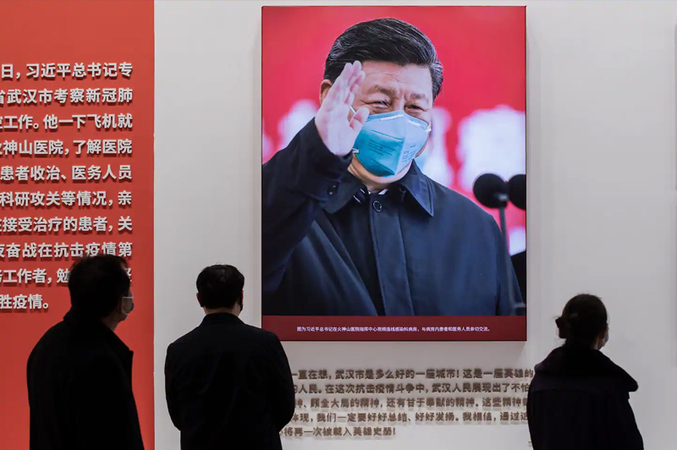
After the WHO team left quarantine on Jan. 28, its itinerary included interviews with Wuhan doctors, former patients, and a stop at an exhibition hall dedicated to the sacrifice of Chinese medics and soldiers who fought the outbreak.
On Feb. 3, security guards lined the streets outside the WIV and shooed away journalists. Peter Daszak, a WHO delegation member whose nonprofit, EcoHealth Alliance, has formerly collaborated and coordinated U.S. grant funding to the WIV, assured reporters from a car that the WHO team was “asking all the questions that need to be asked.”
Jamie Metzl, an adviser to the WHO and a former Senate aide to Joe Biden, said that “a two-week investigation where they’re being driven around by the Chinese government and given access to cherry-pick people and data doesn’t clear the bar of credibility.”
Metzl said the Biden administration needs to continue supporting the WHO after the Trump administration cut ties.
“We must support their investigations, but they can’t be stage-managed by the country being investigated,” he said.
Richard Ebright, a microbiologist at Rutgers University who has accused the WHO of bending to Chinese pressure, said asking questions wasn’t enough.
“Any institution and nation seeking to clear its name would’ve moved quickly to make available all its databases of genetic sequences and strains, provided lab notes, records and private interviews with research, waste removal and janitorial staff,” Ebright said. “None of that happened or was even requested” as part of the agreement to send experts to China.
Skeptical experts argue that records from the WIV should be analyzed closely because the institute collected nearly 300 bat coronaviruses from southwest China in the past decade, including two of the closest genetic relatives to the SARS-CoV-2 virus. These experts do not suggest that the virus was engineered to be a bioweapon.
At Tuesday’s news conference in Wuhan, WHO and Chinese officials said it was unclear what animal was the intermediary source but offered possibilities, including pangolins. But no animals at the Huanan Seafood Market tested positive for the virus, they said.
Daszak told reporters afterward that the probe should press on to Southeast Asia, which shop records showed could be the source of imported wild animals that arrived at the Huanan market.
After the WHO event ended Tuesday, Yan Yuxin, an anchor on the state broadcaster’s evening newscast, said the pandemic was a “global challenge” that required “global traceability.”
Shortly before midnight, the Reference News, a newspaper for government officials, posted an online commentary directed at Chinese critics: “We advise those Western politicians and media who just open their mouth to be less disruptive and not to be a stumbling block while humanity cooperates to fight the virus.”
By The Washington Post · William Booth, Karla Adam
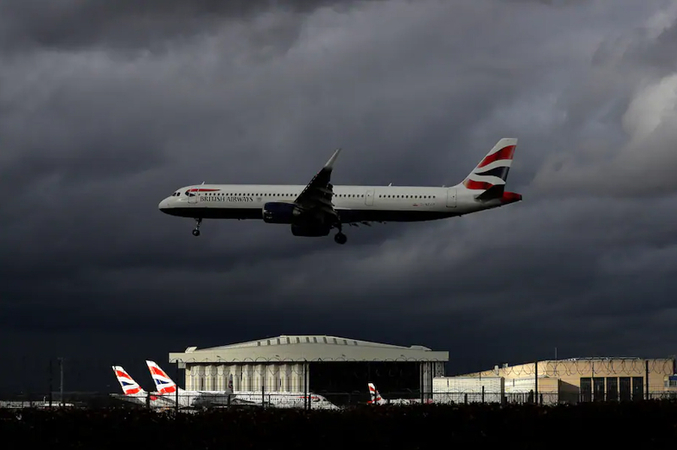
LONDON – Britain, besieged by a more contagious coronavirus strain and alarmed by the potential of new and imported variants, is about to launch the toughest travel restrictions in Europe, including mandatory hotel quarantines and 1o-year prison terms for those who lie on entry forms.
The government has already shut down almost all travel by international visitors from 33 countries seen as viral hotspots, including Brazil and South Africa.
Beginning Monday, British citizens returning from those “red list” countries must quarantine for 10 days in designated hotels, under police guard, costing travelers £1,750 or about $2,400. Travelers must submit to multiple coronavirus tests before release. Those who try to elude quarantine face $14,000 fines.
The threat of prison time is for anyone found guilty of misleading authorities over having recently been in a red list country.
Only essential travel is allowed from countries not on the list, including the United States. And all international arrivals must show proof of a recent negative coronavirus test and self-quarantine for 10 days, getting tested on days 2 and 8, Health Secretary Matt Hancock announced on Tuesday evening.
The raft of measures marks a profound escalation in Britain’s pandemic response, showing how worried the government and its scientific advisers are about the dizzying rise of various coronavirus “variants of concern,” some of which have evolved to be much more infectious, possibly more deadly or potentially less responsive to vaccines.
Already, Britain on many days posts the highest per capita death toll from the virus in the world.
Forcing arrivals into government-run quarantine sites near airports has been policy in Australia, China and South Korea. But it is new for Europe. And it is especially out-of-character for this Conservative Party British government.
Prime Minister Boris Johnson has been criticized for being too slow in declaring each of three national lockdowns. His government reopened pubs before fully reopening schools and paid people to go out and eat in restaurants last summer.
Throughout the pandemic, Johnson and his Tory backbenchers have been resistant to sweeping travel bans, seeing Britain, and London especially, as a vital crossroads of global travel, trade and finance.
That the “sovereign free-trading island nation,” as Johnson like to describe his country, is essentially retreating into its castle keep, pulling up the drawbridges, appears especially hard for Johnson, as the measures come just as the prime minister hoped to launch his vision for a post-Brexit “Global Britain.”
The red flags denote countries with exploding outbreaks or those that have produced concerning mutations of the virus. Fourteen are in Central and South America, alongside a dozen African nations. Portugal is the only country in Europe to make the list.
Tim Bale, a professor of politics at Queen Mary University of London, said the Johnson government tends to view coronavirus restrictions as “something that will harm the economy, rather than seeing the case for how restrictions early on would actually be better for the economy in the long-term.”
Bale said he imagined the government’s threat of prison for travelers caught lying was designed to be “eye-catching” and show that “to breach regulations would be a serious thing to do.”
But he said it could also be “an attempt by the government to get everyone talking about that, rather than failures going back to March to protect the borders.”
The government has been lax in law enforcement of previous coronavirus travel restrictions, with border force police issuing few fines, leaving it to public health tracers to follow up with travelers to see if they are abiding by quarantine rules.
The newly announced, more actively enforced quarantines have stirred deep feelings of lost liberties.
Jonathan Sumption, a former supreme court judge and medieval historian, asked the health minister in a guest column in the Telegraph, “Does Mr. Hancock really think that non-disclosure of a visit to Portugal is worse than the large number of violent firearms offences or sexual offences involving minors, for which the maximum is seven years?”
Sumption continued, “The hotel quarantine rules are a form of imprisonment in solitary confinement. They are brutal, inhumane and disproportionate. They are economically extremely destructive. They are also of limited value because the virus is already endemic in the UK and spontaneously mutates all the time.”
Lindsey Scott, 36, a supervisor on an offshore oil rig in the Black Sea, off the Turkish coast, told The Washington Post he was reevaluating a planned visit home to see his family in Scotland.
“I’m sure there are a lot of people worse off than me right now,” he said. “Just seems a bit extreme. Would be happy to isolate at home and get the two tests so I could at least be with my family.”
Linda Bauld, a professor of public health at the University of Edinburgh, said that once Britain’s new measures come into effect on Monday, it will have some of the strictest border controls in Europe. She noted that Norway and Iceland also have some managed quarantine.
She said that in addition to risks from new variants, there’s a recognition from some research that Britain “should have had a quarantine system in place some time ago” and that international travel contributed to the second wave of the pandemic here.
In Scotland, Bauld said, “we got infection levels down to 2-3 cases a day in July, and then people were allowed to go off on holiday. And the genomic sequencing shows that lineages of the virus were reseeding into the country by people coming back from elsewhere.”
Johnson’s government and the National Health Service have been running one of the most efficient vaccine campaigns in the world, and they’ve held out hope that if everyone lines up and gets their jabs, restrictions could be lifted in the spring – and summer might feel more normal.
But on Wednesday, Transport Secretary Grant Shapps warned on BBC radio: “Please don’t go ahead and book holidays for something which, at this stage, is illegal to actually go and do, whether it’s here or abroad.”
Earlier this week, England’s deputy chief medical officer, Jonathan Van-Tam, said, “The more elaborate your plans are for summer holidays – in terms of crossing borders, in terms of household mixing – given where we are now, I think we just have to say, the more you are stepping into making guesses about the unknown at this point.”
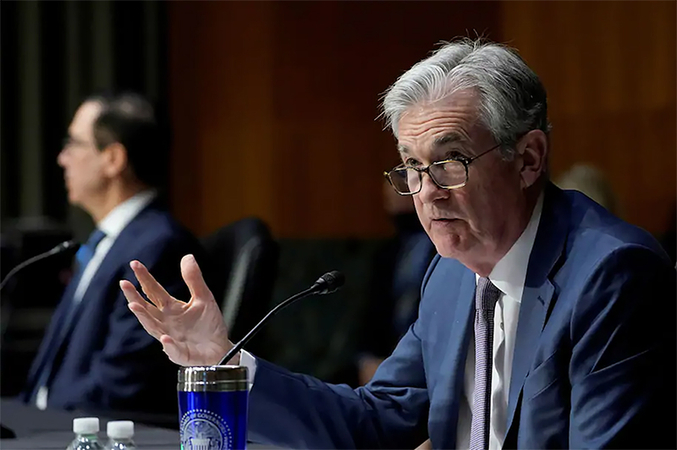
Federal Reserve Chair Jerome Powell said Wednesday that the real unemployment rate in January was “close to 10 percent,” significantly higher than the 6.3% rate reported by the Department of Labor last week.
The discrepancy is due to the “misclassification” of some jobless Americans, Powell said during a virtual speech at the Economic Club of New York. After accounting for people who have left the labor force since February 2020, the unemployment rate is much higher than the official figure, he said.
“Correcting this misclassification and counting those who have left the labor force since last February as unemployed would boost the unemployment rate to close to 10 percent in January,” Powell said Wednesday.
The higher figure is another reflection of how the pandemic continues to constrain the labor market. The U.S. gained back a paltry 49,000 jobs in January. In December, the country lost 227,000 jobs.
The latest figures come as Congress debates President Joe Biden’s $1.9 trillion coronavirus package, which would extend unemployment benefits, issue $1,400 in direct checks and set aside hundreds of billions of dollars to fight the pandemic.
Powell has repeatedly said that the economy’s future depends on controlling the virus. As the number of cases rose through the holiday season, the labor market’s recovery slowed. And for many service-sectors workers, jobs that depend on person-to-person contact have yet to return.
Following Powell’s speech, Senate Finance Committee Chair Ron Wyden, D-Ore. said that the 10% unemployment rate cited by Powell reinforces “the need for the strongest possible benefits package in our COVID relief bill.”
“Federal Reserve Chair Powell’s assessment of joblessness in America is bleak,” Wyden said in a statement.
Powell noted that nearly 5 million people said the pandemic prevented them from looking for work in January. Some parents are providing full-time child care or been forced to stay home with children during virtual schooling. Others have been deterred by fear of the virus, especially in jobs that at restaurants, hotels and entertainment venues.
“We are still very far from a strong labor market whose benefits are broadly shared,” Powell said.
The Bureau of Labor Statistics has flagged undercounts in the official unemployment rate before. In May – when the unemployment rate was a reported 13.3% – the Bureau of Labor Statistics noted a “misclassification error” that lowered the overall rate by about 3 percentage points, meaning the May unemployment rate would have been about 16.3%.
Powell has also spoken about the discrepancy before. After the official unemployment rate fell to 7.9% in September, Powell said that a broader, more accurate measure that adjusts for “mistaken characterizations of job status, and for the decline in labor force participation since February” would put that month’s rate at around 11%.
Powell has repeatedly urged lawmakers to keep relief flowing, especially for the 10 million Americans whose jobs have not returned since the pandemic began. The Fed, in turn, has no plans to raise interest rates until the labor market heals substantially.
As congressional Democrats rush to pass Biden’s coronavirus package, some economists worry the full thrust of the bill could be too much for the economy to handle. Some economists have questioned whether the $1.9 trillion stimulus, combined with pent-up savings that Americans are expected to unleash once the pandemic ends could suddenly overheat the economy, triggering a rise in inflation and forcing the Fed to respond by raising interest rates.
Powell dismissed those concerns. Inflation has been low or stable for decades, and the Fed is prepared to tolerate a temporary rise inflation over its’ 2% target, he said.
It’s possible, Powell said, that aid from Congress plus a spike in consumer spending could cause “some upward pressure on prices.”
But “my expectation is that will be neither large nor sustained,” he said.
By Syndication Washington Post, Bloomberg · Claire Ballentine, Olivia Raimonde
U.S. stocks notched a second straight small decline after reaching a record, as investors assessed what the latest inflation reading means for aid prospects.
The S&P 500 Index ended and up-and-down session lower by less than 0.1%. The Dow Jones industrial average posted a gain, while the Nasdaq 100 retreated. The 10-year Treasury yield fell back below 1.15% after the core consumer price index was unchanged last month.
The CPI data are part of an intensifying debate in financial markets over the course of inflation. Despite the muted January figure, investors continue to worry that price pressures are set to increase in the months ahead as Congress passes an aid bill and more vaccinations spur consumer spending.Twitter Inc. climbed after reporting a jump in revenue. Lyft Inc. rallied as the co-founder said the ride-hailing company will “absolutely” turn a quarterly profit this year.
Surging Inflation May Force Fed to Resort to Yield Curve-Control
These are the main moves in markets:
Stocks
– The S&P 500 Index lost less than 0.1% 4 p.m.EST.
– The Stoxx Europe 600 Index fell 0.2%.
– The MSCI Asia Pacific Index rose 0.8%.
– The MSCI Emerging Market Index gained 1.1%.
Currencies
– The Bloomberg Dollar Spot Index fell 0.1%.
– The euro added 0.1% to $1.2125.
– The British pound rose 0.2% to $1.3841.
– The Japanese yen slipped 0.1% to 104.67 per dollar.
Bonds
– The yield on 10-year Treasurys fell two basis points to 1.13%.
– The yield on two-year Treasurys was unchanged at 0.11%.
– Germany’s 10-year yield rose one basis point to -0.44%.
– Britain’s 10-year yield climbed two basis points to 0.48%.
Commodities
– West Texas Intermediate crude gained 0.5% to $58.65 a barrel.
By Syndication Washington Post, Bloomberg · Andres Guerra Luz
Oil extended its longest winning streak in two years in New York as a decline in U.S. crude inventories further showcased how global supplies are shrinking.
Futures rose almost 1% after a U.S. government report showed domestic oil stockpiles fell by 6.6 million barrels to the lowest since March 2020. Still, the data showed gasoline supplies are at the highest since June, while crude exports fell to the lowest level in weeks.
“It was good to see the crude draw wasn’t just from one area, but constructive that it was throughout the whole U.S.,” said Brian Kessens, a portfolio manager at Tortoise, a firm that manages roughly $8 billion in energy-related assets. “If there was one thing to be concerned about, it was that gasoline inventories built.”
Oil has climbed more than 9% so far this month as the OPEC+ alliance’s supply curbs, led by Saudi Arabia, continue to deplete global oil inventories. Iraq said OPEC+ is unlikely to change its production policy at next month’s meeting, providing a signal to the market that oversupply concerns will be kept at bay.
The spread between Brent’s nearest contracts surged this week — a key sign of market tightness — while swaps tied to the physical North Sea market have also increased amid frenzied trading of derivatives late Tuesday. The so-called prompt spread for U.S. benchmark crude futures is also strengthening as declines at the nation’s largest storage hub in Cushing, Okla., brings oil stockpiles there to the lowest levels since July.
West Texas Intermediate for March delivery rose 32 cents to $58.68 a barrel as of 11:00 a.m. in New York. Brent for April settlement gained 45 cents to $61.54 a barrel.
There are still concerns that the rally may be overdone, with technical indicators showing crude in overbought territory. Rising prices may also spur American oil explorers to boost drilling and production later this year, the Energy Information Administration said in a monthly report Tuesday.
Meanwhile, the combined refining margin for gasoline and diesel fell toward $12 a barrel on Wednesday as the EIA report showed a nearly 4.3 million-barrel increase in gasoline supplies. At the same time, a rolling gauge for gasoline demand remains at its lowest seasonally in decades.
‘Super Mario 3D World + Bowser’s Fury’ is a must-buy. But it’s not because of Bowser’s Fury.
InternationalFeb 11. 2021“Super Mario 3D World + Bowser’s Fury” MUST CREDIT: Nintendo
By The Washington Post · Jhaan Elker
“Super Mario 3D World + Bowser’s Fury” – a Wii U port of a mainline, flagpole-and-course-based Mario game – pairs a revamped version of the original “Super Mario 3D World” with an all new expansion (“Bowser’s Fury”) sectioned off from the main game. Here’s the thing: Despite the heavy marketing on the new content, what makes “Super Mario 3D World + Bowser’s Fury” worth buying for owners of “Super Mario 3D World” isn’t the new stuff found “Bowser’s Fury,” because it’s really not that new. Instead, the best stuff is actually found in the “3D World” redux.
Let me explain.
“Super Mario 3D World + Bowser’s Fury’s” first screen that loads up emphasizes the paired games right away, splitting the screen in half and giving a choice, play the “Super Mario 3D World” game or play the “Bowser’s Fury” game. Nintendo’s advertising heavily emphasized the “Bowser’s Fury” content, which makes a sort of sense. After all, the new stuff is supposed to be the incentive for returning players to repurchase the game. But the reality is this: while Kaiju God-Slaying Bowser vs. Super Saiyan Cat Mario was littering the Internet, Nintendo should’ve pumped up the two key changes made to “Super Mario 3D World” that greatly enhance it overall.
– – –
The “Super Mario 3D World” portion of the package takes the classic Mario games formula and applies it to 3D, meaning in this game, you use 3D Mario game controls like long jumps and butt stomps to navigate courses toward the end goal, the iconic flagpole. Throughout the courses are hidden collectibles like stamps and green stars that unlock special courses and minigames on an overview world map. Toward the end of each section is a castle level with a big boss and a Sprixie to rescue. You do this all while collecting power-ups like the new cat suit to change Mario’s abilities (in the cat suit’s case, you can claw enemies, climb up walls and do diagonal dive attacks).
But the key ingredient to it all? Multiplayer. Adding 1-3 more players to the screen complicates things quickly. Players are supposed to cooperatively work together to reach the flagpole, but power-ups and coins are limited.
The player ahead of the others will move the camera’s focus ahead, leaving lagging teammates behind (who can hit a button to bubble up and catch up). Each player’s individual points are tallied at the end of levels, and the player with the most points gets a nifty crown to wear in the next stage to showcase their dominance. And funniest of all: The run button also grabs other players. Add the fact that each playable character, Mario, Luigi, Peach and Blue Toad, all have different stats and abilities, and it all adds up to a hilarious balance of cooperation and competition while running through challenging obstacles as quickly as possible.
This is where the two critical changes to the Switch version come into play. These changes radically alter the experience and, in my opinion, make the entire purchase worth it. To start, the gameplay is faster in every aspect compared to its Wii U counterpart. Apart from the obvious faster load-times, characters move noticeably faster, as do enemies and obstacles. It just adds to the hilarious chaos multiplayer offers, as players have to hone their reflexes even more to survive courses.
Secondly and more importantly, you can now play the game online with friends. How this wasn’t mentioned more in any of the advertising is baffling, considering how much that radically opens up the multiplayer experience to everyone, especially during these pandemic times.
When I played online in a demo Nintendo hosted for journalists and influencers, I noticed a tiny bit of input delay, but the gameplay never stuttered or lagged, meaning once I got used to the delay, I was able to compete with the others effectively. It was also relatively easy to join the online session. While only the host player is able to save any progress made in an online play session, this downside is outweighed by what I found to be one of the better online experiences Nintendo’s had to offer.
The multiplayer allows for so many unique, creative experiences. Just try playing with your own custom rulesets, like a game where one person’s job is to constantly sabotage the others, or a game where one person has to carry Luigi at all times, and you restart a level if Luigi dies once.
The Wii U was not the success Nintendo was hoping it’d be, so it’s satisfying to see one of the best multiplayer entries of the system find a second life on the much more popular Switch, even if not much of the actual content of the game has changed.
– – –
If you think that the additional content Bowser’s Fury provides is what makes “Super Mario 3D World + Bowser’s Fury” valuable, I encourage you to reset your expectations. Bowser’s Fury feels more like a testing ground for the next “3D World” entry than a fully developed game by itself.
I went into the experience wanting to like Bowser’s Fury. The setup seemed pretty good – Bowser’s been corrupted by this black ink that looks straight out of “Super Mario Sunshine” and, coincidentally, Bowser Jr. is there hoping Mario can help change his father back. The two tackle a brand new “open world,” where the course-world structure is gone and replaced with a world map where the camera is set free on a 360 degree axis.
Bowser’s Fury lets two players control Mario and Bowser Jr. as they set about collecting Cat Shines, this game’s equivalent of power stars. Collecting these Cat Shines powers up lighthouses that further clean up the inky mess and reveal more of the world map. Eventually, you’ll hit a Cat Shine threshold where you can activate the Giga Bell, which allows Mario to go into Super Saiyan Giant Cat form to battle the massively sized Bowser. You need to fight Bowser multiple times until he’s finally completely restored, meaning this game is about continually searching the world for more Cat Shines.
The last wrinkle to the gameplay is a new mechanic that draws inspiration from “Breath of the Wild’s” Blood Moon segments. Every so often, Bowser’s shell, which is at the center of the world map, will rise higher and higher until it summons rain and the goliath himself. During these segments, the sky goes dark and Bowser himself causes mayhem on the map, dropping stone pillars and breathing fireballs. After a short while, or if you collect a Cat Shine during this segment, Bowser will disappear and normal gameplay will resume. It’s a chaotic interlude to break up the otherwise samey-feeling gameplay.
Mario controls exactly as he does in “Super Mario 3D World,” while Bowser Jr. has those controls plus a paintbrush swipe attack and the ability to reveal hidden objects using point and click motion controls. You can also have the computer control Bowser Jr. and select the amount of help it actually gives you.
Here’s where the experience begins to fall apart. To start, the overall map feels like an oversized approximation of one of “Super Mario Odyssey’s” Kingdoms. Because of this, you’ll want every movement option that Odyssey offered in its gameplay and more. But Bowser’s Fury is using “Super Mario 3D World’s” controls engine, which feels dated for this game’s open-world ambition. You can’t do things every other 3D World Mario game offers, like the triple jump, and you don’t have things Odyssey offered that gave you incredible movement flexibility, like infinite rolling or Cappy-hopping.
The “open world” is sort of a facade too. Yes, there are no loading screens between any section of the game, but the world doesn’t offer the same interconnectivity or explorative wonder that, say, Odyssey’s Kingdoms offer, where discoveries really are exciting and unexpected. Instead, this map feels more like five separate “Super Mario 3D World” levels stitched together in different mountain-like zones, with large expanses of water between. I would go through each “mountain zone” similarly to how I’d progress through a regular “Super Mario 3D World” level, from top to bottom, with very short branches off the main path offering a challenge for an extra cat shine.
Finally, facing off against the Giant Bowser quickly loses its luster when you see it for what it is. The game really tries to play up Kaiju Bowser’s menace. Heck, there is even a part in his theme song that perfectly copies Sephiroth’s theme from “Final Fantasy 7.” But facing Bowser just looks grandiose simply because it’s bigger. The actual fight takes the same Mario boss formula that’s been here this entire franchise: recognize the pattern, wait for the opening, then jump on 2-3 times.
In short, the experience falters because it doesn’t offer any truly new ideas, and it just doesn’t compare to the brilliance of Mario’s last game of this variety, “Super Mario Odyssey.” Bowser’s Fury gets beat by Odyssey in every category: aesthetics, sound design, controls and gimmick wow-factor. And while the game does provide a potential blueprint for how to take the 3D World series going forward – it wouldn’t surprise me if the next game applied this open-world format to four players – Bowser’s Fury is certainly not enough to merit a purchase on its own.
The graphics aren’t a noticeably substantial upgrade, and handheld mode for both games had pretty steady framerates throughout (it’s worth noting that “Super Mario 3D World” was closer to 60 FPS and “Bowser’s Fury” is closer to 30).
Even with the Bowser’s Fury miss, the content is worth it. If you want one of the best and most versatile multiplayer experiences to date for the Nintendo Switch, online or offline, go with “Super Mario 3D World + Bowser’s Fury.”
But if you’re looking in particular for the “Bowser’s Fury” part to surprise you with new Mario gameplay concepts, look elsewhere. Bowser’s increase in size and inky gloss may distract you at first, but trust me, it’s simply covering up more of the same.

 A demonstrator holds up a National League for Democracy (NLD) flag during a protest outside the Embassy of Myanmar in Bangkok, Thailand, on Feb. 1 2021. MUST CREDIT: Bloomberg photo by Andre Malerba.

 “Super Mario 3D World + Bowser’s Fury” MUST CREDIT: Nintendo
 เวียดนามเล็งขึ้นภาษีน้ำตาลไทยตอบโต้การทุ่มตลาด ชี้ทำลายอุตสาหกรรมน้ำตาลในประเทศ

