นอกจากนี้เกาหลีเหนือยังถูกกล่าวหาว่าขโมยเงิน 81 ล้านเหรียญสหรัฐจากธนาคารกลางบังกลาเทศ รวมถึงขโมยเงิน 60 ล้านเหรียญสหรัฐจากธนาคาร Far Eastern International ของไต้หวัน
ทั้งนี้ ความสามารถในการโจมตีทางไซเบอร์ของเกาหลีเหนือถูกพูดถึงในระดับโลกครั้งแรกเมื่อปี 2014 เมื่อถูกกล่าวหาว่ามีการแฮ็ก Sony Pictures Entertainment เพื่อแก้แค้นหลังบริษัทดังกล่าวสร้างภาพยนตร์เรื่อง The Interview ที่ล้อเลียนเสียดสีผู้นำคิม จอง อึน
Senate votes to pursue Trump impeachment trial after declaring the proceedings constitutional
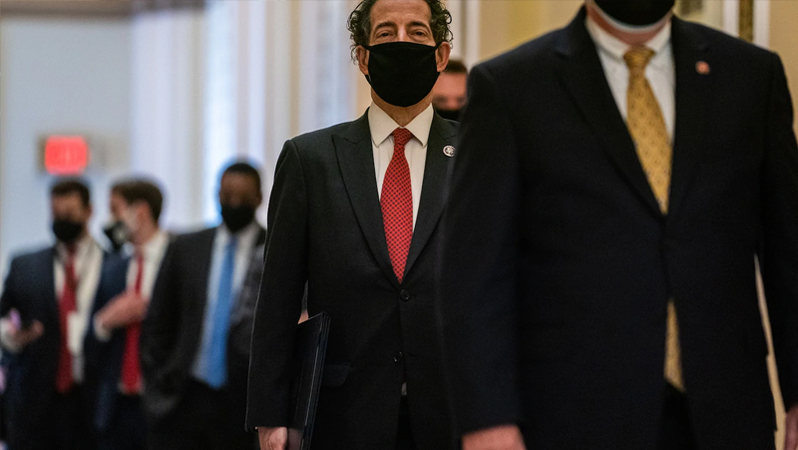
InternationalFeb 10. 2021Rep. Jamie Raskin, D-Md., center, and other House impeachment managers walk through the Capitol Rotunda, where pro-Trump rioters violently threatened lawmakers during last month’s siege, on their way to deliver arguments in the Senate on Tuesday, Feb. 9, 2021. MUST CREDIT: Washington Post photo by Salwan Georges
By The Washington Post · Seung Min Kim, Mike DeBonis, Karoun Demirjian, Tom Hamburger
WASHINGTON – The Senate voted along mostly partisan lines Tuesday to pursue Donald Trump’s second impeachment trial, after hours of arguments and the airing of a gripping documentary of the deadly Capitol riot that followed Trump’s inflammatory rally on Jan. 6.
Aided by the graphic 13-minute video that spliced violent images of the Capitol siege with Trump’s rhetoric, Rep. Jamie Raskin, D-Md., and other impeachment managers delivered an impassioned account of the physical and emotional trauma to lawmakers, police, staffers and local residents. They said there was no “January exception” in the Constitution – meaning that a president couldn’t escape accountability through impeachment just because he had left office before the trial.
“If that’s not an impeachable offense, then there is no such thing,” Raskin said of Trump’s behavior.
Trump’s lawyers countered that the trial – the first proceeding of its kind for an ex-president – would be unconstitutional because Trump was no longer in office, even if he was impeached by the House before leaving. One of the attorneys acknowledged that the former president lost the election, undercutting one baseless claim that Trump has spread since Nov. 3.
The Senate swiftly voted 56 to 44 against Trump. The proceedings will resume at noon Wednesday.
The historic trial opens just one month after the senators gathered in the same chamber to certify the results of the electoral college that gave President Joe Biden his win, only to be interrupted as a frightening mob overtook the Capitol in an unprecedented siege after Trump implored his supporters at a rally to fight on his behalf.
The insurrectionists broke through metal barricades, smashed windows and assaulted police officers to gain access to the citadel of U.S. democracy – prompting Vice President Mike Pence to be quickly ushered into safety and hundreds of lawmakers and staffers to take cover from rampaging rioters. At least five people died, including Capitol Police officer Brian Sicknick, who was memorialized under the Rotunda last week.
Reminders of the riot persist, with tall steel fencing and barbed wire encircling the once-open Capitol grounds, now patrolled by National Guard troops.
The House impeachment managers leaned on legal rulings, images and emotion, particularly Raskin’s recounting of his return to the chamber on Jan. 6 for the first time after burying his son. The former president’s defense lawyers addressed the crux of Tuesday’s debate – the constitutionality of the proceedings – only late in their presentation.
In a distinct appeal to a Republican Party that has long prided itself on its support of law enforcement, Raskin detailed the injuries sustained by 140 Capitol Police officers that day, such as brain damage, gouged eyes, heart attacks and mental trauma. At least two have died by suicide.
“Senators, this cannot be our future. This cannot be the future of America,” Raskin said. “We cannot have presidents inciting and mobilizing mob violence against our government and our institutions because they refuse to accept the will of the people under the Constitution of the United States.”
This photo from Monday, Feb. 8, 2021 shows Rep. Jamie Raskin, D-Md., making edits to his speech during a practice session regarding for the House managers overseeing the second impeachment of President Donald Trump. MUST CREDIT: Washington Post photo by Demetrius Freeman
The argument failed to sway 44 of the chamber’s 50 Republicans, with most favoring dismissing the case against Trump outright – a tally demonstrating the unlikelihood that 17 GOP senators will choose to join Democrats to convict the former president.
That vote was similar to one taken by the Senate last month, in which only five Republicans – Susan Collins of Maine, Lisa Murkowski of Alaska, Mitt Romney of Utah, Patrick Toomey of Pennsylvania and Ben Sasse of Nebraska – voted that an impeachment trial of a former president was constitutional. Sen. Bill Cassidy, R-La., joined them Tuesday in breaking with their party to allow the trial to proceed.
Some GOP senators on Tuesday were compelled by legal arguments from the Democratic impeachment managers, as they invoked conservative legal luminaries such as former 10th Circuit Judge Michael McConnell and attorney Charles Cooper, who have argued in favor of the trial’s constitutionality.
“Anyone that listened to those arguments would recognize that the House managers are focused, organized, they relied both upon precedent, the Constitution and legal scholars. They made a compelling argument,” said Cassidy, who took diligent notes throughout the day.
In contrast, Cassidy said, Trump’s team was “disorganized.”
“They did everything they could but to talk about the question at hand. And when they talked about it, they kind of glided over it, almost as if they were embarrassed of their arguments,” he said.
Raskin said Congress’s impeachment powers were precisely structured to hold accountable leaders such as Trump, who Raskin said “may not know a lot about the framers, but they certainly knew a lot about him.”
In an extraordinarily raw accounting of what he experienced, Raskin also shared that his daughter and son-in-law had come with him to Capitol Hill that day, wanting to remain close in their grief following the death by suicide of Raskin’s son, Tommy, days earlier. The lawmaker’s voice broke after he relayed to senators that his daughter, Tabitha, told him following the insurrection that she never wanted to come to the Capitol again.
“It was very powerful and heart-wrenching testimony,” said Sen. Chris Van Hollen, D-Md. “And I think he posed the question that’s going to hang over this trial at the end, which is whether the verdict will show our children that our democracy is safe and the Capitol is secure.”
Rep. Joe Neguse, D-Colo., another House impeachment manager, leaned heavily on historical precedents, walking senators through the impeachments of Sen. William Blount in 1797 and Secretary of War William Belknap in 1876, both of which occurred after the men were no longer in office.
That was ample evidence that Trump can be convicted even after leaving office, Neguse said.
“Honestly, it’s hard to imagine a clearer example of how a president could abuse his office: inciting violence against a coequal branch while seeking to remain in power after losing an election,” Neguse said. “Presidents can’t inflame insurrection in their final weeks and then walk away like nothing happened. And yet that is the rule that President Trump asks you to adopt.”
Rep. Jamie Raskin, D-Md., goes through his speech with Reps. David Cicilline, D-R.I., Joe Neguse, D-Colo., and chief impeachment counsel Barry Berke during preparations on Tuesday, Feb. 9, 2021. MUST CREDIT: Washington Post photo by Demetrius Freeman
Rep. David Cicilline, D-R.I., a third impeachment manager, directly cited a tweet Trump sent hours after the mob stormed the Capitol, saying the social media missive demonstrated precisely “how President Trump himself felt” even while the nation was in horror. In it, Trump had lamented that his “sacred landslide election victory” had been “stripped away” and embraced his followers as “great patriots.”
“The president of the United States sided with the insurrectionists. He celebrated their cause. He validated their attack,” Cicilline said
When Trump’s defense took over, attorney Bruce Castor spoke first, delivering a 48-minute address in which he repeatedly flattered senators, calling them “extraordinary.” He admitted that Trump lost the 2020 presidential election by noting that “he was removed by the voters,” suggesting he had been punished enough.
Castor argued that Trump’s remarks Jan. 6 were simply a matter of “free and robust political speech” rather than incitement of insurrection, “and if people go and commit lawless acts as a result of their beliefs and they cross the line, they should be locked up.”
A person familiar with the Trump legal strategy who spoke on the condition of anonymity because they were not cleared to speak publicly said Castor’s speech was part of the defense team’s efforts to neutralize the emotional arguments made by the House impeachment managers, although it was unclear whether he succeeded.
“I thought I knew where it was going, and I really didn’t know where it was going,” said Sen. Lindsey Graham, R-S.C., one of Trump’s closest allies.
The second Trump lawyer, David Schoen, immediately took a confrontational and fiery tone at the rostrum, accusing Democrats of instigating a politically motivated impeachment proceeding. He also warned that Democrats were trying to disenfranchise the millions of voters who supported Trump.
He accused House Speaker Nancy Pelosi, D-Calif., of intentionally holding on to the impeachment article so a trial couldn’t occur until Trump was out of office – although it was Republican Mitch McConnell, then the Senate majority leader, who decided against a prompt trial.
The former president’s team also played video clips of Democratic lawmakers – including Raskin, Rep. Maxine Waters, D-Calif., and Rep. Joaquin Castro, D-Texas – calling for Trump’s impeachment for various perceived sins since the start of his presidency in 2017.
“This is about our Constitution and abusing the impeachment power for political gain,” Schoen said. “They don’t want unity, and they know this so-called trial will tear this country in half.”
Trump’s second impeachment trial has undergone adjustments compared to his first because of the coronavirus pandemic that has upended the daily operations of the Senate.
Aides familiar with the preparations said senators are allowed to watch the proceedings from the public galleries above the floor or in the Marble Room, a senators-only space behind the chamber, to allow for social distancing. Tables set up in the well of the Senate for the managers and Trump lawyers held bottles of hand sanitizer and at least one bottle of Clorox wipes.
Still, senators – nearly all masked, an exception being Sen. Rand Paul, R-Ky. – stayed at their desks to listen to the four hours of arguments from the impeachment managers and Trump’s defense attorneys.
As the Democratic video played, nearly every senator was glued to the screens in the Senate chamber – although Paul doodled on a paper pad in his lap and Sen. Tom Cotton, R-Ark., also focused most of his attention on papers in front of him.
Some focused intently, others stared blankly, and some frowned. Sen. Dan Sullivan, R-Alaska, appeared to redden at one point.
The impeachment trial could continue every day through the Presidents’ Day weekend under the terms of a resolution adopted shortly after the Senate convened Tuesday afternoon.
How long the trial runs will depend on several factors, including whether House impeachment managers decide to call witnesses to testify about Trump’s behavior. Senior aides to the managers’ team declined to comment Tuesday on the possibility of witnesses, although there was a palpable lack of appetite among even the most ardent Democratic proponents of impeachment to do so.
“We don’t want to rush justice,” said Rep. Al Green, D-Texas, who watched the Senate proceedings from the chamber on Tuesday. “But by the same token, we don’t want to unnecessarily delay.”
Raskin, as he left the Senate on Tuesday evening, said he was heartened to win over even one more Republican. “We were told that it would be completely partisan and locked from the last vote, and it wasn’t, so people’s minds are open,” he said.
Biden, meantime, remained intentionally disengaged from the proceedings and instead focused on his agenda, including coronavirus relief.
Asked Tuesday whether he was going to watch the trial, Biden replied: “I am not.”
“Look, I told you before: I have a job. . . . The Senate has their job; they’re about to begin it,” he said. “I’m sure they’re going to conduct themselves well. And that’s all I’m going to have to say about impeachment.”
The second impeachment trial of former president Donald Trump is underway.
While Trump is no longer in office – which led to an initial debate about the jurisdiction of the proceedings – he could still be sanctioned and prevented from holding high office again.
Below are some takeaways from the first day of the trial.
– – –
1. Democrats’ appeal to emotion
Democrats have decided to move things on a fast track, including likely not calling any witnesses. The best evidence, they maintain, is what has already been established – on video and otherwise – showing what happened before and during the Jan. 6 storming of the Capitol.
Their early argument was heavy on that. To begin the debate over the proceedings, lead impeachment manager Rep. Jamie B. Raskin (D-Md.) played a 13-minute video recapping the ugly scenes of Jan. 6. The video, which cable news and broadcast networks played in full, featured violent conduct and rhetoric, extensive vulgarity and even video of a Capitol rioter, Ashli Babbitt, being shot to death.
Raskin later closed by recounting his own experience during the Capitol siege, citing “a sound I will never forget: the sound of pounding on the door like a battering ram, the most haunting sound I ever heard.” He mentioned the deaths and many injuries that occurred that day, and officers who took their own lives in the days afterward. He cited an officer who was “tortured” with an American flagpole. Raskin, who buried his son around the time of the Capitol siege, broke down repeatedly while recounting these things.
It was unquestionably moving.
The question before the Senate, though, isn’t about whether what happened on Jan. 6 was bad. It’s whether Trump incited it, as the impeachment article alleges. The 13-minute video showed some of Trump’s comments, including clips of his speech from a rally just beforehand, and his mealy-mouthed comments in the hours after it began. But it didn’t dwell too much on how Trump might actually have fomented the scenes.
Trump’s team countered that such emotion shouldn’t obscure the culpability question. Trump lawyer Bruce L. Castor Jr. began his remarks by commending Raskin for his presentation and personal reflection, but arguing that emotion shouldn’t define the response.
“It’s natural to recoil. It’s an immediate thing that comes over you without your ability to stop it – the desire for retribution,” Castor said. ” ‘Who caused this awful thing? How do we make them pay?’ We recognize in the law . . . [that] we have a specific body of law that deals with passion and rage, blinding logic and reason. That’s the difference between manslaughter and murder.”
There is little doubt that whatever Democrats put forward won’t be compelling to enough Republican senators, or at least the 17 who would be needed to convict Trump. All but 13 have already signaled they support Trump’s acquittal. But there is a real question about just how compelling it is to the broader American public. Polls show Americans favor his conviction, but only marginally.
And there is indeed a difference between saying “this thing involving Trump and his supporters was bad” and “Trump incited this thing.” The onus will be on Democrats to prove the latter.
– – –
2. Trump lawyer Bruce Castor’s head-scratching opening
I wrote earlier Tuesday about how Trump’s team probably didn’t need to do much to actually succeed in this case. I also wrote about how their brief filed Monday didn’t exactly suggest a coherent and well-considered case.
The first comments from his legal team didn’t do anything to correct that impression.
After initially dealing directly with Democrats’ arguments, Castor was all over the place. He tried to work the refs by sympathizing with senators who might have competing motivations in their upcoming votes. The comparison between manslaughter and murder for Trump’s conduct was perhaps ill-advised, given both involve culpability.
But more than anything, it seemed to be an exceedingly off-the-cuff commentary on the issues at hand. And Castor often struggled for specifics. One of the most notable examples came when he recounted a politician – he wasn’t sure who it was, where they served or when it happened – but he was sure that their apology for their comments was unwarranted:
I saw a headline: Representative So-and-so seeks to walk back comments about – I forget what was, something that bothered her. I was devastated when I saw that she thought it was necessary to go on television yesterday or the day before and say she needs to walk back her comments. She should be able to comment as much as she wants, and she should be able to say exactly how she feels. . . .
I don’t expect and I don’t believe that the former president expects anybody to walk back any of the language. If that’s how they feel about the way things transpired over the last couple of years in this country, they should be allowed to say that. And I will go to court and defend them if anything happens to them as a result, if the government takes action against that state representative or that U.S. representative who wants to walk back her comments …
I have no problem going into court and defending those things, even though I don’t agree with them.
Got that? Me neither. Castor had notes, which makes it perplexing that he didn’t offer any specifics. But even so: What? He seemed to be arguing that a politician can say whatever they want regardless of the impact, even as there are well-established limits on speech, including incitement and defamation. (Trump’s lawyers have taken care not to delve into that meddling issue.)
While Castor also tried to empathize with senators facing a tough choice, including his home-state Sen. Robert P. Casey Jr. (D-Pa.), he also took time to target a GOP senator who seems inclined toward convicting Trump: Sen. Ben Sasse (R-Neb.).
“But Nebraska, you’re going to hear, is quite a judicial thinking place. And just maybe Sen. Sasse is on to something,” Castor said. “You’ll hear about what it is that the Nebraska courts have to say about the issue that you all are deciding this week. They seem to be some pretty smart jurists in Nebraska, and I can’t believe a United States senator doesn’t know that.”
Castor added, apparently referring to Sasse’s censure by the state GOP: “He faces the whirlwind, even though he knows what the judiciary in his state thinks.”
Maybe Sasse wasn’t a winnable vote, but again, it was certainly a novel strategy.
And Trump allies acknowledged it as such.
“I’ve seen a lot of lawyers and a lot of arguments and that was – that was not one of the finest I’ve seen,” Sen. John Cornyn (R-Tex.) said.
Trump ally Alan Dershowitz also added on Newsmax: “Maybe he’ll bring it home, but right now, it does not appear to me to be effective advocacy. … It’s not the kind of argument I would have made, I have to tell you that.”
A Trump ally familiar with the legal strategy told The Washington Post that Castor’s presentation was meant to lower the temperature in the room after Raskin’s presentation “before dropping the hammer.”
David I. Schoen, Trump’s other lawyer, offered a more detailed legal case about the issue at hand, repeatedly calling it a “snap impeachment.” He was also much harsher about Democrats’ motives, concluding by suggesting this was somehow an effort to negate the votes of Trump’s supporters (even as those votes objectively counted in the election).
“The singular goal of the House managers and House leadership in pursuing the impeachment conviction of Donald Trump is to use these proceedings to disenfranchise at least 74 million Americans with whom they viscerally disagree and to ensure that neither they nor any other American ever again can cast a vote for Donald Trump,” Schoen said.
– – –
3. The key vote
The day concluded with a significant vote on whether the Senate had jurisdiction to hold this trial. The result indicated Trump’s conviction is no more likely today than it was yesterday.
Previously, 45 of 50 GOP senators voted that the trial was unconstitutional. That was somewhat surprising given some voting that it was unconstitutional had previously expressed reservations about Trump’s conduct, such as Senate Minority Leader Mitch McConnell (R-Ky.).
The vote Tuesday, though, was pretty much the same. Only one Republican voted that the Senate had jurisdiction after previously voting the trial was unconstitutional: Sen. Bill Cassidy (R-La.). McConnell voted that it didn’t. In the end, 44 GOP senators voted not to move forward.
Cassidy had previewed such a vote this weekend, indicating he was still open to hearing the evidence. He also suggested the previous vote was a hasty one in which senators didn’t have a chance to fully digest the arguments. And the Trump team’s performance didn’t do much for him.
That apparently only applies to Cassidy. And while his vote is significant as a senator from a very conservative state, it still leaves Democrats needing the votes of 11 Republicans who voted that the Senate didn’t even have jurisdiction to try a former president in the first place.
– – –
4. Democrats cite conservative scholars
One of the most compelling arguments about the issue at hand on day one – the constitutionality of proceeding with the trial – came from Rep. Joe Neguse (D-Colo.)
Neguse cited the opinions of several conservative legal scholars and a past Trump impeachment witness assuring that impeaching – or at least trying, as the Senate is now doing – a former president is constitutional.
Neguse delved deep into the opinions of Reagan administration solicitor general Charles Fried, former federal judge Michael McConnell, Federalist Society co-founder Steven Calabresi, renowned conservative lawyer Chuck Cooper and Jonathan Turley, whom Republicans called as a witness during Trump’s first impeachment.
Most interestingly, Neguse seemed to allow that there could be debate about impeachment itself occurring for a former official, but cited Michael McConnell’s analysis that the House impeached Trump when he was still in office, and thus that the Senate is tasked with holding a trial.
“We laid it out step by step so that you could consider it, and so that opposing counsel could consider it as well,” Neguse said of the impeachment managers’ brief last week. “We received President Trump’s response yesterday, and the trial brief offers no rebuttal to this point – none. And in fairness, I can’t think of any convincing response. The Constitution is just exceptionally clear on this point.”
The Constitution might not be as clear as Neguse argues – even some of the men he cited acknowledge this situation isn’t directly addressed, nor have courts ruled conclusively on it – but he’s right that Trump’s team hasn’t dealt with this head-on. Instead, its brief Monday cited people who don’t actually agree with their conclusions.
The United Arab Emirates became the first Arab country to send a spacecraft to Mars on Tuesday when its Hope probe reached the red planet, fired its thrusters and slowed down enough to enter orbit.
The mission represents a victory for the country as it seeks to grow its space program. And it opens an unusually active period of deep space exploration. In addition to the UAE, China and the United States have spacecraft that are also expected to reach Mars this month.
China’s Tiawen-1 is scheduled to reach Mars orbit Wednesday before a landing sometime in May. NASA’s Perseverance rover is expected to touch down on Mars Feb. 18 and then explore for signs of past life.
The UAE’s Hope spacecraft fired its thruster for approximately 27 minutes, slowing the spacecraft from some 75,000 mph to 11,000 mph. In mission control, members of the UAE space agency celebrated the mission, and the agency tweeted, “Success! Contact with #HopeProbe has been established again. The Mars Orbit Insertion is now complete.”
Thomas Zurbuchen, the associate administrator for NASA’s science mission directorate, congratulated the UAE on Twitter, writing, “Your bold endeavor to explore the Red Planet will inspire many others to reach for the stars. We hope to join you at Mars soon with @NASAPersevere.”
The Hope probe will not land on Mars but rather stay in orbit, studying the Martian atmosphere. It launched from Japan last July, flying 306 million miles to reach Mars. Given there was an 11-minute radio transmission delay to Earth, the probe had to be autonomous, relying on its own systems to insert itself into the correct orbit.
Reaching Mars orbit “was the most critical and dangerous part of our journey to Mars, exposing the Hope probe to stresses and pressures it has never before faced,” said Omran Sharaf, the director of the Mohammed bin Rashid Space Center. “With this enormous milestone achieved, we are now preparing to transition to our science orbit and commence science data gathering.”
It is a big step for the country’s space agency, which is partnering on the mission with scientists from the University of Colorado at Boulder’s Laboratory for Atmospheric and Space Physics.
“We entered into this wild experiment,” Sarah bint Yousef Al Amiri, the chair of the UAE Space Agency and the Minister of State for Advanced Technology, said last week. “It was something completely new for us.”

 องค์การสหประชาชาติชี้การโจรกรรมทางไซเบอร์ขโมยเงินดิจิทัลกว่า 9 พันล้านบาทเชื่อมโยงกับเกาหลีเหนือ
 งานวิจัยเผยมลพิษทางอากาศรวมถึง PM 2.5 คร่าชีวิตผู้คนทั่วโลกหลายล้านคนต่อปี
 ทางการกรุงโซลจะเริ่มตรวจหาเชื้อไวรัสโคโรนาในสุนัขและแมวหลังพบแมวติดโควิด-19 ครั้งแรกในประเทศ
 แม้จะมีรายงานการใช้ความรุนแรงต่อประชาชนของตำรวจเมียนมา แต่ตำรวจส่วนหนึ่งเลือกที่จะเปลี่ยนฝั่งสนับสนุนกลุ่มผู้ชุมนุมประท้วง
 สำนักข่าวต่างประเทศตีแผ่ชีวิตผู้ให้บริการทางเพศในประเทศไทยหลังเผชิญวิกฤตโควิด-19
 กองทัพเมียนมาบุกค้นสำนักงานใหญ่พรรค NLD ด้านกลุ่มผู้ชุมนุมยังคงประท้วงเดือดแพทย์เผยมีการใช้กระสุนจริง
 พันธมิตรชานมอ้าแขนต้อนรับสมาชิกใหม่อย่างเมียนมาพร้อมผนึกกำลังต้านรัฐประหาร
 Rep. Jamie Raskin, D-Md., center, and other House impeachment managers walk through the Capitol Rotunda, where pro-Trump rioters violently threatened lawmakers during last month’s siege, on their way to deliver arguments in the Senate on Tuesday, Feb. 9, 2021. MUST CREDIT: Washington Post photo by Salwan Georges