PTT, Mitsui join up for robotics, AI development #ศาสตร์เกษตรดินปุ๋ย

#ศาสตร์เกษตรดินปุ๋ย : ขอบคุณแหล่งข้อมูล : หนังสือพิมพ์ The Nation

https://www.nationthailand.com/business/30380836?utm_source=category&utm_medium=internal_referral

PTT, Mitsui join up for robotics, AI development

Jan 20. 2020
By THE NATION

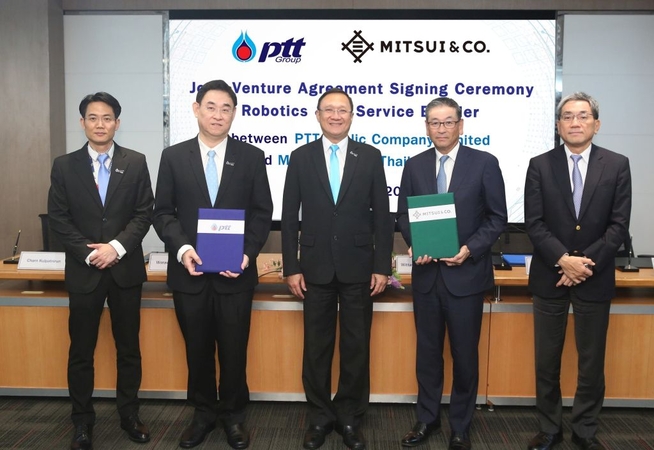
PTT Plc and Mitsui & Co (Thailand) Ltd have signed a cooperation agreement on the development of robotics and artificial intelligence (AI).

The joint venture focuses on creating a value-based economy that is driven by innovation, digital systems, and high-tech automation in the industrial sector.

Wittawat Svasti-xuto, Chief Technology and Engineering Officer at PTT, revealed that the agreement was a significant milestone for PTT’s new business investment strategy to foster sustainable growth while addressing challenges of the digital transformation.

With a strong determination to promote the use of robot technology, automation and intelligent solutions in the industrial sector, this business partnership would emphasise the expertise of the two partners that would be beneficial to industrial development.

In the initial phase, PTT and Mitsui & Co will focus on developing a System Integrator (SI) capability to help local players and potential customers create added value throughout the business chain, based on technology and digital expertise.

Mitsui & Co Ltd is one of the largest and most prominent global trading and investment companies while Mitsui & Co (Thailand) Ltd, an affiliate of Mitsui & Co, has a long presence in the country.

Since the 1950s, Mitsui & Co has built a diverse portfolio of businesses in Thailand covering oil & gas, steel, infrastructure, machinery, vehicles, chemicals, food and ICT.

“Today’s cooperation will be a mechanism that drive our country’s economy by encouraging the industrial sector to use robotics and artificial intelligence in response to the government’s Thailand 4.0 policy. Therefore, the expansion of production will occur, leading to a growing robotics industry and widespread automation that is aligned with the New S-Curve industries, the country’s strategic industries.

The collaboration will play a part in driving Thailand’s economic development through innovation. It can also increase the potential to expand business opportunities to the world market in the future,” added Wittawat.

Unique Construction to offer Bt3 billion, 3-year debentures #ศาสตร์เกษตรดินปุ๋ย

#ศาสตร์เกษตรดินปุ๋ย : ขอบคุณแหล่งข้อมูล : หนังสือพิมพ์ The Nation

https://www.nationthailand.com/business/30380828?utm_source=category&utm_medium=internal_referral

Unique Construction to offer Bt3 billion, 3-year debentures

Jan 20. 2020
Unique SVP of accounts and finance Toemphong Mohsuwa

Unique SVP of accounts and finance Toemphong Mohsuwa
By THE NATION

Construction firm Unique Construction and Engineering Plc is preparing to issue and offer up to Bt3 billion of three-year debentures to the public, the firm said in a statement on Monday (January 20).

The debentures, with 3.70 per cent annual return, was rated BBB by Tris Rating.

It will be available for subscription to the public from February 11-13 via Krungthai Bank.

Interest will be paid quarterly. Minimum investment is Bt100,000.

The key purpose of the issuance is to raise funds for the construction of the SRT Light Red Line Project in the suburban area of Bang Sue-Rangsit and other future projects.

The company appointed Krungthai Bank to be the underwriter of the Bt3-billion debentures, Unique senior vice president of accounts and finance Toemphong Mohsuwa said.

Unique is poised for growth from the much-anticipated public transportation infrastructure projects in the years ahead, the statement added.

Krungsri and companies post record high net of Bt32.7 bn in 2019 #ศาสตร์เกษตรดินปุ๋ย

#ศาสตร์เกษตรดินปุ๋ย : ขอบคุณแหล่งข้อมูล : หนังสือพิมพ์ The Nation

https://www.nationthailand.com/business/30380825?utm_source=category&utm_medium=internal_referral

Krungsri and companies post record high net of Bt32.7 bn in 2019

Jan 20. 2020
Krungsri President and Chief Executive Officer Seiichiro Akita

Krungsri President and Chief Executive Officer Seiichiro Akita
By THE NATION

Bank of Ayudhya (Krungsri) and its business units posted a record net profit of Bt32.7 billion in 2019, representing a surge of 32 per cent year on year.

The outstanding performance was attributed to significantly higher non-interest income, and higher interest income, supported by a healthy loan growth of 8.7 per cent.

Its net profit increased to Bt32.7 billion, a 32-per cent jump from 2018. Excluding the one-off items in 2019, the normalised net profit for the year stood at Bt26.9 billion, a 8.6 per cent increase from 2018.

Krungsri President and Chief Executive Officer Seiichiro Akita said: “Notwithstanding the weakening operating environment, buoyed by the strong fundamentals, Krungsri delivered a record net profit of Bt32.7 billion, a 32 per cent increase from the year before. Loan growth was also robust at 8.7 per cent, exceeding the bank’s target range of 6 – 8 per cent. These reflected the bank’s agility in realigning our loan portfolio towards high-yield segments, thus moving Krungsri closer to the target optimal portfolio mix between retail and commercial loans at a 50:50 ratio”.

Commenting on the overall business outlook for 2020, Akita said:” Despite the improved outlook on the global economy, uncertainties pertaining to trade tensions and geopolitical risks remain high. Continued accommodative monetary policy together with fiscal stimulus measures as well as the expected acceleration in public investment will provide support required to maintain Thailand’s economic growth momentum for 2020 at around 2.5 per cent. Consequently, Krungsri prudently sets a loan growth target of 5 – 7 per cent for the year”.

Goldman readies a hiring spree and capital to meet its China ambitions #ศาสตร์เกษตรดินปุ๋ย

#ศาสตร์เกษตรดินปุ๋ย : ขอบคุณแหล่งข้อมูล : หนังสือพิมพ์ The Nation

https://www.nationthailand.com/business/30380808?utm_source=category&utm_medium=internal_referral

Goldman readies a hiring spree and capital to meet its China ambitions

Jan 20. 2020
David Solomon, chief executive officer of Goldman Sachs, speaks during a panel discussion at the Bloomberg New Economy Forum in Beijing on Nov. 21, 2019. MUST CREDIT: Bloomberg photo by Takaaki Iwabu.

David Solomon, chief executive officer of Goldman Sachs, speaks during a panel discussion at the Bloomberg New Economy Forum in Beijing on Nov. 21, 2019. MUST CREDIT: Bloomberg photo by Takaaki Iwabu.
By Syndication Washington Post, Bloomberg · Cathy Chan

The news swept through Goldman’s offices around China, changing everything.

On a Friday afternoon in late 2017, an official in Beijing announced that the world’s most populous nation would let Wall Street banks expand across its markets. Goldman had spent more than a decade waiting in frustration for that chance. Regional bosses including James Paradise and Todd Leland urgently worked the phones, pinning down details to inform headquarters in New York.

Since then, Goldman Sachs has spoken publicly only in broad strokes about its strategy for China as the gates come down this year. But inside the firm, a massive effort is taking shape. Three months ago, a team of executives presented a five-year plan for China to the board, calling for the bank to take control of a joint venture it set up with a Chinese securities firm in 2004. Infused with hundreds of millions of dollars in new capital, the unit would embark on a hiring spree to double its workforce to 600 and ramp up a wide variety of businesses.

The strategy — described by senior Goldman executives and others familiar with the plan — shows how Chief Executive Officer David Solomon and President John Waldron are taking up the mantle once carried by former CEO Hank Paulson, betting China will finally make the world’s second-largest economy a more level playing field for foreign investment banks. Last year, they traveled to China seven times to meet senior officials, laying the groundwork. Another round of visits is set for 2020.

“We’re increasingly optimistic that we’re going to have the opportunity to actually move more in the right direction, maybe even faster than we thought,” Waldron said in an interview last week. “If you’re going to have a successful business in China, you need to have an appropriate relationship with the government because so much happening in China relates to the government.”

Global investment banks have been stymied from expanding in China amid its economic rise this century. Its laws required foreign firms do local securities business through joint ventures with Chinese partners, who kept controlling stakes. That put U.S. and European firms in the uncomfortable position of risking their capital without the final say on strategy or deals.

Now, a growing number of banks are seeking permission to take over those entities. Goldman applied in August to increase its stake in Goldman Sachs Gao Hua Securities Co. to 51% from 33%. Internally, executives talk about owning the entire business as soon as possible.

China is opening at a key moment for Goldman, offering the bank another frontier as it faces mounting pressure to find ways to boost revenue. Analysts estimate the bank will confirm this week that revenue fell in 2019. It’s expected to brief investors on its broader strategy in coming weeks.

Still, its plan to ambitiously ramp up the venture is striking after a decade in which top executives said they didn’t want to “overinvest” in winning investment banking mandates from China amid its restrictions. In that time, JPMorgan Chase and UBS Group both established a larger presence than Goldman inside the country.

Goldman intends to add to its advisory, markets and merchant banking operations on the mainland. And in a twist, its executives are especially excited about what Waldron calls the potential for “gigantic” growth in its nascent business of tending wealth there. “The biggest opportunity in China is actually not in investment banking,” he said. “The biggest opportunity in China is to be an asset manager for all the savings.”

It would be understandable if the bank were less enthusiastic about expanding in China, given how long it’s waited.

As the country’s economy took off in the 1990s, Goldman was among global banks that seized the opportunity, reaping fees by advising government-backed entities on billions of dollars of stock listings. A decade later, the bank made another bundle as China desperately sought to recapitalize its lenders. By 2006, Paulson arranged what was then Goldman’s biggest-ever principal bet — a $2.58 billion investment in Industrial & Commercial Bank of China Ltd. that produced an estimated $12 billion in dividends and proceeds by the time the firm unloaded it in 2013.

But hopes of running a wholly owned securities division inside China kept getting thwarted.

Paulson made at least 70 trips to China as the firm’s leader, for a time becoming the most famous foreigner there who wasn’t either a head of state or pop star. When he set up the bank’s joint venture with Beijing Gao Hua Securities in 2004, he declared the company was entering “an exciting new chapter.”

But not too long after Paulson stepped down in 2006, cracks started forming in markets that led to a global credit crisis in 2008. Goldman’s star in China faded and officials became highly skeptical of all foreign banks’ practices, products and advice, people familiar with their thinking said.

Paulson’s successor, Lloyd Blankfein, didn’t travel to China as often. Instead, he spent much of his tenure guiding the firm through the fallout of the crisis, adjusting strategy for an era of stiffer regulation and capital requirements. While Blankfein publicly proclaimed this as China’s century, he and other bank chiefs struggled to persuade reluctant Beijing officials to open their market. After the government took some steps, its suspicions of banks such as Goldman flared anew in 2015 when the nation’s stock market swooned. The expansion Paulson sought to set up for Blankfein never materialized.

The result is that Goldman has booked relatively paltry profits onshore, instead focusing mainly on helping Chinese clients tap markets abroad. Inside China, the bank’s best year was 2015, when it generated roughly $120 million in revenue from investment banking, asset management and brokerage operations with its Chinese partner, according to filings by Gao Hua Securities Co. Its onshore revenue in 2018 equates to far less than 1% of what the country’s entire securities industry generated that year.

Blankfein happened to be in Beijing with President Donald Trump in November 2017 as China prepared to make its surprise declaration about opening its market for financial firms. Somewhat famously, Trump didn’t know it was coming. Blankfein boarded a plane before the announcement, and if he knew about it, he didn’t let on. Inside Goldman, executives who had worked directly with the government and suspected something was afoot were caught off guard.

“There was an instant reaction internally,” Paradise recalled in an interview, snapping his fingers. He and Leland oversee Goldman’s businesses in the Asia-Pacific region except for Japan. “And the first people to see and read that news were people in this time zone.”

Banks such as Goldman are hoping that breakthrough will be followed by a regulatory and legal framework in China that will let them sell more sophisticated products and services on the mainland, akin to what’s available in other parts of the world. Offering ways to hedge or diversify investments, for example, can be lucrative for securities firms, but it could also help make China’s capital markets more robust. The pace of Goldman’s expansion will depend on how that develops, Paradise said.

For years, Goldman had been lobbying the government and soliciting regulators’ thoughts on proposed products, Leland said. But the conversation has since reversed as officials show interest in giving Chinese companies access to more capital and financial tools. “Now, it’s them asking us: ‘Would you do this, could you do that?'” Leland said. “That encourages us to move quicker.”

The bank has been working with authorities to teach them about financial products not yet widely available in China, such as derivatives. The thinking is that young Chinese companies will need to shift from focusing solely on grabbing market share to generating reliable profits to attract foreign shareholders. And for that, they will need to hedge risks.

The country’s burgeoning wealth makes asset management a priority, too. High-net-worth people there still have relatively few investment options.

Should China continue its reform pace, Goldman estimates its private bankers will be able to grow the assets they manage at an average percentage rate in the mid-teens over the next five years, which would potentially double onshore revenue, according to Ron Lee, Asia Pacific head of investment management. “If we add bankers, and there’s a growth rate, we can grow even faster,” he said. “We’re looking to do both.”

Once it gains control, the bank will rebrand its wealth business to feature only its own name, rather than including Gao Hua. It also plans to expand its footprint outside of Beijing and Shanghai to the surging metropolis of Shenzhen, home to legions of factories and more than 20 million people. The firm is already interviewing bankers and finding office space there, Lee said. Yet there are limits to how quickly it can add private bankers.

“The reality is we’re finding that because the wealth management landscape is relatively nascent in China, the talent pool is relatively limited, so we have to be a little more patient,” Lee said. “We’re looking for a high, but steady, growth rate.”

Managing global talent mobility through a global employment company #ศาสตร์เกษตรดินปุ๋ย

#ศาสตร์เกษตรดินปุ๋ย : ขอบคุณแหล่งข้อมูล : หนังสือพิมพ์ The Nation

https://www.nationthailand.com/business/30380849?utm_source=category&utm_medium=internal_referral

Managing global talent mobility through a global employment company

Jan 21. 2020
Anthony Loh, Partner, Tax & Legal Services,
Deloitte Thailand

Anthony Loh, Partner, Tax & Legal Services, Deloitte Thailand
By Special to The Nation

The Thai economy has been growing at a slower pace since 2016, and is experiencing a further slowdown due to weaker domestic demands, strong baht impacting export/tourism industry, and varies external factors.

The overall Thai economy growth is forecast to remain flat in 2020. Due to such sluggish domestic economy performance, many Thai-based businesses either are resorting to opportunities offered by the international market, including investing abroad or buying up Thai assets that are previously owned by foreigner investors, or attracting highly skilled talents from other countries.

While expanding their overseas operations, companies might face the situation where employees have to be seconded for a period of time to complete certain assignments abroad, and vice versa.

Traditionally, the employee will usually be seconded by the home entity directly to the host entity (eg the main entity at the designated location). The home entity may continue to control the employment as well as the work product(s) of such seconded employee.

However, depending on the volume and complexity (eg number of countries involved), both the home entity and the host entity may be exposed to various risks, including governance, compliance and reporting risks, tax-related exposures, and other talent mobility considerations.

To be more specific, internationally mobile employees can create significant tax exposures, especially in light of the recent Base Erosion and Profit Shifting (BEPS) developments initiated by the Organisation for Economic Co-operation and Development (OECD).

For example, seconding employees to carry on business of the home entity at the place of the host entity for a period of time could be considered as constituting a permanent establishment (PE) of the home entity situated in the host country, thereby creating tax obligation of the home entity in that host country.

In this regard, to facilitate global expansion via outbound investment whilst managing associated obligations and risks, companies, having the needs to (frequently) send or receive employees for international assignments, can consider to accomplish so through a global employment company (GEC).

The GEC structure has been around and is essentially a special purpose entity established for the purpose of scrutinising mobility status of employees and facilitating international mobility arrangements in order to quarantine risks.

Under the GEC model, the seconded employee will cut ties with the home entity and conclude a new employment contract with the GEC (ie, the GEC will be the employer of record). The GEC will then assign the employee to the host entity. The GEC model would be the most optimal to manage high volumes of mobile employees with a number of home and host country combinations.

The GEC model comes with several advantages. For instance, a GEC can help:

1 Streamline the internal policies and processes for improving operational efficiency (e.g., eliminate lengthy negotiations on compensation and benefits concerning each secondment), thereby facilitating timely redeployment of talent;

2 Increase the available talent pool for deployment in the best interests of the organisation and the employees;

3 Establish specialized central management of administrative and regulatory obligations for better compliance (e.g., visa and immigration processes);

4 Mitigate cross-border tax-related impacts (e.g., PE exposure, personal income tax complications, and transfer pricing issues).

It is worth noting that, in order for the GEC model to achieve its objective, choosing the right location to set up the GEC is one of the most critical exercises involved in the model.

Key considerations of the favored locations includes stable political, economic, and regulatory environment, ease of traveling in and out of the country, less stringent foreign exchange control, availability of local talent and relevant support services (required by the GEC), as well as the existence of a robust treaty network.

Additionally, depending on the intention of operating through a GEC, the potential structures could be either global, regional or in-country. In other words, the structure could range from a straightforward in-country entity (in this case, a Thai entity) set up for the sole purpose of checking employee’s mobility status to a larger scaled entity which might be involved in managing more complex aspects of global talent mobility.

Nevertheless, the GEC model is not free from challenges. One of the challenges are the evolving transfer pricing rules governing intercompany pricing of transfers of property and services.

In light of the worldwide anti-avoidance trend, intercompany transactions are increasingly being scrutinised and movement of highly skillful employees could be viewed, in certain circumstances, as transferring valuable intellectual property rather than just a provision of services, thus warranting careful pricing analysis.

To avoid complications and challenges from tax authorities, it is essential for companies to set up a proper transfer pricing policy in relation to secondment arrangements when implementing the GEC model.

Although the GEC structure has been introduced years ago, the implementation of the structure has not been particularly pervasive. However, given the vast scale of cross-border talent migration nowadays, it is believed that the GEC structure is coming back in trend to better support multinational enterprises with their ever-complexing worldwide operations.

From the perspective of Thai-based companies looking to expand overseas, managing global talent mobility through a GEC would allow Thai-based multinationals to enjoy various benefits, such as operational efficiency and tax risk management, as mentioned above in the article.

Contributed by Anthony Loh, Partner, Tax & Legal Services,

Deloitte Thailand

Millennials’ share of the U.S. housing market: small and shrinking #ศาสตร์เกษตรดินปุ๋ย

#ศาสตร์เกษตรดินปุ๋ย : ขอบคุณแหล่งข้อมูล : หนังสือพิมพ์ The Nation

https://www.nationthailand.com/business/30380851?utm_source=category&utm_medium=internal_referral

Millennials’ share of the U.S. housing market: small and shrinking

Jan 21. 2020
By The Washington Post · Christopher Ingraham 

Today’s young adults are starting their lives on drastically different financial footing than their parents did decades ago. Necessities cost far more and wages have flattened; as a result, many young families have to dig through mountains of debt before they can even think about growing their wealth.

A data point from the Federal Reserve, highlighted recently in a special report on housing by the Economist, underscores the differences between millennials’ financial trajectory and those of earlier generations: In 1990, baby boomers, whose median age was 35, owned nearly one-third of American real estate by value.

In 2019, the millennial generation, with a median age of 31, owned just 4 percent.

Millennials, many of whom are entering their prime home-buying years, are likely to make up some of that gap by the time they see 35. But they’re not likely to reach 30 percent of the housing market – or even the 20 percent attained by the smaller Generation X at the same point in their lives.

Because homeownership is the chief builder of wealth for middle class families, if this trend continues “we’re looking at a generation that will have lower lifetime wealth,” said Jenny Schuetz, a housing policy expert at the Brookings Institution. “That’s bad news for the economy overall, not just millennials,” she added.

The challenge facing would-be millennial home buyers is two-pronged. In many of America’s most desirable cities, the median price of a home is well beyond the reach of a typical salary. For the past several decades, developers in major metro areas like New York City have built a glut of luxury condos while ignoring the needs of the middle class. Strict land use and zoning regulations, as well as opposition to new development by many existing homeowners, have exacerbated the problem.

Millennials’ massive debt burdens also make it difficult to them to save for a down payment at any housing price. For households headed by someone younger than 35, median debt ballooned from $21,000 in 1989 to $39,000 in 2016. During that same time period, the percentage of under-35 households with student loan debt more than doubled, from 17 percent to 45 percent, and their median debt more than tripled, from $5,600 to $18,500.

These factors are propelling us toward an inflection point. As baby boomers slowly age out of homeownership, a projected $13.5 trillion in housing inventory will come on the market in the coming years. But millennials and younger generations might not be able to afford them.

“At some point, boomers will want/need to sell their houses, and it’s not clear that millennials will be able to pay what boomers think their homes are worth,” Schuetz said.

On the other hand, some of those boomers will leave their estates to their children. “Millennials whose parents are sitting on lots of housing wealth will have an easier time paying for college or coming up with a down payment – even if they don’t inherit for a while, they have a family safety net,” Schuetz said. So it’s likely that millennials will rapidly bridge some of the housing gap visible in the chart above.

One mystery remains, however: As things stand, the share of housing wealth accumulated by American millennials is falling – in 2016 it reached a high of 7.5 percent and has been declining steadily since. Conversely, boomers and members of the silent generation have seen their collective share of the American housing market rise about 5 percentage points since 2016.

Schuetz says the reason for that drop isn’t immediately clear. It could be, for instance, that real estate currently owned by older generations is appreciating more rapidly in value than that owned by millennials.

Regardless, the downward trend suggests that the current pressures facing would-be millennial home buyers aren’t easing anytime soon.

The global economy is likely to rebound in 2020, but the IMF warns of eerie parallels to the 1920s #ศาสตร์เกษตรดินปุ๋ย

#ศาสตร์เกษตรดินปุ๋ย : ขอบคุณแหล่งข้อมูล : หนังสือพิมพ์ The Nation

https://www.nationthailand.com/business/30380850?utm_source=category&utm_medium=internal_referral

The global economy is likely to rebound in 2020, but the IMF warns of eerie parallels to the 1920s

Jan 21. 2020
By The Washington Post · Heather Long

DAVOS, Switzerland – This year is likely to see a “sluggish recovery” for the world economy, the International Monetary Fund said Monday, but it warned that there are alarming parallels between today’s economy and that of the 1920s.

Global growth is expected to hit 3.3 percent this year, the IMF predicted. That is up from 2.9 percent last year, which was the worst year for the world economy since the Great Recession.

The more upbeat forecast for 2020 is largely due to President Donald Trump’s trade war easing with China and the stimulus from 49 central banks, including the Federal Reserve, that lowered interest rates in recent months. IMF Managing Director Kristalina Georgieva called the initial U.S.-China trade deal a “welcoming sign.”

But here in Davos, as top business and political leaders gather in this ski chalet town in the Swiss Alps, uncertainty remains high – about Trump launching a trade war with Europe, about military flare-ups in the Middle East, about central banks running out of medicine to revive the economy, about inequality and about record levels of corporate debt.

“The reality is global growth remains sluggish,” Georgieva said Monday. “We are adjusting to live with the new normal of higher uncertainty.”

Georgieva warned that the record or near-record levels of wealth inequality in the United States, United Kingdom and many other parts of the world, combined with the rapid advancement of technology, feels a lot like the 1920s, which ultimately led to financial disaster.

“The beginning of this decade (has been) eerily reminiscent of the 1920s – high inequality, rapid spread of technology and huge risks and rewards in finance,” Georgieva said. “For the analogy to stop right there and go no further, acting together in a coordinated manner is absolutely critical.”

The IMF is urging countries to use this time now, while unemployment is low and growth is decent, to address bigger problems in the economy. While the short-term economic outlook is positive, there are deep structural trends in the economy that are worrying for the longer term.

The U.S. economy will grow at 2 percent, down modestly from 2.3 percent last year, the IMF predicted. China is expected to grow at 6 percent, down from 6.1 percent last year. Growth is expected to pick up in Europe, Brazil, Mexico and some other emerging markets.

“We’re probably at a low right now. We should start to see growth accelerate as the year goes on,” said Chris Williamson, chief business economist at IHS Markit.

American consumers continue to be the backbone of the U.S. economy. Business investment dried up last year as executives sat on their cash to see what would happen with the trade war. There is hope that there might be a modest uptick in business investment.

“I do believe we will see an uptick in investment now,” said Kelly Grier, U.S. chair of EY, the consulting firm formerly known and Ernst & Young. In discussions with business leaders in recent days, Grier said reaction has been “quite positive” on the trade deals and the perception is this is a “period of relative calm” now for trade.

More business spending and a rebound in global growth should help boost manufacturing, which was in a mild recession last year in the United States and other countries.

Treasury Secretary Steven Mnuchin recently predicted a surge in growth following the signing of the partial China trade deal and the U.S.-Mexico-Canada trade agreement. Most independent economists say while finalizing the deals is a small positive for the economy, they don’t expect a big bump from that alone.

After 2020, there are concerns about where the U.S. and global economies are headed. The extremely low interest rates that have been in place for over a decade have side effects. They push investors into riskier investments that could backfire.

“The Fed is pumping liquidity into the system. We had a period like this back in 1998 and 1999 that inflated the internet bubble,” said Scott Minerd, global chief investment officer of Guggenheim Investments and a Davos attendee. “The fact the Fed doesn’t seem to be aware they are creating bubbles in risky assets is really disconcerting.”

The world is awash in debt again. Leading into the 2008 financial crisis, housing and consumer debt was at record levels, causing a bubble that ultimately burst. Today, there is around $10 trillion in corporate debt, a level never seen before. No one knows how long this can be sustained or what would happen if interest rates went up again. Minerd also pointed to the surge in commercial real estate as a red flag.

The United States is enjoying the longest expansion in its history, lasting 11 years. While recession risks have largely faded for 2020, there’s heightened attention on every sign of a potential slowdown.

“There is a sense that even though risks have receded at the moment, that this is a very long, old bull market for equities and a very long, old economic expansion,” said Rich Nuzum, president of Mercer’s wealth business, which works with large investors around the world.

Fuel consumption forecast to expand 2 per cent #ศาสตร์เกษตรดินปุ๋ย

#ศาสตร์เกษตรดินปุ๋ย : ขอบคุณแหล่งข้อมูล : หนังสือพิมพ์ The Nation

https://www.nationthailand.com/business/30380834?utm_source=category&utm_medium=internal_referral

Fuel consumption forecast to expand 2 per cent

Jan 21. 2020
By THE NATION

Total fuel consumption in Thailand is expected to expand 2 per cent this year, the Department of Energy Business estimates.

The projection is based on the assumption that the 2020 economy will expand between 2.8 per cent and 3 per cent while the Dubai crude oil price will be in the range of US$65-70 (Bt1,972-Bt2,125) per barrel, director-general Nantika Thangsuphanich said on Monday (January 20).

Fuel demand in the first quarter, excluding NGV, is expected to be 132.5 million litres daily, she added.

However, LPG demand this year is projected to fall 1.9 per cent to 17.5 million kilogrammes per day.

Meanwhile, diesel demand is expected to be 71.6 million litres daily, up 6.3 per cent from the 67.3 million litres per day last year.

The demand for B10 diesel is projected to be 22.5 million litres daily in the first quarter this year before rising to 57 million litres per day in December.

The number of petrol stations selling B10 is expected to increase to around 3,000 at the end of this month, up from 800 last year, and is likely to expand to 4,000 stations next month. All stations will sell B10 at the end of March.

Benzene-based fuel consumption is projected to expand 3.7 per cent this year to 33.4 million litres per day.

The department estimated that the consumption of gasohol 95 will increase 1.9 per cent this year to 14.2 million litres per day, while that of gasohol 91 will expand 4.2 per cent to 10 million litres per day.

The demand for gasohol E20 is forecast to grow 3.6 per cent to 6.8 million litres per day, while that for gasohol E85 will increase 3.1 per cent to 1.3 million litres daily.

Agencies meet on steps to boost liquidity #ศาสตร์เกษตรดินปุ๋ย

#ศาสตร์เกษตรดินปุ๋ย : ขอบคุณแหล่งข้อมูล : หนังสือพิมพ์ The Nation

https://www.nationthailand.com/business/30380848?utm_source=category&utm_medium=internal_referral

Agencies meet on steps to boost liquidity

Jan 21. 2020
By THE NATION

State agencies involved in monetary and fiscal policies convened a meeting on Monday (January 20) on new measures to boost liquidity in the Thai economy, chaired by Deputy Prime Minister Somkid Jatusripitak.

Kobsak Pootrakool, deputy secretary-general to the prime minister for political affairs, said Somkid urged the specialised financial institutions to promptly ease loan interest burden for small and medium-sized enterprises (SMEs).

Somkid also instructed the Finance Ministry to accelerate refund of VAT and personal income tax to SMEs to help boost their liquidity.

The meeting discussed guidelines on ensuring the baht’s stability and movement in alignment with other currencies in the region.

Meanwhile, the Office of Insurance Commission was asked to consider allowing insurance companies to invest overseas as a means to drive outflow of the Thai currency in a bid to stem the strengthening baht.

The meeting also asked the Bank of Thailand to consider investing its international reserve on higher return assets.

BOT eases loan to value ratio for homebuyers #ศาสตร์เกษตรดินปุ๋ย

#ศาสตร์เกษตรดินปุ๋ย : ขอบคุณแหล่งข้อมูล : หนังสือพิมพ์ The Nation

https://www.nationthailand.com/business/30380833?utm_source=category&utm_medium=internal_referral

BOT eases loan to value ratio for homebuyers

Jan 20. 2020
 Deputy central bank governor Ronadol Numnonda.

Deputy central bank governor Ronadol Numnonda.
By The Nation

The Bank of Thailand has relaxed conditions on home loans, aimed at supporting first-time homebuyers and those buying a second residence, said deputy central bank governor Ronadol Numnonda, adding that however, they must show a record of financial disciplines.

The BOT today (January 20) announced new rules on loan to value ratio (LTV), under which, in addition to first-time homebuyers being able to apply for a loan equivalent to 100 per cent of the property’s value, banks are allowed to offer 10 per cent more for expenses on furniture and interior decor.

Those buying a second home are required to place a 10 per cent down payment if they have serviced the first home loan for two years or more. Previously, they needed to service debt under the first mortgage contract for at least three years. However, a 20-per cent down payment is required if they have serviced the first contract for less than two years.These apply to properties valued at less than Bt10 million.

For homes worth more than Bt10 million each, buyers need to settle a 10 per cent down payment for the first contract, down from 20 per cent. This measure aims to serve those seeking a  different lifestyle.

The central bank has also relaxed mortgage loan reserves for banks to reduce their financial cost and boost their liquidity.