Thailand, Laos target big jump in bilateral trade #ศาสตร์เกษตรดินปุ๋ย

#ศาสตร์เกษตรดินปุ๋ย : ขอบคุณแหล่งข้อมูล : หนังสือพิมพ์ The Nation

https://www.nationthailand.com/business/30381105?utm_source=category&utm_medium=internal_referral

Thailand, Laos target big jump in bilateral trade

Jan 27. 2020
By The Nation
Thailand and Laos will hold negotiations late next month with the goal of giving a big boost to bilateral trade next year.

Auramon Supthaweethum, director-general of Thailand’s Trade Negotiations Department, revealed that on February 25-26 there will be a meeting of the Thai-Laos cooperation plan at the ministerial level. There will also be a meeting between the Ministry of Commerce of Thailand and the Ministry of Industry and Trade of Laos in Bangkok with the goal of promoting cooperation in trade and investment.

They aim to nearly double bilateral trade from the 2016 figure of $5.9 billion to around $11 billion by 2021, she said.

In 2018, bilateral trade amounted to $6.73 billion, increasing by 9.21 per cent over 2017 with Thailand enjoying a trade surplus. Thai exports to Laos amounted to $4.12 billion and Thai imports from Laos were valued at $2.61 billion.

Laos is Thailand’s 21st biggest partner in the world market and eighth largest trading partner in Asean. Exports included refined oil, cars, equipment and components, livestock products, iron, steel, chemicals and cosmetics, soaps, etc while major imports were fuel (electricity), metal ore, electrical machinery and components, electrical appliances, vegetables, fruits, cement, etc.

Meanwhile, the third meeting of the Thai-Maldives Joint Trade Committee (JTC) at the ministerial level will also be held. The Maldives is Thailand’s 84th largest trading partner in the world market and the fifth in South Asia behind India, Pakistan, Bangladesh and Sri Lanka. The meeting aims to promote investment and reduce trade barriers, especially in tourism. The Maldives has many tourists visiting each year, resulting in tourism investment, especially in the service sector, hotels, restaurants, spas, etc. Therefore, there is a need for construction equipment, furniture, various machinery including personnel who will help service training and premium products for tourists, she said.

“This is an opportunity for Thailand to expand further in accordance with the policy of Jurin Laksanawisit, Deputy Prime Minister and Minister of Commerce,” she added.

Trade between Thailand and Maldives during the first 11 months of 2019 (January to November) was valued at $170.28 million. Thai exports accounted for $108.60 million. Exports included motorcycles and components, plastic products, clothes, furniture, machinery and mechanical components. Thailand’s imports totalled $61.69 million, including products such as fresh, chilled, frozen, processed and semi-processed aquatic animals, metal products, textile products and publications etc.

“Maldives is a tourist destination that many tourists want to visit. Therefore, the restaurant, spa, and hotel service businesses are likely to grow. It is an opportunity for Thailand which has potential in this field to invest and open the market for premium products,” said Auramon.

Auramon said the 12th Thailand-India JTC Meeting is expected to take place in March in New Delhi while the Thailand-South Africa JTC meeting at senior officer level will be held on February 18 in Pretoria.

Water management a make-or-break challenge for industrial corridors #ศาสตร์เกษตรดินปุ๋ย

#ศาสตร์เกษตรดินปุ๋ย : ขอบคุณแหล่งข้อมูล : หนังสือพิมพ์ The Nation

https://www.nationthailand.com/business/30381083?utm_source=category&utm_medium=internal_referral

Water management a make-or-break challenge for industrial corridors

Jan 27. 2020
By The Nation

The Eastern Economic Corridor (EEC) currently has enough water for its needs but as people, labour and industrial activity gather pace the demand is seen spiking.

To ensure preparedness, the government has urged sufficient water management to support future growth by looking at the number of reservoirs in the eastern region in order to increase water storage. The government should be campaigning for factories in the EEC area to use technology to improve efficiency of water use and encourage various industrial estates improve their wastewater treatment systems to be able to recycle 50 per cent of water, experts said. That process, combined with the expansion of existing reservoirs, is seen as supplying the EEC area with sufficient water in the future

Jareeporn Jarukornsakul, group chief executive officer at WHA Corp Pcl, recently said that after buying four industrial estates — logistics, industrial business group, electricity and public utility, and digital business — WHA sees an opportunity for managing public utility in the estate. However, the heart of public utility is water; the firm that manages water and recycles waste has potential to make a lot of profit. She added that a water crisis was possible in the future and hence new technology for water recycling is needed.

“The company’s water business has expanded to serve customers in various factories. It expanded overseas, investing in water companies in Vietnam to produce more than 330 million cubic metres per year and we plan to expand in more businesses. In terms of wastewater treatment, we have coordinated with other estates that lack water management. At the moment, there are more than 70 estates in Thailand, with many sub-estates, for whom it is not worthwhile to manage themselves. We, therefore, go into service in these areas,” said Jareeporn.

Rojana Industrial Park manager Pakin Chonrattanahiran said that even before setting up the industrial estate, Rojana had designed and prepared well-water reserves to meet the needs of every plant and to be able to supply water for at least half a year without rains. It is confident that Rojana’s industrial estates in the eastern region and Ayutthaya province will survive the drought.

However, in order to build confidence for investors who will invest in the EEC in the future, the government should create more reservoirs and expand the current ones in the eastern region. Since the great flood of 2011 to the current drought, investor confidence has been affected as water is an important factor for industry. The government should have clear water management strategies — from drought to floods — including publicising for foreign investors. This will help build confidence among foreigners to invest in the EEC.

Viboon Kromadit, executive director and chief marketing officer at Amata Corp Pcl, said that all companies have shown concern after the drought hit the eastern region. Two Amata industrial estates — Amata City Chonburi and Amata City Rayong — have back-up measures to deal with the drought for more than 10 years, he said.

Amata has improved the wastewater management system in both industrial estates to recycle all the wastewater from the factories within the industrial estate so that 50 per cent can be recycled, resulting in a significant reduction in water usage, along with reserve ponds with a total capacity of more than 50 million cubic metres. When combined with 50 per cent of recycled water, Amata Industrial Estate is able to handle drought for more than a year and six months, and the estate will no longer be affected by current or future disasters, he said.

“Amata Industrial Estate uses 30 million cubic metres of water each year. Of these, 15 million cubic metres can be recycled which, combined with the Amata Reservoir’s 50 million cubic metres reservoir, helps build confidence in the operators that the industrial estate will not be affected by drought,” said Viboon.

Prasit Boondoungprasert, director of CPF, revealed that the severe and ongoing drought was affecting the overall economy of the country. “The company is aware of the importance of water resources, which are the key to the production of agriculture and industry. Water is managed with prudence to maximise benefits throughout the entire production chain according to eco-efficiency guidelines, which help to balance business growth and preserve the ecosystem by reducing the environmental impact at the same time towards the goal of reducing the use of natural water,” he said.

CPF aims to reduce the amount of water used per unit of production by 25 per cent in 2020 and 30 per cent in 2025 and has three sustainable water management ways: assessing water shortage risks on a regular basis according to the principles of Aqueduct, an international water risk assessment agency; reuse of water; distribution of treated water from livestock farms and food processing plants to communities and farmers around the factory to alleviate water shortages, he said.

In 2018 the company had 28 million cubic metres of treated and reused water, accounting for 18 per cent of the total volume of water use.

Trairat Udomsriyo, executive vice president at CP Intertrade, which produces the Khaotrachat rice brand, showed some concern as the drought crisis has affected the overall economy of the country. Many sectors have experienced various problems, especially the Thai agricultural sector. There is not enough water for agriculture while also lacking water for consumption which is the worst drought warning signal in the past decade, Trairat said.

As a private sector, whose business is agricultural products, Trairat said they were concerned about the current drought crisis, so the upstream material development team ​​has closely monitored the situation and assessed it together with a network of member farmers under the Upstream Raw Materials Development Project. The project aims to help rice farmers grow rice correctly according to GAP standards, which has a network of more than 13,108 farmers, covering an area of ​​301,322 rai in the northern, central and eastern regions and coordinating closely to find ways and solutions to the drought.

As for farming, 10 per cent of the farmers under the company’s project have to stop planting for one planting season. The company has found a way to deal with the situation through the concept of “Turning drought crisis into opportunity”.

“Throughout the period, farmers have to stop planting for one season and use the opportunity to adjust the level of land [laser land levelling], joining the project with the Department of Rice. Adjusting the area of ​​the rice field to be levelled will enable farmers to reduce water use in the next planting season by up to 50 per cent,” Trairat said.

Study on smart city in EEC close to completion #ศาสตร์เกษตรดินปุ๋ย

#ศาสตร์เกษตรดินปุ๋ย : ขอบคุณแหล่งข้อมูล : หนังสือพิมพ์ The Nation

https://www.nationthailand.com/business/30381066?utm_source=category&utm_medium=internal_referral

Study on smart city in EEC close to completion

Jan 27. 2020
Photo credit: EEC

Photo credit: EEC
By THE NATION

The Office of the Eastern Economic Corridor (EEC) is close to finishing the study on developing the “smart city” project in Chachoengsao province.

The office secretary-general, Kanit Sangsubhan, said that a group of private investors from China are keen to bid for the contract to develop the smart city in the province where they want to develop a financial centre.

He added that the development of the smart city will be on a Public-Private Partnership basis.

Recently Deputy Prime Minister Somkid Jatusripitak urged the EEC office to accelerate the development of mega-projects in the corridor as part of the government’s policy to lift the softening economy.

Wuhan virus expected to hit Thai and Asian tourism hard #ศาสตร์เกษตรดินปุ๋ย

#ศาสตร์เกษตรดินปุ๋ย : ขอบคุณแหล่งข้อมูล : หนังสือพิมพ์ The Nation

https://www.nationthailand.com/business/30381104?utm_source=category&utm_medium=internal_referral

Wuhan virus expected to hit Thai and Asian tourism hard

Jan 27. 2020
File Photo/Nationphoto

File Photo/Nationphoto
By The Nation

The outbreak of the Wuhan virus may cost Thai and Asian tourism industries Bt100 billion in lost income, an economist has warned.

Preliminary estimates of the impact on tourism and related businesses in Thailand and other Asian nations are at around Bt80 billion to Bt100 billion, if the spread of the virus is contained by early March, Anusorn Tamajai, director of Economic and Business Research Centre at Rangsit University, said.

He warned that the impact could be more severe than that of SARS 17 years ago.

If the virus is not controlled by March, then the cost could be even higher, he said.

The Thai economy could expand by just 1.8 to 2.4 per cent in the first and second quarters, he said.

Asian economies this year may not recover to the average 6 per cent growth as expected and China’s growth may fall below 5.8 per cent.

The number of Chinese tourists are expected to drop by 1 to 2 million and foreign arrivals could be down by at least 2 per cent.

The Chinese government has already imposed travel restriction measures on Wuhan and other cities suspected of having cases of the new coronavirus infections.

The Thai government is targeting 41.8 million tourists this year with estimated revenue of Bt2.2 trillion, which will make Thailand one of the top six countries in terms of income from tourism.

The UN World Tourism Organisation had forecast that Asia’s tourism industry would expand by 7 per cent this year. However, the impact of the new coronavirus could slow growth to below 5 per cent, said Anusorn.

Speaking on a related issued, he said he did not agree with the Tourism and Sports Ministry’s proposal to offer cash handouts to foreign tourists. The government should instead allocate a budget to develop tourism sites and clean up air pollution, or PM 2.5 dust particles, he said.

Stuck-in-the-past Japanese banks wary of fintech revolution #ศาสตร์เกษตรดินปุ๋ย

#ศาสตร์เกษตรดินปุ๋ย : ขอบคุณแหล่งข้อมูล : หนังสือพิมพ์ The Nation

https://www.nationthailand.com/business/30381093?utm_source=category&utm_medium=internal_referral

Stuck-in-the-past Japanese banks wary of fintech revolution

Jan 26. 2020
The Money Forward app is displayed on a smartphone in Tokyo, on Jan. 22, 2020. MUST CREDIT: Bloomberg photo by Toru Hanai.

The Money Forward app is displayed on a smartphone in Tokyo, on Jan. 22, 2020. MUST CREDIT: Bloomberg photo by Toru Hanai.
By Syndication Washington Post, Bloomberg · Taiga Uranaka, Yuki Hagiwara

Japan’s effort to nudge its more than 100 struggling regional lenders into the digital age is floundering.

More than a year after rules to spur open banking were issued, small lenders are stuck in a back-and-forth with startups over fees for access to client account data, according to a Financial Services Agency official. Fintechs that must reach agreements with individual banks before a May deadline say they don’t have the resources to pay hefty charges or crisscross the country convincing hold-outs.

The impasse risks embarrassing policymakers keen to lift Japan off the bottom of a ranking on fintech adoption. A successful move into open banking would put the Asian nation in the company of the U.K. and Australia, which are freeing up data access to spur competition and create innovative financial solutions.

Japan is hoping for voluntary partnerships where startups help overhaul a stodgy industry hammered by years of negative interest rates, deflation and, for rural banks, depopulation. Mired in shrinking profits as the hinterland ages and empties of its young, some lenders are reluctant to ink deals that promise vague future returns but demand immediate investments.

“It’s difficult for some banks to fork out additional costs, even if they’re investments for the future, when it’s not clear how much they can profit by doing this,” said Junichi Kanda, an executive officer at fintech Money Forward Inc.

Progress has been slow. Just 25 of 59 eligible fintech companies had signed contracts with any banks as of September, the most recent FSA figures show. Only 57 of 130 lenders had any one-on-one agreements.

Teaming up with fintechs can give lenders a quick way to offer new digital services, while also gaining a fuller view of customer finances, the FSA official said, asking not to be identified in accordance with the agency’s policy. The official hoped talks would accelerate as the deadline neared.

Money Forward, one of the biggest startup participating in the project, has made agreements with fewer than half the 100 banks it wants to tie up with, Kanda said. He tries to convince banks that sharing data via application programming interfaces, or APIs, will migrate customers to mobile platforms from costly branches and automated teller machines.

Money Forward is developing apps for lenders including Gunma Bank and North Pacific Bank. For smaller peers, Kanda said negotiating with banks around the country is daunting, even with the FSA and industry groups arranging match-making sessions.

Another fintech, Moneytree KK, says putting a financial burden on startups could undermine the initiative. “We’re not a competitor to banks, we’re there to help them win,” sales chief Taizo Miyagami said.

Concerns about data-leak risks have played a role in some lenders’ slow adoption of open banking, according to Hideki Osawa, a senior consultant at Nomura Research Institute.

The lack of a dominant fintech player of the scale of China’s Alipay and WeChat Pay — which have reams of data on individual spending — is also a stumbling block in luring banks on board.

For the startups, failure to reach agreements means they risk being stranded without data access after May, disrupting services for households and small business owners who use their budgeting and accounting apps. That’s because the current practice of screen scraping without a bank’s permission will end after the deadline.

Some banks may decide to offer data access “for free or very low fees if they see significant benefits,” Japanese Bankers Association Chairman Makoto Takashima said at a briefing in December. “On the other hand, there could be cases where banks don’t see benefits and can’t even cover the costs of maintaining systems.”

Rural banks have also been frustrated by the process. Joyo Bank Ltd. President Ritsuo Sasajima, said his firm was quick to build APIs but short-staffed fintechs have been slow to respond. Still, Sasajima, who chairs the Regional Banks Association of Japan, said that on the whole “progress has been made.”

Traditional banks often have a “fortress mentality,” said James Lloyd, who leads Asia-Pacific fintech and payments at consultancy EY. Ultimately, “this will only work if the banks themselves see value in opening up.”

S. Korea reports 3rd confirmed case of Wuhan coronavirus #ศาสตร์เกษตรดินปุ๋ย

#ศาสตร์เกษตรดินปุ๋ย : ขอบคุณแหล่งข้อมูล : หนังสือพิมพ์ The Nation

https://www.nationthailand.com/news/30381112?utm_source=category&utm_medium=internal_referral

S. Korea reports 3rd confirmed case of Wuhan coronavirus

Jan 27. 2020
A patient with infected with the new strain of coronavirus is under treatment at a hospital in China. Yonhap

A patient with infected with the new strain of coronavirus is under treatment at a hospital in China. Yonhap
By Yonhap/The Korea Herald/ANN

South Korea on Sunday reported its third confirmed case of the Wuhan coronavirus amid mounting fears over the spread of the pneumonia-like illness throughout China and other parts of the world.

According to the Korea Centers for Disease Control and Prevention (KCDC), a 54-year-old South Korean resident of Wuhan who arrived back home on Monday tested positive for the new strain of the virus that has killed 56 people so far.

“Upon arrival at the airport he showed no symptoms but he started suffering from fever, chills and muscle cramps on Wednesday. His condition seems to have improved for a few days before getting worse again, at which time he contacted health authorities and was placed in isolation on Saturday for tests and treatment,” the KCDC said.

It said more information about the third case will be made available in due course.

Besides the latest confirmed case, the KCDC said it has checked 47 people who have showed symptoms so far, with all testing negative for the illness. The tally was 32 on Saturday.

The country reported two confirmed cases of the new coronavirus strain on Monday and Friday and is keeping close tabs on those that may have come in contact with such people.

To counter the health threat posed by the virus, the health authorities here said Saturday that they have designated mainland China a “coronavirus watch” zone as part of their ongoing efforts to prevent the spread of the Wuhan coronavirus here.

Later in the day, South Korea’s foreign ministry raised the travel advisory level for Wuhan and the Hubei region to “red alert” and recommended its citizens to evacuate the region.

The “red alert” is the third highest in the country’s four-tier travel warning system.

Reflecting the concerns raised by the coronavirus, airports across South Korea have set up checkpoints to screen passengers from China and other countries for signs of illness, with local authorities accelerating quarantine efforts to contain the virus as people visit relatives at home or travel abroad.

Health workers stressed citizens should follow strict personal hygiene rules whether they are in the country or traveling abroad, especially since large numbers of Chinese tourists are visiting South Korea during the holiday period. The start of the Lunar New Year is celebrated by both Korean and Chinese people.

They said people feeling ill should immediately contact its emergency call center by dialing “1339.”

It also asked people to wash their hands frequently, cover their mouths when coughing and, if they have respiratory problems, wear a mask.

Common symptoms of the coronavirus, thought to have originated in Wuhan, central China, include fever, sore throat and breathing difficulties, with more acute cases bringing chills and muscle pain. Health experts said that elderly people and those with underlying disorders should be more careful.

China announced that besides the deaths, 1,975 people are confirmed infected amid concerns that the virus is spreading quickly and widely. It said that of those infected, 324 were in critical condition.

Outside China, Japan, Taiwan, Thailand, Vietnam, Singapore, Malaysia, Macao, Hong Kong, France, Australia and the United States have reported confirmed cases of the new coronavirus strain, and there are media reports of a new case in Canada. (Yonhap)

5th case confirmed in U.S., 1,000 more expected in China #ศาสตร์เกษตรดินปุ๋ย

#ศาสตร์เกษตรดินปุ๋ย : ขอบคุณแหล่งข้อมูล : หนังสือพิมพ์ The Nation

https://www.nationthailand.com/news/30381111?utm_source=category&utm_medium=internal_referral

5th case confirmed in U.S., 1,000 more expected in China

Jan 27. 2020
By The Washington Post
Gerry Shih, David J. Lynch, Simon Denyer, Brittany Shammas
BEIJING – The Chinese government struggled Sunday to cope with a worsening coronavirus epidemic as its official number of infections soared and the death toll rose to 80, while additional cases appeared in the United States.

The government in Beijing broadened an extraordinary quarantine to more than 50 million people – roughly equal to the population of Spain – enforcing a travel ban on 16 cities in central Hubei province, where the lethal virus first appeared.

In the United States, health officials confirmed three new cases – one in Arizona and two in California – bringing the total to five. The patients – in Southern California, Chicago, Arizona and Washington state – had traveled from Wuhan, officials with the Centers for Disease Control and Prevention said. All are hospitalized.

As of midafternoon Sunday, the CDC has been investigating 100 people in 26 states, including the five who were confirmed infected. Of those, 25 people have been tested and are not infected with the virus.
https://www.washingtonpost.com/video/c/embed/57d569c4-b016-4f48-94c1-9c53dde48efe

Health officials expect more American cases, Nancy Messonnier, director of the CDC’s National Center for Immunization and Respiratory Diseases, told reporters. But the virus is not believed to be spreading from person to person in the United States, she said.

“For this reason, we continue to believe that the immediate health risks from the 2019 coronavirus to the general American public is low at this time,” Messonnier said. “But the threat is serious, and our public health response is aggressive, with the aim of helping protect Americans.”

Chinese officials, however, say the worst is yet to come. Health Minister Ma Xiaowei said Sunday that the virus is developing the ability to spread more easily, while the vice minister of industry, Wang Jiangping, said demand for medical supplies is overwhelming China’s ability to produce them.

The mayor of Wuhan, the epicenter of the outbreak, said he expects at least 1,000 more infections to surface. Workers are racing to build at least three pop-up 1,000-bed hospitals in the city to cope with the anticipated surge.

China’s national health commission reported that 2,744 people across 30 provinces had been infected as of Sunday. Eighty deaths have been reported, including in major metropolitan areas such as Shanghai. Several doctors in Beijing, the capital, also reported being infected.

Patients also have been confirmed in France, South Korea, Japan, Nepal, Thailand, Singapore, Vietnam, Taiwan and Australia.

After a slow start, Chinese authorities have moved aggressively to combat the novel ailment. Officials indefinitely extended the annual Lunar New Year holiday beyond its scheduled Jan. 30 end and deployed more than 1,000 doctors and military personnel to Wuhan.

The State Department, meanwhile, plans to evacuate diplomats posted at the U.S. Consulate in Wuhan on a charter flight on Tuesday, according to a statement posted on the website of the U.S. Embassy in Beijing. The consulate is about two miles from the Huanan Seafood Market, where the virus is believed to have first jumped from animals to humans.

A “limited” number of seats on the aircraft will be available for other Americans seeking to flee the city, with priority being given to those most at risk of succumbing to the fatal illness, the statement said.

Chinese authorities have banned the sale of wild animals for the duration of the crisis.

The economic fallout from the epidemic also is likely to be significant. Even before the outbreak, China’s economy was slowing, hampered by the trade war with the United States and government efforts to slow widespread borrowing. The galloping virus, which has crimped travel, shuttered movie theaters and idled factories, will further depress growth.

That will put pressure on Chinese officials to pause their debt-reduction campaign and goose the economy with more spending. Federal Reserve Chair Jerome Powell may address the implications for the global economy at Wednesday’s scheduled meeting of the central bank’s rate-setting committee, said Diane Swonk, chief economist for Grant Thornton in Chicago.

The virus will also imperil China’s ability to meet the targets for additional purchases of U.S. goods contained in the trade deal President Donald Trump signed this month.

That “phase one” accord calls for China over the next two years to buy $200 billion worth of American goods and services beyond previous levels, a goal many analysts regarded as ambitious even before the outbreak of disease.

“All of a sudden phase one looks pretty hard to reach,” said Swonk.

Ma, the health minister, told reporters Sunday that the virus is infectious during its incubation period, meaning that a person could spread it to others before experiencing symptoms. That’s a significant difference from the SARS (severe acute respiratory syndrome) coronavirus, which began in China in 2002 and spread globally, killing 774 people.

The Chinese announcement about the new coronavirus’s transmissibility could explain the soaring rate of infection in China, which registered a 50% jump in cases on Sunday. Local authorities expect a similar leap on Monday.

But the CDC does not have “any clear evidence of patients being infectious before symptom onset,” Messonnier said during the Sunday news conference, adding that health officials are “actively investigating” that possibility.

Scientists say the virus is adapting to humans much faster than SARS. It took the SARS virus three months to mutate into a form that spread easily among humans, but the related Wuhan coronavirus took one month, George Fu, a top Chinese epidemiologist, told reporters.

“Why is it transmitting so fast?” he said. “The two species are like the cartoon Tom and Jerry: Viruses are continually adapting to humans, but human also adapt, and the virus’s ability to make people ill also goes down.”

The director-general of the World Health Organization (WHO) said he was en route to Beijing for meetings with Chinese government officials. Tedros Adhanom Ghebreyesus, named to the post in 2017, said on Twitter that the agency was “working 24/7 to support” Chinese efforts to battle the disease.

The Wuhan coronavirus has caused mild to severe respiratory illness, fever, coughing and shortness of breath. The CDC believes symptoms can manifest two to 14 days after exposure. No drugs or vaccines have been recommended specifically to treat the virus.

At the heart of the outbreak, in central China’s Hubei province, a travel ban extended to a total of 16 cities and covered about 51 million people. Video distributed by state media showed local officials in adjacent regions taking extreme measures, including using excavators to destroy and block roads, to discourage residents from traveling to infected areas of Hubei to visit stranded relatives inside the quarantine zone.

China’s Center for Disease Control on Sunday found large amounts of the coronavirus from samples taken from Wuhan’s South China seafood market, where wild animals, including deer and bats, were being sold.

“It is highly suspected that the epidemic is related to wildlife trade,” state broadcaster CCTV reported. Researchers say the related SARS coronavirus in 2002 probably originated in bats and spread to humans through civet cat, which was sold in wildlife markets and eaten as a delicacy in southern China.

The spread of the virus – and travel bans extending to several major hubs in China – threatened to paralyze the country for an indefinite period. Officials in Beijing said Sunday that they “have not and will not close the city because of the epidemic” in response to online rumors suggesting an imminent lockdown of the capital, which has a population of 22 million, with a significant fraction traveling this week to visit family.

Two teams of British epidemiologists released studies over the weekend estimating that each infected person was spreading the disease to two or three people. A team from Lancaster University projected that infections in Wuhan could explode to 190,000 cases by as early as next week.

The Chinese central government said it is mustering manufacturers to send 100,000 hazardous-materials suits and millions of face masks to Wuhan, where hospitals reported overfilled beds and doctors collapsing from exhaustion. Videos on social media from Wuhan hospitals showed patient queues stretching around the block and nurses worrying the true number of cases – based on what they were witnessing – far exceeded what was being officially reported.

Wang, the vice minister of industry, said Sunday that the country was facing a significant shortage of medical supplies, including protective suits for medical workers. Hubei province alone required 100,000 suits a day, he said, but Chinese manufacturers could only produce 30,000 a day.

Michael Einhorn, president of Dealmed, an independent medical supply distributor in New York, New Jersey, Connecticut and Pennsylvania, said prices of masks jumped as soon as news of the virus spread, while sales volumes tripled through retailers such as Amazon.

Dealmed typically carries at least 90 days’ supply but currently has only about two weeks’ worth left.

If demand continues, the availability of masks will be “very limited” within 10 days, Einhorn said in a statement, and if the virus continues to spread, there will be “extreme shortages” in as early as three weeks’ time.

Meanwhile, Chinese citizens stranded inside the vast quarantine zone, locked down by paramilitary police checkpoints for the fourth day, took to social media to describe a sense of surreal desperation during a week when families should be celebrating the new year with dumplings, fireworks and presents.

One Wuhan resident described sharing the dwindling groceries she had purchased to last for three days with an elderly couple whose food supplies were exhausted.

“I don’t know how to solve this food problem,” wrote the user, Guapidawushi. “Right now I really, really don’t know what to do. I’m completely helpless.”

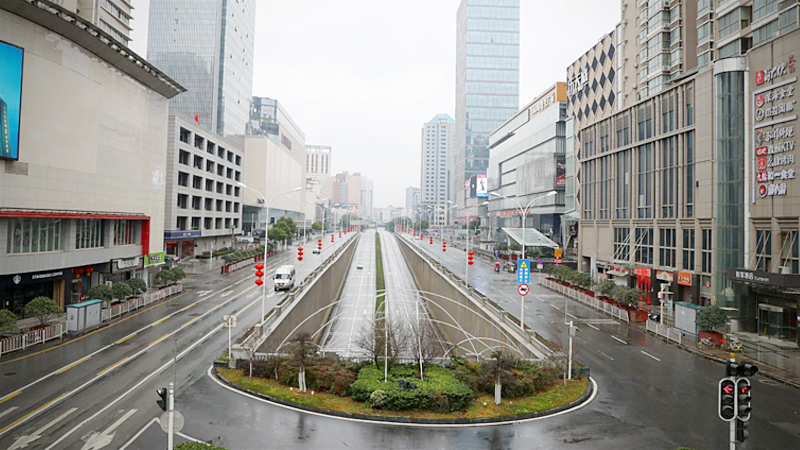
Some users shared videos of once-buzzing streets in Wuhan’s historic, European-style riverside district lying empty. Others posted more lighthearted pictures of women playing Mah-jongg with masks and transparent grocery bags over their heads.

The situation appeared to be more dire in the vast Hubei countryside.

The Chinese magazine Caijing reported that some smaller village clinics were rationed six masks, and large hospitals were within one or two days of running out of supplies. In Jingzhou city, a short distance up the Yangtze River from Wuhan, doctors told reporters that they were wearing rain ponchos because they lacked protective suits.

In Hong Kong, where a sixth case of the virus was confirmed Sunday, pressure is mounting on the government to tighten border controls with China. One hospital workers’ union threatened a five-day strike if more measures weren’t taken.

Protesters in the evening attacked a building that has been set aside for quarantine and set its lobby alight with molotov cocktails, police reported.

“We are all nervous here and everyone has begun curtailing their social lives,” said Andrew Collier, managing director at Orient Capital Research. “I was planning a trip to China but will delay that until there is more information.”

– – –

Denyer reported from Tokyo. Lynch and Shammas reported from Washington. Min Joo Kim in Seoul, Shibani Mahtani in Hong Kong, Lyric Li in Beijing, Paul Schemm in Dubai contributed to this report.

Kobe Bryant, a tireless competitor who became a global sports icon, dies at 41 #ศาสตร์เกษตรดินปุ๋ย

#ศาสตร์เกษตรดินปุ๋ย : ขอบคุณแหล่งข้อมูล : หนังสือพิมพ์ The Nation

https://www.nationthailand.com/news/30381110?utm_source=category&utm_medium=internal_referral

Kobe Bryant, a tireless competitor who became a global sports icon, dies at 41

Jan 27. 2020
By The Washington Post
Kent Babb

Kobe Bryant, a five-time National Basketball Association champion and global sports icon who retired in 2016 before adding an Academy Award to his considerable trophy case two years later, died Sunday in a helicopter crash northwest of Los Angeles. He was 41.

The aircraft, which also carried Bryant’s 13-year-old daughter, Gianna, and seven others, crashed and burst into flames near Calabasas, California, late Sunday morning. There were no survivors. Bryant, whose home and post-NBA film and publishing offices were in the Orange County suburbs of southern Los Angeles, traveled frequently via helicopter.

Bryant’s wife, Vanessa, and three other daughters were not aboard the aircraft, which was reportedly on the way to a youth basketball tournament in which Gianna, known as Gigi, would be playing.

The incident sent shock waves throughout the sports and pop culture worlds, and several NBA teams took 24- and eight-second violations during Sunday’s games to commemorate Bryant’s jersey numbers with the Los Angeles Lakers.

“Words can’t describe the pain I’m feeling,” former NBA superstar Michael Jordan said in a statement Sunday afternoon. “I loved Kobe – he was like a little brother to me. We used to talk often, and I will miss those conversations very much. He was a fierce competitor, one of the greats of the game and a creative force.”

“Kobe was a legend on the court and just getting started in what would have been just as meaningful a second act,” said former president Barack Obama, who along with former first lady Michelle Obama, Bryant referred to as friends in 2018. “To lose Gianna is even more heartbreaking to us as parents.”

In sports and in life, Bryant was an individual whose tirelessness and competitive drive were as notable as his versatility and ambition.

Known late in his career by the nickname “Black Mamba,” Bryant was one of the smoothest and most dangerous shooters in a league previously dominated by Jordan, Earvin “Magic” Johnson and Larry Bird. When those players retired or their talents faded, Bryant took up their mantle. The 6-f00t-6 shooting guard was named to the NBA’s all-star team in 18 of his 20 seasons, all with the Lakers, and he twice led the league in scoring. He scored 81 points during a game in 2006, the second-highest total in a game in league history.

He and Shaquille O’Neal led the Lakers to three consecutive championships, from 2000 to 2002, though perhaps more impressive was Bryant’s ability to push the Lakers back into the league’s championship ranks after the departures of O’Neal and Coach Phil Jackson, who had guided Jordan’s Chicago Bulls to six championships during the 1990s.

Bryant, who was one of the first players to skip college basketball and declare himself eligible for the NBA draft in 1996, modeled his game after Jordan and saw himself as the heir apparent – and occasional rival – to the former Bulls superstar.

“I was thinking in my mind: I didn’t care,” Bryant said in 2017 during a podcast hosted by Geno Auriemma, the 11-time national championship coach of the University of Connecticut women’s basketball team. “I’m going to destroy this guy. I don’t care if I’m 18; I’m coming for blood.”

Indeed, Bryant’s voracious competitiveness could strike some as aloofness, and his reputation as a teammate and sports role model were matters of controversy. He famously clashed with O’Neal, orchestrating the fun-loving center’s trade from Los Angeles in 2004 because Bryant occasionally viewed him as lazy.

Bryant’s image had already changed a year earlier, when an employee of a Colorado resort accused him of sexually assaulting her. Although charges were eventually dropped, a civil settlement was reached, and Bryant’s image as a clean-cut cultural darling was tarnished.

He would spend the next decade rebuilding his image not just as a detail-oriented perfectionist but as a person obsessed with greatness and achievement overall. He became a mentor of famous young NBA players and anonymous youngsters interested in basketball’s finer points. He coached Gianna’s teams and would occasionally lose himself in extolling her prowess on the court, where she showed instincts and devotion that reminded him of himself.

Gianna will “be standing next to me,” Bryant said during a 2018 appearance on “Jimmy Kimmel Live,” “and it’ll be like: ‘And you gotta have a boy. You and [Vanessa] gotta have a boy; have somebody carry on the tradition, the legacy.’ She’s like, ‘I got this.’ ”

There was no doubt Bryant seemed fascinated with the concept of greatness and mastering basketball’s finer points. He attended Women’s National Basketball Association games and frequently commented on the highly successful women’s college teams at Connecticut and Notre Dame. In one of his final public appearances, Bryant and Gianna were courtside at a Lakers game in December, with Bryant appearing to intensely break down a play to his daughter.

If his commitment to fulfilling potential sometimes rubbed peers the wrong way, it also could be infectious. After the U.S. men’s basketball team’s disappointing bronze-medal performance in the 2004 Athens Olympics, Bryant was added to the team and quickly became a veteran leader. A noted early riser who, even as he passed his 40th birthday, would often be up by 5 a.m. for an intense workout or shooting session, he challenged Olympic teammates to join the “Breakfast Club.” Bryant’s group met each morning at 7 for weight training or basketball drills, and alongside fellow team leader and NBA superstar LeBron James, Team USA returned to its past dominance with gold medals in 2008 and 2012.

On Saturday, James passed Bryant on the NBA’s career scoring list, and Bryant’s final post to his 15 million Twitter followers was a congratulations to the 35-year-old James, who has spent the past two seasons with the Lakers.

“Continuing to move the game forward @KingJames. Much respect my brother,” Mr. Bryant’s tweet read, with a hashtag of James’s points total when he passed Bryant: 33,644.

Between games and workouts, Bryant was an insatiable learner on and off the court. Early in his career, he picked the brains of Jordan and Hakeem Olajuwon to learn and mimic their signature basketball moves. Although Bryant had never attended college, he was nonetheless captivated by the pursuit of knowledge and lifelong improvement. He took summer school courses at UCLA after his rookie season in the NBA, and years later he invited entertainers and visionaries – Oprah Winfrey, J.K. Rowling and George R.R. Martin among them – for in-depth discussions about their crafts.

“It can seem a little obtuse, maybe, but he seemed to be interested in all of this,” John Williams, the legendary film-score composer and five-time Oscar winner, said of Bryant in a 2018 interview with The Washington Post.

Although Bryant accomplished almost everything possible on the basketball court, a traditional retirement never held much appeal. A lifelong film buff who filled idle time by quoting “Star Wars,” “The Big Lebowski” or a Harry Potter movie, Bryant began imagining his next career before stepping away from his first. His basketball career had made him a millionaire a few hundred times over, but his investments in the sports drink company BodyArmor and other companies that included grooming products and artificial intelligence were positioning Bryant to again follow Jordan, this time into an exclusive club of billionaires who began their careers as athletes.

Unlike Jordan, Bryant had no intention of spending his decades after basketball earning passive income. It was during a ride aboard “The Mamba Chopper,” or what he called the Sikorsky S-76 helicopter he took to Lakers games, that in 2016 he conceived of an alternate world in which his stories and characters would exist. He would call that world “Granity” and would name his fledgling film studio the same.

“There are infinite possibilities,” he told The Post in September 2018, and it was precisely that concept that drew him in.

During Bryant’s final season with the Lakers, he wrote a poem called “Dear Basketball,” or what amounted to a farewell to the game that made him a household name. He later adapted the poem into a nearly four-minute animated film, complete with a rousing score by Williams. It was one of five nominees for best animated short before the 2018 Academy Awards, and Bryant took to the stage in his victory and, in one of the four languages Bryant claimed fluency in, thanked Vanessa and his three daughters. (His fourth, Capri, was born in 2019.)

“You are my inspiration,” he said first in Italian and then English before walking away with his Oscar statuette.

Kobe Bean Bryant was born in Philadelphia on Aug. 23, 1978, before spending many of his formative years in Italy. His mother, the former Pamela Cox, was a homemaker and the sister of former NBA player Chubby Cox; his father, Joe “Jellybean” Bryant, was a professional basketball player who spent most of his playing and coaching career in Europe. Both parents survived him, in addition to his wife of 18 years; three daughters, Bianka, Natalia and Capri; and two sisters.

Bryant first attracted national attention as a high school player at Lower Merion High in suburban Philadelphia, and he combined generational talent with looks and flair – his date to senior prom was R&B singer Brandy – perfectly suited for Hollywood.

Although his first name, at least according to Bryant mythology, was inspired by a visit to a high-end steak house, Yahoo Sports reported in 2016 that more than 14,000 boys had been named Kobe during Bryant’s NBA career.

As a 17-year-old, he was the No. 13 pick in the 1996 NBA draft by the Charlotte Hornets, but he threatened to follow in his father’s footsteps and begin his career in Italy if the Hornets retained his rights. The team traded him to the Lakers, with whom he would spend his entire career and become an immediate fan favorite by winning the 1997 slam dunk contest, beginning a sensational career and fulfilling Bryant’s ambition for suiting up for an NBA team most famous for glitz, glamour and an era of glory known as “Showtime.”

The journey had begun on his family’s driveway in Philadelphia, where on snowy days Bryant’s mother would ask him to clear the driveway. He would do so just enough to shoot hoops, sometimes putting up hundreds of shots per day as he perfected a form that would become internationally famous.

“As a six-year-old boy deeply in love with you,” Mr. Bryant would write nearly two decades later in his poem “Dear Basketball,” “I never saw the end of the tunnel. I only saw myself running out of one.”

Strengthening coronavirus surges across China as authorities mobilize response; third case confirmed in U.S. #ศาสตร์เกษตรดินปุ๋ย

#ศาสตร์เกษตรดินปุ๋ย : ขอบคุณแหล่งข้อมูล : หนังสือพิมพ์ The Nation

https://www.nationthailand.com/news/30381097?utm_source=category&utm_medium=internal_referral

Strengthening coronavirus surges across China as authorities mobilize response; third case confirmed in U.S.

Jan 26. 2020
Photo Credit :China Daily/Peng Zhiyong (C), head of the department of critical care medicine of Zhongnan Hospital, performs diagnosis on a patient with his colleagues in Zhongnan Hospital of Wuhan University in Wuhan, Central China's Hubei province, Jan 24, 2020. [Photo/Xinhua]

Photo Credit :China Daily/Peng Zhiyong (C), head of the department of critical care medicine of Zhongnan Hospital, performs diagnosis on a patient with his colleagues in Zhongnan Hospital of Wuhan University in Wuhan, Central China’s Hubei province, Jan 24, 2020. [Photo/Xinhua]
By The Washington Post · Gerry Shih, Simon Denyer

BEIJING – Chinese health authorities are extending the holidays and deploying more than a thousand doctors and military personnel to the epicenter of the coronavirus outbreak as the number of infections skyrocket and desperation grips the quarantined province of Hubei, where more than 50 million people are stranded with a severe shortage of medical supplies.

The United States, meanwhile, announced a third case of the coronavirus – a Chinese traveler from Wuhan who took ill in Orange County, California. Authorities say he is under care in isolation and the “risk of local transmission is low.”

China’s national health commission said early Sunday that the number of confirmed infections had soared 50 percent over the prior 24 hours to 1,975 people across 30 provinces. Fifty-six deaths have been reported, including in major metropolitan areas such as Shanghai. Several doctors in Beijing, the capital, also reported being infected.

“Transmissibility is increasing,” Chinese Health Minister Ma Xiaowei told reporters Sunday. “The outbreak has come to a severe and complicated situation.”

He added that there could “still be new developments” as the virus mutates. “We still don’t know the risks of transformation,” he said.

Scientists have already noticed that the virus is adapting to humans much faster than its predecessor, the SARS (severe acute respiratory syndrome) outbreak, which killed more than 750 people in 2002-2003.

It took SARS three months to mutate into a form that spread easily between humans, but the related Wuhan coronavirus took only one month, George Fu, a top Chinese epidemiologist told reporters.

“Why is it transmitting so fast?” he said. “The two species are like the cartoon Tom and Jerry: viruses are continually adapting to humans, but human also adapt, and the virus’ ability to make people ill also goes down.”

A government group led by Premier Li Keqiang handling the epidemic response on Sunday proposed a “reasonable extension” of the New Year holiday in order to weather a “vital phase in epidemic prevention and control.” Cities are already rolling out such measures: Beijing’s education officials said schools will resume classes in mid-February, while the manufacturing hub of Suzhou prohibited large businesses from reopening earlier than Feb. 8.

At the heart of the outbreak, in central China’s Hubei Province, a travel ban extended to a total of 16 cities and covered approximately 51 million people. Video distributed by state media showed local officials in adjacent regions taking extreme measures, including using excavators to destroy and block roads, to discourage residents from traveling to infected areas of Hubei to visit stranded relatives – as per Chinese tradition – inside the quarantine zone.

Authorities have also announced the banning of the sale of wild animals after evidence emerged that the disease was transmitted to humans through a market in the city of Wuhan that traded in game meat.

The spread of the virus – and travel bans extending to several major hubs around China – threatened to paralyze the country for an indefinite period, with uncertain implications around the world. Officials in Beijing said Sunday they “have not and will not close the city because of the epidemic” in response to online rumors suggesting an imminent lockdown of the capital, which has a population of 22 million, with a significant fraction traveling this week to visit family.

On Saturday – China’s New Year’s Day – numerous Chinese government agencies said they had summoned workers back to their posts as President Xi Jinping warned of a “grave” situation as the virus “accelerated its spread.”

Two teams of British epidemiologists released studies over the weekend estimating that each infected person was spreading the disease to two or three other people. A team from Lancaster University projected that infections in Wuhan could explode to 190,000 cases by as early as next week.

The Chinese central government said it is mustering manufacturers to send 100,000 hazardous materials suits and millions of face masks to Wuhan, where hospitals reported overfilled beds and doctors collapsing from exhaustion. Videos on social media from Wuhan hospitals showed patient queues stretching around the block and nurses surmising that the true number of cases – based on what they were witnessing – far exceeded what was being officially reported.

The vice minister of industry, Wang Jiangping, said Sunday the country was facing a significant shortage of medical supplies including protective suits for medical workers. Hubei Province alone required 100,000 suits a day but Chinese manufacturers could only produce 30,000 a day, he said. “There’s a prominent gap in supply and demand,” he said, adding that China was hoping to purchase supplies on the international market.

Masks in particular have been in short supply, with shortages now being reported abroad as well. In Japan, Chinese tourists have been emptying the shelves of face masks, according to local news reports, while supplies are also running out globally.

Michael Einhorn, president of Dealmed, an independent medical supply distributor in New York, New Jersey, Connecticut and Pennsylvania, said prices of masks jumped as soon as news of the virus spread, while sales volumes tripled through retailers such as Amazon.

Dealmed typically carries at least 90-days’ supply, and but said the company currently only has about two weeks’ worth left.

If demand continues, the availability of masks will be “very limited” within the next 10 days, and of the virus continues to spread there will be “extreme shortages” as early as three weeks’ time, Einhorn said in a statement.

Authorities in Wuhan and another hard-hit Hubei city, Huanggang, have announced the construction of three pop-up hospitals with thousands of beds to be built within the next few days. Ma, the health minister, said 5,000 new beds should be available by midweek while hundreds of medical professionals are preparing to deploy to the region.

Days after ordering the departure of all non-emergency U.S. personnel, the U.S. Embassy said Sunday it would charter a single flight on Jan. 26 out of Wuhan for remaining consulate staff and American citizens.

Japan has also said it is readying flights to bring home more than 700 Japanese stranded in Wuhan.

Meanwhile, Chinese citizens stranded inside the vast quarantine zone, locked down by paramilitary police checkpoints for the fourth day, took to social media to describe a sense of surreal desperation during a week when families should otherwise be celebrating the new year with dumplings, fireworks and presents.

One Wuhan resident described sharing her dwindling groceries that she had purchased to last for three days with an elderly couple whose food supplies were down to nothing. She said she worried about her food lasting one more day and the population of stray animals abandoned throughout the city.

“I don’t know how to solve this food problem,” wrote the user “Guapidawushi. “Right now I really, really don’t know what to do. I’m completely helpless.”

Some users shared videos of once-buzzing streets in Wuhan’s historic, European-style riverside district lying empty. Others posted more lighthearted pictures of women playing Mah-jongg with masks and transparent grocery bags over their heads.

The situation appeared to be more dire in the vast Hubei countryside outside of Wuhan, where rural authorities were struggling to cope.

The Chinese magazine Caijing reported that some smaller village clinics were only rationed six masks, and large hospitals were within one or two days of running out of supplies. In Jingzhou city, a short distance up the Yangtze River from Wuhan, doctors told reporters they were wearing rain ponchos because they lacked protective suits.

Deng Anqing, a Beijing-based writer who was visiting family in rural Hubei for the New Year holiday, said the hidden crisis was in the countryside.

“The media is focused on Wuhan but we know absolutely nothing about the current situation in the countryside,” Deng wrote in a post. “Large numbers of workers are returning here from Wuhan, but the capabilities of village hospitals are awful. Villages don’t have masks, and it’s hard to convince the elderly to wear them.”

Infections have been confirmed in France, Australia and the United States, but countries in Asia have been especially concerned as millions of Chinese people fan out across the region for the Lunar New Year.

An online petition asking South Korean President Moon Jae-in to ban Chinese nationals from entering the country has drawn more than 280,000 signatures over four days. South Korea confirmed a third case of coronavirus infection on Sunday, a 54-year old man who returned from Wuhan.

North Korea’s official party daily Rodong Sinmun posted prevention advice on Sunday and called for stronger border controls in a piece headlined “We should thoroughly contain the new coronavirus.” Earlier this week, North Korea banned all foreign tourists, most of whom come from its biggest neighbor and ally China. Flights between Beijing and Pyongyang have also been canceled, the Russian Embassy in North Korea said in a statement on Friday.

Japan confirmed it’s fourth case of the virus, a middle aged man from Wuhan who arrived on Wednesday for vacation.

In Hong Kong, where a sixth case of the virus was confirmed Sunday, pressure is mounting on the government to tighten border controls with China over fear of contagion. One hospital workers’ union threatened a five-day strike if more measures weren’t taken.

Protesters in the evening attacked a building that has been set aside for quarantine and set its lobby alight with molotov cocktails, police reported.

Trump’s lawyers begin their defense in impeachment trial as Republicans rally around the president #ศาสตร์เกษตรดินปุ๋ย

#ศาสตร์เกษตรดินปุ๋ย : ขอบคุณแหล่งข้อมูล : หนังสือพิมพ์ The Nation

https://www.nationthailand.com/news/30381078?utm_source=category&utm_medium=internal_referral

Trump’s lawyers begin their defense in impeachment trial as Republicans rally around the president

Jan 26. 2020
Sen. Lindsey Graham, R-S.C., speaks to reporters after the fifth day of the Senate impeachment trial of President Donald Trump on Saturday, Jan. 25, 2020. MUST CREDIT: Photo for The Washington Post by Astrid Riecken

Sen. Lindsey Graham, R-S.C., speaks to reporters after the fifth day of the Senate impeachment trial of President Donald Trump on Saturday, Jan. 25, 2020. MUST CREDIT: Photo for The Washington Post by Astrid Riecken
By The Washington Post · Elise Viebeck, Mike DeBonis, Rachael Bade

WASHINGTON – Lawyers for President Donald Trump argued Saturday that he had valid reasons for withholding military aid to Ukraine and that House prosecutors overlooked facts that are more favorable to his case, giving a short preview of the aggressive defense they are expected to mount next week in the Senate impeachment trial.

In a two-hour presentation that reserved their most provocative attacks for Monday, members of Trump’s legal team echoed the president’s justifications for his actions toward Ukraine and sought to plant doubts about both the prosecutors’ case and its lead advocate, Rep. Adam Schiff, D-Calif.

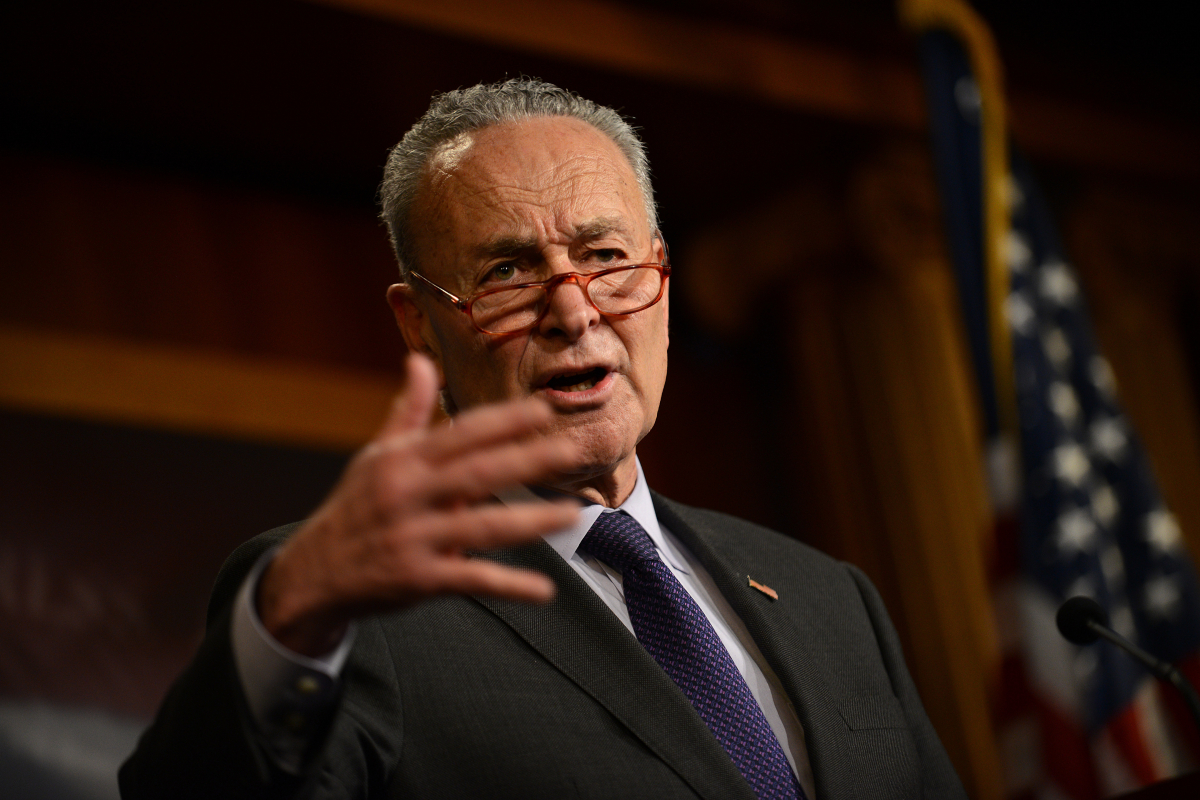
Senate Minority Leader Chuck Schumer, D-N.Y., speaks during a news conference about the Senate impeachment trial of President Donald Trump on Saturday, Jan. 25, 2020. MUST CREDIT: Photo for The Washington Post by Astrid Riecken

Senate Minority Leader Chuck Schumer, D-N.Y., speaks during a news conference about the Senate impeachment trial of President Donald Trump on Saturday, Jan. 25, 2020. MUST CREDIT: Photo for The Washington Post by Astrid Riecken

Yet in arguing that the case for Trump’s removal was partisan and misleading, lawyers for the president omitted facts, presented claims that lacked context or downplayed evidence gathered by House investigators. Their most sweeping arguments did not specifically defend Trump, but instead framed impeachment as no more than a politically motivated effort to remove him from the ballot in November.

Lead House impeachment manager Adam Schiff, D-Calif., and other impeachment officials hold a news conference at the end of the fifth day of the Senate impeachment trial of President Donald Trump on Saturday, Jan. 25, 2020. MUST CREDIT: Photo for The Washington Post by Astrid Riecken

Lead House impeachment manager Adam Schiff, D-Calif., and other impeachment officials hold a news conference at the end of the fifth day of the Senate impeachment trial of President Donald Trump on Saturday, Jan. 25, 2020. MUST CREDIT: Photo for The Washington Post by Astrid Riecken

“They’re here to perpetrate the most massive interference in an election in American history,” said White House counsel Pat Cipollone, who said Trump did “absolutely nothing wrong.”

“We can’t allow that to happen. It would violate our constitution. It would violate our history. It would violate our obligations to the future,” Cipollone told the Senate. “And most importantly, it would violate the sacred trust that the American people have placed in you.”

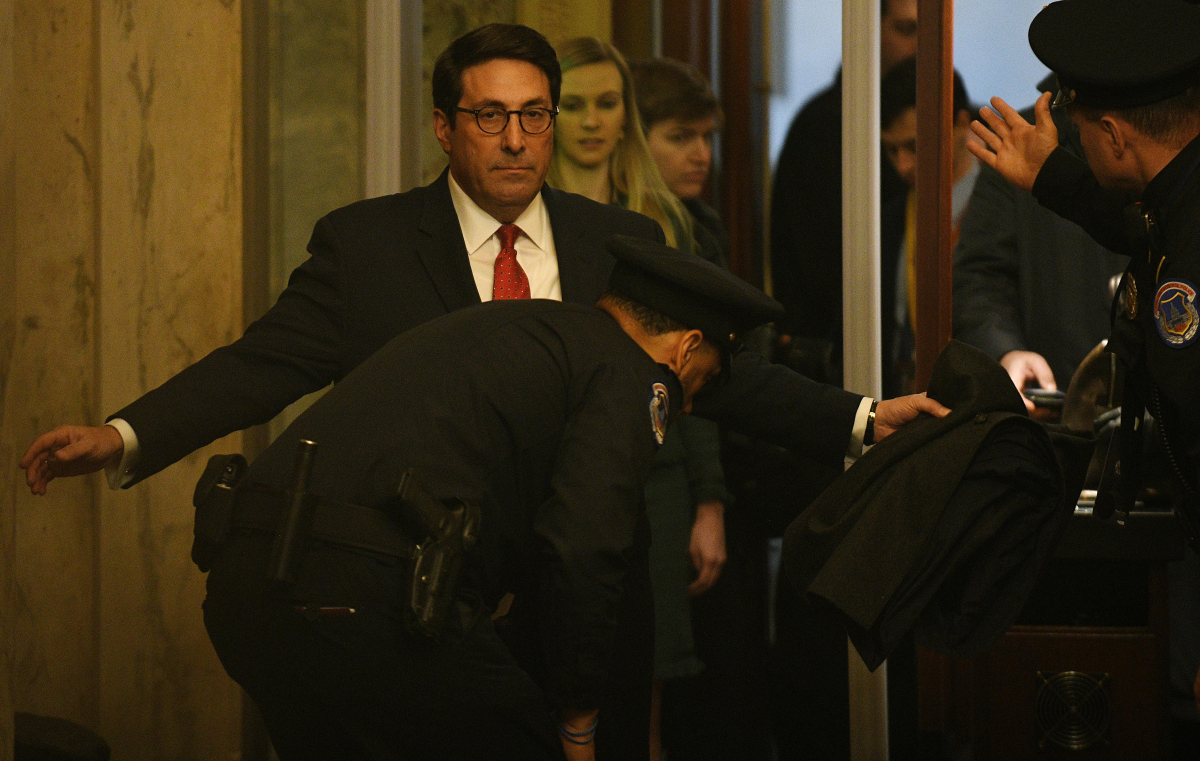
Jay Sekulow, a personal attorney for President Donald Trump, goes through a security check point to enter the U.S. Capitol on Saturday, Jan. 25, 2020. MUST CREDIT: Photo for The Washington Post by Astrid Riecken

Jay Sekulow, a personal attorney for President Donald Trump, goes through a security check point to enter the U.S. Capitol on Saturday, Jan. 25, 2020. MUST CREDIT: Photo for The Washington Post by Astrid Riecken

After three days of arguments in favor of Trump’s removal from House Democrats, most Senate Republicans rallied behind the president’s defense, predicting acquittal. But a small group of closely watched Republicans largely reserved judgment or declined to comment, leaving open the question of whether the trial will include witnesses. Democrats need four Republicans to join them to secure further testimony or evidence.

Trump faces the third presidential impeachment trial in U.S. history amid accusations that he withheld military aid and an Oval Office meeting to pressure Ukraine’s leaders into announcing investigations of his political rivals, including former vice president Joe Biden, now a presidential candidate. Trump was impeached by the House in December on charges of abuse of power and obstruction of Congress related to these allegations and his directive that his administration not cooperate with the House’s investigation.

His team’s opening argument came on a day when more evidence emerged outside the Senate: A video was released showing Trump ordering the firing of Marie Yovanovitch, the U.S. ambassador to Ukraine, at a 2018 donor dinner. His order came minutes after Ukrainian American business executive Lev Parnas criticized her as an impediment.

Yovanovitch was removed more than a year later. Parnas is now under indictment on campaign-finance charges, and the video was released by Parnas’ attorney.

At the end of a marathon week of presentations before the Senate, Trump’s lawyers began speaking at 10 a.m. and ended by noon, allowing senators to return home for a short period before the trial resumes at 1 p.m. on Monday. The next session is expected to include full-throated attacks on Biden and his son Hunter, who served on the board of Ukrainian gas company Burisma while his father was in office and has become a target for criticism by Republicans. The intent is to argue that Trump was justified in seeking investigations into the Bidens despite the Ukrainian government never accusing them of any wrongdoing.

On Tuesday, Chief Justice John Roberts Jr., chastised both the House managers and the president’s defense team for using overheated rhetoric as they debated ground rules for the trial. But when Trump’s lawyers took the podium on Saturday to begin rebutting the managers’ case, their tone was largely subdued.

“We are going to be very respectful of your time,” Cipollones said in his opening remarks. “You heard the House managers speak for nearly 24 hours over three days. We don’t anticipate using that much time.”

The lawyers painted Trump as having sincere concerns about corruption in Ukraine, despite evidence to the contrary, and suggested he was justified in doubting the intelligence community’s conclusion that Russia, not Ukraine, interfered in the 2016 presidential election.

In taking this approach, the lawyers landed repeatedly on themes that matter to Trump, including what he has described as his “perfect” July 25 phone call with Ukrainian President Volodymyr Zelensky, special counsel Robert Mueller III’s report and omissions and errors by the FBI in documents submitted to the Foreign Intelligence Surveillance Court during the 2016 investigation of the Trump campaign and Russian interference in the election.

Because of that case, Trump attorney Jay Sekulow argued, the president had reason not to “blindly trust some of the advice he was being given” by intelligence officials.

Taken together, the lawyers’ remarks laid the foundation for a defense of Trump’s unconventional foreign policy toward Ukraine, led by his personal attorney Rudy Giuliani; and an attempt to shore up Trump’s claim that by seeking investigations of the Bidens, he was working to fight corruption, not undermine a political opponent who he might face in November.

Focusing on the July 25 call, deputy White House counsel Michael Purpura suggested that witnesses who expressed concerns about it were politically motivated and said Trump’s conversation with Zelensky reflected the administration’s “legitimate concerns about corruption” in Ukraine.

A rough transcript released by the White House shows the president did not mention “corruption” or a general concern about the issue – only a theory about Ukrainian influence in the 2016 election that has been discredited and his request that Kyiv scrutinize the Bidens.

Purpura also spent considerable time claiming that Ukraine did not learn about the hold on military aid until late August.

“There can’t be a threat without the person knowing he’s being threatened,” he said.

While two Trump administration officials – Pentagon official Laura Cooper and State Department official Catherine Croft – testified that they believed that Ukrainians knew about the hold before that time, Purpura argued that others’ testimony was more credible.

The second part of the defense’s presentation sought to raise doubts about the legal and constitutional validity of the impeachment inquiry. Deputy White House counsel Patrick Philbin also mentioned the anonymous whistleblower, whose report helped launch the impeachment probe, and the House’s decision not to investigate them.

“Motivations, bias, reasons for wanting to bring this complaint could be relevant,” Philbin said. “But there wasn’t any inquiry into that.”

The details of the whistleblower’s memo were confirmed by the rough transcript of the July 25 call released by the White House and by the evidence gathered during the House investigation.

In several moments, Trump’s lawyers attacked Schiff, the chairman of the House Intelligence Committee who has helped to lead the impeachment inquiry.

Philbin noted that Schiff had once mischaracterized his staff’s dealings with the whistleblower. Purpura also showed a video clip of Schiff parodying dialogue from the July 25 call during a House hearing, a dramatic embellishment that Trump and his allies say obliterates Schiff’s credibility.

“We can shrug it off and say we were making light or a joke. But that was in a hearing in the United States House of Representatives discussing the removal of the president of the United States from office,” Purpura said. “There are very few things, if any, that can be as grave and as serious.”

Senators already allied with Trump declared the presentation a slam-dunk.

“In two hours, the White House counsel entirely shredded the case by the House managers,” Sen. Joni Ernst, R-Iowa, told reporters, echoing several other Republicans who used a form of the word shred to characterize the effect of the lawyers’ arguments.

But moderate Republican senators – whose votes will determine whether additional evidence is sought in the trial – did not share detailed opinions on the presentation or the possible need for witnesses.

“I think it’s very likely I’ll be in favor of witnesses, but I haven’t made a decision finally yet and I won’t until both side’s opening arguments are done,” Sen. Mitt Romney, R-Utah, told reporters on Capitol Hill.

“I thought for the most part, the House managers were effective, and I thought the president’s attorneys this morning were very effective,” Sen. Lamar Alexander, R-Tenn., told CBS News.

Sen. Susan Collins, R-Maine, declined to comment when approached by The Washington Post.

A handful of moderate Democratic senators – who could prove pivotal if they choose to side with Republicans – declared witnesses necessary to the process.

“I thought they did a good job in presenting the defense for the president,” Sen. Joe Manchin III, D-W.Va., said. “[But] the most important thing I took away from today was they made very clear that there’s not one witness that we’ve heard from . . . that had direct contact with the president.”

Sen. Doug Jones, D-Ala., said he was “stunned” that Trump’s lawyers argued at one point that cross examination is essential to due process, even as the White House bars witnesses from testifying on Trump’s dealings with Ukraine.

“They American people deserve the truth. They deserve the whole truth,” Jones said. “We’re not getting it.”

The House managers were not permitted to speak during Saturday’s session – though they drew some attention around 9:50 a.m. as part of a procession transferring their 28,578-page trial record across the Capitol to the Senate.

“They don’t contest the basic architecture of the scheme,” Schiff said at a news conference after the presentation by Trump’s lawyers. “They do not contest that the president solicited a foreign nation to interfere in our election, to help him cheat. I think they acknowledged by not even contesting this that the facts are overwhelming.”

In his closing, Cipollone shifted the charges facing the president onto Democrats – a strategy often employed by Trump himself.

“It would be a completely irresponsible abuse of power to do what they’re asking you do – to stop an election, to interfere in an election, and to remove the president of the United States from the ballot,” he said. “Let the people decide for themselves.”