Copper tops $8,000 as Goldman points to commodities super-cycle #SootinClaimon.Com

#SootinClaimon.Com : ขอบคุณแหล่งข้อมูล : หนังสือพิมพ์ The Nation.

Copper tops $8,000 as Goldman points to commodities super-cycle (nationthailand.com)

Copper tops $8,000 as Goldman points to commodities super-cycle

EconDec 19. 2020A worker wearing a protective face mask checks newly made copper cathode sheets at the Uralelectromed Copper Refinery in Verkhnyaya Pyshma, Russia, on July 30, 2020. MUST CREDIT: Bloomberg photo by Andrey Rudakov.A worker wearing a protective face mask checks newly made copper cathode sheets at the Uralelectromed Copper Refinery in Verkhnyaya Pyshma, Russia, on July 30, 2020. MUST CREDIT: Bloomberg photo by Andrey Rudakov. 

By Syndication Washington Post, Bloomberg

Copper topped $8,000 a ton for the first time in more than seven years, with Goldman Sachs and BlackRock pointing to the start of a new long-term bull market as supply lags an expected demand boom.

The market is witnessing the sharpest rally in more than a decade, with China’s appetite for commodities and supply snags early on in the covid-19 pandemic lifting copper about 80% from its March lows.

Expectations for a deficit, the weaker dollar, and its role in green technology have also fueled gains. Some banks and investors are now drawing comparisons to the spike in the early 2000s, when a jump in Chinese orders ushered in the last super-cycle for commodities.

“You have all the tell-tale signs of a super-cycle,” Jeff Currie, head of commodities research at Goldman Sachs, told Bloomberg TV. He cited metals hitting multiyear highs, the weaker dollar, crude oil reaching $50, and rising global liquidity.

The surge in prices has been a boon for miners, with shares in copper-focused producers including Antofagasta and Freeport-McMoRan vaulting to multiyear highs recently. In addition, production costs have been falling, setting the stage for a blowout year for profitability.

Copper rose as much as 1.4% to $8,028 a ton, the highest price since 2013, and was at $7,999.50 by 12:50 p.m. on the London Metal Exchange. Most other metals also gained, with nickel rising 0.4%. Singapore iron ore futures pushed above $160 a ton, hitting the highest level since trading began in 2013.

Goldman pointed to the start of a positive feedback loop between commodities, the dollar and emerging-market growth that has driven past structural bull markets. At the center is strong, synchronized, policy-driven demand focused on wealth redistribution and renewables and, with commodity supply-side spending outside of renewables still at very low levels, this demand growth should keep markets tight for the foreseeable future, it said in a Dec. 17 note.

BlackRock expects copper to hit new all-time highs in the upswing of the cycle, Evy Hambro, the firm’s global head of thematic investing, told Bloomberg TV on Thursday.

China’s relative success at containing the pandemic and optimism about global economic growth next year as vaccines are rolled out is fueling gains across industrial commodities from iron ore to oil. It’s been a remarkable turnaround for copper, which fell more than 50% from a record high in 2011, trading below $5,000 a ton during a slump in 2015-16 and again earlier this year.

Copper also benefits from more specific factors that make it attractive to long-term investors. While many expect oil prices to rebound in the short term as the world begins returning to normal, there’s more doubt about its long-term outlook as the energy transition gathers pace. Copper, on the other hand, is likely to benefit from the shift because of its use in electrical wiring.

In the near term, copper is getting a boost from tight supplies and strong demand. Top consumer China churned out a record volume last month, pointing to resilient consumption as the country emerges from the pandemic. Among signs of tightness, stockpiles tracked by top exchanges including the LME have slumped to a six-year low.

There’s also a brighter outlook for consumption outside China. U.S. lawmakers are pressing to finalize a spending deal, and the Federal Reserve this week strengthened its commitment to supporting the world’s largest economy.

Still, copper’s surge may be at risk of cooling. Citigroup warned earlier this month that the metal was “too hot to handle” following a recent rally, and that prices may retrace if gains aren’t supported by the physical market.

“Investors are probably already currently pricing in the broader, deeper and strong 2021 economic recovery,” Fitch Solutions said in a note. “This increases the risk that prices could struggle to hold such gains later in 2021.”

On the technical side, LME copper’s 14-day relative-strength index was at 77 on Friday and has largely remained in overbought territory for three weeks, even as prices continued to rise.
SET dips 0.1% after week of rises #SootinClaimon.Com

#SootinClaimon.Com : ขอบคุณแหล่งข้อมูล : หนังสือพิมพ์ The Nation.

SET dips 0.1% after week of rises (nationthailand.com)

SET dips 0.1% after week of rises

EconDec 18. 2020

By The Nation

The Stock Exchange of Thailand (SET) Index closed at 1,482.38 on Friday, down 1.51 points or 0.1 per cent. Total transactions amounted to Bt117.09 billion with an index high of 1,489.78 and a low of 1,475.01.

In the morning session, an analyst at Krungsri Securities expected the day’s index to fluctuate between 1,475 and 1,495 points amid hope of a US $900-billion stimulus package and foreign fund inflows in line with the baht’s appreciation.

“However, investors should beware of volatility due to the FTSE rebalance and the SET’s tight valuation,” he said.

The 10 stocks with the highest trade value today were PTT, BANPU, CPALL, KBANK, CPF, AOT, SCC, ADVANC, BBL and BAM.

As of 4.30pm, the price of oil rose by US$0.04 or 0.08 per cent to $48.40 per barrel, while gold dropped by $5.20 or 0.28 per cent, to $1,885.20 per ounce.

Other Asian indices were mixed:

Japan’s Nikkei Index closed at 26,763.39, down 43.28 points or 0.16 per cent.

China’s Shang Hai SE Composite Index closed at 3,394.90, down 9.98 points or 0.29 per cent, while Shenzhen SE Component Index closed at 13,854.12, down 35.75 points or 0.26 per cent.

Hong Kong’s Hang Seng Index closed at 26,498.60, down 179.78 points or 0.67 per cent.

South Korea’s KOSPI Index closed at 2,772.18, up 1.75 points or 0.063 per cent.

Taiwan’s TAIEX Index closed at 14,249.96, down 8.97 points or 0.063 per cent.

Singapore’s Straits Times Index closed at 2,852.18, down 5.84 points or 0.20 per cent.

Vietnam’s Ho Chi Minh Stock Index closed at 1,067.46, up 15.69 points or 1.49 per cent.

Stronger baht will help push SET up by 3-4%, says analyst #SootinClaimon.Com

#SootinClaimon.Com : ขอบคุณแหล่งข้อมูล : หนังสือพิมพ์ The Nation.

Stronger baht will help push SET up by 3-4%, says analyst (nationthailand.com)

Stronger baht will help push SET up by 3-4%, says analyst

EconDec 18. 2020

By The Nation

The appreciation of the baht will help push the Stock Exchange of Thailand (SET) Index up by 3 to 4 per cent as foreign investors are making profits from speculating on the exchange rate, an analyst at Asia Plus Securities said on Friday.

He said the baht is likely to strengthen further due to US move to place Thailand on its monitoring list for currency manipulation, resulting in foreign investors speculating on the foreign exchange rate in Thai stock market.

The baht opened at 29.79 to the US dollar on Friday, strengthening from 29.84 at close on Thursday, the strongest in seven years.

“Funds are expected to flow from the bond market to the stock market as Thailand’s one-year bond yield dropped to 0.42 per cent, lower than policy interest at 0.5 per cent,” he said.

According to statistics in the past, he said funds often flow into the stock market when the baht strengthens, resulting in a boost in the stock index.

“Every Bt10 billion fund that flows into the stock market is likely to push the index up by 3-4 per cent,” he said.

He has advised investors to buy large-cap stocks that benefit from foreign fund flows such as PTT, Advanced Info Service, including stocks that benefit from the strengthening of the baht, such as Thaifoods Group.

UNHCR ‘shocked’ at lese majeste charges against child, urges change to law #SootinClaimon.Com

#SootinClaimon.Com : ขอบคุณแหล่งข้อมูล : หนังสือพิมพ์ The Nation.

UNHCR ‘shocked’ at lese majeste charges against child, urges change to law (nationthailand.com)

UNHCR ‘shocked’ at lese majeste charges against child, urges change to law

PoliticsDec 18. 2020UNHCR spokesperson Ravina ShamdasaniUNHCR spokesperson Ravina Shamdasani 

By The Nation

The United Nations High Commission for Human Rights (UNHCR) has expressed dismay at the move by Thai authorities to charge at least 35 protesters, including a child, with lèse majesté under Article 112 of the penal code.

“We are particularly alarmed that [a]16-year-oldprotester was yesterday [December 17] presented by police to the Juvenile Court with a request for a detention order,” said UNHCR spokesperson Ravina Shamdasani.

The UNHCR, which oversees implementation of the International Covenant on Civil and Political Rights, had repeatedly called on Thailand to bring the lèse majesté law in line with the country’s international obligations, she said 

“It is extremely disappointing that after a period of two years without any cases, we are suddenly witnessing a large number of cases, and – shockingly – now also against a minor,” she added.

“We also remain concerned that other serious criminal charges are being filed against protesters engaged in peaceful protests in recent months, including charges of sedition and offences under the Computer Crime Act. Again, such charges have been filed against a minor, among others.” 

The UN rights body called on the government to stop bringing serious criminal charges against individuals for exercising their rights to freedom of expression and peaceful assembly. People should be able to exercise these rights without fear of reprisals, it said. 

“The UN Human Rights Committee has found that detention of individuals solely for exercising the right to freedom of expression or other human rights constitutes arbitrary arrest or detention,” said the spokesperson.

“We also urge the government to amend the lèse majesté law and bring it into line with Article 19 of the ICCPR on the right to freedom of expression.”

Change of guard next year for Ratsadon rallies #SootinClaimon.Com

#SootinClaimon.Com : ขอบคุณแหล่งข้อมูล : หนังสือพิมพ์ The Nation.

Change of guard next year for Ratsadon rallies (nationthailand.com)

Change of guard next year for Ratsadon rallies

PoliticsDec 18. 2020Piyarat JongthepPiyarat Jongthep 

By THE NATION

The decision by Piyarat Jongthep and the “We Volunteer” group that he founded, also known as “Wevo guards”, on November 30 to leave the “Ratsadon” pro-democracy protesters is expected to create opportunities for other groups to become volunteer guards for the planned political rallies aimed at ousting Prime Minister General Prayut Chan-o-cha and reforming the monarch.

Wevo guards had been working as security guards for the protesters during the series of political rallies in Thailand since July.

On November 22, other groups of volunteer guards held a meeting in a bid to organise over 1,500 members and make sure their mission and ideology were on the same page. Eleven groups of volunteer guards joined the meeting — Plod Aek guards, Muan Chon guards, Ratsadon guards, Thonburi Ratsadon team, Chaphokit guards, Phoenix guards, Special Force guards, White Pigeon team, Vocational students team, Nonthaburi guards and Secure Ranger.

The responsibility of the volunteer guards is to protect the protesters and leaders. They divide their responsible areas at rally venues into zones, each with their own mobile command centre to make sure the situation is always under control.

However, on December 11 protest leader Parit “Penguin” Chiwarak from United Front of Thammasat and Demonstration announced that the group will from now on handle security duties of the next rallies by itself and therefore relieved all volunteer guards of their duties. It is speculated that his decision followed suspicions that government national security staff might have infiltrated the volunteer guards to know about the protesters’ strategy.

Although Wevo guards have left Ratsadon, the group still has close ties with Free Youth group, another pro-democracy protester group led by students, who also have been working together since July.

“We will continue to work with Free Youth in their future rallies,” said Piyarat. “From now on we will use the ‘Bangkok Model’, which we have modified from the methods Vietnamese soldiers used against the US army in the Vietnam War, by traversing the labyrinthine routes of Viet Cong cave to complete the guerrilla attacks.”

Piyarat expected to mobilise his guards through the sois and alleys of Bangkok to avoid clashes with the authorities.

“Currently Wevo has at least 500 members who are well trained in security duties and rapid response,” he added. “Wevo guards will be placed in strategic positions throughout Bangkok. We can mobilise in 30 minutes using routes that we had planned ahead, without prior briefing needed.”

The government security team will probably need a new strategy to handle political rallies in 2021, especially now that the Wevo group has changed their role from merely security guards to “rapid response” team.

Red-shirt leader Nattawut released, but will be monitored #SootinClaimon.Com

#SootinClaimon.Com : ขอบคุณแหล่งข้อมูล : หนังสือพิมพ์ The Nation.

Red-shirt leader Nattawut released, but will be monitored (nationthailand.com)

Red-shirt leader Nattawut released, but will be monitored

PoliticsDec 18. 2020

By THE NATION

Red-shirt leader Nattawut Saikua was released from prison on Friday, but not before he was tagged with an electronic monitoring bracelet, which will track his every move.

Pro-democracy protest leader Parit “Penguin” Chiwarak welcomed the red-shirt leader posting a congratulatory message on Facebook as well as thanking Nattawut for taking care of him while he was in prison.

Nattawut was among five red-shirt leaders who were handed jail sentences by the Supreme Court on June 26 for bringing together more than 10 people, allegedly creating chaos in the city and fighting the authorities in 2007.

On July 22, 2007, leaders of the red-shirt United Front for Democracy against Dictatorship led a march to late Privy Council president Prem Tinsulanonda’s Si Sao Thewes residence to pressure him to step down as chief royal adviser.

Nopparut Worachitwutthikul was sentenced to two years and eight months in jail, while Veerakarn Musikapong, Wiputhalaeng Pattanapoom, Weng Tochirakarn and Natthawut were each given four years and four months.

In 2010, Natthawut was detained after the military crackdown on demonstrators on May 19, and remained incarcerated for nine months before being bailed out.

Youngest victim of draconian lese majeste charge gets father’s support #SootinClaimon.Com

#SootinClaimon.Com : ขอบคุณแหล่งข้อมูล : หนังสือพิมพ์ The Nation.

Youngest victim of draconian lese majeste charge gets father’s support (nationthailand.com)

Youngest victim of draconian lese majeste charge gets father’s support

PoliticsDec 18. 2020

By THE NATION

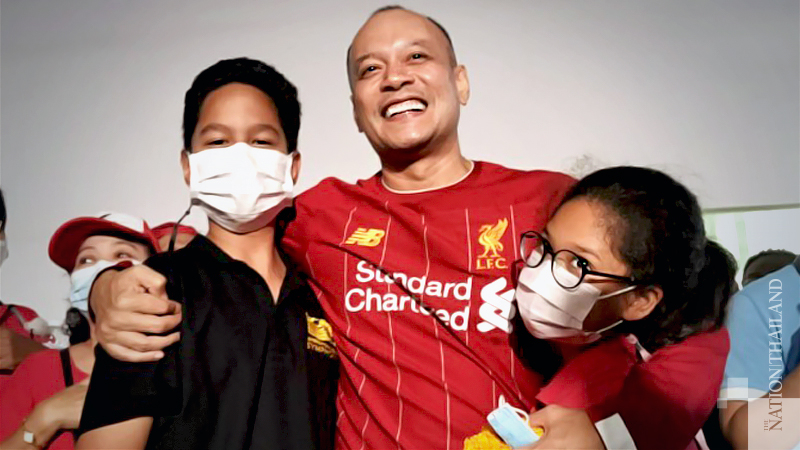
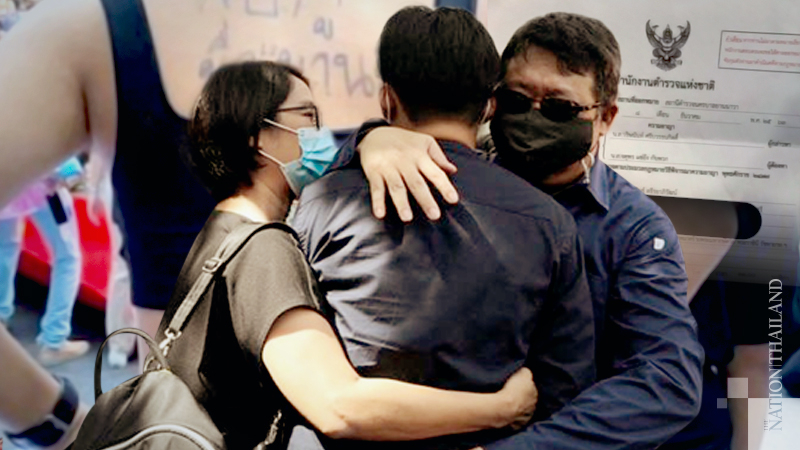
The father of a 16-year-old student who has been hit by lese majeste charges, said he will always respect his son’s decisions, regardless of whether they are right or wrong.

On Thursday, two protestors were summoned to Yannawa Police Station in Bangkok to acknowledge their charge of violating Section 112 of the criminal code, which states that “whoever, defames, insults or threatens the King, the Queen, the Heir-apparent or the Regent, shall be punished with imprisonment of three to 15 years”.Two individuals summoned yesterday had participated in a pro-democracy rally in Bangkok’s Silom Road on October 29.They were Jatuporn Sae-Aueng, who had dressed in a traditional Thai costume that day, and a student aged 16 – the youngest person ever to face lese majeste charges.

On Friday, the boy’s father said in a Facebook post: “I can sincerely say I do not agree with some things that my son has done. But I respect his decisions. I’m not sure if it’s right or wrong, but I’ve taught my son the freedom of thought, taught him to ask questions and find answers by himself. I have also taught him to take responsibility for his actions.”

In terms of the charge, he said “it is a matter of justice”. As for his own feelings, he said: “It’s painful for a parent to see his son at this age facing such severe charges.

“As a parent at this time, all I can do is hold my son’s hand tightly and help him overcome obstacles. When the child falls down, all a parent can do is provide a cushion to break the fall and reduce the pain,” his post read.

He father also said he hopes this pain only occurs in his home, and does not spread to other families.

Most pro-democracy students being punished for their beliefs, NGO says #SootinClaimon.Com

#SootinClaimon.Com : ขอบคุณแหล่งข้อมูล : หนังสือพิมพ์ The Nation.

Most pro-democracy students being punished for their beliefs, NGO says (nationthailand.com)

Most pro-democracy students being punished for their beliefs, NGO says

PoliticsDec 18. 2020

By THE NATION

Protection International (PI), a non-profit organisation dedicated to the protection of human-rights defenders, found that 87.9 per cent of students fighting for democracy have faced some form of intimidation, especially from their teachers.

Some students and members of their family have even faced threats from officials.

On Thursday, PI and members of the student-led pro-democracy movement, held an event titled “Who should be protected by the government when the youth decide to protect their rights?” at the Foreign Correspondents’ Club of Thailand in Bangkok.

At the event, PI member Pranom Somwong said most students who tried to fight for their political rights had been threatened in some way or the other – facing mental abuse from teachers in school or being followed home by police officers.

She also said that at least five youngsters, below the age of 18, have been charged for violating the emergency decree and sedition, while at least one 18-year-old faces lese majeste charges.

Pranom also pointed out that Thailand has been a signatory to the United Nations Convention on the Rights of the Child for 28 years now. “Yet, what are the Thai government and UNICEF doing to fulfil their duties in protecting children from intimidation?” she asked.

Kunthida Rungruengkiat from the Progressive Movement said students’ rights began being violated in school and by officials as soon as they decided to fight for their rights and present their political views. In some cases, strangers were seen taking their photographs in school, which should be the safest place.

Kunthida said the government should take Thailand’s Child Protection Act seriously, adding that organising political activities is not illegal. It is a right ensured by the Constitution, she added.

She also reminded schools that the Education Ministry has written to them, saying students have the right to express themselves freely.

Laponpat Wangpaisit from the Bad Student group said that more than 1,000 intimidation cases have been reported by students over the past five or six months.

He said these cases are a reflection of the government’s inefficiency in addressing problems, adding that the authorities have, so far, not responded to any of the demands made by the Bad Student group.

U.S. bans technology exports to Chinese semiconductor and drone companies, calling them security threats #SootinClaimon.Com

#SootinClaimon.Com : ขอบคุณแหล่งข้อมูล : หนังสือพิมพ์ The Nation.

U.S. bans technology exports to Chinese semiconductor and drone companies, calling them security threats (nationthailand.com)

U.S. bans technology exports to Chinese semiconductor and drone companies, calling them security threats

InternationalDec 19. 2020

By The Washington Post · Jeanne Whalen

The Trump administration has added prominent Chinese semiconductor and drone manufacturers to an export blacklist, continuing to exert pressure on the country in the final weeks of the Trump presidency.

The Commerce Department said it has placed Semiconductor Manufacturing International Corp., or SMIC, drone maker DJI; and dozens of other Chinese companies and universities on the Entity List, which bans the export of U.S. technology to the entities unless the exporter receives a government license.

The sanction follows “evidence of activities between SMIC and entities of concern in the Chinese military industrial complex,” Commerce said in a statement.

“We will not allow advanced U.S. technology to help build the military of an increasingly belligerent adversary,” Commerce Secretary Wilbur Ross said about SMIC in a statement. “Between SMIC’s relationships of concern with the military industrial complex, China’s aggressive application of military civil fusion mandates and state-directed subsidies, SMIC perfectly illustrates the risks of China’s leverage of U.S. technology to support its military modernization.”

The Commerce Department said it was adding DJI for enabling high-tech surveillance in China, which the agency called a human-rights abuse.

The additions also include several construction companies, including China Communications Construction Company, for helping China militarize and claim disputed territory in the South China Sea.

Commerce also added to the list several universities, in Beijing, Nanjing and Tianjin, for actions including trade-secret theft or “acquiring and attempting to acquire U.S.-origin items in support of programs for the People’s Liberation Army.”

The sanction shows that cutting trade ties with China remains a top priority for the Trump administration’s many China hawks, who view the country’s growing tech and military might with increasing alarm. Similar concerns have also taken root in Congress, among both Republicans and Democrats, and could continue during a Biden administration.

The Entity List has become a favorite Trump administration tool to punish China and now includes more than 300 Chinese entities.

The Commerce Department, which maintains the list, has previously used it against Chinese telecom company Huawei and against Chinese entities engaged in alleged human rights violations in China’s Xinjiang region.

Officials at SMIC and DJI, and at China’s embassy in Washington, D.C., didn’t respond immediately to requests for comment. SMIC has previously denied supporting China’s military.

It wasn’t immediately clear how much U.S. technology DJI uses to make its drones. The Shenzhen-based company is among the world’s biggest drone manufacturers.

The Trump administration already began restricting exports to SMIC in September by notifying some U.S. companies that they would need a license to export to the chip maker. Inclusion on the Entity List is a broader sanction.

Founded in 2000 in Shanghai, SMIC ranks among the top five semiconductor manufacturers in the world, according to a report from the United States International Trade Commission, or USITC.

Industry experts say that SMIC’s technology lags behind that of chip manufacturers in Taiwan and the United States but that Beijing is pouring billions into the industry to help SMIC and other Chinese companies catch up.

SMIC has enjoyed generous government financial support, including low-interest loans, tax breaks and investments to help build manufacturing facilities, the Organization for Economic Cooperation and Development in Paris said in a report last year.

Commerce said that the export ban will apply to technology needed to produce advanced semiconductors with silicon transistors sized at 10 nanometers or less. There are one billion nanometers in a meter.

Chip-industry experts say SMIC and other Chinese companies are not yet able to make such advanced semiconductors, and would for now need software and equipment from the U.S. and other Western countries to reach that capability.

SMIC started as a private company, but state ownership has steadily grown over time, to more than 45 percent of SMIC stock as of 2018, according to the OECD report.

SMIC’s shares used to trade on the New York Stock Exchange, but the company removed its stock from the NYSE last year. The shares now trade on the Shanghai and Hong Kong exchanges.

SMIC’s stock, held by some Western investors, fell 5% in Hong Kong trading on Friday.

The additions to the list also include some lesser known Chinese companies, such as NucTech, which makes luggage- and cargo-screening equipment. The Trump administration said it had determined that “NucTech’s lower performing equipment impair U.S. efforts to counter illicit international trafficking in nuclear and other radioactive materials.”

The administration also added several Russian entities, including OOO Sovtest Comp and Cosmos Complect, to the list, saying they appear to have used a front company to acquire “sensitive electronic components” for use in Russia, without obtaining required licenses.

Europe is paying less than U.S. for many coronavirus vaccines #SootinClaimon.Com

#SootinClaimon.Com : ขอบคุณแหล่งข้อมูล : หนังสือพิมพ์ The Nation.

Europe is paying less than U.S. for many coronavirus vaccines (nationthailand.com)

Europe is paying less than U.S. for many coronavirus vaccines

InternationalDec 19. 2020

By The Washington Post · Michael Birnbaum, Christopher Rowland, Quentin Ariès

The European Union is paying less money than the United States for a range of coronavirus vaccines, including the Pfizer-BioNTech inoculation being rolled out across the country, according to a Washington Post comparison of the breakdowns.

The costs to the EU had been confidential until a Belgian official tweeted – and then deleted – a list late Thursday.

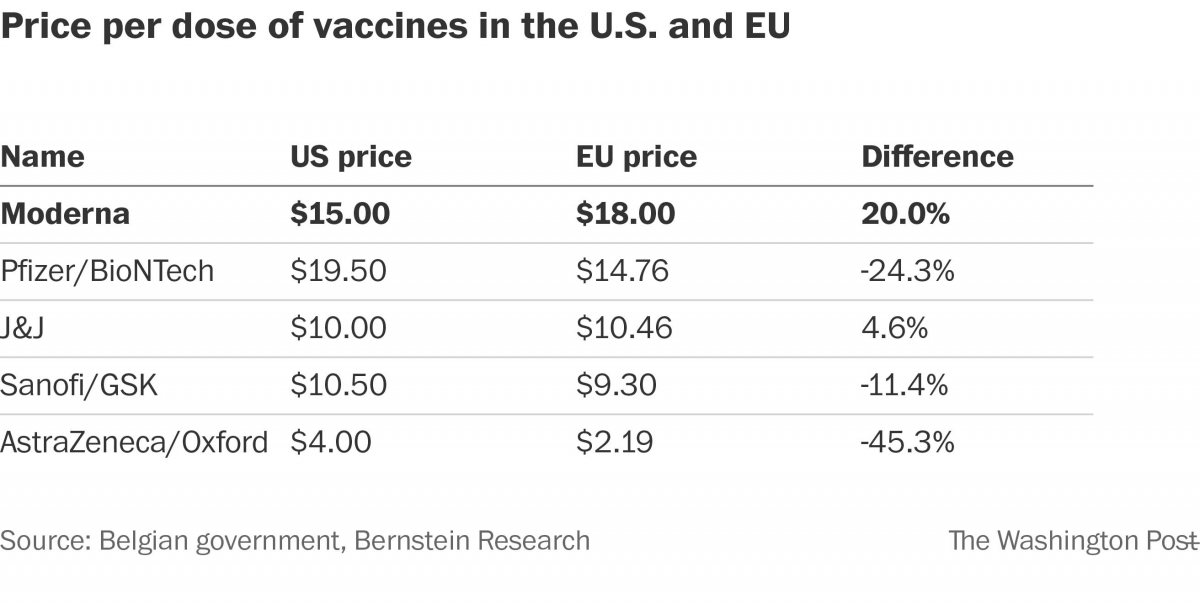
Comparing that list with U.S. calculations by Bernstein Research, an analysis and investment firm, it appears that the 27-nation union has a 24% discount on the Pfizer vaccine, paying $14.76 per dose relative to $19.50 in the United States. Some of the difference may reflect that the EU subsidized that vaccine’s development and the cost of shipping the European-made shots across the Atlantic.

According to the Belgian document, the bloc will pay 45 percent less than the United States for the AstraZeneca-Oxford vaccine currently under development. But it will pay 20 percent more than the United States for the Moderna vaccine, which is expected to be approved for U.S. use on Friday. Both of those vaccines were funded partly by the U.S. government as part of Operation Warp Speed, an effort to expedite their development. The AstraZeneca-Oxford team received $1.2 billion, and Moderna got $4.1 billion.

As in the United States, European countries generally plan to make the vaccines free for their citizens.

The per-dose prices of the vaccines are lower than most brand-name drugs, but the hundreds of millions of doses required to vaccinate entire populations will drive up costs significantly for individual countries. Disparities between the higher prices in the United States and Europe in overall drug prices have long driven outrage in Congress.

Asked about the price differences between the United States and Europe, Pfizer noted that the EU coronavirus vaccine purchase, 200 million doses, was double that of the United States.

“Pfizer and BioNTech are using a tiered pricing formula based on volume and delivery dates,” Pfizer said in a statement. “The agreement with the European Commission for the supply of 200m doses, and an option to request an additional 100m, represents the largest initial order of our candidate vaccine to date.”

It said it would not disclose further details.

“AstraZeneca is providing the vaccine at no profit during the pandemic and the price per dose varies depending on the supply chain. We are unable to comment on specific agreements,” the company said in a statement. The company has previously said it expected its vaccine to cost between $3 and $5 a dose, based on the cost of production. It was not clear why the Belgian figure was so much lower.

The U.S. Pfizer order has already been the subject of frustration, since Pfizer urged Operation Warp Speed over the summer to purchase double what the United States ultimately decided to order. By the time U.S. buyers asked for more doses earlier this month, the availability had been snapped up elsewhere – including by Europe.

Operation Warp Speed said that it had negotiated extensively with each drug manufacturer.

“Based on the significantly varying levels of developmental funding, distribution costs, and other contract terms, we are confident we negotiated the best possible price for the American taxpayer,”‘ the initiative said in a statement. It noted that the price of Pfizer’s vaccine included distribution across the United States and territories, including charter flights from manufacturing flights in Europe.

Most vaccines currently under development require two doses, although Johnson & Johnson’s – $10 in the United States and $8.50 in Europe – is a single shot.

The two vaccines that are first in line for approval – Pfizer-BioNTech and Moderna – are more expensive than others partly because they are more expensive to make, the result of a never-before-used approach that primes the immune system to defeat the coronavirus.

The EU’s finance arm offered a $122 million loan to BioNTech in June to help develop the vaccine, followed by an additional $458 million from the German government in September.

The other vaccine prices noted on the EU list were $9.30 for the one under development by Sanofi and GlaxoSmithKline, an 11 percent discount on the U.S. cost, and $12.30 for the one under development by CureVac, for which the United States has not signed contracts.

The EU has been secretive about the prices it negotiated for its 2 billion doses of various vaccines, drawing fire from transparency advocates who say the public and policymakers have a right to know how much their governments are paying for the inoculations.

The EU negotiated as a bloc, but most other countries, including the United States, are negotiating individual contracts with pharmaceutical companies. The confidentiality clauses presumably benefit the manufacturers, since they make it easier to vary the prices from country to country.

A spokesman for the European Commission, which negotiated the contracts for the vaccines on behalf of EU members, declined to comment about the pricing on Friday, other than to say disclosure was a breach of confidentiality clauses of the contracts.

The Belgian official, State Secretary for Budget Eva De Bleeker, posted the table of Belgium’s costs for vaccines on Twitter on Thursday, then deleted it shortly afterward. Because the EU has negotiated collectively for vaccines on behalf of its members, the same prices apply across all of its 27 nations.

A spokesman for De Bleeker confirmed the authenticity of the tweet, and said that it came after a Thursday evening discussion in the Belgian Parliament and opposition charges that there was no money to pay for the vaccines in the country’s 2021 budget.

“The communication team posted the tweet to close the discussion,” said Bavo De Mol, the spokesman. “We wanted to be as transparent as possible, but maybe we were a bit too transparent.”

The breach was first reported by HLN, a Belgian newspaper. Late Friday, Belgian media noted there was at least one error in the document – the number of doses of CureVac that the country planned to purchase was incorrect – but said that the prices per dose appeared to be accurate.

Drug pricing is linked to a number of factors, including volume discounts and other specific promises made by governments when they sign the contracts. Some governments have agreed to limit the liability drug manufacturers will face if side effects arise from the vaccines, for instance. In February, the Trump administration offered vaccine manufacturers protection from lawsuits until 2024.

Europe has spread its bets relatively evenly among six vaccines, reserving 200 million to 300 million doses of all of them except the one produced by Moderna, of which it purchased 80 million. A few countries, including Germany and Hungary, have purchased additional vaccines on the side.

The European Medicines Agency is likely to approve the Pfizer-BioNTech vaccine on Monday, with the vaccine expected to roll out across the EU the final week of this month.

The EU vaccines will be shared equally across the European Union based on each country’s population size.