By Syndication Washington Post, Bloomberg · Stuart Biggs
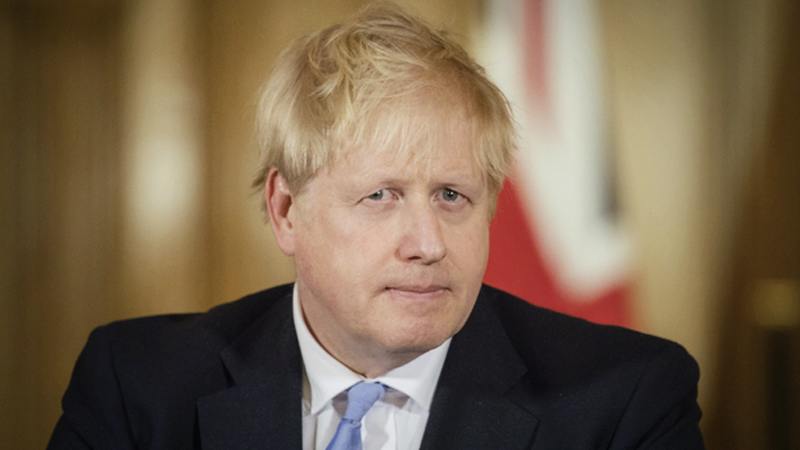
The British government will draft in the armed forces to help with coronavirus testing in schools, as pressure builds on Prime Minister Boris Johnson to delay the return of students after the holidays amid a surge in cases.
The Ministry of Defence said 1,500 personnel will help ensure testing systems are up and running when schools reopen next week. The government has previously said students facing public exams this year will return on Jan. 4, with other pupils back later in the month.
But a growing number of unions, politicians and scientists called for more time to prepare testing to prevent virus transmission in schools. The number of new cases in the U.K. surged to a daily record of more than 41,000 on Monday and hospitalizations exceeded the peak recorded in the first wave in the spring, as a more virulent strain of the virus takes hold.
Johnson has made keeping schools open a key priority as he looks for ways to kick start the U.K. economy after months of restrictions left it facing its worst downturn for 300 years. Ministers threatened legal action to stop schools offering home learning before Christmas, but a government statement late Monday left open the possibility of that position being reversed in the new year.
“We want all pupils to return in January as school is the best place for their development and mental health,” it said. “But as the prime minister has said, it is right that we follow the path of the pandemic and keep our approach under constant review.”
Schools should remain closed for “a week or two” to ensure testing is effective, Steve Chalke, founder of the Oasis chain of academy schools, told BBC radio on Tuesday. His intervention followed similar calls for a delay from the National Education Union on Monday.
“We would ask government to pause, to come up with a clear strategy for the continuity of education,” Chalke said. “We think that if you really care about kids you would do this well — to invest now, to give time now makes sense.”
Roger Gale, a member of Parliament in Johnson’s Conservative Party, said schools should remain closed until vaccines have been made available to teachers.
“Education is important, but so are the lives and well-being of teachers,” Gale, the MP for North Thanet, said on Twitter.
Since the fallout from the decision to close schools in March, which led to the cancellation of exams and a furor over university admissions in the summer, ministers have repeatedly said education must continue even if other parts of society and the economy have to close to accommodate it.
But the government’s pandemic strategy has been uprooted in recent weeks by the emergence of a new strain of the virus, which has spread rapidly in London and surrounding areas and led many countries to block arrivals from the U.K.
The government’s Scientific Advisory Group for Emergencies told Johnson to keep secondary schools closed in January and to consider another national lockdown, Politico reported Monday, citing an adviser familiar with the group’s conclusions.
The group said a lockdown on the same terms as November may not be enough to control the new strain of the virus, according to the report.
National restrictions are needed to prevent a “catastrophe” at the start of year, a member of the government’s advisory group on new respiratory virus threats — which itself advises SAGE — told the BBC on Tuesday.
“We are entering a very dangerous new phase of the pandemic and we’re going to need decisive, early, national action to prevent a catastrophe in January and February,” said Andrew Hayward, professor of infectious diseases epidemiology at University College London. “Previous levels of restrictions that worked before won’t work now.”
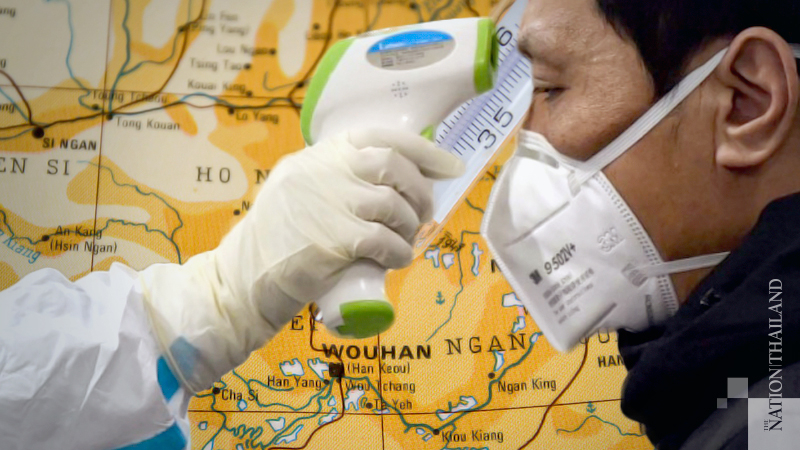
The scale of the covid-19 outbreak in Wuhan early this year may have been nearly 10 times the recorded tally, a study conducted by China’s public health authorities indicates, leaving the city where the coronavirus first took hold still well short of the immunity required to protect against a potential resurgence.
About 4.4% of those tested were found to have specific antibodies that can fight off the pathogen that causes covid-19, indicating they were infected some time in the past, according to a serological survey of more than 34,000 people conducted in April by the Chinese Center for Disease Control and Prevention. The data was released late Monday.
That ratio would suggest that with Wuhan home to about 11 million people, as many as 500,000 residents may have been infected, nearly 10 times more than the 50,000 confirmed covid-19 cases reported by health authorities in mid-April, when the survey was conducted.
China has been criticized internationally for its initial handling of the outbreak, which has spread around the world in a global pandemic in the year since the first cases emerged. The U.S. has raised questions about China’s accounting of the virus fallout in Wuhan, which was quickly eclipsed by larger outbreaks in Europe and North America. A number of revisions of the case and deaths data added to suspicions China was massaging the numbers.
While the serological data may reignite those claims, it is common for health authorities to underreport cases during an acute outbreak, given testing capabilities can be limited and hospitals overwhelmed with a sudden surge in patients. The coronavirus’s ability to quietly infect people without making some of them sick until later or even throughout the infection period only exacerbates the problem.
Serological surveillance has been widely used by health professionals around the world to gauge the true scale of epidemics, from covid-19 to AIDS and hepatitis. The prevalence of disease derived from such studies can guide mitigation and vaccination efforts.
The China CDC survey showed a far less impact of the virus outside Wuhan, which was effectively shut off as a way of containing the outbreak. The positive rate for antibodies dropped to 0.44% for the broader Hubei province, which was also placed under a three-month lockdown. Only two people tested positive for the antibody among the 12,000 surveyed in six other Chinese cities and provinces, including Beijing, Shanghai and Guangdong, suggesting an extremely low prevalence of the virus across the rest of the country.
The results for Wuhan mean even China’s worst-hit city is still vulnerable to covid-19. Epidemiologists say at least half a population needs to have come into contact with the virus for even the minimum threshold for herd immunity. But the city’s rate of infection is generally in line with those found in other countries after the first wave of coronavirus infections, the China CDC said in a news release published on its website.
The antibody positive rates in Spain and Switzerland this spring, for example, were as much as 6.2% and 11%, respectively, the China CDC said. While those are higher than the 4.4% found in Wuhan, and come before later waves that have swept across Europe, they still fall short of the herd immunity threshold.
Since quelling the Hubei outbreak, China has largely contained the coronavirus, with sporadic flare-ups since April snuffed out through aggressive contact tracing and quickly testing millions of people in a matter of days.
Argentina kicks off vaccination drive with Russia’s Sputnik V
InternationalDec 30. 2020A screen displays images of the Russian Sputnik V vaccine arriving during a press conference at Ezeiza International Airport airport in Buenos Aires, Argentina, on Dec. 24, 2020. Argentina approved the emergency use of Russia’s vaccine to combat the spread of Covid-19, becoming the first nation outside the former Soviet Union to authorize the shot. MUST CREDIT: Bloomberg photo by Anita Pouchard Serra
By Syndication Washington Post, Bloomberg · Scott Squires, Jake Rudnitsky
Argentina became the third country worldwide to begin inoculating its citizens against covid-19 with the Sputnik V vaccine outside of trials, boosting Russia’s attempts to push the shot into developing nations.
Vaccinations began around 9 a.m. local time Tuesday in the capital, Buenos Aires, and in provinces with some 300,000 people expected to be given the shot. Argentina’s health regulator gave swift emergency approval for the vaccine last week, following earlier clearances from Russia and Belarus.
“I think people have a lot of faith in the vaccine,” President Alberto Fernandez said on state television, according to Telam. “They aren’t paying attention to attempts to scare them.”
With the initiative, Argentina joins North America, the U.K., EU, China and Chile in offering preventive shots that are expected to bring the pandemic, its deaths and its disastrous economic effects, to an end. More than 1.7 million people have died worldwide from the new coronavirus that surfaced almost a year ago in China.
Controversy has swirled around Sputnik V since Russian President Vladimir Putin announced its registration for use before large-scale clinical studies were completed. Its developers have since said that an interim analysis of final-stage studies indicated it was more than 91% effective after volunteers received two doses.
The Kremlin is seeking to promote the Russian vaccine as a cheap, effective defense against the coronavirus. A course of two doses taken three weeks apart will cost $20, which is significantly less than shots being produced by Pfizer Inc. Over 50 countries have expressed interest in obtaining Sputnik V, according to its developers.
Russians remain skeptical of their homegrown vaccine, despite suffering one of the highest covid-19 tolls globally. Only 38% are ready to take Sputnik V, according to a Dec. 21-23 poll conducted by the Levada Center.
Argentina became the first country outside the former Soviet Union to begin administering the shot, which has yet to publish data from late-stage trials in a peer-reviewed journal. Venezuela, however, has vaccinated 120 people with Sputnik in a trial, its health minister said on Sunday.
Argentina expects to receive 20 million doses of the Sputnik V vaccine over the next two months, and may add 5 million more in March. The government plans to prioritize health workers. Fernandez, 61, said earlier this month he would be among the first to take the vaccine to show that it’s safe.
Axel Kicillof, a former Economy Minister and current Governor of Buenos Aires Province was among the first to receive the shot, according to television network TN. He posed for photos and showed his vaccination card.
In the rest of Latin America, Mexico, Chile and Costa Rica have begun giving the Pfizer vaccine. Many other countries in the region are either awaiting final approval for the shot being developed by AstraZeneca Plc. and Oxford University or for deliveries from Covax, a World Health Organization-backed effort to provide a coronavirus vaccine to developing nations.
Brazil’s Sao Paulo state has partnered with China’s Sinovac Biotech Ltd., though publication of final-stage trial results has been delayed.
With a population of around 45 million people, Argentina ranks 11th worldwide in covid deaths with 42,868 and 12th in cases with 1.6 million. After weeks of declines, Argentina’s covid curve has begun to rise again amid more international travel and holiday gatherings.
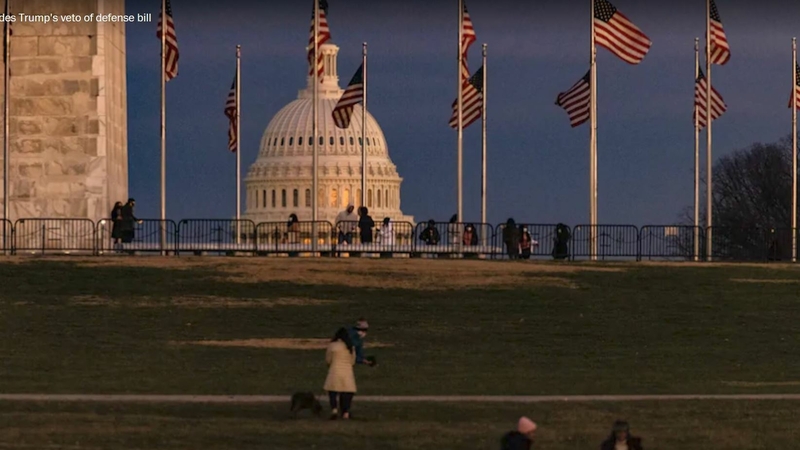
WASHINGTON – Republicans in Congress are about to hand President Donald Trump the biggest legislative loss of his presidency by helping Democrats override a Trump veto for the first time. On Monday, the House of Representatives overwhelmingly voted to override his veto of what is normally a broad bipartisan defense bill. The Republican-controlled Senate is setting up a vote to do the same this week.
It’s worth asking how much of a rebuke this is by Trump’s own party. In one sense, it’s big. In today’s hyperpartisan environment, members of a party don’t willingly and easily override the president of the same party. This veto override is coming from a GOP that has been consistently loyal to Trump, even as he has forced party members to overturn many of their core principles.
Republicans have been willing to distance themselves these past four years from their previous views on immigration, government spending, election security and even acknowledgment of the results of a free and fair election. But most drew the line here, on funding and supporting the military.
But there are also plenty of reasons not to read too much into this. The first is the most obvious: Trump is leaving office in a few weeks. It’s simply less risky for Republicans to override a veto now that he won’t be president much longer. The Washington Post’s Karoun Demirjian counts that Congress has tried and failed to override eight other Trump vetoes.
Republicans have occasionally voted in ways that rebuke Trump, if not this forcefully. Most notably, in 2018, Congress took a historic vote to end the Trump administration’s participation in the war in Yemen. But most often, their concerns about the president have been expressed only in private rooms.
This veto override is happening after Trump significantly weakened his negotiating power with Congress on a separate matter, a dual bill on coronavirus relief and government spending. After his administration negotiated key parts of the package and Congress passed it by wide margins, Trump publicly opposed it.
He kept Congress in doubt for days about the fate of perhaps the most important legislation of 2020 before eventually signing it Sunday. He exacted precisely zero concessions, and he arguably made his party look bad in the process. Coronavirus stimulus is popular, but Trump cast a spotlight on the fact that Republicans didn’t want to do it, writes The Post’s Aaron Blake.
Republicans saw no reason to negotiate with the president during or after his holdout on the coronavirus bill. Earlier Monday, most Republicans in the House voted against a Democratic-approved bill to increase the coronavirus stimulus checks in the legislation from $600 to $2,000, a move Trump supports. It’s not clear if the Republican Senate will take this up, even though Trump has made expanded stimulus checks one of his core issues this past week.
Perhaps things would have been different for Trump on the defense bill had he not severely frustrated members of his own party just days before they were scheduled to consider overriding him.
Finally, some powerful Republicans did side with Trump on the defense bill. Minority Leader Kevin McCarthy of California, the top House Republican, said he would vote against overriding Trump’s veto, even though just weeks earlier he voted for this very legislation. (He wasn’t able to vote Monday because he was recovering from elbow surgery, reported C-SPAN’s Craig Caplan.) A handful of other House Republicans who originally supported the legislation before Trump’s veto also effectively voted against it Monday.
In the Senate, Sen. Lindsey Graham, R-S.C., a Trump ally, may do the same. Graham made regular appearances on the president’s Twitter feed Monday, urging Republicans to consider Trump’s demands. (Chief among them is an unrelated provision to make it easier to sue social media companies for content on their sites.)
We’ll see how many, if any, Senate Republicans join Graham.
The reality is that Trump has never been very good at dealing with Congress. Its members have often played along, at least rhetorically. He has kept Republican lawmakers from publicly criticizing him. And he did get a remarkable number of them to deny that he lost the presidential election, a moment without parallel in modern American history.
But Monday’s veto override in the House underscores that Trump has struggled to actually change their minds on policy. He never got the money he sought for his border wall with Mexico. He was forced to accept harsher policies toward Russia than he wanted. And he’s going to leave office without Congress acquiescing to his last-minute demands.
That Republicans are rebuking Trump so forcefully and clearly suggests a significant weakening of his power over Congress when it comes to policymaking. But there are also reasons not to read too much into this in regard to Republicans’ relationship with Trump. We’ll never know what may have happened if Trump were heading into a second term, rather than out of the White House in a few weeks.
By The Washington Post · Amy B Wang, Jenna Johnson, Dan Lamothe
President-elect Joe Biden on Monday accused President Donald Trump and his political appointees of obstructing the transition of power to his incoming administration, particularly in the national security sphere, an escalation in tone after reports of isolated difficulties in the transition process last week.
Biden specifically called out the Office of Management and Budget and the Defense Department as agencies where his transition team had encountered “roadblocks” from political leadership.
“Right now, we just aren’t getting all the information that we need from the outgoing administration in key national security areas. It’s nothing short, in my view, of irresponsibility,” Biden said of the resistance his team was facing. He warned that such delays could allow enemies of the United States to take advantage of vulnerabilities, citing a recent massive cybersecurity breach that compromised several U.S. agencies.
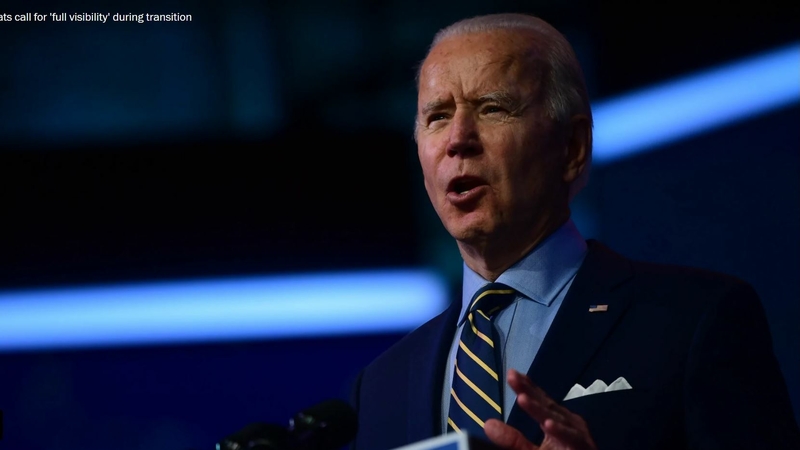
“As our nation is in a period of transition, we need to make sure that nothing is lost in the handoff between administrations. My team needs a clear picture of our force posture around the world and our operations to deter our enemies,” Biden said in remarks from Wilmington, Del. “We need full visibility into the budget planning underway at the Defense Department and other agencies in order to avoid any window of confusion or catch-up that our adversaries may try to exploit.”
The pointed accusation by a president-elect that the incumbent was putting national security at risk by refusing to cooperate underscored the unprecedented and divisive nature of the current transition.
With less than a month before Inauguration Day, Biden has been laying the groundwork for how to tackle the gargantuan twin challenges that he will face as soon as he assumes the presidency – ending the coronavirus pandemic and rebuilding the economy. He has steadily filled vacancies in his Cabinet and in senior positions in his government, which will take over at noon on Jan. 20.
He has been met with remarkable resistance from Trump, who has refused to concede the election and has continued attempting to overturn the results. Trump blocked any transition efforts outright for more than two weeks before relenting, at least initially. He has declined to say whether he will attend Biden’s inauguration, and the incoming team planning the event assumes he will not.
Trump also has appeared increasingly uninterested in the nation’s most critical matters, instead pressuring allies to change the results of an election that his own administration said had been free of widespread fraud. On Dec. 23, he vetoed a defense authorization bill that included raises for service members, forcing a veto override effort this week. He complained that the measure would allow the renaming of military facilities honoring Confederate soldiers and had not included an unrelated measure punishing social media companies. He threatened to veto a coronavirus relief measure, delaying benefits before he eventually signed it Sunday.
On Monday, Trump continued to tweet conspiracy theories about the election – at one point retweeting a view that opponents were guilty of “treason” – and spent much of the day at his private golf club in Florida.
Meanwhile, Biden and Vice President-elect Kamala Harris attended a virtual briefing with 15 national security and foreign policy advisers, including several would-be Cabinet nominees. In comments that followed, Biden said the advisers told him that many of the agencies critical to national security have sustained “enormous damage” during the Trump administration.
“Many of them have been hollowed out in personnel, capacity and in morale, in the policy processes that have atrophied or have been sidelined, in the disrepair of our alliances . . . in the general disengagement from the world,” Biden said. “And all of that makes it harder for our government to protect the American people, to defend our vital interests in a world where threats are constantly evolving and our adversaries are constantly adapting.”
Acting defense secretary Christopher Miller disputed Biden’s accusation, saying in a statement Monday night that more than 400 defense officials have participated in 164 meetings with the transition team and provided more than 5,000 pages of documents. Miller said these efforts “already surpass those of recent administrations,” despite a compressed time frame.
Miller had, however, abruptly postponed all transition meetings on Dec. 18, saying in a statement then that the Biden team and Trump administration had mutually agreed on a pause through the holiday season. Biden team officials have denied that was the case. An official familiar with the situation who spoke on the condition of anonymity to discuss the matter said no meetings have occurred since then. The Defense Department announced late Monday that three meetings are scheduled for this week, two related to the pandemic and one on cybersecurity.
The Office of Management and Budget did not immediately respond to Biden’s comments.
Biden said Monday that most government agencies have shown “exemplary cooperation” with his transition team, especially given the challenges of the pandemic and the Trump administration’s effort to stall conversations, but that his staff has encountered “obstruction from political leadership” when they could not afford to waste any time. He noted that four years ago, he and then-President Barack Obama gave the incoming Trump-Pence administration “access to all that we had.”
In raising concerns about the transition, Biden was careful to distinguish between political appointees in the agencies and the career professionals who he said had cooperated fully.
“They never stopped doing their job and continued to serve our country, day in and day out, to keep their fellow Americans safe,” Biden said of the career government workers. “These agencies are filled with patriots who’ve earned our respect, and who should never be treated as political footballs.”
As an example of the potential impact of the obstruction, Biden pointed to the pandemic, which in December killed more Americans than in any previous month. More than 330,000 have died since March, with nearly 19.3 million sickened.
“We’ve learned so painfully this year the cost of being unprepared,” Biden said.
Biden said that under his administration, the Federal Emergency Management Agency will play an “enormous part” in the “safe, equitable and efficient distribution of vaccines to as many Americans as possible, as quickly as possible.” Harris and her husband plan to receive vaccinations in Washington on Tuesday.
“We want to make sure that our administration is poised to make full use of FEMA’s domestic reach and capacity,” Biden said.
In his Monday remarks, Biden also took issue with Trump’s handling of foreign affairs, repeatedly saying that the United States needs to strengthen its alliances with like-minded countries, not just to confront the pandemic but also to address climate change and “strategic challenges” from China and Russia.
“Right now there’s an enormous vacuum,” Biden said. “We’re going to have to regain the trust and confidence of a world that has begun to find ways to work around us or work without us.”
Biden said he was also briefed Monday on the steps needed to “clean up the humanitarian disaster that the Trump administration has systematically created on our southern border.”
Biden said that the work will start on his first day in office but could take some time, especially when it comes to rebuilding the nation’s capacity for processing asylum claims. He has previously pledged a comprehensive immigration plan on his first day in office.
“We’re going to work purposefully, diligently and responsibly to roll back Trump’s restrictions starting on day one,” he said. “But it’s not as simple as throwing a switch to turn everything back on, especially amid a pandemic.”
Biden opened his comments by addressing the Christmas Day explosion in Nashville, Tenn., saying federal, state and local law enforcement “are working around-the-clock to gain more information on motive or intent.” He praised Nashville police and other first responders, saying that “their bravery and coolheadedness” probably saved lives. Local and federal authorities have said a local man whose remains were found in the wreckage was responsible for the explosion, which spread destruction for blocks.
“This bombing was a reminder of the destructive power that individuals and small groups can muster,” Biden said, “and the need for continuing vigilance across the board.”
WASHINGTON – The House voted Monday to reject President Donald Trump’s veto of a $741 billion defense authorization bill, setting up the first congressional override of his presidency just days before he exits office.
The 322-to-87 vote was comfortably more than the two-thirds of the House that was needed to pass the measure and set up the legislation for a similar override vote in the Senate this week. But the House’s margin of victory was smaller than the support the same bill received earlier this month, before the president’s veto. Some Republicans who supported the measure three weeks ago did not vote to override the president’s veto.
Trump made good on repeated threats to veto the legislation last week, when he sent the bill back to Congress with a laundry list of objections. Among the president’s complaints were that it ordered the Pentagon to change the names of military installations commemorating Confederate generals; restricted his ability to pull U.S. troops out of Germany, South Korea and Afghanistan; and did not repeal an unrelated law giving certain liability protections to technology companies.
His move led some of his stalwart supporters, including House Minority Leader Kevin McCarthy, R-Calif., to announce that they would not cross the president’s veto, even though they had voted for the defense bill. But despite those gestures of solidarity, the president has never had the numbers to sustain a veto, according to congressional officials.
In a statement after the vote, House Speaker Nancy Pelosi, D-Calif., called on Trump to “end his eleventh-hour campaign of chaos,” and respect the will of Congress.
Trump should “stop using his final moments in office to obstruct bipartisan and bicameral action to protect our military and defend our security,” she said.
Since the summer, the National Defense Authorization Act – an annual measure authorizing funds for everything from overseas military operations to pay increases for service members – has had overwhelming, veto-proof support in both chambers of Congress and the backing of a majority of each political party.
Over several weeks, many leading Republicans, particularly in the Senate, engaged in a concerted effort to get Trump to back off his veto threat, arguing that if the president’s push to retain the Confederate names kept the defense bill – for the first time in six decades – from becoming law, he would be on the wrong side of history.
They also appealed to Trump to abandon his insistence that the bill repeal Section 230 of the Communications Decency Act, a law that shields social media companies from legal liability for what third parties post to their websites. Trump has taken special aim at the law as part of his vendetta against Facebook, Google and Twitter for what he alleges is anti-conservative bias.
On Sunday night, Trump included a mention of Section 230 in a statement announcing he had signed a federal budget and pandemic relief bill into law.
“Congress has promised that Section 230, which so unfairly benefits Big Tech at the expense of the American people, will be reviewed and either be terminated or substantially reformed,” Trump said.
Trump’s statement did not represent a concession from Congress but a reflection of reality. While Democrats and most Republicans are in agreement that Section 230 needs revisiting, they also believe that it should be changed through a more careful process rather than shoehorning it into the defense bill.
Some leaders hope that Trump’s statement could free some Republicans who were loath to cross his veto over the Section 230 issue to support Monday’s override vote in the House.
Speaking on the floor just before the vote, the House Armed Services Committee’s top Republican, Rep. Mac Thornberry, R-Texas, implored his colleagues to do so.
“It’s the exact same bill, not a comma has changed,” he said, calling on those who had backed the legislation earlier this month to vote in support of it again.
Panel chairman Rep. Adam Smith, D-Wash., also said that the defense bill presented Congress with a rare opportunity to close the year out on a high note.
“We put together a bipartisan, bicameral product that has gotten an overwhelming number of votes,” Smith said. “Let’s show the American people that the legislative process works, at least a little better than sometimes they think it does.”
The bill now heads to the Senate, which must also pass the measure with a two-thirds majority in order for it to become law. That vote could happen as soon as Wednesday.
Congress to date has never been able to muster the votes to override a Trump veto, of which there have been nine since the start of his presidency. That is a higher rate of vetoes than either Barack Obama or George W. Bush, who each issued 12 vetoes over eight years in office. Before them, Bill Clinton issued 36 vetoes and George H.W. Bush issued 29. Each of those presidents faced at least one veto override by Congress.
Parts of the bill run against key elements of Trump’s agenda. The bill’s provisions restricting troop reductions at foreign outposts were inspired by Trump’s efforts to do so over the objections of Congress. Similarly, its prohibition on presidents using their emergency authority to move unlimited military construction funds to pay for domestic projects is a response to Trump’s efforts to siphon off billions of military funds to pay for a border wall.
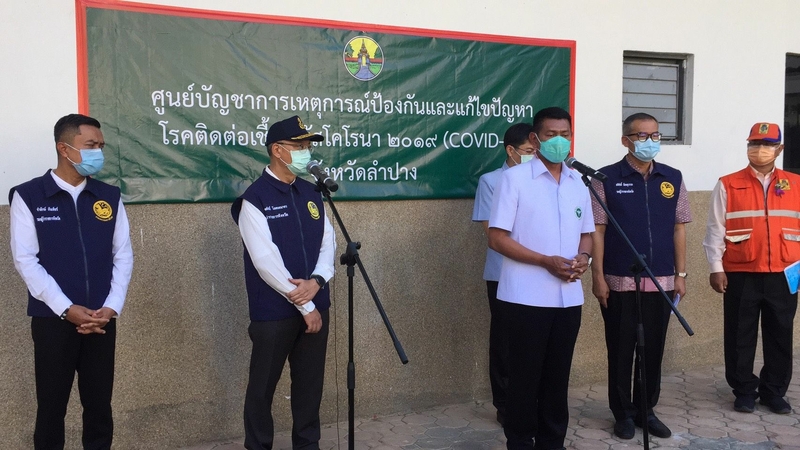
Lampang Governor Narongsak Osotthanakorn told a press conference at city hall on Tuesday that a Covid-19 infection has been reported in the province.
“The patient is a Thai male aged 33 years. He travelled from U-tapao Airport in Rayong on AirAsia Flight No FD 103 to Chiang Mai International Airport on December 24,” Narongsak said. “After spending two nights in Chiang Mai, he drove a rented car to Lampang on December 26 and spent a night at a house in Ton Thongchai subdistrict. He then went to his friend’s wedding in Ban Huay Sai village on December 27 and started to feel sick with a cough and headache,” the governor said.
“The patient was tested on December 28 and the test came back positive for Covid-19. He has been hospitalised since,” Narongsak said.
He said preliminary tracing shows that 23 persons in Lampang came into close contact with the patient and carry a high risk of contracting Covid-19.
They have been alerted and instructed to go into self-quarantine at home and monitor their symptoms for 14 days.
The province has also contacted the Chiang Mai public health office to trace the places the patient visited during his stay there.
The Thailand Meteorological Department said on Wednesday that a strong high-pressure system over Vietnam and Laos will cover upper Thailand from today until January 3. Cool to cold weather and strong winds are still likely over the whole area, with a 6-8°C decrease in temperatures.
Meanwhile, the strong northeast monsoon prevails over the Gulf and the South, causing more showers and isolated heavy rain, the department said, adding that waves in the Gulf are 2-3 metres high and more than 3 metres in areas experiencing thundershowers.
Here’s the weather forecast for the next 24 hours:
North: Cool to cold weather; temperature lows of 11-18 degrees and highs of 30-35 degrees Celsius. Temperature on hilltops is likely to drop to 3-10 degrees Celsius.
Northeast: Cool to cold weather with strong wind; temperature lows of 14-20 degrees and highs of 29-31 degrees Celsius. Temperature on hilltops is likely to drop to 9-14 degrees Celsius.
Central region: Cool weather with morning fog; temperature lows of 18-20 degrees, highs of 33-35 degrees Celsius.
East: Cool weather with strong wind; temperature lows of 20-22 degrees, highs of 30-34 degrees Celsius; waves 1-2 metres high and 2 metres offshore.
South (east coast): Mostly cloudy with thundershowers in 20 per cent of the area and isolated heavy rain; temperature lows of 22-24 degrees, highs of 31-33 degrees Celsius; waves 2-3 metres high and over 3 metres during thundershowers.
South (west coast): Partly cloudy with thundershowers in 10 per cent of the area; temperature lows of 22-25 degrees, highs of 32-34 degrees Celsius; waves a metre high and 1-2 metres during thundershowers.
Bangkok and surrounding areas: Cool weather; temperature lows of 22-24 degrees, highs of 33-35 degrees Celsius.
Kasikorn Research Centre on Tuesday retained its projection of 2.6 per cent GDP growth for Thailand next year, despite the fresh outbreak of Covid-19. However, the projection is still considerably lower than the Bank of Thailand’s 2021 GDP growth forecast of 3.2 per cent.
The centre said the economic recovery would be slow and driven by government spending, with market instability to be expected. The pace at which economic activity revived and tourists returned would also depend on the Covid-19 situation, it said.
The centre noted that global vaccine supply was still not meeting demand, while the 26 million doses ordered by Thailand would only cover 13 million of its 69 million population.
Another factor affecting the economy was the baht rate. The centre projects the currency will strengthen throughout next year due to the weakening dollar. It sees a rate of Bt29-Bt29.25 per dollar by the end of 2021, hitting Thailand’s export competitiveness.
Kasikorn Research added that US President-elect Joe Biden’s policies and approach to China would also impact Thailand. Meanwhile it said the Covid-19 situation in Thailand should be monitored closely since failure to contain the latest outbreak would have serious ramifications for the economy.
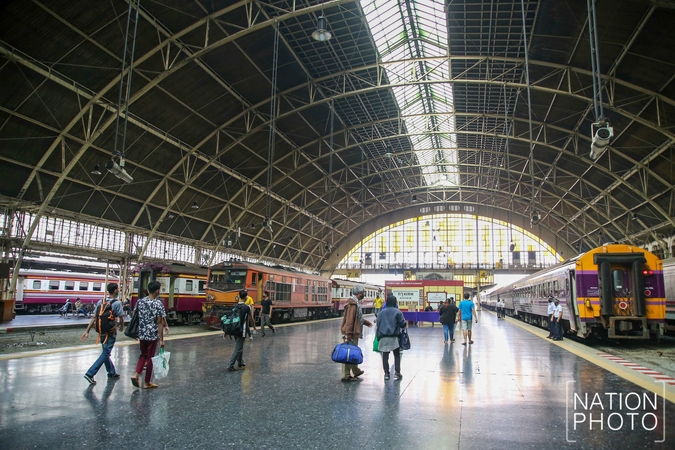
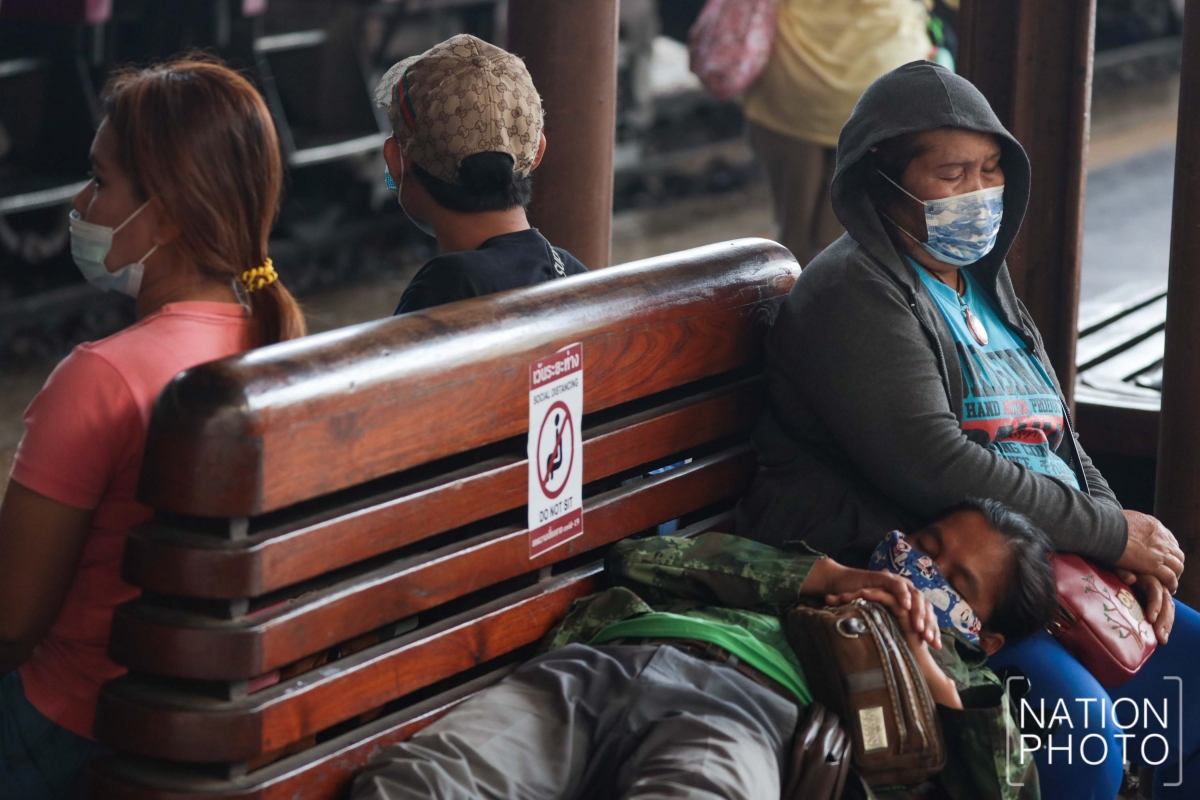
The fresh outbreak of Covid-19 has prevented people from returning to their hometowns over the New Year holidays, as evidenced by fewer passengers this festive season at Hua Lamphong Station in Bangkok.The station has implemented virus-prevention measures for passengers and staff, including mandatory wearing of face masks.On Tuesday, the Centre for Covid-19 Situation Administration (CCSA) reported 155 new cases – 145 local infections and 10 found in quarantine.The three worst-hit provinces were Rayong with 56 new cases, Chonburi (28) and Bangkok (11).Entertainment venues including horseracing tracks and cockfighting stadiums have been closed in Bangkok until January 4.
Restaurants have been allowed to stay open, while live music and other performances are permitted but audience members cannot dance or sing and hostesses must not entertain clients.Otherwise, food and alcohol can be served as normal in the capital, but all dining places must close by midnight.

 A screen displays images of the Russian Sputnik V vaccine arriving during a press conference at Ezeiza International Airport airport in Buenos Aires, Argentina, on Dec. 24, 2020. Argentina approved the emergency use of Russia’s vaccine to combat the spread of Covid-19, becoming the first nation outside the former Soviet Union to authorize the shot. MUST CREDIT: Bloomberg photo by Anita Pouchard Serra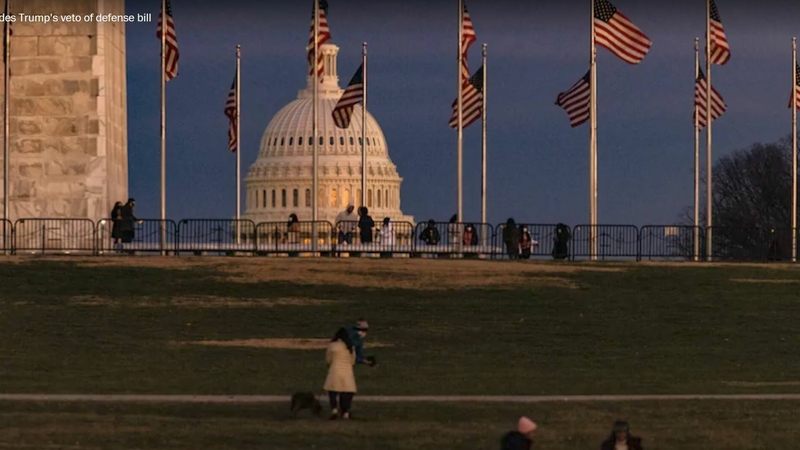



 SootinClaimon.Com