The Stock Exchange of Thailand (SET) Index closed at 1,587.21 on Wednesday, down 2.32 points or 0.15 per cent. Total transactions amounted to Bt72 billion with an index high of 1,593.93 and a low of 1,585.58.
In the morning session, Krungsri Securities forecast the day’s index would fluctuate between 1,580 and 1,600 points despite hopes from a US infrastructure plan worth a massive $3 trillion (Bt93.6 trillion).
“The index would be under pressure due to the falling oil price and uncertainty over a rising US bond yield,” said the Krungsri Securities analyst.
The 10 stocks with the highest trade value today were PTT, EA, STGT, OSP, CPALL, OR, KBANK, RS, GPSC and CBG.
Other Asian indices were on the fall:
Japan’s Nikkei Index closed at 29,178.80, down 253.90 points or 0.86 per cent.
China’s Shang Hai SE Composite Index closed at 3,441.91, down 14.76 points or 0.43 per cent, while Shenzhen SE Component Index closed at 13,778.67, down 109.77 points or 0.79 per cent.
Hong Kong’s Hang Seng Index closed at 28,378.35, down 199.15 points or 0.70 per cent.
South Korea’s KOSPI closed at 3,061.42, down 8.58 points or 0.28 per cent.
Taiwan’s TAIEX Index closed at 16,431.13, down 123.77 points or 0.75 per cent.
The price of small and medium stocks on Tuesday skyrocketed because large stocks are offering limited room for expansion, experts said.
On Tuesday, the price of Better World Green (BWG) shares rose by 19.44 per cent to Bt0.86 per share, followed by Italian-Thai Development (ITD) by 14.19 per cent to Bt1.77, Thai Film Industries by 13.79 per cent to Bt0.33, and Nawarat Patanakarn (NWR) by 12.16 per cent to Bt0.83.
Chanchai Pantathanakit, investment strategy manager at Asia Plus Securities, said large stocks offer limited upside room due to foreign investors and local institutions’ net buys and sales in the latter part of March.
He said small and medium shares rose thanks to retail investors, judging from the fact that the number of stock-trading accounts had increased to 274,000 in February compared to 62,200 last year.
“Since the beginning of 2021, the Market for Alternative Investment has generated returns of up to 36.3 per cent, followed by 27.7 per cent in the sSET Index, 9.6 per cent in the SET, 8.3 per cent in SET100 and 6.7 per cent in SET50,” he said.
The investment strategist advised investors to speculate on stocks whose performance is likely to grow, such as SPVI at a fair value of Bt6.92 per share and Infraset (INSET) at Bt4.66 per share.
Meanwhile, Yuanta Securities (Thailand) strategist Natapon Khamthakrue advised investors to speculate on stocks with strong first-quarter performance that have gained from the government’s stimulus measures, such as Arrow Syndicate (ARROW), TAC Consumer (TACC), Business Alignment (BIZ), Moong Pattana International (MOONG), AMA Marine (AMA), Techno Medical (TM), ND Rubber (NDR), Sea Oil (SEAOIL) and Intermedical Care and Lab Hospital (IMH).
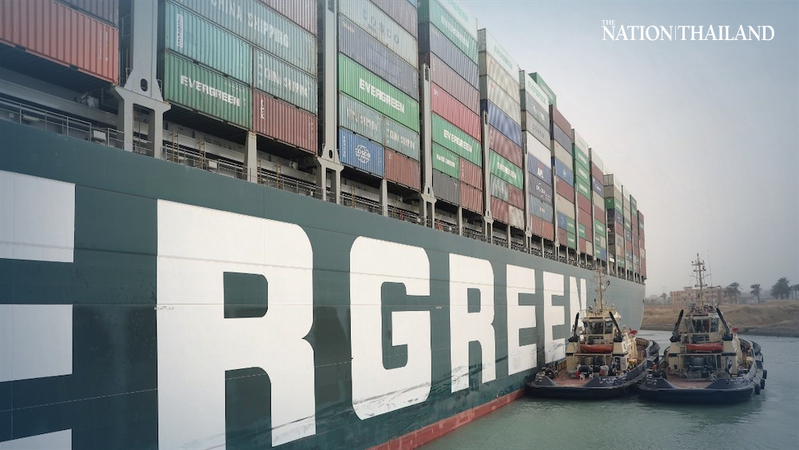
Despite the massive Ever Given ship being freed from choking the Suez Canal and the smooth flow now of cargo vessels through the vital waterway, the private sector believes the overall problem is not over yet and it won’t be all smooth sailing for exports.
The 400-metre-long Ever Given, one of the five largest cargo ships in the world, had paralysed transport since March 23 by blocking the Suez Canal, a major artery of Asia-Europe freight transport, leaving more than 450 cargo ships stranded at either end of the canal. Experts estimate the blockage caused damage worth around $9.6 billion (over Bt300 billion) per day until March 29, when tug boats with the help of land-based digging machines and a high tide got the huge ship moving again. Transportation experts expect the situation to return to normal and all stranded ships to pass through the waterway in four days.
However, international trade, tax and logistics specialist and chairman of Excellent Business Corporation International Sayan Chanvipaswongse said that although the blockage problem has been resolved, there are still many issues that will follow. Containers that the world is already short on will become more scarce because of the container volume on the now-freed Ever Given, which is more than 18,300, combined with the volume of containers on ships presently waiting to enter and exit the Suez Canal. Hence, delays in container deliveries will only exacerbate the already tight container circulation problem in the system, he explained.
The other problem is the delay in goods deliveries for customers in Europe. If trade partners lose sales opportunities, it might affect production plants in a chain. So if Thai exporters receive money under L/C, they may end up with nothing in hand, he said.
However, if it is a money transfer, there may be discussions with the buyer, in which case the Thai exporter could compensate for the delay in delivery as well as request to pay import tax in the event that the product still has to be delivered.
“Business partners have the right to not accept goods after the scheduled time and leave it to the exporter to pay the freight charge itself, this will be a burden on the exporter,” Sayan said.
Lessons must be learned from this incident, he added. Exporters must be aware of marine cargo insurance, including also having to find additional suppliers in case goods or raw materials need to be imported from Europe to produce products and in turn export these. They may need to find additional suppliers in other parts of the world, such as in the US, China, Japan, South Korea or Asean to mitigate the risk.
Thai National Shippers Council (TNSC) vice president Visit Limlurcha said the Suez Canal incident in the past week has delayed the export of Thai products to Europe.
In 2020, Thai-EU trade (including the UK) was worth more than Bt1.1 trillion, with the Suez Canal being the main passage of goods transport.
Among the top 10 products that Thailand exports to Europe are computer equipment and components, jewellery and accessories, rubber products, air conditioners and components, automobile equipment and components, motor vehicles and related parts, electric circuit boards, processed chicken, machinery and components, and clothing, he said.
“The impact is delayed delivery. Buyers have postponed new orders to wait and see how the situation turns out. From now on, containers will become more scarce. In respect to freight charges, the various fees have not yet been raised,” Visit said.
“However, the TNSC still expects Thai exports this year to expand by 4 per cent as predicted,” he added.
The Stock Exchange of Thailand (SET) Index rose by 1.87 points or 0.12 per cent to 1,591.40 in the morning session on Wednesday.
A Krungsri Securities analyst forecast the SET index would fluctuate between 1,580 and 1,600 points despite hopes over a US infrastructure plan worth a massive $3 trillion (Bt93.6 trillion).
“The index would be under pressure due to the falling oil price and uncertainty over a rising US bond yield,” he said.
He recommended investors buy:
▪︎ AOT, MINT, CENTEL, AAV, BA, CPN, CRC, Major, BDMS and BH, which benefit from positive news of Covid-19 vaccinations in Thailand.
▪︎ Hana, KCE, TU and CPF, which benefit from the weakening baht.
▪︎ CBG, Ichi, Sappe, RBF, DOD, IP, TACC, Gunkul and Kiss, which benefit from positive news on hemp production and its general use.
The SET Index closed at 1,590.97 on Tuesday, up 7.08 points or 0.45 per cent. Total transactions amounted to Bt97 billion with an index high of 1,593.52 points and a low of 1,585.06.
The price of gold dropped by Bt150 per baht weight in morning trade on Wednesday, the Gold Traders Association reported. The price has now dropped sharply for two consecutive days.
As of 9.22am, the buying price of a gold bar was Bt24,900 per baht weight and selling price Bt25,000 while gold ornaments cost Bt24,453.08 and Bt25,500, respectively.
At close on Tuesday, the buying price of a gold bar was Bt25,050 per baht weight and selling price Bt25,150 while gold ornaments cost Bt24,604.68 and Bt25,650, respectively.
The spot gold price dropped to US$1,682 (Bt52,784) per ounce on Wednesday after falling by $28.60 to $1,686 on Tuesday due to a rising US bond yield and strengthening dollar.
The Hong Kong gold price dropped by HK$130 to $15,630 (Bt63,085) per tael, the Chinese Gold and Silver Exchange Society reported.
By Syndication Washington Post, Bloomberg · Vildana Hajric
Stocks fell for a second day and Treasury yields touched a 14-month high as traders weighed the consequences of more stimulus from the Biden administration.
The utilities, information technology and consumer staples sectors pushed the benchmark S&P 500 lower, though financial shares recovered from Monday’s slide in the wake of the implosion of Archegos Capital Management. Apple Inc. led the Nasdaq Composite into negative territory. The dollar strengthened for a second day and gold slipped below $1,700 per troy ounce. Oil halted a two-day rally before the April 1 meeting of OPEC and its allies.
“The market’s still trying to figure out what the trade is — by that I mean, the stay-at-home stocks were the trade for basically a year,” said JJ Kinahan, chief market strategist at TD Ameritrade. “Now, more people are getting vaccinated, but at the same time, you’re starting to see a rise in cases in many states. So just like that is messy, so is the market.”
President Joe Biden, in an address slated for Wednesday in Pittsburgh, will detail a mass expansion of government spending aimed at reducing inequality and strengthening infrastructure. A revamp of the tax code is also part of the plan and is already proving divisive among economists and lawmakers.
Ten-year Treasury yields increased to as high as 1.77%. The five-year rate rose as high as 0.95%, a 13-month high, followed by a block sale in the notes.
ViacomCBS and Discovery rose, while the American Depositary Receipts of Chinese companies linked to the Archegos block trades also posted gains.
Europe’s equity benchmark rose to its highest level in 13 months as the momentum swung in favor of cyclical stocks such as banks and automakers.
Meanwhile, the U.S. reached a record three-day stretch of 10 million shots over the weekend, according to the Bloomberg Vaccine Tracker, and plans to offer inoculations to 90% of adults.
Stocks
The S&P 500 Index dipped 0.3% to 3,958.86 as of 4:02 p.m. EDT.
The Dow Jones industrial average fell 0.3% to 33,070.94, the biggest fall in a week.
The Nasdaq Composite Index fell 0.1% to 13,045.40.
The Nasdaq 100 Index declined 0.5% to 12,896.54.
The Stoxx Europe 600 Index jumped 0.7% to 430.65, the highest in more than 13 months.
Currencies
The Bloomberg Dollar Spot Index rose 0.3% to 1,154.34, the highest in almost 20 weeks on the biggest advance in a week.
The euro dipped 0.4% to $1.172, the weakest in 21 weeks.
The British pound fell 0.3% to $1.3724.
The Japanese yen depreciated 0.5% to 110.34 per dollar, hitting the weakest in about a year with its fifth straight decline and the largest decrease in more than three weeks.
Bonds
The yield on two-year Treasurys rose less than one basis point to 0.14%.
The yield on 10-year Treasurys climbed less than one basis point to 1.71%, the highest in more than a week.
The yield on 30-year Treasurys fell three basis points to 2.37%, the biggest fall in a week.
Britain’s 10-year yield climbed four basis points to 0.824%, the highest in more than a week on the largest increase in more than a week.
Germany’s 10-year yield increased three basis points to -0.29%, the highest in more than a week.
Commodities
West Texas Intermediate crude decreased 1.9% to $60.38 a barrel.
Gold depreciated 1.7% to $1,682.95 an ounce, the weakest in more than 11 months on the biggest tumble in more than a month.
The Stock Exchange of Thailand (SET) Index closed at 1,590.97 on Tuesday, up 7.08 points or 0.45 per cent. Total transactions amounted to Bt97 billion with an index high of 1,593.52 and a low of 1,585.06.
In the morning session, a Krungsri Securities analyst expected the index to rise to between 1,590 and 1,600 during the day in line with the direction of US and Asian indices.
He said the index also gained positive sentiment from the rising oil price after Russia backed Opec+ on oil production levels through May this year.
However, a rising US bond yield and volatility due to a rollover in the Thailand Futures Exchange market would pressure the index, he said.
He advised investors to follow US President Joe Biden’s announcement of a $3-trillion infrastructure plan on Wednesday.
The 10 stocks with the highest trade value today were CPALL, COM7, OR, PTT, KTC, BANPU, DELTA, AOT, CBG and BBL.
Other Asian indices were on the rise:
Japan’s Nikkei Index closed at 29,432.70, up 48.18 points or 0.16 per cent.
China’s Shang Hai SE Composite Index closed at 3,456.68, up 21.38 points or 0.62 per cent, while Shenzhen SE Component Index closed at 13,888.44, up 117.18 points or 0.85 per cent.
Hong Kong’s Hang Seng Index closed at 28,577.50, up 239.20 points or 0.84 per cent.
South Korea’s KOSPI Index closed at 3,070.00, up 33.96 points or 1.12 per cent.
Taiwan’s TAIEX Index closed at 16,554.90, up 78.93 points or 0.48 per cent.
Five protesters were indicted on Wednesday for allegedly hurting the “liberty of the Queen” when her motorcade drove past an anti-establishment rally on October 14 last year.
Prosecutors also charged them with holding a gathering of more than 10 persons and obstructing traffic.
Since five activists have said they will fight the charges and the Criminal Court has decided to hear their case on April 26.
“We have the right to fight for freedom and justice, and we were honoured for being given the chance. I will go to jail without any hesitation if the court decides. I will continue fighting so what I have done so far will not be in vain and my name will be recorded in history,” activist Boonkueanoon Paothong, 21, said.
“We did not do anything wrong because we had no idea a royal convoy was heading in our direction,” another indicted political activist Ekkachai Hongkangwan, 45, said.
Their lawyer Poonsuk Poonsukcharoen said she expects the five to be granted bail as they are not a flight risk. The protesters have apparently prepared Bt300,000 each as bail guarantee.
The lawyer said the charges carry a minimum sentence of 16 years in jail for violence or attempted violence against the queen or heir-apparent.
The event took place at the height of anti-establishment protests last year when Her Majesty’s motorcade passed through a group of protesters. Video clips show police pushing protesters away from the queen’s car.
Prime Minister Prayut Chan-o-cha vowed on Tuesday that Thailand would not push back refugees fleeing violence in Myanmar.
Speaking at a briefing after the weekly Cabinet meeting, Prayut said Thai officials were seeking a solution to the refugee problem. However, he added that Thailand would negotiate to return those found crossing the border from Myanmar without good reason.
“Nobody is pointing guns to keep them out of the country,” said Prayut of the refugees. “This is a humanitarian problem and both sides need to find a solution together.”
Activists on Monday accused Thai authorities of pushing back about 2,000 ethnic Karen fleeing airstrikes by Myanmar government forces. Thai officials denied the reports. The airstrikes came amid the bloodiest week so far in the Myanmar junta’s crackdown on the civilian population, with 141 reportedly killed on Saturday alone.
Prayut said Thailand had many years of experience in resolving such issues, having hosted 400,000 refugees in nine border camps for 10 to 20 years.
He added that a repatriation programme for the 100,000 refugees who remain in the camps had been suspended following the February 1 military coup in Myanmar.
“The [Thai] government must therefore stop sending them back and prepare to accommodate more people who will be evacuated according to humanitarian principles,” said Prayut.
He added that usually, legal procedures should be followed when crossing the border, but this was an unusual situation and people were dying.
“Thailand has a duty to provide help to unfortunate people seeking aid, but authorities cannot announce they will accept everyone, as border security officials and related agencies must first work out a plan and principles to protect national security,” Prayut told reporters.
Asked whether the Thai government was in contact with United Nations refugee agency, Prayut said the organisation had a branch in Thailand and that refugees cannot be sent to a third country.
Former red-shirt leader Nattawut Saikua on Tuesday called on the government to release pro-democracy protesters from jail and seek a peaceful resolution to the political conflict.
Nattawut said sovereign power in the country belonged to the people as everyone is equal.
The former United Front of Democracy Against Dictatorship (UDD) leader said his view on this had not changed even though he had been banned from political activities for 10 years.
“I have no regrets over the path I chose. I have been sentenced to jail three times, but I can handle it if I have to face such punishment again.”
Nattawut was speaking ahead of a large protest rally planned at Government House on Tuesday.
He also reaffirmed his support for the pro-democracy protesters, saying that he believes the new generation has the power to change the country.
“The country can’t move forward if the new generation is still in jail, so the government should talk with the [young protesters] to seek a peaceful solution for the country,” he said.
He added that he hadn’t talked with current UDD chairman Jatuporn Prompan about holding an anti-government protest at Pruesapha Prachatham monument in Bangkok’s Phra Nakhon district on Sunday (April 4).
 Ekkachai Hongkangwan

 SootinClaimon.Com