Philippines hits record high new 19,441 COVID-19 cases — DOH
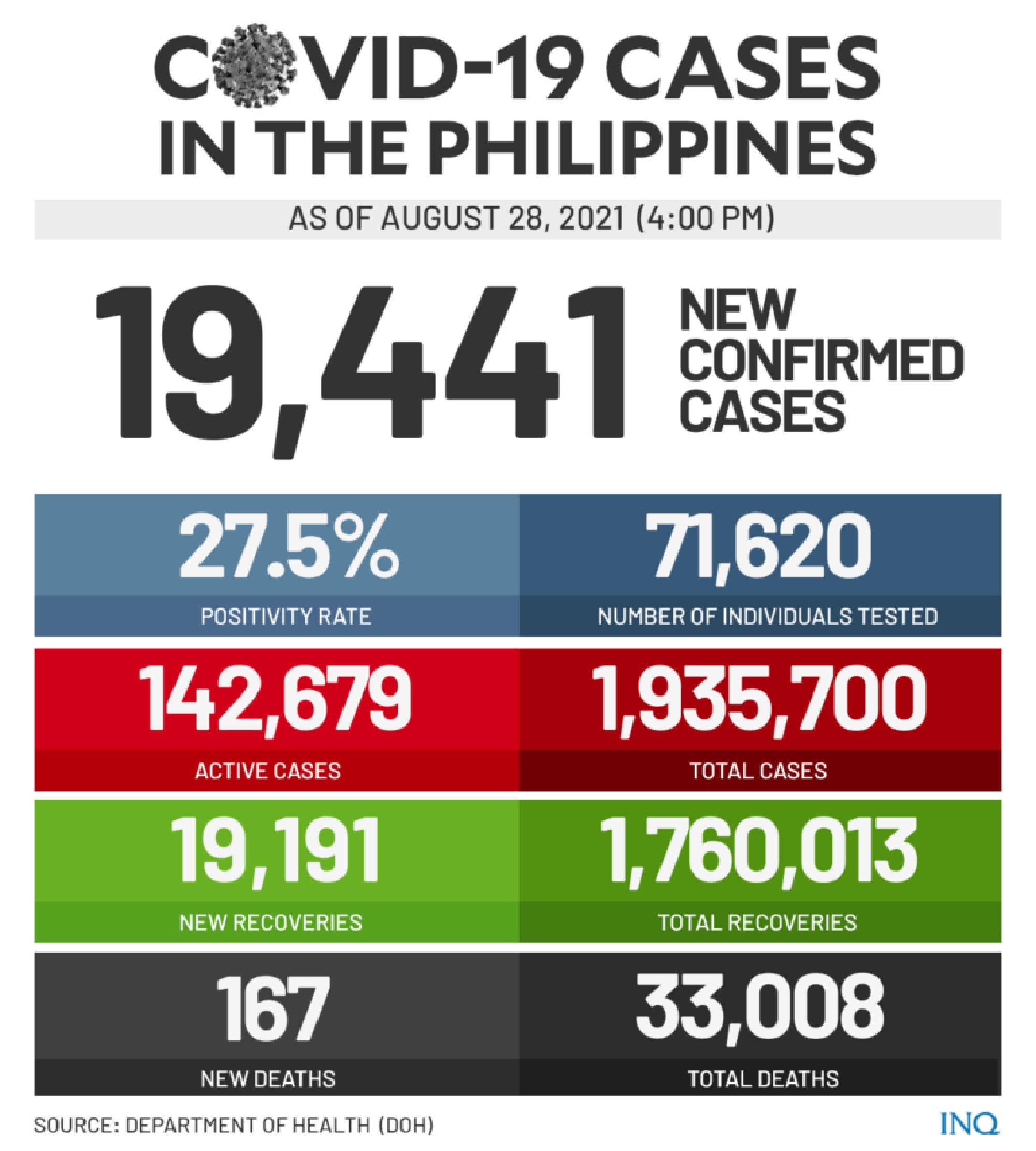
MANILA, Philippines — The Department of Health (DOH) on Saturday reported 19,441 new COVID-19 cases to bring the country’s caseload to 1,935,700.
This is the highest number of cases after the 18,332 cases reported last August 23.
Of the total cases, 142,679 or 7.4 percent were tagged as “active cases,” with most having mild or no symptoms at 97.3 percent.
The total number of recoveries is now at 1,760,013 after 19,191 patients recovered.
The country’s COVID-19 death toll meanwhile is now at 33,008 with 167 new deaths reported.
“Moreover, 76 cases that were previously tagged as recoveries were reclassified as deaths after final validation,” the DOH said.
ADVERTISEMENTx
Philippines hits record high new 19,441 COVID-19 cases — DOH
The latest data from the Johns Hopkins University COVID-19 tracker reported that the Philippines is only behind Indonesia in terms of COVID-19 cases in Southeast Asia with 4,056,354 cases.
As of posting, the COVID-19 global case count is now at 215.4 million including 4.4 million deaths, according to the tracker.
CDC Hanoi office to help beef up surveillance, response to emerging diseases across region
WASHINGTON – A new South-east Asia office of the US Centres for Disease Control and Prevention (CDC) in Vietnam is part of the agency’s long-term vision of a “robust, interconnected network of about eight to 12 regional offices around the globe”, US officials said.
The CDC office in Hanoi was launched on Wednesday (Aug 25) by United States Vice-President Kamala Harris.
“It’s critical that we strengthen global health security even further to prepare for the next global health crisis,” CDC chief medical officer Mitchell Wolfe told reporters during a conference call.
“A disease threat anywhere is a disease threat everywhere.
“The regional office will work to strengthen core health security capacities in areas such as surveillance, data use, laboratory science, workforce development and emergency preparedness,” Dr Wolfe said.
CDC South-east Asia regional director John MacArthur said: “Over the past two decades, South-east Asia and neighbouring areas have seen the emergence of Nipah virus, Sars, avian influenza, and Covid-19. Even the Zika virus that significantly impacted the health of South Americans was of Asian lineage.
ADVERTISEMENTx
“Our regional office will work to coordinate CDC’s approach to help address risks associated with the development of these new pathogens of pandemic potential, work to mitigate them at the source, and work collaboratively to prepare and address any future public health threats.”
Dr MacArthur told The Straits Times: “My team in the regional office… will be engaged in the development of strategies for the region and policies for the region.”
He added: “We will have a sort of a bird’s-eye view of what is happening here, and through communications with our partners across the region, we’ll be able to advocate for resources to leadership in Atlanta and in Washington.”
But the main focus is to help strengthen health security partnerships across the region, both at the bilateral level and with regional partners.
“And those areas are fairly… clear,” he said.
“No. 1 is surveillance. We need to have robust surveillance systems that can detect a new pathogen or an old pathogen early so that our public health authorities and the ministries around the region can respond quickly and effectively… to contain that outbreak before it grows.”
He added: “It will also ensure that the lab systems are as strong as they possibly can be.
“And then focus on the coordination of the response through public health emergency management training, (and) strengthening the emergency operations centres, which really serve as the main coordinating unit for many of the ministries of health across the region.”
Afghanistan neighbours realistic on Kabul situation, says Qureshi after four-nation tour
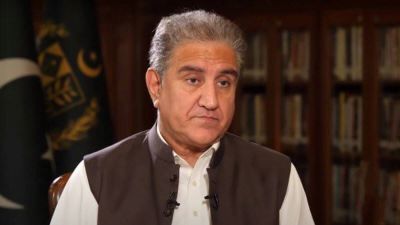
Foreign Minister Shah Mahmood Qureshi, who recently concluded a four-nation tour of Tajikistan, Uzbekistan, Turkmenistan and Iran, has said that Afghanistans neighbours were “fully aware” of the situation in Kabul and their approach towards the issue “was realistic”.
In a statement issued on Saturday, the foreign minister detailed his findings after holding dialogues with regional leadership surrounding Afghanistan. “I had the opportunity to learn about their views on Afghanistan during my four-nation tour,” he said.
“The entire region will benefit if there is peace and stability in Afghanistan,” Qureshi said, adding that the Taliban leadership was also in contact with all the countries.
“The people of Afghanistan have been dealing with wars for decades and want peace. They are suffering for the mistakes made in the past. We need to learn from the mistakes made in the past so that they are not repeated.”
ADVERTISEMENTx
If there is a positive message coming from Afghanistan, it should be encouraged, Qureshi said, adding that isolating Afghanistan would be detrimental to all.
The minister said the world was “expressing confidence” in Pakistan, adding that the country’s role as a mediator in Afghanistan had also been praised.
“Pakistan is helping evacuate the diplomatic staff of several countries from Afghanistan,” he said. “Pakistan International Airlines has played an important role in this regard.”
Commenting on neighbouring India, he said that it was at the top of the list of “spoilers” in the region. He said India was carrying out “negative activities” to harm Pakistan and was bent upon destroying peace in the region.
The minister denied that the border with Afghanistan had been closed, adding that only “border management measures” have been taken.
Police request foreign investigation over claims of Malaysians detained by Taliban
KUALA LUMPUR (Bernama): The police have submitted applications to foreign security agencies to investigate allegations of two Malaysians detained by Taliban authorities in Afghanistan.
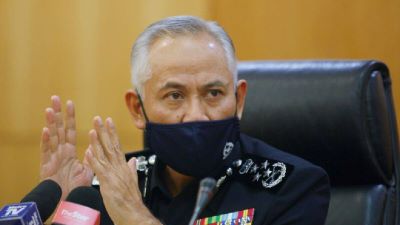
Inspector-General of Police Datuk Seri Acryl Sani Abdullah Sani said police have taken note of news report that two Malaysians were arrested over their alleged involvement with the Islamic State (IS).
“So far, the police do not have any information regarding the involvement of Malaysians in IS activities in Afghanistan.
“However, investigations are underway to look into the possibility that the reported news involves Malaysian IS fighters who are already abroad,” he said in a statement Saturday night (Aug 28).
International media reported that two Malaysians were among six individuals detained by Taliban authorities for being involved in armed clashes in Kabul, Afghanistan on Thursday (Aug 26). – Bernama
Most of the Americans killed in the Kabul bombing were 9/11 babies who never knew a nation at peace
They had signed up to do their part, to heal a country – their own – that had not known a moment of peace in their entire lives. Rylee McCollum wanted to become a history teacher, but only after doing what he could as a Marine to serve his country. Hunter Lopez knew this was what he wanted since he was 11 years old. Ryan Knauss knew it in second grade.
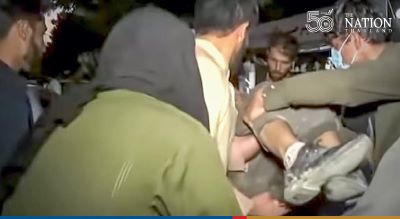
The 13 American service members killed in Kabul on Thursday died in gruesome violence, victims of a terrorist bombing. They were, with one exception, 9/11 babies, born within a few years of the terrorist attacks that led the United States into a military conflict that stretched across four presidencies and throughout the lives of these 11 men and two women.
They never knew a United States that was not at war, never lived in the world before the Department of Homeland Security and the Transportation Security Administration, a country without ID checks in office buildings, metal detectors at schools, shoes X-rayed at the airport.
Instead, they grew up keenly conscious of security concerns, in a culture now sometimes fixated on safety, always aware of a war on terrorism that men and women in uniform were fighting thousands of miles from home.
ADVERTISEMENTx
They were in Afghanistan this month not to fight, but to help finally end a war that has lasted two decades. In the pictures they posted, the videos they sent home, they held Afghan babies and guided fleeing families and stood guard in a hectic, precarious place. The stories of battles and bombs they heard in their training had seemed to some like tales of another time, the kind of lore their superiors liked to pass along to the next generation.
On Saturday, as the Pentagon released the names and biographies of those who were killed, their families groped to make some sense of the ultimate loss. Parents and other relatives spoke of these deaths as searing reminders that these young people had lived in the shadow of wars that took place an ocean away, conflicts strangely detached from most Americans’ daily existence.
“Our generation of Marines has been listening to the Iraq/Afghan vets tell their war stories for years,” wrote Mallory Harrison, Marine Corps Sgt. Nicole Gee’s friend and roommate first in the barracks and later at their shared house in North Carolina. “It’s easy for that war & those stories to sound like something so distant – something that you feel like you’re never going to experience since you joined the Marine Corps during peacetime.
“You know it can happen,” Harrison wrote on Facebook. “You raise your hand for all of the deployments, you put in the work. But it’s hard to truly relate to those stories when most of the deployments nowadays involve a trip to [Okinawa] or a boring 6 months on ship. Then bad people do bad things.”
Gee’s car, Harrison wrote, is still “parked in our lot. It’s so mundane. Simple. But it’s there. My very best friend, my person, my sister forever. My other half . . .”
The bombing killed Gee six days after Pentagon officials had tweeted a picture of her cradling an Afghan infant in her arms in Kabul. Gee had reposted that photo on Instagram, adding a caption: “I love my job.”
Gee’s father, Richard Herrera, told The Washington Post that she had texted him from Afghanistan a few days before she died. She had just been in Kuwait and now was helping women and children who sought to flee from the Taliban.
Gee, who was from Roseville, Calif., had set out to become an air traffic controller, but an irregular heartbeat steered her into a position as a maintenance technician. Her father said he had “never expected her to be on the front lines in Afghanistan,” but she told him that “she was having the experience of her life,” he recalled. “And I told her I was proud of her.”
Gee, who was promoted to sergeant last month, was 23 when she died.
So was Army Staff Sgt. Ryan Knauss of Corryton, Tenn. “I want to be a Marine,” he wrote in his second-grade yearbook, drawing himself in uniform.
Knauss recently completed psychological operations training and hoped to serve next in Washington, his relatives said. He was “a motivated young man who loved his country,” his grandfather, Wayne Knauss, told WATE-TV in Knoxville. “He was a believer, so we will see him again in God’s heaven.”
Five of the 13 were 20 years old, as old as the attacks on the World Trade Center and the Pentagon.
One 20-year-old, Marine Lance Cpl. David Espinoza, had called his mother from Kabul on Wednesday.
“I love you,” he told Elizabeth Holguin before they hung up. Becoming a Marine had always been Espinoza’s dream, his mother told The Post, and he enlisted right after finishing high school in Rio Bravo, Texas, a small, mostly Hispanic town near Laredo.
“It was his calling, and he died a hero,” Holguin said. She said her heart has “a David-sized hole nobody can fill.”
Another of the 20-year-olds, Marine Lance Cpl. Rylee J. McCollum, was a baby on 9/11 and had wanted to join the armed forces since he was 2 years old, according to his sister, Roice. Another sister recalled Rylee as a toddler, carrying around a toy rifle and wearing his sister’s pink princess snow boots.
“He signed up the day he turned 18,” she said. “That was his plan his whole life.”
Rylee, who grew up in Jackson, Wyo., and was a decorated wrestler in high school, had just gotten married on Valentine’s Day before departing on his first overseas assignment in April. He’d been transferred to Afghanistan two weeks ago.
His wife, Jiennah Crayton, who lives in San Diego, was counting the days until McCollum’s return from his tour of duty. She is pregnant, and the couple had hoped Rylee might be home just in time for the arrival of their baby in three weeks, the sister said.
“He would’ve been the best dad,” Crayton wrote on Facebook. “I wish he could see how much of an impact he made on this world.”
The oldest service member killed in Thursday’s attack, Marine Staff Sgt. Darin Taylor Hoover, who went by Taylor, was 31. He had decided on a military career after seeing New York’s twin towers collapse in the 2001 attack, when he was 11. He enlisted when he was 19.
“Why he did this was because he loves his country,” his father, Darin Hoover, told KUTV in Salt Lake City. “He loves people.”
On Thursday, Taylor, who played football at Hillcrest High School in Midvale, Utah, “led his men into that, and they followed him, but I know, I know in my heart of hearts he was out front,” his father said. “And they would have followed him through the gates of hell if that’s what it took, and ultimately that’s pretty much what he did.”
Ever since two Marines arrived at his doorstep outside Salt Lake City to deliver news of Taylor’s death, his father has heard from other Marines who’d served with his son in Afghanistan and elsewhere and wanted his family to know that they’d been honored to have him as their sergeant.
“They look back on him and say that they’ve learned so much from him,” Darin Hoover told KUTV. “One heck of a leader.”
Darin Hoover said he did not want his son’s legacy to be tarnished by the politics of how the war in Afghanistan ended. The father wanted the eldest of his three children to be remembered instead simply as “a great young man” who decided 20 years ago that a historic attack on his country would shape the course of his life.
The father recalled: “He decided, ‘That’s what I want to do.’ “
For some other families of the fallen, the circumstances of these deaths are colored by politics. Some sounded like President Biden when they spoke of the American involvement in Afghanistan, as they wondered why U.S. military forces remained on the ground for so many years, the mission never entirely clear to many of the troops, the endgame never quite certain.
On the first day after two Marine bereavement officers showed up at his front door, Steve Nikoui struggled to assess what had happened to his boy, Marine Lance Cpl. Kareem Nikoui, who was 20 years old.
“I haven’t been able to grasp everything that’s going on,” Steve Nikoui told the Daily Beast. “He was born the same year it started, and ended his life with the end of this war.”
Although the father felt a duty to “respect the office” of the presidency, “Biden turned his back on him,” Steve Nikoui said. “That’s it.”
He told Reuters that “I’m really disappointed in the way that the president has handled this, even more so the way the military has handled it. The commanders on the ground should have recognized this threat and addressed it.”
The father, a carpenter in Norco, Calif., said he’d been pleased to see his son join the Marines while Donald Trump was president because “I really believed this guy didn’t want to send people into harm’s way. They sent my son over there as a paper pusher.”
The way the war is ending has divided the bereaved families just as it has split the nation.
Twenty-three hundred miles from Nikoui’s home, in Berlin Heights, Ohio, the same knock at the door came from two Navy notification officers, and now Navy Corpsman Maxton W. Soviak’s sister Marilyn finds herself one of 12 surviving siblings in a family that will never be the same.
“I’ve never been one for politics and I’m not going to start now,” Marilyn Soviak wrote on Instagram. “What I will say is that my beautiful, intelligent, beat-to-the-sound of his own drum, annoying, charming baby brother was killed yesterday helping to save lives. He was a … medic. There to help people . . . He was just a kid. We are sending kids over there to die. Kids with families that now have holes just like ours.”
Max Soviak, who was 22, was the only sailor killed in the bombing. His last words to his mother came recently over video chat. He assured her that he’d be okay.
“Don’t worry, Mom. My guys got me,” he said. “They won’t let anything happen to me.”
On Friday, after the knock on the door, his mother “realized that they all” – Max and his guys – “just went together,” according to a statement his parents, Kip and Rachel, gave to The Post.
Their son, who had played on the football, wrestling, tennis and track teams in high school, had wanted to make the Navy his career.
Marine Cpl. Hunter Lopez had formed a solid plan, too. His father is a captain and his mother a deputy in the sheriff’s department in Riverside County, Calif., and Hunter, who was 22, intended to follow his parents into the same office, according to a statement from the Riverside Sheriffs’ Association.
“Like his parents who serve our community, being a Marine to Hunter wasn’t a job; it was a calling,” the statement said.
“This kid knew since he was 11 what he wanted to do,” Hunter’s uncle, JC Lopez, said on Facebook. “Every free moment was spent training and perfecting his craft. Hunter, you did your job. Rest now.”
Biden to withdraw U.S. diplomatic staff from Afghanistan as future relationship with the Taliban remains unclear
WASHINGTON – President Joe Biden is planning to withdraw the U.S. ambassador and all diplomatic staff in Afghanistan by Tuesday, and it is unclear when – or if – they might return to the country, according to two U.S. officials.
Despite the Taliban’s expressed interest in having the United States maintain a diplomatic mission in Kabul, the Biden administration has not made a final decision about what a future presence might look like. On Friday, State Department spokesman Ned Price said the Biden administration is “actively discussing” the Taliban’s request with U.S. allies and partners in the region – but the United States has not yet engaged directly with the Taliban to discuss what form a diplomatic mission might take, according to one U.S. official who, like others, spoke on the condition of anonymity to discuss sensitive policy deliberations.
The lack of a set plan all but ensures that the United States’ diplomatic presence in Kabul will lapse for weeks, months or even longer – potentially complicating the Biden administration’s ability to make good on recent assurances that although the U.S. military is departing the country by Aug. 31, the United States will continue to help Americans and Afghans who want to leave after they are gone.
The Biden administration will also have to decide whether to formally recognize a Taliban government, a decision that also may take some time and may be a factor in any return, officials said.
“We’re developing detailed plans for how we can continue to provide consular support and facilitate departures for those who wish to leave after August 31,” a senior State Department official said, when asked about how the United States will be able to assist those who remain. The officials said the administration is “looking at a series of options with regard to our diplomatic engagement.”
There are an estimated 350 Americans still in Afghanistan who have told U.S. officials they want to get out of the country, a State Department spokesperson said Saturday, noting that some of those individuals may have already found passage out of Kabul. The State Department also has made contact with an additional 280 people who have claimed to be Americans in Afghanistan but either have not communicated their plans, or said they intend to stay behind.
On Saturday, Pentagon spokesman John Kirby said that any U.S. passport holder who wants to get into the Kabul airport can get in, even though the evacuations are winding down. Army Maj. Gen. William Taylor reported that between 3 a.m. Friday and 3 a.m. Saturday, 6,800 people were airlifted out of Kabul – 4,000 of them on U.S. military planes. That is far less than earlier this week, when upward of 21,000 people were being evacuated on a daily basis.
Taylor said a total of about 117,000 people – “the vast majority of which are Afghans” – have been flown out of Hamid Karzai International Airport since the evacuation operation began Aug. 14.
Yet for thousands of other Afghans fearful of returning to life under repressive Taliban rule – including many who provided assistance the U.S. military, diplomatic and nongovernmental missions and may be eligible for evacuation – the chances of departing Kabul before the end of the month are slim.
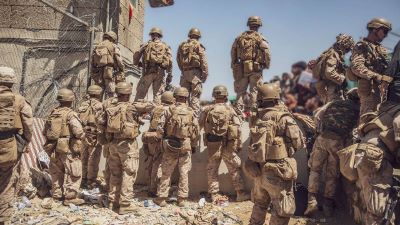
The military has begun carting out equipment on flights, leaving less room for people to board. Most gates to the airport have been closed – an apparent response to Thursday’s suicide bombing by an Islamic State affiliate known as Islamic State-Khorasan, which killed 13 U.S. service members and over 170 others, most of them Afghans.
The United States retaliated on Friday with a drone strike that killed what Pentagon officials are calling two “ISIS-K planners and facilitators,” though they refused to answer questions about whether those individuals had any role in orchestrating the Kabul airport attack.
“This strike was not the last,” Biden said in a statement Saturday, noting that another attack is “highly likely” to occur in the next 24 to 36 hours. “The situation on the ground continues to be extremely dangerous,” he added, noting that he has directed the military “to take every possible measure to prioritize force protection.”
One U.S. official familiar with the situation said Saturday that the bombing in Kabul marked a “capping point where the main evacuation ended.” Evacuations have continued, the official said, but have been scaled back and focused heavily on people already inside the airport.
On Saturday, the Taliban’s de facto leader released a video message appealing with Afghans to let the United States complete its withdrawal before trying to leave the country, promising that “no one will prevent” Afghans with the proper documents from leaving the country afterward.
“Afghans who have documents, passports, and want to go abroad, they have the right to do so,” Mullah Abdul Ghani Baradar said, according to a translation provided by Zalmay Khalilzad, the U.S. special representative for Afghan peace negotiations. “Let the foreign forces withdraw first, finish their evacuation and then our compatriots – whether they have worked with the Americans or otherwise – may leave the country if they want . . . all airports, particularly Kabul airport, will be open for their travel.”
“The statement is positive,” Khalilzad noted on Twitter. “We, our allies, and the international community will hold them to these commitments.”
The United States is engaged in talks about the future management of the Kabul airport, discussions that involve the private sector, regional partners such as Turkey and the Taliban, officials said.
When asked whether the United States was seeking assurances on women’s rights from the Taliban before approving a diplomatic presence, Price said a future Afghan government that does not respect the rights of its people and uphold counterterrorism commitments is “almost certainly a government we cannot work with.”
The Taliban’s request for international recognition comes as it grapples with a bleak economic outlook for the country that is now its to govern, after Western nations froze billions of dollars of Afghanistan government assets and blocked promised aid money following the rapid takeover.
Afghanistan’s financial and commercial sectors are not considered to be vibrant enough to keep the economy afloat without at least some of those funds, making the release of government assets and development aid key factors in any forthcoming negotiations about reestablishing formal diplomatic ties with a Taliban-led Afghanistan.
In considering retaining a diplomatic presence, Price said Friday that the safety and security of U.S. personnel in that mission would be “first and foremost on our minds,” particularly after Thursday’s deadly suicide bombing.
A senior State Department official said that the Biden administration would remain “relentlessly focused on using every appropriate tool at our disposal to do everything possible to uphold the basic rights of all Afghans, as we continue to use every instrument of national power to ensure that terrorists cannot use Afghanistan to threaten our security and that of our allies.”
But on the ground, service members are a lot less sanguine about what they are leaving behind.
“We lost a war, and everyone who is trying to spin it differently is just trying to save face,” said one U.S. official familiar with the situation in Kabul. Although the official acknowledged that a large number of evacuations have occurred, he said he was sure that not all of the Afghans who needed to flee the Taliban have been able to. He cited Afghan attack pilots he was aware of who were still in hiding.
“We’re going to pat ourselves on the back for exceeding the high score on other evacuations, but we didn’t get all of the right people,” he said. “It’s heartbreaking to see some people get lucky – beyond lucky – and other people who needed it did not.”
Asean reports lower new Covid cases and deaths but Philippines extends lockdown
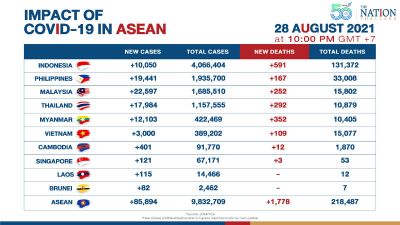
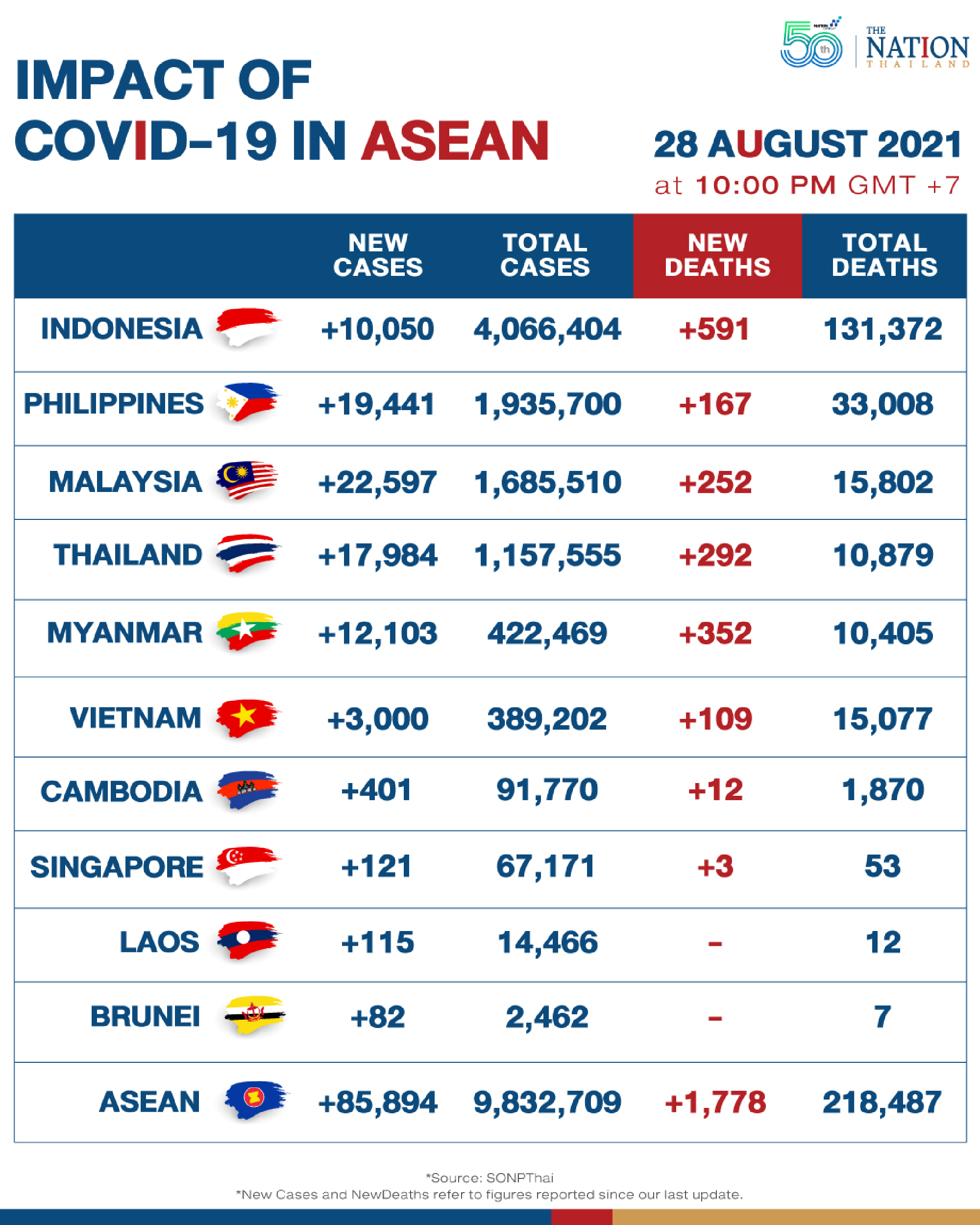
Southeast Asia saw a decrease in new Covid-19 cases and related deaths on Saturday, collated data showed. Asean countries reported 85,894 infections and 1,778 deaths on Saturday, lower than 87,340 and 1,845 respectively on Friday.
Singapore‘s Ministry of Health is delivering Covid-19 rapid antigen test kits (ATKs) to citizens by post until September 27.
Each household will receive six ATKs and instructions on how to use and drop them off properly.
Meanwhile, the ministry will hand out three ATKs per person to students and staff at kindergartens, children development centres, elementary schools and special education schools from September 13.
Schools will contact parents to ensure that students are used to antigen rapid tests for Covid-19.
ADVERTISEMENTx
Phillippines President Rodrigo Duterte decided to extend measures to contain the spread of Covid-19 in Manila and some provinces until September 7 this year.
Though some businesses were allowed to reopen, people were not allowed to dine at restaurants, use personal health services or perform religious activities.
Asean reports lower new Covid cases and deaths but Philippines extends lockdown
Philippines had the second highest number of cases in the region on Saturday with 19,441 patients and 167 deaths, up from Friday’s 17,447 and 113 respectively.
Malaysia had the most cases in Asean with 22,597 patients and 252 deaths.
Namibia starts tracking giraffe movements with tail-mounted devices
Giraffes in Namibias largest national park, Etosha, and the Ehirovipuka Communal Conservancy have been fitted with satellite GPS telemetry, in a move aimed at protecting the species growing numbers.
Giraffes in Namibia’s largest national park, Etosha, and the Ehirovipuka Communal Conservancy were recently fitted with satellite GPS telemetry, in a move aimed at protecting the species’ growing numbers.
ADVERTISEMENTx
“Understanding their movements, what they eat, and how they react to human encroachment can be used for their global protection,” Morgan Hauptfleisch, head and associate professor of Biodiversity Research Center in Namibia University of Science and Technology (NUST), said on Friday.
He said that due to giraffes’ unique physical structure, it is not a simple task to fit GPS monitors on them.
“The Giraffe Conservation Foundation (GCF) was the first to use GPS satellite units and have been evolving them for the last 20 years,” Hauptfleisch said.
He said NUST and GCF tested a new device that can be attached to the tail of the giraffe, and this could replace the previous technology, which fits devices to the horn of the animal.
In the past, research showed that horn-mounted GPS devices got damaged when giraffes fight, Hauptfleisch said, adding that in general, fitting devices on giraffes’ horns takes longer.
“The tail units take a minute, at most, to fit, and since this species does not respond well to anesthetics, we need to get the animal back on its feet as quickly as possible,” he said.
Pentagon says U.S. drone strike kills 2 ISIS-K targets
The strike came after a suicide bombing outside Kabul airport on Thursday which killed 13 U.S. service members and some 170 Afghans. ISIS-K had claimed responsibility for the attack.
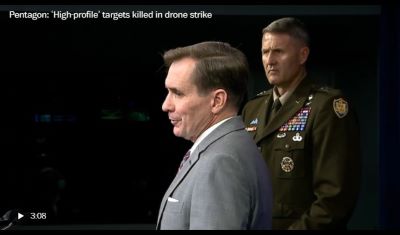
The Pentagon said on Saturday that two high-profile targets of ISIS-K, a local affiliate of the Islamic State in Afghanistan, were killed in a U.S. drone strike on Friday.
ADVERTISEMENTx
“Two high-profile ISIS targets were killed, one was wounded, and we know of zero civilian casualties,” U.S. Army Major General Hank Taylor told reporters in a Pentagon briefing.
U.S. Central Command initially assessed on Friday that the drone strike, which occurred in Nangarhar province of eastern Afghanistan, killed one ISIS-K planner.
The strike came after a suicide bombing outside Kabul airport on Thursday which killed 13 U.S. service members and some 170 Afghans. ISIS-K had claimed responsibility for the attack.
Pentagon Press Secretary John Kirby said in the briefing that the U.S. military supporting evacuation had begun its withdrawal from Kabul airport.
President Joe Biden set Aug. 31 as the deadline to end U.S. military mission in Afghanistan.
The United States has been scrambling to evacuate Americans and its Afghan partners from the country since the Taliban entered Kabul on Aug. 15. The White House said on Saturday around 111,900 people had left Afghanistan since Aug. 14.
Terror attack against Kabul airport “highly likely” in 36 hours: Biden
“The situation on the ground continues to be extremely dangerous, and the threat of terrorist attacks on the airport remains high. Our commanders informed me that an attack is highly likely in the next 24-36 hours,” U.S. President Joe Biden said.
U.S. President Joe Biden warned on Saturday that another terror attack against Kabul airport could be “highly likely in the next 24-36 hours.”
“The situation on the ground continues to be extremely dangerous, and the threat of terrorist attacks on the airport remains high. Our commanders informed me that an attack is highly likely in the next 24-36 hours,” Biden said in a statement after meeting with his national security team.
ADVERTISEMENTx
“I directed them to take every possible measure to prioritize force protection, and ensured that they have all the authorities, resources and plans to protect our men and women on the ground,” he added.
Thirteen U.S. service members and some 170 Afghans were killed in a suicide bombing attack outside Kabul airport on Thursday. ISIS-K, a local affiliate of the Islamic State in Afghanistan, had claimed responsibility for the attack.
In retaliation for the deadly attack, the U.S. military on Friday launched a drone strike against the terror group in Nangarhar province of eastern Afghanistan, which killed two “high-profile” members and wounded another, according to the Pentagon.
“This strike was not the last,” Biden said in the statement. “We will continue to hunt down any person involved in that heinous attack and make them pay.”
Biden set Aug. 31 as the deadline to end U.S. military mission in Afghanistan. Pentagon Press Secretary John Kirby said earlier in the day that the U.S. forces on the ground had begun withdrawal from Kabul airport.
The United States has been scrambling to evacuate Americans and its Afghan partners from the country since the Taliban entered Kabul on Aug. 15. The White House said on Saturday that around 111,900 people had left Afghanistan since Aug. 14.
 Philippines hits record high new 19,441 COVID-19 cases — DOH
 Asean reports lower new Covid cases and deaths but Philippines extends lockdown
 SootinClaimon.Com