Ajinomoto delivers Company Products to support Healthcare workers to fight against COVID-19
The product presentation was held at Department of Medical services, Ministry of Public Health, Nonthaburi Province.
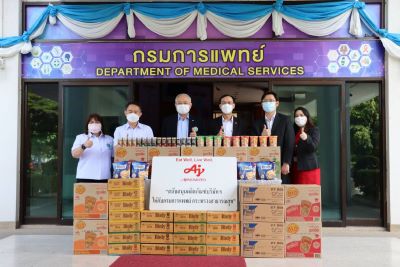
Recently, Ajinomoto Co., (Thailand) Ltd. led by Mr.Thongdee Paso (3rd from right), Managing Director, delivered company products including “Birdy®” RTD canned coffee, “Birdy® 3in1” instant coffee mixed powder and “YumYum™ Cup” instant noodles worth 40,000 Baht to Dr.Manus Potaporn (3rd from left), Deputy Director General of Department of Medical services, together with Dr.Pairoj Surattanawanich (2nd from left), Deputy Director General of Department of Medical services, and Mrs.Nitayaporn Thaweechaitanasakul (leftmost), Secretary to the Department of Medical services, in order to support the work of the Department as well as to encourage morale of all Healthcare workers who have worked hard during the COVID-19 epidemic situation.
The product presentation was held at Department of Medical services, Ministry of Public Health, Nonthaburi Province.
FTI- DENSO-CEP signing of a letter of intent to cooperate on a pilot project on renewable energy trading
The DENSO Group, a global automotive components manufacturer, has expressed their goal to reach 100% of renewable energy usage by “2035”
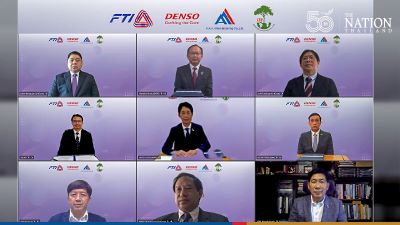
Signed on Wednesday the 25th August 2021, a letter of intent will be signed between The Federation of Thai Industries (FTI), the “DENSO group”, and the clean energy for people foundation (CEP) concerning a pilot project regarding energy trading. Each party’s representatives are to include Dr. Suvit Toraninpanich, the Chairman of FTI’s greenhouse gas reduction working group, Mr. Natee Sithiprasasana, Vice Chairman of the CEP foundation and four DENSO group representatives.
The pilot project will focus on the trading of renewable energy to support current business trends and is to be available in select areas between 2022- 2025, or later if deemed appropriate. It aims to act as a showcase to encourage the restructuring for the energy administration of Thailand along with the energy reform plan and adapt appropriately to newer regulations from the global community, such as the European green deal’s “Carbon Border Adjustment Mechanism (CBAM)”.
ADVERTISEMENTx
This LOI is dependent on the cooperation of all three entities, where to promote and support greenhouse gas reductions, the FTI has formed the Greenhouse Gas Reduction Working Group, responsible for co-operating with the Energy Regulatory Committee(ERC) to push the pilot project, whereas DENSO will focus a feasibility study to test their readiness for participation of the said project, and the CEP is to provide an initial consultations on the restrictions regarding the project. As such, the CEP aims to promote, educate the public, as well as encourage community-government relations.
The FTI’s Greenhouse gas reduction group will also additionally push for a greenhouse gas emissions trading market for parties with a desire to sell or offset the generated carbon within their business activities, where a digital trading platform is required and is set to be registered with relevant agencies such as the Thai Greenhouse Gas Management Organization (TGO).
Khun Kawin Thangsupanich, Secretary to the Ministry of Energy attended the event as a witness to give his congratulations to the working group, promoting and supporting the FTI’s greenhouse gas reduction group,the DENSO Group and the Clean Energy for People Foundation for their intention to cooperate in the electricity trading pilot projects using renewable energy and green carbon to prepare for future greenhouse gas mechanisms. He also mentions
The current situation regarding global warming in Thailand where under the Paris agreement Thailand’s Nationally Determined Contribution – NDC during the years 2021-2030, are set at 20-25% under normal conditions.
The DENSO group,a global automotive components manufacturer, has expressed their goal to reach 100% of renewable energy usage by “2035” and has pledged to support the reduction of carbon emissions from both within the group and outside the group, through carbon emissions trading.
Singha Drinking Water supports all Thais with the “Never give up” clip starring Tennis Panipak.
The company has produced a video hoping to spread positivity and encourage everyone to fight through the crisis with the “Never give up” video starring Tennis – Panipak Wongpattanakit, Thailands Taekwondo Olympic gold medalist.
Singha Drinking Water encourages everyone to stand tall amidst the COVID-19 pandemic with the ” Never give up” video starring Tennis – Panipak Wongpattanakit, Thailand’s Taekwondo Olympic gold medalist, sharing her stories in the ring, which serves as an inspirational anecdote for us all.
Mr. Bhurit Bhirombhakdi, Chief Executive Officer of the Boonrawd Trading Co., Ltd., shares that the COVID-19 is a worldwide pandemic that Thais have suffered through for almost two years. The high infection number and the uncertainty of when or how it’s going to end have impacted the nation’s economy and society.
Since the beginning, the company has initiated a lot of relief efforts to different sectors of the society, such as financial donations for medical supplies and protective kits to medical personnel of hospitals nationwide, the food and water support which is over 2 million bottles, and initiatives from the Singha R-SA network in terms of jobs created and hired. The overall effort now totals up to more than 250 million Baht and counting.
ADVERTISEMENTx
Singha Drinking Water supports all Thais with the “Never give up” clip starring Tennis Panipak.
Although the COVID-19 pandemic might leave people feeling down, distressed, and discouraged, Singha Drinking Water believes that in addition to physical support, emotional support is needed in times like this as well. The company has produced a video hoping to spread positivity and encourage everyone to fight through the crisis with the “Never give up” video starring Tennis – Panipak Wongpattanakit, Thailand’s Taekwondo Olympic gold medalist. She will share her story comparing life as a competitive sport where we have to fight until the end and don’t give up as long as we are in this together.
Singha Drinking Water supports all Thais with the “Never give up” clip starring Tennis Panipak.
“We are proud to be a force of positivity and kindness once again for all Thais. Previously we have launched a “Live and Learn” music video, a rearranged version by Boyd Kosiyapong telling an inspirational story for Thais to march on and a message of support for frontline workers with messages on Bangkok’s billboards as well. The “Never give up” video will resonate the undying spirit which will not give up no matter what,” Mr. Bhurit said.
Singha Drinking Water supports all Thais with the “Never give up” clip starring Tennis Panipak.
Singha Drinking Water’s mission is not only to deliver the best product to its consumers, but the company has been involved with societal developments in numerous areas such as education, the environment, and sports. Singha Corporation has been the main sponsor of the Taekwondo Association of Thailand since 2005 and countless sports organizations, along with supports for athletes of all sports and levels, which has been the driving force of Thailand’s success on the world stage until now.
Huawei, IUCN join hands to preserve biodiversity in APAC with tech innovations
The Asia Pacific region is one of the most biodiverse regions in the world. It is home to the worlds largest mangrove forest, a global center of marine biodiversity, and has seventeen of the worlds 36 “biodiversity hotspots”.
Global leading tech company Huawei and the worlds’ largest conservation organization IUCN will join hands on innovative solutions to promote the green transformation and sustainable development in the Asia Pacific region, said representatives at the TECH for a Better Planet Symposium.
Climate change presents a key challenge for social development, driving an urgent need for a low-carbon society & green growth models to protect the environment & promote green economic recovery.
The symposium, co-organized by IUCN (International Union for Conservation of Nature) and Huawei, and supported by ITU (International Telecommunication Union), brought together industrial experts and opinion leaders from the ICT and environmental protection communities across the Asia Pacific region. This two-part symposium series explored how technology can drive environmental protection and ensure sustainable development.
ADVERTISEMENTx
Huawei, IUCN join hands to preserve biodiversity in APAC with tech innovations
The Asia Pacific region is one of the most biodiverse regions in the world. It is home to the world’s largest mangrove forest, a global center of marine biodiversity, and has seventeen of the world’s 36 “biodiversity hotspots”. However, the region is facing many threats including habitat loss, over-exploitation and climate change.
IUCN is now leading a new, open partnership called ‘Tech4Nature’ together with Huawei. The aim of the partnership is to harness innovative technologies in support of better conservation outcomes in and around protected and conserved areas, according to Dr. Dindo Campilan.
This three-year partnership will pilot a series of innovative digital tools and solutions in 5 countries including Thailand and China.
In partnership with the Thai Department of National Parks, for example, the Tech4Nature program is collaborating with Huawei on its flagship project at the Thailand Khao Yai National Park, a UNESCO World Heritage Site, to explore technological solutions including the use of digital monitor system to navigate wildlife. “IUCN is very pleased to partner with Huawei on Tech4Nature, which is seeking scale-up success nature conservation through digital technology innovations,” said Dr. Dindo Campilan, IUCN Regional Director for Asia.
“ICT has become central to conversations around environmental sustainability,” said Yondeen Sherpa, E-waste Policy and Technology Consultant at the Environment & Emergency Telecommunications Division of the International Telecommunication Union (ITU). To contribute to the pursuit of the SDGs, ITU is working together with members like Huawei to develop international standards and provided measurement methodologies addressing ICT, environment, and circular economy.
E-waste, as one of the fastest growing and most complex waste streams in the world, is affecting both human health and the environment, and proliferating a loss of valuable raw materials. At the same time, if treated through appropriate recycling methods, e-waste could offer economic returns worth, valuable raw materials and new jobs in recycling, Sherpa explained.
As part of the efforts to recycle as much electronic waste as possible, Huawei has built a global recycling program for device products and scaled up the product trade-in program. Over the course of 2020, Huawei processed more than 4,500 tons of e-waste through its recycling stations.
“Technology can help better understand and conserve nature. This is the idea of ‘Tech4Nature’ we share with IUCN. ICT could be applied to monitor and analyze habitats & biodiversity, improve operational efficiency, better connect the stakeholders of nature conservation,” said Kevin Zhang Huawei’s Chief Marketing Officer of ICT infrastructure business.
“We appreciate the partnership with technology companies like Huawei to help protect the environment,” said DENR-4A Regional Director NILO B. TAMORIA (CESO III) at the Symposium, “We’re hoping that we can still improve the technology to make it more effective and efficient as a tool to protect the environment.”
More companies are weighing penalties for unvaccinated workers
More companies are considering imposing financial penalties on workers who refuse to get the coronavirus vaccine – from added health-care costs to withholding gym access – potentially adding a financial cost in addition to the severe health risks facing the unvaccinated.
After Delta Air Lines grabbed headlines Wednesday for saying it will charge unvaccinated workers an additional $200 monthly health-care-plan fee, a growing number of companies have been making inquiries with their legal counsels about asking unvaccinated workers to pay more for their health plans.
Some companies are exploring whether they can withhold raises for unvaccinated workers, decline to cover those workers’ covid-19-related claims or restrict their access to workplace amenities such as gyms, lawyers and consultants who advise business say.
Employers are increasingly moving from luring workers to get their shots to using threats, workplace experts say, frustrated by vaccine holdouts and emboldened by the U.S. Food and Drug Administration’s full approval of the Pfizer-BioNTech vaccine this week.
“I think a lot of employers are seeing the limitations of incentives for folks who are on the fence or who are really digging their heels in and don’t want to get the vaccine,” said Jeffrey Smith, an employee benefits partner at the law firm Fisher Phillips. “Every day we see more questions about ‘Can we charge more for health-care participants if they don’t get the vaccine?’ “
ADVERTISEMENTx
Another employment lawyer, who spoke on the condition of anonymity to speak freely about an issue affecting clients, said: “I think what’s happening right now is people are mad. You’ve got decision-makers, people in boardrooms who’ve been vaccinated forever. They had their plan for hot conference room summer.”
Since the FDA’s full approval, more employers have been moving to vaccination mandates, with CVS Health, Deloitte, Walt Disney Co. and Goldman Sachs announcing or expanding requirements. Some employers that have mandates, including health systems and CNN, fired unvaccinated employees earlier in the summer.
Others, however, are stopping short of requirements, in part to avoid exacerbating worker shortages as the economy reopens.
Delta CEO Ed Bastian said Wednesday in a memo to employees that the surcharge is “necessary to address the financial risk the decision to not vaccinate is creating for our company,” noting the average covid-related hospital stay has cost the airline $40,000 per person. As of Sept. 30, unvaccinated employees will no longer be eligible for additional paid leave for covid-related absences.
The airline, which says it has a 75% vaccination rate and requires vaccinations from new employees, also said unvaccinated workers would have to wear masks and submit to weekly testing.
ADVERTISEMENT
Wade Symons, a partner with Mercer, said he’s had at least 50 clients ask about adding surcharges for unvaccinated employees.
“If you have an employer that’s just philosophically opposed to a vaccine mandate, and they want to continue to give employees at least an appearance of a choice, [surcharges] go beyond just the incentives,” he said.
Yet employment lawyers also caution that adding such surcharges is legally complicated, noting that they implicate the Affordable Care Act, the Americans With Disabilities Act, the Health Insurance Portability and Accountability Act (HIPAA) wellness rules and other laws.
Those rules place a limit on surcharges or incentives tied to health-care plans if they can be considered “health-contingent,” lawyers said.
As a result, more-modest surcharges are more likely, Symons suggested – in the range of $30 to $50 per paycheck, he said.
ADVERTISEMENT
“I’ve even had companies say, well, we’re just going to replace our tobacco surcharge with a vaccine surcharge,” he said. “This is the important thing of the moment.”
The rules may also require employers to offer a “reasonable alternative” for the rare employee who has a valid medical or religious reason not to be vaccinated, said Joseph Lazzarotti, an employee benefits lawyer at Jackson Lewis.
“The question then becomes, what’s the alternative?” he said. Unlike offering smokers the opportunity to take a course on quitting smoking, “there’s not a covid-cessation program.”
Many employers would rather position economic incentives as a financial perk or discount for vaccinated workers than call it a surcharge for the unvaccinated.
Henry Albrecht, CEO of Limeade, which administers corporate wellness programs, said some companies are installing mandates or adding surcharges, but the bulk of his clients are giving workers “points” for becoming vaccinated that they can combine with other healthy behaviors to win rewards such as a gift card.
“They want to keep it a little more positive but also get those numbers up,” said Albrecht.
Lawyers cautioned that just because employers are asking about other tactics does not mean they will be implemented. And not covering covid-related treatments carries substantial legal risk, said Lazzarotti.
Companies could in theory give notice they will cut pay or withhold raises if employees don’t meet certain conditions – unless they are governed by a contract or collective bargaining agreement, said Bob Lian, who leads the labor and employment practice at Akin Gump Strauss Hauer & Feld.
Other employers are considering limiting access to workplace gyms or transports for unvaccinated workers, according to research and advisory firm Gartner.
Brian Kropp, vice president of research for Gartner, said in an email that “what is most interesting about this approach is not the exact details of it – but the larger shift from encouraging vaccines for employees, to creating real costs for employees who don’t get vaccinated.”
Digital transformation ‘exploding’ in Southeast Asia: Deloitte
The pace of digital transformation in Southeast Asia has exploded, according to Deloitte’s latest report on Covid-19’s impact on the business environment.
“Crisis as Catalyst: Accelerating transformation” reveals that many Asia Pacific businesses believe they are well on their way to becoming more resilient in a post-pandemic environment, said Deloitte. More than two-thirds of business leaders surveyed expressed high confidence in their company’s outlook over the next 12 months, it added.
Data from the report shows:
• Sixty-nine per cent of Asia Pacific companies surveyed said the pandemic significantly accelerated their digital transformation – not just sparking but exploding the pace of adoption.
• Sixty-three per cent of companies expect to form new partnerships and alliances.
• Sixty-seven per cent of respondents believe supply chains need to be redesigned as a direct result of the pandemic.
ADVERTISEMENTx
Digital transformation ‘exploding’ in Southeast Asia: Deloitte
In the survey of 2,750 private company executives across 33 countries between January 21 and March 9, Deloitte found that a majority of organisations are now building their resilience across seven key elements: strategy, growth, operations, technology, workforce, capital and society.
“This research resonates with many of Deloitte’s private clients in Southeast Asia, where the pandemic has pushed leaders to speed up their transformations to meet the challenges of a dynamic, uncertain environment,” said Richard Loi, Southeast Asia and Singapore Deloitte private leader.
“Digital solutions are becoming increasingly important for companies as CEOs seek to optimise the present while building a platform for future innovation and competitive advantage.”
A majority of respondents believe their company will snap back from the crisis during the next 12 months, said Deloitte. It added that companies appear to have laid the groundwork for workforce changes through flexible workforce arrangements and by redesigning their organisations to be more agile and accomplish more with smaller, independent teams, including:
Emphasis on digital transformation’s benefits
Executives have broad expectations about the gains technology investments will deliver for their private organisations, and they plan to continue to increase the breadth of their technology investments. For example:
• Highly resilient organisations were nearly twice as likely (80% versus 43%) as those with low resilience scores to say that their digital transformation had begun before the crisis or is currently underway.
• The difference in how highly resilient companies view the importance of digital transformation to their growth versus those with low resilience was 18 percentage points.
Companies are also spending on technology in other areas. In the next 12 months, information security is primed to be the most popular technology spending area according to 39% of respondents, followed closely by cloud computing (38%) and data analytics (37%).
A sharper focus on purpose
Purpose and trust have always been intertwined in the culture and foundation of private companies but took on greater importance in 2020. The report unveiled that:
• Nearly 70% of the respondents said purpose increased in importance for their organisation as a direct result of the COVID-19 crisis.
• Highly resilient organisations were at the forefront in this respect, with 84% of the executives from these organisations saying they sharpened their focus on purpose.
The Labour Ministry is speeding up efforts to create almost 400,000 jobs in the Eastern Economic Corridor (EEC) to help those affected by the Covid-19 outbreak.
This move came after the National Economic and Social Development Council indicated that unemployment in the country has risen due to the Covid-19 crisis.
Labour Minister Suchart Chomklin said he had instructed the Department of Employment to conduct a survey on employers’ demand for workers.
“According to the survey, there are 31,556 jobs available in the three EEC provinces – Rayong, Chonburi and Chachoengsao,” he said.
“Workers are being sought in the manufacturing, retail and wholesale, automotive engineering, medical supplies, health and logistics industries as well as in government agencies.”
ADVERTISEMENTx
The minister added that he expects the number of available positions in the EEC to rise to 400,000 in the next five years.
“Companies with a high demand for workers include Big C Supercentre, Panus Poultry Group, Italian-Thai Development, Seafco, CH Karnchang and Minor International,” Suchart added.
Gold gains in Thai, HK markets as demand up amid US stock market decline
The price of gold in Thailand rose by THB150 on Friday morning.
AGold Traders Association report at 9.27am said the buying price of a gold bar was THB27,750 per baht weight and selling price THB27,850, while gold ornaments were priced at THB27,257.68 and THB28,350, respectively.
At close on Thursday, the buying price of a gold bar was THB27,600 per baht weight and selling price THB27,700, while gold ornaments were THB27,106.08 and THB28,200, respectively.
Spot gold on Friday morning was moving at around US$1,797 (THB58,720) per ounce after Comex gold rose by $4.20 to $1,795.20 per ounce at close on Thursday, due to support for buying gold as a safe-haven asset after the fall in the US stock market. Meanwhile, the market is keeping an eye on US Federal Reserve chairman Jerome Powell’s announcement on Friday at the Fed annual meeting.
ADVERTISEMENTx
Hong Kong gold price rose sharply by HK$100 to $16,670 (THB69,890) per tael, the Chinese Gold and Silver Exchange Society reported.
US Fed meeting outcome expected to arrest five days of gains for SET
The Stock Exchange of Thailand (SET) Index fell by 0.07 points to 1,601.84 on Friday morning.
The SET Index closed at 1,601.91 on Thursday, up 1.42 points or 0.09 per cent. Transactions totalled THB81.23 billion with an index high of 1,603.99 and a low of 1,595.69.
The SET rose for a fifth straight day after surging past the 1,600 mark on Wednesday.
Krungsri Securities forecast the index on Friday would fall to between 1,590 and 1,595 points despite the Centre for Covid-19 Situation Administration subcommittee proposing the easing of Covid-19 restrictions as domestic infections are declining.
It predicted the index would be under pressure due to investors’ mass sell-offs of stocks in response to the US Federal Reserve’s signal it would taper its quantitative easing programme by this year.
“Meanwhile, ongoing political issues would pressure the index,” Krungsri Securities added.
ADVERTISEMENTx
It recommended selective buying as an investment strategy:
▪︎ AOT, CPN, CRC, HMPRO, AAV, BA, MINT, CENTEL, AMATA and WHA, which would benefit from the country’s reopening.
▪︎ PSL, TTA and RCL, which would benefit from a rise in the freight rate.
Baht expected to move sideways as markets await US Fed meeting outcome
The baht opened at 32.76 to the US dollar on Friday, weakening from Thursday’s closing rate of 32.74.
The Thai currency is likely to move between 32.70 and 32.85 during the day, Krungthai Bank market strategist Poon Panichpibool said.
Poon predicted the baht would move sideways as investors were waiting for important factors, such as the US Federal Reserve’s move to reduce quantitative easing (QE).
Poon expected the baht to strengthen in the short term amid hopes of an economic recovery.
The government might ease lockdown measures and foreign investors might invest in Thai stocks because the situation was stable and might be resolved soon.
ADVERTISEMENTx
He was concerned about the Covid-19 situation in Thailand, as he was not sure if the spread of the virus had been contained because enough proactive testing was not being done. The positive rate in Thailand was higher than 20 per cent, while WHO recommends it should be lower than 5 per cent.
He added that the baht was likely to fluctuate and weaken as the situation was not clearly better.


 Singha Drinking Water supports all Thais with the “Never give up” clip starring Tennis Panipak.
 Singha Drinking Water supports all Thais with the “Never give up” clip starring Tennis Panipak.
 Singha Drinking Water supports all Thais with the “Never give up” clip starring Tennis Panipak.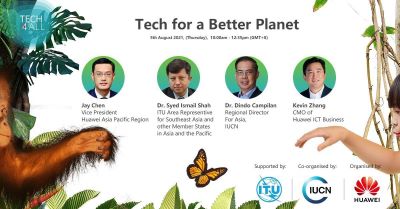
 Huawei, IUCN join hands to preserve biodiversity in APAC with tech innovations

 Digital transformation ‘exploding’ in Southeast Asia: Deloitte



 SootinClaimon.Com