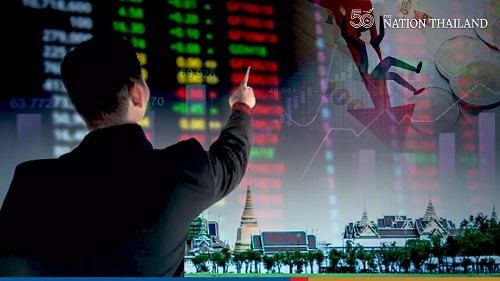
The Stock Exchange of Thailand (SET) Index closed at 1,620.02 on Monday, down 11.13 points or 0.68 per cent. Transactions totalled 135.31 billion baht with an index high of 1,639.97 and a low of 1,616.60.
The index fell after rising by 0.71 per cent on the previous day of trading (Thursday). Analysts blamed uncertainty over floods that have hit 26 provinces in Thailand.
The 10 stocks with the highest trade value today were KBANK, BBL, SCB, PTT, TRUE, PTTEP, XPG, JMART, PTTGC and KCE.
Japan’s Nikkei Index closed at 30,240.06, down 8.75 points or 0.029 per cent.
China’s Shanghai SE Composite Index closed at 3,582.83, down 30.24 points or 0.84 per cent, while the Shenzhen SE Component Index closed at 14,344.29, down 13.56 points or 0.094 per cent.
Hong Kong’s Hang Seng Index closed at 24,208.78, up 16.62 points or 0.069 per cent.
South Korea’s KOSPI Index closed at 3,133.64, up 8.40 points or 0.27 per cent.
Taiwan’s TAIEX Index closed at 17,313.77, up 53.58 points or 0.31 per cent.
Government Savings Bank (GSB) is offering emergency loans for people hit by flooding from storm Dianmu.
Flash floods and runoff have been reported in 26 provinces in the Northeast and Central regions since last week, with Phichit, Chaiyaphum, Nakhon Ratchasima, Sukhothai, Chai Nat, Ayutthaya, Nakhon Sawan, Khon Kaen and Ubon Ratchathani badly affected.
GSB is offering emergency loans of up to Bt50,000 for people affected by flooding, with a grace period of three months for repayment. Those whose houses or property have been damaged by floods can get a home-repair loan of up to Bt1 million with 0 per cent interest in the first year. Homeowners can also apply for an additional loan of up to Bt300,000 to buy or fix furniture and other accessories damaged by the flood.
GSB said its home-related loans have a low interest of MMR-1.25 per cent per year, and customers can offer their house, apartment, land or farm as collateral provided they are unencumbered.
GSB has also boosted its loan limit for existing SME customers affected by the floods by 10 per cent, but not exceeding Bt5 million. The interest rate in the first year will be fixed at 3.5 per cent, while the following year will be set at MLR.
Loan information and application is available at any branch of GSB or by contacting the call centre at 1115.
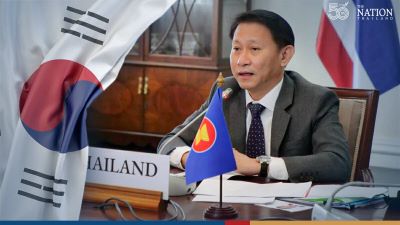
Asean countries and South Korea agreed to improve their free trade agreement during the recent 18th Asean-Korea Economic Ministers Consultation held virtually from September 13 to 15, Vice Commerce Minister Sansern Samalapa said on Sunday.
“The meeting agreed to expand the existing Asean Korea Free Trade Agreement (AKFTA) to provide tax exemption for additional products and promote trading between Asean members and South Korea,” he said.
“The ministers also urged the countries to exchange know-how in Covid-19 management to speed up their economic recovery after the outbreak situation has improved.
“South Korea is especially eager to cooperate with Asean nations in various aspects, such as establishing an industrial innovation centre to promote innovation development and commercial adaptation of innovations in Southeast Asia and South Korea,” added Sansern.
“They are also interested in opening more research and development centres dedicated to startup businesses in the region.”
The meeting also urged Vietnam, the only country in Asean yet to sign the Asean-Korea Trade in Goods Agreement (AKTIGA), to do so as soon as they can so that the agreement can start taking full effect. The AKTIGA is expected to help Asean-Korean entrepreneurs speed up export and import processes by issuing and signing a product’s certificate of origin digitally.
Statistics from the Commerce Ministry indicate that South Korea is currently Thailand’s ninth biggest trade partner with total trade value at $9.1 billion in the first seven months of 2021, increasing 34.5 per cent from the same period of the previous year. Thailand’s exports to South Korea were valued at $3.39 billion, comprising rubber products, wood, computer components, chemicals and aluminium products. Thailand’s imports from South Korea were recorded at $5.71 billion, made up of iron, steel, and electronic circuits.
The baht opened at 33.41 to the US dollar on Monday, weakening from the previous closing rate of 33.24.
The Thai currency is likely to move between 33.25 and 33.40 during the day and between 33.20 and 33.60, Krungthai Bank market strategist Poon Panichpibool predicted.
He said the baht in the short term would weaken due to sales of Thai assets and the risk-off market.
If the Monetary Policy Committee remains unfazed about the Thai economy, the baht will stop weakening, he added.
Regarding the US currency, Poon predicted that the dollar index will move near 93 points, because of several positive factors in the market, namely, an extension of debt ceiling, political turbulence in Germany and the Evergrande issue.
The price of gold rose by THB50 in morning trade on Monday.
AGold Traders Association report at 9.25am said the buying price of a gold bar was THB27,700 per baht weight and selling price THB27,800, while gold ornaments cost THB27,197.04 and THB28,300, respectively.
At close on Saturday, the buying price of a gold bar was THB27,650 per baht weight and selling price THB27,750, while gold ornaments cost THB27,151.56 and THB28,250, respectively.
The Stock Exchange of Thailand (SET) Index rose by 3.54 points, or 0.22 per cent, to 1,634.69 on Monday morning.
The volume of total transactions was THB10.20 billion with an index high of 1,639.97 and a low of 1,634.09 in opening trade.
The 10 stocks with the highest trade value were KBANK, SCB, PTTEP, BBL, DTAC, TRUE, PTT, TIDLOR, ADVANC and MENA.
The SET Index closed at 1,631.15 on Thursday, up 11.56 points or 0.71 per cent. Transactions totalled 140.53 billion baht with an index high of 1,637.65 and a low of 1,623.00.
Last week President Biden, in announcing on video the Australia/United Kingdom/United States called Australian Prime Minister Scott Morrison “that fellow from Down Under” in what appears to be a senior moment. Considering that the military alliance has upset a lot of people from China, France and even their own commentators should not have been surprising.
Has Australia, one of the four advanced OECD countries from the Asian region (Japan, South Korea and New Zealand) seriously thought through AUKUS implications on her Asian neighbours?
First, do eight nuclear submarines by 2040 make serious military sense for Australian security? We can understand that a maritime power in the South Pacific with lots of coastal waters to patrol needs a strong navy. But as former Prime Minister Paul Keating rightly pointed out, China is a land-based power and being over 2,000 miles away from Australia, does not present a military threat to Australia. Assuming that the nuclear submarines will be similar to those planned by the United States, which will acquire 12 of the Columbia class nuclear submarines for $128 billion by 2030 (US GAO), Australia may be paying at least $85 billion for equipment that may be obsolete by the time they come onstream. By 2040, even the US Director of National Intelligence has admitted that China’s GDP (22.8% of world GDP) would outclass the US (20.8%). 20 years is a long time to improve defences against submarine attacks. Submarines have at best deterrent effects under conventional warfare, but their real threat comes from carrying nuclear missiles. But even the potential of carrying such missiles would invite enemy nuclear retaliation.
This is exactly why ASEAN countries like Malaysia and Indonesia showed serious concern that the AUKUS deal may become a catalyst to the nuclear arms race. If that is the case, Australia would lose her status as a haven for nuclear-free living, something that New Zealand cares seriously about, which is why she distanced herself from the deal.
Second, which businessman would spend nearly the same amount of money that he earns to point a gun at his best customer? China imported $100 billion in 2020 from Australia, with the latter earning a trade and service surplus of $55.5 billion. Then to spend $85 billion (with likely huge over-runs based on past experience) on defense against your top trading customer defies business logic.
ADVERTISEMENT
Third, the Anglosphere military alliance created a split with Europe, already sore after Brexit and Kabul. France is not only the first foreign ally of the United States (helping in the US Independence War against Britain), but also has serious Indo-Pacific interests with 93% of her maritime economic exclusivity zone (10.2 million sq.km), the second largest in the world, located there.
Fourth, you have to ask whether Australian military intelligence is an oxymoron when they recently ordered 70-tonne US Abram tanks that are too heavy to carry by train nor across Northern Territory bridges by road to defend the Northern Australia coast.
Her Asian neighbours would be much happier if Australia took the lead in the Asia-Pacific region on climate change, rather than spending on arms. Amongst the rich countries, Australia has the highest per capita emission rate, similar to the US. But out of 200 countries, Australia ranks fifth or sixth as biggest global emitter, so her voice on fulfilling the requirements of the Paris Accord matters. Unfortunately, given the huge influence of the mining lobby, Australia may not even achieve her Paris agreement to cut emissions by 26-28% below 2005 levels by 2030, let alone improve on that commitment by COP26.
Australia may be rich enough to mitigate against her own risks of climate warming, but the effect of climate change on her neighbours, particularly the Pacific Islands is going to be devastating. In 2019, Pacific island nations such as Fiji, Kiribati, Nauru, Micronesia, Marshall Islands, Solomon Islands, Vanuatu, Timor Leste and Tonga declared that by 2030, their lands could become uninhabitable by rising seas, water salination, reef destruction and more natural disasters.
The latest World Bank model suggests that the global decline in biodiversity and collapse in ecosystem services such as wild pollination, food from marine fisheries and timber from native forests could result in $2.7 trillion decline in global GDP by 2030. The injustice is that the poorest countries, including those in Asia-Pacific will bear most of such eco-system and GDP losses. In particular, many indigenous people whose livelihood depends on nature will bear the costs of loss of habitat and livelihoods.
Why are we not surprised that on 13 September 2007, when the United Nations Declaration on the Rights of Indigenous Peoples was adopted by 144 member countries, the four votes against were Anglosphere countries of Australia, Canada, New Zealand and the United States? In all four rich countries, the record of treatment of the Indigenous People have been shameful, such as the unmarked graves of Indigenous school children in forced assimilation schools in Canada. According to Human Rights Watch, Aboriginal and Torres Islander people comprise 29% of the Australian adult prison population, but just 3% of the population. In the US, states with large native populations have incarceration rates for American Indians up to 7 times that of whites.
The AUKUS military alliance essentially signals to the world that money spent on real war is preferred to money spent on social justice at home and concerns for people and planet. Who really profits from the nuclear submarine contract? Look no further than the exclusive submarine suppliers such as General Dynamics (US) and British Aerospace (UK).
The AUKUS deal confirms essentially that Australia opts to sink or swim with their rich Anglosphere few, rather than the global many.
Who said the world was fair?
Andrew Sheng writes on global issues from an Asian perspective.
PDI’s shareholders greenlight moving forward with hospitality business by increasing ownership in Four Seasons Hotel Bangkok and Capella Bangkok to 100%, divesting the remaining solar energy business, and announcing a plan to rebrand to “Bound and Beyond” (BEYOND)
At Padaeng Industry Public Company Limited (PDI)’s Extraordinary General Meeting (EGM) No. 2/2021 on September 23, 2021, shareholders approved the additional acquisition of 49% of the investment in the Four Seasons Hotel Bangkok and Capella Bangkok, the disposition of the solar energy business in Japan, and the change of the Company name from Padaeng Industry Public Company Limited to “Bound and Beyond Public Company Limited” with a new trading symbol of “BEYOND” in order to craft a new transformative image that is consistent with the company’s latest corporate strategy.
Four Season Hotel Bangkok
ADVERTISEMENT
Mr. Tommy Taechaubol, Managing Director, stated on behalf of the Board of Directors and managements, “I would like to express gratitude to fellow shareholders for their support in approving all agenda items and embracing the Company’s transformative vision and bold direction, particularly the additional acquisition of 49% in Urban Resort Hotel Company Limited (URH) and Waterfront Company Limited (WFH) from Landmark Holdings Company Limited (LH) to own 100% in one of Bangkok’s most prestigious luxury hotels, Four Seasons Hotel Bangkok and Capella Bangkok. These are brand-new ultra-luxury hotels situated along the Chao Phraya River with stunning facilities and managed by world-renowned hotel management companies, Four Seasons and Capella, and have received several accolades from reputable organizations. In the recent Travel + Leisure 2021 World’s Best Awards, Capella Bangkok was named the world’s fourth best hotel”
Capella Hotel Bangkok
Additionally, shareholders have approved the Company’s name change to “Bound and Beyond Public Company Limited” with a new trading symbol of “BEYOND” to reflect the Company’s imminent business strategies and innovative direction, as well as the Company’s goal of becoming a leading international hotel owner and manager.
“This is a significant milestone in the Company’s transition from commodity and energy business to hotel operator under the new name “BEYOND”, which started off with a significant successful investment in the Four Seasons Hotel Bangkok and Capella Bangkok that paves the way for the Company to become one of the leading hospitality players in Thailand. BEYOND also plans to launch a new flagship hotel under its own brand and management in the near future with a strategic prime location in the CBD area on Sathorn road, the investment cost is estimated to be around THB 1,500 million. Thailand’s tourism and hotel industries are significant part driving Thailand’s economy and are well recognized by international travelers worldwide. The Company believes this is a once-in-a-generation opportunity for a strategic acquisition at a discount value. With travel activities also showing signs of improvement, led by domestic travel, the Company believes that the tourism and hospitality industries will experience rapid growth once the current crisis has fully recovered” Mr. Taechaubol added.
Shareholders also approved the disposition of PDI Energy Company Limited (PDIE) to BAFS Clean Energy Corporation Limited (BC), a subsidiary of Bangkok Aviation Fuel Services Public Company Limited (BAFS), for approximately THB 768 million. PDIE owns the investment in two Japan solar energy plants with a combined capacity of 13 Megawatts. On March 1, 2021, the Company sold all solar energy plants in Thailand with a capacity of 36.4 Megawatts to BC, receiving THB 1,704.67 million. The proceeds from the sale of Japan’s solar energy plants are planned to redeem the existing debenture that is approaching its maturity and to fund future hotel investments.
The Centre for Covid-19 Situation Administration (CCSA) on Monday unveiled its plan to reopen the country over the next few months.
Provinces will reopen in four phases according to factors that include their tourism revenue, geography and Covid-19 preventive measures.
Pilot Phase (October 1-31): (Phuket and Samui sandbox schemes already launched in July and August)
Phuket, Surat Thani (Koh Samui, Koh Pha-ngan and Koh Tao islands), Phang Nga (Khao Lak coastal area and Koh Yao island) and Krabi (Koh Phi Phi and Koh Ngai islands, Railay, Khlong Muang and Tub Kaak beaches).
Phase 1 (November 1-30):
Bangkok, Krabi, Phang Nga, Prachuap Khiri Khan (Hua Hin and Nong Kae subdistricts), Phetchaburi (Cha-am district), Chonburi (Pattaya City, Jomtien and Bang Saray subdistricts), Ranong (Koh Phayam), Chiang Mai (Muang, Mae Rim, Mae Taeng and Doi Tao districts), Loei (Chiang Khan district) and Buriram (Muang district).
Phase 2 (December 1-31):
ADVERTISEMENT
Chiang Rai, Mae Hong Son, Lamphun, Phrae, Nong Khai, Sukhothai, Phetchabun, Pathum Thani, Ayutthaya, Samut Prakan, Trat, Rayong, Khon Kaen, Nakhon Ratchasima, Nakhon Si Thammarat, Trang, Phatthalung, Songkhla, Yala and Narathiwat.
More venues in Dark Red provinces will be allowed to reopen from October 1, the Centre for Covid-19 Situation Administration (CCSA) said on Monday.
Thailand logged 10,288 cases of Covid-19 over the past 24 hours, CCSA spokesperson Taweesin Visanuyothin reported.
The following businesses and venues have been permitted to reopen on Friday (October 1):
• Child development centres: Can reopen if approved by the local communicable disease committee.
• Libraries, museums or art galleries: Visitors limited to 75 per cent of total capacity, must wear face masks, no food.
• Nail salons: Customers must book services in advance.
• Tattoo shops: Customers must be fully vaccinated or show a negative antigen test taken within 72 hours and must book services in advance.
• Spas and massage shops: Customers must book in advance for services that can last no more than 2 hours, and must be fully vaccinated or show a negative antigen test taken within 72 hours
• Cinemas: Must close at 9pm and limit customers to 50 per cent capacity.
The curfew will also be reduced to 10pm-4am from October 1, while complexes, convenience stores and sports areas – indoor and outdoor – can stay open an hour longer until 9pm.
ADVERTISEMENT
Meanwhile, music bands of up to five people can play in restaurants though all except the singer must wear face masks.
Taweesin added that quarantine for Thai returnees and foreign travellers will be reduced from 14 days to 7 days from October 1, if they have vaccine certificate.





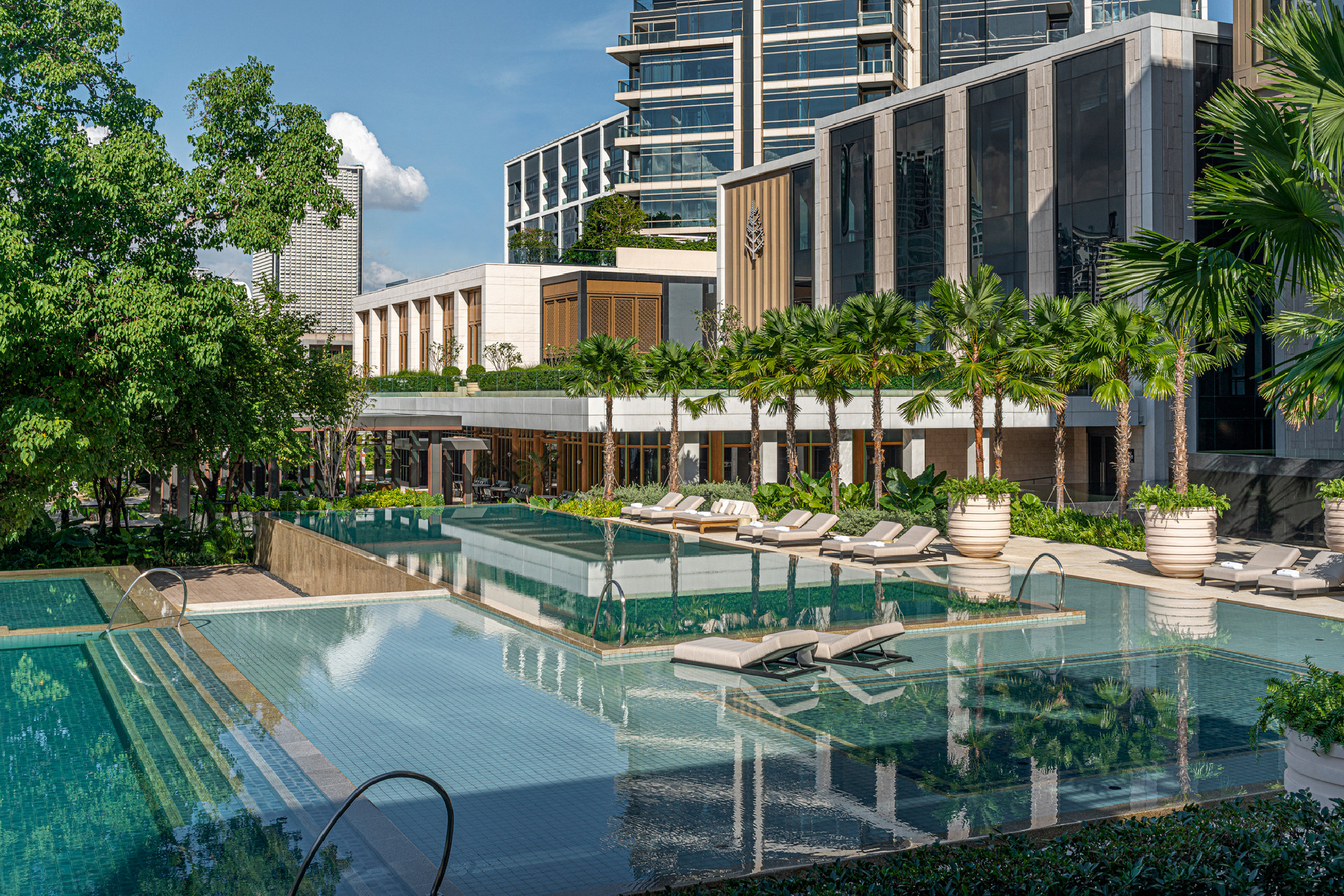 Four Season Hotel Bangkok
 Capella Hotel Bangkok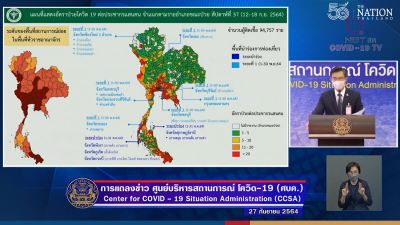

 SootinClaimon.Com