EconOct 01. 2020Veerathai Santiprabhob, left, passes the baton to his successor Setthaput Suthiwart-Narueput on October 1.
By The Nation
New Bank of Thailand governor Setthaput Suthiwart-Narueput officially took office on Thursday.
He is Thailand’s 21st central bank governor, taking over from Veerathai Santiprabhob, whose five-year term expired at the end of last month.
Meanwhile, Finance Ministry permanent secretary Krisda Chinavicharana said he will deliver his policies to high-ranking ministry executives on Friday (October 2).
Krisda said the ministry had witnessed improvement in many economic indicators.
The ministry will also examine each business sector, one by one, as part of its efforts to tailor relief measures to their specific needs.
The price of gold was unchanged in morning trade on Thursday, the Gold Traders Association reported.
As of 9.22am, the buying price of a gold bar was Bt28,150 per baht weight and selling price Bt28,250, while gold ornaments cost Bt27,636.68 and Bt28,750, respectively.
The gold price at Wednesday’s close rose by Bt50 per baht weight after the association announced a change in the price of the precious metal four times.
The spot gold price moved to US$1,889 (Bt59,677.48) per ounce on Thursday morning after the price dropped by $7.70 to $1,895.50 per ounce at yesterday’s close.
The gold price closed in negative territory due to a strengthening dollar, the rise in US stock markets and strong US economic data.
The Stock Exchange of Thailand (SET) Index rose by 4.32 points, or 0.35 per cent, to 1,241.36 in the morning session on Thursday.
An analyst at Krungsri Securities expects the index to rebound to 1,245 points before falling from hopes that US lawmakers will reach an agreement on further economic stimulus measures and also a rising oil price.
“US Treasury Secretary Steven Mnuchin and Speaker of the House of Representatives Nancy Pelosi have indicated that Republicans and Democrats will reach an agreement soon,” the analyst said.
“However, investors should beware of high market volatility after the expiration of SET’s ceiling-floor adjustment, uptick rules and a circuit breaker, as well as a mass sell-off of Thai shares by foreign investors,” he said.
He recommended investors buy shares of:
> Banpu and AGE that benefit from a rising coal price in response to China’s demand.
> TU, Asian, Com7, CHG, PTG and PlanB, whose third-quarter performance is expected to grow.
> Delta, Hana, KCE and SMT that benefit from the weakening baht.
The SET Index closed at 1,237.04 points on Wednesday, down 20.30 points, or 1.61 per cent. The volume of total transactions was Bt48.98 billion, with an index high of 1,260.06 points and a low of 1,236.53.
Photo by: The Washington Post — The Washington Post
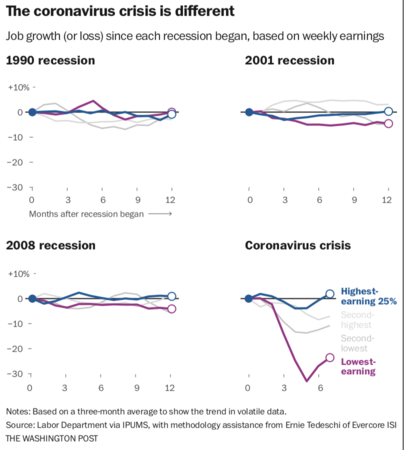
By The Washington Post · Heather Long, Andrew Van Dam, Alyssa Fowers, Leslie Shapiro · NATIONAL, BUSINESS The economic collapse sparked by the pandemic is triggering the most unequal recession in modern U.S. history, delivering a mild setback for those at or near the top and a depression-like blow for those at the bottom, according to a Washington Post analysis of job losses across the income spectrum.
Recessions often hit poorer households harder, but this one is doing so at a scale that is the worst in generations, the analysis shows.
While the nation overall has regained nearly half the lost jobs, several key demographic groups have recovered more slowly, including mothers of school-age children, Black men, Black women, Hispanic men, Asian Americans, younger Americans (ages 25 to 34) and people without college degrees.
White women, for example, have recovered 61% of the jobs they lost – the most of any demographic group – while Black women have recovered 34%, according to Labor Department data through August. And workers with college degrees are 55% recovered, compared with less than 40% for workers with high school degrees.
The recession’s inequality is a reflection of the coronavirus itself, which has caused more deaths in low-income communities and severely affected jobs in restaurants, hotels and entertainment venues as Americans try to avoid crowded places to protect their own health and slow the spread of the virus. Jobs in these places pay, on average, $17 an hour and were mostly held by women and people of color.
No other recession in modern history has so pummeled society’s most vulnerable. The Great Recession of 2008 and 2009 caused similar job losses across the income spectrum as Wall Street bankers and other white-collar workers were handed pink slips alongside factory and restaurant workers. The 2001 recession was more unequal than the Great Recession: After the 9/11 terrorist attacks, travel and tourism jobs vanished and low-wage employment fell 7% below the previous year’s level, while high earners remained largely unscathed. Yet, even that inequality is a blip compared with what the coronavirus inflicted on low-wage workers this year.
“It’s an even more unequal recession than usual,” said Ben Bernanke, who led the Federal Reserve through the Great Recession. “The sectors most deeply affected by covid disproportionately employ women, minorities and lower-income workers.”
At the height of the coronavirus crisis, low-wage jobs were lost at about eight times the rate of high-wage ones, The Post found. The devastation was deepest among the lowest-paid, but middle-class jobs were not spared. A clear trend emerged: The less workers earned at their job, the more likely they were to lose work as businesses across the country closed.
By the end of the summer, the downturn was largely over for the wealthy – white-collar jobs had mostly rebounded, along with home values and stock prices. The shift to remote work strongly favored more-educated workers, with as many as 6 in 10 college-educated employees working from home at the outset of the crisis, compared with about 1 in 7 who have only high school diplomas.
Deep pain remains nearly seven months into the crisis: Employment for low-wage workers was still down more than 20% in August from the summer before, and around 10% for middle-wage workers.
Americans ages 20 to 24 suffered the greatest job losses, by far, of any age group when many businesses closed in the spring. College-age workers and recent graduates tend to be overrepresented in low-paying retail and restaurant jobs, which allow them to gain a toehold in the workforce and save money for school or training. While about half the jobs have returned for this age group, they still have a steep climb – roughly 2 million more jobs – to get back to pre-coronavirus levels. Young Black workers remain the furthest behind.
In the wake of widespread closings of schools and day-care centers, mothers are struggling to return to the workforce. Mothers of children ages 6 to 17 saw employment fall by about a third more than fathers of children the same age, and mothers are returning to work at a much slower rate. This disparity threatens years of progress for women in the labor force.
Sierra Phillips of Columbus, Ohio, is a mother to two young children who is struggling to get back into the workforce. She lost her job nannying for two families in the spring. Her employers laid her off after they started working from home and opted to watch their own children to save money. Phillips, 25, cannot return to work until she finds suitable child care for her own children.
“I’m still kind of worried about going back to work. My youngest is 10 months and my oldest is autistic. The program my autistic child was in has not opened back up yet,” said Phillips, who is African American and is getting by on her husband’s salary since he kept his job at a warehouse. “I do not feel comfortable hiring a babysitter.”
The unemployed are facing new challenges. Despite President Donald Trump’s promises of brevity regarding the recession, 26 million people are still receiving now-diminished unemployment benefits. The unemployed went from receiving, on average, over $900 a week in April, May, June and July, under the first federal stimulus package, to about $600 for a few weeks in late August and early September under a temporary White House executive action, to about $300 a week now on state benefits.
The drop in aid is hurting groups that have traditionally struggled to get hired coming out of recessions. Research and historical data show that White workers and those with college degrees are typically hired first, a trend that appears to be playing out again.
– – –
What ties all of the hardest-hit groups together – low-wage workers, Black workers, Hispanic men, those without college degrees and mothers with school-age children – is that they are concentrated in hotels, restaurants and other hospitality jobs.
When The Post analyzed Labor Department data to understand the disparities in this recession, the group hit hardest by the crisis tended to also be the subgroup that had the most employees who worked in services.
Most recessions, including the Great Recession, have affected manufacturing and construction jobs the most, but not this time. Nine of the 10 hardest-hit industries in the coronavirus recession are services. They include performing arts, sightseeing, hotels, transportation, clothing retail and museums.
Economists worry that many of these jobs will not return, with restaurants and entertainment venues going out of business. Hospitality jobs are still down nearly 25%. Even if a vaccine is developed and widely distributed, business travel might not return for years to pre-coronavirus levels, with videoconferencing increasingly becoming a more routine way of doing business for many companies.
“The writing is on the wall. I don’t think my owner is going to make it,” said Tiffany Burgin, an assistant manager of a restaurant in the French Quarter of New Orleans that remains closed. “It’s a 100% tourist-driven economy here. Until the tourists come back, we’re screwed.”
Burgin, 51, never got a college degree. She climbed her way up the ranks of New Orleans’ booming restaurant industry, serving entrees and tending bar for years before becoming a manager. But she has not worked since mid-March, after a mass of tourists caught the coronavirus following Mardi Gras celebrations. Many establishments in the French Quarter are still boarded up.
“I get $247 a week in unemployment,” Burgin said. “Who can live on that? Who? Nobody I know. I haven’t been this poor since I was a teenager.”
While the U.S. unemployment rate has fallen to 8.4%, double-digit unemployment lingers in cities and states that depend heavily on tourism. In Nevada and Hawaii, unemployment is still over 12%.
Burgin wants to keep working in the restaurant industry, but more than 30,000 restaurant and hospitality workers are unemployed in New Orleans, making it nearly impossible to find a job. The city’s official unemployment rate is near 12%.
Burgin and her boyfriend received an eviction notice but are fighting to stay. Burgin does not know how they can find a cheaper place. Her boyfriend also lost his restaurant job. Their rent is $675 a month.
Ten percent of renters reported “no confidence” in their ability to pay next month’s rent, according to a U.S. Census Bureau survey conducted Sept. 2 to 14.
Hospitality jobs became a lifeline for workers struggling to recover from the last crisis. The U.S. economy added 22.5 million jobs – 18.9 million in services – from 2010 until the coronavirus health emergency. The industry that added the most jobs over that time, restaurants and bars, pays the lowest wages. Restaurant servers typically make about $11 an hour, and cooks make about $13.40, with many workers living paycheck to paycheck.
People who are working again in the service sector say they are often making far less than before, especially in coronavirus hot spots, leaving these workers barely able to pay bills. Alison Detrick, 44, cleans homes in New Orleans. All her clients canceled in the spring. She slashed her prices this summer to lure some of them back.
“I’m cleaning people’s homes for bargain-basement prices,” said Detrick, who is African American and has invested heavily in masks, jumpsuits and shoe covers. “I used to charge $200 to clean a home. Now I charge $75.”
The reduced pay and added safety costs have left Detrick struggling to pay rent and other bills. For the first time, Detrick accepted help when a church group was offering free groceries across the street from her apartment building.
– – –
Black women are facing the largest barriers to returning to work, data shows, and have recovered 34% of jobs lost in the early months of the pandemic. They are among the most likely to work in low-paying service-sector jobs, which have been slow to rebound at a time when it is still a major health risk to be around others. Nearly 30% of Black women work in services, compared with a fifth of White women. Black people also often face discrimination in the hiring process, research from Texas A&M University and elsewhere has shown.
It took until 2018 for Black women’s employment to recover from the Great Recession. Now almost all of those gains have been erased.
Natasha Smith found out from a TV news report on May 15 that she would not be returning to her job at the DiamondJacks Casino and Hotel in Louisiana. The casino announced that it was closing forever, and her boss never called to let her know. For four years, she worked there as a hotel housekeeper, inching her way up to $9.50 an hour with ample overtime. Now she cannot get a call back after submitting dozens of job applications.
“I have a package of chicken legs and a package of wings left in my refrigerator, and that’s it,” said Smith, who is African American. “I’m barely making it. I owe $170 on my electric bill. They sent me a cutoff notice.”
A single mother, Smith, 34, of Shreveport, went from being able to pay her bills to having to beg the electric company to work with her on a payment plan. She prays daily that she will at least get a job interview and that Congress “can see how we are living” and increase the payments at least a bit. Smith currently gets $100 a week in unemployment benefits.
Historically, people of color and Americans with less education have been overrepresented in low-paying service jobs. Economists call it “occupational segregation.”
In many cases, occupational segregation traces back to the end of slavery, when Black women were expected to work only in the lowest rungs of the service-work ladder as housekeepers and caretakers, jobs in which they remain overrepresented today, said Bucknell University economics professor Nina Banks.
“I’ve been doing so many job applications, but no one calls you back,” said Smith, who has a 13-year-old son. “They say they are ‘hiring immediately,’ but when you do the application, you don’t even hear back. I call and they say they’ll get back to be, but they never do.”
– – –
Black and Hispanic men face many of the same challenges as Black women, encountering discrimination in the workforce more often than others, and they struggled to rebound from the Great Recession.
Top policymakers at the Federal Reserve have acknowledged this problem but have maintained over the years that getting the overall economy to full employment is the best way to help minorities find jobs. By 2019, African American employment hit record levels, an achievement for which Trump often took credit. This was particularly notable for Black men, who unlike other American men had not seen substantial job gains during the expansion of the early 2000s.
But that changed in this recession. The employment rate for Black and Hispanic men hit its lowest level ever in April, and these workers have struggled to get their jobs back. Black men have recovered fewer than 40% of jobs lost – the slowest recovery of any demographic group, other than Black women. Hispanic men have recovered about 47% of lost jobs.
James Barker says the best meal he gets each week now comes from a Missionary Baptist Church in downtown Chicago. Barker, who is African American, never thought he would be lining up for free meals at a church, but he lost all his work in March.
Barker, 58, is a handyman who has been running his own construction business for years. He often got calls from big commercial real estate companies in Chicago to do jobs for them, but that gig dried up, with few people working in offices now. He received his first call in months on Friday and was offered $12 an hour, half the rate he commanded pre-pandemic. He needed the money, so he took the handyman job, which is only for a few days.
“You don’t want to cry, but sometimes you have no choice,” Barker said. “People need to know how unfair this has been.”
Barker says he and his wife also never received the $2,400 stimulus check they expected. He was also turned down for a Small Business Administration grant and loan. The couple ran down their savings and are now behind on bills.
– – –
Among the hardest-hit in this crisis, mothers also stand out. Women had logged tremendous job gains in the past decade before the pandemic. Last year, women made up more than half of the labor force for only the second time in U.S. history.
But with many schools and child-care centers closed and the migration to online learning, many working parents have had to become part- or full-time teachers, making it difficult to work at the same time. That burden has fallen mainly on mothers, data shows. For example, mothers of children ages 6 to 12 – the elementary school years – have recovered fewer than 45% of jobs lost, while employment of fathers of children the same age is 70% back.
Single parents have faced an especially hard blow. Jessica Duke is a single mother who wakes up every day worried about having enough food for her two teens. They eat ramen noodles or SpaghettiOs on a good night. It is all they can afford on the $86 a week Duke receives in unemployment aid from the state of North Carolina.
Since losing her $11-an-hour job as a home health aid in early April, Duke said, she has lost 38 pounds from stress and lack of food. Her son keeps asking where her bowl is. She tells him she eats later, a small lie.
“I want to make sure the kids get food,” Duke, 37, said from her home in Monroe, N.C. “If there’s anything left in their bowls, I’ll eat. I never eat before they do. I want to make sure they’re full.”
Duke’s Nissan SUV was repossessed after she could not make the payments. Since losing her car, she has had to ask friends for rides to food banks and the grocery store, and it has severely limited her job options. One in eight households with children do not have enough to eat, according to a U.S. Census survey conducted Sept. 2 to 14.
Duke received a few weeks of the $600 payments from the federal government, but it was used up quickly, at first by rent.
When the pandemic hit, Duke’s brother, a 30-year-old welder, moved in with her family to try to help them out, picking up an extra job at a warehouse to earn more. But at the end of May he developed a nasty cough. When Duke went to wake him on June 2, his body was cold. An autopsy confirmed he died of covid-19, the illness caused by the novel coronavirus. Much of the rest of Duke’s summer unemployment checks went to pay for his funeral.
“I’m just ready to wake up from this nightmare and have everything go back to the way it was before. But I know it won’t ever be like that,” said Duke, who cries when she talks about her brother. “This covid has totally ruined our lives. It took my baby brother from me.”
– – –
The Federal Reserve predicts unemployment will not near pre-pandemic levels until the end of 2023. For many jobs, it may take even longer – especially those already at high risk of being replaced with software and robots.
Lei Ding and Julieth Saenz Molina of the Federal Reserve Bank of Philadelphia predict that the covid-19 crisis will accelerate the pace of automation. For example, the Pennsylvania Turnpike sped up its plan to go cashless, eliminating more than 500 jobs at tollbooths. Hotels are using more check-in kiosks and cleaning robots.
“Since the 1980s, almost all employment losses in routine occupations, which are relatively easier to be automated, occurred during recessions,” Ding and Molina wrote in a new research paper. “Automatable jobs held by minority workers were hit particularly hard by the pandemic, putting these workers who were already vulnerable in the job market at a greater risk of permanent job loss.”
It took a full decade to return to full employment after the Great Recession. University of Texas economist Aysegul Sahin expects a faster recovery this time, but she fears that older workers and people who are primary caregivers of young children will struggle to return to the workforce.
Many economists and business leaders are urging Congress to enact another large relief package, especially given the unevenness of the recovery and the long road for those who have been left behind.
“There are very clear winners and losers here,” said Mark Zandi, chief economist at Moody’s Analytics. “The losers are just being completely crushed. If the winners fail to help bring the losers along, everyone will lose. Things feel like they are at a breaking point from a societal perspective.”
The coronavirus recession is, in many ways, redefining the dividing line between the haves and have-nots in the United States. As more people who had just been getting by, like Jessica Duke in North Carolina or Natasha Smith of Shreveport, La., fall into poverty, the longer the nation’s recovery will take.
– – –
About this report
This report relies on the Current Population Survey, a monthly survey of about 60,000 households conducted by the Census Bureau on behalf of the Bureau of Labor Statistics. For employment comparisons, The Post used both seasonally adjusted job-loss numbers and employment-population ratios – sometimes referred to as employment rates. To keep the data from being distorted by the effect of an aging U.S. population, analyses that compare employment rates back to 1975 and 2011 are limited to ages 25 to 54, the “prime” working ages. Analyses that focus on the current downturn, on the other hand, comprise ages 16 and older.
Race, age and gender analyses are based on seasonally adjusted employment figures. Analyses of employment among parents, as well as analyses of income quartiles, are based on public-use microdata from the Current Population Survey, obtained via IPUMS (formerly Integrated Public Use Microdata Series), which provides anonymized survey responses. Parental employment includes individuals living with at least one of their own children under 18 years of age. Children’s age groups are based on the youngest child in the household.
To measure the inequality of this recession, The Post broke the workforce into four equal-size groups based on average weekly earnings and measured how workers of each income level fared after the recession hit. To smooth volatile data, we looked at a three-month average. For recessions before 1990, when earnings data is scarce, The Post estimated earnings based on characteristics such as occupation and industry.
By The Washington Post · Taylor Telford, Hannah Denham · NATIONAL, BUSINESS, US-GLOBAL-MARKETS Wall Street wrapped up the third quarter on a high note Wednesday, even as a maelstrom of uncertainty surrounding the pandemic and stimulus hopes weighed on investors.
Better-than-expected jobs data, progress toward a possible coronavirus treatment by Regeneron Pharmaceuticals and promising results from Moderna’s covid-19 vaccine trials spurred some positive sentiment on Wall Street. But conflicting signals about a possible stimulus deal from Treasury Secretary Steven Mnuchin and Senate leader Mitch McConnell, R-Ky., dampened gains.
The Dow Jones industrial average seesawed but closed up 329 points, or 1.2%, at 27,781.70. The S&P 500 index climbed more than 27 points, or 0.8%, to settle at 3,361.00. The tech-heavy Nasdaq advanced 82 points, or 0.7%, to settle at 11,167.51.
September is a historically tough month for stocks, but this one was particularly volatile following months of dizzying highs. The major U.S. indexes posted their first monthly losses since March. The S&P 500 slumped more than 3%, the Dow erased 2.3% while steep sell-offs in tech shaved 4.4 off the Nasdaq.
This week, coronavirus deaths surpassed 1 million worldwide as Europe wrestled with the beginnings of a second wave. Analysts say possible economic head winds are still swirling.
“The economy faces no shortage of risks in the near-term including uncertainties associated with the election, fall and winter COVID-19 challenges, and failure of elected officials in Washington to pass further economic relief legislation,” Mark Hamrick, senior economic analyst at Bankrate, wrote in a commentary Wednesday.
Despite the rockiness of September, Wall Street bagged its best back-to-back quarters since 2009, with the S&P 500 growing 8.5% and the Dow gaining 7.6%. The Nasdaq added 11% from July through September, for its best two consecutive quarters since the early 2000s. The market’s sharp turnaround has nonetheless created the most uneven recovery in modern U.S. history, according to analysis by The Washington Post.
While the nation overall has regained nearly half of the lost jobs during the pandemic, several key demographic groups have recovered more slowly, including mothers of school-age children, Black men, Black women, Hispanic men, Asian Americans, younger Americans (ages 25 to 34) and people without college degrees.
New data from the Bureau of Economic Analysis released Wednesday showed the depth of the damage to the overall economy last quarter, estimating that the GDP dropped 31.4% as stay-at-home orders lifted and the federal government distributed aid to struggling businesses and households.
This week, Disney said it would lay off 28,000 people across its theme-park division in the United States due to the toll covid-19 has taken on its core business. Royal Dutch Shell also announced 9,000 layoffs this week as it shifts away from fossil fuels. Boeing, American Airlines and United Airlines all ticked higher Wednesday after news broke of widespread impending layoffs in the air travel industry.
Investors are looking to the monthly jobs report on Friday for a better sense of whether more job losses are becoming permanent. Analysts expect to see a slight drop in the unemployment rate, which stood at 8.4% in August.
“One reason for temporary job losses becoming permanent is the length of the pandemic; the longer it runs, the higher the chances of business failures,” Beth Ann Bovino, chief U.S. economist at S&P Global, wrote in a jobs report preview Wednesday. “On top of that, if state and local governments – which are some of the country’s largest employers – don’t get budget relief from the federal government, there will likely be more pressure to cut positions, rather than just furlough employees.”
Jeffrey Kleintop, chief global investment strategist with Charles Schwab, called it “an unconvincing end to the quarter” as momentum in earnings and in the economic recovery slowed. He said individual investors have yet to embrace the rally, even amid record-setting highs.
“Take today. The best performing sector is health care . . . and the second-best performer is consumer staples. Those two usually do well when the market is going down,” Kleintop said. “The economically sensitive sectors are the weakest and the most defensive ones are the strongest. To me, that’s not a sign of a durable rally.”
Chris Rupkey, chief financial economist for MUFG, said in an email that he expects the next quarter to be marked by economic growth. But whether that holds for the nation’s GDP will be determined by the success rate of vaccines for the coronavirus and the results of the election.
“This is looking like a short recession that will be just two quarters long and we haven’t seen such a brief downturn like this since the 1980s,” he said. “Hopefully, the record job losses will also recover just as fast as spending in the economy.”
October, another historically turbulent time for traders, is sure to be a spectacle as investors parse the potential for a deadly second wave of covid-19 and the upcoming presidential election. While the U.S. is mired in political uncertainty, Tuesday’s contentious presidential debate didn’t likely move markets according to David Bahnsen, chief investment officer at the Bahnsen Group.
“The election is not the primary driver of markets right now,” Bahnsen wrote in a commentary Wednesday. “The level of economic reopening is.”
The Civil Aviation Authority of Thailand (CAAT) expects passenger numbers in 2020 to plummet 68 per cent year on year to 52.8 million, due to the Covid-19 impact, said director-general Chula Sukmanop.
Of the total, 36.7 million are expected to be domestic passengers, down 51.8 per cent from 76.2 million last year.
International arrivals are expected to number 16.1 million, falling 81.8 per cent from 88.8 million last year.
The CAAT chief expects travel to return to normalcy in 2023.
Many airlines have adjusted to the virus fallout by seeking ways to boost revenue from domestic routes.
Nitinai Sirismatthakarn, president of Airports of Thailand, which operates six international airports, said the AOT has only Bt40 billion liquidity left, falling from Bt70 billion prior to the outbreak.
The AOT is waiting to see if the aviation situation improves in next two years on the expectation that a Covid vaccine will be available by April next year.
Thailand’s economy has shown signs of slight improvement in August, held up by lighter contraction in the value of merchandise export, manufacturing and private investment indicator, according to the central bank.
Even though the Covid-19 outbreak hit the export sector hard, there are signs of recovery.
The value of export contracted by 8.2 per cent from the same period last year. Excluding gold exports, which came in at a historical high, the value of merchandise export in August showed a contraction of 13.6 per cent, less than the 14.3 per cent contraction in the previous month.
This was attributed to an improvement in the export of petroleum-related products, automotive and parts and electrical appliances, consistent with gradual recovery of demands in trading partner countries.
However, agricultural products contracted deeper, especially in terms of fruit exports to China after having grown in the preceding period. Manufacturing production had a softer contraction in almost all categories, aligning with gradual recovery in merchandise exports and domestic spending.
Private investment indicators, meanwhile, marked a lighter contraction in comparison to the previous month, mainly from investment in machinery and equipment.
Private investment index contracted 4.6 per cent year on year, compared to 7.5 per cent contraction in July. This is evidenced by an improvement in the import of capital goods – 13 per cent contraction, up from 24.8 per cent contraction in July. The number of newly registered motor vehicles is aligned with modest recovery in domestic and external demand as well as an upturn in momentum, despite business sentiment being at a low level. Meanwhile, investment in construction expanded at a slightly softer pace, following construction material sales.
The value of merchandise imports contracted by 19.1 per cent from the same period last year, exhibiting a softer contraction in all categories of products compared to the previous month; notably consumer products, capital goods, raw materials and intermediate goods, in line with the improvement in overall economic activities.
Private consumption indicators were still on a recovery path in line with factors supporting consumer purchasing power. This was exhibited by gradual improvement in employment condition, household income and consumer confidence, despite private consumption indicators contracting deeper this month.
The reversal was led by higher contraction in non-durable goods and services spending after positive effects of special extended holidays last month came to an end. Meanwhile, spending on durable goods continued to contract at a lower rate, partly due to the purchase of new passenger car models entered the market in the previous month, according to the central bank.
The number of foreign tourist arrivals continued to contract severely at 100 per cent from the same period last year. Thailand has had no foreign tourists for five consecutive months as international travel restrictions remain in place.
Public spending, excluding transfers, had greater expansion attributed by marked expansion in capital expenditures (47 per cent rise year on year in fiscal 2020) from the central government. However, current expenditures contracted slightly (2 per cent) due to purchases of goods and services. Meanwhile, state enterprises’ capital expenditures shrank from disbursement of transportation agencies.
On the overall economic stability, headline inflation recorded a softer negative at 0.5 per cent, on the back of an increase in fresh food and energy prices, while core inflation declined slightly. As for labour market, the unemployment rate came down slightly but the number of workers registered for jobless claims remained high. The current account stands at a $3-billion surplus, up from $1.7 billion in July largely contributed by gold exports. The capital and financial accounts posted a deficit of $400 million, down from $400 million surplus in July owing to the outflow of liabilities, led by the net sell-off of Thai equity securities by foreign investors and the loan repayment by Thai depository financial corporations, the central bank statement added.
Prime Minister Prayut Chan-o-cha will meet representatives of companies in the Eastern Economic Corridor (EEC) on Thursday to learn about progress in their project development as well as listen to ideas on how the zone can be further developed.
The meeting will take place at Laem Chabang, Energy Minister Supattanapong Punmeechaow said.
Present at the meeting will be representatives of some 16 major companies, including PTT, Amata Corporation, WHA Industrial Development and Mitsubishi Motors (Thailand).
Also attending will be some ministers, including Supattanapong, Deputy PM and Public Health Minister Anutin Charnvirakul and Transport Minister Saksayam Chidchob, the government’s spokesman Anucha Burapachaisri said.
Targeting big earners
Meanwhile, Supattanapong said the Centre for Economic Situation Administration (CESA) will study new economic stimulus packages on October 7 to boost domestic consumption.
The new package will target the upper middle class who earn a high salary, such as encouraging them to co-pay for products and services, he added.
“They may get subsidies in the form of tax returns,” he said.
Energy Minister Supattanapong Punmeechaow
On September 29, the Cabinet gave the go-ahead to a three-month economic stimulus package in a bid to stimulate domestic consumption.
Under the Kon La Khreung (Let’s Go Halves) scheme, 10 million people will get daily discounts on their shopping of up to Bt150, capped at Bt3,000 per person. The scheme will open for merchants to register online from Thursday.
Under the second scheme, 14 million welfare cardholders will receive an extra monthly discount of Bt500 on their shopping from October 23 to December 31.
Supattanapong said he also wants to promote Bangkok as an international hub for major foreign companies by cashing on the capital’s strong infrastructure and competitive office rents and living cost.
He also wants to woo foreign investment in real estate.
On September 16, CESA approved in principle amendments to the criteria of granting permanent residence to foreigners in a bid to woo more investment.
The centre is considering the option of granting permanent residence to buyers of condominium units, provided applicants do not mortgage, sell or transfer this asset for five years after purchase.
Gradual recovery
Supattanapong said that Thailand’s economic indicators have improved. Thailand has effectively handled the outbreak and continues to launch measures to revive the sapping economy.
He is confident that the Thai economic growth will return to the pre-outbreak level within two years.
He said the key economic driver is the private sector investment and it is time for the private companies to stop fearing the Covid-19 outbreak.
He added that some private companies have continued to invest, because the interest rate is low and the price of construction materials is dropping.
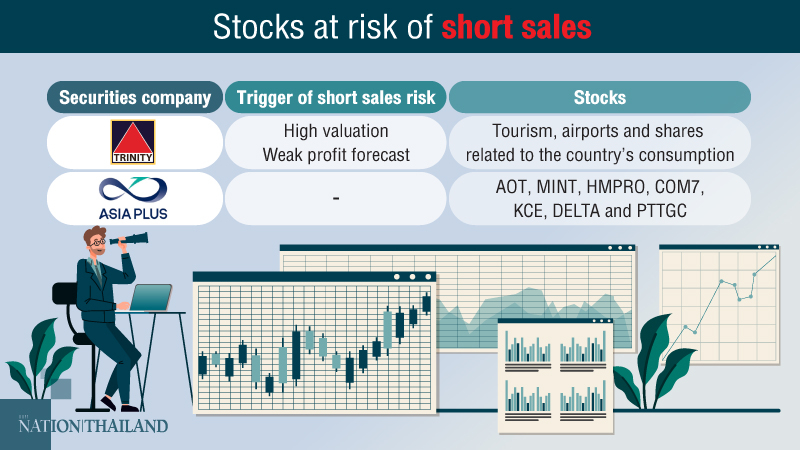
The value of short sales is expected to hit Bt1 billion daily after the Stock Exchange of Thailand (SET)’s uptick rule expires on Thursday (October 1). Stocks in businesses related to tourism and consumption will be vulnerable to short-selling due to their high valuation and weak profit forecasts.
Nuttachart Mekmasin, deputy managing director at Trinity Securities, said short-selling is not a worry when the SET valuation is not high.
“However, the index valuation is currently high, so we expect stocks with a high valuation and weak profit forecast to face short sales, especially in tourism businesses such as hotels and airports as their price will reflect profit in the next few years.”
He said short-selling would also hit consumption-related firms such as retail and telecommunication businesses.
He predicted short sales will hit Bt1 billion daily because the SET’s valuation was not as high as before the Covid-19 outbreak.
“Daily short sales will total Bt3 billion to Bt5 billion daily when the SET valuation is very high,” he added.
Koraphat Vorachet, director of research and investment at Capital Nomura Securities, said the SET’s new zero-plus tick rule would not trigger uncertainty among investors as the market is still relying on its fundamentals, and internal and external factors.
However, he predicted the short-sales value will return to a normal level of Bt3 billion to Bt3.5 billion daily, up from Bt400 million to Bt500 million daily.
“On Wednesday [September 30], investors sold stocks to reduce risks and accommodate the impact of the zero-plus tick rules on the market because the market situation is currently gloomy,” he said.
An analyst at Asia Plus Securities forecast volatility from a fivefold increase in short sales after the zero-plus tick rules come into effect.
“Our research on triggers of short sales risk, such as high valuation … found that seven companies are at risk of short-selling – Airports of Thailand (AOT), Minor International (MINT), Home Product Center (HMPRO), Com7 (COM7), KCE Electronics (KCE), Delta Electronics (DELTA) and PTT Global Chemical (PTTGC),” he said.
“Meanwhile, eight stocks will be able to escape short sales risks, namely Asia Sermkij Leasing (ASK), MCS Steel (MCS), Noble Development (NOBLE), Sri Trang Gloves (STGT), Infraset (INSET), Dynasty Ceramic (DCC), Nawarat Patanakarn (NWR) and Workpoint Entertainment (WORK).”
SET president Pakorn Peetathawatchai said he was not interested in using old short-sales rules because volatility was currently low, unlike the situation in March and April this year when volatility was high due to the Covid-19 outbreak.
“The SET is monitoring factors that affect trading to improve regulations for the current situation, so there is no need to change regulations in the short term,” he said.
The Stock Exchange of Thailand (SET) Index closed at 1,237.04 on Wednesday, down 20.30 points or 1.61 per cent. The volume of total transactions was Bt48.98 billion with an index high of 1,260.06 and a low of 1,236.53.
In the morning session, an analyst at Krungsri Securities expected the day’s index to fall to the support line at 1,250 due to lack of positive sentiment and the sharp fall in oil price amid uncertain fuel demand during the Covid-19 crisis.
“Meanwhile, uncertainty over market volatility from the expiry of the SET’s ceiling-floor adjustment, uptick rules and circuit-breaker would pressure the index,” he said.
The 10 stocks with the highest trade value today were PTT, STGT, DIF, AOT, CPALL, KBANK, CPF, BBL, TKN and BDMS.
As of 4.30pm, the price of oil dropped by US$0.48 or 1.22 per cent to $38.81 per barrel, while gold dropped by $15.50 or 0.81 per cent, to $1,887.70 per ounce.
Other Asian indices were mixed:
Japan’s Nikkei Index closed at 23,185.12, down 353.98 points or 1.50 per cent.
China’s Shang Hai SE Composite Index closed at 3,218.05, down 6.31 points or 0.20 per cent, while Shenzhen SE Component Index closed at 12,907.45, up 6.75 points or 0.052 per cent.
Hong Kong’s Hang Seng Index closed at 23,459.05, up 183.52 points or 0.79 per cent.
South Korea’s KOSPI Index closed at 2,327.89, up 19.81 points or 0.86 per cent.
Taiwan’s TAIEX Index closed at 12,515.61, up 47.88 points or 0.38 per cent.

 Veerathai Santiprabhob, left, passes the baton to his successor Setthaput Suthiwart-Narueput on October 1.


 CAAT chief Chula Sukmanop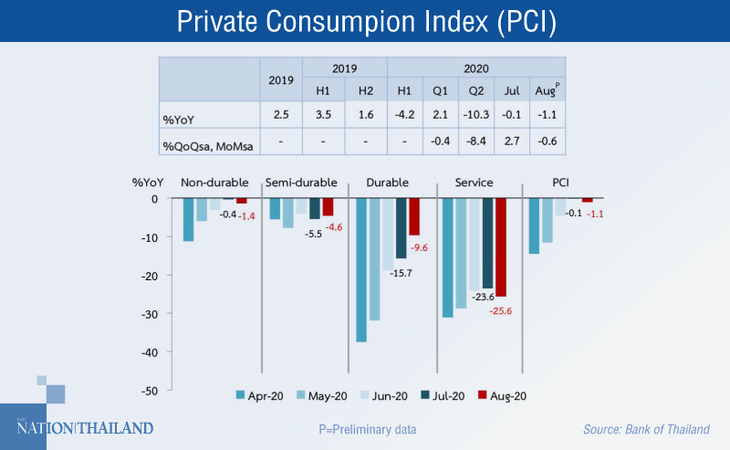
 Prime Minister Prayut Chan-o-cha