Japan push to cut China reliance may be boost for Southeast Asia #ศาสตร์เกษตรดินปุ๋ย

#ศาสตร์เกษตรดินปุ๋ย : ขอบคุณแหล่งข้อมูล : หนังสือพิมพ์ The Nation.

Japan push to cut China reliance may be boost for Southeast Asia

EconAug 09. 2020File photo: Vietnamese authorities conduct temperature checks in an effort to contain  the covid-19 outbreak.File photo: Vietnamese authorities conduct temperature checks in an effort to contain the covid-19 outbreak.

By Syndication Washington Post, Bloomberg · Yuko Takeo, Michelle Jamrisko · BUSINESS, WORLD, US-GLOBAL-MARKETS, ASIA-PACIFIC 
Japan’s quiet push to protect its supply chains in the era of covid-19 may prove a boon for Southeast Asian nations looking to gain from the growing backlash against China.

The Japanese government is paying about 12 billion yen ($114 million) to 30 companies to increase production in Southeast Asia, in the first round of a multi-billion dollar program to diversify supply chains after covid-19 and worsening relations between the U.S. and China.

Japan wants to cut its reliance on China or any other individual nation and the money will hasten the trend of firms moving out of China and into cheaper neighbors like Vietnam or Thailand.

Fujikin Inc. makes parts used in semiconductor manufacturing and is one firm benefiting from the incentives. The Osaka-based manufacturer will receive subsidies worth two-thirds of its costs to shift production out of China and into Vietnam.

“We’d been thinking about increasing our capacity in Vietnam before the subsidy was announced, and it fit right in,” said company President Shinya Nojima.

When the virus shut down Fujikin’s suppliers in China earlier this year, their customers became worried about shipments of parts. “Our customers were asking us: Is the China procurement happening? Are we going to be able to meet the deadline?” Nojima said Monday.

The coronavirus outbreak, and the lockdowns that followed, have forced businesses and government officials around the world to rethink their supply chains in order to reduce reliance on China as a manufacturing source.

Japan had already been a key player in Southeast Asia, home to some of Asia’s fastest-expanding economies before the pandemic and a growing and youthful population. Japanese investment into five of the region’s economies — Vietnam, the Philippines, Malaysia, Indonesia and Thailand — rose at nearly double the pace into China over the past decade.

Infrastructure development formed a big chunk of that investment, with Japanese firms vying with Chinese ones to build railways and hospitals in countries like Indonesia, the Philippines and Vietnam.

The U.S.-China trade war and worries about China’s growing dominance in Southeast Asia have fostered stronger economic ties between Japan and the region.

Japan is considered the most trusted major power among Southeast Asian nations, according to an annual survey by the Singapore-based ISEAS-Yusof Ishak Institute, released in January. Of 1,308 people surveyed across five professional sectors, 61.2% said they had confidence Japan would “do theright thing” to provide public goods.

That trust goes both ways, with Japan putting a net $139 billion into Vietnam, Thailand, Indonesia, Malaysia and the Philippines over the past decade.

“Even before coronavirus and the U.S.-China trade war struck, there was a shift away from production in China,” said Satoshi Kitashima, a deputy director at the Japan External Trade Organization.

Vietnam has emerged as the clear favorite for many manufacturers over the years, given its proximity to China, relatively low labor and power costs, and its openness to foreign investment. Kitashima, who had previously spent nine years in Vietnam facilitating business between the two countries, said there’s been a clear upward swing in Japanese direct investment into Vietnam since the global financial crisis more than a decade ago.

Fujikin’s Nojima says Vietnam’s wages are a 10th of Japan’s and lower than in China, while Kitashima says many firms are now moving to Vietnam with their focus on the nation’s young and rapidly growing domestic market. Investors also credit Vietnam for its stable political leadership and ability to contain the coronavirus outbreak, although the nation has recently seen a spike in cases again.

Of the 30 firms that secured Japanese government subsidies to expand production abroad to protect their supply chains, half of them will be using that money in Vietnam.

One of them is Showa International Co., a Tokyo-based business that’s been making clothes in Vietnam for 25 years. The pandemic has seen it ramp up production of medical gowns and masks, with Kazuo Nishizawa, head of the company, projecting it should be able to produce up to 150,000 gowns a month.

“There’s still a large shortage of gowns and masks,” he said. With demand surging across the world, “we have a mission to first be able to provide stable supplies to Japan,” he said.

In the first round of the new subsidy program, 57 companies shared 57.4 billion yen to boost output in Japan, and the 30 companies shared about 12 billion yen to increase output in other nations. That leaves around 174 billion yen that firms can apply for in the next round.

Indonesia, Southeast Asia’s largest economy and the world’s fourth most-populous nation, is another country that’s benefited from a surge in Japanese investment, including in Jakarta’s first underground rail network.

Japan was the biggest Asian investor in Indonesia in the first quarter, according to data from the central bank. In June, authorities announced that seven foreign companies will relocate their plants from China to Indonesia with a total investment value of $850 million. Three of them were from Japan, including electronics giant Panasonic Corp. and auto parts maker Denso Corp.

“FDI from Japan will remain high or even higher, especially because the second phase of the mass rapid transit construction project in Jakarta will soon begin,” said Yuliot, a deputy chairman at the Indonesian Investment Coordinating Board, who goes by one name. Another reason is “the relocation trend of Japanese plants from China to Indonesia,” he said.

Within Japan, pressure is growing to secure supply chains.

“In the past supply chains were put together solely from the perspective of economic rationale,” Akira Amari, a confidante of Prime Minister Shinzo Abe and a senior ruling party official, said in an interview last month. “Amid the coronavirus crisis, the thinking is shifting toward diversifying risk from the perspective of national economic security.”

Tourism revenue could plummet over 75 per cent #ศาสตร์เกษตรดินปุ๋ย

#ศาสตร์เกษตรดินปุ๋ย : ขอบคุณแหล่งข้อมูล : หนังสือพิมพ์ The Nation.

Tourism revenue could plummet over 75 per cent

EconAug 08. 2020

By The Nation

In a worst-case scenario, the Thai tourism sector is expected to generate revenue of Bt676.7 billion next year due to the impact of the Covid-19 outbreak, Tourism Authority of Thailand Governor Yuthasak Supasorn said.

This represents a drop of 9 per cent from the previous worst-case scenario forecast for this year of Bt742.5 billion, a sharp decline of 75 per cent from around Bt3 trillion last year.

In the best-case scenario, the sector is expected to generate Bt1.52 trillion revenue next year, far lower than the Bt3.93 trillion predicted before the outbreak began.

If the sector quickly recovers early next year or in the second quarter next year, it will have revenue of Bt1.525 trillion of which Bt977 billion will be contributed by foreign tourists. The number of tourist arrivals is expected to reach 20.5 million next year.

If the sector recovers to a medium level during middle of next year or late in the third quarter, it is expected to generate revenue of Bt1.108 trillion of which Bt617.5 billion will be from foreign tourists. The number of foreign tourists is expected to reach 12.5 million.

If recovery happens late next year, the sector is estimated to post revenue of between Bt675.7 billion to Bt754.8 billion of which Bt296 billion will be contributed by foreign tourists. The number of foreign tourists is estimated at 6.14 million.

Investors urged to be cautious amid clamour for gold #ศาสตร์เกษตรดินปุ๋ย

#ศาสตร์เกษตรดินปุ๋ย : ขอบคุณแหล่งข้อมูล : หนังสือพิมพ์ The Nation.

Investors urged to be cautious amid clamour for gold

EconAug 08. 2020

By The Nation

Investors were advised to beware of volatility amid the rise in gold price.

Gold price in Thailand was expected to hit Bt31,000 per baht weight, an expert said.

MTS Gold chief executive Nattapong Hirunyasiri said gold price in Thailand continued to rise, reflecting the uncertainty following the Covid-19 pandemic and unrest in many regions.

“People believe gold is worthy of investment, while there are various types of investments, such as gold bars, gold ornaments, gold contracts, and gold funds that meet the needs of people of all ages,” he said.

“However, investors must manage their investment portfolio carefully because the gold market still faces volatility, while they should study thoroughly before investing in this precious metal to prevent risks and create opportunity to take profits.”

He expected gold price to hit Bt31,000 per baht weight as the spot gold price continues to hit a new high due to the weakening dollar.

“Gold’s next resistance level is US$2,100 per ounce,” he said.

“Factors that are boosting the gold price are the Covid-19 pandemic, governments and central banks’ efforts to stimulate the economy due to uncertainty following the global economic slowdown, the US-China trade war, and blasts in Iraq and Lebanon,” he added.

Consumers remain sunk in worry over Covid-19, politics #ศาสตร์เกษตรดินปุ๋ย

#ศาสตร์เกษตรดินปุ๋ย : ขอบคุณแหล่งข้อมูล : หนังสือพิมพ์ The Nation.

Consumers remain sunk in worry over Covid-19, politics

EconAug 08. 2020Pro-democracy activists launch a petition for 50,000 signatures needed for a motion to rewrite the Constitution at Thammasat University on Friday (August 7). Meanwhile consumers are worried about emerging political instability and the persisting impact of Covid-19.Pro-democracy activists launch a petition for 50,000 signatures needed for a motion to rewrite the Constitution at Thammasat University on Friday (August 7). Meanwhile consumers are worried about emerging political instability and the persisting impact of Covid-19.

By The Nation

Consumer confidence rose for a third consecutive month in July, but the index remains at a record low.

The Consumer Confidence Index moved to 50.1 in July, up from 49.2 in June, the University of the Thai Chamber of Commerce (UTCC) said.

 “This is the third monthly increase in a row, but the index remains at a historic low since being launched 21 years and 10 months ago, Thanawat Polvichai, rector of UTCC and chief adviser to UTCC’s Centre for Economic and Business Forecasting, said on Friday (August 7).

The index rated the state of economy at 42.6, job opportunities at 48.4 and outlook for future income at 59.3 – far below the threshold of 100 and the lowest level in 21 years, he said.

Consumers lack confidence because they are worried about the threat of a second wave of virus infections, which will continue to drag down the economy and wipe away job opportunities.

On the positive side, the economy had bottomed out in the second quarter, Thanawat said.

However, consumers were delaying spending on durable goods such as cars and large household items over worry about their future income.

Consumers are also worried about political stability following the Cabinet reshuffle and almost daily student-led protests.

More political gatherings are expected after universities open next week, he said.

The Consumer Confidence Index was released on the same day that police issued a batch of arrest warrants for protest leaders. Pro-democracy groups have vowed to intensify their political activities in response to what they say is legal suppression of free speech by authorities.

Thanawat said newly appointed Finance Minister Predee Daochai and Energy Minister Supattanapong Punmeechaow are thought to have a strong understanding of the current economic situation. The government may need another stimulus injection of Bt200 billion to Bt300 billion and spend another Bt300 billion to rescue small and medium-sized enterprises (SMEs) with soft loans, he said.

Should the economy not continue improving this year, 1-2 million workers may lose their jobs, he warned.

The government could boost the jobs situation by allowing private companies to hire workers on an hourly basis, he suggested.

A survey showed consumers are expected to spend Bt9.98 billion on Mother’s Day (August 12) – down by 28 per cent on last year’s holiday.

“Facing high debt burdens and uncertain futures, more and more consumers are borrowing money from pawn shops, underground lenders and their relatives,” he added.

SET dips again due to lack of new upbeat factors #ศาสตร์เกษตรดินปุ๋ย

#ศาสตร์เกษตรดินปุ๋ย : ขอบคุณแหล่งข้อมูล : หนังสือพิมพ์ The Nation.

SET dips again due to lack of new upbeat factors

EconAug 07. 2020

By The Nation

The Stock Exchange of Thailand (SET) Index fell for a second day today (August 7) closing at 1,324.40, down 8.82 points or 0.66 per cent. Total transactions stood at Bt44.367 billion with an index high of 1,333.21 and a low of 1,321.16.

During the morning session, a stock analyst at Krungsri Securities said he expected the index to fluctuate between 1,325 and 1,340 due to the lack of new positive sentiment to boost investment.

“The market had initially been positive about ongoing progress in the $1-trillion US economic stimulus package, an agreement for which is expected to be reached soon, and from the price of crude oil rising to more than $41 per barrel,” he said.

“However, mass sell-offs after listed companies announce their second-quarter performance will pressure the index.”

The top 10 stocks with the highest trade value today were PTT, ADVANC, AOT, PTTEP, STGT, STA, CPALL, CPF, GPSC and PTTGC.

As of 4.30pm, the price of crude oil dropped by US$0.37 or 0.88 per cent to $41.58 per barrel, while gold rose by $0.80 or 0.04 per cent, to $2,070.20 per ounce.

Other Asian indices were mixed:

Japan’s Nikkei Index closed at 22,329.94, down 88.21 points, or 0.39 per cent.

China’s Shanghai SE Composite Index closed at 3,354.04, down 32.43 points, or 0.96 per cent, while Shenzhen SE Component Index closed at 13,648.50, down 214.63 points, or 1.55 per cent.

Hong Kong’s Hang Seng Index closed at 24,531.62, down 398.96 points, or 1.60 per cent.

South Korea’s KOSPI Index closed at 2,351.67, up 9.06 points, or 0.39 per cent.

Taiwan’s TAIEX Index closed at 12,828.87, down 84.63 points, or 0.66 per cent.

BH Q2 slump rings alarm bells for hospital stocks #ศาสตร์เกษตรดินปุ๋ย

#ศาสตร์เกษตรดินปุ๋ย : ขอบคุณแหล่งข้อมูล : หนังสือพิมพ์ The Nation.

BH Q2 slump rings alarm bells for hospital stocks

EconAug 07. 2020

By The Nation

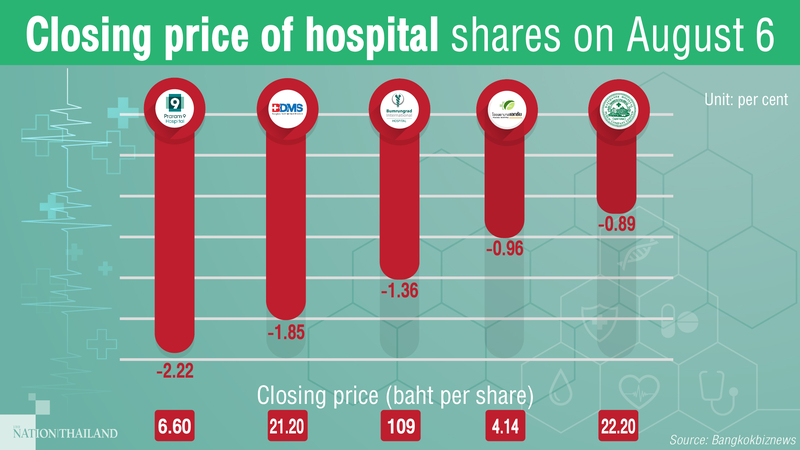
The price of hospital shares dropped sharply due to uncertainty among investors over weak second-quarter performance after Bumrungrad Hospital’s profit dropped by 93.9 per cent to Bt44.42 million from the same period of the previous year at Bt724 million.

Hospitals’ share price on Thursday (August 6) fell by 50.30 points, or 1.07 per cent, to 4,635.04 points. The price of Praram 9 Hospital (PR9)’s shares closed at Bt6.60 per share, down Bt0.15 or 2.22 per cent, Bangkok Dusit Medical Services (BDMS) closed at Bt21.20 per share, down Bt0.40 or 1.85 per cent, and Bumrungrad Hospital (BH) closed at Bt109 per share, down Bt1.50 or 1.36 per cent.

Suwat Wattanapornprom, director of Asia Plus Securities’s research department, expected the profit of other hospitals to take as big a hit as BH, especially hospitals that get a lot of foreign patients because the number of these patients have dropped significantly due to the Covid-19 fallout that has resulted in countries’ lockdowns and travel restrictions.

“We expect hospitals’ second-quarter performance to be the worst this year because the Covid-19 situation in the country began to ease, while some countries began to lift lockdown measures,” he said.

“However, hospitals that have a lot of foreign patients would recover slower than hospitals that have domestic patients because foreign patients still face a lot of difficulties.”

He added that the securities company had cut BH’s profit forecast for this year by approximately 30 per cent to Bt1.6 billion from the previous forecast of Bt2.3 billion because the hospital’s second-quarter profit was worse than expected.

“We weighted investment in hospital shares same as the market,” he added.

Meanwhile, Piyachat Ratanasuvan, senior director at Kasikorn Securities, said investors were concerned about weak hospital performance as BH’s second-quarter profit was worse than expected.

“We expect hospitals’ performance to recover by the third quarter of this year because the number of domestic and foreign patients is expected to increase,” she said.

Slow sales by foreign investors keeps Thai stocks stable #ศาสตร์เกษตรดินปุ๋ย

#ศาสตร์เกษตรดินปุ๋ย : ขอบคุณแหล่งข้อมูล : หนังสือพิมพ์ The Nation.

Slow sales by foreign investors keeps Thai stocks stable

EconAug 07. 2020

By The Nation

Thai stock market in July this year was stable as foreign investors delayed net sales, the Stock Exchange of Thailand (SET) said.

Soraphol Tulayasathien, SET senior executive vice president and head of corporate strategy division, said the SET Index in July this year closed at 1,328.53, down 0.8 per cent month on month due to uncertainty following US-China tensions, the second Covid-19 wave, countries’ economic data, and listed companies’ performance in the first half of this year, causing the index to move in a narrow range.

“The SET Index at the end of the previous year fell by 15.9 per cent, but still higher than MSCI Asean that fell by 19.4 per cent,” he said.

“However, some industries, such as agro-food and consumer products industries in July this year rose more than the SET at the end of the previous year.”

He said some businesses had benefited from the government’s move to ease lockdown measures, such as electronic components, food and beverage, and personal items and medical supplies businesses, adding that July was the first month to see signs of recovery outside the SET100 Index.

“In July this year, average daily transactions on the SET and Market for Alternative Investment amounted to Bt64.010 billion, same as the previous year, while average daily transactions in the first seven months amounted to Bt67.972 billion, up 31.3 per cent year on year,” he said.

“Investors in the country made the highest transaction for five consecutive months at 48.03 per cent of total transactions, while foreign investors made net sales of only Bt9.938 billion, the lowest in seven months.”

He said two companies had launched initial public offerings (IPO) in July this year, namely Sri Trang Gloves and Silicon Craft Technology.

“The IPO value totalled Bt15.043 billion, while transactions amounted to Bt81.441 billion, accounting for 6.46 per cent of transactions in July,” he said.

The Thai stock market’s forward and historical price to earnings (P/E) at the end of July was 21.4 and 19.1 times respectively, higher than the average forward and historical price to earnings of Asian stock markets at 16.3 and 17.5 times respectively.

“Meanwhile, the market dividend yield at the end of July was 3.66, higher than the average dividend yield of Asian stock markets at 3.03 per cent,” he said.

He added that the Thai futures market’s average daily transaction in July was 397,340 contracts, down 20.3 per cent month on month, especially from Single Stock Future and SET50 Index Futures.

“In the first seven months, Thai futures market’s average daily transactions were 484,269 contracts, up 21.75 per cent year on year,” he added.

Limited upside room for SET due to lack of positive factors #ศาสตร์เกษตรดินปุ๋ย

#ศาสตร์เกษตรดินปุ๋ย : ขอบคุณแหล่งข้อมูล : หนังสือพิมพ์ The Nation.

Limited upside room for SET due to lack of positive factors

EconAug 07. 2020

By The Nation

The Stock Exchange of Thailand (SET) Index fell by 0.98 points, or 0.07 per cent, to 1,332.24 on Friday morning (August 7).

A stock analyst at Krungsri Securities expected the index to fluctuate between 1,325 and 1,340 due to lack of new positive sentiment to boost the investment.

“The market gained positive sentiment from ongoing progress in the $1-trillion US economic stimulus package on which an agreement is expected to be reached soon, and from the rising price of crude oil to over $41 per barrel,” he said.

“However, mass sell-offs in stocks after listed companies announced their second-quarter performance will pressure the index.”

He recommended that investors buy:

▪︎ Energy stocks that benefit from rising crude oil price, such as PTT, PTTEP, TOP, PTTGC, SPRC and IVL.

▪︎ Stocks whose second-quarter performance will improve, such as TOP, PTTGC, SPRC, BGRIM, CPF, TU, ASIAN, TASCO, STA, STGT, AP, PRM, PTL, AJ, CBG, TQM, JMT, CHAYO, PTG and BCH.

The SET index fell by 4.13 points, or 0.31 per cent, closing at 1,333 at close on Thursday.

Total transactions amounted to Bt55 billion due to mass sell-offs in small and medium stocks before listed companies announce their second-quarter performance by next week.

The market also was pressured by the fall in the European stock market due to weak economic data in several countries.

Foreign investors made net buys in stocks worth Bt608 million and net sales in bonds worth Bt2.626 billion. There were 11,587 net TFEX SET50 contracts.

Gold continues its march for fifth successive day #ศาสตร์เกษตรดินปุ๋ย

#ศาสตร์เกษตรดินปุ๋ย : ขอบคุณแหล่งข้อมูล : หนังสือพิมพ์ The Nation.

Gold continues its march for fifth successive day

EconAug 07. 2020

By The Nation

Gold price has hit a new high for five consecutive days from the weakening dollar and hopes of a US economic stimulus package.

The price of gold rose by Bt300 per baht weight in morning trade on Friday (August 7), the Gold Traders Association reported.

As of 9.27am, the buying price of a gold bar was Bt30,250 per baht weight and selling price Bt30,350, while gold ornaments cost Bt29,698.44 and Bt30,850, respectively.

At close on Thursday (August 6), the buying price of a gold bar was Bt29,950 per baht weight and selling price Bt30,050, while gold ornaments cost Bt29,410.40 and Bt30,550, respectively.

The Comex (Commodity Exchange) gold price to be delivered in December rose by US$20.1 or 0.98 per cent to $2,069.4 (Bt64,537.12) per ounce at close on Thursday.

Gold closed at a new high for the fifth consecutive day from the weakening dollar and ongoing progress in the US$1-trillion US economic stimulus package. Also, the market gained positive sentiment from the Bank of England’s move to maintain interest rate and the promise that the bank will not tighten monetary policy until inflation rate moves to their target.

Federal Reserve data show little appetite so far for its $600 billion ‘Main Street’ lending program #ศาสตร์เกษตรดินปุ๋ย

#ศาสตร์เกษตรดินปุ๋ย : ขอบคุณแหล่งข้อมูล : หนังสือพิมพ์ The Nation.

Federal Reserve data show little appetite so far for its $600 billion ‘Main Street’ lending program

EconAug 07. 2020

By The Washington Post · Rachel Siegel · NATIONAL, BUSINESS 
The Federal Reserve’s $600 billion Main Street lending facility had covered less than $77 million in loans to only eight companies near the end of July, further revealing how little reach the program has had even as millions of business vie for survival.

The Fed on Thursday released a report breaking down each outstanding loan, including the lending bank, borrower and loan amount as of July 27. Of the eight companies, six are in Florida and received loans issued by the City National Bank of Florida.

The largest loan, secured by a Pennsylvania casino operator, was for $50 million, followed by a $12.3 million loan to a dental practice in Wisconsin. Other loans, ranging from $5.5 million to $1.5 million, went to a roofing company, a building company and a realtor.

When the Fed’s public balance sheet is updated later Thursday afternoon, it should reflect a greater cumulative tally of loans covered since July 27.

As part of the Fed’s vast portfolio of emergency tools, the Main Street program is meant to provide low-interest loans to midsized businesses. But the facility has been dogged for months by a slow rollout, a bumpy start and little uptake since it went fully operational last month.

Struggling businesses say the terms are too onerous and can’t practically serve as a lifeboat in a time of such economic distress. Thousands of banks are eligible to sign up, but many of the country’s largest firms did not sign on initially. None of the loans included in Thursday’s report were issued by major banks.

Under the program, which was established jointly with the Treasury Department, the Fed can purchase 95 percent of a loan from banks if the loans go to businesses with fewer than 15,000 employees, or less than $5 billion in annual revenue. Loans can range from $250,000 to $300 million. If a borrower defaults on the loan, the Treasury Department will help cover any losses with funding from the Cares Act.

The program was meant to make sure firms had access to money, but many companies have opted against taking out the loans.

The lending program is seen as a kind of barometer for how effective and creative the Fed’s emergency response can be. The Fed’s quick moves to bolster the markets and bring interest rates to near zero are credited with avoiding even more financial uncertainty. But some critics also say that Fed’s approach has largely benefited massive corporations and the stock market, thereby widening wealth inequality and extending less support for struggling businesses as the nascent recovery from earlier this summer seems to be slipping away.

Meanwhile, Congressional Democrats and Republicans are in a tense standoff ahead of a critical negotiating session on a coronavirus relief bill. President Donald Trump told reporters he was preparing to sign executive orders, as soon as Friday morning, that he says would extend enhanced unemployment benefits and provide a payroll tax cut, though it’s unclear whether that will actually happen.

Federal Reserve Chair Jerome Powell has said that the Fed’s programs can be tweaked to make them as effective as possible. In mid-July, the Main Street program was expanded to give more cover to nonprofits, including educational institutions and hospitals.

But the Fed only has lending power, not spending power. Powell has said that for some businesses, a Main Street loan may not be the best fit.

“More debt may not be the answer here,” Powell said in a June hearing before the House Financial Services Committee.

On Friday morning, the bipartisan Congressional Oversight Commission will hold a hearing on the Main Street program.