The big factor holding back the U.S. economic recovery: Child care #ศาสตร์เกษตรดินปุ๋ย

#ศาสตร์เกษตรดินปุ๋ย : ขอบคุณแหล่งข้อมูล : หนังสือพิมพ์ The Nation.

The big factor holding back the U.S. economic recovery: Child care

Econ

Jul 04. 2020Manda Jaramillo holds her 10-month-old son Lucas Jamarillo while Stephanie Strother takes his temperature at Penn Quarter KinderCare in Washington, D.C. on June 26. MUST CREDIT: Photo by Manda Andrade-Rhoades for The Washington PostManda Jaramillo holds her 10-month-old son Lucas Jamarillo while Stephanie Strother takes his temperature at Penn Quarter KinderCare in Washington, D.C. on June 26. MUST CREDIT: Photo by Manda Andrade-Rhoades for The Washington Post

By The Washington Post · Heather Long · NATIONAL, BUSINESS, FEATURES, HEALTH, PERSONAL-FINANCE, KIDS, PARENTING 
The child-care crunch triggered by the pandemic has rapidly become a crisis for many workers and companies that is hindering the economic recovery, disproportionately harming women, and threatening to leave deep scars for years to come.

A consensus is emerging among top economists and business leaders that getting kids back into day cares and schools is critical to getting the economy back to normal. And the American Academy of Pediatrics warned this week that keeping children out of school in the fall would threaten a degree of “social isolation” for children that could lead to mental and physical harm.

Children maintain social distancing while riding scooters indoors at emergency child care provided to health care workers in San Francisco at the beginning of the coronavirus pandemic in March. MUST CREDIT: Photo by Max Whittaker for The Washington Post

Children maintain social distancing while riding scooters indoors at emergency child care provided to health care workers in San Francisco at the beginning of the coronavirus pandemic in March. MUST CREDIT: Photo by Max Whittaker for The Washington Post

Yet many school systems are discussing only a partial reopening in the fall or remaining virtual, and up to half of America’s child care centers may shut permanently since they can’t survive financially, industry leaders warn, leaving families with even fewer options.

As parents struggle with this new reality, some employers are not showing much flexibility. Florida State University announced that effective Aug. 7, employees can no longer care for children while working remotely.

The impact of the lack of child care won’t be evenly distributed, say economists and other experts. While big companies might be able to provide white-collar workers with generous work-at-home flexibility, blue-collar and “essential” industries often can’t. That’s expected to disproportionately affect low-income women – who have already been hardest hit by the crisis – as well as smaller businesses.

If schools and child-care centers remain closed, German researchers estimate 8.4 percent of economic activity in Europe won’t happen, a substantial loss that could hit the United States similarly, researchers say.

Small business owner Bridget McGinty made the painful decision to close her restaurant in May, partially because she and many of her staff have small children they couldn’t find care for.

“I’m a single mom, and my son won’t be in school. It was just impossible to take on that much work physically and mentally of reopening,” said McGinty, who ran Tastebuds in downtown Cleveland for two decades.

McGinty is not alone. Eleven percent of the U.S. workforce – 17.5 million workers – are taking care of young kids on their own and will be unlikely to return to work full time until schools and day cares fully reopen according to an analysis by the University of Chicago’s Becker Friedman Institute.

Large companies like Microsoft, Google, Medtronic and Evergy have expanded paid leave to make it easier on families struggling to find child care during this pandemic, but not all businesses have the resources to help.

“If schools don’t open, a lot of people can’t go back to work,” Jamie Dimon, chief executive of JPMorgan Chase, said in an interview.

Eliza Navarro was forced to quit her nursing job at a hospital in San Benito, Texas, when she couldn’t find child care for her two children. It’s been a devastating financial blow, but she felt out of options.

“I want to work, but because of everything that happened with schools and day cares closed, I wasn’t able to,” said Navarro, 33, a single mom who is the custodial parent. “I’ve been working since I was 17. I love working. I love my patients and my job.”

Thirteen percent of U.S. parents had to quit a job or reduce their working hours due to a lack of child care, according to survey of 2,557 working parents conducted by Northeastern University from May 10 to June 22. The survey found parents were losing an average of eight hours of work a week – the equivalent of a full day – because they had to address their kids’ needs.

Economics professor Alicia Sasser Modestino, who led the study that has not been made public yet, said even she was surprised how much of an effect child-care challenges are having on America’s workforce.

Parents who can work from home are struggling to produce the same amount of work while balancing child-care. As the mom of two boys under 6, Karin Brownawell has come to dread videoconferences.

In late March, on her first video chat with her top bosses, she told her sons to play in the backyard and not come inside unless it was an emergency. Ten minutes into the call, her 3-year-old burst into the kitchen and yelled at the top of his lungs, “Mom, I have to poop!” 

She had to leave the video chat to deal with it.

“I’m way more productive when my kids aren’t there,” said Brownawell, 38, a licensed clinical social worker in Mechanicsburg, Pa. “It’s an anxiety roller coaster. You are trying to prioritize not just your workday, but your kids’ schedule.”

As stressful as it’s been, Brownawell is thankful she can work from the desk that’s wedged between her kitchen and living room. Her husband is an essential worker for the U.S. Postal Service and can’t alter his schedule.

Relief for parents like Navarro and the Brownawells looks unlikely until there is a vaccine.

Tom Wyatt, chief executive of KinderCare Learning Centers, said in an interview that his inbox is filled with parents begging him to find a place for their children. All 1,500 KinderCare centers are open now, but most classrooms are restricted to 10 children, down from 24 before the pandemic. With costs up and enrollment limited, the company isn’t making money. “Obviously, that is not sustainable,” he said.

“The child-care industry is going through a gut-wrenching challenge right now,” Wyatt said. “We literally have waiting lists at this point.”

Already, there were not enough day-care spots, and quarter of child-care workers – 258,000 people – have lost their jobs. Wyatt says without aid from Congress in the coming months, thousands of day cares could close, exacerbating the crunch.

Industry groups are urging Congress and the Trump administration to approve $50 billion in federal aid to ensure child-care centers don’t go out of business and families, especially those looking for work, can afford to send their kids. Business leaders and economists have joined that call.

“The child-care industry supports all others. Without it, a lot of these other industries are not able to get back to where they need to be,” said Cheryl Oldham, vice president for education policy and the U.S. Chamber of Commerce.

The burden is falling heavily on women. Research shows that in “child-care deserts” where there aren’t enough day-care spots for kids, there’s a 12 percentage point drop in mothers’ labor force participation. There is no detectable impact on fathers. During this pandemic, more women have lost their jobs than men, Labor Department data show. Economists are deeply worried the pandemic will set American women’s job prospects back for years.

So far, Congress has allotted $3.5 billion for child-care help during the pandemic. That’s less than the emergency aid for Delta Air Lines, notes Haley Swenson, deputy director of Better Life Lab, a left-leaning think tank. Congress is also debating heavily whether to extend unemployment benefits beyond July 31, but many economists think child care is a bigger issue.

“It’s amazing to me how many people are worried that Americans won’t go back to work because unemployment pays too darn much,” said Betsey Stevenson, a University of Michigan economics professor. “I’m way more worried about people not going back to work because they have no child care.”

Almost a third of the U.S. workers have children under 18 at home.

It’s hard to put an exact dollar figure on how much kids interrupting their parents’ workdays is hampering the economy, but Nicholas Bloom believes the productivity loss is substantial. Most parents of young kids are ages 30 to 45, census data show, which are prime working years.

“You can’t run an economy with so many people aged 30 to 45 missing. It’s like the doughnut economy. You just have younger and older workers and none of the middle-aged people working,” said Bloom, a professor at Stanford Graduate School of Business.

Bloom is known for a study he did that found working from home makes workers way more productive, but he says that is not true during the pandemic. His study looked at 1,000 Chinese workers who did not have kids at home during working hours, a complete contrast to the situation now. Bloom himself has been attempting to work from home lately with four kids. (During a phone call with The Washington Post, he had to bribe his 4-year-old with TV and candy to be able to talk to a reporter.)

He’s also concerned about a drop in research and high-level thinking that tend to lead to breakthrough ideas. A study of 4,500 top scientists in the United States and Europe found a “sharp decline” in research during the pandemic. Child-care problems were the biggest factor.

In an early warning sign, new patent applications to the U.S. Patent and Trademark Office fell 9 percent this May vs. May 2019, the Information Technology and Innovation Foundation found.

Finding affordable child care has long been a problem in the United States, but the pandemic has caused a unique challenge: Families can no longer rely on grandparents for help.

Erin Palmer, 37, is an emergency room nurse in Salt Lake City. She works the 6 p.m.-to-6 a.m. shift and used to leave her 7-year-old daughter with her parents, but she the risks are too high to do that now. Palmer nearly quit her job as she struggled to find another option. An overnight babysitter on Care.com cost $30 an hour – more than she makes as an ER nurse.

In the end, Palmer’s younger brother and his girlfriend scaled back their work hours to help out, but it isn’t sustainable, she said.

“If schools don’t reopen in the fall, I don’t know what I am going to do. Mentally, emotionally, financially, I’m not prepared for that,” Palmer said.

Congress passed a law in March that was supposed to help parents who had no choice but to stay home to care for – and educate – their children get unemployment aid while schools and day cares are closed. Getting that money has not been easy for Navarro, the nurse who had to quit her job in Texas.

Navarro says she filed her first unemployment claim ever in April and received one payment. Then the money stopped. After days of calling, she learned Texas keeps marking her case as “under review.” She’s been saying a daily prayer to Saint Jude, the Catholic patron saint of desperate cases, that she can get another payment before July rent is due.

“Until this spring I was always able to pay all my bills. This pandemic has totally changed my life,” Navarro said. “My son just told me what he wants for his birthday, and for the first time, I might not be able to get it.”


SET flat despite signs of US recovery #ศาสตร์เกษตรดินปุ๋ย

#ศาสตร์เกษตรดินปุ๋ย : ขอบคุณแหล่งข้อมูล : หนังสือพิมพ์ The Nation.

SET flat despite signs of US recovery

Econ

Jul 03. 2020

By The Nation

The Stock Exchange of Thailand (SET) Index closed at 1,372.27 today (July 3), down 1.86 points or 0.14 per cent. Total transaction volume was Bt71.138 billion with an index high of 1,380.08 and a low of 1,370.37.

In the morning session, a stock analyst at Krungsri Securities expected the index to rise to between 1,385 and 1,390 on hopes of a US economic recovery after the US June non-farm payrolls rose by 4.8 million jobs and the June unemployment rate dropped to 11.1 per cent.

“The market was also buoyed by the rising crude oil price after Opec-plus cut June’s daily crude oil exports by 1.84 million barrels to 17.2 million barrels,” the analyst said.

The analyst cautioned investors to beware of mass sell-offs amid uncertainty over a second wave of Covid-19 in the US, and the tight SET valuation with the index’s price to earnings ratio standing at 19.5.

The 10 stocks with the highest trade value today were STGT, STA, GULF, SUPER, PTT, KBANK, MINT, AOT, EA, and BGRIM.

As of 4.30pm, the price of crude oil had dropped by US$0.53 or 1.30 per cent to $40.12 per barrel, while the gold price dropped by $4.30 or 0.24 per cent, to $1,785.70 per ounce.

Changes in other Asian indices were as follows:

Japan’s Nikkei Index closed at 22,306.48, up 160.52 points, or 0.72 per cent.

China’s Shang Hai SE Composite Index closed at 3,152.81, up 62.24 points, or 2.01 per cent, while the Shenzhen SE Component Index closed at 12,433.26, up 163.78 points, or 1.33 per cent.

Hong Kong’s Hang Seng Index closed at 25,373.12, up 248.93 points, or 0.99 per cent.

South Korea’s KOSPI Index closed at 2,152.41, up 17.04 points, or 0.80 per cent.

Taiwan’s TAIEX Index closed at 11,909.16, up 104.02 points, or 0.88 per cent.

Govt urged to not let opportunities offered by CPTPP pass by #ศาสตร์เกษตรดินปุ๋ย

#ศาสตร์เกษตรดินปุ๋ย : ขอบคุณแหล่งข้อมูล : หนังสือพิมพ์ The Nation.

Govt urged to not let opportunities offered by CPTPP pass by

Econ

Jul 03. 2020

Kalin Sarasin, chair of the Thai Chamber of Commerce and the Board of Trade of Thailand

Kalin Sarasin, chair of the Thai Chamber of Commerce and the Board of Trade of Thailand

By The Nation

The private sector is calling on the government to make a decision on the trans-Pacific partnership as Thailand seems to be losing opportunities as Japanese businesses consider relocating to Vietnam.

Thailand has signed many free-trade agreements (FTA), but there seem to be several issues with when exactly extensive negotiations for the Comprehensive and Progressive Agreement for Trans-Pacific Partnership (CPTPP) should begin.

On Thursday (July 2), the Joint Standing Committee on Commerce, Industry and Banking (JSCCIB) held a seminar to discuss the pros and cons of joining CPTPP and invited members to share their experiences after joining the agreement.

Kalin Sarasin, chair of the Thai Chamber of Commerce and the Board of Trade of Thailand, said CPTPP membership is an important issue for the government as it will require every sector to be prepared, including the private sector and various sectors of the society.

Also, he said, if Thailand joins the partnership, it will have to spend many years negotiating deals with other members.

Kalin said he has discussed the issue with the Japanese Chamber of Commerce (JCC), which said Japan wants Thailand to join the partnership as it wants to maintain its long-term investment ties with the Kingdom, which it considers an investment hub in Asean. However, after Vietnam joined the partnership, many Japanese companies have decided to shift due to better perceived benefits.

Delaying the signing of the pact will make things more difficult for Thailand, as the partnership already has 11 members and the government will have to negotiate its standing with them first. If these negotiations are delayed and there are new members, then Thailand will have to negotiate with more countries, which will further delay the membership process.

“The government should make the decision soon, because otherwise Thai businesses will lose out,” Kalin said.

Meanwhile, Auramon Supthaweethum, director general of the Trade Negotiations Department, said she can’t confirm if Thailand will submit its application within the August 5 deadline as the special panel studying the pros and cons of CPTPP has extended its study by another 60 days. Joining CPTPP may take seven to eight years, about as long as the Regional Comprehensive Economic Partnership did, she said.

Japanese investors eye Vietnam

Ryohei Gamada, a senior economist at Japan External Trade Organisation (Jetro), told the seminar that a survey of 1,000 Japanese businessmen showed that most of them (41 per cent) wanted to invest in Vietnam now that it has entered the CPTPP. Only 23 per cent said they were willing to stay in Thailand and would support it in the long-term if it joined the pact.

Joining the CPTPP has helped boost Japan’s economic value by 7.5 per cent of its GDP, which is worth more than its FTA with the European Union.

Meanwhile, Tran Thi Thanh My, commercial counsellor of trade at the Vietnamese embassy in Thailand, said that Vietnam like Thailand has free-trade agreements with many CPTPP members, such as Canada, Peru and Mexico. The value of its exports to the 10 CPTPP partners covers 50 per cent of its exports and further widening the sector.

Hugh Robilliard, the Australian embassy’s political and economic counsellor, told the seminar that CPTPP has helped his country’s GDP to grow 5.4 per cent now that the value of exports to member countries has risen from 26 per cent to 70 per cent.

Australia currently exports to 10 partner countries with tax exemptions of up to 98 per cent on all products.

The partnership has also had a positive impact on Australia’s ties with partners such as Japan, which is starting to import and exchange more products like beef, rice and sugar. Robilliard said in the next decade or so, Australia will receive better economic benefits with its per capita income rising by 0.5 per cent and revenue rising by 1 per cent due to a rise in trade of goods and services.

Meanwhile, opposition Pheu Thai Party has said it will have its party leader Sompong Amornvivat observe the discussion the special CPTPP will hold next week. The opposition party has recently said it opposes the agreement, which is also opposed by coalition members Democrat and Bhumjaithai parties.

SRT unveils ambitious plans for expansion and boosting revenue #ศาสตร์เกษตรดินปุ๋ย

#ศาสตร์เกษตรดินปุ๋ย : ขอบคุณแหล่งข้อมูล : หนังสือพิมพ์ The Nation.

SRT unveils ambitious plans for expansion and boosting revenue

Econ

Jul 03. 2020

By The Nation

The State Railway of Thailand (SRT) has ambitious plans to expand its network as well as boost income from its non-core businesses.

Bids will be invited by the end of the year for two new dual-track train lines and land lease agreements will be revised to open the transit-oriented development Hua Hin railway station.

New SRT governor Nirut Maneepan is pursuing three strategies: increasing capacity in rail transportation services; increasing revenue and reducing expenses; and driving and raising work efficiency

The plan to increase revenue will look at increasing investment in railway infrastructure development, such as the push for dual-track railway project, high-speed train, red line suburban train system, and an extension of the railways.

SRT is in the process of inviting tenders for two new dual-track rail routes — Den Chai-Chiang Rai-Chiang Khong and Ban Phai-Nakhon Phanom — by the end of this year.

The Den Chai-Chiang Rai-Chiang Khong route is in the process of being proposed to the Cabinet before inviting bids, which will be divided into three contracts. After a review, SRT has found that three contracts are appropriate.

SRT has presented the study to the Ministry of Transport for consideration. Tender documents are being prepared for the Ban Phai-Nakhon Phanom line.

The SRT still plans to push for development of the dual-track railway in Phase 2, which is currently under consideration by the Office of the National Economic and Social Development Board, with seven routes.

“The SRT recognises that the opportunity for development in Phase 2. Some parts are still single track. If developed, they will all become dual-track routes, such as Pak Nam Pho-Den Chai, Khon Kaen-Nong Khai etc,” he said.

The second plan covers improvement in land management. SRT has set guidelines for tenants to be of the same standards, and also fix the problem of land encroachment. The SRT found that it had approximately 20,000 rai of land but they earned only Bt2 billion in revenue on average per year, which is very low, he said.

Regarding the development plan for the areas around the train stations in provinces such as Khon Kaen and Nakhon Ratchasima railway stations, he said they have the potential for development to generate more revenue from non-core businesses for the organisation, besides making the train stations the centre of the city.

He added that the development of Bang Sue Central Station, Area A, has not been speeded up as the development is in the Bangkok area. There will be many commercial area developments such as Makkasan station. Therefore, SRT must review the requirements when accelerating the auction or developing a commercial area in Bang Sue Central Station to lure private development.

Meanwhile, the Administrative Court has received a request filed by the SRT asking the court to investigate issues about the incorrect registration of Hopewell (Thailand) Co Ltd. The Red Line suburban railway project is expected to be open by May 2021 while the bus management model under study is expected to finish within two months.

SEC proposes provident-fund boost for ageing society #ศาสตร์เกษตรดินปุ๋ย

#ศาสตร์เกษตรดินปุ๋ย : ขอบคุณแหล่งข้อมูล : หนังสือพิมพ์ The Nation.

SEC proposes provident-fund boost for ageing society

Econ

Jul 03. 2020SEC secretary-general Ruenvadee Suwanmongkol SEC secretary-general Ruenvadee Suwanmongkol



By The Nation

The Securities and Exchange Commission (SEC) has proposed guidelines for amending the Provident Fund Act BE2530 (1987) to boost provident funds (PVD)s’ efficiency as a tool supporting long-term retirement savings.

SEC secretary-general Ruenvadee Suwanmongkol noted that Thailand will next year become a full-scale ageing society with the elderly accounting for 20 per cent of the total population. 
“Yet, most of today’s documented workforce are unlikely to earn adequate income after retirement. Given this landscape, retirement savings has become a part of the national agenda stated in the 20-Year National Strategy, the 12th National Economic and Social Development Plan and the Capital Market Development Plan.” 

PVDs are a major source of savings supporting post-retirement living, but only 3 million private sector employees (20 per cent) have PVD accounts. 

Moreover, only 24 per cent of PVD members are likely to have more than Bt3 million in retirement savings, said Ruenvadee. 

To increase PVD efficiency in supporting employees’ retirement and creating adequate income for the documented workforce after retirement, the SEC Board proposed four guidelines:

1. to support current PVD employers in signing up employees for PVD membership automatically unless they opt out.

2. To promote a mechanism for PVD to automatically choose investment policies for members who do not make a choice themselves by considering members’ age, risk-tolerance, etc.

3. To enhance PVD efficiency by improving member protection mechanisms: qualifications, roles and responsibilities of the Fund Committee must be clearly specified, members must be notified of their savings sufficiency through post-retirement savings forecast, and standards of regulations and PVD registration must be specified, to reduce private sector burdens and increase savings flexibility for members.

4. To develop PVD in support of the draft National Pension Fund Act, which prescribes a compulsory pension fund for the documented workforce in the private sector.

EEC projects like turning seawater into drinking water get approved #ศาสตร์เกษตรดินปุ๋ย

#ศาสตร์เกษตรดินปุ๋ย : ขอบคุณแหล่งข้อมูล : หนังสือพิมพ์ The Nation.

EEC projects like turning seawater into drinking water get approved

Econ

Jul 03. 2020

By THE NATION

The government subcommittee steering mega projects approved the development of water projects and water-resource management in the East of the country until 2037.

One key project is the production of fresh water from seawater, which will kick off in the next couple of years and will aim to produce at least 200,000 cubic metres of water daily.

These projects will serve the Eastern Economic Corridor (EEC).

Worries over Covid-19 situation increases demand for gold #ศาสตร์เกษตรดินปุ๋ย

#ศาสตร์เกษตรดินปุ๋ย : ขอบคุณแหล่งข้อมูล : หนังสือพิมพ์ The Nation.

Worries over Covid-19 situation increases demand for gold

Econ

Jul 03. 2020

By The Nation

The price of gold rose by Bt100 per baht weight in morning trade on Friday (July 3), the Gold Traders Association reported.

As of 9.24am, buying price of a gold bar was Bt26,050 per baht weight and selling price Bt26,150, while gold ornaments were priced at Bt25,574.92 and Bt26,650, respectively.

At close on Thursday (July 2), buying price of a gold bar was Bt25,950 per baht weight and selling price Bt26,050, while gold ornaments were priced at Bt25,483.96 and Bt26,550, respectively.

The price of gold contracts in Comex (Commodity Exchange) to be delivered in August rose by US$10.1 per ounce or 0.57 per cent, closing at $1,790 per ounce at yesterday’s close.

Investors were buying gold as a safe haven asset due to uncertainty following the Covid-19 outbreak as the number of new cases worldwide continue to increase

SET rises on signs of US economic recovery, rising crude oil price #ศาสตร์เกษตรดินปุ๋ย

#ศาสตร์เกษตรดินปุ๋ย : ขอบคุณแหล่งข้อมูล : หนังสือพิมพ์ The Nation.

SET rises on signs of US economic recovery, rising crude oil price

Econ

Jul 03. 2020

By The Nation

The Stock Exchange of Thailand (SET) Index rose by 3.18 points, or 0.23 per cent to 1,377.31 in the morning session on Friday (July 3).

A stock analyst at Krungsri Securities expected the index to rise between 1,385 and 1,390 on hopes of a US economic recovery after the US June non-farm payrolls rose by 4.8 million jobs and June unemployment rate dropped to 11.1 per cent.

“Besides, the market gained positive sentiment from the rising crude oil price after Opec-plus cut June crude oil exports by 1.84 million barrels per day to 17.2 barrels per day,” the analyst said.

Meanwhile, the analyst advised investors to beware of mass sell-offs due to uncertainty following the second coronavirus wave after the number of new cases in US continued to rise, and the tight SET valuation as the index’s price to earnings ratio was 19.5 times.

“The New York Stock Exchange was closed due to the US independence day,” the analyst added.

He recommended that investors buy:

▪ Energy stocks that benefit from the rising crude oil price, such as PTT, PTTEP, Top, PTTGC, IRPC, SPRC and IVL.

▪ Stocks whose second-quarter performance will improve, such as CKP, Tasco and STA.

▪ Stocks that benefit from the Cabinet’s domestic tourism stimulus measures, such as MINT, CENTEL, ERW, AOT and AAV.

The SET Index rose by 25 points, or 1.83 per cent, on Thursday (July 2), closing at 1,374. Total transactions amounted to Bt84 billion on hopes of Pfizer and BioNTech’s Covid-19 vaccine testing and increasing US, euro-zone, and China’s manufacturing purchasing managers’ index in June.

Foreign investors made net sales in stocks worth Bt614 million and net buys in bonds worth Bt1.613 billion. There are 5,612 net long TFEX SET50 contracts.

U.S. economy added 4.8 million jobs in June, but fierce new headwinds have emerged #ศาสตร์เกษตรดินปุ๋ย

#ศาสตร์เกษตรดินปุ๋ย : ขอบคุณแหล่งข้อมูล : หนังสือพิมพ์ The Nation.

U.S. economy added 4.8 million jobs in June, but fierce new headwinds have emerged

Econ

Jul 03. 2020

Payrolls information

Payrolls information

By The Washington Post · Eli Rosenberg, Heather Long, Jeff Stein · NATIONAL, BUSINESS, US-GLOBAL-MARKETS 

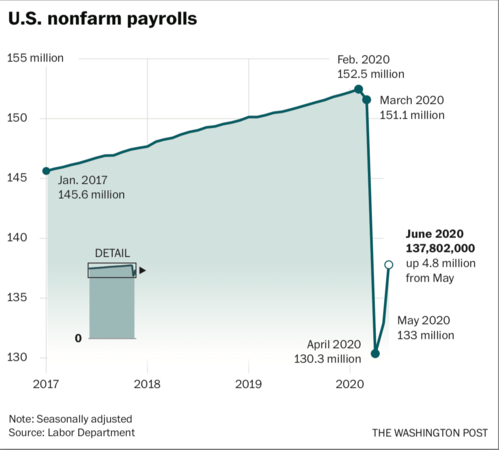
WASHINGTON – The U.S. economy added a record 4.8 million jobs in June, according to federal data released Thursday, but a surge in new infections and a spate of new closings threatens the nascent recovery.

Two key federal measurements showed the precarious place the economy finds itself in three and a half months into the pandemic as the country struggles to hire back the more than 20 million workers who lost their jobs in March and April.

Unemployment claims

Unemployment claims

While companies have continued to reopen, a large number of Americans are finding their jobs are no longer available. The unemployment rate in June was 11.1 percent, the Bureau of Labor Statistics said, down from a peak of 14.7 percent in April but still far above the 3.5 percent level notched in February.

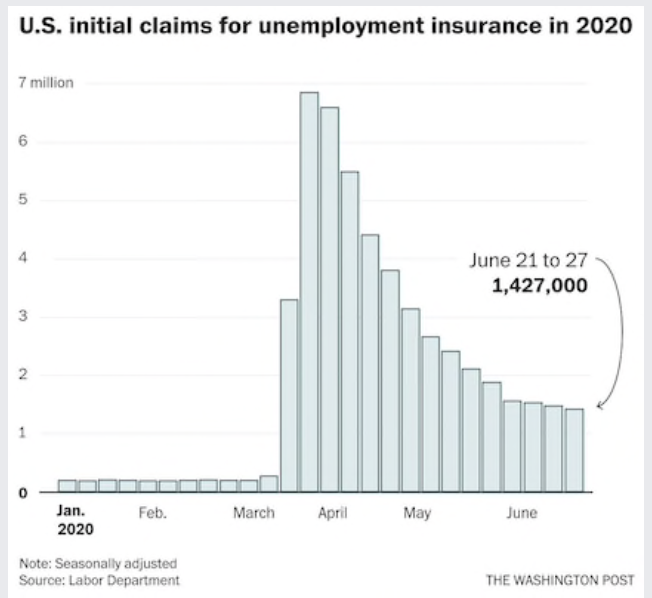
And another 1.4 million Americans applied for unemployment insurance for the first time last week and more than 19 million people are still receiving unemployment benefits, stubbornly high levels that show how many people are struggling to find or keep work.

The Congressional Budget Office on Thursday said the coronavirus pandemic gave such a shock to the labor market that it would not fully recover for more than 10 years.

Snanpsho of jobs in the U.S.

Snanpsho of jobs in the U.S.

President Trump touted the jobs that were added at a news conference called shortly after they were released, saying they were a sign that “America’s economy is now roaring back to life like nobody has ever seen before.”

“All of this incredible news is the result of historic actions my administration has taken,” Trump said.

But his top aides acknowledged there was still a long way to go.

“There is still a lot of hardship, and a lot of heartbreak, in these numbers,” National Economic Council Director Larry Kudlow said. “I think we have a lot more work to do.”

The stock market initially rose on the news, with the Dow Jones industrial average rising 400 points, or 1.5 percent, before retreating. It closed up 92 points on the day.

Economists called the 4.8 million jobs added encouraging, saying they were a sign that the massive financial incentives that Congress passed appeared to have succeeded at stanching even greater job loss.

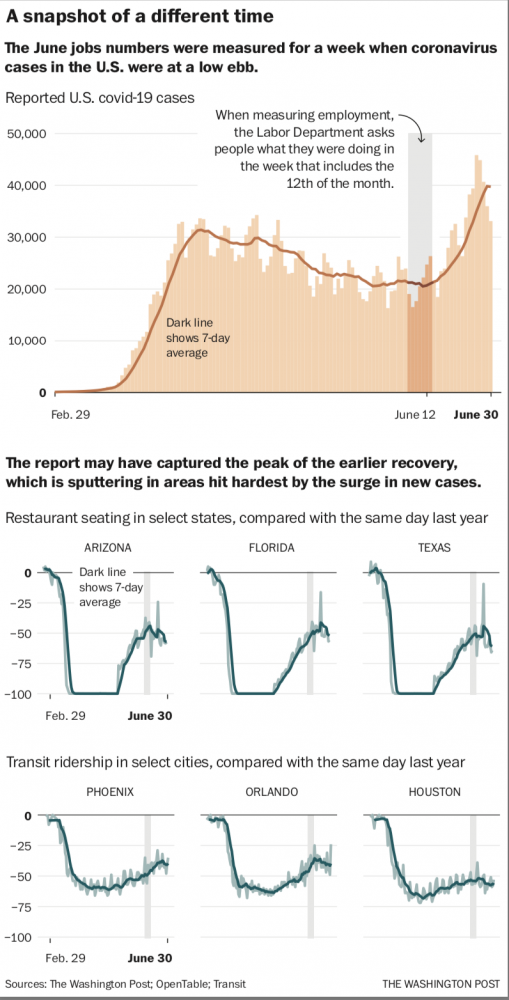
But the good news came with a couple of significant asterisks: It was gathered the week of June 12, when the country was reporting less than 25,000 new cases a day, not the current average of more than 40,000 that has sent new closures and shutdowns cascading across states and counties.

“The pandemic pushed us into a very deep economic hole,” said Mark Zandi, chief economist at Moody’s Analytics. “We can certainly fall back.”

The more than 14.7 million people who are still out of work have left the country with an unemployment rate higher than any point during the Great Recession.

The unemployment insurance data, based on statewide claims that are separate from the survey that informs the jobs report, paints an even less sanguine picture: Last week was the 15th straight where unemployment claims exceeded 1 million, a sign that the economic recovery has not taken hold for many Americans.

The strong month of job gains was driven by robust hiring in the leisure and hospitality sector, with 2.1 million additional jobs added, accounting for about 40 percent of the total gained for the month. Food services and drinking establishments saw their payrolls swell by 1.5 million people, but they still remain 3.1 million lower than before the pandemic.

These are the industries that are getting hit hard in the past two weeks by new closings, as a numbers of states shuttered bars and restricted restaurant service as they try to get the case surge under control.

Retail gained back 740,000 jobs, though employment remains at less than half its pre-pandemic level; education and health services regained 568,000 jobs and health care 358,000 as people returned to the offices of dentists, physicians and other medical practitioners.

The data bring into sharper focus the turmoil facing the U.S. economy after many businesses sent workers home in March during the beginning of the spike in deaths caused by the virus.

Many companies began rehiring in May and June, but there are signs that some workers are getting laid off for the second time in just a few months. 

Others technically remain employed but are working drastically reduced schedules – more than 9 million workers reported working part time because of economic reasons, more than double the level in February before the pandemic. Still a participation rate of 61.5 percent in June, slightly up from April and May but nearly a percentage point below February, indicates that others may be leaving the labor force all together – an echo of the deep economic turbulence in the Great Recession.

Economists said there are other reasons to be concerned as incentives for businesses to retain employees and some benefits that have allowed people out of work to stay afloat financially are winding down without more federal action.

Federal and state officials struggled to time their reopening efforts in April and May, in some cases ignoring warnings from public health officials. Now, cases in some of the states that reopened the fastest, or with the loosest restrictions, are seeing the biggest spikes, such as Florida, Arizona, and South Carolina.

In recent days, Texas shut down all bars just weeks after they had reopened. California announced the closure of bars and indoor dining in 19 counties, more than 70 percent of the state. And at least nine other states have slowed or reversed their reopenings. Restaurant bookings have begun to sink in hard-hit states such as Florida, Texas and Arizona. Job postings on the Indeed website, though up from a low of 39 percent, are still down 24 percent from last year.

Many workers are starting to report being laid off or furloughed for a second time in just a few months.

But those effects will not be captured in these reports for the most part.

In the May jobs report, there was a particular focus on a misclassification error the Bureau of Labor Statistics said it made that marred how it calculated the unemployment rate. On Thursday, it said that issue had been mostly been fixed.

The BLS said the true unemployment rate is probably closer to 12.1 percent, 1 percentage point higher than the official rate it gave. Last month, it said the unemployment rate was 13.3 percent, but the data collection error had artificially lowered it from 16.3 percent. In April, the 14.7 percent official rate was likely closer to 19.7 percent.

The disconnect stems from the way surveyors interview people about their job status, as many Americans are unclear about whether they have actually been laid off or just sent home temporarily.

There are other strains on the economy. Only a third of the 22 million Americans who lost their jobs in March and April have returned to work so far. The number of people who reported permanently losing a job rose by 588,000 in June, bringing the total since February to 2.9 million

“It’s becoming clearer that some of what people hoped were temporary layoffs are now turning into permanent layoffs,” said Donald Marron, an economist at the Urban Institute.

The new unemployment claims, a different measurement which has stagnated around 1.4-1.5 million a week during the last month, remain at more than double the pre-pandemic record, pointing to the magnitude of the crisis. With the supplemental insurance given to gig and self-employed workers, that number was well over 2 million last week.

“I would take solace with these numbers but I wouldn’t pop any champagne,” Zandi said. “It’s ten times what you would see in a well-functioning economy.”

At the start of the pandemic, most workers believed they would quickly be rehired, but as the deadly virus continues to be a danger, more and more businesses are telling workers they will never get their old job back.

The job loss has had a disproportionate affect on people of color as well.

The jobless rate for black people is 15.4 percent and 13.8 percent for Asians. For Latinos, the jobless rate is 14.5 percent.

Federal legislators continue to wrangle over proposals that would continue or extend some of the emergency unemployment benefits that will run out by the end of July. Democrats and the White House are at odds over how to authorize the funds even though there are large numbers of people still out of work.

White House officials told outside advisers on Thursday that the jobs report makes it less likely they will approve legislation that would cost as much as $2 trillion or $3 trillion, according to Stephen Moore, a conservative close to the White House. Moore said the jobs report is also likely to shore up White House opposition to extending the significant increase in unemployment benefits approved by Congress in March.

“There will be a phase four, but this makes the case in their eyes for a smaller one and makes even stronger the case for not extending the unemployment benefits,” Moore said. “You don’t have the sense of crisis you did a few weeks ago.”

Trump and Treasury Secretary Steven Mnuchin on Thursday talked about providing more money for businesses and schools, but Mnuchin said they had not decided on what to do for households.

“Our work is not done until every single American who lost a job because of Covid is back to work,” Mnuchin said.

There are some positive indications about the country’s reopening. Data gathered by the HR software company Kronos on 30,000 private industry businesses and 3.2 million hourly workers found that businesses had by the end of last week recovered more than half – 59 percent – the work shifts they lost between March and April. Even in places where coronavirus cases are still surging, more workers clocked in during the last week of June than at the beginning of the month.

“From February through June, we will have seen an enormous amount of job loss,” Jason Furman, a former top economic adviser to President Barack Obama, said on a conference call organized by Rep. James Clyburn, D-S.C., the chairman of the House’s coronavirus subcommittee. “Whatever happens month to month, the economy is in a much worse place than it was four months ago.”

Stocks pare gains as virus angst offsets jobs data #ศาสตร์เกษตรดินปุ๋ย

#ศาสตร์เกษตรดินปุ๋ย : ขอบคุณแหล่งข้อมูล : หนังสือพิมพ์ The Nation.

Stocks pare gains as virus angst offsets jobs data

Econ

Jul 03. 2020

By Syndication Washington Post, Bloomberg · Rita Nazareth, Vildana Hajric · BUSINESS, US-GLOBAL-MARKETS

U.S. stocks pared gains on speculation that an increase in coronavirus cases could jeopardize an economic rebound from the sharpest contraction on record.

The S&P 500 came off session highs amid a plunge in trading volume ahead of a holiday on news that U.S. virus cases had the biggest increase since May 9. Earlier, Florida reported that infections and hospitalizations jumped the most ever, and Houston had a surge in intensive-care patients. The figures offset data showing that payrolls increased by 4.8 million in June after an upwardly revised 2.7 million gain in the prior month.

The U.S. labor market made greater progress than expected last month digging out of a deep hole, yet optimism over the rebound was tempered by stubbornly high layoffs and a resurgent coronavirus outbreak across the country. President Donald Trump still said the report shows the economy is “roaring back.” Massive monetary and fiscal policy stimulus helped lower borrowing costs and keep the financial system liquid in a time of stress while propelling the stock market higher.

“There’s still a general positive sentiment about how quickly we’re seeing the recovery,” said Chris Gaffney, president of world markets at TIAA Bank. “But we do think you’re going to see the recovery level off, especially if we continue to see higher case numbers on the virus.”

Investors also assessed remarks from White House Economic Adviser Larry Kudlow, who told Fox Business Network that “we are very unhappy with China” and that “there are going to be export restrictions.”

U.S. stocks are poised to rise this quarter if history is any guide, according to Keith Lerner, chief market strategist at SunTrust Private Wealth Management. Lerner cited the S&P 500’s track record after its biggest quarterly gains since 1950 in a report Tuesday. The gains ranged from 15% to 22%, in line with last quarter’s 20% increase, according to data compiled by Bloomberg. In each case, the S&P 500 rose in the following quarter. The average advance was 8.4%.

– – –

These are some of the main moves in markets:

Stocks

– The S&P 500 gained 0.5% as of 4 p.m. New York time.

– The Dow Jones Industrial Average rose 0.4%.

– The Nasdaq Composite Index advanced 0.5%.

– The Stoxx Europe 600 Index added 2%.

– The MSCI Asia Pacific Index increased 1.7%.

Currencies

– The Bloomberg Dollar Spot Index declined 0.1%.

– The euro fell 0.1% to $1.124.

– The Japanese yen weakened 0.1% to 107.53 per dollar.

Bonds

– The yield on 10-year Treasuries declined one basis point, to 0.67%.

– Germany’s 10-year yield sank three basis points, to -0.43%.

– Britain’s 10-year yield fell three basis points, to 0.186%.

Commodities

– The Bloomberg Commodity Index advanced 0.7%.

– West Texas Intermediate crude advanced 1.2%, to $40.29 a barrel.

– Gold increased 0.5%, to $1,788.30 an ounce.