The Stock Exchange of Thailand (SET) Index closed at 1,374.13 today (July 2), up 24.69 points or 1.83 per cent.
Total transactions amounted to Bt84.485 billion with an index high of 1,376.31 and a low of 1,353.50.
In the morning session, a stock analyst at Krungsri Securities expected the index to fluctuate between 1,340 and 1,360 due to mixed sentiments.
“The market was buoyed by advances in Pfizer and BioNTech’s Covid-19 vaccine research, the US private payroll in June adding 2.369 million jobs, and the crude oil price rising in response to US storage dropping by 7.2 million barrels,” the analyst said.
However, the index was still pressured by uncertainty following the second wave of Covid-19 cases in the US where daily cases are still rising, added the analyst.
“Also, the latest US Federal Reserve’s meeting pinpointed a risk that fiscal measures may not be enough to assist households, businesses, and local governments, which would drag down the index.”
The 10 stocks with the highest trade values today were STGT, STA, PTT, SCC, MINT, PTTEP, KBANK, CPF, BAM, and AOT.
As of 4.30pm, the crude oil price had risen by US$0.22 or 0.55 per cent to $40.04 per barrel, while gold was up by $3.20 or 0.18 per cent to $1,783.10 per ounce.
Other Asian indices were on the rise:
Japan’s Nikkei Index closed at 22,145.96, up 24.23 points, or 0.11 per cent.
China’s Shang Hai SE Composite Index closed at 3,090.57, up 64.59 points, or 2.13 per cent, while the Shenzhen SE Component Index closed at 12,269.49, up 156.52 points, or 1.29 per cent.
Hong Kong’s Hang Seng Index closed at 25,124.19, up 697.00 points, or 2.85 per cent.
South Korea’s KOSPI Index closed at 2,135.37, up 28.67 points, or 1.36 per cent.
Taiwan’s TAIEX Index closed at 11,805.14, up 101.72 points, or 0.87 per cent.
Jul 02. 2020Prime Minster Prayut Chan-o-cha has scheduled a meeting with the council of economic ministers on July 10 to discuss the country’s economic situation.
By THE NATION
Prime Minister Prayut Chan-o-cha has called a meeting with the council of economic ministers on July 10 to discuss the state of Thailand’s economy, the council’s secretary-general Kobsak Pootrakul said on Thursday (July 2).
The meeting will also seek measures to assist small and medium-sized enterprises from the impact of the Covid-19 outbreak, he added.
Meanwhile, Deputy Prime Minister Somkid Jatusripitak on Thursday assigned the Revenue Department and the Fiscal Policy Office to come up with measures to encourage community-level tourism and woo big spenders. The measures should be ready by mid this month, he added.
Somkid has also asked the central bank to widen the opportunity for businesses to take bank loans.
Meanwhile, Finance Minister Uttama Savanayana said his ministry was thinking about asking the Thai Credit Guarantee Corporation to develop a credit guarantee project to help small businesses. This measure is expected to be ready in two weeks.
The Joint Standing Committee on Commerce, Industry and Banking revised itsforecast for Thailand’s economic growth on Wednesday, bringing it down from between -3 and -5 per cent to between -5 and -8 per cent.
The Bank of Thailand has also recently said that the country’s economy this year will contract 8.1 per cent, worst ever, because the Covid-19 crisis has had a greater impact on both the Kingdom’s and global economy.
Thanavath Phonvichai, president of the University of the Thai Chamber of Commerce (UTCC), expects Thai gross domestic product (GDP) to show a 10-15 per cent contraction in the second quarter of this year, the period of lockdown when the economy felt the full impact of Covid-19.
He forecasts that the spending level of Thais will return to normal spending in a year’s time.
According to the university’s Economic and Business Forecasting survey, the consumer confidence index rose to 49.2 from the previous month’s score of 48.2. The rise coincided with phases 3 and 4 of lockdown easing.
The survey was conducted on 2,241 participants.
Positive factors affecting the results were the government’s relaxation of lockdown restrictions and launch of measures to ease burdens on consumers and businesses, Thanavath added.
Negative factors included public concern over the outbreak and weakened economy as well as the state of emergency extension.
People were also worried over the renewed trade war between the US and China, which threatens Thai exports.
United Nations Conference on Trade and Development (UNCTAD) estimates that for every US$1 million a country loses in tourism revenue its national income can drop by up to $3 million and have a dramatic effect on local employment.
Globally, the tourism sector could lose at least $1.2 trillion or 1.5 per cent of the world’s GDP now that travel has come to a virtual standstill for nearly four months due to the Covid-19 pandemic, an UNCTAD report published on Wednesday (July 1) said.
In the report, UNCTAD warned that the loss could rise to $2.2 trillion or 2.8 per cent of the global GDP if the halt on tourism lasts for eight months, and as much as $3.3 trillion or 4.2 per cent of global GDP if travel is halted for 12 months.
Tourism is the backbone of many countries and a lifeline for millions around the world, having more than tripled in value from $490 billion to $1.6 trillion in the last two decades, according to the UN World Tourism Organisation (UNWTO). However, the Covid-19 pandemic has brought travel to a halt, causing severe economic consequences globally.
Prevailing lockdown measures in some countries, travel restrictions, reduction in consumers’ disposable income and low confidence levels could significantly slow down the sector’s recovery, UNCTAD said.
“These numbers are a clear reminder of something we often seem to forget: the economic importance of the sector and its role as a lifeline for millions of people all around the world,” said Pamela Coke-Hamilton, UNCTAD’s director of international trade.
“For many countries, like small island developing states, a collapse in tourism means a collapse in their development prospects. This is not something we can afford.”
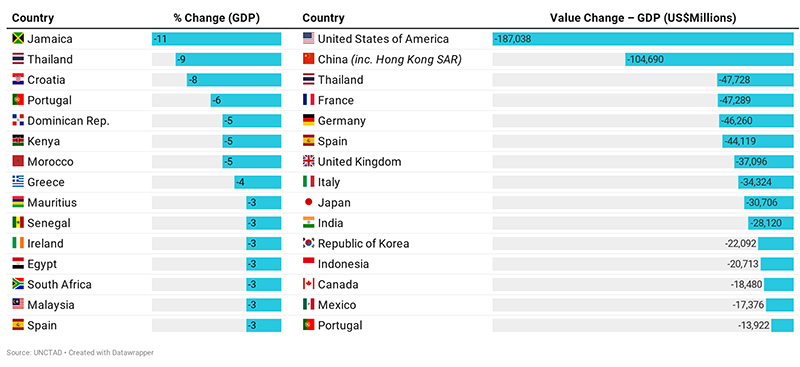
Developing countries could suffer the steepest GDP losses and Jamaica and Thailand stan out in this, losing 11 per cent and 9 per cent of GDP in the most optimistic scenario. Other tourism hotspots like Kenya, Egypt and Malaysia could lose over 3 per cent of their GDP.
Even rich countries are also feeling the pinch. Many popular European and American destinations, including France, Greece, Italy, Portugal, Spain and the United States may lose billions of dollars due to the dramatic drop in international tourism, UNCTAD forecasts.
Changes in GDP: 15 most affected countries, moderate scenario
Impact on other sectors, jobs and wages
Tourism accounts for a significant share of the global GDP and more than half of many countries’ national income. The coronavirus-induced losses in tourism are having a knock-on effect on other sectors that supply goods and services to tourists, such as food, beverages and entertainment.
Hence, UNCTAD estimates that for every $1 million lost in international tourism revenue, a country’s national income may decline by between $2 million and $3 million.
The massive drop in tourist arrivals has also left a growing number of people unemployed or with less income.
UNCTAD estimates show that in the worst-affected countries, such as Thailand, Jamaica and Croatia, employment for unskilled workers could drop at double-digit rates even in the most moderate scenario. Meanwhile, in terms of wages for skilled workers, the steepest drops were seen in Thailand (12 per cent), Jamaica (11 per cent) and Croatia (9 per cent) in the most optimistic scenario.
The effects could be worse for women who are expected to be disproportionately affected by layoffs in tourism due to Covid-19, the report said.
Women are more likely to run tourism businesses and make up about 54 per cent of workers in the accommodation and food services sectors. Since many women in the sector work informally in low-skilled jobs, they are unlikely to have unemployment benefits or other safety nets.
“This is why women are particularly hard hit in this crisis. And this is why policies that help protect the sector also protect the economic empowerment that many of these women have long fought for,” Coke-Hamilton said.
Recovery support needed
UNCTAD, meanwhile, is calling for stronger social protection in affected nations to prevent worse economic hardship for people and communities that depend on tourism.
It is urging governments to protect workers, and design subsidies to help workers move to new industries if their workplace is unlikely to recover.
Government should also help tourism companies facing the risk of bankruptcy, like hotels and airlines. One approach may be low-interest loans or grants, the report states.
UNCTAD is also calling on the international community to support access to funding for the hardest-hit countries.
The government is planning to boost Thailand’s international trade by signing bilateral free-trade pacts with three countries over the next two years.
Trade Negotiations Department director general Auramon Supthaweethum said the department was targeting the following free trade agreements (FTAs) as it prepared its 2022 budget.
1. The Thailand-Pakistan FTA, delayed by political developments in Pakistan after nine rounds of talks.
2. The Thailand-Turkey FTA, with the 7th round of talks due in Turkey this December.
3. The Thai-Sri Lanka FTA, delayed by elections in Sri Lanka after two rounds of talks.
Meanwhile, ongoing talks on the 15-member Regional Economic Partnership (RCEP) covering Asia-Pacific trade are set to conclude this month, with proposals put to the Cabinet in October ahead of the signing in Vietnam next year.
The Trade Negotiations Department will also prepare frameworks for talks on FTAs with the Eurasian Economic Union, the European Free Trade Association (EFTA), Bangladesh, the UK, Hong Kong, and separate Asean and Thailand pacts with the European Union. Budget will also be reserved to study whether Thailand should join the Comprehensive and Progressive Trans-pacific Partnership (CPTPP).
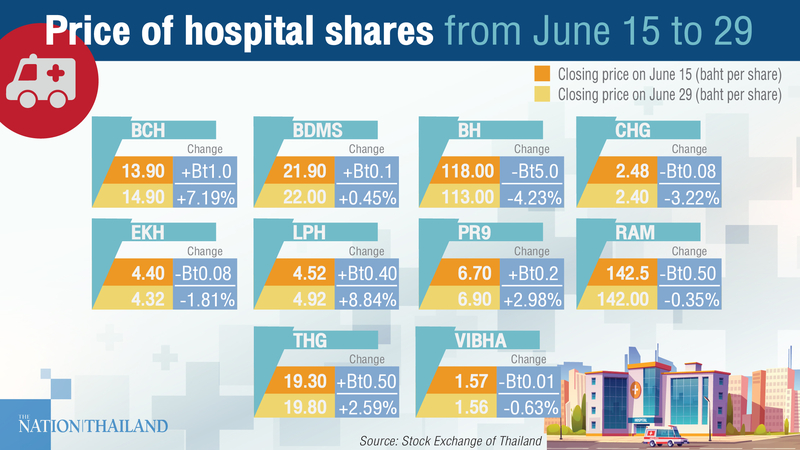
Private hospital share prices are recovering after the government’s fifth phase of lockdown easing allowed foreigners to visit Thailand for medical treatment, said experts.
Parin Kitchatornpitak, an analyst at KGI Securities (Thailand), said that the price of hospital stocks is likely to increase after the Centre for Covid-19 Situation Administration (CCSA) lifted the restriction on medical tourists.
“According to the CCSA, 30,000 to 50,000 foreigners are set to undergo medical treatment in Thailand, after submitting travel itineraries and undergoing 14-day quarantine,” he said.
The government’s move to ban foreign arrivals from April hit hospitals hard, since foreign patients contribute anything from 10 per cent to 60 per cent of their revenue.
“However, we expect shares in hospitals that receive revenue from foreign patients to increase significantly from the fourth quarter of this year onwards, as countries ease their lockdown measures and a Covid-19 vaccine comes available,” he added.
Meanwhile, Apaporn Sawangpak, head of research at DBS Vickers Securities (Thailand), said that a collaboration between hospital network Bangkok Dusit Medical Services (BDMS) and China’s Ping An Health insurers will draw up to 4,000 Chinese medical tourists per year.
“BDMS expects this collaboration to generate up to Bt2 billion per year in revenue,” she said.
She explained that prior to the Covid-19 outbreak, 70 per cent of BDMS revenue came from Thai patients, and 30 per cent from foreigners.
“Most foreign patients came from the Middle East, followed by Japan, Myanmar and China,” she said.
She expects BDMS performance to improve in the second half of this year in response to the lockdown easing.
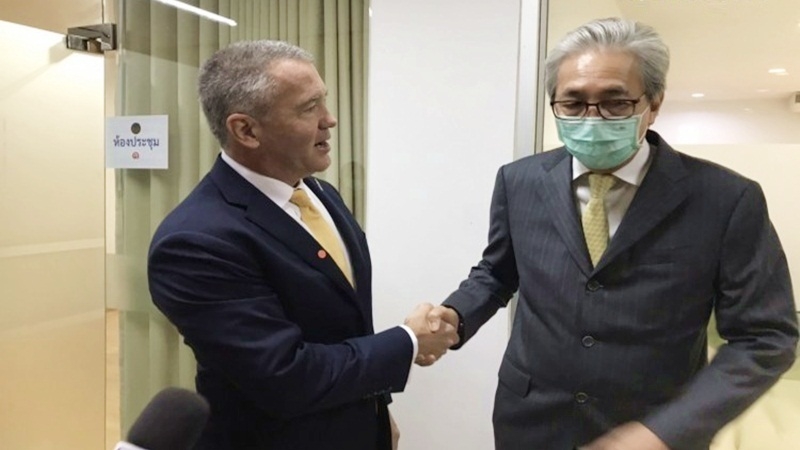
Deputy Prime Minister Somkid Jatusripitak today (July 2) met with US ambassador Michael George DeSombre to discuss collaboration in the Eastern Economic Corridor’s Thai Silicon Valley project.
Set to launch in the next year, Thailand’s own Silicon Valley will attract start-up businesses and research institutions to the government’s flagship infrastructure project on the eastern seaboard.
“I told him [DeSombre] that we can be a base of production, services and finance in the region,” Somkid said.
“Thailand also has potential in the medical industry and we want the US to be our partner,” he added.
DeSombre said collaboration between the two countries would strengthen Thailand’s economy and boost investment from US businesses.
Thailand has the potential to become a supply chain of Southeast Asia, the ambassador added.
The price of gold dropped by Bt150 per baht weight in morning trade on Thursday (July 2), the Gold Traders Association reported.
As of 9.24am, buying price of a gold bar was Bt25,900 per baht weight and selling price Bt26,000, while gold ornaments were priced at Bt25,438.48 and Bt26,500, respectively.
At close on Wednesday (July 1), buying price of a gold bar was Bt26,050 per baht weight and selling price Bt26,150, while gold ornaments were priced at Bt25,574.92 and Bt26,650, respectively.
The price in Gold Spot on Thursday morning moved to around US$1,770 (Bt54,951) per ounce after the price dropped sharply by $20.6 to $1,779.9 per ounce at Wednesday’s close due to mass sell-offs to take profit after the price rose over $1,800 per ounce on Tuesday.
Meanwhile, the strong US economy also pressured the gold price.
The Stock Exchange of Thailand (SET) Index opened on Thursday (July 2) at 1,356.22, up 6.78 points, or 0.50 per cent.
A stock analyst at Krungsri Securities expected the index to fluctuate between 1,340 and 1,360 due to mixed sentiments.
“The market gained positive sentiment from Pfizer and BioNTech’s Covid-19 vaccine testing going well, the US private payroll in June rising by 2.369 million jobs, and the rising crude oil price in response to the US crude oil storage dropping by 7.2 million barrels,” the analyst said.
However, the analyst said the index was still under pressure from uncertainty following the second wave of coronavirus cases as the number of patients in the US was still rising.
“Also, the US Federal Reserve’s meeting report stated that there was a risk that fiscal measures may not be able to assist households, businesses, and local governments, which would plunge the index,” the analyst added.
He recommended that investors buy:
▪︎ Energy stocks that benefit from a rising crude oil price, such as PTT, PTTEP, Top, PTTGC, IRPC, SPRC, and IVL.
▪︎ Stocks whose second-quarter performance will improve, such as CKP, Tasco, and STA.
▪︎ Stocks that benefit from the Cabinet’s domestic tourism stimulus measures, such as MINT, CENTEL, ERW, AOT, and AAV.
The SET Index rose by 10.41 points, or 0.78 per cent, on Wednesday (July 1), closing at 1,349.44. Total transactions amounted to Bt53 billion.
By Bloomberg · Rita Nazareth, Sarah Ponczek · BUSINESS, US-GLOBAL-MARKETS
U.S. stocks rose as positive vaccine developments and better-than-expected manufacturing data tempered concern over a jump in coronavirus cases. Treasuries and the dollar fell.
The S&P 500 rose for a third day while the Nasdaq Composite jumped to a record as an early trial of an experimental shot from Pfizer and BioNtech showed that it’s safe and prompted patients to produce antibodies. Earlier Wednesday, equities came off session highs after California and Arizona reported their biggest daily virus case increases and Houston’s intensive-care units exceeded full capacity. FedEx soared on a surprise profit, while Boeing and Walgreens Boots Alliance weighed on the Dow Jones Industrial Average.
Traders also monitored minutes of the Federal Reserve’s June meeting that showed participants viewing the economy as needing support “for some time.” Fed officials showed no readiness at their June meeting to commit to yield-curve control, but they did have an eagerness to provide more guidance in coming months on the future path of interest rates and asset purchases. A closely watched measure of manufacturing jumped in June to the highest in more than a year.
“There’s this inherent tension between health of the economy and health of the population,” said David Lebovitz, a global market strategist at JPMorgan Asset Management. “It’s going to be the way to think about what drives markets over the next couple of weeks or months.”
The U.S. is preparing to roll out sanctions to punish senior Chinese officials over human-rights abuses against Muslims in Xinjiang, two people familiar with the matter said. Relations between Washington and Beijing have soured badly in the months since the first-phase trade deal was signed, while the coronavirus pandemic made many of its elements moot.
The monthly U.S. jobs report will be released Thursday.
– – –
These are some of the main moves in markets:
Stocks
– The S&P 500 climbed 0.5% as of 4 p.m. New York time.
– The Dow Jones Industrial Average declined 0.3%.
– The Nasdaq Composite Index jumped 1%.
– The Stoxx Europe 600 Index rose 0.2%.
– The MSCI Asia Pacific Index increased 0.1%.
Currencies
– The Bloomberg Dollar Spot Index fell 0.3%.
– The euro increased 0.2%, to $1.1255.
– The Japanese yen strengthened 0.4%, to 107.46 per dollar.
Bonds
– The yield on 10-year Treasuries increased two basis points, to 0.68%.
– Germany’s 10-year yield climbed six basis points, to -0.40%.
– Britain’s 10-year yield gained four basis points, to 0.211%.
Commodities
– The Bloomberg Commodity Index increased 0.3%.
– West Texas Intermediate crude rose 1.1%, to $39.71 a barrel.
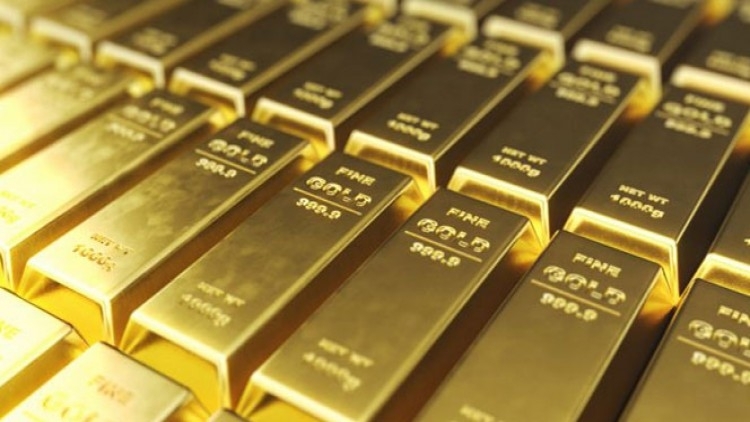
Gold has generated outstanding returns in the first half of this year, rising 17 per cent year on year.
The price in Gold Futures skyrocketed to the highest in almost nine years from US$1,500 to $1,800 (Bt46,465 to Bt55,758) per ounce on Tuesday’s (June 30) closing, while the price of the precious metal in Thailand rose from Bt21,450 at the beginning of the year to Bt26,100 per baht weight on Wednesday’s closing.
In comparison, the Stock Exchange of Thailand (SET) Index has contracted 15 per cent year on year, S&P500 4.8 per cent year on year and the MSCI World Index contracted 7 per cent year on year. Crude oil has contracted 37 per cent and domestic property fund 16.76 per cent.
Benjama Ma-in, an analyst at YLG Bullion and Futures, said the price of gold in the second quarter of this year rose by 13 per cent, the highest since 2016, and this can be put down to the Covid-19 outbreak.
“We expect gold to rise the highest since 2011 to $1,920 per ounce as investors are choosing to park their funds in this safe haven due to uncertainty over the global economy, a second coronavirus wave, US-China trade war and conflicts among countries,” she said.
“Another factor that is encouraging investors to buy gold is that ETF [exchange-traded funds] worldwide are holding up to 3,510 tonnes of gold, while the SPDR Gold Trust is holding up to 1,187.90 tonnes of gold, the highest since 2013.”
She said negative factors such as mass sell-offs for easy profits may affect the price of gold in the short term because investors may want to hold cash or turn to other assets that are rising.
“Investors decided to sell gold after the price rose to Bt26,800 per baht weight, but bought it right back once the price fell below Bt26,000 per baht weight,” she said.
She added that in the long term, the price of gold will rise to $2,000 per ounce, though it will depend on the rate of US inflation, which is currently less than 1 per cent.
“We expect investors to buy gold if the rate of US inflation rises beyond 3 per cent,” she added.
Meanwhile, Kritrat Hiranyasiri, chairman of MTS Gold, said he expects the price of gold in Gold Spot, which is now $1,762 per ounce, should rise to $1,800 per ounce like in Gold Futures within four weeks.
“The price of gold may rise further because the economy has not recovered yet and the dollar is likely to weaken further,” he added.

 Prime Minster Prayut Chan-o-cha has scheduled a meeting with the council of economic ministers on July 10 to discuss the country’s economic situation.
 Photo credit: freepik