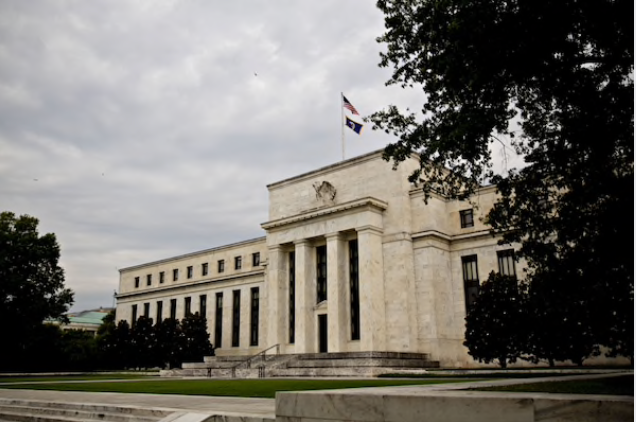
In its meeting on Tuesday (June 30), the Cabinet approved the Finance Ministry’s proposal to cut down on state-owned banks’ contribution to specialised financial institutions’ (SFIs) development fund due to the impact the Covid-19 crisis has had on SFIs’ financial standing.
Government spokesperson Narumon Pinyonsinwat said the Cabinet had agreed to reduce contributions to SFI development funds in order to ease the burden on state-owned banks such as the Bank for Agriculture and Agricultural Cooperatives (BAAC), the Government Savings Bank, the Government Housing Bank and the Islamic Bank of Thailand.
Currently, these banks pay 0.25 per cent of their deposit base annually to the SFI fund.
According to the Cabinet’s decision on Tuesday, their contribution will be reduced to 0.125 per cent for this year and next, before they return to paying 0.25 per cent in 2022.
In its proposal, the Finance Ministry cited the impact of Covid-19 on state-run banks, and this new rate will ease their financial costs. It will also be in line with the central bank’s decision to halve commercial banks’ contribution to the Financial Institutions Development Fund.
The Bank of Thailand and the Finance Ministry are closely monitoring bad debts in the financial system, which have the potential of rising due to the severe impact the virus has had on the country.
The banks’ contribution is designed to save taxpayers from bearing the cost of government rescue financial institutions should a crisis take place in the future as it did during the 1997 financial crisis.
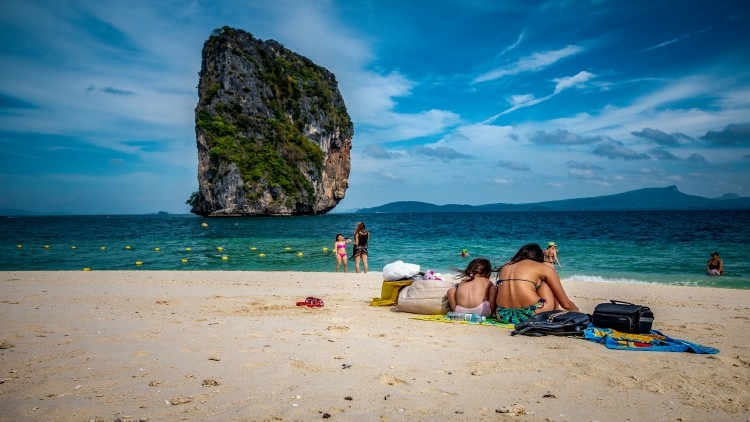
The Cabinet approved the amended version of the Bt22.4-billion domestic tourism campaign at its meeting on Tuesday (June 30), said deputy government spokesperson Traisulee Traisoranakul.
The campaign, which will run from July 1 to October 31, aims to bring the tourism industry back to life after it was brought to its knees by the Covid-19 outbreak.
The campaign includes a government subsidy on hotel stays totalling 5 million nights, restaurants and tourism activities as well as up to 2 million domestic air tickets.
The air ticket subsidy gives travellers a 40 per cent discount on airfare, but not exceeding Bt1,000 per seat.
The campaign also includes a Bt2,000-per-head subsidy for 1.2 million village health volunteers and medical staff at tambon hospitals for study tours.
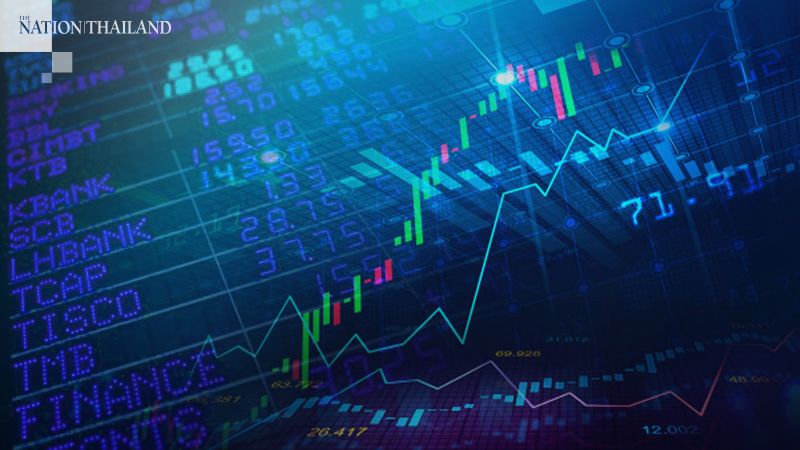
The Stock Exchange of Thailand (SET) Index closed at 1,339.03 today (June 30), up 9.27 points or 0.70 per cent.
Total transactions amounted to Bt58.589 billion with an index high of 1,351.59 and a low of 1,339.03.
In the morning session, a stock analyst at Krungsri Securities expected the index to rebound to between 1,340 and 1,345 points in response to strong economic data emanating from the US and China, before falling back.
“The US Pending Home Sales Index in May rose by 44.3 per cent compared to the previous month, while China’s industrial profits in May rose 6 per cent year on year,” the analyst said.
“Resulting positive sentiment boosted the price of crude oil, with demand for fuel expected to increase.”
However, the analyst said the index was still pressured by uncertainty following a second wave of Covid-19 infections in the United States.
The 10 stocks with the highest trade values today were ADVANC, PTT, KBANK, CBG, KCE, AOT, CPF, CPALL, SCC, and PTTEP.
As of 4.30pm, the crude oil price had dropped by US$0.53 or 1.34 per cent to $39.17 per barrel, while gold rose by $1.40 or 0.08 per cent to $1,782.60 per ounce.
Other Asian indices were on the rise:
Japan’s Nikkei Index closed at 22,288.14, up 293.10 points, or 1.33 per cent.
China’s Shang Hai SE Composite Index closed at 2,984.67, up 23.16 points, or 0.78 per cent, while the Shenzhen SE Component Index closed at 11,992.35, up 239.99 points, or 2.04 per cent.
Hong Kong’s Hang Seng Index closed at 24,427.19, up 125.91 points, or 0.52 per cent.
South Korea’s KOSPI Index closed at 2,108.33, up 14.85 points, or 0.71 per cent.
Taiwan’s TAIEX Index closed at 11,621.24, up 78.62 points, or 0.68 per cent.
The Bank of Thailand’s report for May shows that the Thai economy continued contracting substantially due to a drop in external demand, both in the tourism sector and in export.
According to the report, the number of tourist arrivals contracted by 100 per cent from the same period last year. There were no arrivals for two consecutive months due to restrictions on inbound travel, and due to this, businesses and workers in tourism-related sectors were severely affected.
Meanwhile, the value of exports contracted sharply by 23.6 per cent from the same period last year, and excluding gold, the value of exports shrank to 29 per cent. High contraction in export in nearly all categories was due to weak demands and low global crude oil prices, as well as the effect of drought, which brought down the export of sugar. However, the export of one agricultural product showed signs of expansion – fruits sold to China.
Private consumption indicators also continued to contract significantly from the same period last year in all spending categories due to weakening factors such as employment, income and consumer confidence. However, the contraction rate was slightly lower compared to April because the easing of Covid-19 restrictions allowed some economic activities to resume, while the government’s relief measures also helped farming income to contract at a lower rate.
However, high inventories, weakening domestic and external demand contributed to a high rate of contraction in the manufacturing sector.
Private investment in machinery, equipment and construction sectors continued to contract at a higher rate from the same period last year, proving that businesses had delayed their investment plans, while stocks remained high due to low local and foreign demand, coupled with concerns over economic outlook which remains highly uncertain.
The value of merchandise imports also contracted sharply at 34.2 per cent from the same period last year. The contraction was in all categories including consumer goods, raw materials and intermediate goods, as well as capital goods. The sharp decline in merchandise imports led to a higher trade balance, as merchandise exports also contracted.
However, with the exception of transfers, public spending was flat due to a contraction in current expenditure and state enterprises’ capital expenditure after expansion in March and April, though capital expenditure by the central government continued to expand.
Overall, economic stability remains sound though more vulnerable. Headline inflation was more negative compared to April due to a drop in fresh food and core inflation. The labour market was more vulnerable as reflected by the continued rise in social-security claims by the unemployed.
The country’s current account, however, became balanced after a deficit last month from a huge surplus in trade balance. Capital and financial accounts posted a surplus mainly from both asset and liability positions, despite the net sell in portfolios by foreign investors. The former continued to contract extremely due to international travel restriction, while the latter contracted from weakening demand from trading partners.
Consequently, domestic economic activities were affected, especially from sharp contraction in private investment and manufacturing. Nevertheless, public spending continued to expand and contraction in private consumption was somewhat lower due to the easing of lockdown measures and the government’s Covid-19 relief schemes.
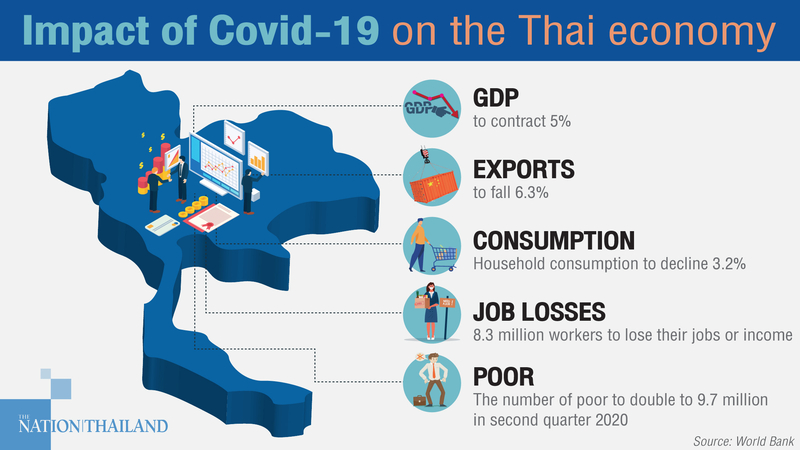
Thailand’s economy is expected to be impacted severely by Covid-19, shrinking by at least 5 per cent in 2020 and taking more than two years to return to pre-virus GDP levels, according to the World Bank’s Thailand Economic Monitor, released today (June 30).
The pandemic has “shocked the economy especially in the second quarter of 2020 and has already led to widespread job losses, affecting middle-class households and the poor alike”, it said.
While Thailand has been successful in stemming the tide of infections over the last three months, the economic impact has been severe. The tourism sector, which makes up close to 15 per cent of GDP, has been hit hard, with a near cessation of international tourist arrivals since March 2020, the monitor said.
Exports are expected to decline by 6.3 per cent in 2020, the sharpest quarterly contraction in five years, as demand for Thai goods abroad remains weak by the global slowdown. Household consumption is projected to decline by 3.2 per cent as restrictions on movement and dwindling incomes limit consumer spending, especially in the second quarter of 2020.
As Thailand starts to ease mobility restrictions, domestic consumption – traditionally the strongest driver of growth – may pick up in the second half of 2020 and in 2021, but economic recovery will be gradual and uncertain, it said. In the baseline, the economy is projected to grow by 4.1 per cent in 2021 and by 3.6 percent in 2022, which represents a slow recovery to pre-Covid GDP levels by mid-2022. The shape of the recovery is subject to considerable downside risks, including weaker global growth, feeble tourism, and continuing trade and supply chain disruptions.
“The strength of the economic recovery will depend in part on an effective policy response, in particular effective support to vulnerable households and firms,” said Birgit Hansl, World Bank country manager for Thailand. “As the recovery phase begins, a key challenge will be how to help people who lost their jobs reconnect with the labour market. Active labour market measures, such as wage-subsidies targeting individuals in the most vulnerable sectors, and on-the-job training to promote re-employment, should be explored.”
An estimated 8.3 million workers will lose their jobs or income because of the Covid-19 crisis.
The report found that the number of “economically insecure”, or those earning below US$5.5 (Bt170) per day, is projected to double from 4.7 million people in the first quarter to 9.7 million people in the second quarter of 2020. In particular, the share of economically insecure middle-class households with workers in the manufacturing and services sector will rise three-fold, from 6 per cent to 20 per cent.
Thailand’s combined Covid-19 aid packages amount to 12.9 per cent of GDP, the report said, focused on providing relief to vulnerable households and affected firms.
To protect vulnerable households, the World Bank report recommends extending social protection coverage to ensure that no gaps remain for the elderly and migrant workers.
The report also recommends continuing cash transfers for the most vulnerable groups and, where possible, linking such transfers to training, mentoring and other types of support that could create income-generating opportunities. Over the medium term, Thailand could consider establishing programmes with universal benefits to help cushion against epidemic outbreaks as well as other negative shocks, complemented by more targeted programmes for the poor, it said.
“For vulnerable companies, the nature of support will need to shift from emergency relief to more support for productive firms that are still standing,” said the bank’s senior economist for Thailand, Kiatipong Ariyapruchya. “This includes redirecting fiscal support from emergency measures to temporary job creation programmes by easing firm participation in public procurement and public works.”
Going forward, interventions could revamp firm support programmes focused on promoting companies and productivity growth, especially promoting investments for worker training, management training and technology adoption, he said.
Kiatipong also said Thailand “still has fiscal space to implement fiscal expansion policies and to extend the Bt5,000-cash transfer scheme to support affected people”.
The Bank of Thailand recently revised its forecast to a 8.1 per cent GDP contraction. World Bank economists said the forecast, which is subject to downside risks, is not different from others in times of big shock.
All analysts agree that the impact from Covid-19 is severe and it would take two to three years before economic recovery can reach pre-virus-crisis levels.
The Stock Exchange of Thailand (SET) Index opened today (June 30) at 1,343.99, up 14.23 points, or 1.07 per cent.
A stock analyst at Krungsri Securities expected the index to rebound between 1,340 and 1,345 points before falling in response to strong economic data emanating from the US and China.
“The US pending home sales index in May rose by 44.3 per cent compared to the previous month, while China’s industrial profits in May rose by 6 per cent year on year,” the analyst said.
“These positive sentiments also boosted the price of crude oil, with the demand for fuel expected to increase.”
The analyst, however, said the index is still under pressure from uncertainty following the second wave of Covid-19 infections in the United States.
He recommended investors buy:
▪ Energy stocks that benefit from a rising crude oil price, such as PTT, PTTEP, Top, PTTGC, IRPC, SPRC, and IVL.
▪ Stocks whose second-quarter performance will improve, such as CKP, Tasco, and STA.
▪ Stocks that were added to the SET50 and SET100 calculation – BPP, TTW, Ace, BFIT, DoHome, RBF, SIRI, SISB, SPCG, TVO, and WHAUP.
The SET Index fell by 0.58 points, or 0.04 per cent, yesterday, closing at 1,329.76. Total transactions amounted to Bt48 billion.
The price of gold was unchanged in morning trade today (June 30), the Gold Traders Association reported.
As of 9.20am, the buying price of a gold bar was Bt25,800 per baht weight and selling price Bt25,900, while gold ornaments were priced at Bt25,332.36 and Bt26,400, respectively.
The Gold Spot Index price this morning moved to around US$1,768 (Bt54,616) per ounce after the price rose slightly by 90 cents to $1,781.2 per ounce at yesterday’s close.
Gold gained as investors continued to buy the metal as a safe-haven asset amid uncertainty following the second coronavirus wave, especially in the United States, while the number of cases worldwide has shot past the 10-million mark.
However, a strengthening dollar has put pressure on the gold price, which has risen in a limited range.
Jun 30. 2020A man looks at stock prices displayed in the trading gallery of the RHB Investment Bank headquarters in Kuala Lumpur, Malaysia. MUST CREDIT: Bloomberg photo by Samsul Said
By Syndication Washington Post, Bloomberg · Gearoid Reidy, Ayaka Maki · BUSINESS, US-GLOBAL-MARKETS
When the coronavirus pandemic sent shares plunging, you didn’t have to be a professional investor to spot a buying opportunity. In fact, it might be better if you weren’t.
The can’t-miss rise of equity markets around Asia is fueling the explosion of interest among retail investors in the region, mirroring their exuberance worldwide. Millions of investors who had never so much as opened a trading account before have been piling into the market.
Just as the pandemic led bored Americans to make the Robinhood investing app a household name, it’s the amateurs who have helped to lift equities from India to Thailand despite some of the worst macroeconomic fundamentals in memory. But it’s also giving professionals pause – what happens when these investors are no longer around?
“If everyone is going into the same name and something happens, those names are likely to be sold off quite aggressively,” said Catherine Yeung, Fidelity International’s investment director. “I think we just need to be wary that market seems a bit complacent at the moment.”
In Japan, the Tokyo Stock Exchange Mothers Index, which hosts many tech start-up listings, has soared throughout the pandemic: buying the dip on almost any small-cap stock would make money. All but seven of the 320 companies on the board have gained since April’s start, from vaccine hopeful AnGes Inc., up 228%, to Precision System Science Co., which is developing a virus test and has added more than 509%.
“If there’s a report on TV about a coronavirus-related stock that’s going up, they can just buy it the next day and make profit,” said Naoki Murakami, a longtime Japanese day trader. He points to “simple” bets by amateur investors on stocks such as AnGes or Avigan maker Fujifilm Holdings Corp.
In the U.S., Robinhood and the Reddit forum called r/wallstreetbets have become a dominant force in the market, boosting everything from the stocks of bankrupt companies such as Hertz Global Holdings Inc. to revenue-less start-ups like truck maker Nikola Corp. That pattern has been repeated in Europe with brokerages in Germany, the U.K. and France all reporting a jump in participation by individual investors, fueled by a fear of missing out.
And while the names may be less familiar, the same picture appears across countries in Asia that imposed lockdowns.
Retail investors supported Singapore’s exit from bear market territory. Dividends in the city-state are a draw, “and they are sitting at home, they have nothing to do,” said Aik Hong Ng, deputy head of Phillip Investor Centre, a unit of Phillip Securities Pte. Some are loading up on debt and leverage to buy more shares.
“Almost-global shelter-in-place measures are entrenching digital habits across all aspects of daily life. This includes digitizing our investment behavior,” said Clarie Kwa, chief market officer for wealth management advisory firm 360F in Singapore. “Without the normal distractions of life, people actually stop procrastinating and open their first retail accounts, motivated further by their fear of missing a chance to buy low.”
In the Philippines, AAA Southeast Equities Inc. saw two to three times more new online brokerage accounts opened each month from March when the lockdown was imposed, said President William Matthew Cabangon. Meanwhile, India has seen 1.8 million new accounts opened since March, while South Koreans are borrowing to fuel their purchases.
As the first major economy to adopt the zero-interest rate policies and central bank asset purchases that are boosting equity valuations across the world, Japan’s experience may be the most informative.
Burned when the bubble collapsed, for years Japan’s retail investors have avoided stocks. Two decades of underperformance instilled habits that propelled investors to try to sell at the top. Yet that attitude could at last be shifting.
Japanese individuals opened more than 820,000 online brokerage accounts between February and April, more than double the number in the same period in 2019. That’s been prompted by a growing awareness of Japanese firms’ favorable dividends, a push to promote tax-exempt investing accounts and the backing of the Bank of Japan’s ETF purchases, said Makoto Sengoku, a market analyst at Tokai Tokyo Research Institute Co.
A 35-year-old Japanese housewife, who had long watched her husband and parents buy stocks and get gifts typical for shareholders, never before found the right time to start buying herself.
“I’m THE amateur,” she said, declining to give her name citing privacy concerns. “But I saw a chance when shares plunged and I started buying.” She’s been documenting her experience on Twitter under the handle @kabukonosekai, buying the dips on large companies and planning to hold them long term.
In a regular survey this month of retail investors by Monex Group Inc., just 17% said the plunge led them to sell risk assets and move into cash, with 37% saying they took the opportunity to increase their share holdings.
A separate Nikkei Money survey of more than 30,000 individual investors found that of those who had started this year, just 0.1% had thought about quitting due to losses, with close to 60% either happy with their performance or wanting to invest more actively.
Well, who wouldn’t be happy with their performance in the market that goes up regardless of bad news? The question turns to whether these investors will cut and run during the next dip, or learn new ways to succeed.
In China, interest has waned somewhat. A surge of account openings in March and April coincided with lockdowns throughout the country, but May figures were more muted. China has already had a considerable retail investor presence, with the lockdown stock boom paling in comparison to some recent share rallies.
In Japan, where retail investors are less of a force, individuals’ share of trading volume jumped during the state of emergency, and more surprisingly has stayed consistent even as workers have returned to the office.
“Amateurs can make money just by buying stocks now, but the difference will be if they can grow when they start losing,” said Murakami, the Japanese day trader.
“Oddly enough, many if not most of the retail investors take a long view,” said veteran investor Mark Mobius, co-founder of Mobius Capital Partners, “and they will probably keep their money in the market and think of a long term return.”
By The Washington Post · Rachel Siegel · BUSINESS, US-GLOBAL-MARKETS
The Federal Reserve’s disclosure that it could purchase the debt of massive companies such as Apple and Microsoft, as well as U.S. subsidiaries of foreign firms, triggered a fresh debate about the central bank’s norm-shattering response to the economic crisis and whether its efforts are going to the neediest slices of the economy.
The Fed on Sunday disclosed its index of nearly 800 companies, including Verizon, Comcast and U.S. divisions of Toyota, Volkswagen, Daimler and BMW. The index essentially guides the Fed’s corporate debt purchases and widens the scope of questions the Fed could face as it tries to prevent a broader economic collapse. The central bank has said it launched the corporate debt program to support the markets and, in turn, companies in need of cash that are vying to keep workers on the payrolls.
But as with much of the Fed’s recession response, the central bank has never bought corporate debt like this before, and it’s unclear what the implications of its actions will be.
William Slaughter, senior portfolio manager at Northwest Passage Capital Advisors, tweeted that “it is exceedingly hard to fathom what public interest the Fed is serving by buying bonds” of Apple, Microsoft and Oracle. Pointing to the foreign automakers that came in near the top of the index, Slaughter asked, “should the Fed really make it easier to lease your next Porsche?” (The luxury car company is owned by Volkswagen.)
The Treasury Department has devoted $75 billion to the Fed’s two corporate credit facilities as part of money allocated by the Cares Act, which passed in March. The Fed has bought almost $429 million in individual bonds, according to Sunday’s disclosures.
The Fed’s corporate credit facilities are twofold: the “primary market” facility, which launched Monday, allows the Fed to purchase bonds directly issued by large companies that apply for certification. The “secondary market” facility purchases already-issued bonds that fall within the index and are trading in the secondary market. The Fed has said that even as the markets have healed significantly since March, the facilities should still be in place in case conditions turn south.
The central bank has said it is within its legal bounds to include American subsidiaries of foreign companies. The central bank has said it is buying a broad set of bonds reflecting a swath of companies that issue in the American bond market, and many foreign-based companies borrow in that market. Foreign investors, particularly those in Asia and Europe, have scooped up U.S. corporate bonds, which has helped bolster credit markets, and the Fed’s decision to buy corporate debt will give bondholders assurances about their investments.
The index will be recalculated every four to five weeks as new companies meet eligibility requirements and existing ones do not. And with the index, the Fed doesn’t specifically pick and choose which companies to help. Among the 794 companies in the index were a slew of energy firms, along with utilities, tech, capital goods and insurance companies.
Still, some say the makeup of the index raises questions about why the Fed is buying corporate debt in the first place, particularly when the markets have rebounded since the start of the pandemic.
Aaron Klein, policy director of the Center on Regulation and Markets at the Brookings Institution, said the fault wasn’t necessarily with the Fed, whose corporate credit facilities are supported by the Cares Act. But Klein said it’s unclear why the central bank’s response extends to companies that weren’t as vulnerable to national lockdowns that shuttered hotels, casinos and retail stores.
“Why is the solution buying Apple, Microsoft and Comcast debt? Or Ebay or Google?” Klein said. “Is the problem in America that the holders of Apple stock need more help? Is the problem that investors in Google debt are likely to suffer catastrophic and unexpected losses from the covid shutdown?”
Fed Chair Jerome Powell has said that many of the Fed’s programs are meant to ensure proper market functioning, and that even when the markets are strong, the support keeps companies and individuals in a healthy position to borrow. In testimony before the House Financial Services Committee this month, Powell said “we’ll put the tools away” once they are no longer needed.
Companies can borrow money by issuing bonds, a type of debt. These bonds must be repaid in a certain amount of time, and companies often repay that debt by issuing new debt. If companies can’t issue new debt, there could be severe economic consequences.
David Wessel, director of the Hutchins Center on Fiscal and Monetary Policy at Brookings, said the makeup of the index reflects how globalized the American bond market – and any particular slice of it – is today.
“Who is being bailed out here?” Wessel said. “It’s certainly not the companies – the companies already borrowed the money. The people who are getting help are the people who own those bonds.”
But with any new program comes new challenges. The Fed has signaled that its primary focus is on helping the economy and ensuring that financial markets operate smoothly, and there has been less attention paid to what the repercussions might be.
During the financial crisis in 2008 and 2009, the Fed intervened numerous times in ways that officials said prevented an even broader crisis. But politicians later curbed the Fed’s future powers amid complaints about bailouts and the Fed’s unusual authority over the economy.
A number of economists believe that the Fed’s actions now could lead to another round of these discussions, but that is not the central bank’s focus at the moment.
“The Fed is doing whatever it can at the moment,” said Diane Swonk, chief economist at Grant Thornton. “The reality is some of it could come back and haunt the Fed. The law of unintended consequences is not one we can worry about now.”
By Syndication Washington Post, Bloomberg · Rita Nazareth, Vildana Hajric · BUSINESS U.S. stocks climbed after better-than-estimated economic data overshadowed concern over an increase in coronavirus cases. Treasurys and the dollar advanced.
The S&P 500 erased its June decline after data showed U.S. pending home sales posted a record gain, exceeding all forecasts. Boeing Co. led gains the Dow Jones industrial average after a 737 Max lifted off from a Seattle airfield with a U.S. Federal Aviation Administration pilot on board. The tech-heavy Nasdaq extended gains as Facebook Inc. wiped out its losses.
The unexpected improvement in economic data partly resulted from some states beginning to ease restrictions from coronavirus lockdowns. Florida reported a jump in its double-digit infection rate, New Jersey halted plans for indoor dining and New York City said it’s considering it. Deaths from the virus surpassed 500,000 worldwide and confirmed cases exceeded 10 million as the World Health Organization warned that the worst is yet to come.
“There’s a lot of cash on the sidelines,” Tom Lee, co-founder and head of research at Fundstrat Global Advisors, told Bloomberg TV. “It’s not clear what trajectory coronavirus is heading. But I also think because we’re into quarter-end, there’s been some rebalancing. So I’m kind of in the camp that any weakness is short-lived. I would think July is going to be a strong month for stocks.”
U.S. companies are providing reason for hope that an earnings recession may be less severe than analysts expect. The signal comes from a profit-outlook index, compiled by Bloomberg and based on corporate revisions to forecasts.
For almost all of June, the index’s 20-day moving average has exceeded 50, showing more companies raised projections than lowered them. The average peaked June 17 at 63.4, the highest reading in the index’s 20-year history. Analysts estimate that second-quarter earnings for the S&P 500 will plunge 44% after a first-quarter decline of 18%.
These are some of the main moves in markets:
Stocks
The S&P 500 Index rose 1.5% as of 4 p.m. New York time.
The Dow Jones industrial average jumped 2.3%.
The Nasdaq Composite Index rose 1.2%.
The Stoxx Europe 600 Index increased 0.4%.
The MSCI Asia Pacific Index decreased 1.4%.
Currencies
The Bloomberg Dollar Spot Index gained 0.2%.
The euro increased 0.2% to $1.1238.
The Japanese yen depreciated 0.3% to 107.59 per dollar.
Bonds
The yield on 10-year Treasurys dipped less than one basis point to 0.64%.
Germany’s 10-year yield rose one basis point to -0.47%.
Britain’s 10-year yield declined one basis point to 0.163%.
Commodities
The Bloomberg Commodity Index jumped 1.6%.
West Texas Intermediate crude rose 3% to $39.63 a barrel.





 A man looks at stock prices displayed in the trading gallery of the RHB Investment Bank headquarters in Kuala Lumpur, Malaysia. MUST CREDIT: Bloomberg photo by Samsul Said